Lawmakers, Victims Call for Release of Epstein Files Ahead of Vote

(Andrew Rice, The Center Square) Republicans, Democrats and alleged victims of convicted sex offender Jeffrey Epstein called on the U.S. House of Representatives to approve a resolution to release unclassified documents related to Epstein.

Reps. Ro Khanna, D-Penn.; Thomas Massie, R-Ky.,; and Marjorie Taylor Greene, R-Ga., spoke at a news conference ahead of an expected vote at 2 p.m.

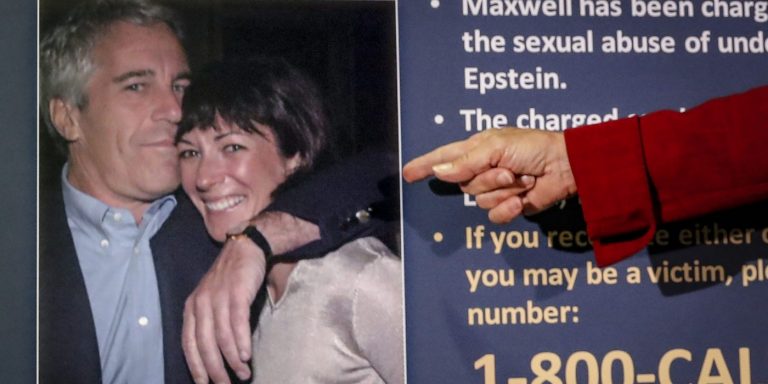
The resolution calls on the Justice Department to “publicly disclose all unclassified records, documents, communications, and investigative materials in its possession that relate to Epstein or [his associate Ghisalene] Maxwell.”

On Tuesday, Massie highlighted the path to obtain enough signatures on the discharge petition that would bring the bill to a House vote. A discharge petition requires 218 signatures from the House of Representatives to force a bill out of committee and into an official vote.

“We’ve fought the president, the attorney general, the FBI director, the speaker of the House and the vice president to get this win,” Massie said.

Trump has vowed to fund a political challenger to take Massie’s congressional seat.

Ahead of the vote, victims of Jeffrey Epstein spoke called on the House to approve release of the documents and highlighted their involvement in details of the case.

Annie Farmer, one of those speaking at the conference, said she and her sister Maria met Epstein and Maxwell when Annie was 16. She said Maria reported Epstein and Maxwell’s actions to the FBI in 1996 but did not receive a follow up.

“This is not an issue of a few corrupt Democrats or a few corrupt Republicans, this is a case of institutional betrayal,” Farmer said.

Sky Roberts, brother of Virginia Giuffre, spoke as well. Giuffre, a victim of Epstein, died by suicide in April.

“Today, we find ourselves in a place of deep sorrow, shattered by the loss of our beloved sister, yet we are honored and privileged to carry her voice forward and continue her relentless fight alongside her fellow survivor sisters,” Roberts said. “These are not just political tools for you to use, these are real survivors, real trauma,” Roberts said.

Charlene Rochard, another woman who met Epstein as a child, called for transparency.

“Let me be clear, this is not a hoax,” Rochard said. “What we endured was real, and it has scarred lives across five presidential administrations.”

Khanna said he hopes President Trump will meet with Epstein’s victims.

“My goal is to get justice here, so I hope he will meet them and really hear what’s happened and actually take action,” Khanna said.

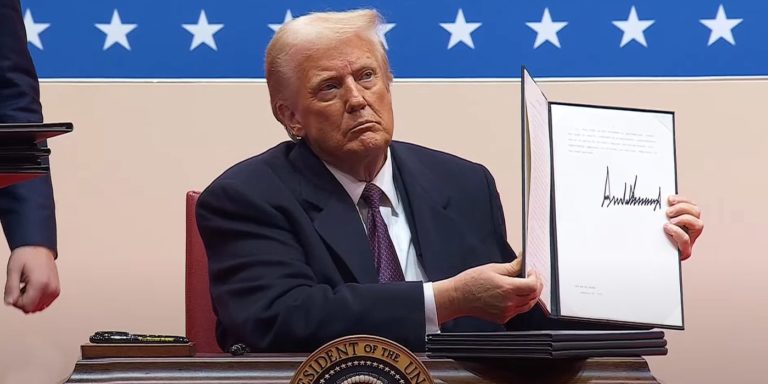
After calling the legislation “a Democratic hoax,” President Trump called on House Republicans to approve the release of documents.

“House Republicans should vote to release the Epstein files, because we have nothing to hide, and it’s time to move on from this Democrat Hoax perpetrated by Radical Left Lunatics in order to deflect from the Great Success of the Republican Party,” Trump wrote.

In a separate news conference on Tuesday, House Speaker Mike Johnson said he would vote to release the files on Epstein.

“I think it could be close to a unanimous vote,” Johnson said.

Massie called on the U.S. Senate to pass the same legislation after it gets approved in the House of Representatives.

“It may be tempting for them to get cute and to do things that will limit the release of these documents,” Massie said. “They are afraid that people will be embarrassed, well that’s the whole point here, they need to be brought to justice and embarrassment has no reason to stop it.”

House Votes Overwhelmingly to Force Release of Epstein Files, Sending Bill to Senate

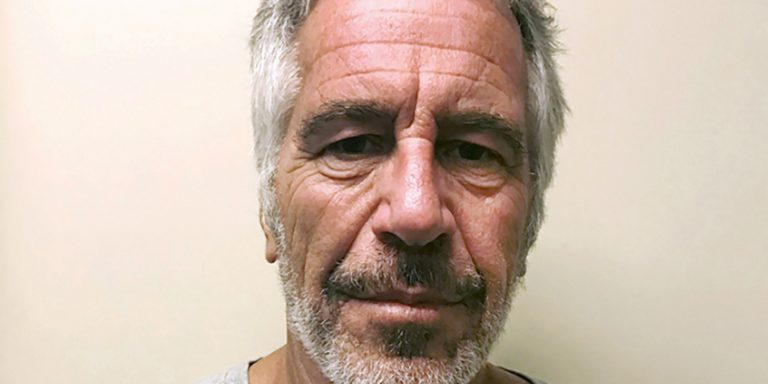
(Headline USA) The House voted overwhelmingly in favor of a bill Tuesday to force the Justice Department to publicly release its files on the convicted sex offender Jeffrey Epstein, a remarkable display of approval for an effort that had struggled for months to overcome opposition from President Donald Trump and Republican leadership.

When a small bipartisan group of House lawmakers introduced a petition in July to maneuver around House Speaker Mike Johnson’s control of which bills reach the House floor, it appeared a longshot effort — especially as Trump urged his supporters to dismiss the matter as a “hoax.”

But both Trump and Johnson failed in their efforts to prevent the vote. Now the president has bowed to the growing momentum behind the bill and even said he will sign it if it also passes the Senate.

The bill passed 427-1, with the only no vote coming from Rep. Clay Higgins, a Louisiana Republican who is a fervent supporter of Trump. He also chairs a subcommittee that initiated a subpoena on the Justice Department for the Epstein files.

Tuesday’s vote further showed the pressure mounting on lawmakers and the Trump administration to meet long-held demands that the Justice Department release its case files on Epstein, a well-connected financier who killed himself in a Manhattan jail while awaiting trial in 2019 on charges he sexually abused and trafficked underage girls.

“These women have fought the most horrific fight that no woman should have to fight. And they did it by banding together and never giving up,” said Rep. Marjorie Taylor Greene as she stood with some of the abuse survivors outside the Capitol Tuesday morning.

“That’s what we did by fighting so hard against the most powerful people in the world, even the president of the United States, in order to make this vote happen today,” added Greene, a Georgia Republican and longtime Trump loyalist.

A separate investigation conducted by the House Oversight Committee has released thousands of pages of emails and other documents from Epstein’s estate, showing his connections to global leaders, Wall Street powerbrokers, influential political figures and Trump himself. In the United Kingdom, King Charles III stripped his disgraced brother Prince Andrew of his remaining titles and evicted him from his royal residence after pressure to act over his relationship with Epstein.

Pushing for more accountability, the survivors of Epstein’s abuse cast the current effort in Congress as a step towards accountability for Epstein’s crimes after years of government failure under multiple presidential administrations.

Trump has said he cut ties with Epstein years ago, but tried for months to move past the demands for disclosure. On Monday, he told reporters that Epstein was connected to more Democrats and that he didn’t want the Epstein files to “detract from the great success of the Republican Party.”

Still, many in the Republican base have continued to demand the release of the files. Adding to that pressure, several survivors of Epstein’s abuse rallied outside the Capitol Tuesday morning. Bundled in jackets against the November chill and holding photos of themselves as teenagers, they recounted their stories of abuse.

“We are exhausted from surviving the trauma and then surviving the political conflicts that surround it,” said Jena-Lisa Jones, one of the survivors.

She added that she had voted for Trump, but had a message for the president: “I beg you Donald Trump, please stop making this political.”

The group of women also met with Johnson and rallied outside the Capitol in September, but have had to wait months for the vote.

That’s because Johnson kept the House closed for legislative business for nearly two months and also refused to swear-in Democratic Rep. Adelita Grijalva of Arizona during the government shutdown. After winning a special election on Sept. 23, Grijalva had pledged to provide the crucial 218th vote to the petition for the Epstein files bill. But only after she was sworn into office last week could she sign her name to the discharge petition to give it majority support in the 435-member House.

It quickly became apparent the bill would pass, and both Johnson and Trump began to fold. Trump on Sunday said Republicans should vote for the bill.

Yet Greene told reporters that Trump’s decision to fight the bill had betrayed his Make America Great Again political movement. It’s one of the reasons behind her prominent split with the president.

“Watching this turn into a fight has ripped MAGA apart,” she said.

Rather than waiting until next week for the discharge position to officially take effect, Johnson is moving to hold the vote under a procedure that requires a two-thirds majority.

But Johnson also spent a morning news conference listing off problems that he sees with the legislation. He argued that the bill could have unintended consequences by disclosing parts of federal investigations that are usually kept private, including information on victims.

“This is a raw and obvious political exercise,” Johnson said.

Still, he planned to vote for the bill. “None of us want to go on record and in any way be accused of not being for maximum transparency,” he added.

Meanwhile, House Democrats celebrated the vote as a rare win for the minority.

“It’s a complete and total surrender, because as Democrats we made clear from the very beginning, the survivors and the American people deserve full and complete transparency as it relates to the lives that were ruined by Jeffrey Epstein,” said House Democratic leader Hakeem Jeffries.

It’s not clear how the Senate will handle the bill.

Senate Majority Leader John Thune, R-S.D., has previously been circumspect when asked about the legislation and instead said he trusted the Justice Department to release information on the Epstein investigation.

But what the Justice Department has released so far under Trump was mostly already public. The bill would go further, forcing the release within 30 days of all files and communications related to Epstein, as well as any information about the investigation into his death in federal prison. Information about Epstein’s victims or continuing federal investigations would be allowed to be redacted, but not information due to “embarrassment, reputational harm, or political sensitivity, including to any government official, public figure, or foreign dignitary.”

Johnson also said he wants to see the Senate amend the bill to protect the information of “victims and whistleblowers.”

But the bipartisan pair who sponsored the bill, Reps. Thomas Massie, R-Ky., and Ro Khanna, D-Calif., warned senators against doing anything that would “muck it up” and said they would face the same public uproar that forced both Trump and Johnson to back down.

“We’ve needlessly dragged this out for four months,” Massie said, adding that those raising problems with the bill “are afraid that people will be embarrassed. Well, that’s the whole point here.”

Adapted from reporting by the Associated Press

Dramatic Year for Silver: Market On Pace for Fifth Straight Supply Shortfall

(Mike Maharrey, Money Metals News Service) The silver market is on track for its fifth straight structural market deficit.

The recent silver squeeze that pushed the silver price to a record high was partly due to a displacement of metal. There was too much silver in New York and not enough in London and India. However, the situation underscored a more fundamental problem in the silver market.

There isn’t enough metal being produced to meet demand.

A Dramatic Year!

Metals Focus called 2025 a “dramatic year” for the silver market, citing “record metal prices, an unprecedented liquidity squeeze resulting in record-high lease rates, record volumes being delivered into CME vaults as a reflection of tariff concerns in the U.S., and silver being officially designated as a critical mineral by the U.S. government.

“These developments coincide with elevated macroeconomic and geopolitical risks, including US trade policy, prompting investors to lift allocations to precious metals for portfolio diversification. As a result, investment demand has strengthened noticeably, comfortably offsetting the weakness across all key areas of silver demand.”

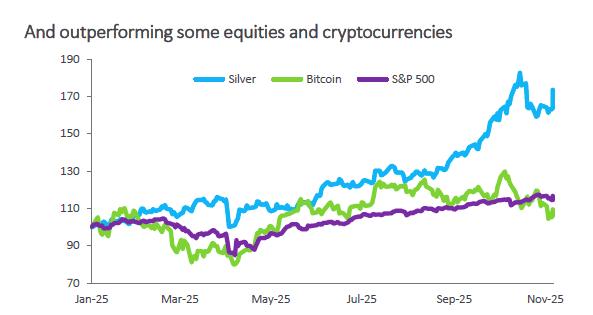
The silver price has gained over 74 percent this year and set a new record of $54.48. That compares to a 52 percent price increase for gold and a 14 percent gain for the S&P 500.

According to projections by Metals Focus, overall silver demand is forecast to decline by 4 percent year over year, driven by a 2 percent decline in industrial offtake.

According to the Silver Institute, industrial demand softened this year due to “global economic uncertainty stemming from tariff policies and geopolitical tensions, as well as a more rapid pace of thrifting due to soaring silver prices.

However, despite the modest drop in demand, 2025 will still likely come in with the second-highest silver industrial offtake on record.

Jewelry demand is also soft due to higher prices. Metals Focus forecasts the use of silver in jewelry will fall by 4 percent, with a more significant 11 percent decline in silverware.

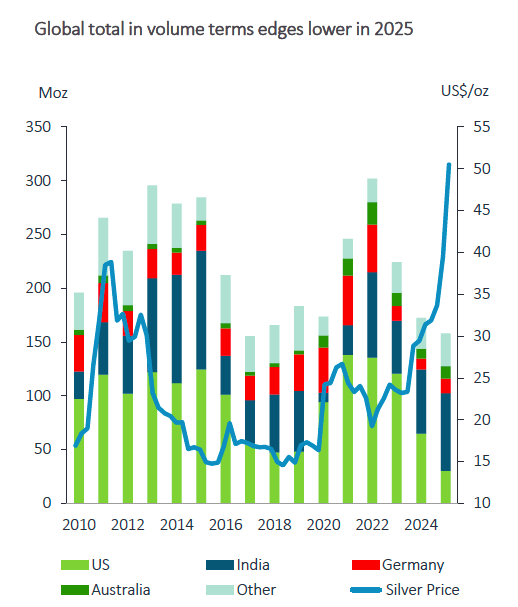
While silver bar and coin buying are up significantly, there are also higher levels of selling as some investors seek to book profits. This is especially evident in the U.S., where selling is exceeding buying. Weakness in the U.S. market is offsetting gains in India, Germany, and Australia.

Meanwhile, silver held by ETFs was up by 18 percent as of November 6.

Mine supply is projected to remain flat this year at 813 million ounces. With recycling, global supply is expected to rise by a modest 1 percent.

Given the forecast supply and demand levels, Metals Focus projects demand will outstrip supply by 95 million ounces. That would bring the cumulative 5-year market deficit to 820 million ounces, an entire year of average mine output.

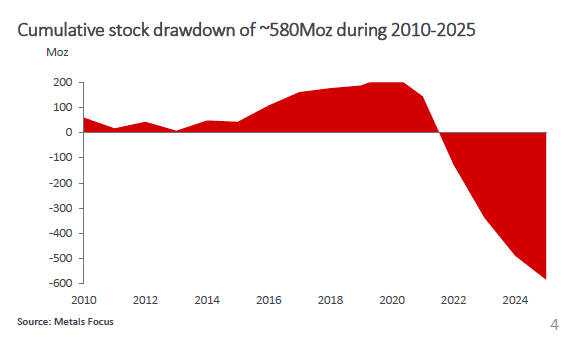
Since 2010, the silver market has accumulated a supply deficit of over 580 million ounces.

Even with higher prices, it is unlikely that mine supply will quickly grow to erase the supply shortfall.

Silver mine output peaked in 2016 at 900 million ounces. Up until last year, silver production had dropped by an average of 1.4 percent each year. In 2023, mines produced 814 million ounces of silver.

It appears that for the next few years at least, we will have to depend on drawdowns of above-ground stocks to meet the silver supply deficit.

This is fundamentally bullish for the silver market, and why many analysts believe the silver bull run is just getting started.


Mike Maharrey is a journalist and market analyst for Money Metals with over a decade of experience in precious metals. He holds a BS in accounting from the University of Kentucky and a BA in journalism from the University of South Florida.

Immigration Arrests Escalating in Charlotte

(Alan Wooten, The Center Square) Three days of U.S. Customs and Border Patrol in Charlotte are in the books, and the arrests are piling up.

Raleigh is next on Tuesday.

Critics and protestors are getting heavy criticism for their actions now compared to when Iryna Zarutska was killed on a city light rail train. Supporters are hopeful a dent in international gang activity is being achieved, and public safety is being enhanced.

The battle line has fallen along the major party lines of Republicans (for it) and Democrats (against). While there have been protest scenes and even attempts to stop lawmen from their work in Charlotte, there were no protests when Zarutska was killed.

Decarlos Brown is the suspect charged with first-degree murder of Zarutska and indicted by a federal grand jury. Zarutska was aboard a light rail train in North Carolina’s largest city on Aug. 22 when she died.

Video evidence released by Charlotte-Mecklenburg Police and a signed affidavit with still shots from the video shows Brown, 34, stabbing her to death. Brown is not someone who came illegally into the country.

On Monday, U.S. Homeland Security led by Secretary Kristi Noem said Operation Charlotte’s Web netted 130 arrests of people illegally in America over the first two days. Criminal records of 44 of them included aggravated assault, assault with a dangerous weapon, assault on a police officer, battery, driving under the influence, and hit-and-run.

U.S. Immigration and Customs Enforcement on Monday night said 450,000 migrant children nationwide are being sought in order to reunite them with families.

In a statement, Homeland Security said, “There is absolutely no excuse to continue allowing criminal illegal aliens to terrorize our American communities. These are violent assailants, gang members, and repeat offenders who have zero regard for the rule of law in our country. They are here illegally and should never have been here in the first place.

“Under President Trump and Secretary Noem, we are removing the worst of the worst criminal illegal aliens from our communities once and for all.”

Second-term Republican President Donald Trump has sent the National Guard to the cities of Washington, Los Angeles and Memphis, with authorizations for Chicago and Portland blocked by judges. Throughout his second term since Jan. 20, regional offices of Enforcement and Removal Operations, the FBI led by Kash Patel, and Homeland Security led by Noem have spotlighted removal by the thousands of people illegally in the United States.

In North Carolina, three members of the U.S. House of Representatives on Nov. 5 asked first-term Democratic Gov. Josh Stein to deploy the National Guard to Charlotte. The former two-term state attorney general refused.

The efforts to enforce the nation’s laws have been met by sympathizers, many holding protests and others – including media outlets and elected politicians – suggesting ways for immigrants illegally in the country to avoid federal lawmen. There are accusations of mistreatment, including by Stein; and there are accusations of lawmen such as county sheriffs failing to cooperate with U.S. Immigration and Customs Enforcement.

In North Carolina, it is illegal for any of the 100 county sheriffs or their deputies to not cooperate with ICE. Former two-term Democratic Gov. Roy Cooper, a four-term top prosecutor in the state, three times vetoed legislation of the requirement; the last was overturned by the General Assembly in 2024.

Published reports say about 15% of students in Charlotte-Mecklenburg Schools did not attend the 185 public schools on Monday.

In a statement, Charlotte Mayor Vi Lyles said in part, “The rights and constitutional protections of every person in Charlotte – regardless of immigration status – must be upheld. Our city has a long-standing commitment to fairness, dignity and justice.”

Raleigh is Next for Federal Immigration Enforcement

(Alan Wooten, The Center Square) Another North Carolina city on Tuesday is expecting a visit from the U.S. Customs and Border Patrol.

Following up on Raleigh Mayor Janet Cowell’s confirmation, first-term Democratic Gov. Josh Stein late Monday evening said he was aware as well. Lawmakers were reportedly told Monday afternoon.

Stein’s social media message said, “I call on federal agents to target violent criminals, not neighbors walking down the street, going to church, or putting up Christmas decorations. Stop targeting people simply going about their lives because of the color of their skin, as you are doing in Charlotte.”

The governor offered no evidence of names or statistics proving federal immigration efforts were outside the scope of upholding the nation’s border laws.

Cowell in a published report said federal lawmen were in Raleigh on Monday and would become active the following day. There was no request for their presence, she said.

U.S. Immigration and Customs Enforcement on Monday night said 450,000 migrant children are being sought in order to reunite them with families.

On Monday, U.S. Homeland Security led by Secretary Kristi Noem said Operation Charlotte’s Web netted 130 arrests of people illegally in America over the first two days. Criminal records of 44 of them included aggravated assault, assault with a dangerous weapon, assault on a police officer, battery, driving under the influence, and hit-and-run.

Homeland Security said among them were Manual Vasquez-Gavarrete, a Honduran and 18th Street gang member; and Humberto Pozada-Rodriguez, another Honduran and MS-13 gang member. Barrio 18, as 18th Street is also known, and MS-13 are rivals.

The U.S. Department of Justice says Barrio 18 is known for “acts of murder, kidnapping, assault, robbery, witness intimidation, and firearms and narcotics trafficking to fuel the gang’s violent operations.” The Justice Department says “MS-13 operates through the use of intimidation and violence, including murder, and enriching members and associates through criminal activities, including breaking into houses and stealing firearms, jewelry, cash, and other items of value, and selling narcotics.”

The Justice Department believed MS-13 to have more than 10,000 members in 10 states and Washington, D.C. – roughly between 20% and 33% of its global membership. Barrio 18 is reportedly in 28 states with 30,000 to 50,000 members.

US Marines Conducting Drills in Trinidad and Tobago, Just Miles From Venezuela’s Coast

(Dave DeCamp, Antiwar.com) US Marines began drills on Sunday in Trinidad and Tobago, the Caribbean island nation that’s just miles off the coast of Venezuela, as the US military continues its activity in the region amid a push toward a potential US attack aimed at ousting Venezuelan President Nicolas Maduro.

The US Embassy in Trinidad and Tobago said the US Marine Corps 22nd Marine Expeditionary Unit (MEU) will be deployed to the Caribbean nation from November 16 to November 21 and will participate in exercises with the Trinidad and Tobago Defence Force (TTDF).

According to Task & Purpose, the deployment came after the Trinidadian attorney general said the US military would “intensify” its exercises in the country. The 22nd MEU has been in the Caribbean since it was deployed to the region with the Iwo Jima Amphibious Ready Group in August.

Maduro has criticized the increased US drills in Trinidad and Tobago, calling them “irresponsible” and warning against the US push toward war. “The people of Trinidad and Tobago will see if they continue allowing their waters and land to be used to gravely threaten the peace of the Caribbean,” he said over the weekend.

A US aircraft carrier, the USS Gerald Ford, just arrived in the Caribbean, and according to The Washington Post, its fighter jet pilots have been studying Venezuela’s air defenses as the Trump administration is considering bombing the country. Trump suggested on Sunday that his administration was in talks with the Maduro government.

The US has continued its bombing campaign against alleged drug-running boats in the region, which has received criticism from US allies over its clear illegality under both US and international law, but Trinidadian Prime Minister Kamla Persad-Bissessar has strongly supported the campaign despite fears among her country’s fishing community.

Bodies of people believed to be killed in the US strikes have washed up in Trinidad and Tobago, and fishermen in the country have said the US bombing campaign has them fearing for their lives and jobs.

This article originally appeared at Antiwar.com. 


Trump Won’t Rule Out Sending US Troops Into Venezuela

(Dave DeCamp, Antiwar.com) President Trump said on Monday that he wouldn’t rule out sending American troops into Venezuela amid the US military buildup in the Caribbean and push toward a potential war to oust Venezuelan President Nicolas Maduro.

“I don’t rule out that. I don’t rule out anything,” the president told reporters in the Oval Office when asked if he would rule out putting troops on the ground in Venezuela.

The New York Times previously reported that Trump has been presented with options for attacking Venezuela, including two that involve sending troops: deploying a special operations team to kill or capture Maduro or sending a much larger force to seize strategic airfields and oil infrastructure inside the country. Amid US threats to attack Venezuela, US troops have been conducting drills in the region, including training in jungle warfare at a base in Panama. 

Trump has been sending mixed signals on the possibility of starting a war with Venezuela, which would be illegal without congressional authorization, per the US Constitution. On Sunday, Trump said that his administration “may be having some discussions with Maduro,” suggesting he may not have cut off all diplomacy with the Venezuelan government.

Last week, Trump was reportedly briefed on options to bomb Venezuela. According to The Washington Post, senior administration officials, including Vice President JD Vance, War Secretary Pete Hegseth, Joint Chiefs Chairman Gen. Dan Caine, Secretary of State Marco Rubio, and Deputy Chief of Staff Stephen Miller, held deliberations with Trump on Friday to discuss whether and how the US should attack Venezuela.

One administration official told the Post that Trump was “very good at maintaining strategic ambiguity, and something he does very well is he does not dictate or broadcast to our adversaries what he wants to do next.”

Rubio is seen as the main driver of the US push toward war with Venezuela within the administration, and he declared on Sunday that the State Department would label the so-called “Cartel of the Suns,” an organization that doesn’t actually exist, as a Foreign Terrorist Organization. Rubio also claimed that Maduro is a leader of the non-existent organization, giving the US a pretext for military action against him.

This article originally appeared at Antiwar.com. 


UN Security Council Adopts Resolution Placing Gaza Under Control of US-Led Board

(Dave DeCamp, Antiwar.com) The UN Security Council on Monday adopted a US-proposed resolution that places Gaza under the control of a US-led body, dubbed the “Board of Peace,” for at least two years and authorizes the deployment of an international force to the Palestinian territory that will operate under the watch of the US military.

The 15-member Security Council passed the resolution with 13 voting in favor and none voting against. Russia and China abstained from voting, choosing not to use their veto power to stop the resolution. Ahead of the vote, US Ambassador to the UN Mike Waltz warned that a vote against the resolution was a “vote to return to war.”

The resolution endorses the 20-point US-Israeli Gaza plan released by the White House on September 29, which it refers to as the “Comprehensive Plan.”

The resolution states that the Security Council welcomes the establishment of the Board of Peace, or BoP, which will be headed by President Trump. It describes the BoP as “a transitional administration with international legal personality that will set the framework, and coordinate funding for, the redevelopment of Gaza pursuant to the Comprehensive Plan.”

The UN resolution says that the BoP will remain the authority in Gaza until the Palestinian Authority (PA) “has satisfactorily completed its reform program,” though Israeli Prime Minister Benjamin Netanyahu has repeatedly rejected the idea of the PA having a role in Gaza, and whether the PA has “reformed” enough to take over in Gaza would likely be up to the US and Israel.

The US initially didn’t mention the possibility of a Palestinian state in its draft resolution, but added a vague mention of one in response to feedback from Arab states. The resolution states that a path toward a Palestinian state “may” be possible once the PA makes the unspecified “reforms.” But the Israeli government has been explicit in its opposition to a Palestinian state, and the resolution makes no mention of the Israeli-occupied West Bank, where Israel continues to expand illegal Jewish settlements.

The resolution authorizes the BoP’s control of Gaza until December 31, 2027, and leaves open the possibility of the Security Council extending its mandate. Over the next two years, the BoP is tasked with overseeing “a Palestinian technocratic, apolitical committee of competent Palestinians from the Strip,” which will be responsible for “day-to-day operations of Gaza’s civil service and administration.”

The resolution also authorizes Security Council member states working with the BoP to “establish a temporary International Stabilization Force (ISF) in Gaza to deploy under unified command acceptable to the BoP.” US Central Command has established a military outpost in southern Israel to oversee the ISF, and according to Israeli media reports, the US may build a large base on the Gaza border to house international troops.

The ISF is supposed to work with Israel and Egypt on the demilitarization of Gaza, but Hamas has repeatedly rejected the idea of disarming without the establishment of a Palestinian state, and countries willing to send troops to Gaza don’t want to be involved if it means fighting Hamas on behalf of Israel. In response to the resolution being passed, Hamas said that it would consider the ISF a party to the conflict if it were tasked with disarmament.

“Assigning the international force with tasks and roles inside the Gaza Strip, including disarming the resistance, strips it of its neutrality, and turns it into a party to the conflict in favor of the occupation,” Hamas said, according to Reuters. The group said the resolution fails to meet Palestinians’ rights and demands and seeks to impose an international trusteeship on the enclave that Palestinians and resistance factions oppose.

The resolution also provides no guarantees that Israel would withdraw its troops from Gaza, as it says the IDF will only leave once the ISF is deployed and Israel has agreed that certain “standards, milestones, and timeframes linked to demilitarization” have been met. Israeli troops currently occupy more than 50% of the Gaza Strip.

The resolution tasks the US-led BoP with overseeing the reconstruction of Gaza, but the US is currently pushing a plan that would allow reconstruction only in the Israeli-occupied side of Gaza, which Arab states fear will lead to a permanent Israeli occupation. The US is also reportedly in contact with Israeli-backed militias and gangs who are operating in IDF-controlled areas and is considering using them to enforce order in Gaza, which would almost certainly lead to inter-Palestinian conflict.

Despite the issues with the US’s plan for Gaza, Trump celebrated the UN Security Council passing the resolution in a post on Truth Social and reaffirmed that he would be in charge of the BoP.

“Congratulations to the World on the incredible Vote of the United Nations Security Council, just moments ago, acknowledging and endorsing the BOARD OF PEACE, which will be chaired by me, and include the most powerful and respected Leaders throughout the World,” the president said. “The members of the Board, and many more exciting announcements, will be made in the coming weeks.”

This article originally appeared at Antiwar.com. 


Trump Says He Will Sell F-35 Fighter Jets to Saudi Arabia

(Dave DeCamp, Antiwar.com) President Trump said on Monday that he plans to sell F-35 fighter jets to Saudi Arabia, comments that came a day before Saudi Crown Prince Mohammed bin Salman will meet with him at the White House.

“I am planning on doing that,” Trump told reporters when asked if he would allow Riyadh to purchase the US jets. “They want to buy them. They’ve been a great ally.”

Currently, Israel is the only Middle Eastern country that’s armed with F-35s, and US officials have been hesitant to sell the jets to Arab countries to uphold Israel’s so-called “qualitative military edge” in the region. Israel has previously agreed that the US could sell F-35s to the UAE as part of its 2020 normalization deal, but the sale has been put on hold, and it’s unclear if it will ever go through.

Israeli officials have told Axios that they want the US to condition the F-35 sale to Saudi Arabia on Riyadh agreeing to normalize with Israel, but that’s unlikely to happen, as Saudi officials have maintained they won’t establish diplomatic relations with Israel until there’s a guaranteed path toward a Palestinian state.

An Israeli official told Axios that it would be “a mistake and counterproductive” for the US to sell F-35s to Saudi Arabia without getting a diplomatic concession. The report also said that if the US arms Riyadh with F-35s, Israel will likely ask the US for security guarantees.

While the US provides Israel with billions in military aid each year, has supported its wars across the Middle East, and defended it from Iranian missile and drone attacks, the US and Israel do not have a formal military alliance that includes a defense guarantee. Israeli officials could push the issue as they negotiate a new Memorandum of Understanding (MOU) on US military aid, as the current MOU, under which the US provides Israel with $3.8 billion each year, is due to expire in 2028.

Saudi Arabia has long sought a formal defense guarantee from the US, and MbS is expected to raise the issue during his meeting with Trump. The president recently gave Qatar a security guarantee by signing an executive order, which came after Israel bombed Doha.

This article originally appeared at Antiwar.com. 

BREAKING: Twitter, ChatGPT and Other Internet Platforms are Down Due to Cloudflare Outage

(Headline USA) Internet infrastructure provider Cloudflare says it is deploying a fix for an issue that caused global outages for ChatGPT, social media platform X, transit infrastructure and other prominent internet services.

Cloudflare said on its status page earlier Tuesday that it identified an issue that was impacting multiple customers. There were reports of widespread 500 errors as well as Cloudflare Dashboard and API failing.

In the process of remediating the issue, Cloudflare said it had to temporarily disable certain services for United Kingdom users.

“We have made changes that have allowed Cloudflare Access and WARP to recover. Error levels for Access and WARP users have returned to pre-incident rates. We have re-enabled WARP access in London,” the company wrote on its status page. “We are continuing to work towards restoring other services.”

Cloudflare is a prominent internet hub providing network and security products for internet service providers. Some cybersecurity experts have warned for years about the potentially ugly consequences of allowing a handful of big tech companies to underpin the online world’s plumbing.

Adapted from reporting by the Associated Press