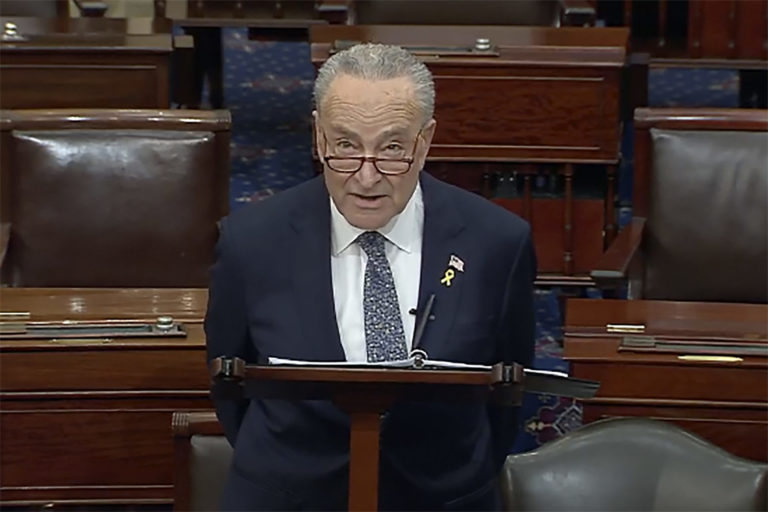
(José Niño, Headline USA) Senate Minority Leader Chuck Schumer just forced Republicans into an uncomfortable corner over antisemitism, and the silence from the GOP side of the aisle speaks volumes. On Monday, Schumerintroduced a resolution condemning nationalist influencer Nick Fuentes for his antisemitic views and Tucker Carlson for platforming him.
All 47 Senate Democrats signed on as co-sponsors. However, no Republicans have signed on to the resolution.
For gun rights advocates and Second Amendment supporters who value constitutional principles and limited government, this political theater reveals something far more troubling than a debate over offensive speech. It exposes how establishment politicians weaponize accusations of extremism to marginalize voices that challenge the bipartisan foreign policy consensus and question unlimited military commitments abroad.
The controversy erupted after Carlson’s October 2025interview with Fuentes on his podcast. The two hour conversation sparked fierce debate within conservative circles, as Headline USA previouslyreported, particularly among pro-Israel voices on the right who condemned Carlson for failing to challenge Fuentes on his views. The discussion included references to “organized Jewry in America” and criticism of Christians who support Israel, whom they characterized as having a “brain virus.”
Fuentes, a 27-year-old nationalist, advocates for immigration restriction and a more restrained foreign policy. These positions, particularly skepticism toward endless foreign interventions and nation building projects, align closely with views held by many in the gun rights community who recognize that expansive government power abroad inevitably threatens constitutional liberties at home.
The resolution Schumerintroduced formally demands that the Senate strongly reject “the views of and platforming of Nick Fuentes” and condemn “the effort by Tucker Carlson to platform and mainstream Nick Fuentes.” It calls on all elected officials and community leaders to reject white supremacy and antisemitism whenever they occur.
But the resolution goes further, targeting Heritage Foundation President Kevin Roberts for defending Carlson and releasing a video attacking critics of the interview. Democrats accuse Roberts of using “antisemitic dog whistles” in his defense. The resolution also highlights Trump administration official Paul Ingrassia, who said in an unearthed group chat that he has a “Nazi streak in me from time to time,” as Headline USA previouslydemonstrated.
The partisan divide could not be starker. Schumer reportedly sought Republican backing for his condemnation resolution, but not a single GOP senator joined.
Multiple Jewish organizations rushed to support the Democratic resolution, including the Jewish Democratic Council of America, Democratic Majority for Israel, the Jewish Council for Public Affairs, and Jewish Women International. JDCA CEO Halie Soifer attacked Republicans for their absence, telling Jewish Insider that “this issue should not be partisan, yet not one Republican has joined this resolution, and the President of the United States has refused to condemn Fuentes, Tucker Carlson’s platforming of Fuentes, and the hate they’ve espoused.”
José Niño is the deputy editor of Headline USA. Follow him at x.com/JoseAlNino
(Money Metals News Service) In this Midweek Memo, Money Metals’ Mike Maharrey opens with physics, not finance. Water “should” freeze at 0° C (32° F), but very pure, undisturbed water can be supercooled to –5, –10, even –20° C and stay liquid. Tap the glass or drop in a speck of ice, and the whole thing crystallizes at once.
His point is that even so-called laws of nature depend on assumptions. Change the conditions and behavior changes. Maharrey argues something similar is happening in the silver market today, and that it could make the metal even more bullish than people realize.
Named after Scottish economist Sir Robert Giffen, a Giffen good is an inferior good whose demand rises as its price rises, holding income and other prices steady. That directly contradicts the standard law of demand.
“Inferior” here is an economic term, not an insult. An inferior good is one that people buy less of as their income rises. Maharrey uses the classic “meat and potatoes” example. When a family gets richer, it usually buys more meat and fewer potatoes. When it gets poorer, it cuts back on meat and eats more potatoes because they are cheaper.
In a true Giffen scenario, the income effect (people becoming poorer and forced into cheaper goods) overwhelms the normal substitution effect. People end up buying more of the inferior good even as its price climbs.
The Irish Potato Famine and a Modern Silver Parallel
Maharrey highlights the Irish potato famine as the textbook Giffen case. As general prices rose, the Irish became effectively poorer. They could no longer afford much meat. To survive, they bought even more potatoes, even though potatoes themselves were getting more expensive. Demand and price rose together in a vicious upward spiral.
He then asks whether silver might be sliding into a similar pattern relative to gold. Many investors would prefer gold if money were no object, but silver is far cheaper on a per-ounce basis. In today’s market, he notes silver trading close to $60 an ounce while gold sits well over $4,000 an ounce. For poor and middle-income investors, silver becomes the practical choice.
Maharrey describes an investor with a fixed monthly budget who prefers gold but mostly buys silver because it is more affordable and lets him stack ounces faster. As both metals rise in price, the budget buys fewer ounces. To maintain his total exposure, he cuts back on “luxury-like” gold and pushes even more of his monthly allocation into silver, despite the higher silver price. That is Giffen-style behavior.
The clearest real-world example right now is India. Indians traditionally love gold and weave it into marriage ceremonies, religious practice, and family wealth. But when gold hit record highs in October, many poorer Indians were priced out.
Survey work from Metals Focus shows they pivoted to silver, explicitly saying gold had become too expensive. This wave of buying helped trigger a silver squeeze, pulling metal out of London, Shanghai, New York, and even large 10,000-ounce bars shipped by Money Metals to India, and helped push silver over $50 an ounce for the first time ever.
Giffen, Veblen, or Something in Between?
A commenter on Maharrey’s related article suggested gold and silver look more like “Veblen goods,” named after Thorstein Veblen. Veblen goods are luxuries – like Ferraris – that become more desirable as their prices rise because of their status symbolism.
Maharrey sees some superficial resemblance in that rising prices attract attention and “bandwagon” buyers. But he argues investors are not buying silver for status. They are buying it because they see it as a better hedge or opportunity. That is not classic Veblen behavior.
He also pushes back on calling gold and silver “luxuries” globally. A 2018 survey found that one in two Indian households had purchased gold in the previous five years, 87% of households own at least some gold, and more than 75% of families in the bottom 10% of income still managed to buy gold. Around two-thirds of India’s gold demand comes from poorer, non-urban regions where agriculture dominates and many people operate outside the formal tax system.
For these households, gold and silver are not luxuries. They are essential tools for coping with inflation, currency devaluation, and political and financial uncertainty – just as Iranians today are turning to gold to escape high inflation.
That demand story sits on top of a tight supply picture. Maharrey cites Metals Focus data showing that silver is on track for its fifth straight structural market deficit, with demand expected to exceed supply by 95 million ounces this year. That would bring the cumulative five-year deficit to about 820 million ounces, roughly an entire year’s average mine output. Since 2010, the market has built up a deficit of more than 580 million ounces.
Mine production peaked around 900 million ounces in 2016. It then declined by an average of 1.4% per year until a recent rebound, but even last year’s output was only about 814 million ounces, still nearly 100 million ounces below the peak.
In practice, that means the world must draw down above-ground stocks – the silver already sitting in vaults – to close the gap. Releasing that metal onto the market will require significantly higher prices to pry it loose from existing holders.
On the industrial side, substituting away from silver is not easy. Even with silver prices up nearly 100% this year, Metals Focus projects only about a 2% drop in industrial offtake. Silver’s unique performance in electronics and other uses makes demand relatively inelastic. At the same time, investment demand is “skyrocketing,” as Maharrey puts it.
Central Banks, Gold, and the Macro Backdrop
Maharrey then zooms out to gold, arguing that his bullishness on silver is reinforced by a powerful gold backdrop.
He notes that some mainstream voices, including an article in the Financial Times, are already fretting about gold entering “bubble territory.” He counters with World Gold Council data showing central banks are still buying aggressively. In October alone, central banks added a net 53 tons to their reserves, a 36% increase over September and the highest monthly total of the year.
Third-quarter official purchases came in at 220 tons, up 28% from the second quarter and about 6% above the five-year third-quarter average. For 2024 as a whole, central banks increased their gold holdings by 1,044.6 tons, the 15th consecutive year of net buying. That total was just 6.2 tons below 2023 and 91 tons below the all-time record set in 2022, which itself was the largest net central bank buying on record since 1950, including the period around the 1971 suspension of dollar convertibility into gold.
From 2010 through 2021, central bank reserves rose by an average of only 473 tons per year. The last three years have more than doubled that pace. A World Gold Council survey found that 95% of central bank respondents expect global gold reserves to increase over the next 12 months, 43% expect their own reserves to rise, and none anticipate a decline.
Analysts like Jan Nieuwenhuijs have shown that some of the biggest buyers, notably China, are almost certainly adding even more gold off the books than official data reveals. The World Gold Council explicitly links this buying to diversification away from US assets and dollar exposure, a de-dollarization trend driven by fears of inflation, financial repression, and the use of dollar assets as geopolitical weapons.
Overlay this on a Federal Reserve that is easing again and widely expected to cut interest rates despite persistent inflation, and on a US economy trapped in what Maharrey calls a “giant debt black hole,” and the policy backdrop remains firmly supportive for both gold and silver.
Maharrey’s Bottom Line on Silver
Maharrey closes by stressing that the same policies that drove gold and silver to new highs are still in place. Politicians are not going to stop running deficits or devaluing the dollar; they are devaluing it “every single day as a matter of policy.”
In his view, combining a structural silver supply deficit, relatively inelastic industrial demand, surging investment demand, central bank gold accumulation, and the possibility that silver is showing Giffen-like behavior creates “truly explosive” upside potential for silver prices in the years ahead.
(Dave DeCamp, Antiwar.com) The House on Wednesday passed the $901 billion 2026 National Defense Authorization Act (NDAA), the sweeping annual military spending bill that will be combined with a supplemental bill passed earlier in the year to bring the total US military budget to over $1 trillion.
The bill passed in a vote of 312-112 and received significant support from Democrats, with 115 voting in favor. A total of 18 Republicans and 94 Democrats voted against the legislation. The NDAA now heads to the Senate, where it’s expected to pass and then be sent to President Trump’s desk.
Rep. Marjorie Taylor Greene (R-GA) voted against the legislation, citing the foreign military aid packed into the bill as the reason for her opposition. The bill includes $1 billion in military aid for Taiwan, $800 million for Ukraine to be disbursed over the next two years, $650 million for Israel, on top of the $3.3 billion it receives through the State Department, and other provisions.
The NDAA includes a new provision to ensure Israel is not impacted by global arms restrictions that have been imposed in response to its genocidal war in Gaza. The amendment requires a review of the arms restrictions and says the US will take steps to “mitigate” and “gaps” it may find.
The spending bill also includes at least two provisions that go against President Trump’s agenda, including amendments to block troop drawdowns from Europe and South Korea and a provision to require the Pentagon to release to Congress videos of its bombings of alleged drug boats in Latin America.
If the Pentagon doesn’t hand over the videos, the amendment would withhold a quarter of the travel budget for US Secretary of War Pete Hegseth, who has been under increasing scrutiny due to the September 2 bombing that involved multiple strikes to kill survivors.
(Headline USA) The Trump administration must stop deploying the California National Guard in Los Angeles and return control of the troops to the state, a federal judge ruled Wednesday.
U.S. District Judge Charles Breyer in San Francisco granted a preliminary injunction sought by California officials who opposed President Donald Trump’s extraordinary move to use state Guard troops without the governor’s approval to further his immigration enforcement efforts. But he also put the decision on hold until Monday.
California argued that conditions in Los Angeles had changed since Trump first took command of the troops and deployed them in June. The administration initially called up more than 4,000 California National Guard troops but that number had dropped to several hundred by late October. Only a 100 or so troops remain in the Los Angeles area.
The Republican administration extended the deployment until February while also trying to use California Guard members in Portland, Oregon as part of its effort to send the military into Democratic-run cities over the objections of mayors and governors.
U.S. Justice Department lawyers said the administration still needed Guard members in the Los Angeles area to help protect federal personnel and property.
An email to the White House seeking comment on Wednesday’s ruling was not immediately returned.
Trump took command of the California National Guard following protests over his stepped-up enforcement of immigration laws. The call up was the first time in decades that a state’s national guard was activated without a request from its governor and marked a significant escalation in the administration’s efforts to carry out its mass deportation policy. The troops were stationed outside a federal detention center in downtown Los Angeles where protesters gathered and later sent on the streets to protect immigration officers as they made arrests.
California sued, and Breyer issued a temporary restraining order that required the administration to return control of the Guard members to California. An appeals court panel, however, put that decision on hold.
California argued that the president was using Guard members as his personal police force in violation of a law limiting the use of the military in domestic affairs.
The administration said courts could not second-guess the president’s decision that violence during the protests made it impossible for him to execute U.S. laws with regular forces and reflected a rebellion, or danger of rebellion.
In September, Breyer ruled after a trial that the deployment violated the law. Other judges have blocked the administration from deploying National Guard troops to Portland, Oregon, and Chicago.
(Dave DeCamp, Antiwar.com) Technology developed by the US firm Palantir was deployed by the Israeli military during its attacks on Lebanon in 2024, including the infamous pager attack, which Israel has nicknamed “Operation Grim Beeper,” according to a new book.
The book, a biography of Palantir co-founder and CEO Alex Karp, titled The Philosopher in the Valley: Alex Karp, Palantir and the Rise of the Surveillance State, was written by Michael Steinberger, a contributor to The New York Times Magazine.
Steinberger wrote that Palantir’s “technology was deployed by the Israelis during military operations in Lebanon in 2024 that decimated Hezbollah’s top leadership. It was also used in Operation Grim Beeper, in which hundreds of Hezbollah fighters were injured and maimed when their pagers and walkie-talkies exploded (the Israelis had booby-trapped the devices).”
The initial pager attack was carried out on September 17, when thousands of beepers used by Hezbollah exploded in Lebanon and Syria. The following day, Israel detonated walkie-talkies, and some exploded at funerals for people who were killed in the initial attack.
According to numbers from the Lebanese government, the attacks killed around 40 people, including 12 civilians. Two children were killed by the explosions, and others were left injured or maimed. One of the victims, a nine-year-old girl named Fatima, was home with her father when his pager beeped, and she picked it up to bring it to him, but it exploded, mangling her face and killing her.
Steinberger’s book didn’t specify how Palantir’s technology aided in the attack. According to former Israeli intelligence officials, the attack was years in the making, and Israel tricked Hezbollah into purchasing thousands of booby-trapped pagers and walkie-talkies from a fake company.
Steinberger’s book also said that people who worked at Palantir denied being involved in developing AI targeting systems for Gaza that were reported by the Israeli outlet 972 Magazine, but they detailed other ways the US company aided Israel in its genocidal war against Palestinians in the besieged territory.
“Palantir was assisting Israel in other ways. Its software was used by the Israeli military in several raids in Gaza in which hostages were freed, and also helped facilitate the handover of detainees who were released by Hamas,” he wrote. The book also said that Palantir helped repel Iranian missile attacks via the US military’s Project Maven.
Earlier this year, Karp was confronted by a protester who said that Palantir’s AI technology “kills Palestinians” in Gaza, which he didn’t deny. “Mostly terrorists, that’s true,” he said in response.
(Luis Cornelio, Headline USA) Erika Kirk forcefully shut down unsubstantiated claims surrounding the senseless murder of her late husband, conservative activist Charlie Kirk, during a Wednesday interview on Fox News.
During the interview, Fox News co-host Harris Faulkner raised ongoing conspiracy theories surrounding Charlie’s death, including claims that Turning Point USA staffers, or even foreign governments, were involved.
“Come after me. Call me names. I don’t care. Call me whatever you want. Go down that rabbit hole if you need to,” Kirk said. “But when you go after my family—my Turning Point USA family, my Charlie Kirk Show family—when you go after the people I love, that’s where I draw the line. Especially when you’re making hundreds of thousands of dollars every single episode attacking the people I love, claiming they’re somehow ‘in on this.’ No!”
Her rebuke came amid continued speculation about Charlie’s death by a handful of online and podcast personalities, including Candace Owens, whom Kirk did not mention by name during the interview.
Some of Owens’s questions and insinuations centered on the alleged role of foreign governments in Kirk’s death. Comments from other commentators have further fueled conspiracy theories pointing toward Israel.
Owens has claimed that Charlie had begun questioning Israel’s military operations in Gaza and was allegedly “offered a ton of money” before being “on the brink of changing some of his perspectives.”
Owens has also claimed that France was involved in the assassination plot, the motive being to distract the public from her series on Bridget Macron. Additionally, she’s insinuated that Egypt, the Mormons and TPUSA itself were somehow involved in Charlie’s murder.
Owens has not provided evidence for any of her claims, other than a few text messages showing that Charlie was upset when he lost a pro-Israel donor.
Erika Kirk said the comments appeared part of a “mind virus,” adding that she believes in the judicial system.
“We have a hell of a team working on this—excuse my French. But what’s happening is not okay,” Erika added. “My team isn’t made up of machines. They’re not robots. They’re human. We’ve received more death threats than I’ve ever seen. There are kidnapping threats. You name it—we’ve dealt with it.”
Owens issued a video response shortly after Erika’s interview aired.
JUST IN: A giddy and smiling Candace Owens responds to Erika Kirk’s comments from today on Fox News.
“Super fun show today. You're probably seeing the clips … it's about me.”
“It's indirect, but it's also about me. And don't worry, in case you think it's not about me, she is… pic.twitter.com/WBeHBDTMwn
(Dave DeCamp, Antiwar.com) The New York Times editorial board released a video on Monday calling for the US to “prepare for the future of war” and urged the Pentagon to take drastic steps to be better prepared for a potential fight with China, a conflict that could quickly turn nuclear.
“US politicians often boast that America has the ‘Strongest and most powerful military in the history of the world’ but behind closed doors, they’re being told a different story,” the editorial board said. “New York Times Opinion has learned that the Pentagon has been delivering a classified, comprehensive overview of US military power called the Overmatch brief. The report shows what could happen if a war were to break out between China and the United States. The results are alarming.”
The video said that a war with China might seem “purely hypothetical,” but claimed that Chinese President Xi Jinping ordered the Chinese military to be ready to seize the island of Taiwan by 2027. However, that timeline is based on claims from the CIA and has never been confirmed by Chinese officials. Xi reportedly told President Biden last year that there were “no such plans” to be ready to invade Taiwan by 2027.
The Times editorial board said that defending Taiwan “won’t be easy” and called on the US to invest more in new technologies, such as drones, rather than “symbols of might,” referring to large aircraft and warships.
“America must prepare for the future of war. This is the opinion of The New York Times editorial board. You might be thinking America should focus on peace, not war. But one of the most effective ways to prevent a war is to be strong enough to win it. That’s why it’s imperative that we change,” the board said.
The board suggested several steps for the US to take to prepare for war with China, including building “new autonomous weapons and leading the world in controlling them” and relaxing rules on purchasing weapons to “make bets on young companies.”
“It’s been nearly 10 years since the Overmatch brief was first delivered. Its warnings have been updated and delivered again to the new Trump administration. We’ve been warned about the urgent need for change. The question is whether we’ll change in time,” the video concluded.
For years now, the Pentagon has named China as the top “pacing threat” facing the US and has been openly preparing for war with China. President Trump’s War Department is expected to prioritize the Homeland and the Western Hemisphere in its coming National Defense Strategy, as outlined by the recently released National Security Strategy, but it will still be putting a focus on a military buildup in the Asia Pacific to get ready for a future clash with China, while stressing that US allies in the region should spend more on their militaries.
(Ken Silva, Headline USA) On the heels of two train stabbings—one of them deadly—the Charlotte City Council has approved a $3.4 million contract for a Texas-based public relations firm to improve the image of its public transportation system.
The city council voted anonymously Monday to approve the contract for the firm, Sherry Matthews Group. Company founder Sherry Matthews says on her website that she’s interested in “social justice, health, transportation, wildlife protection, and the environment.”
According to the city council meeting agenda, Sherry Matthews Group’s job will be “promoting [Charlotte Area Transit System’s] services, engaging with the community, and enhancing the public’s perception and use of public transit in the Charlotte-Mecklenburg area.”
The city council put out a request for proposals on Sept. 11, received 18 responses, and eventually found that Sherry Matthews “meets CATS’s needs in terms of qualifications, experience, cost and responsiveness to RFP requirements.”
The approval came just three days after an illegal immigrant from Honduras stabbed a man on a Charlotte train who was defending an old lady from him. The alleged stabber, 33-year-old Oscar Solarzano, was charged with attempted murder, while the heroic victim, Kenyon Dobie, continues to recover from his wounds.
Before that, a homeless man stabbed 23-year-old Ukrainian refugee Iryna Zarutska to death in late August. The stabber in that case, DeCarlos Brown Jr., faces a state murder charge as well as federal charges. The Justice Department has signaled that it may pursue the death penalty.
Brown’s first federal court hearing is set for Thursday.
CATS spokesman Brett Baldeck told the Charlotte Observerthat the PR contract had nothing to do with the stabbings.
“There’s no correlation between the contract approved at council last night and anything that’s happened along our system in the past year,” Baldeck reportedly said. “The timing was not good, so it makes it look different than it really is.”
Local Republicans blasted the move.
“Let us be clear, public safety in Charlotte is not a messaging problem. It’s a leadership problem,” Mecklenburg County Republican Party Chairman Kyle Kirby reportedly said in the statement on Tuesday.
Ken Silva is the editor of Headline USA. Follow him at x.com/jd_cashless.
(Dave DeCamp, Antiwar.com) President Trump said on Wednesday that US forces have seized an oil tanker off the coast of Venezuela, marking the latest US escalation in its push toward a regime change war aimed at ousting Venezuelan President Nicolas Maduro.
“As you probably know, we’ve just seized a tanker on the coast of Venezuela,” the president said during an event at the White House. “A large tanker, very large. Largest one ever seized, actually, and other things are happening.”
Trump didn’t offer any details about the operation, but US officials told The New York Times that the seizure was conducted by the US Coast Guard. The officials said the seizure came after “deliberate planning” and that there was no resistance from the crew or any casualties as a result of the military operation.
The officials didn’t specify the ship’s name, the flag it was flying, or the country its owners are based in. The US seizure came about a month after the US military condemned Iran for seizing a tanker off its own coast that it claimed was smuggling fuel, an action US Central Command called “illegal.”
The US maintains oil sanctions on Venezuela, and proponents of a regime change war have pointed to the country’s vast oil resources as a reason to attack.
“Venezuela, for those Americans who do not understand why we need to go in … Venezuela, for the American oil companies, will be a field day, because it will be more than a trillion dollars in economic activity,” Rep. Maria Salazar (R-FL) said last month.
The US escalation against Venezuela came a day after the US flew two Navy F/A-18 fighter jets deep into the Gulf of Venezuela, marking what appeared to be the closest US flight to the country’s coast since the major US military buildup began in the Caribbean a few months ago.
(Headline USA) More and more people are turning to GoFundMe for help covering the cost of housing, food and other basic needs.
The for-profit crowdfunding platform’s annual “Year in Help” report, released Tuesday, underscored ongoing concerns around affordability. The number of fundraisers started to help cover essential expenses such as rent, utilities and groceries jumped 20%, according to the company’s 2025 review, after already quadrupling last year. “Monthly bills” were the second fastest-growing category behind individual support for nonprofits.
The number of “essentials” fundraisers has increased over the last three years in all of the company’s major English-speaking markets, according to GoFundMe CEO Tim Cadogan. That includes the United States, Canada, United Kingdom and Australia.
In the United States, the self-published report comes at the end of a year that has seen weakened wage growth for lower-income workers, sluggish hiring, a rise in the unemployment rate and low consumer confidence in the economy.
Cadogan said GoFundMe can see that people are struggling to keep up with the rising cost of living.
“Someone may be behind on rent or needs a little bit of extra help to get through the next month,” Cadogan said. “That’s a function of what’s going on in these economies. And what is interesting is that people do step up and support folks in those situations.”
Among campaigns aimed at addressing broader community needs, food banks were the most common recipient on GoFundMe this year. The platform experienced a nearly sixfold spike in food-related fundraisers between the end of October and first weeks of November, according to Cadogan, as many Americans’ monthly SNAP benefits got suddenly cut off during the government shutdown.
These uses suggest that online crowdfunding has come a long way from its roots as a way for entrepreneurs to raise money for their artistic or business endeavors, according to University of Toronto postdoctoral researcher Martin Lukk.
Lukk, who studies economic inequality and co-authored a book about the “unfulfilled promise of digital crowdfunding,” said the findings act somewhat as a “barometer of where things are at in terms of desperation.”
“When there’s no other net to catch people, I think GoFundMe is where they often end up,” Lukk said.
Lukk cautioned that GoFundMe data doesn’t show the “full extent of the desperation” because not everyone in need participates and many users don’t end up reaching their goals. Organizers must have internet access and technological know-how, he said, and a successful campaign often requires savvy storytelling and strong social networks.
Iesha Shepard, 34, was initially embarrassed to ask for help.
The New Orleans native said she’s dealt with chronic heart failure ever since she was shot multiple times four years ago. A single mother of two daughters, she said she fell sick last month and hasn’t been able to work her part-time hotel job for the past three weeks.
Then came the eviction notice. As someone who “barely can make a living,” Shepard said she has struggled to keep up with the rising cost of rent and groceries. When her social security application got denied for the second time, she said she felt especially discouraged.
She turned to crowdfunding because, as she said, “I don’t want to be homeless with my children around the holiday time.”
“That was my last option,” Shepard said. “I prayed and I did a GoFundMe.”
She never expected the response she’s gotten. Her fundraiser has collected more than $1,000 of her $1,800 goal. Setting up the campaign was easy, she said, and the donations really ramped up after she uploaded TikTok videos about her situation. A Nov. 29 post has been viewed more than 10,000 times.
Cadogan said his team always hopes that countries have strong government programs around health, housing or seniors’ well-being, for example. But GoFundMe recognizes that no country’s systems address everything, he added.
At the end of a year that began with the Los Angeles wildfires that struck Cadogan’s community of Altadena, the GoFundMe CEO said he is “blown away” by the power of help. While asking for help can be a “difficult step,” he said, it is a “courageous act” that is worth taking.
“Taking that action opens the door to what can be incredible goodness,” Cadogan said.