MS-13 Assassin Arrested in Nebraska as Attacks Against Law Enforcement Continue

(Bethany Blankley, The Center Square)  U.S. Immigration and Customs Enforcement and law enforcement partners continue to arrest MS-13 Salvatrucha Salvadoran transnational gang members and violent illegal foreign nationals in Nebraska.

The latest MS-13 arrest this month was of a man known internationally as “Fantasma” (ghost), an alleged member of an MS-13 assassination squad in Honduras. He was wanted by Honduran authorities for a quadruple homicide after he escaped from prison and illegally entered the U.S. through the southwest border during the Biden administration.

He evaded capture in Honduras and in the U.S. until a multiagency investigation located him and ICE arrested him in Grand Island, Nebraska.

Honduran national Gerson Emir Cuadra Soto illegally entered the U.S. in 2022 at the southwest border and obtained a California’s driver’s license, the U.S. Department of Homeland Security said. This was after he was arrested, charged and detained on firearms offenses and a quadruple homicide. He allegedly bribed his way out of a Honduran jail and was wanted by authorities, DHS said.

MS-13 was designated as a foreign terrorist organization earlier this year. It originated in Los Angeles in the 1980s to protect Salvadoran illegal foreign nationals but later expanded its criminal enterprise. Its members engage in “campaigns of violence and terror in the United States and internationally” and present “an unusual and extraordinary threat to the national security, foreign policy, and economy of the United States,” President Donald Trump said in a June MS-13 FTO order.

Trump issued the order to expand border crime enforcement after more than 300,000 Salvadorans illegally entered the U.S. during the Biden administration, The Center Square reported. MS-13 members are being prosecuted nationwide for on charges of murder, fentanyl trafficking and violent crimes, The Center Square reported.

In July, ICE arrested a Salvadoran national and MS-13 kingpin on El Salvador’s top 100 most wanted list and an MS-13 associate who were both living illegally in the Omaha area.

The MS-13 leader was wanted for aggravated homicide of five victims; attempted aggravated homicide; deprivation of liberty; and terrorist organization affiliation. His associate was also wanted in El Salvador, accused of ordering fellow gang members to commit multiple homicides, extortion, imprisonment and drug trafficking, ICE said.

The MS-13 leaders were arrested without incident in targeted enforcement actions. “They had embedded themselves in the Omaha area, where they posed severe threats to the local community’s safety,” ICE said.

“These illegal aliens didn’t just sneak into our country; they brought with them a legacy of violence, terror and death,” HSI Kansas City Special Agent in Charge Mark Zito said. “They thought they could hide in America’s heartland, but they were sadly mistaken. Not on our watch.”

Also this month, a Salvadoran illegally in the country was involved in an officer-involved shooting. Although not an MS-13 member, Juan Melgar-Ayala randomly targeted and shot an elderly man multiple times in an Omaha grocery store parking lot, Omaha police said. He fled the scene and barricaded himself inside a nearby gas station bathroom where Omaha Police detectives tracked him down, authorities said. He fired at least 16 rounds at six officers, hitting four. Officers returned fire and shot and killed him, the OPD said. The OPD later learned he was in the country illegally and a convicted felon.

“Despite multiple previous criminal arrests, he remained at large in American communities,” DHS said. His criminal history included charges for assault by strangulation in 2019 and arrests for burglary and possession of a stolen firearm in 2021.

He illegally entered the U.S. in June 2007 as an unaccompanied minor, according to ICE records. Law enforcement authorities are continuing to arrest violent men in major cities years after they illegally entered the country as unaccompanied minors, The Center Square reported.

Illegal foreign nationals have also been arrested in Omaha for assaulting ICE officers during targeted enforcement operations, including at Glenn Valley Foods, where an alleged large-scale identity theft scheme was uncovered. More than 70 were arrested in the largest worksite enforcement action in Nebraska. Several were charged with “assaulting, resisting, opposing, impeding, intimidating, or interfering with a federal officer while engaged in the performance of their official duties” and damaging government property.

Nebraska has been grappling with illegal border crosser crime stemming from a surge of foreign nationals working primarily in meat processing plants and agricultural communities. Authorities have found many are involved in identity theft rings, using fraudulent Social Security cards, state driver’s licenses, and lawful permanent resident cards to unlawfully obtain employment and steal from Americans, The Center Square reported.

A Homeland Security Task Force is also targeting transnational crime in Nebraska including violent Tren de Aragua terrorist members, The Center Square reported. In one case, a TdA member was charged with attempted murder after throwing an ICE agent to the ground, slamming her head on the pavement, ripping off her body armor, and making “repeated and physical violent contact,” in Bellevue, Nebraska, The Center Square reported.


Trump Administration Approves More Than $11 Billion in Arms Sales for Taiwan

(Dave DeCamp, Antiwar.com) The State Department on Wednesday approved a series of arms deals for Taiwan worth more than $11 billion, including multiple types of missile systems and munitions, an announcement that China has strongly condemned.

If the sales aren’t blocked by Congress, which is unlikely to happen since there’s virtually no opposition to arming Taiwan in Washington, they would exceed the $8.4 billion in arms sold to Taiwan during the Biden administration, according to The New York Times.

According to the Pentagon’s Defense Security Cooperation Agency (DSCA), the arms deals include a total of eight sales, which include:

  • High Mobility Artillery Rocket Systems and related equipment for an estimated cost of $4.05 billion
  • M107A7 Self-Propelled Howitzers and related equipment for an estimated cost of $4.03 billion
  • Tactical Mission Network Software, equipment, and services, and related equipment for an estimated cost of $1.01 billion
  • Anduril-made ALTIUS-700M and ALTIUS-600 drones with loitering munitions and other related equipment for an estimated cost of $1.1 billion
  • Javelin anti-tank missile system and related equipment for an estimated cost of $375 million
  • Tube-launched, optically tracked, Wire-guided missile system and related equipment for an estimated cost of $353 million
  • AH-1W Helicopter Spare and Repair Parts and related equipment for an estimated cost of $96 million
  • Harpoon Missile Repair Follow-on Support and related equipment for an estimated cost of $91.4 million

In response to the announcement, Chinese Foreign Ministry spokesman Guo Jiakun said the move “grossly violates the one-China principle and the three China-US joint communiqués, infringes on China’s sovereignty, security and territorial integrity, undermines peace and stability in the Taiwan Strait, and sends a gravely wrong signal to ‘Taiwan independence’ separatist forces. China firmly opposes and strongly condemns it.”

Guo said that the weapons sales “will only push the Taiwan Strait into the danger of military conflict at a faster pace.” He added that the “Taiwan question is at the core of China’s core interests, and is the first red line that must not be crossed in China-US relations,” a warning that Chinese officials have delivered to their American counterparts for years.

This article originally appeared at Antiwar.com. 


Multiple Deaths Reported in North Carolina Crash of Business Jet Connected to Retired NASCAR Driver

(Headline USA) A business jet with six people aboard crashed Thursday at a regional airport in North Carolina used by NASCAR teams and Fortune 500 companies, erupting in a large fire and killing multiple people, authorities said.

Flight records show the plane was registered to a company run by retired NASCAR driver Greg Biffle.

There were six people on the Cessna C550 that crashed while landing at Statesville Regional Airport, about 45 miles (72 kilometers) north of Charlotte, the Federal Aviation Administration said.

“I can confirm there were fatalities,” Iredell County Sheriff Darren Campbell said.

Golfers playing next to the airport were shocked as they witnessed the disaster, even dropping to the ground at the Lakewood Golf Club while the plane was overhead. The ninth hole was covered with debris.

“We were like, ‘Oh my gosh! That’s way too low,’” said Joshua Green of Mooresville. “It was scary.”

The National Transportation Safety Board and the FAA were investigating. AccuWeather says there was some drizzle and clouds at the time of the crash.

The plane took off from the airport shortly after 10 a.m. but then returned and was attempting to land there, according to tracking data posted by FlightAware.com.

The plane had planned to fly later from Sarasota, Florida, to Treasure Cay International Airport in the Bahamas before returning to Fort Lauderdale, Florida, and then to Statesville by evening, data showed.

Video from WSOC-TV showed first responders rushing onto the runway as flames burned near scattered wreckage from the plane.

The airport’s website states that it offers corporate aviation facilities for Fortune 500 companies and several NASCAR teams.

Adapted from reporting by the Associated Press


November CPI Report Like the Gift of an Ugly Sweater

(Mike Maharrey, Money Metals News Service) The November CPI data is a little like that ugly sweater you got for Christmas last year. It was an interesting topic of conversation, but it wasn’t good for much by the time January rolled around.

The November CPI data came out much cooler than expected, but most analysts don’t seem to be putting much stock in the report due to the chaos created by the government shutdown. The BLS never released any October data, and the November report came out a week later than scheduled.

As the BLS noted, it didn’t collect any survey data for October, and data collection didn’t resume until November 14. The agency claimed that it was able to use “nonsurvey data sources” to make the index calculations.

In other words, they made stuff up.

CNBC reported, “Economists may be hesitant to read too much into this report as the start of a downward trend in inflation because of the lack of October comparison data in the report.

Quite frankly, I’m always reluctant to read too much into these reports because they understate price inflation by design. The government revised the CPI formula in the 1990s so that it understated the actual rise in prices. Based on the formula used in the 1970s, CPI is closer to double the official numbers. So, if the BLS used the old formula, we’d be looking at CPI closer to 6 percent. And using an honest formula, it would probably be worse than that.

However, suspect that this government data drives decision-making, so we have to pay attention to what it tells us.

And the November report tells us that inflation is still well above the Fed’s stated target, despite being “cooler than expected.”

November CPI By the Numbers

Prices increased by 2.7 percent on an annual basis last month, according to BLS data. The forecast was for a 3.1 percent increase.

The headline number was down from 3 percent in September, but still above the low of 2 percent.

Compared to September’s reading, prices were up 0.2 percent.

Stripping out more volatile food and energy prices, core CPI fell to 2.6 percent on an annualized basis. That was much lower than the 3 percent forecast.

Core CPI was up 0.2 percent from September’s reading.

Over the last five readings (with no October data), core CPI has increased by 0.2, 0.3, 0.3, 0.2, and 0.2 percent, annualizing to 2.9 percent. Core CPI has been mired in this range for well over a year.

Even though the data was cooler than expected, it was still well above the mythical 2 percent target. And as already noted, it’s impossible to determine how the report fits into the broader trend due to the lack of October data.

In a sane world, a 3 percent inflation print would put the brakes on monetary easing. However, when you have a giant debt black hole, the economy can’t function in even a modestly high-interest-rate environment. That means the powers that be will spin data; however, they must justify rate cuts.

They have a choice between propping up the debt-riddled, bubble economy and inflation.

They picked inflation.

The Real Inflation Story

CPI only tells part of the inflation story. It reveals fluctuations in consumer prices. However, rising consumer prices are just one symptom of inflation, which, properly defined, is the increase in the supply of money and credit.

When we look at money supply data, we find the inflation rate is rapidly accelerating. As the Federal Reserve revs up the money-creating machine even higher, the money supply is already growing at the fastest rate since July 2022, in the early stages of the tightening cycle.

After peaking in April 2022, the money supply began to decline as the Fed hiked rates that year. The money supply bottomed in October 2023 and began increasing again. The money supply is now well above the pandemic peak.

And money creation has accelerated over the last several months.

So, why would the central bank continue to loosen monetary policy even when faced with sticky inflation?

Because, as I have been saying for months, the Fed is in a Catch-22.

The Fed needs to cut interest rates and run quantitative easing to support the debt-riddled bubble economy. But it also needs higher rates to keep price inflation under control.

Obviously, it can’t do both.

This “cooler” CPI report will throw more fuel on the easing fire and raise the possibility for more cuts next year, despite the central bankers’ efforts to tamp down expectations for further easing.

In other words, you get more inflation — despite what the CPI data might indicate.

I think I’d rather just have the ugly sweater.


Mike Maharrey is a journalist and market analyst for Money Metals with over a decade of experience in precious metals. He holds a BS in accounting from the University of Kentucky and a BA in journalism from the University of South Florida.

Federal Budget Deficit Narrowed in November Thanks to Tariffs But Large Spending Gap Persists

(Mike Maharrey, Money Metals News Service) Good news! The federal budget deficit shrank substantially in November. Bad news! Uncle Sam still ran a significant budget shortfall in November, despite a massive surge in tariff revenue.

The November deficit came in at $173.28 billion. Through the first two months of fiscal 2026 (Oct-Nov), the federal government spent $457.68 billion more than it took in. That was down 26.7 percent compared to the first two months of fiscal ’25.

Looking at it another way, for every dollar the U.S. Treasury received, the Trump administration spent $1.62.

The federal government spent 38.2 percent more than it took in through the first two months of the fiscal year.

Last year, the U.S. government ran the fourth-largest budget deficit on record despite a 142 percent increase in tariff revenue.

Rolling In that Tariff Money

The federal government enjoyed a massive influx of revenue thanks to tariff receipts.

November federal revenue totaled $336 billion, the highest on record for any November. November 2025 receipts were 11 percent higher than in the same month last year.

Through the first two months of the new fiscal year, the Treasury collected $740.37, a 17 percent revenue increase year-on-year.

Customs duties totaled $30.76 billion last month, a 292 percent year-on-year increase. That was down modestly from a record $31.4 billion in October. Tariff receipts came in at $62.11 billion through the first two months of fiscal 2026.

The slight month-on-month drop in tariff receipts may indicate the U.S. has hit peak tariff revenue. With the U.S. inking more trade deals, tariff rates are slowly moderating.

It should be clear that claims that the federal government is going to use tariff revenue to pay a “dividend” to poor and middle-class taxpayers and pay down the national debt are nothing but political rhetoric. Math is the great enemy of this ambitious plan. Even with triple-digit percent increases in tariff revenue, the federal government is still running a huge deficit.

It’s a Spending Problem

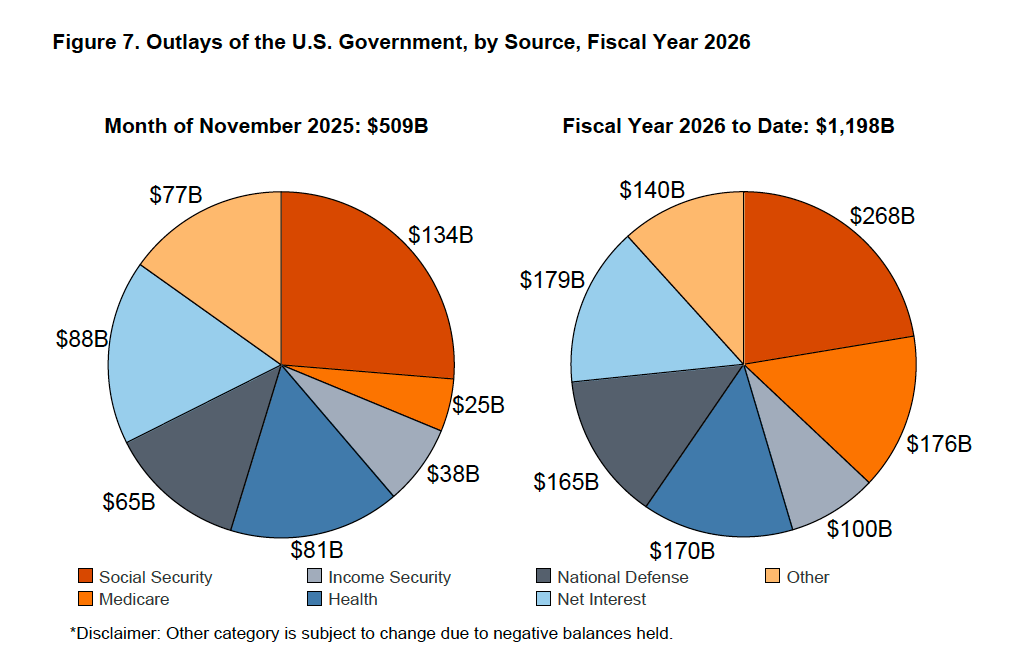
The Trump administration blew through $509.28 billion last month. That represents a percent year-on-year increase. That was a significant 23.9 percent decrease compared to November 2024.

But don’t get too excited. Some of November’s payments were shifted back into October due to calendar effects. Total spending through the first two months of fiscal 2025 came in at $1.2 trillion. That was a more modest 4.7 percent decline in spending.

According to the Bipartisan Policy Center, after adjusting for calendar effects, November spending was up 2 percent compared to last year. Spending through the first two months of the fiscal year was down a modest 1 percent after accounting for calendar effects.

Even that slight spending decrease comes with a caveat. Treasury officials say some payments have been delayed due to lingering effects from the government shutdown. Some of that spending will show up in subsequent months.

However, some real spending cuts at the EPA and the Department of Education are showing up in the data. Lower disaster spending also helped moderate spending levels through the first two months of fiscal ’26.

Nevertheless, the spending trajectory is up. Even with all the hype about DOGE and some lip service to cutting spending during the early days of the Trump administration, the U.S. government spent just over $7 trillion last year. That’s an average of $583.3 billion per month or $19.2 billion per day.

Despite some non-specific talk about “spending cuts,” there seems to be little to no commitment to dealing with the runaway spending in a substantial way.

The Big Beautiful Bill trimmed some spending but increased it in other areas. Furthermore, those “cuts” were from projected spending increases. Actual expenditures will still go up, just not as fast as originally planned. The bottom line is that even with the Big Beautiful Bill, spending will increase on an absolute basis.

And all that waste uncovered by DOGE? Virtually none of it was removed from the budget.

This is par for the course.

You might recall that President Biden promised that the [pretend] spending cuts would save “hundreds of billions” with the debt ceiling deal (aka the [misnamed] Fiscal Responsibility Act).

That never happened.

Supporters of the Big Beautiful Bill expect economic growth stimulated by tax cuts to boost revenue and narrow the deficit. However, history casts significant doubt on this claim.

The ugly truth is the government isn’t committed to cutting spending in any meaningful way, and it always finds new reasons to spend even more, whether for “crises” at home or wars overseas.

The Cost of the Debt

On October 21, the national debt surged to over $38 trillion. Less than two months later, the debt stands at $38.4 trillion.

Uncle Sam must pay interest on all that debt. Interest expense has grown into the second-largest spending category in the federal budget behind only Social Security.

In October, the Treasury forked out $96.26 billion on interest expense alone. That pushed interest expense to $200.66 billion through the first two months of fiscal 2026, a 19 percent increase from the same period last year.

Interest on the national debt cost $1.2 trillion in fiscal 2025. That was up 7.3 percent over 2024.

Net interest (interest expense – interest receipts) was $88 billion last month.

Last month, the federal government spent more on interest on the debt than it did on national defense ($65 billion) or Medicare ($25 billion). The only higher spending category is Social Security ($134 billion).

Much of the debt currently on the books was financed at very low rates before the Federal Reserve started its hiking cycle. Every month, some of that super-low-yielding paper matures and must be replaced by bonds yielding much higher rates. And even after the Federal Reserve cut rates, Treasury yields have pushed upward as demand for U.S. debt sags.

Ramifications

People clutch their pearls and bemoan the skyrocketing debt whenever the data comes out, but there seems to be very little real concern. Most people seem to believe that while the debt might be a problem in the abstract, it’s not an immediate crisis. Some people even claim a massive national debt doesn’t matter.

It does.

As the Bipartisan Policy Center points out, the growing national debt and the mounting fiscal irresponsibility make the dollar less and less desirable.

“Confidence in U.S. creditworthiness may be undermined by a rapidly deteriorating fiscal situation, an increasing concern with federal debt set to grow substantially in the coming years.”

This could lead to lower economic growth, higher unemployment, and less investment wealth.

Lack of confidence in the U.S. fiscal situation could also lower demand for U.S. debt. This would force interest rates on U.S. Treasuries even higher to attract investors, exacerbating the interest payment problem.

The bottom line is the U.S. government has a spending problem it won’t address. No matter what the politicians in D.C. claim, there is no way to fix the budget problem by shoveling more money into the hole with tariffs, much less replacing the IRS.

The rest of the world is paying attention.

Biden ran the debt higher at a dizzying pace, but to be fair, this isn’t just a Biden problemEvery president since Calvin Coolidge has left the U.S. with a bigger national debt than when he took office.

It’s going to take more than DOGE rooting out waste to get the borrowing and spending under control. Even if the Trump administration manages to slash discretionary outlays as promised, that only accounts for 27 percent of total spending. The vast majority is for entitlements, and there is little political will to take the scissors to Social Security or Medicare.

And the sad fact is that, given the political incentives, people in power will always kick the debt can down the road. It is a long-term problem that will require painful measures to fix. Politicians don’t want to create pain. That’s a quick path out of office. So, they will punt the debt problem and spend more to make constituents happy.

As I say every month, this is all well and good, but the problem with playing kick the can down the road is that you eventually run out of road.


Mike Maharrey is a journalist and market analyst for Money Metals with over a decade of experience in precious metals. He holds a BS in accounting from the University of Kentucky and a BA in journalism from the University of South Florida.

US Southern Command Blows Up Another Boat in the Eastern Pacific Ocean

(Dave DeCamp, Antiwar.com) US Southern Command announced on Wednesday night that it bombed another boat in the Eastern Pacific Ocean as the Trump administration continues conducting extra-judicial executions at sea in the waters of Latin America.

As usual, SOUTHCOM claimed without providing any evidence that the vessel was “engaged in narco-trafficking operations.” The command said that the strike killed a total of four “narco-terrorists,” a term the administration uses to justify executions without due process for an alleged crime that doesn’t receive the death penalty in the US.

According to numbers released by the Trump administration, the attack brings the total number of people killed in the bombing campaign to 99. So far, 25 strikes have been launched, and 27 boats have been destroyed, including 11 in the Caribbean near Venezuela, where the strikes started, and 16 in the Eastern Pacific.

The strike came after US War Secretary Pete Hegseth vowed that the bombing campaign would continue despite the scrutiny of the September 2 attack that involved multiple strikes to kill survivors. Hegseth also said that the video wouldn’t be released to the public. “Of course, we’re not going to release a top secret, full, unedited video of that to the general public,” he said.

Some members of Congress are probing the September 2 strike to see if it was a war crime, but many legal experts say the entire bombing campaign is clearly illegal under international law. In an effort to rein in the strikes, a War Powers Resolution to block them was introduced in the House, but it failed in a vote of 210-216.

The House also killed a War Powers Resolution to block Trump from attacking Venezuela, a vote that came after he declared a “total and complete” blockade on all “sanctioned” tankers going into and out of the country. US military aircraft have continued flying near Venezuela’s coast, and there have been at least two near midair collisions involving civilian planes and US military planes flying without transponders on.

This article originally appeared at Antiwar.com. 


Senate Passes Massive $901 Billion National Defense Authorization Act

(Dave DeCamp, Antiwar.comThe Senate on Wednesday passed the $901 billion 2026 National Defense Authorization Act (NDAA), the sweeping annual military spending bill that will be combined with legislation passed earlier this year to bring the total US military budget to over $1 trillion.

The bill passed in a vote of 77-20, with just two Republicans, Senators Rand Paul (KY) and Mike Lee (UT), and 18 Democrats voting against it. The massive bill now heads to President Trump’s desk for his signature.

Notable amendments include a provision directing the Selective Service System (SSS) to register all potential draftees in the US automatically. According to Edward Hasbrouk, an expert on the Selective Service, it marks the biggest change to the system since 1980.

The NDAA also includes a new provision to ensure Israel is not impacted by global arms restrictions that have been imposed in response to its genocidal war in Gaza. The amendment requires a review of the arms restrictions and says the US will take steps to “mitigate” any “gaps” it may find.

The spending bill includes at least two provisions that go against President Trump’s agenda, including amendments to block troop drawdowns from Europe and South Korea, and one that requires the Pentagon to release to Congress videos of its bombings of alleged drug boats in Latin America.

If the Pentagon doesn’t hand over the videos, the amendment would withhold a quarter of the travel budget for US Secretary of War Pete Hegseth, who has been under increasing scrutiny due to the September 2 bombing that involved multiple strikes to kill survivors.

This article originally appeared at Antiwar.com.


Trump Admin. Awards Palantir $300M No-Bid Contract to Monitor Food Stamps

(José Niño, Headline USA) The Trump administration awarded Silicon Valley data analytics firm Palantir Technologies a $300 million contract without competitive bidding to construct an AI powered system targeting alleged fraud in the Supplemental Nutrition Assistance Program. This move has sparked widespread concern about surveillance overreach and discriminatory targeting of vulnerable Americans.

According to a report by Orange Slices, federal officials announced the three-year Blanket Purchase Agreement last Friday, bypassing normal procurement procedures under claims that Palantir represents the only vendor capable of meeting requirements without unacceptable delays. The system will utilize platforms originally developed for defense and intelligence operations to perform real time data fusion, conduct security checks on SNAP applicants, and implement automated compliance monitoring across Department of Agriculture systems.

According to HigherGov, officials justified the sole source award by emphasizing Palantir’s existing security accreditations and claiming the platform can deploy in days rather than years. The contract includes integration with producer and entity management systems, automated data extraction from applications, and continuous risk alert generation.

This contract implements portions of the USDA’s broader National Farm Security Action Plan, which frames American agriculture as a national security issue requiring protection from foreign adversaries. The plan’s seven priorities range from securing farmland from foreign purchases to safeguarding nutrition programs through enhanced enforcement.

The plan explicitly states its goal involves preserving programs like SNAP for truly needy individuals legally in the United States and requires compliance with Executive Order 14218, which the administration titled Ending Taxpayer Subsidization of Open Borders. Earlier this month, Fox News reported that Agriculture Secretary Brooke Rollins threatened to withhold SNAP administrative funding from 21 states, predominantly those under Democratic control, that refuse to provide immigration status data on recipients.

Civil liberties organizations warn this SNAP contract could integrate with broader efforts to link federal databases across agencies, including IRS filings, Social Security records, and immigration data, into what privacy advocates characterize as an unprecedented domestic surveillance net. A May 2025 New York Times investigation detailed these integration plans, though Palantir denied it collects data to unlawfully surveil Americans.

ICE awarded Palantir a $30 million no bid contract in April 2025 for ImmigrationOS, a platform providing agents with near real time visibility into the movements and backgrounds of migrants. Amnesty International’s August 2025 report condemned these AI-powered tools as enabling mass monitoring, surveillance, and assessments of people with high risk of discriminatory targeting and false positives.

Palantir’s government contract growth under the Trump administration has proven dramatic. Per a report by Evotek, the company secured over $300 million in new federal contracts since January 2025. 

Peter Thiel, Palantir’s cofounder and chairman, donated $1.25 million to Trump’s 2016 campaign and joined his transition team, as Mother Jones reported. Though Thiel sat out the 2024 presidential race, he donated over $850,000 in 2025 to House Speaker Mike Johnson’s political action committee supporting Republican congressional candidates. Thiel also contributed $15 million to launch JD Vance’s political career, helping elevate Trump’s eventual vice president.

A particularly concerning conflict involves Stephen Miller, Trump’s deputy chief of staff and architect of immigration enforcement policies. Miller owns between $100,000 and $250,000 in Palantir stock while simultaneously shaping policies that expand the company’s government contracts, a situation the Project on Government Oversight flagged as a major potential conflict of interest.

José Niño is the deputy editor of Headline USA. Follow him at x.com/JoseAlNino 


Republican Leader Died in Brown University Shooting. Was it a Targeted Assassination?

(Ken Silva, Headline USA) As law enforcement continues to search for a gunman who killed two Brown University students and wounded nine others five days ago, some conservative pundits are questioning whether the shooting was a targeted assassination of one of the school’s leading Republican students.

The murdered student in question is 19-year-old Ella Cook, the vice president of the college Republican Club. Cook was reportedly an accomplished pianist who was fluent in French.

The fact that Cook was rumored to be shot numerous times is one of the reasons conservatives are questioning whether she was the target of Saturday’s shooting.

“We’re hearing reports that the Vice President of the Brown Republicans [Ella Cook] might have been shot multiple times. We still don’t understand if this was a targeted shooting and they’re not giving us any clue about that,” Fox News’s Jesse Waters said Tuesday.

“[The shooter looked one guy] directly in the eye and then the shooter didn’t kill him. Why didn’t the shooter shoot the guy if this is a random attack? He’s just spraying bullets around. Why didn’t he shoot the guy?” he added.

Providence’s police chief, Col. Oscar Perez, has claimed that investigators haven’t found evidence to suggest someone was targeted.

Investigators have described the person they’re seeking as about 5 feet, 8 inches and stocky, but they’ve given no indication that they are close to zeroing in on their identity.

Authorities have been canvassing nearby neighborhoods and have received hundreds of tips.

Providence police on Wednesday released a new photo of a separate individual who they said was in “proximity of the person of interest” and asked the public to help identify that person.

Felipe Rodriguez, a retired New York Police Department detective sergeant and adjunct professor at John Jay College of Criminal Justice, said it is very rare for authorities to make this kind of plea during a criminal investigation.

“They are grasping at straws,” he said.

Meanwhile, Boston-area police are searching for the person who killed a Massachusetts Institute of Technology professor earlier this week. That professor was attacked at home, and the FBI said it had no reason to think the two attacks were linked.

The attack and shooter’s escape have raised questions about campus security.

Paxson said Brown has two security systems. One, which is activated in emergencies, sent out text messages, phone calls and emails that reached 20,000 people. The other features three sirens across the campus and was not activated Saturday. Paxson said doing so would have caused people to rush into buildings, including where the shooter was.

Brown’s website says the sirens can be used when there is a shooter, but Paxson said it depends on circumstances such as location.

The Associated Press contributed to this report.

Ken Silva is the editor of Headline USA. Follow him at x.com/jd_cashless.

American Jewish Committee Pushes Censorship After Bondi Beach Attack

(José Niño, Headline USA) In the wake of the mass shooting at Bondi Beach in Sydney, Australia, American Jewish Committee (AJC) CEO Ted Deutch embarked on a high profile media tour that framed the atrocity as a mandate for global action against online speech. 

The shooting which Australian authorities classified as a terrorist attack targeting a Jewish event left at least fifteen people dead and dozens injured according to reporting from Reuters. As details emerged, Deutch used the moment to argue that social media expression now poses a direct threat to public safety.

Chris Menahan of Information Liberation first highlighted the campaign in a post on X where he noted that Deutch moved rapidly after the attack to demand what he called bold action to suppress antisemitism online. Menahan wrote that Deutch used the Bondi Beach killings as evidence that digital speech leads directly to real world violence. 

During a series of interviews Deutch insisted that rhetoric tolerated online creates conditions for violence offline. “We have to speak out against the kind of language that puts Jews at risk. We have to adopt policies that recognize that fighting antisemitism needs to be a priority, and we have to do more to make sure that on social media, what would never be tolerated on Main Street isn’t tolerated online,” Deutch said in an interview with CNN.

Australian officials described the Bondi Beach attack as an Islamic State inspired act of terrorism aimed at a Hanukkah gathering of roughly one thousand people. Police killed one attacker at the scene and charged the second with multiple counts of murder according to Reuters. The scale and symbolism of the attack intensified global media attention and provided the backdrop for Deutch’s remarks.

Deutch repeatedly linked the shooting to online expression. “The kind of calls for violence that put Jews at risk and that lead to the kinds of atrocities like we just saw in Bondi Beach. That’s a horrible situation indeed,” he said. He urged audiences to accept a causal link between online discourse and physical attacks. 

Since becoming AJC CEO after leaving Congress in 2022, Deutch has consistently pushed for stronger government involvement in policing speech particularly on digital platforms.


José Niño is the deputy editor of Headline USA. Follow him at x.com/JoseAlNino