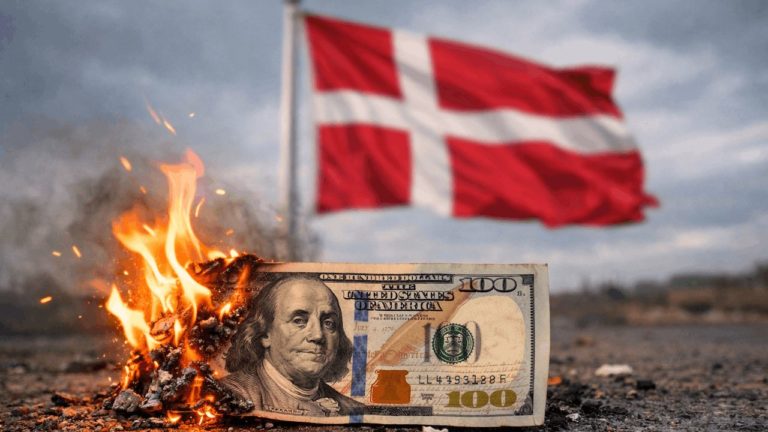
De-dollarization Alert! Danish Pension Fund Dumps U.S. Treasuries

(Mike Maharrey, Money Metals News Service) This is how de-dollarization works.

Danish pension operator AkademikerPension said it is selling all of its U.S. Treasurys.

AkademikerPension investing chief Anders Schelde said the fund will divest its entire $100 million in U.S. Treasury holdings by the end of the month.

He cited concerns about the U.S. government’s fiscal malfeasance.

“The decision is rooted in the poor U.S. government finances.”

The move also comes along with increasing tensions between the U.S. and Danish governments over Greenland, but Schelde said that was not the primary motivator behind the decision.

“It is not directly related to the ongoing rift between the [U.S.] and Europe, but of course that didn’t make it more difficult to take the decision.”

Schelde said the driving concern is ever-increasing U.S. debt and decades of overspending. Last October, the national debt eclipsed $38 trillion, and despite record tariff revenue, the federal government continues to run large budget deficits.

Schelde said the U.S.′s finances made “us think that we need to make an effort to find an alternative way of conducting our liquidity and risk management.

“Now we have found such a way and we [are] executing on that.”

The EU is trying to decide how to deal with Trump’s aggressive efforts to take Greenland as a U.S. territory. There has been talk about retaliatory tariffs, and some discussion about dumping U.S. asset holdings.

Treasury Secretary Scott Bessent downplayed threats about divestment, calling Denmark’s “irrelevant.”

“Denmark’s investment in U.S. Treasury bonds – like Denmark itself – is irrelevant.”

He noted that the divestment was less than 100 million.

“They’ve been selling Treasuries. They have for years. I’m not concerned at all.”

However, enough small amounts add up to large amounts.

Denmark currently holds just under $10 billion in U.S. debt. That’s down from about $18 billion as recently as 2021. This underscores that de-dollarization was ongoing even before the spat over Greenland.

Many countries began shifting away from the dollar when the U.S. weaponized the greenback and aggressively sanctioned Russia after it invaded Ukraine.

Collectively, the EU holds $8 trillion in Treasuries, making it the largest foreign financer of U.S. debt.

The dollar is in no danger of losing its status as the primary global reserve currency, but de-dollarization is chipping away at its dominance. It’s clear we’re moving toward a “multipolar” world where several currencies, along with gold, are making up a growing share of global reserves.

Central banks worldwide are diversifying away from dollars and buying gold. We’ve seen central bank gold buying eclipse 1,000 tonnes for three straight years. To put that into context, central bank gold reserves increased by an average of just 473 tonnes annually between 2010 and 2021.

We’ve also seen declining dollar reserves.

As of the end of last year, dollars made up 57.8 percent of global reserves. That is the lowest level since 1994, representing a 7.3 percent decline over the last decade. In 2002, dollars accounted for about 72 percent of total reserves.

Bessent’s dismissal notwithstanding, de-dollarization could cause significant problems for the U.S. government. As Bridgewater Associates founder Ray Dalio told CNBC, there is a risk to using the dollar and tariffs as a foreign policy tool (even if you think the policy is justified).

“On the other side of trade, deficits, and trade wars, there are capital and capital wars. If you take the conflicts, you can’t ignore the possibility of the capital wars. In other words, maybe there’s not the same inclination to buy … U.S. debt and so on.”

Even a modest de-dollarization spells trouble for the federal government and the U.S. economy.

In a nutshell, the United States needs the world to need dollars.

The U.S. depends on a global demand for dollars supported by its reserve status to underpin its massive government. The only reason Uncle Sam can borrow, spend, and run massive budget deficits to the extent that it does is the dollar’s role as the world’s reserve currency. It creates a built-in global demand for dollars and dollar-denominated assets. This absorbs the Federal Reserve’s money creation and helps maintain dollar strength despite the Federal Reserve’s inflationary policies.

If the world needs fewer dollars, they will begin to return to the U.S., causing a dollar glut. This will increase inflationary pressure domestically as the value of the U.S. currency further depreciates. In the worst-case scenario, the dollar could collapse completely, leading to hyperinflation.


Mike Maharrey is a journalist and market analyst for Money Metals with over a decade of experience in precious metals. He holds a BS in accounting from the University of Kentucky and a BA in journalism from the University of South Florida.

Silver Squeeze, Supply Chain Chaos, or Both? Money Metals’ CEO Explains

(Money Metals News Service) On an episode of Soar Financially hosted by Kai Hoffmann, Stefan Gleason joined the show to explain what is driving the near-daily precious metals headlines. With gold and silver setting frequent new highs, Hoffmann pressed on the question that many investors keep asking.

Is this a real silver squeeze, a supply chain and logistics story… or BOTH?

Why Stefan Gleason’s Perspective Matters

Stefan Gleason is the Chief Executive Officer of Money Metals, the top U.S.-focused bullion dealer and depository operator. That role puts him inside the retail bullion supply chain rather than watching it from the outside. From that vantage point, he sees real-time order flow, buyback activity from customers, wholesale sourcing conditions, and the operational constraints that determine whether investors can actually get specific products at any given moment.

His commentary is grounded in day-to-day exposure to inventory management, delivery lead times, mint capacity, and refining backlogs. Those realities often explain why premiums spike, why certain items go out of stock, and why regional pricing dislocations can appear even when raw metal is still available. In this interview, the on-the-ground view helps distinguish between true scarcity and bottlenecks in processing and fabrication.

Retail Demand Runs Hot as Silver Triples in 12 Months

Retail conditions were described as total pandemonium, with heavy activity on both sides as people sell and buy. Demand over the last three to four weeks was characterized as exceeding COVID-era levels, even as long-time holders take profits after silver tripled over the last 12 months.

The U.S. is not yet facing a true raw-metal shortage in silver. The better way to understand the stress is to separate metal availability from the system that refines, fabricates, and delivers retail products. The 1,000-ounce bars used for minting are still available in the U.S., but bottlenecks in refining and minting can create backlogs, out-of-stocks, and premium spikes that look like a shortage to the public.

“Silver Squeeze” or Something Else

The current move appears to be driven by new investors entering the market while long-term holders take some profits. Selling is significant, but it is more than being replaced by new buyers reacting to headlines and price action. There are also real dislocations and tightness outside the U.S., particularly in London and Asia, where premiums reflect a more constrained market.

Why U.S. Mint “Shortages” Are Mostly Mismanagement

Reports that the U.S. Mint paused American Eagle sales were framed as mismanagement rather than a true metal shortage.

Proof products on the Mint’s website were previously priced around $95, but the rapid price rise made those items effectively sit near spot even though they were intended to sell far above spot. Sales paused while repricing, and proof Silver Eagles later showed up around $170. These were framed as collector or gift items, not an efficient way to buy silver as an investor.

The U.S. Mint was also presented as a poor bellwether because production decisions can be erratic, contributing to large premium swings.

For value-focused buyers, bars, rounds, or alternatives like Canadian Maple Leafs were positioned as better options than relying heavily on Silver Eagles during high-premium periods.

Minting Bottlenecks and Why Premiums Rise

The last two years were described as slow because of heavy secondary supply, meaning customers selling back into the market.

With wholesale pricing often below the cost of newly minted products, private mints had little incentive to expand production. Some mints laid off staff, and a couple went out of business.

When demand flipped hard, beginning around October and accelerating again in the last four weeks, many mints were caught flat-footed. Securing metal deliveries and scaling staffing and shifts takes time, which is a major driver behind rising premiums and out-of-stocks across many dealers.

The Real Choke Point Is Silver Refining Capacity

Refining was described as an even bigger bottleneck than minting. The U.S. has limited silver refining capacity, and refineries capable of processing silver are backlogged for months, with some refusing scrap silver altogether. This affects everything from silverware to 90% silver coins, which can be melted and refined if capacity exists.

China was described as controlling roughly 55 to 60 percent of the world’s silver refining capacity, leaving the U.S. short on the ability to process recycled silver streams into refined product quickly.

London, Asia, and Pricing Dislocations

Tightness was described as more visible outside the U.S. Earlier in the year, silver moved into New York as traders responded to tariff concerns, creating a premium in New York and a discount in London. COMEX inventories were described as climbing to around 530 million ounces as metal moved in. Later, that dynamic flipped as tariff fears eased and demand in Asia surged, including China and India. ETF inflows sourcing metal from the London market were also described as adding pressure there.

A snapshot of price gaps was offered, with New York trading about $0.50 below London and roughly $2 to $3 below Asia. Closing those gaps requires physical transport and logistics costs, so the dislocations can persist and create regional stress.

Why Silver Demand Can Flip Overnight

Retail participation can change fast because ownership is still low. Only about 1 to 1.5 percent of Americans were estimated to own meaningful gold or silver outside jewelry.

In that framework, a move from 1 percent to 2 percent to 3 percent of the public buying silver would be more demand than the market can absorb smoothly.

That helps explain why the current surge could mark the start of a new growth phase in U.S. retail demand, even if the system is not yet in a full emergency.

Are Banks Caught Short on Silver

Speculation around the silver price run included indications that Deutsche Bank may be selling significant silver tied to commitments, implying potential stress on the short side.

Commentary from Robert Gottliebsen was also referenced, suggesting bullion banks in the U.S. are positioned long and benefiting from the move.

Even so, the broader explanation leaned structural rather than hinging on a single trapped player.

Supply Inelasticity and Why Higher Prices May Not Fix It

Silver supply was described as less responsive than many assume.

In 1980, about 70 percent of silver was described as coming from primary silver mines, while today it is closer to the opposite, with roughly 30 percent from primary mines.

If true, that implies much of the silver supply is tied to byproduct mining and may not surge even if prices rise dramatically. Silver’s unique industrial properties were also cited as reasons why substitution can be slow.

At around $150 silver, solar panels could potentially shift toward copper designs, but that would take time and engineering.

Momentum analyst Michael Oliver’s work was cited as a key framework, including his $200 silver target this year. That target was framed as plausible given the breakout and the scale of the move already underway.

Critical Minerals, Tariffs, and China’s Dominance

Silver’s critical mineral status was discussed in the context of tariffs and policy. Direct involvement in those discussions was denied, and near-term government stockpiling was not expected. The main impact was framed as faster permitting for mining projects.

A joint venture in Tennessee was also mentioned, where the U.S. government is partnering with a Korean zinc company to build a zinc smelter, with the possibility that silver could be refined there, too.

The idea of tariffs on imported silver was dismissed as inconsistent with the goal of securing more supply. Export controls and administrative friction were framed as more plausible. Asia’s refining dominance was also described as a factor that can pull silver into the region and keep it there when local premiums are higher.

“Junk Silver” Sells Under Spot

90% silver coins were described as currently selling under spot, about $1 under spot, because supply is heavy and newer buyers often prefer .999 bars and rounds. New investors sometimes avoid junk silver because they do not understand it or worry about sorting coins, while experienced buyers often view it as one of the best ways to buy silver, especially when it is discounted.

Gold Is Strong, but Silver Is the Story

Gold’s supply chain was described as comparatively stable, even though gold has performed strongly. A major shift in Money Metals’ revenue mix was also described.

Earlier in the year, over 60 percent of sales were described as gold and under 40 percent silver, but in the last two months, that flipped to roughly 70 to 75 percent silver. Gold demand has been steadier, while silver has drawn the excitement.

What a Real Silver Squeeze Would Look Like

The best squeeze indicators were framed as deeper than temporary retail out-of-stocks or premium spikes. Exchange inventories and liquidity were highlighted as the key signals, especially signs of industrial users bypassing exchanges and going directly to mines and refiners, draining available metal. Shortages at that commercial level would signal a true emergency.

The conclusion was that there are indications of tightness in parts of the world, but not yet a full global squeeze.

To stay connected with Kai Hoffman and Soar Financial or the Soar Financially Podcast, visit their website HERE.
To buy precious metals like silver, gold, platinum, and more, visit Money Metals’ website HERE.

BREAKING: DOJ Arrests Woman Who Led Minnesota Church Invasion

(Headline USAA woman who invaded a Minnesota church on Sunday has been arrested, Attorney General Pam Bondi said Thursday.

Bondi announced the arrest of Nekima Levy Armstrong in a post on X days after protesters during Sunday service disrupted the Cities Church in St. Paul, where a local official with U.S. Immigration and Customs Enforcement serves as a pastor.

The Justice Department quickly opened a civil rights investigation after the group interrupted services by chanting “ICE out” and “Justice for Renee Good,” referring to the 37-year-old mother of three who was fatally shot by an ICE officer in Minneapolis earlier this month after striking him with her vehicle.

“Listen loud and clear: WE DO NOT TOLERATE ATTACKS ON PLACES OF WORSHIP,” the attorney general wrote on X.

Levy Armstrong, a civil rights attorney and prominent local activist, had called for the pastor affiliated with ICE to resign, saying his dual role poses a “fundamental moral conflict.”

However, rominent leaders of the Southern Baptist Convention have come to the church’s defense, arguing that the protestors’ political views cannot justify violating a sacred space during worship.

A longtime activist in the Twin Cities metropolitan area, Levy Armstrong is a former president of the NAACP’s Minneapolis branch.

It was not immediately clear what charge or charges Levy Armstrong faces. Justice Department officials have said in recent days they were considering charging the protesters under the Freedom of Access to Clinic Entrances Act.

The FACE Act prohibits physically obstructing or using the threat of force to intimidate or interfere with a person seeking reproductive health services or seeking to participate in a service at a house of worship.

The Justice Department has separately opened an investigation into whether Minnesota officials impeded or obstructed federal immigration enforcement though their public statements. Prosecutors this week sent subpoenas to the offices of Gov. Tim Walz, Attorney General Keith Ellison, Minneapolis Mayor Jacob Frey, St. Paul Mayor Kaohly Her and officials in Ramsey and Hennepin counties, according to a person familiar with the matter.

Adapted from reporting by the Associated Press


Leftist Congressional Candidate Snoozes Through Public Event

(Luis CornelioHeadline USA) One radical leftist candidate offered a bizarre excuse for skipping a major candidate forum: she fell asleep. 

The candidate, leftist journalist Kat Abughazaleh, is running for the Democratic nomination in Illinois’s 9th congressional district. The seat is held by Rep. Jan Schakowsky, who is not seeking re-election. 

Abughazaleh is one of several individuals federally indicted on charges alleging they conspired to impede and interfere with a U.S. law enforcement officer during an anti-ICE protest.

Abughazaleh, 26, admitted she missed the event after experiencing what she described as a “sleep attack.” 

“I want to offer my sincerest apologies as well as an explanation. I have a chronic illness called narcolepsy,” Abughazaleh wrote in a statement. “It makes me extremely tired and occasionally causes ‘sleep attacks,’ times when my brain literally cannot stay awake.” 

The leftist journalist-turned-politician claimed her condition was “usually well-managed but — like with any disability — has flare-ups and today was one of those.” 

She added, “I ended up sleeping through alarms, calls, and even my campaign manager knocking on my door repeatedly.” 

Abughazaleh insisted the incident was not an excuse and said she wanted to be “transparent” with voters. 

The leftist activist was known online for her past work with Media Matters, the far-left nonprofit that claims to be “dedicated to comprehensively monitoring, analyzing, and correcting conservative misinformation in the U.S. media.” 

Abughazaleh said she was attempting to reschedule the forum and vowed not to sleep through it next time. 

Keep Calm in a 2026 Metals Mania

(Money Metals News Service) Mike Maharrey opens the Money Metals Midweek Memo with a mindset for chaotic times. He borrows from the famous keep calm & carry on message that originated as a British government propaganda campaign in 1939 during World War II. His point is modern and simple. Stay grounded even when the headlines and prices are screaming.

That grounding feels necessary in a market where the numbers are turning into a daily spectacle. Maharrey says gold is trading well over $4,800 an ounce and cites $4,876 as the level pushing toward $5,000 in 2026. Silver is trading over $95. Record prices keep showing up, and he says the excitement is also feeding rumors, conspiracy theories, and overheated claims.

Why Breaking News Gets It Wrong

Maharrey leans on his time in television news to explain why early narratives so often fail. He worked about 5 years producing web content for the NBC affiliate in Lexington, Kentucky, and watched stories evolve from first reports to final confirmation. In his experience, the first wave is frequently incomplete or incorrect because information comes in fragments.

He gives a personal example from 9/11. The first report he saw described a small plane hitting one of the towers, a detail that turned out to be drastically wrong as the picture became clear. He also describes a psychology class exercise at the University of Kentucky that revealed how unreliable eyewitness memory can be. People in the same room saw the same event and gave wildly different descriptions.

Bias, Balance, and Integrity

He ties those media dynamics to something bigger than precious metals. People interpret information through presuppositions, and those biases shape what they think they saw. He argues that true, unbiased news is impossible, but balance is still a worthwhile goal. You try to put assumptions aside and report what you can verify.

He also draws a line for his own work. He says he has editorial license, but he does not want to ignore facts or use fear to hype gold and silver. He stresses integrity as something you choose in real time, including admitting mistakes when you make them. Then he does exactly that.

The China Silver Export Rules Correction

Maharrey says he overstated the likely impact of Chinese silver export rules that went into effect on January 1st, 2026.

Last week, he reported that China might be trying to control the silver market through more restrictive export rules that could worsen a global shortage. He says that was not an unreasonable concern given China’s history of using export controls to shape markets for rare earth metals, but new analysis suggests the effect may be limited.

He recaps what analysts thought at first. Under the policy framework, only large state-approved companies with an annual silver production capacity of 80 tons and a credit line exceeding $30 million can legally export silver. The initial interpretation was that hundreds of smaller exporters would be locked out and global supply would tighten further.

Then he explains what Metals Focus found. Metals Focus is an independent consultancy based in London with a team on the ground in Shanghai, and their assessment is that China was already regulating and licensing silver exports. Smaller exporters were already excluded. The new rules appear to be tweaks in an existing framework rather than a sudden new wave of export restrictions, and the updates tend to occur on a two-year cycle.

The numbers matter here. Metals Focus compared the new approved exporter list with the prior version and found only minor changes. There are now 44 approved silver exporters for the 2026 2027 cycle, up from 42 for the 2025 2026 cycle. Maharrey also notes that China removed silver export quota restrictions a few years ago, and that remains true under the current rules.

What Still Might Change in Practice

He does not claim the story is finished. He says exporters may now have to obtain approval for individual overseas shipments, which could add friction. He cites Trivia China, saying that even without quotas or national security scrutiny, licensing can raise costs for exporters and customers. He also cites CIRS, noting that licensing regimes can be one license, one shipment, or one license, multiple shipments, depending on the category.

The key issue is ambiguity. The publicly available catalog summaries do not clearly establish that silver is always one order and one approval. Metals Focus says the announcement should have little impact on global silver trade flows or market tightness, and that a misunderstanding likely contributed to the market treating it as a bullish signal.

Maharrey says the measured approach is to watch how the policy is applied rather than insisting China is definitely trying to corner silver. Skepticism toward Chinese policy is reasonable, he says, but certainty without evidence is where hype begins.

The Silver Shortage That Does Not Go Away

He argues that even if policy adds friction, it does not change the core reality. The silver market is structurally short on metal. He cites a structural market deficit of 148.9 million ounces last year, meaning consumers used 148.9 million more ounces than were produced by mines or recycling. He says the 4-year shortfall totals 678 million ounces, and he expects the deficit to push over 800 million ounces once 2025 numbers are in, roughly equal to an entire year of global silver mine output.

He restates the point for emphasis. Over the last 5 years, the silver market has consumed six years of global mine output. Metal can be shifted between hubs like New York, London, and Shanghai, but that does not solve the shortage. Users must pull from above-ground stocks, and holders are less willing to sell at current prices, which he says helps drive prices higher.

He also notes policy risk is not limited to China. The US Geological Survey recently designated silver a critical mineral. He says the critical mineral list was established in 2017 and guides federal strategy on investment and mine permitting decisions, and that designation could influence the market through future policy choices.

The US Mint Rumor and What the Notice Really Said

Maharrey then tackles a second overhyped story. A rumor circulated that the US Mint is running out of silver. People pointed to a notice on the Mint’s website stating that due to rapidly rising metal costs, silver numismatic products were temporarily removed from sale while pricing is evaluated, and that American Eagle silver bullion coins remain available through authorized purchasers.

His interpretation is straightforward. The notice refers to numismatic products, meaning collectible items, not standard bullion. When spot prices rise rapidly, fixed pricing for proof and burnished collectibles can lag and even dip below spot, so the Mint pauses sales to adjust pricing rather than sell at a loss. He emphasizes that the US Mint does not sell bullion American Eagle coins directly to the public, which is why the notice points buyers to authorized purchasers.

He credits his colleague Joshua D Glawson’s analysis and summarizes the basic lesson. People saw a headline, filled in the blanks, and treated it as proof that the market was out of metal. In reality, it was pricing and bureaucracy, not an empty vault.

Money Metals Operations in a Surge

Maharrey acknowledges real stress in the retail market. Some dealers are having trouble sourcing silver, especially smaller shops, but he says he spoke with CEO Stefan Gleason and was assured Money Metals has plenty of inventory. He supports that with personal observation from visiting the Idaho operation and seeing the inventory at the depository.

He shares a concrete snapshot of how far prices have run. While prepping the show, he says the melt value of a 90 percent silver 1964 quarter was over $17. He highlights junk silver as pre 1965 dimes, quarters, and half dollars, and notes that Money Metals still has some supply, including quarters under spot if purchased in high enough volume.

He says the main issue they are facing is processing speed. Order volume is overwhelming, and there can be shipping delays. Phone lines may also be backed up at 800 8001865. He says the company has hired 55 new employees since Christmas Day to address order flow and call volume.

He adds that Money Metals has not imposed order minimums or raised thresholds for free shipping the way some other dealers have. He says there is no guarantee that never changes depending on market conditions, but it would be a last resort because they value smaller customers and first-time precious metals investors.

The Closing Message on Dollars and Allocation

Maharrey finishes by returning to the emotional temperature of the moment. Do not let hype or fear drive you. Be skeptical, even of him. He says de-dollarization is not an imminent collapse but a death by a million paper cuts, and he warns that even modest reductions in global dollar demand could push inflationary pressure back into the United States as dollars flow home.

He tells a story about a retired friend who asked what to do with a pile of cash after selling a business. Maharrey says he is not a certified financial planner, but he would not hold money you do not plan to spend within the next year or two in cash because purchasing power is eroding.

He expects the Federal Reserve to keep cutting interest rates and says the Fed is engaged in quantitative easing. He also says Donald Trump will choose a new Fed chair soon and expects the next chair to be more open to easy monetary policy than Jerome Powell.

He says he believes in diversification, but not the traditional 60/40 portfolio. He prefers a 60/20/20 approach with 20 percent in precious metals and 20 percent in bonds.

He reiterates his core refrain…

Do not save in dollars. Save in real money, and if you want growth, consider assets like stocks, including mining stocks.

He wraps with the same steady posture he started with. Keep calm. Carry on. Keep thinking. Keep your integrity intact as the bull market roars.

Barron Trump Saved Woman’s Life During Frantic FaceTime Attack 

(Luis CornelioHeadline USA) President Donald Trump’s youngest son, Barron, helped save a woman’s life in London after calling law enforcement when he saw her being attacked during a FaceTime call, according to court records. 

The Daily Mail reported Wednesday that Barron contacted London police after allegedly witnessing a man assault the woman during an argument over her relationship with him.

Details of the call were disclosed during the criminal trial against the alleged assailant, 22-year-old Russian national Matvei Rumiantsev. 

Court documents alleged that the suspect became enraged after answering the woman’s ringing phone and realizing she was speaking with Barron. 

“You are not worth anything,” the man allegedly shouted while grabbing the woman’s hair and pushing her to the floor, according to the outlet. 

Rumiantsev is facing charges of rape, assault, bodily harm and perverting the course of justice. He has denied all charges. 

The Mail noted that an emergency dispatcher initially struggled to obtain details from Barron, who was presumably calling from the United States. 

Barron told the dispatcher he had met the woman through social media, though the dispatcher pressed for additional details. 

“Can you stop being rude and actually answer my questions?” the dispatcher said. “If you want to help the person, you’ll answer my questions clearly and precisely, thank you. So how do you know her?” 

In response, Barron stated that he “met her on social media,” adding: “She’s getting really badly beat up and the call was about eight minutes ago, I don’t know what could have happened by now.” 

He later apologized, reportedly telling the dispatcher that he was “sorry for being rude.” 

The call was placed shortly after 2:00 a.m. on Jan. 18, 2025. 

According to body-cam footage from responding officers, the woman told police that she was friends with Barron, prompting one officer to remark: “So apparently this informant from America is likely to be Donald Trump’s son.” 

The woman credited Barron with helping save her life, describing his call as a “sign from God.” 

The Mail reported that the trial is ongoing. 

A transcript of the purported call appears below: 

OPERATOR: City of London Police how can I help you? 

BARRON: Oh I’m calling from the US, uh I just got a call from a girl, you know, she’s getting beat up. The address is [Redacted]. This was happening about eight minutes ago. I just figured out how to, how to call someone. Uh, uh it’s really an emergency. 

OPERATOR: What’s her name? 

BARRON: Her name is [Redacted]. 

OPERATOR: Her date of birth? 

BARRON: It’s really an emergency, please. 

OPERATOR: How do you know her? 

BARRON: I mean these details don’t matter, she’s getting beat up like I… 

OPERATOR: Yeah I know but I need to take information from you so how have you come by this information? 

BARRON: Uh I got a call from her with a guy beating her up. 

OPERATOR: Okay how do you know her? 

BARRON: I don’t think these details matter she’s getting beat up but okay fine, also I met her on social media, I don’t think that matters. 

OPERATOR: You know I can…  

BARRON: She’s getting beat up! 

OPERATOR: Can you stop being rude and actually answer my questions. If you want to help the person, you’ll answer my questions clearly and precisely, thank you. So how do you know her?  

BARRON: I met her on social media. 

OPERATOR: Okay.   

OPERATOR: Know the partners name or the person that’s beating her up at all? 

BARRON: No. 

OPERATOR: And they’re at home, they’re not out into the street? 

BARRON: Correct. She’s getting really badly beat up and the call was about 8 minutes ago, I don’t know what could have happened by now. 

OPERATOR: Okay. 

BARRON: So, sorry for being rude. 

Ex-DEA Agent Sentenced for Protecting Drug Trafficking Friends

(Headline USA) In two decades of kicking in doors for the U.S. Drug Enforcement Administration, Joseph Bongiovanni often took on the risks of being the “lead breacher,” meaning he was the first person into the room.

On Wednesday, he felt a familiar uncertainty awaiting sentencing for using his DEA badge to protect childhood friends who became prolific drug traffickers in Buffalo, New York.

“I knew never what was on the other side of that door — that fear is what I feel today,” Bongiovanni, 61, told a federal judge, pounding the defense table as his face reddened with emotion. “I’ve always been innocent. I loved that job.”

U.S. District Court Judge Lawrence J. Vilardo sentenced the disgraced lawman to five years in federal prison on a string of corruption counts. The punishment was significantly less than the 15 years prosecutors sought even after a jury acquitted Bongiovanni of the most serious charges he faced, including an allegation he pocketed $250,000 in bribes from the Mafia.

The judge said the sentence reflected the complexity of the mixed verdicts following two lengthy trials and the almost Jekyll-and-Hyde nature of Bongiovanni’s career, in which the lawman racked up enough front-page accolades to fill a trophy case.

Bongiovanni once hurtled into a burning apartment building to evacuate residents through billowing smoke. He locked up drug dealers, including the first ever prosecuted in the region for causing a fatal overdose.

“There are two completely polar opposite versions of the facts and polar opposite versions of the defendant,” Vilardo said, assuring prosecutors five years behind bars would pose a considerable hardship to someone who has never been to prison.

Defense attorney Parker MacKay noted the judge had acknowledged Bongiovanni as a “beacon” of the Buffalo community. The government’s request for a 15-year sentence, he added, was “completely unmoored to the nature of the convictions.”

“As Mr. Bongiovanni told the judge at sentencing, he is innocent, and we look forward to continuing to work with him to prove that,” MacKay told The Associated Press.

A jury in 2024 convicted Bongiovanni of four counts of obstruction of justice, counts of conspiracy to defraud the United States, conspiracy to distribute controlled substances and making false statements to law enforcement.

Prosecutors said Bongiovanni’s “little dark secret” caused immeasurable damage over 11 years. They likened him to Jose Irizarry, a disgraced former DEA agent serving a 12-year federal sentence after confessing to laundering money for Colombian drug cartels.

Bongiovanni upheld an oath not to the DEA, they argued, but to organized crime figures in the tight-knit Italian American community of his North Buffalo upbringing. During sentencing, Bongiovanni’s family dissolved into tears on the front row of the packed courtroom in downtown Buffalo.

Prosecutors said Bongiovanni’s corruption involved as much inaction as calculated coverup. They pointed to a turning point in 2008 when Bongiovanni could have acted on intelligence about traffickers he knew whose operation would evolve into a large-scale organization with links to California, Vancouver, and New York City.

He also was accused of authoring bogus DEA reports, stealing sensitive files, throwing off colleagues, outing confidential informants, covering for a sex-trafficking strip club and helping a high school English teacher keep his marijuana-growing side hustle. Prosecutors said he brazenly urged colleagues to spend less time investigating Italians and focus instead on Black and Hispanic people.

“His conduct shook the foundation of law enforcement — and this community — to its core,” Assistant U.S. Attorney Joseph Tripi told the judge. “That’s what a betrayal is.”

The ex-agent’s downfall came amid a sex-trafficking prosecution that took sensational turns, including an implicated judge who killed himself after the FBI raided his home, law enforcement dragging a pond in search of an overdose victim and dead rats planted outside the home of a government witness who prosecutors allege was later killed by a fatal dose of fentanyl.

It also involved the Pharoah’s Gentlemen’s Club outside Buffalo. Bongiovanni was childhood friends with the strip club’s owner, Peter Gerace Jr., who authorities say has close ties to both the Buffalo Mafia and the violent Outlaws Motorcycle Club. A separate jury convicted Gerace of a sex trafficking conspiracy and of paying bribes to Bongiovanni.

The prosecution also cast a harsh light on the DEA after a string of corruption scandals prompted at least 17 agents brought up on federal charges over the past decade. Last month, prosecutors charged another former agent with conspiring to launder millions of dollars and obtain military-grade firearms and explosives for a Mexican drug cartel.

Frank Tarentino, the DEA’s northeast associate chief of operations, said Bongiovanni’s sentence “sends a powerful message that those who betray their badge will be held accountable to the fullest extent of the law.”

Adapted from reporting by the Associated Press

WATCH: Trump Says He Plans to Send Out $2,000 Tariff Checks Without Congress

(Brett Rolwland, The Center Square)  President Donald Trump on Tuesday said he could bypass Congress to send $2,000 tariff rebate checks to some Americans.

This directly contradicts his top economic adviser’s comments last month, making this the first time Trump has proposed issuing tariff-funded checks without congressional approval.

“I don’t think we’d have to go the Congress route, but you know, we’ll find out,” Trump said during a White House news briefing.

The president  said he would like to send $2,000 checks to Americans, subject to a “reasonable” income limit, but did not specify a threshold.

“We will be able to make a very substantial dividend to the people of our country and I believe we can do that without Congress,” Trump said.

Trump also said he would use tariff revenue to pay down U.S. debt.

Days before Christmas last month, Director of the National Economic Council Kevin Hassett said the U.S. House and Senate would need to be involved.

“I would expect that in the new year, the president will bring forth a proposal to Congress to make that happen,” Hassett said.

Details about Trump’s tariff rebate plan are limited. He wants to send $2,000 checks to certain Americans and use the remaining tariff revenue to reduce the $38 trillion U.S. debt. The Supreme Court has not decided whether Trump has the authority to impose tariffs.

Trump said the rebates would be for low and middle-income Americans, not the wealthy, but has not specified any income limits. Treasury Secretary Scott Bessent previously suggested the checks could go to those earning less than $100,000 a year, but noted that no decision had been made on income caps.

Three different scenarios analyzed by the Tax Foundation estimate that costs of distributing the checks would range from $279.8 billion to $606.8 billion.

The Committee for a Responsible Federal Budget says the math does not add up. If the rebate mimics COVID-19 stimulus payments, the proposed $2,000 dividends would cost about $600 billion, double the tariff revenue expected.

A report from a German think tank released Monday found Americans are paying almost the entire cost of Trump’s tariffs, directly challenging the president’s claim that foreign nations absorb the burden. Nearly all tariff costs fall on American importers and consumers, according to a report from the Kiel Institute for the World Economy.

Trump has made tariffs a key part of his agenda during his second term. In April 2025, Trump imposed import taxes of at least 10% on every U.S. trading partner.

A group of states and small businesses challenged Trump’s tariffs under the 1977 law, winning in two lower courts before the administration appealed to the Supreme Court. The high court agreed to hear the case on an expedited basis. A ruling in the case is expected before June, but could come sooner.

WATCH House Hearing: Fraud Goes Far Beyond Minnesota

(Elyse S. Apel, The Center Square)  The U.S. House Judiciary Subcommittee on Crime and Federal Government Surveillance heard Wednesday from witnesses on the ongoing Minnesota fraud scandal.

Republicans and Democrats on the committee sparred over what Democrats consider the politicization of the fraud story, which has dominated headlines in Minnesota and beyond.

“Minnesota has lost billions of dollars in state-administered and federally-funded programs due to organized fraud,” said U.S. Rep. Andy Biggs, R-Ariona and chair of the committee. “Fraud networks operating in Minnesota dating back more than a decade have submitted over $9 billion . . . in false claims.”

Witnesses at the hearing included Nick Shirley, a YouTuber and content creator, whose December reporting contributed to launching the story on the national stage.

“I’m here today to speak on behalf of all hard-working, law-abiding, tax-paying citizens here inside of the United States,” Shirley said during his testimony. “We, the people, have had enough of our hard-earned money going towards fraudsters as if it’s no big deal.”

The firestorm first broke about the Minneapolis fraud cases following the release of reports in late November which alleged that millions of taxpayer dollars had been fraudulently stolen from the Minnesota welfare system and then sent to the Somali-based terror group Al-Shabaab.

That was according to original reporting from Chris Rufo and Ryan Thorpe that was published in City Journal. It detailed how, throughout the fall, the then-acting U.S. Attorney for the District of Minnesota Joe Thompson, was investigating several different cases of fraud in the state. At that time, Thompson called it a “crisis.”

Much of that attention has been focused on reports of fraud among the city’s significant Somalian population.

Since the story first broke, there have been far-reaching ramifications. Actions from the Trump administration include:

  • A surge of federal agents to the Twin Cities area
  • Minnesota Gov. Tim Walz and others subpoenaed by the U.S. Department of Justice
  • Funding cut to child care assistance programs
  • Protected status ended for Somalis in the U.S.

The surge of federal agents, which included officials from U.S. Immigration and Customs Enforcement, has led to widespread tension and protests throughout the city—especially in the wake of an ICE officer killing Renee Nicole Good.

Democrats on the committee defended Minnesota Democrats and accused President Donald Trump of having a double standard when it comes to addressing fraud.

“Minnesota lawmakers have also taken steps to reduce fraud in their state, strengthening the state’s ability to stop potential fraud sooner and improving investigations to hold those scammers accountable. President Trump has taken a very different approach to fraud,” said U.S. Rep. Lucy McBath, D-Georgia and ranking member on the committee. “We know this hearing is not really about fraud. It is about trust. The Trump administration does not want you to trust these programs, because if you don’t trust them, they’re easier to destroy.”

Both Democrats and Republicans on the committee acknowledged that fraud is widespread throughout government welfare programs.

“This is not just a Minnesota issue, but it just happens to be at the forefront of why we’re here today,” said Biggs.

U.S. Rep. Jamie Raskin, D-Maryland, said that fraud is a part of governments everywhere.

“Fraud is endemic in government,” he said. “All over the world, there are fraudsters attacking our public institutions, trying to undermine them and rip them off.”

He argued that the federal fraud investigations in Minnesota are just a “pretext” for surging federal agents to the Twin Cities.

“Fraud is not headquartered in one state, for one municipality, much less one ethnic, racial or religious community,” Raskin said. “But, President Trump couldn’t resist the temptation to use fraud in Minnesota as an occasion to mobilize the power of the federal government to bully and intimidate first and second generation Somali Americans who live in that state.”

Online Sleuths Who Hunted J6ers Were Paid FBI Informants, New Docs Reveal

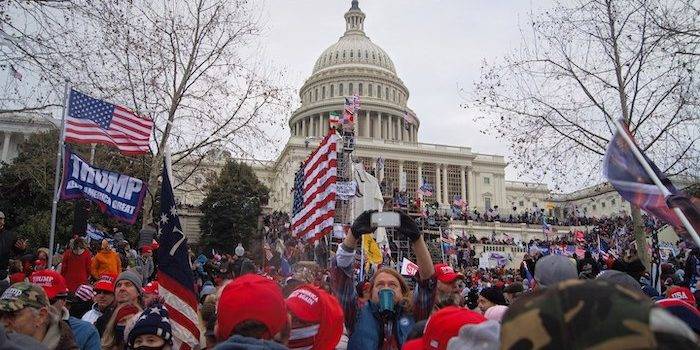
(Ken Silva, Headline USA) For more than five years, the “Sedition Hunters,” the shadowy group of online sleuths that used controversial facial recognition technology to help the FBI track down Jan. 6, 2021, Capitol Hill protestors, were portrayed by mainstream media as “volunteers” who were helping the U.S. government for patriotic reasons.

But new documents prove otherwise. Records from the FBI show that the “Sedition Hunters” received more than $150,000 for their efforts—many of which were constitutionally dubious. The records also reportedly show that some of the so-called Sedition Hunters were apparently foreigners, according to Just the News, which reviewed the records.

“[A] late January 2021 email from the FBI’s Washington field office stated that ‘we have a sedition hunter from the United Kingdom running facial recognition software’ with the tipster telling the bureau that this UK-based so-called sedition hunter ‘just found this possible match’ to an alleged January 6 suspect a few minutes prior, sharing the picture with the FBI,” Just the News reported Wednesday.

FBI Director Kashyap Patel told Just the News that the FBI’s relationship with the “Sedition Hunters” was inappropriate. Most of the officials involved in the scheme have been fired, but the FBI is reportedly conducting an audit to make sure the bureau hasn’t missed anyone.

Along with helping hunt J6ers, at least one of the so-called Sedition Hunters was reportedly paid for assisting in the Justice Department’s “Arctic Frost” operation, which investigated Trump and his allies for contesting the 2020 election.

A June 2023 FBI memo cites a “payment for information in the amount of $20,000.00 to [REDACTED] for information provided in support of captioned investigation.”

The memo was accompanied by an email, in which an agent wrote to the DOJ: “As discussed, request your office’s concurrence in our proposed payment of $20,000 for [the FBI informant’s] provision of information in support of the investigation.”

Arctic Frost documents have shown that at least 156 individuals were subjected to the secret probe.

The Sedition Hunters’ bias was evident by the group openly lobbying the DOJ to arrest more J6ers in 2024.

“It appears that the department and the FBI are not on pace to arrest an alarmingly large percentage [of those] who committed crimes at the Capitol on January 6 but have not been charged yet,” the group said in an April 2024 letter to then-Attorney General Merrick Garland.

Ken Silva is the editor of Headline USA. Follow him at x.com/jd_cashless.