Bad Bunny’s Plan To Disrupt Super Bowl Halftime Show (Hide The Kids)

(Mark E. Johnson, Contributor) When Janet Jackson’s breast “accidentally” came flying out on live television during the 2004 Superbowl Halftime Show, the NFL tried to pass it off as an innocent “wardrobe malfunction.” 

Sadly, the league has done little to actually raise the standards in its “Big Game” entertainment selections in the two decades since. 

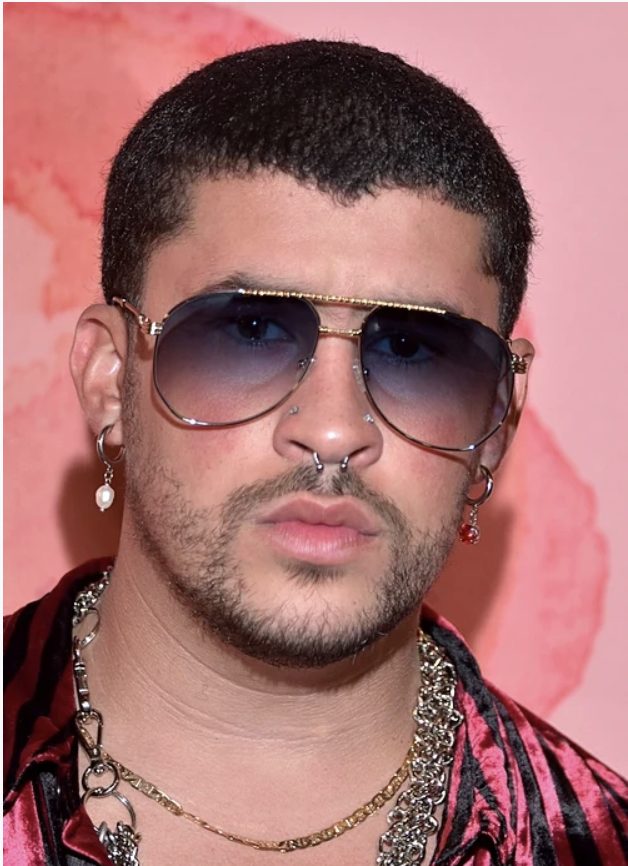
According to news reports, this year’s Super Bowl halftime act, a Puerto Rican rapper who likes it when people call him ‘Bad Bunny,’ is planning to wear a dress during the show.

This report comes after months of backlash over Mr. Bunny [real name, Benito Antonio Martínez Ocasio] being named as the featured act Super Bowl LX.

According to a Wikipedia page in his name, the performer “is considered one of the best Latin rappers of all time” – who knew that was even a thing? 

The backlash against Bunny being the headliner for the 2026 Super Bowl Halftime Show began the moment he was announced and has not died down since. 

An online petition to replace him with legendary country singer and American patriot George Strait has reportedly surpassed 120,000 signatures. 

“The Super Bowl halftime show should unite our country, honor American culture, and remain family-friendly, not be turned into a political stunt,” the petition reads. “Bad Bunny represents none of these values; his drag performances and style are the opposite of what families expect on football’s biggest stage.”

Perhaps the performer takes perverse pleasure in being as offensive as possible; a new report claims he plans to wear a dress during his performance. 

According to an unnamed stylist participating the creation of the show, Bunny “is 100 percent going to wear a dress.” His intent is to “honor Puerto Rican queer icons and generations of drag, resistance, and cultural rebellion.”

“He loves controversy,” the source said. “He lives to push envelopes.”

NFL Commissioner Roger Goodell has already rebuffed weeks of fan outrage, insisting the choice of Bunny was “carefully thought through.” 

“I’m not sure we’ve ever selected an artist where we didn’t have some blowback or criticism,” he quipped. 

What’d he say? 

Bunny typically ‘raps’ in Spanish, which should somewhat mitigate the impact of his most vile lyrics for Super Bowl viewers. 

Google AI has complied the following list of Bunny’s most inappropriate lyrics with AI-generated interpretations: 

  • “Compré una forty y a cupido se la vacié” (“I bought a gun and shot up Cupid”) Soy Peor (2017)
    This line is a common reference in discussions about the use of metaphors of violence in his music, with some interpreting it as a promotion of toxic masculinity.
  • “Baby, te lo meto/ Tú eres pa’ que te lo metan por el c*” (“Baby, I pull it out/ You’re for getting it in the ass”) — Bichiyal (2020)**
    This song is often cited as a prime example of his X-rated, highly explicit, and controversial lyrics.
  • “Aquí el calor es diferente, el sol es taíno. La capital del perreo, ahora todos quieren ser latino. Pero les falta sazón.” (“Here the heat is different, the sun is Taino… But they lack flavor.”) — El Apagón (2022)
    These lyrics are debated in the context of cultural appropriation and the popularization of non-white traits by white people.
  • “Ojalá que los míos nunca se muden” (“I wish my people would never move”) — Debí Tirar Más Fotos (2025)
    This line is part of a larger, more political theme in his music that addresses the gentrification and displacement of Puerto Ricans.
  • “No quería irse pa’ Orlando, pero el corrupto lo echó” (“He didn’t want to go to Orlando, but the scoundrel pushed him out”) — Lo Que Le Pasó a Hawaii (2025)
    These lyrics are considered highly political, as they directly address the economic and social issues in Puerto Rico, including forced migration.
  • “Tú no ere’ mi fan real, por eso te tiré el celular” (“You’re not my real fan, that’s why I threw your phone”) — Nadie Sabe (2023)
    A direct reference to the widely criticized incident where he threw a fan’s phone into the ocean. 

“Hey kids, how about some more pizza!?” Mark E. Johnson writes about culture, politics, and health for national publishers. In a moment of unusual clairvoyance during a family-oriented 2004 Super Bowl party at his home, he ushered all the children out of the rec room and  into the kitchen just as Janet Jackson was about to take the stage and do what she famously did during the Halftime Show. 

Federal Reserve Puts Rate Cuts on Pause

(Mike Maharrey, Money Metals News Service) As usual, the Federal Reserve did exactly what everybody expected at its January meeting.

The central bank put interest rate hikes on pause and delivered a generally sanguine view of the economy.

After three consecutive rate cuts, the FOMC held rates between 3.5 and 3.75 percent. Two governors broke ranks with the others, with Trump appointees Stephen Miran and Christopher Waller voting for another quarter percentage point cut.

The official FOMC statement painted a rosy economic picture, stating, “Available indicators suggest that economic activity has been expanding at a solid pace.” And while “job gains have remained low,” the FOMC said “the unemployment rate has shown some signs of stabilization.

On the downside, the committee acknowledged “inflation remains somewhat elevated.”

Powell reiterated the rosy economic evaluation during his post-meeting press conference.

“If you look at the incoming data since the last meeting, [there is] clear improvement in the outlook for growth. Inflation performed about as expected, and, as I mentioned, some of the labor market data came in suggesting evidence of stabilization. So, it’s overall, a stronger forecast, really.”

Powell said he thought the federal funds rate is “loosely neutral,” and the committee broadly agreed.

“Many of my colleagues think it’s hard to look at the incoming data and say that policy is significantly restrictive at this time.”

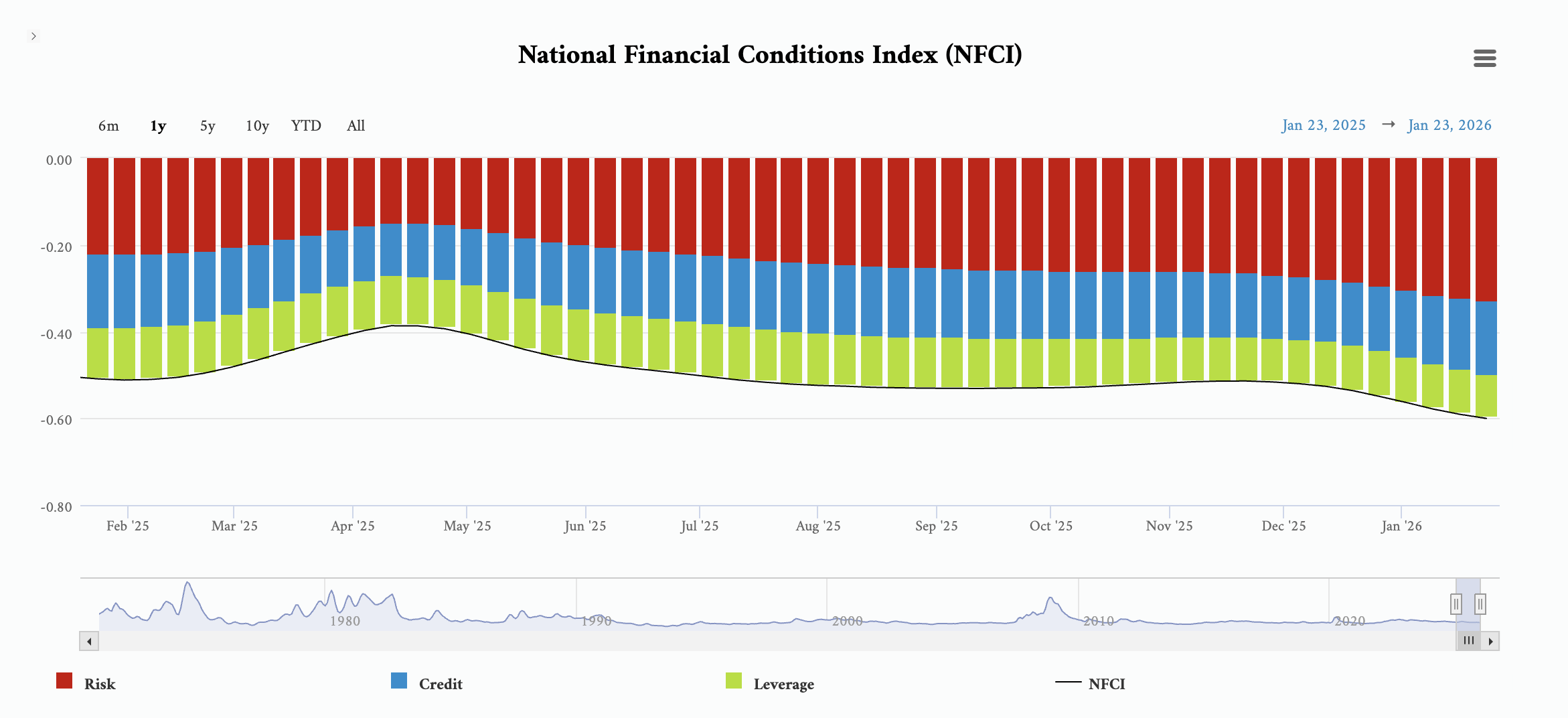
In fact, monetary policy remains loose from a historical standpoint. The Chicago Fed’s Financial Conditions Index was -0.60 as of the week of Jan. 23. A negative number indicates historically loose financial conditions.  Based on the NFCI, financial conditions have become progressively looser since early December.

The FOMC provided little guidance on what might come next. The official statement said, “In considering the extent and timing of additional adjustments to the target range for the federal funds rate, the Committee will carefully assess incoming data, the evolving outlook, and the balance of risks.

It’s pretty clear the FOMC is still trying to walk a tightrope, balancing inflation concerns with the impact of higher rates in an economy dominated by a Debt Black Hole.

I have argued for more than a year that the central bank is in a Catch-22. It simultaneously needs to raise rates to battle persistent inflation and cut rates because this debt-riddled bubble economy can’t function in a normal rate environment.

Powell carefully framed his comments so the Fed could plausibly move in either direction. He insisted “monetary policy is not on a preset course,” and indicated the FOMC will make future decisions on “a meeting-by-meeting basis.

“After the three recent rate cuts, we’re well-positioned to address the risks that we face on both sides of our dual mandate. [We] haven’t made any decisions about future meetings, but the economy is growing a solid pace. The unemployment rate has been broadly stable, and inflation remains somewhat elevated. So, we’ll be looking to our goal variables and letting the data light the way for us.”

If you’ve been watching the employment data carefully, this will concern you. The Bureau of Labor Statistics has consistently revised job numbers downward. By reporting strong job growth and then erasing jobs with revisions down the road, the BLS creates the impression that the labor market is stronger than it is in reality.

When asked about the national debt, Powell conceded that it is on an “unsustainable” path. However, he insisted the current debt level is sustainable. Stubbornly high bond yields and $5,500 gold beg to differ.

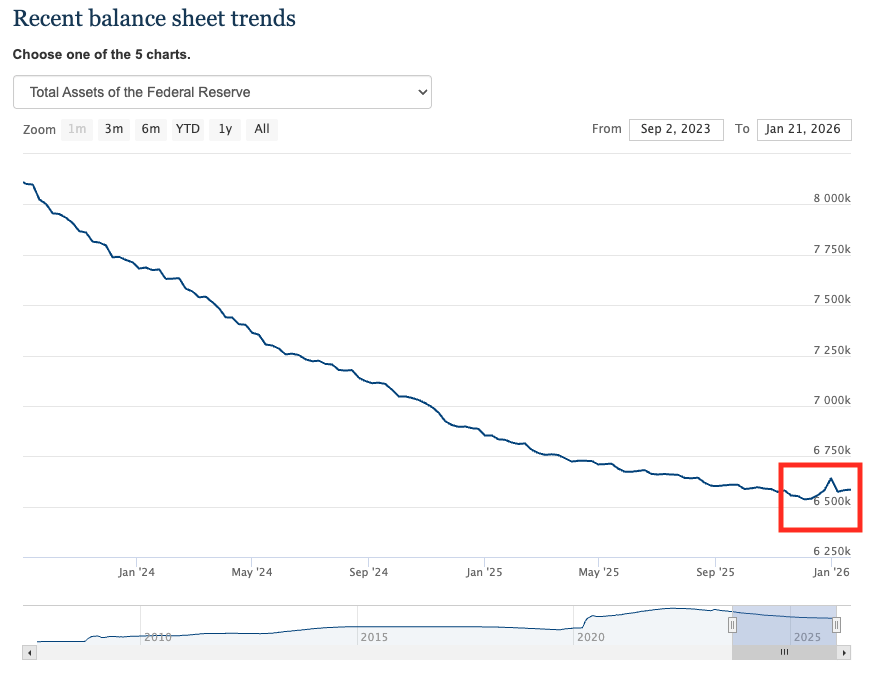
During the December meeting, the Fed announced it would relaunch quantitative easing (although it didn’t use that term). Since then, the Fed’s balance sheet has increased modestly by 48.4 million.

The FOMC statement didn’t address the balance sheet, and it remains unclear whether the central bankers intend to continue QE operations. Last month, the FOMC indicated it would increase the balance sheet by $40 million, and purchases would “remain elevated for a few months” before they are “significantly reduced.

QE operations involve money creation. Expansion of the money supply is, by definition, inflation.

As for the rest of Powell’s presser, CNBC characterized it as “a snoozer,” noting the Fed chair delivered variations on the theme “I have nothing for you on that,” as reporters tried to get him to talk about various political issues swirling around the Fed and his chairmanship.

The markets barely reacted to what was a pretty ho-hum meeting. Stocks closed basically unchanged, while gold and silver continued their relentless climb higher. Typically, this more hawkish Fed messaging would create headwinds for precious metals. This may indicate that the world knows the central bank isn’t in control of the financial system to the extent that they would have you believe.


Mike Maharrey is a journalist and market analyst for Money Metals with over a decade of experience in precious metals. He holds a BS in accounting from the University of Kentucky and a BA in journalism from the University of South Florida.

Surging Gold and Silver Prices Creating Chaos In Chinese Markets

(Mike Maharrey, Money Metals News Service) With demand for gold and silver at a fevered pitch, speculative mania has driven premiums in China to extremely high levels, creating tension in the marketplace.

As Bloomberg reported, the precious metals frenzy created by rapidly rising prices has increasingly exposed Chinese investors to high levels of risk as local prices soar high above international benchmarks.

Gold has surged to over $5,500 an ounce, and silver briefly topped $120 on Thursday (Jan. 29). The Shanghai silver premium has run above $5 an ounce this month, with gold premiums spiking as high as $100.

Bloomberg characterized the appetite for precious metals in China as “insatiable.”

This has created problems.

According to Bloomberg, authorities in the southern city of Shenzhen set up a special task force to oversee the operations of a gold-trading platform. According to a statement from the Luohu district government, investors faced difficulties withdrawing funds from their accounts.

Meanwhile, China’s sole pure-play (silver only) silver fund recently halted trading temporarily and turned away new investors.

Unable to withdraw funds, around 100 investors showed up at the offices of the Shenzhen Jiewo Rui gold-trading platform. Video showed a few people scuffling with police.

According to Bloomberg, the trading platform allows users to lock in future prices by posting as little as 1/40th of the spot price. In effect, the platform offers 40-times leverage. For this scheme to work, Jiewo Rui must hedge against price swings and maintain adequate fund flows, along with maintaining enough gold inventory for delivery. As Bloomberg put it, “With gold prices hitting successive highs, this becomes especially challenging.”

Jiewo Rui reflects the struggles of many small and mid-sized gold trading platforms in China.

Shenzhen is home to the largest physical bullion marketplace in China. Last fall, the local industry association issued a warning, citing a crackdown on three companies unable to make deliveries or release funds.

On Wednesday, the E Fund Gold Theme Fund tried to calm the exuberance by halting new subscriptions.

The Chinese silver market is even tighter. A major seller in the city’s Shuibei market recently defaulted on delivery, leaving more than 350 people waiting for compensation.

The underscores one of the primary dynamics driving the silver market. There simply isn’t enough metal. Silver charted its fifth consecutive structural market deficit in 2025 based on preliminary analysis of the data. The shortfall will likely exacerbate tight supply issues that have precipitated a significant silver squeeze.

The structural market deficit came in at 148.9 million ounces in 2024. That drove the four-year market shortfall to 678 million ounces. Including the projected 2025 shortfall, the market deficit will likely be well over 800 million ounces, an entire year of mining output.

Given the short supply, several Chinese silver funds have halted new subscriptions.

On Wednesday, UBS SDIC Silver Futures Fund LOF took that step. The fund has frequently paused trading and issued warnings almost daily since early December. The fund was running a 36 percent premium over Shanghai Futures Exchange silver contracts, according to data compiled by Bloomberg.

In its latest notice, the company called the premium “unsustainable” and warned investors could face significant losses if the market suddenly turns.

Here in the U.S., many retailers have reported shortages of metal, particularly silver. Here at Money Metals, we have plenty of inventory, and we currently have no order restrictions.


Mike Maharrey is a journalist and market analyst for Money Metals with over a decade of experience in precious metals. He holds a BS in accounting from the University of Kentucky and a BA in journalism from the University of South Florida.

Texas Governor Halts H-1B Visas for State Agencies and Universities

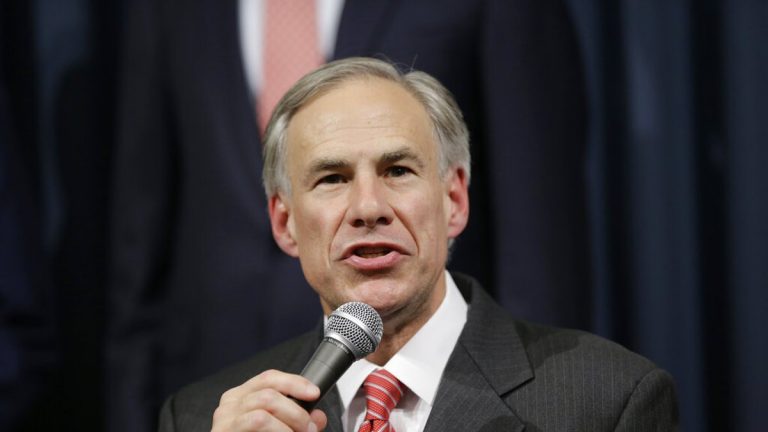
(José Niño, Headline USA) Governor Greg Abbott has ordered an immediate halt on new H-1B visa requests by Texas state agencies and public universities, asserting the federal program has been exploited to replace American workers.

Texas Scorecard reports that Abbott issued a directive Monday declaring that “the economy of Texas should work for the benefit of Texas workers and Texas employers.” He emphasized that the state government must “lead by example” and prioritize Texans for taxpayer-funded positions.

The order prohibits any state agency controlled by gubernatorial appointees or public higher education institutions from initiating new H-1B visa petitions without written authorization from the Texas Workforce Commission. This freeze remains active through May 31, 2027, when the next regular legislative session concludes.

H-1B visas allow American employers to recruit foreign workers for specialty occupations typically requiring bachelor’s degrees in fields including technology, engineering, science, and mathematics. Program advocates claim it addresses domestic skill shortages, though critics contend it replaces American workers while fueling mass migration.

Abbott condemned what he characterized as systematic exploitation of the federal program, which was “created to supplement the United States’ workforce—not to replace it.”

“Evidence suggests that bad actors have exploited this program by failing to make good-faith efforts to recruit qualified U.S. workers before seeking to use foreign labor,” Abbott stated. “In the most egregious schemes, employers have even fired American workers and replaced them with H-1B employees, often at lower wages.”

Rather than attracting exceptional global talent for genuinely specialized positions, Abbott argued the program “has too often been used to fill jobs that otherwise could—and should—have been filled by Texans.”

Last year, Texas approved 7,212 new H-1B visas, ranking second nationally behind California’s 13,000 approvals.

Abbott’s directive mirrors concerns President Donald Trump raised last September, accusing employers of systematic exploitation to replace Americans with cheaper foreign workers. Trump noted foreign STEM workers doubled between 2000 and 2019, while overall STEM employment growth lagged significantly. He cited information technology specifically, where H-1B workers increased from 32 percent in 2003 to over 65 percent recently, even as companies terminated thousands of American employees.

Abbott additionally mandated affected agencies and universities submit comprehensive reports to the Texas Workforce Commission by March 27, 2026, documenting all 2025 H-1B petitions, current sponsorships, worker origins, classifications, visa expirations, and proof that qualified Texas residents received fair application opportunities.

José Niño is the deputy editor of Headline USA. Follow him at x.com/JoseAlNino 

Case Dropped Against Illegal Alien Arrested for Assaulting ICE

(José Niño, Headline USA) A federal judge has dismissed criminal charges against Jose Espinoza-Espinoza, who was accused of assaulting federal officers during an immigration enforcement operation, after prosecutors failed to present any witnesses establishing probable cause for the allegations.

Fox 21 reports that federal agents arrested the 19-year-old Guatemalan national earlier this month, near the Cazadores Mexican restaurant in Virginia, Minnesota. Authorities claimed Espinoza-Espinoza occupied a vehicle they suspected was “transporting illegal aliens.”

The preliminary hearing on Monday, before U.S. Magistrate Judge Leo Brisbois lasted approximately five minutes. In a surprising development, federal prosecutors failed to present any witnesses to establish probable cause for the assault charge, despite having access to multiple agents present during the incident.

Court records indicate the federal government did not present witnesses necessary to demonstrate that the complaint against Espinoza-Espinoza was supported by probable cause. The U.S. Attorney’s Office subsequently moved to dismiss the charges rather than proceed with the hearing.

According to the criminal complaint, prosecutors alleged that when a special agent attempted to open the driver’s side door, Espinoza-Espinoza “rapidly accelerated,” causing multiple injuries and property damage, as the Cloquet Pine Journal reported. The complaint claimed the vehicle’s acceleration injured an agent’s finger and that Espinoza-Espinoza’s car rammed a government Ford Explorer positioned approximately 10 feet ahead, causing damage including a coolant leak.

The New York Times reported this appears to be the first instance of the DOJ backing away from an assault case against a federal agent in Minnesota since Operation Metro Surge began.

Judge Brisbois granted the government’s motion and ordered Espinoza-Espinoza released from custody on the criminal charges. However, KAXE reports it remains unclear whether he continues to be held on immigration violations.

The dismissal is part of a broader pattern emerging from Operation Metro Surge. A Fox 9 investigation found that the majority of people arrested for assaulting or impeding agents during the operation were either never charged or had their cases dismissed.

Charging documents from the now dismissed case claimed Espinoza-Espinoza informed authorities he was born in Guatemala, held Guatemalan citizenship, and was present in the United States illegally.

José Niño is the deputy editor of Headline USA. Follow him at x.com/JoseAlNino 

Gold $5,300 and Silver $115: The Real Signal

(Money Metals News Service) In a recent episode of the Money Metals Midweek Memo, host Mike Maharrey argues that gold near $5,300 and silver around $115 are not just headline prices but warning signals.

These are telltale warning signals of weakening fiat currency, ballooning debt, shifting global confidence in U.S. financial stability, and a mainstream portfolio rotation into precious metals that could intensify the bull market.

A storm, a travel week, and a warning about forecasting

Mike Maharrey had just returned home to the Tampa Bay area after traveling to northern Kentucky for a funeral and getting caught in a major snowstorm.

Even Florida felt cold to him with temperatures in the 30s, but Kentucky was the real test. Forecasts swung between 8 inches and 24 inches before Covington, near Cincinnati, ended up with about 11 inches.

Maharrey uses the forecasting chaos as a metaphor. Weather is hard to predict in real time because small shifts change outcomes, and he argues markets and the economy work the same way.

Bank of America hit $5,000 gold and moved to $6,000

Maharrey points to an October call from Bank of America that raised its 2026 gold forecast to $5,000 an ounce, up from roughly the $4,500 range. He says that as of January 23, gold was already over $5,000, and that morning it was around $5,287.

He adds that silver was at $114. He also says analysts he respected had long argued that once silver cracked $50, it would accelerate, and he believes that is what played out.

With $5,000 already reached, Maharrey says Bank of America increased its projection again and is now calling for $6,000 gold this year. He cites Bank of America analyst Michael Hartnett, who looked at past bull markets and noted an average gain of 300% over 43 months, implying $6,000 by the spring as a rough benchmark.

High prices do not end bull markets

Maharrey leans on comments from Michael Whitmer, Bank of America’s head of metals research. Whitmer argues bull markets do not end simply because prices reach levels that feel high to investors.

Instead, Whitmer says the bull case fades when the fundamentals shift. Maharrey stresses that the current fundamentals are not easing, and he lists de-dollarization, central bank gold buying, inflation pressures, monetary easing, geopolitics, and U.S. debt as forces that remain in place.

Whitmer also frames gold as overbought but still underinvested, meaning ownership is low relative to what portfolios could hold. Maharrey argues that matters more than the headline price, because incremental adoption can move demand sharply in a tight market.

The 60/20/20 portfolio and the under-1% reality

Maharrey says mainstream finance is starting to talk about gold in a way he rarely heard in the past. He cites Morgan Stanley CIO Michael Wilson, who suggested investors consider abandoning the traditional 60/40 portfolio and using a 60/20/20 allocation with 20% in precious metals.

Maharrey calls that idea unprecedented, coming from a major Wall Street voice. He adds that Whitmer said the 60/20/20 concept makes sense and that analysis since 2020 could justify a gold share above 20%, even 30% at the moment.

Then Maharrey delivers what he treats as the key statistic. He says the average western investor holds less than 1% of their portfolio in gold, and even a small shift higher would represent enormous new demand.

Supply constraints and why shuffling metal is not the fix

Maharrey returns to a theme he has stressed on previous shows, which is tight supply in the silver market. He argues the issue is not solved by moving inventory between hubs like New York, London, or China, because the real problem is that there is not enough metal.

He says Whitmer expects supply constraints could also matter more for gold going forward. Whitmer forecasts that 13 major North American gold miners will produce 19.2 million ounces this year, which would be a 2% decline from 2025.

Whitmer also believes many mine output forecasts are too optimistic. Maharrey says gold is a larger market than silver, but he argues that any tightening still adds pressure in a bull market that is already accelerating.

The grocery store mindset and FOMO in metals

Maharrey describes a stop at the grocery store while traveling in Kentucky before the storm hit. He saw familiar panic buying with basics like bread and water disappearing, and he says people tend to prepare only when the threat is right in front of them.

He compares that behavior to what he sees in gold and silver now. As prices rise and attention grows, more people feel fear of missing out and begin acting late instead of preparing early.

Maharrey also suggests it is not only FOMO. He thinks many people intuitively sense that the metals market is signaling something deeper about the financial system.

Stop asking what is driving gold and ask what it means

Maharrey says people keep asking what is driving gold and silver higher, and he runs through the usual list of explanations. He does not deny demand or the common macro factors, but he says the better question is why this is happening now.

To explain the difference, he shares a personal story about experiencing chest palpitations. Because he has an artificial heart valve, he feared it was failing, but it turned out to be stress and anxiety.

His point is that symptoms can have wildly different causes, and the job is to interpret what the symptom is really telling you. He argues the metals surge is a symptom of a larger problem, not just a story about price momentum.

Fiat currency, debt, and the message of $5,000 gold

Maharrey’s diagnosis is direct. He says fiat currency, especially the dollar, is collapsing, and that the system is built on a tower of debt that is becoming unstable.

He clarifies that he does not expect an overnight shift where the U.S. wakes up as Zimbabwe tomorrow. He frames it as a slower breakdown that still matters because it steadily destroys purchasing power.

In that view, gold and silver are not simply “going up.” They are reflecting a declining confidence in paper money and the long-term consequences of debt, deficits, and monetary expansion.

Rick Rule on a bull market that began in 2000

Maharrey references an interview with Rick Rule of Rule Investment Media. Rule argues the gold bull market did not start two years ago, and instead began in 2000 as purchasing power eroded under negative real interest rates and rising government debt.

Rule also argues a bond bear market has been underway since 2000, and Maharrey says the bond side matters as much as gold. He points to persistently high yields as evidence of weak demand for government debt, even when policymakers want rates lower.

Maharrey highlights an example Rule cited involving a Danish pension fund divesting U.S. Treasuries. The fund’s spokesperson said it was rooted in poor U.S. government finances and driven by ever-increasing U.S. debt and decades of overspending, along with a need to rethink liquidity and risk management.

Maharrey frames that as de-dollarization in action. He also mentions renewed talk in Germany about pulling German gold out of New York, arguing these moves reflect international wariness toward U.S. fiscal and policy risk.

The debt math and the inflation tax

Maharrey says the national debt eclipsed $38 trillion last October, and he argues the federal government continues to run large deficits month after month. He also cites Rule’s estimate that the net present value of unfunded entitlement liabilities exceeds $120 trillion, including Medicare, Medicaid, Social Security, and federal pensions.

Rule’s conclusion, as Maharrey presents it, is that the government leans on the inflation tax. Maharrey says this is how obligations get “met” over time, because liabilities are effectively reduced in real terms as the currency weakens.

He stresses that this is why price is the wrong obsession. The deeper issue is value, meaning what the dollar can actually buy.

What Money Metals is seeing right now

Maharrey says many dealers are dealing with inventory shortages, particularly in silver. He says Money Metals still has gold and silver inventory available, but there have been shipping delays and longer phone wait times due to demand.

He says the company has hired over 50+ people since Christmas to keep up. He also mentions a monthly accumulation plan that allows people to start building a position with as little as $100.

He closes with the insurance analogy. You usually cannot buy insurance when the house is already on fire, but he argues that precious metals still offer a window to act even after prices rise, because the underlying issue is purchasing power erosion, not a simple trading move.

Ghislaine Maxwell Cites Dozens of Men in Alleged Epstein ‘Secret Settlements’

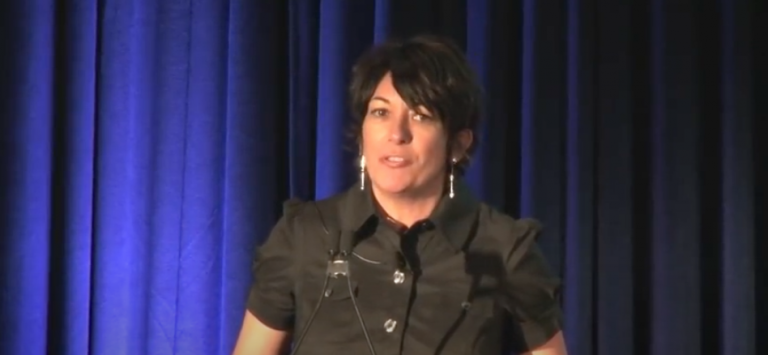
(Luis CornelioHeadline USA) Convicted felon Ghislaine Maxwell claimed in December that at least 25 men with ties to Jeffrey Epstein entered “secret settlements” to serve charges over their alleged role in the late sex offender’s crimes. 

Maxwell made the claim in a petition for a writ of habeas corpus filed on Dec. 17 in the U.S. Southern District of New York, according to Courthouse News. 

She is serving a 20-year sentence for her role in Jeffrey Epstein’s sex-trafficking operation and is seeking to void her conviction. 

Her filing comes amid renewed scrutiny surrounding the pending release of Epstein-related documents. 

The petition references four alleged “co-conspirators” and 25 additional men who were never indicted despite, according to Maxwell, being similarly implicated in the crimes. 

She said the government’s purported failure to charge those individuals showed she was selectively prosecuted. 

In the filing, Maxwell acknowledged that a defendant moving to dismiss for selective prosecution “bears the heavy burden of establishing” that others similarly situated were not prosecuted for the same conduct while she was singled out, and that the government’s decision was discriminatory or made in bad faith. 

“None of the 4 named co-conspirators or the 25 men with secret settlements were indicted,” Maxwell wrote. 

Maxwell claimed the existence of the 25 men emerged through government disclosures and civil litigation materials that were never provided to her defense. 

“New evidence reveals that there were 25 men with which the plaintiff lawyers reached secret settlements – that could equally be considered as coconspirators,” she added. “None of these men have been prosecuted and none has been revealed to Petitioner; she would have called them as witnesses had she known.” 

Maxwell further alleged that her indictment followed Epstein’s 2019 death in federal custody and was driven by political expediency. 

“New evidence reveals the reason why the Petitioner was indicted after having not been named and included in any of the earlier criminal indictments against Epstein or the Palm Beach Police Investigation, simply put it was for expediency and purely political motives following the death of Jeffrey Epstein in the care custody and control of the US Government,” she claimed. 

New Video Challenges ‘Peaceful’ Narrative Around Man Killed by ICE

(Luis CornelioHeadline USA) Alex Pretti, the 37-year-old man recently fatally shot by ICE, appears to have been captured in newly surfaced video showing a violent confrontation with federal agents just 11 days before his death. 

The footage, released by The News Movement on Wednesday but recorded on Jan. 13, shows a man, whom the outlet said “appears to be” Pretti, shouting at a federal vehicle, kicking and breaking its taillights and then being taken to the ground by multiple agents. Why he wasn’t arrested is unclear.

As seen in the video, federal agents subsequently fired gas and pepper balls toward a crowd of anti-ICE agitators. Despite the confrontation, the individual believed to be Pretti was ultimately allowed to walk free. 

According to The News Movement, the man appeared to have a firearm in his waistband and was wearing clothing similar to what Pretti wore on the day of his death, Jan. 24. 

The outlet said the footage was reviewed by the BBC, which confirmed the individual’s identity with a reported 97% degree of accuracy. 

The video appears to directly contradict statements from Pretti’s family members and friends, who have repeatedly described him as a peaceful ICU nurse.

CNN reported on a similar development Tuesday, though key details differed about Pretti’s previous ICE encounter. An unnamed source told CNN that Pretti confronted ICE last week after he saw officers “chasing what he described as a family on foot.” Pretti began shouting and blowing his whistle, an anonymous source told CNN.

“Pretti later told the source that five agents tackled him and one leaned on his back—an encounter that left him with a broken rib. The agents quickly released him at the scene,” CNN reported.

CNN also reported that ICE has been collecting the personal information of agitators and protesters who they encounter.

“Pretti’s name was known to federal agents, according to a source—though it’s unclear whether the new intake form was used to share his information,” CNN reported.

“It’s also not clear whether the federal agents who encountered Pretti on Saturday recognized him before they confronted him—eventually wrestling him to the ground, taking a gun from his waistband and then fatally shooting him.”

Pretti was fatally shot on Sunday by two Border Patrol agents after a confrontation erupted while he was recording what DHS said was a targeted federal operation. 

Video from Jan. 24 showed agents attempting to detain Pretti, followed by a physical struggle as he resisted arrest, before one officer was heard saying, “He’s got a gun.” Pretti was seemingly disarmed before he was shot.

Pretti was the second individual fatally shot by federal agents following President Donald Trump’s deployment of ICE to Minnesota as part of a crackdown on illegal immigration. 

The first was anti-ICE agitator Renee Good, who was fatally shot on Jan. 7 after she struck ICE agent Jonathan Ross with her vehicle. 

Man Who Sprayed Ilhan Omar Foreshadowed His Attack

(Headline USA) The man accused of squirting an unknown substance on Democratic U.S. Rep. Ilhan Omar at a town hall in Minneapolis has a criminal history.

Anthony Kazmierczak, 55, was convicted of felony auto theft in 1989, has been arrested multiple times for driving under the influence and has had numerous traffic citations, Minnesota court records show. There are also indications he has had significant financial problems, including two bankruptcy filings.

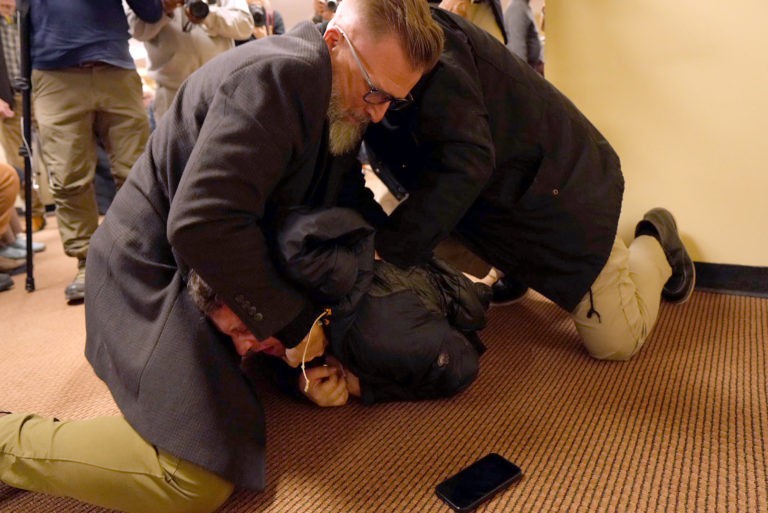
Police say Kazmierczak used a syringe to squirt liquid on Omar during Tuesday’s event after she called for the abolishment of U.S. Immigration and Customs Enforcement and the firing or impeachment of Homeland Security Secretary Kristi Noem following the fatal shootings of Renee Good and Alex Pretti. Officers immediately tackled and arrested Kazmierczak, who was jailed on a preliminary third-degree assault charge, police spokesperson Trevor Folke said.

Photos of the syringe, which fell when the man was tackled, show what appears to be a light-brown liquid inside. Authorities haven’t publicly identified the substance.

After the attack, there was a strong, vinegarlike smell in the room, according to an Associated Press journalist who was there. Forensic scientists were called in, but none of the roughly 100 people who were there had a noticeable physical reaction to the substance.

Omar continued speaking for about 25 minutes after Kazmierczak was ushered out, saying she wouldn’t be intimidated. While leaving, she said that she felt a little flustered but wasn’t hurt and that she was going to be screened by a medical team.

She later posted on X: “I’m ok. I’m a survivor so this small agitator isn’t going to intimidate me from doing my work. I don’t let bullies win.”

Kazmierczak hadn’t been formally charged or scheduled for an initial court appearance as of Wednesday morning. The Hennepin County Attorney’s Office has until Thursday to charge him but could seek an extension. A spokesperson for the prosecutor’s office didn’t immediately return a call seeking further information.

It’s unclear if Kazmierczak has a lawyer who could speak on his behalf. The county’s chief public defender, Michael Berger, said the case hasn’t been assigned to his office.

A neighbor told the New York Post that Kazmierczak said he was going to Omar’s town hall and “I might get arrested.”

In social media posts, Kazmierczak described himself as a former network engineer who lives in Minneapolis. Among other things, he made comments critical of former President Joe Biden, a Democrat, and referred to Democrats as “angry and liars.”

Following the fatal shooting of conservative activist Charlie Kirk in September, Kazmierczak for a time changed his profile picture on Facebook to an AP photo of Trump embracing Kirk’s widow, Erika Kirk.

The attack came days after a man was arrested in Utah for allegedly punching U.S. Rep. Maxwell Frost, a Democrat from Florida, in the face at a bar during the Sundance Film Festival.

Christian Joel Young, 28, said “we are going to deport your kind” before striking the congressman, according to a probable cause affidavit. Young also said something similar to a woman and pushed her, the affidavit said. He was charged Tuesday in state court with two counts of misdemeanor assault and felony burglary for entering the bar illegally.

A judge ordered him held without bail. Young’s attorney declined to comment.

Threats against members of Congress have increased in recent years, peaking in 2021 following the Jan. 6 attack on the U.S. Capitol before dipping slightly only to climb again, according to the most recent figures from the U.S. Capitol Police.

Following Tuesday’s attack on Omar, U.S. Capitol Police said in a statement that the agency was “working with our federal partners to see this man faces the most serious charges possible to deter this kind of violence in our society.”

Lawmakers have discussed the impact of the threatening political climate on their ability to hold town halls and public events, with some even citing it in their decisions not to seek reelection.

Adapted from reporting by the Associated Press


DHS: Agents Linked to Death of Pretti Placed on Leave

(Elyse S. Apel, The Center Square) ​​Two federal agents accused of firing the shots in Saturday’s death of Alex Pretti in Minnesota are on administrative leave.

The Department of Homeland Security confirmed that and told TCS it is “standard protocol.”

In the wake of the shooting of Renee Good by a U.S. Immigration and Customs Enforcement officer earlier this month, Homeland Security Secretary Kristi Noem explained that a three-day administrative leave is what is directed by protocol.

“We are following the exact same investigative and review process that we always have under ICE and under the Department of Homeland Security and within the administration,” Noem said in a network interview. “The protocol and the advice and the guidance within that handbook and within our policies is being followed exactly like it has been for years.”

It is unclear when the agents involved in the Pretti shooting were put on leave. 

On Sunday, Border Patrol official Gregory Bovino told reporters the agents were still working – just on a different assignment than in the Twin Cities.

“All agents that were involved in that scene are working, not in Minneapolis, but in other locations,” Bovino said. “That’s for their safety. There’s this thing called doxxing, and the safety of our employees is very important to us. We’re going to keep those employees safe.”

It is unclear why there is a discrepancy between Bovino’s weekend announcement and the standard protocol followed by the department.

According to published reports, Bovino will soon be leaving Minneapolis to  resume his former post as chief of U.S. Customs and Border Protection’s El Centro Sector.