Missouri School District Reinstates Spanking If Parents OK

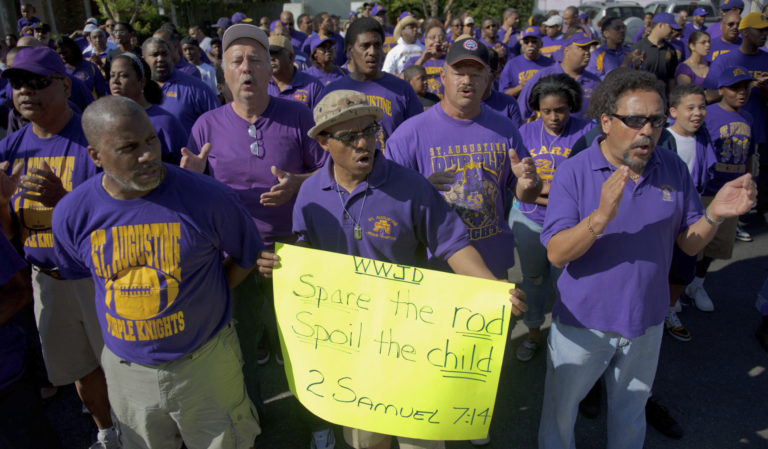
(Headline USA) A school district in southwest Missouri decided to bring back spanking as a form of discipline for students—if their parents agree.

Classes resumed Tuesday in the Cassville School District district for the first time since the school board in June approved bringing corporal punishment back to the 1,900-student district about 60 miles southwest of Springfield. The district had dropped the practice in 2001.

The policy states that corporal punishment will be used only when other forms of discipline, such as suspensions, have failed and then only with the superintendent’s permission.

Superintendent Merlyn Johnson told the Springfield News–Leader the decision came after an anonymous survey found that parents, students and school employees were concerned about student behavior and discipline.

“We’ve had people actually thank us for it,” he said. “Surprisingly, those on social media would probably be appalled to hear us say these things, but the majority of people that I’ve run into have been supportive.”

Parent Khristina Harkey told the Associated Press on Friday that she is on the fence about Cassville’s policy.

She and her husband did not opt-in because her 6-year-old son, Anakin Modine, is autistic and would hit back if he were spanked. But she said corporal punishment worked for her when she was a “troublemaker” during her school years in California.

“There are all different types of kids,” Harkey said. “Some people need a good butt-whipping. I was one of them.”

The U.S. Supreme Court ruled in 1977 that corporal punishment is constitutional and left it up to states to set their own policies. Craven said 19 states, many in the South, have laws allowing it in schools. The most current data from 2017-18 shows about 70,000 children in the U.S. were hit at least once in their schools.

Students who are hit at school do not fare as well academically as their peers and suffer physical and psychological trauma, said Morgan Craven, national director of policy, advocacy and community engagement with the Intercultural Development Research Association, a national educational equity nonprofit.

“If you have a situation where a kid goes to school and they could be slapped for, you know, some minor offense, it certainly creates a really hostile, unpredictable and violent environment,” Craven said. “And that’s not what we want for kids in schools.”

But Tess Walters, 54, the guardian of her 8-year-old granddaughter, had no qualms about signing the corporal punishment opt-in papers. She said the possibility of being spanked is a deterrent for her granddaughter, who has attention-deficit/hyperactivity disorder.

“I’ve read some some people’s responses on Facebook recently, and they’re just going over the top like, ‘Oh, this is abuse, and, oh, you’re just going to threaten them with, you know, violence.’ And I’m like, ‘What? The child is getting spanked once; it’s not beatings.’ People are just going crazy. They’re just being ridiculous,” Walters said.

Mitch Prinstein, chief science officer with American Psychological Association, said better methods for eliminating undesirable conduct include problem-solving training; rewarding positive behavior, such as with extra recess; and providing extra attention in the classroom.

“Parents are experts on what works for their own children,” Prinstein said. “But it’s important for parents to be educated on very substantial science literature demonstrating again that corporal punishment is not a consistently effective way of changing undesirable behavior.”

Cassville School District spokeswoman Mindi Artherton was out of the office Friday and a woman who answered the phone in her office suggested reading the policy. She said staff had already done interviews. “At this time, we will focus on educating our students,” she added, before hanging up.

The policy says a witness from the district must be present and that the discipline will not be used in front of other students.

“When it becomes necessary to use corporal punishment, it shall be administered so that there can be no chance of bodily injury or harm,” the policy says. “Striking a student on the head or face is not permitted.”

In Missouri, periodic efforts to ban corporal punishment in schools have failed to gain traction in the Legislature.

The state does not track which districts allow spanking because those decisions are made at the local level, a spokeswoman for Missouri’s K-12 education department said.

U.S. Sen. Christopher Murphy, D-Conn., is pushing for a ban on the use of corporal punishment in schools that receive federal funding. He has called it a “barbaric practice” that allows teachers and administrators to physically abuse students.

Adapted from reporting by the Associated Press
Emails Prove UW’s Puberty Blocker Claim Was False

(Headline USA) Emails between University of Washington researchers and the Seattle Children’s Hospital show they knew a study they published about about the positive effects of so-called “gender-affirming care” was wrong, but they refused to correct the record due to the positive media coverage the study received.

Shortly after independent journalist Jesse Singal published a blistering review of the study, which claimed access to puberty blockers led to better mental health outcomes in transgender youth, University of Washington and Seattle Children’s Hospital leaders pondered whether they ought to acknowledge the problems with the study that Singal had found, according to Fox News.

“As there is an overwhelming amount of positive coverage of the study’s findings, I don’t believe there’s a need for a proactive response beyond continuing to monitor, but welcome your ideas for any other actions or messaging with the study team,” an email from UW Department of Epidemiology spokesperson Laura East reads.

East admitted that Singal’s criticism raised “concerning claims,” but added she didn’t want UW to “drive traffic” to the piece.

“The article resulting from the inquiry was recently posted on the author’s Substack, and includes some pretty concerning claims. UW Epidemiology/UW SPH/UW News will not be including this article in our media tracking/or otherwise driving traffic to this piece,” she wrote.

UW Medicine communications manager Barbara Clement agreed with East that they should just ignore the criticism.

“FYI, I read through his exceedingly long (very, very long) article, which claimed the research was flawed or, at worst, made up, but given the extremely positive pick up by mainstream media, I would agree and just let this be,” she wrote.

One of the authors of the study, UW Medicine Dr. Kym Ahrens, who also works at UW, said, “If it gives too much attention to clarify at all, I am also very open to not responding.”

Gov’t Pushes Media, Big Tech to be Consistent w/ Inconsistent COVID Claims

(Chris Parker, Headline USA) Federal officials and mainstream media outlets are pressuring Big Tech to continue censoring COVID information and maintain a consistent narrative.

That pressure is ramping up despite inconsistent data driving drastic changes to official policies, reported Just the News.

The Centers for Disease Control and Prevention recently announced an agency-wide overhaul after its reputation was “battered by a series of missteps in the Covid-19 pandemic and a slow response to the monkeypox outbreak.” It also also struggled with “confusing messaging” on how to isolation times and procedures.

“For 75 years, CDC and public health have been preparing for Covid-19, and in our big moment, our performance did not reliably meet expectations,” agency chief Rochelle Walensky said in the email sent to the agency’s employees. “

My goal is a new, public health action-oriented culture at CDC that emphasizes accountability, collaboration, communication, and timeliness.”

Despite the fumbling COVID narrative, Twitter has still been rebuked for censoring and suspending the “wrong” people. Those who agree with the narrative have been confused with those who don’t as Twitter’s algorithms struggle to keep up with the constant changes.

“We’re always working to improve the safety of our service and ensuring we provide avenues of recourse when we get it wrong through our appeals processes,” Twitter spokesperson Celeste Carswell said.

“We acknowledge the mistakes made in these cases, and we are reviewing our team’s protocol to safeguard against such mistakes in the future.”

However, those critical of the narrative have also been censored for publishing fact-based, peer-reviewed posts. Dr. Clare Craig, a diagnostic pathologist, was one such user after she exposed – using science – how Pfizer used the facts surrounding its vaccine to gain approval for children.

“There’s an awful lot about this trial that has shocked me,” she said in a video posted to Twitter. “The trial recruited 4,526 children aged from six months to four years old; 3,000 of these children did not make it to the end of the trial. That was a huge number, two-thirds of them.”

Her account was suspended for discussing that fact and stating that it should’ve rendered the trail “null and void.” It has since been restored. YouTube also suspended her channel.

Alex Berenson, a former New York Times journalist, also believes his account was suspended after the feds pressured Twitter to ban him. His account has also since been restored as part of a lawsuit. Berenson frequently questioned the official COVID narrative in his Tweets.

Twitter may also be caving to powers outside of the US. Ahmad Abouammo, a dual US-Lebanese who worked as a manager at Twitter, was fired and convicted of working as a spy for Saudi Arabia.

Twitter has also refused to disclose the actual number of bots on the platform, which have the potential to pose a security threat.

Heavily Redacted Affidavit Offers Few Clues into FBI’s Raid Justification

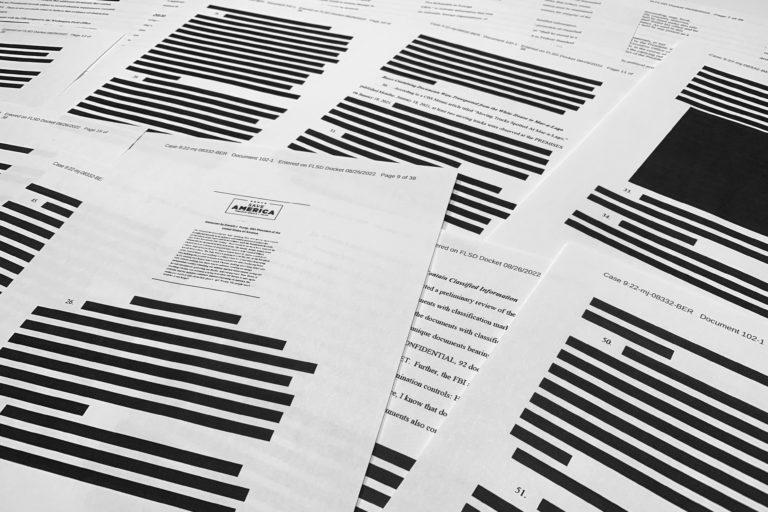
(Headline USA) The heavily redacted affidavit from an FBI special agent that was cited as “probably cause” for the bureau’s controversial raid on former President Donald Trump’s Florida estate, Mar-a-Lago, did little to illuminate any actual evidence it had that Trump had committed a crime.

The FBI has come under sharp criticism for the raid—which even the biased magistrate who authorized it, Judge Bruce Reinhart, has acknowledged was an “unprecedented” step.

Reinhart, who was exposed for making derogatory attacks on Trump via his own social media, sought to defuse the public outrage by mandating that the Justice Department release the redacted version of the affidavit by noon on Friday.

However, the 32-page document is unlikely to placate critics, who still have many unanswered concerns and questions amid suspicions that the politicized law-enforcement agency is pressing its case to wage partisan lawfare against Trump that it can use as fodder in the upcoming 2022 and 2024 elections.

“The government is conducting a criminal investigation concerning the improper removal and storage of classified information in unauthorized spaces, as well as the unlawful concealment or removal of government records,” an FBI agent wrote on the first page of the affidavit in seeking a judge’s permission for a warrant to search the property.

It went on to claim that 14 of the 15 boxes recovered from Mar-a-Lago early this year contained documents with classification markings, including at the top secret level.

Trump has argued that as president he had the authority to declassify these at his discretion—and depending on the contents of those specific documents, may have publicly announced his intention to do so.

Rumors and speculation abound that the FBI may be seeking documents related to its own role in the Russia-collusion hoax, all of which Trump said he intended to declassify in the final days of his term.

The affidavit does not provide new details about the 11 sets of classified records recovered during the Aug. 8 search at Mar-a-Lago but instead concerns a separate batch of 15 boxes that the National Archives and Records Administration retrieved from the home in January.

In those boxes, according to the affidavit, officials located 184 documents bearing classification markings, including 25 documents marked as top secret. Agents who inspected the boxes found markings related to information provided by confidential human sources as well as information related to the Foreign Intelligence Surveillance Act.

In a separate document unsealed Friday, Justice Department officials explained that it was necessary to redact some information to “protect the safety and privacy of a significant number of civilian witnesses, in addition to law enforcement personnel, as well as to protect the integrity of the ongoing investigation.”

Documents previously made public show the FBI retrieved from the property 11 sets of classified documents, including information marked at the top secret level.

They also show that federal agents are investigating potential violations of three federal laws, including one that governs gathering, transmitting or losing defense information under the Espionage Act.

The other statutes address the concealment, mutilation or removal of records and the destruction, alteration or falsification of records in federal investigations.

None of the charges require that the FBI prove the classification status of the documents, despite its having used that as its probable cause for the raid.

It’s possible that the affidavit, particularly in its unredacted form, could shed light on key unanswered questions, including why sensitive presidential documents were transported to Mar-a-Lago after Trump left the White House and why Trump and his representatives did not supply the entire tranche of material to the National Archives and Records Administration despite repeated entreaties.

It could also offer additional details on the back-and-forth between Trump and the FBI, including a subpoena for documents that was issued last spring, as well as a June visit by FBI and Justice Department officials to assess how the materials were being stored.

In an acknowledgment of the extraordinary public interest in the investigation, Reinhart on Thursday ordered the department by Friday to make public a redacted version of the affidavit. The directive came hours after federal law enforcement officials submitted under seal the portions of the affidavit that they wanted to keep secret as their investigation moves forward.

In his order Thursday, Reinhart said the department had made compelling arguments to leave sealed broad swaths of the document that, if disclosed, would reveal grand jury information; the identities of witnesses and “uncharged parties”; and details about the investigation’s “strategy, direction, scope, sources and methods.”

But he also said he was satisfied “that the Government has met its burden of showing that its proposed redactions are narrowly tailored to serve the Government’s legitimate interest in the integrity of the ongoing investigation and are the least onerous alternative to sealing the entire Affidavit.”

Adapted from reporting by the Associated Press
Virtue-Signaling Blue States Renege on Pledges to Divest from Russia

(Headline USA) Driven by moral outrage over Russia’s invasion of Ukraine earlier this year, U.S. governors and other top state officials made it clear: They wanted to cut their financial ties with Russia.

A few states quickly followed through. Idaho sold $300,000 of bonds in a Russian oil company in early March. A day before the invasion, the Kentucky Teachers Retirement System sold its shares in the Russian bank Sberbank.

But those examples are outliers, with a bulk of leftist-run blue states failing to keep their promises. Most of the pledges to drop Russian investments — some made with great fanfare during news conferences — have gone unfulfilled, according to an Associated Press review, state retirement administrators and firms that invest state funds.

Swift global reaction has cut off much of Russia’s economy from the rest of the world. That has made it nearly impossible for divestment by state pension funds, university endowments and other public-sector holdings — as well as private investments such as those in 401(k) accounts.

“These pension funds want to get out, but it’s just not realistic to sell everything in the current environment,” said Keith Brainard, research director at the National Association of State Retirement Administrators.

Benjamin Smith, a spokesperson for the Rhode Island treasury, said the factors that make it hard to divest also show that a worldwide effort to isolate Russian President Vladimir Putin is working.

“This is good news because it means that pressure from investors across the world, including Rhode Island, is succeeding in exacting a toll on the Russian economy, making it more difficult for Putin to fund his military operation, state-owned companies, and corrupt network of oligarchs,” he said in an email, noting that Rhode Island’s pension plan exposure in Russia never exceeded 0.3% of its assets.

Any pre-war investments in Russia are now worthless, or nearly so. That’s raising questions from some officials and fund managers about whether divesting is even necessary.

In Hawaii, one of a handful of states where top administration officials did not pledge to divest, Gov. David Ige said at a May 5 news conference that the state’s employee pension system had “very little to almost nothing” invested in Russia.

“The few remaining investments are quite small, and so I didn’t feel compelled to just make a statement for political reasons that we would be divesting,” he said.

Before Russia’s invasion in late February, many government-controlled investments had only small holdings—a fraction of 1% in every reported case—in Russian investments. But even that could amount to millions of dollars.

The largest U.S. public-sector retirement fund, California’s CalPERS, said just 17 cents of every $100 of its portfolio was in Russian investments as the war broke out. Even so, that translated into $765 million worth of stocks, real estate and private equity.

By the end of June, the value had shrunk to $194 million. The entire loss was because the holdings dropped in value; none had been sold.

There is no way to know how much state government entities in the U.S. have invested in Russia or companies based there, but collectively they were worth billions of dollars before the war. Much of the money was invested in Russian government bonds, oil and coal companies as part of emerging-markets index funds.

Quick to condemn the invasion, state officials said they could put pressure on Putin by dumping their Russian investments.

“Our moral imperative before these atrocities demand that you act to address Russia’s aggressions and immediately restrict Russian access to California’s capital and investments,” California Gov. Gavin Newsom wrote in a letter Feb. 28 to the boards overseeing the massive pension funds that serve teachers, state and local government workers and university employees.

Across the country, governors and other top officials made similar statements.

Just after the invasion began, New York Gov. Kathy Hochul signed an executive order calling for divestment “to the extent possible,” while Arizona’s Board of Regents voted to exit any Russian investments.

The treasurers for 36 states plus the District of Columbia and U.S. Virgin Islands signed a joint letter in March advocating divestment of publicly controlled funds from Russia. They noted a financial reason for doing so: “The current crisis also constitutes a substantial risk for states’ investments and our economic security.”

A major chunk of the government holdings in Russia are in the form of index funds that investors use to mimic overall stock market performance. Russian stocks were commonly part of funds specializing in emerging markets. MCSI and other firms that decide which stocks should be in the funds quickly dropped Russian securities.

But the companies that sell investment products based on those indexes were left in the lurch, still leaving pieces of Russian stocks in their investors’ portfolios.

As part of the sanctions, stock markets in the U.S. and elsewhere stopped the trading of Russian stocks. And the Moscow Stock Exchange was closed for nearly a month, reopening with tight controls that keep U.S. investors from selling.

The assets sank in value amid the invasion, though the precise value isn’t always clear.

Maryland said that as of the beginning of February, $197 million of its state retirement and pension system funds were invested in Russian assets. A month later, the state estimated the value had plunged and amounted to just $32 million. The state has been unable to unload its investments.

For the handful of states in which top officials have not endorsed divestment, eroding values like that are a main reason.

Shortly after the invasion, South Carolina Gov. Henry McMaster said the amount of state investments in Russia was “miniscule” and noted that the value was about to “shrink to almost nothing as the Russian economy is being virtually shut off from the world.”

In Florida, Lamar Taylor, the interim executive director of the agency that oversees investments of pension funds, said during a cabinet meeting that some investment managers might seek to unload Russian assets as soon as they’re able, while others could hold on in case they’re worth more later.

At the meeting, Gov. Ron DeSantis said the State Board of Administration has a legal responsibility to try to make money for the retirement system.

“That would violate your fiduciary duty, if you liquidated at massive losses for political reasons rather than for the best interests of the beneficiaries,” he said.

But DeSantis said there was a way to make it easier: Lawmakers passing a bill banning investment in Russia.

“If the Legislature could speak clearly, that would be something we’d welcome here, just to make sure we’re not furthering investments in parts of the world that are not reflective of our interests or values,” he said.

Hank Kim, executive director of the National Conference on Public Employee Retirement Systems, said he has told member pension funds that taking steps to divest is important even if it can’t be completed right away.

“The public has a right to know that it was debated in a serious manner,” he said.

Adapted from reporting by the Associated Press
White House Stumped by Legal Paradox on Biden’s Pandemic Fiats

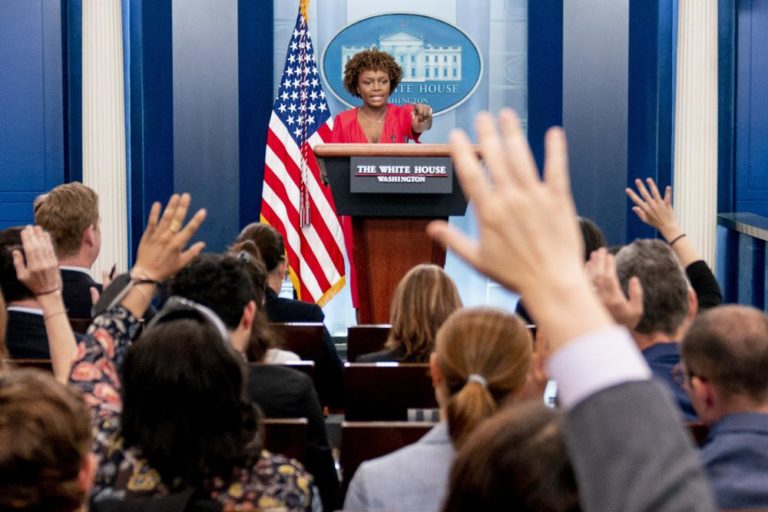
(Tony Sifert, Headline USA) White House press secretary Karine Jean-Pierre stumbled through another press briefing Thursday as reporters peppered her with questions about President Joe Biden’s decision to cancel $10,000 in student loan debt, according to the Western Journal.

Fox News White House Correspondent Jacqui Heinrich asked Jean-Pierre how the Biden administration could justify appealing to the COVID pandemic as a “national emergency” warranting debt forgiveness when it has recently argued in court that strict border controls are no longer necessary because the pandemic is over.

“The HEROES Act hinges on student debt cancelation being tied to the pandemic and that being a national emergency, but the administration argued in court that the pandemic is over at the southern border to lift Title 42,” Heinrich said.

“How is COVID a national emergency when it comes to student debt?”

Jean-Pierre’s totally unresponsive response was as incoherent as White House reporters have come to expect — she slogged her way through a laundry list of sympathy-inspiring beneficiaries (including nurses and first responders) and argued that the system was in need of reform.

“It’s a very good question,” Jean-Pierre said. “Look we used The Heroes Act because there are going to be some people, when we lift the pause, who are still going to have a little bit of a hard time, and so that’s one of the reasons that we made this decision.”

Jean-Pierre has elsewhere claimed that the administration is “confident” in legal authority the president claimed he did not have as recently as 2021.

Heinrich pointed out another contradiction in the regime’s rhetoric: the White House has repeatedly insisted that the American economy is doing better than ever (even changing the definition of “recession” to bring the argument home), but then claims that the situation is so desperate that student debt must be forgiven.

Jean-Pierre again had no answer, except to say that “some folks” still need assistance.

Megyn Kelly Drops F-Bomb over Fauci Dodging Subpoenas

Editor’s note: Video contains profanity.

(Jacob Bruns, Headline USA) Former Fox News host Megyn Kelly appeared to go off script on a recent podcost episode of “The Megyn Kelly Show,” dropping an f-bomb while ranting about COVID Czar Anthony Fauci.

Fauci, the director of the National Institute of Allergy and Infectious Diseases, this week announced that he would resign from his current position in December—a move that is widely considered his effort to pre-empt investigation from a Republican controlled Congress.

In a recent interview with CNN, he suggested that if he were summoned to testify in Congress via subpoena, he would exercise his personal discretion on whether to attend, the Daily Caller reported.

“I certainly would consider that,” he said.

“I believe oversight is a very important part of government structure, and I welcome it, and it can be productive,” he continued. “But what has happened up to now, is more of a character assassination than it is oversight.”

After being criticized for having flip-flopped regularly on his pandemic mandates and having covered up his own role in funding the research conducted at the Wuhan Institute of Virology that likely caused the pandemic, Fauci has used prior appearances before Congress to spread misinformation and falsehoods, as well as to wage partisan attacks on his Republican critics.

Kelly lambasted Fauci for his presumption and belief that he could simply ignore the congressional summons if he wished.

“He sounds like he’s been invited to afternoon tea at one of our houses,” Kelly said.

“I will consider it. I’ll consider it,” she continued. “Only if it’s oversight, because what I experienced was personal attacks.”

Kelly then launched a full-fledged attack on the public health official.

“F*** you, Dr. Fauci!” she said. “You don’t get to say whether you go. You get a congressional subpoena, you show up, or you get the Steve Bannon treatment,” referring to Bannon’s refusal to obey to the Jan. 6 committee’s show-trial subpoena.

Bannon has since been convicted on two counts of contempt of Congress, and is set to face trial on Oct. 21.

Republicans, including two powerful Kentucky lawmakers—Rep. James Comer, the top-ranked GOP member of the House Oversight Committee, and Sen. Rand Paul, Fauci’s top Senate nemesis due to his background as a medical doctor—have announced their intention to investigate Fauci regardless of his retirement.

Ex-NYC Mayor de Blasio to Teach Classes at Harvard this Fall

(Headline USA) Former New York City Mayor Bill de Blasio revealed this week that he will be teaching classes on politics at Harvard University in the fall.

De Blasio is joining the Institute of Politics at Harvard Kennedy School, and will be teaching various discussions, events and programming throughout the semester, he said. He will not be a full-time employee.

“I am happy to join the IOP to help inspire our nation’s next generation of leaders to find ways to serve in politics and public service, and to build a government that serves working people,” he said in a statement.

The former mayor added he is “VERY optimistic about the generation of leaders and activists coming up.”

Harvard’s IOP interim director Setti Warren claimed de Blasio’s “decades of experience in local government, federal agencies, national campaigns, and running the largest city in the country will provide invaluable insight to our students and the Harvard community.”

“We are excited to welcome Mayor de Blasio to campus as we look for pathways forward on the challenges facing our democracy,” Warren added.

The new job follows de Blasio’s humiliating congressional loss. He launched a bid for New York’s 10th congressional district earlier this year, but dropped out of the race after realizing “it’s not going to work out.”

“I’ve really listened carefully to people and it’s clear to me that when it comes to this congressional district, people are looking for another option. And I respect that,” he said last month.

FBI Whistleblower Says Investigation of Hunter’s Laptop Delayed until after 2020 Election

(Headline USA) A new FBI whistleblower accused the agency of deliberately slow-walking its investigation into Hunter Biden’s abandoned laptop, according to Sen. Ron Johnson, R-Wisc.

Johnson sent a letter to Justice Department Inspector General Michael Horowitz this week detailing the new whistleblower claims, following a similar disclosure made public last month about FBI leadership deliberately labeling evidence against Hunter Biden as “disinformation.”

“Whistleblowers have recently contacted my office to share serious concerns about the FBI’s handling of Hunter Biden’s laptop,” Johnson told Horowitz, telling the watchdog that local FBI leadership told agents not to “look at that Hunter Biden laptop” after the agency obtained it from a Delaware computer repair shop in 2019.

FBI leaders allegedly said they were “not going to change the outcome of the election again” by investigating Hunter Biden during a presidential election cycle, Johnson said.

As a result, the FBI “did not begin to examine the contents of Hunter Biden’s laptop until after the 2020 presidential election — potentially a year after the FBI obtained the laptop in Dec. 2019,” Johnson added.

These new revelations should prompt an immediate investigation into the FBI’s handling of this case, Johnson argued.

“It is clear to me based on numerous credible whistleblower disclosures that the FBI cannot be trusted with the handling of Hunter Biden’s laptop,” he wrote.

“I call on you to immediately investigate the FBI’s handling of Hunter Biden’s laptop and begin by obtaining the history of the investigative actions taken by the FBI on Hunter Biden’s laptop which should be available on the FBI’s case management system, Sentinel.”

Another whistleblower report provided to Sen. Chuck Grassley’s, R-Iowa, office revealed FBI leaders deliberately labeled information about Hunter Biden’s alleged criminal activity as “misinformation.”

FBI Director Christopher Wray admitted during a congressional hearing that he found the allegations “deeply troubling,” but refused to say whether he would take action to hold those responsible accountable.

Entitled Borrowers Gripe that Biden’s Loan Bailouts Don’t Go Far Enough

(Tony Sifert, Headline USA) Entitled leftists duped by colleges into spending more than $100,000 on worthless degrees are complaining that President Joe Biden’s unconstitutional plan to transfer $10,000 in student loan debt from borrowers U.S. taxpayers to isn’t doing enough to help American minorities, according to a report from The Hill.

Cheyanne Daniels, The Hill‘s “Race & Politics” reporter, drew her readers’ attention to the plight of Chicago native James Alford, who borrowed $120,000 to minor in “Black studies” before getting a master’s degree in adult education.

Alford hasn’t yet been able to secure a job and, following the NAACP’s lead, complained that Democrats need to do more for blacks.

“It’s cool, but it really doesn’t mean anything,” said Alford. “I feel like there were promises for more, and I feel like more could be done to ease the burden on people of color and first generation students.”

Alford’s sentiments echoed those of NAACP President Derrick Johnson, who took to Twitter to castigate Biden for leaving blacks behind.

“This is not how you treat Black voters who turned out in record numbers and provided 90% of their vote to once again save democracy in 2020,” Johnson wrote.

Perhaps these activists should have paid attention when 2020 presidential candidate Sen. Elizabeth Warren, D-Mass., turned up her nose at the plight of a blue-collar father who took extra shifts at work in order to pay for his daughter’s college tuition.

For politicians like Biden and Warren, the American working and middle classes exist to fund the Democratic party’s political program and the interns needed to staff it, and only an American underclass increasingly divided by race can fail to notice that debt relief is not for them.