Indian Gold Demand Robust in India In January as Prices Scaled New Highs

(Mike Maharrey, Money Metals News Service) Investment continues to drive strong gold demand in India, driving prices to a premium in January.

India ranks as the second-largest gold market in the world.

The gold price continued to scale new highs in the new year. The yellow metal eclipsed all-time highs 12 times last month and topped $5,400 an ounce before sharply correcting in late January.

In rupee terms, gold set a record of ₹175,231 per 10 grams. The rising gold price, coupled with a weakening rupee, drove the local gold price up 24 percent as of the end of January.

Premiums grew as wide as $80 an ounce in January due to expectations of an import duty hike. When the tax didn’t materialize, premiums moderated.
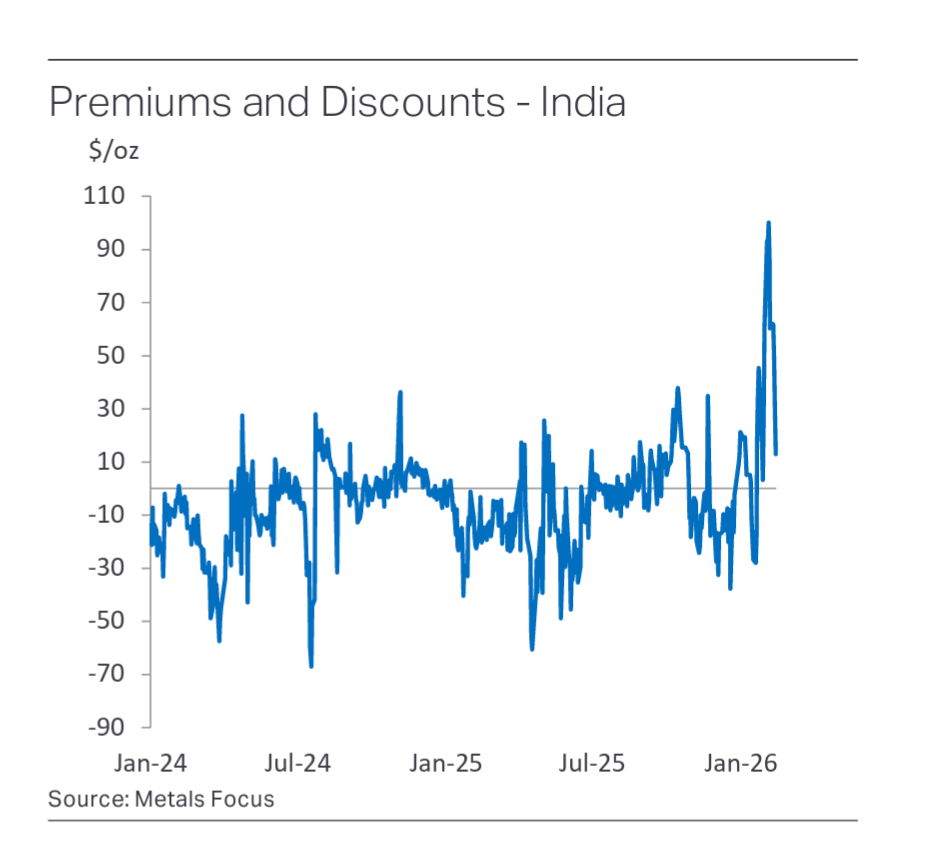
Prices cooled into early February, falling by around 7 percent with the correction and some strengthening of the Indian currency.

The premium also flipped to a discount on February 11 as it became clear there wasn’t going to be a significant rise in import duties, and local gold supplies increased.

Investment Demand Surging

Investment demand continues to lead the way in India, as the jewelry market struggles with headwinds due to higher prices.

Demand for gold ETFs continues to surge. India-based funds reported record gold inflows, holdings, assets under management (AUM), and investor participation.

Indian ETFs charted their ninth straight month of gold inflows, totaling ₹240 billion ($2.5 billion). That drove AUM to a new high of ₹1.8 trillion. AUM by Indian-based gold funds has more than tripled on a year-over-year basis.

In tonnage terms, Indian ETFs added another 15.5 tonnes in January, pushing cumulative gold holdings over 100 tonnes for the first time at 110 tonnes.

The World Gold Council estimates another 3 tonnes of gold flowed into Indian ETFs in the first 12 days of February.

Notably, inflows into gold ETFs eclipsed inflows into Indian equities for the first time. According to the World Gold Council, this could indicate “evolving preference in investor asset allocation.

WGC analysts say gold ETFs now account for 2.3 percent of the total mutual fund industry AUM in India. That represents the highest share on record, up substantially from 0.8 percent just one year ago.

Investor participation also grew in January with gold ETFs reporting another 1.2 million accounts. That drove the total number of gold ETF folios to 11.4 million.

Indians have historically preferred physical gold, but interest in ETFs has swelled in the last year.

A gold ETF is backed by a trust company that holds metal owned and stored by the trust. In most cases, investing in an ETF does not entitle you to any amount of physical gold. You own a share of the ETF, not gold itself. ETFs are a convenient way for investors to play the gold market, but owning ETF shares is not the same as holding physical gold.

Anecdotal evidence suggests physical gold investment also remains robust. As the World Gold Council summed it up, “Feedback from physical market participants suggests that consumer demand has remained resilient following the inauspicious period (mid-December to mid-January), despite record-high gold prices and elevated volatility, with buying skewed towards investment products.”

World Gold Council analysts say price gains have reinforced bullish sentiment among Indian investors, and there are “limited expectations of meaningful correction.” It has also attracted new buyers “across age groups,” with price dips triggering buying.

“Investment demand for bars and coins continues to hold firm, with some participants indicating a potential shift in allocation from capital markets to gold. Meanwhile, liquidation activity remains limited, reflecting confidence among holders that prices are unlikely to see a sharp correction.”

Unlike Western markets, where selling has been robust, liquidation has been moderate in the Indian market, with investors holding onto their metal, expecting additional price gains.

Indian gold jewelry demand is described as “measured,” with consumers staggering accumulation instead of buying with lump-sum purchases. The World Gold Council estimates jewelry demand is down about 20 percent in volume. However, with the higher prices, the value of purchases is up 25 to 30 percent.

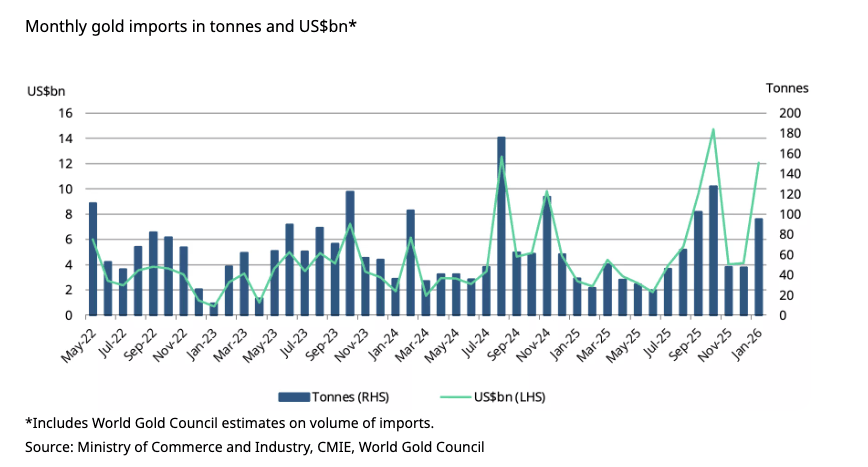
Gold imports last month reflected strong demand, rising to a 3-month high of 95 to 100 tonnes.

The surge in gold prices drove the import value up 192 percent month-on-month at $12.1 billion.
India’s Love Affair With Gold

Indians love gold for both cultural and economic reasons.

The yellow metal is deeply interwoven into India’s marriage ceremonies, along with its religious and cultural rituals. Festival seasons typically boost gold demand.

Indians also value the yellow metal as a store of wealth, especially in poorer rural regions. Around two-thirds of India’s gold demand comes from beyond the urban centers, where large numbers of people operate outside the tax system. Many Indians use gold jewelry not only as an adornment but as a way to preserve wealth.

In the West, gold is generally viewed as a luxury item.

Not in India. Even poor Indians buy gold.

According to a 2018 ICE360 survey, one in every two households in India had purchased gold within the last five years. Overall, 87 percent of Indian households own some gold. Even households at the lowest income levels in India hold some of the yellow metal. According to the survey, more than 75 percent of families in the bottom 10 percent of income managed to buy some gold.

The yellow metal was a lifeline for Indians buffeted by the economic storm caused by the government’s response to COVID-19. After the Indian government locked down the country, banks tightened credit to mitigate the default risk. Unable to secure traditional loans, Indians used gold to secure financing. As Indians endured a second wave of lockdowns, many Indians resorted to selling gold outright to make ends meet.


Mike Maharrey is a journalist and market analyst for Money Metals with over a decade of experience in precious metals. He holds a BS in accounting from the University of Kentucky and a BA in journalism from the University of South Florida.

Republican Mayor Doesn’t Want ICE Facility in His Town

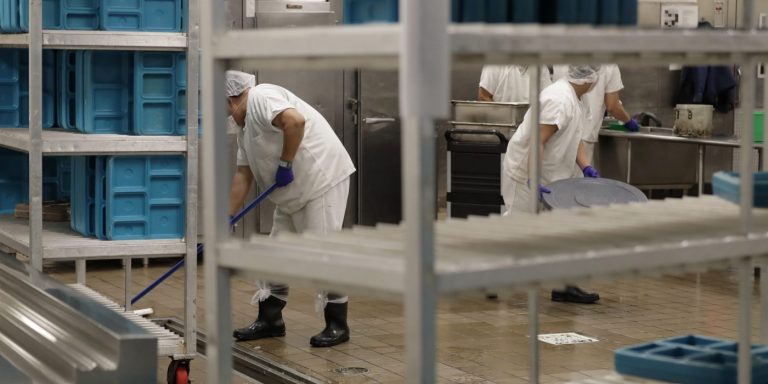
(The Center Square) A middle Tennessee mayor said Friday he is a conservative Republican, but he does not want a U.S. Immigration and Customs Enforcement facility coming to his town.

The Department of Homeland Security is looking at property in Lebanon, Mayor Rick Bell said. The department had not spoken with the city’s utilities or engineering departments, he said.

“As a conservative Republican, I believe we should have a secure border,” Bell said in the post. “However, other than the Wilson County Jail, Lebanon, Tennessee is not the place for any type of correctional facility – ICE or otherwise.”

Sen. Marsha Blackburn agrees with him, Bell said.

“This morning, I spoke with U.S. Senator Marsha Blackburn,” Bell said. “She is working with us along with leaders of the Department of Homeland Security to rectify this situation. She too believes that the city of Lebanon is not the right location for this facility.”

Blackburn’s office told The Center Square in an email: “Senator Blackburn supports the incredible work ICE is doing in Tennessee to apprehend, detain, and deport criminal illegal aliens, and she is working closely with local and state leaders as well as ICE to ensure the agency can find a proper placement for a new detention facility.”

Lebanon is not the first Tennessee city where residents pushed back against a new ICE detention center.

Residents of Mason, a town of about 1,200 located 30 minutes from Memphis, protested the opening of an ICE facility there in August. Mason Mayor Eddie Noeman pitched the deal with ICE as a way to generate revenue for the city. The West Tennessee Detention Facility is overseen by private prison contractor CoreCivic.

Two Georgia towns are also pushing back at two ICE detention centers.

The Department of Homeland Security is planning for two detention centers in the Georgia towns of Social Circle and Oakwood.

Social Circle, a town of about 5,000 people east of Atlanta, could see a facility that would house up to 10,000 detainees. Oakwood is just outside the Hall County seat of Gainesville.

Social Circle officials shared plans for the ICE facility there on Wednesday but reiterated their opposition.

“To be clear, the City has repeatedly communicated that it does not have the capacity or resources to accommodate this demand, and no proposal presented to date has demonstrated otherwise,” city officials said in an update. “The Department of Homeland Security has stated that an economic impact study has been conducted in connection with this proposed facility; however, City officials have not received a copy of that study and are awaiting the opportunity to review the analysis.”

Plans for the Oakwood facility are still moving forward, according to U.S. Rep. Andrew Clyde, R-Ga. He said Wednesday that the Oakwood facility would house 1,400 to 1,600 detainees. The facility would add 429 jobs and contribute $13.9 million in state, local and federal tax revenue, according to Clyde.

“Based on ICE’s economic impact analysis, track record, and unwavering commitment to protecting the American people, I am confident that the Oakwood ICE facility will be a safe and prosperous addition to the Ninth District,” Clyde said.

U.S. Sen. Raphael Warnock, D-Ga., an opponent of funding ICE, filed an amendment to the continuing resolution that would block both detention facilities.

Businesses Seek Quick Tariff Refunds after Supreme Court Ruling

(The Center Square) The U.S. businesses that paid billions in tariffs to the federal government want their money back.

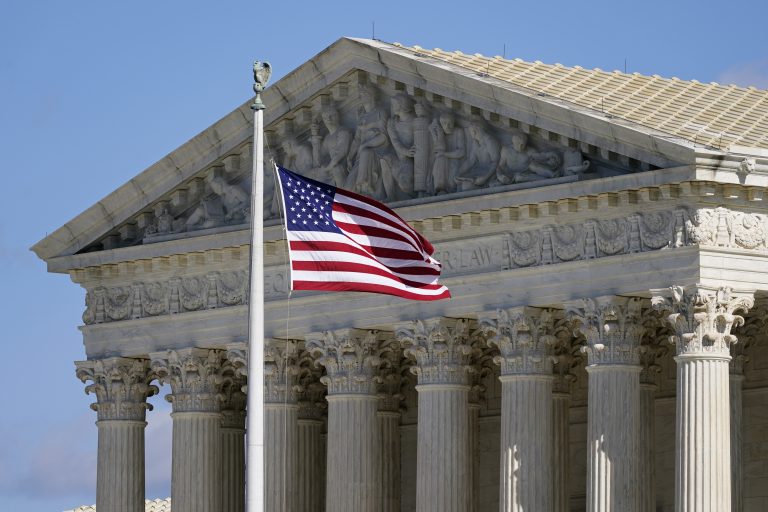
After the U.S. Supreme Court found President Donald Trump exceeded his authority under a 1977 law, business groups quickly called for refunds of these tariffs.

The high court decision affects Trump’s tariffs enacted under the International Emergency Economic Powers Act. Trump had used the law to impose tariffs on nearly every imported product from every country.

Neil Bradley, executive vice president at the U.S. Chamber of Commerce, said the ruling was good news for U.S. businesses and consumers.

“Swift refunds of the impermissible tariffs will be meaningful for the more than 200,000 small business importers in this country,” he said.

The nation’s largest business lobby also asked for a full reset on tariffs.

“We encourage the administration to use this opportunity to reset overall tariff policy in a manner that will lead to greater economic growth, larger wage gains for workers, and lower costs for families,” Bradley said.

The Penn Wharton Budget Model estimated the Supreme Court ruling will generate up to $175 billion in refunds.

Getting that money won’t be easy. International Chamber of Commerce Secretary General John Denton warned that refunds could be challenging.

“Companies should not expect a simple process: the structure of U.S. import procedures means claims are likely to be administratively complex,” he said. “[The] ruling is worryingly silent on this issue and clear guidance from the Court of International Trade and the relevant U.S. authorities will be essential to minimize avoidable costs and prevent litigation risks.”

Trump sharply criticized the Supreme Court’s decision on Friday before announcing a new set of tariffs under different laws to replace the import duties invalidated by the high court. He also criticized the Supreme Court for its silence on the issue of refunds. He said that failure by the high court could mean refunds end up in court disputes for years.

Gary Shapiro, CEO of the Consumer Technology Association, a trade group, said “the government must act quickly to refund retailers and importers without red tape or delay.”

Some businesses filed for refunds even before the Supreme Court ruling.

Warehouse retailer Costco filed a lawsuit in December to hold its place in the refund line, where other companies were already waiting. Costco noted a separate lawsuit was needed because importers “are not guaranteed a refund for those unlawfully collected tariffs in the absence of their own judgment and judicial relief.”

The request hints at a complicated refund process for a share of the billions in tariffs the federal government collected in fiscal year 2025. Supreme Court Justice Amy Coney Barrett said refunds could be a “mess” during oral arguments in November.

U.S. Sen. Maria Cantwell, D-Wash., wrote a letter to Treasury Secretary Scott Bessent seeking a “detailed explanation” of how the refund process would work.

“Many American businesses, especially small and medium-sized businesses, have struggled to pay these illegal tariffs and, for some, the financial strain has placed them on the brink of bankruptcy,” she wrote in the letter. “It is essential [that the Treasury Department] implement an expeditious and transparent process to remediate the financial harm that resulted from these illegal tariffs.”

Illinois Gov. J.B. Pritzker, a Democrat with plans for higher office, demanded a refund of $8.6 billion for all families in his state.

“On behalf of the people of Illinois, I demand a refund of $1,700 for every family in Illinois,” the governor wrote, threatening further action if the White House failed to comply.

Recent economic research has found that Americans are picking up the cost of tariffs. The Federal Reserve Bank of New York confirmed “U.S. firms and consumers continue to bear the bulk of the economic burden of the high tariffs imposed in 2025,” according to a report from the Federal Reserve Bank of New York. Other studies have reported similar findings on the impact of the tariffs. The Kiel Institute for the World Economy found that Americans are paying almost the entire cost of tariffs.

U.S. Supreme Court to Hear Tax Foreclosure Case Wednesday

(The Center Square) The U.S. Supreme Court will hear a case on Wednesday over whether tax foreclosure sales are constitutional.

Pung v. Isabella County involves the rights of a foreclosed upon homeowner to receive equity back when their home is sold over a tax foreclosure. The dispute comes between the Pung family and Isabella County, Michigan, over real estate taxes on a home the Pungs owned.

A judge determined that the Pungs owed about $2,200 in taxes and allowed the government to auction off their home for $76,000. An individual purchased the Pungs’ home from the government and later sold it for $195,000.

The Pung family sued the government and claimed the sales price was far below the house’s fair market value. Michael Pung, who brought the lawsuit against the county, argued the takings clause of the Fifth Amendment requires that he receive the monetary equivalent of the property that the state has taken from him.

“The deep history of the takings clause and property rights [comes from] the Magna Carta and early colonial practices and the Northwest Ordinance,” said Jay Carson, senior litigator at the Buckeye Institute. “All of them have the same concept that the government can’t take any more than what is actually owed to it.”

The case builds from Tyler v. Hennepin County, where the U.S. Supreme Court ruled unanimously against a Minnesota county for seizing a 94-year-old woman’s home due to her $15,000 tax debt. The county kept the $25,000 profit from the sale, in violation of the takings clause, according to the high court.

The key difference in Pung v. Isabella County is that the Pung family received their surplus proceeds after the sale of the house.

Lawyers for Isabella County argued that the Pungs’ home was sold for less due to the tax burden owed by the family during the process.

“Property that must be sold within those strictures is simply worth less and is not ground for objection by the former owner,” lawyers for the county wrote to the high court.

However, the Pung family and Carson argued the government should owe payments based on a property’s fair market value rather than the value assessed during a foreclosure sale. They argue the county assessed the property’s fair market value to be around $200,000 despite selling it for less.

“The facts in this case where the subsequent purchasers turned around and sold it for that approximate value shortly thereafter speaks volumes to the underlying equity in this,” Carson said.

Carson said the unanimous decision in Tyler v. Hennepin County makes him feel hopeful that the court will side with the Pung family. He said governments should award foreclosed upon homeowners based on fair market value.

He predicted the justices may not rule on what standard should apply for the government in determining foreclosure payments but argued the case should go in favor of the Pung family.

“In this case, fair market value sure looks like it might be the best or most appropriate test to use,” Carson said.

The justices will hear arguments in the consequential foreclosure case on Wednesday and will likely issue a decision by July.

Discord Leaker Who Exposed Ukraine Sham Sent to Country’s Harshest Prison

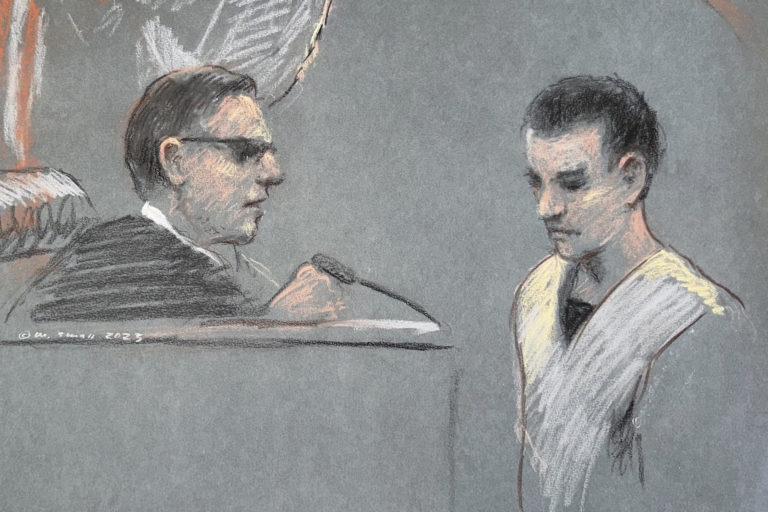
(Ken Silva, Headline USA) Jack Teixeira, the former Massachusetts Air National Guard member who caused an international uproar when he leaked highly classified documents about the war in Ukraine, is now incarcerated at the supermax prison in Florence, Colorado—widely considered the harshest detention center in the U.S.

The 24-year-old Teixeira had been held at the “Big Sandy” high-security prison in Kentucky, but is now listed as being held in Florence. It’s not clear when he was transferred. Florence supermax is the home of inmates such as drug lord Joaquín “El Chapo” Guzmán, Oklahoma City bombing accomplice Terry Nichols and 1993 World Trade Center bomber Ramzi Yousef. Florence is also where Whitmer kidnap defendants Adam Fox and Barry Croft are being caged.

Teixeira’s leaks in 2022, when he was just 21 years old, effectively debunked a longstanding Biden-administration narrative that the U.S.-backed Ukrainian resistance was decimating the Russian army on the battlefield. They included evidence that the Pentagon had soldiers on the ground in Ukraine when Biden administration officials said that there weren’t any, that the U.S. had spied on Ukrainian President Volodymyr Zelenskyy, and that the war in Ukraine was going worse than officials were saying publicly.

Rather than taking part in a sophisticated foreign intelligence operation or domestic whistleblowing, it turned out that Teixeira was simply trying to build clout with his fellow gamers. The Washington Post reported in April 2023 that Teixeira uploaded the Pentagon documents to a Discord chatroom using an anonymous account called “OG.”

But at his sentencing, which is set to run through 2036, Teixeira did not express remorse.

In a 10-minute address, Teixeira said he was “exposing and correcting the lies that were perpetrated by President Biden and force-fed to the American people” about the war in Ukraine.

“I believe the Department of Justice was politicized against President Trump and myself,” added Teixeira, who said he acted alone. He called on Trump and members of his administration to reverse his convictions.

“If I saved one American, Russian or Ukrainian life in this money-grabbing war, my punishment was worth it,” he said.

Teixeira’s actions prompted enhanced government surveillance of Discord and other gaming platforms.

NBC News reported in April 2023 that the Biden White House was “looking at expanding the universe of online sites that intelligence agencies and law enforcement authorities track.”

“The intelligence community is now grappling with how it can scrub platforms like Discord in search of relevant material to avoid a similar leak in the future,” the outlet added, quoting an unnamed congressional official.

More information on the government’s targeting of gamers came out in February 2024, when the Government Accountability Office (GAO) reported that the FBI had increased its efforts to infiltrate gaming servers the year prior.

Ken Silva is the editor of Headline USA. Follow him at x.com/jd_cashless.

FBI Director Parties in Italy w/ Olympic Hockey Team

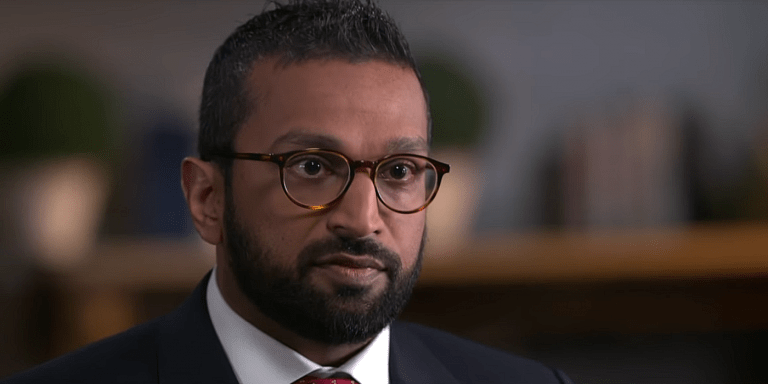
(Ken Silva, Headline USA) FBI Director Kashyap Patel joined the American men’s hockey players in the locker room Sunday for a rowdy celebration of winning the gold medal in the Winter Olympics.

Videos shared on social media showed a pumped-up Patel drinking beer from a bottle and spraying the rest around the locker room. After one of the players draped his gold medal around Patel’s neck, he joined the players as they jumped up and down.

“There was a threat at the president’s residence at MAL, Americans in Mexico are facing major threats by cartel members, Nancy Guthrie is still missing, and our FBI Director thinks he’s a frat bro?!,” Xochitl Hinojosa, the spokeswoman for former Attorney General Merrick Garland said on X.

Patel responded to the criticism by posting that he was “extremely humbled when my friends, the newly minted Gold Medal winners on Team USA, invited me into the locker room to celebrate this historic moment with the boys.”

The FBI director had defended his official trip to Italy by saying he was going to meet with Italian law enforcement officials and Americans helping to provide security at the Olympics. He posted pictures this week of his visit to the Milan Joint Operations Center, which he said was charged with protecting the security of American athletes and all those who traveled to Milan for the Winter Games. He also posted a photo of his meeting with the U.S. ambassador to Italy.

Patel has been under heavy criticism for using the FBI’s gulfstream jet for personal reasons during the government shutdown, when agents weren’t getting paid. Patel’s trips included seeing Wilkins sing the National Anthem at a wrestling match in Pennsylvania last October, and visiting a hunting resort called Boondoggle Ranch in Texas a week later.

FBI spokesman Ben Williamson has attempted to downplay his boss’s use of the FBI jet, posting on Twitter/X that Patel is forced to use a government plane even when flying for personal reasons. Williamson also said Patel pays a reimbursement in advance for his flights, as per government rules.

However, Patel is only required to pay the equivalent of commercial fare for his flights. The cost of operating FBI jets is exponentially more than that. For example, a Government Accountability Office report found in 2013 that then-Attorney General Eric Holder paid $420.90 for a flight that cost the taxpayers $15,894.

Patel has also devoted public resources to protect his girlfriend, Alexis Wilkins, despite the two not even living together.

“Patel’s country music performer girlfriend currently enjoys the protection of an FBI security detail to shield her from potential threats, prompting concerns that the arrangement may delay law enforcement from responding to other incidents,” MS NOW reported in November, citing two anonymous sources.

“People familiar with FBI security protocols said they were unaware of any instance in which the girlfriends of top FBI officials received government-staffed security details. Former FBI Director Christopher Wray’s wife Helen received a security detail; she lived with Wray in their home in Atlanta.”

Along with using taxpayer resources for personal benefit, Patel has reversed his position on Section 702 of the Foreign Intelligence Surveillance Act. Patel previously expressed support for implementing warrant requirements for FISA 702, but he abandoned that position during his confirmation hearings—meaning he supports warrantless surveillance of Americans.

Patel also said that he’d shut down its headquarters and turn it into a “museum for the deep state.” Additionally, he’s yet to live up to promises such as that he’d release all the FBI’s files on notorious sex criminal Jeffrey Epstein.

The Associated Press contributed to this report.

Ken Silva is the editor of Headline USA. Follow him at x.com/jd_cashless.

Trump Considers ‘Targeted Strike’ on Iran, Followed by Much Larger Attack

(Dave DeCamp, Antiwar.comPresident Trump is considering launching a “targeted strike” on Iran in the coming days that would be followed by a much larger attack, potentially aimed at regime change, if Tehran doesn’t agree to his demands, The New York Times reported on Sunday.

US and Iranian officials are set to hold another round of talks in Geneva this Thursday, and Iran is expected to provide its proposal for a potential deal in the days ahead. But the Trump administration is not signaling it’s really interested in an agreement as it continues to demand zero uranium enrichment, a condition Tehran has made clear it won’t accept, and threatens war amid the largest US military buildup in the Middle East since the US invasion of Iraq in 2003.

The Times report said that Trump may launch a limited attack on Iran to get it to capitulate to US demands, something the president confirmed on Friday. “I guess you can say I am considering it,” he said when asked about the possibility of a limited strike.

An F/A-18 fighter jet on the aircraft carrier USS Abraham Lincoln, which is operating in the Arabian Sea (US Navy photo)

Potential targets in the initial attack could include the headquarters of Iran’s Islamic Revolutionary Guard Corps (IRGC), nuclear sites, or Iran’s ballistic missile program. But a “limited strike” will likely lead to a major war, as all signs indicate that if the US launches any sort of attack, Iran will not hold back in its retaliation and could unleash its missiles on US bases and warships in the region, which could cause thousands of US casualties.

The Times report said that if an initial attack doesn’t make Iran capitulate, then the US could escalate to launching strikes aimed at toppling Iranian Supreme Leader Ayatollah Ali Khamenei, and other media reports have said that the US is considering a “sustained” multi-week attack on the country.

Sources told the Times that Trump met with his senior advisors about the possibility of attacking Iran on Wednesday and that Gen. Dan Caine, the chairman of the Joint Chiefs of Staff, couldn’t provide the same assurances for success that he had about the US attack on Venezuela, which resulted in the abductions of President Nicolas Maduro. The report said that after the meeting, the idea of sending teams of US commandos into Iran has been shelved, at least for now.

Trump officials have not made a coherent case to the American people about why the US should attack Iran, and have reverted to claiming that Iran might try to build a nuclear weapon, contradicting Trump’s insistence that the June 2025 airstrikes “obliterated” Iran’s nuclear facilities. The main US goal appears to be eliminating Iran’s ability to threaten Israel, which would require destroying its missile program or regime change, both of which would require a massive, sustained attack.

This article originally appeared at Antiwar.com.


Ex-Obama Official Threatens Companies Working With Trump

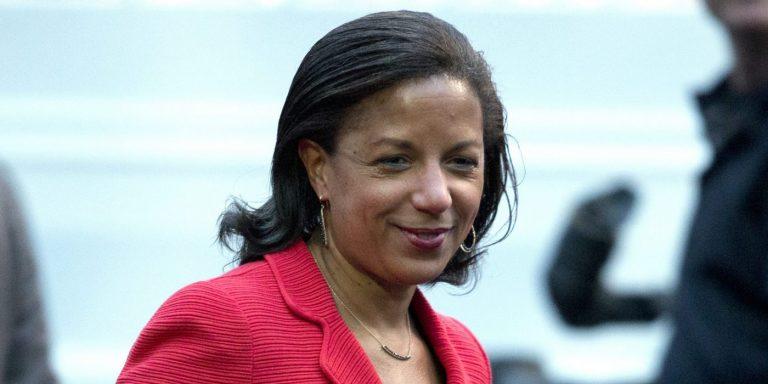
(Luis CornelioHeadline USA) Susan Rice, a former official in both the Obama and Biden administrations, issued a stark warning to companies and other entities that may work with President Donald Trump if Democrats regain control. 

Speaking on the Stay Tuned podcast with former federal prosecutor Preet Bharara, Rice threatened Big Tech companies, law firms, corporations, and media outlets, saying if they worked with Trump, “it is not going to end well for them.”  

“For those who decided they would act in their perceived very narrow self-interest—which I would underscore is very short-term self-interest—and take a knee to Trump, I think they’re now starting to realize this is not popular. Trump is not popular,” Rice claimed.

She added, “There is likely to be a swing in the other direction, and they are going to be caught with more than their pants down. They will be held accountable by those who come in opposition to Trump and win at the ballot box.” 

Rice also urged these entities to “play a long game, not this short game that has been so detrimental.” She claimed that there “will be an accountability agenda,” adding that “this is not going to be an instance of forgive and forget.” 

Critics say Rice’s comments suggest Democrats could be even more driven for revenge, following efforts to prosecute Trump and investigate hundreds of Republican and conservative organizations.  

Conservatives have already faced widespread censorship from Big Tech and other left-leaning entities, fueling concerns that Rice’s warning signals a coordinated push to punish Trump allies economically and socially. 

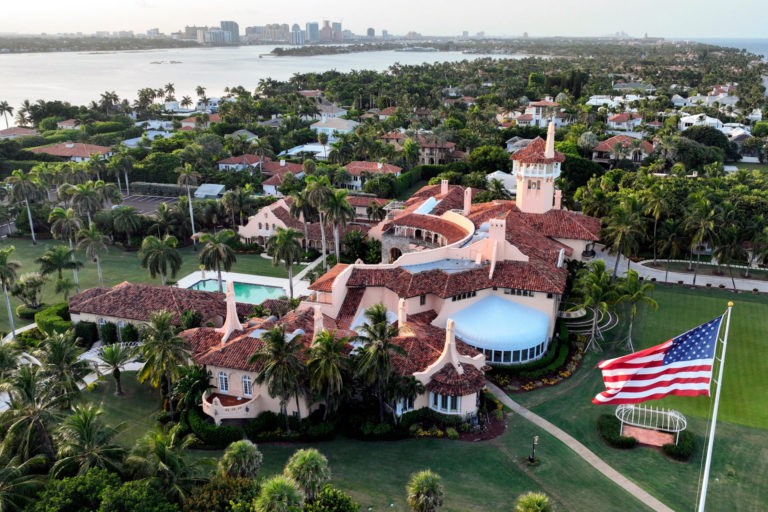
Armed Man Shot and Killed After Entering Secure Perimeter of Mar-a-Lago, Secret Service Says

(Headline USA) An armed man drove into the secure perimeter of Mar-a-Lago, President Donald Trump’s resort in Palm Beach, Florida, as another vehicle was exiting before being shot and killed early Sunday morning, according to a spokesman for the U.S. Secret Service.

The man, who was in his early 20s and from North Carolina, had a gas can and a shotgun, according to Anthony Guglielmi, the spokesman. He had been reported missing by his family a few days ago, and investigators believe he headed south and picked up the shotgun along the way.

Guglielmi said a box for the weapon was discovered in the man’s vehicle after the incident, which took place around 1:30 a.m.

The man killed was identified by investigators as 21-year-old Austin Tucker Martin, according to a person familiar with the matter. The person spoke on the condition of anonymity because they were not authorized to publicly discuss details of the investigation.

Trump has faced threats to his life before, including two assassination attempts during the 2024 campaign. Although the president often spends weekends at his resort, he and first lady Melania Trump were at the White House when the breach at Mar-a-Lago occurred.

After entering near the north gate of the property, the man was confronted by two Secret Service agents and a Palm Beach County sheriff’s deputy, according to Palm Beach County Sheriff Ric Bradshaw.

“He was ordered to drop those two pieces of equipment that he had with them. At which time he put down the gas can, raised the shotgun to a shooting position,” Bradshaw said at a brief press conference. The two agents and the deputy “fired their weapons to neutralize the threat.”

The FBI asked residents who live near Mar-a-Lago to check any security cameras they may have for footage that could help investigators.

Investigators are working to compile a psychological profile and a motive is still under investigation. Asked whether the individual was known to law enforcement, Bradshaw said “not right now.”

The incident comes as the United States has been rocked by spasms political violence.

The incursion at Mar-a-Lago took place a few miles from Trump’s West Palm Beach club where a man tried to assassinate him while he played golf during the 2024 campaign.

A Secret Service agent spotted that man, Ryan Routh, aiming a rifle through the shrubbery before Trump came into view. Officials said Routh aimed his rifle at the agent, who opened fire and caused Routh to drop his weapon.

Routh was found guilty last year and sentenced this month to life in prison.

Trump also survived an assassination attempt at a Butler, Pennsylvania campaign rally. That gunman fired eight shots before being killed by a Secret Service counter sniper.

The White House referred all questions to the Secret Service and FBI.

There have been other recent incidents of political violence as well.

In the last year, there was the assassination of conservative activist Charlie Kirk; the assassination of the Democratic leader in the Minnesota state House and her husband and the shooting of another lawmaker and his wife; and an arson attack at the official residence of Pennsylvania Gov. Josh Shapiro.

Five days ago, a Georgia man armed with a shotgun was arrested as he sprinted towards the west side of the U.S. Capitol.


Adapted from reporting by the Associated Press


Business Groups Seek Quick Tariff Refunds After Supreme Court Ruling

(Brett Rowland, The Center Square) The U.S. businesses that paid billions in tariffs to the federal government want their money back.

After the U.S. Supreme Court found President Donald Trump exceeded his authority under a 1977 law, business groups quickly called for refunds of these tariffs.

The high court decision affects Trump’s tariffs enacted under the International Emergency Economic Powers Act. Trump had used the law to impose tariffs on nearly every imported product from every country.

Neil Bradley, executive vice president at the U.S. Chamber of Commerce, said the ruling was good news for U.S. businesses and consumers.

“Swift refunds of the impermissible tariffs will be meaningful for the more than 200,000 small business importers in this country,” he said.

The nation’s largest business lobby also asked for a full reset on tariffs.

“We encourage the administration to use this opportunity to reset overall tariff policy in a manner that will lead to greater economic growth, larger wage gains for workers, and lower costs for families,” Bradley said.

The Penn Wharton Budget Model estimated the Supreme Court ruling will generate up to $175 billion in refunds.

Getting that money won’t be easy. International Chamber of Commerce Secretary General John Denton warned that refunds could be challenging.

“Companies should not expect a simple process: the structure of U.S. import procedures means claims are likely to be administratively complex,” he said. “[The] ruling is worryingly silent on this issue and clear guidance from the Court of International Trade and the relevant U.S. authorities will be essential to minimize avoidable costs and prevent litigation risks.”

Trump sharply criticized the Supreme Court’s decision on Friday before announcing a new set of tariffs under different laws to replace the import duties invalidated by the high court. He also criticized the Supreme Court for its silence on the issue of refunds. He said that failure by the high court could mean refunds end up in court disputes for years.

Gary Shapiro, CEO of the Consumer Technology Association, a trade group, said “the government must act quickly to refund retailers and importers without red tape or delay.”

Some businesses filed for refunds even before the Supreme Court ruling.

Warehouse retailer Costco filed a lawsuit in December to hold its place in the refund line, where other companies were already waiting. Costco noted a separate lawsuit was needed because importers “are not guaranteed a refund for those unlawfully collected tariffs in the absence of their own judgment and judicial relief.”

The request hints at a complicated refund process for a share of the billions in tariffs the federal government collected in fiscal year 2025. Supreme Court Justice Amy Coney Barrett said refunds could be a “mess” during oral arguments in November.

U.S. Sen. Maria Cantwell, D-Wash., wrote a letter to Treasury Secretary Scott Bessent seeking a “detailed explanation” of how the refund process would work.

“Many American businesses, especially small and medium-sized businesses, have struggled to pay these illegal tariffs and, for some, the financial strain has placed them on the brink of bankruptcy,” she wrote in the letter. “It is essential [that the Treasury Department] implement an expeditious and transparent process to remediate the financial harm that resulted from these illegal tariffs.”

Illinois Gov. J.B. Pritzker, a Democrat with plans for higher office, demanded a refund of $8.6 billion for all families in his state.

“On behalf of the people of Illinois, I demand a refund of $1,700 for every family in Illinois,” the governor wrote, threatening further action if the White House failed to comply.

Recent economic research has found that Americans are picking up the cost of tariffs. A report from the Federal Reserve Bank of New York confirmed “U.S. firms and consumers continue to bear the bulk of the economic burden of the high tariffs imposed in 2025,” according to a report from the Federal Reserve Bank of New York. Other studies have reported similar findings on the impact of the tariffs. The Kiel Institute for the World Economy found that Americans are paying almost the entire cost of tariffs.