

War With Iran Pushes Gas Over $5 a Gallon in California, Raises Prices Throughout Southwest

(Liam Hibbert, The Center Square) Gas prices have risen above $5 a gallon in California as the Southwest and the rest of America feel the impact of the U.S.-Israeli war with Iran.

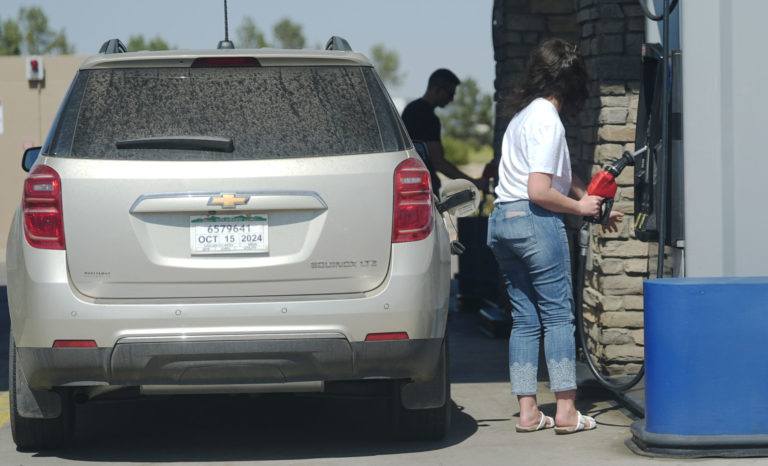
The average at the Golden State’s pumps hit $5.16 a gallon Sunday and increased to $5.20 Monday, according to AAA. That’s an increase of 54 cents from the March 2 average of $4.66 a gallon in California, which consistently has had the most expensive gas in the U.S. for several years.

Similar increases were seen elsewhere in the Southwest. In Arizona, prices were up from $3.32 on March 2 to $3.86 on Monday. Colorado saw prices rise from $2.89 on March 2 to $3.41 on Monday. And Nevadans saw their gas average rise from $3.70 on March 2 to $4.21 on Monday.

California consistently has the nation’s highest prices, and the national average nearly passed the $3.50 per gallon average.

Gas prices, which largely reflect delayed oil prices, are expected to come down from a near 50-cent increase over the past week, if oil prices remain low in the coming days, according to AAA.

“Most of what we should think about right now is what oil’s doing today,” AAA Mountain West Group Spokesperson John Treanor told The Center Square Monday. The crude oil market peaked Sunday night over $118 and quickly came down overnight into Monday, according to OilPrice.com.

Gas prices, however, remained high in reaction to the sharp increase in oil prices from the war’s start on Feb. 28. The U.S. average gas price for a regular gallon was $3.48 Monday, up 48 cents from $3 last week, according to AAA.

The rapid increase of gas prices has impacted every state in the U.S., including in the Southwest where gas prices were already among the highest in the country.

The oil price dip Monday came after President Donald Trump said the war could end “very soon.” Later the same day, Trump said, “We will hit them so hard that it will not be possible for them or anybody else helping them to ever recover that section of the world,” according to media reports.

“For every dollar increase in crude oil, you can expect a 2- to 2.5-cent increase in the cost of gasoline at the pump,” Auto Club Group Spokesperson Skyler McKinley in Colorado told The Center Square. “And so I think it’s notable that [oil] prices have fallen since Friday, but we haven’t even priced those in yet on what we’re paying at the pump. We’re just now starting to probably price that swing in.”

McKinley added that while gas prices could be expected to come down in line with oil prices, it would be difficult to know how soon that might be, as the war continues to quickly change. As of Monday afternoon, the price of oil was at $87, its lowest since last week, according to OilPrices.com.

The U.S.-Israeli war with Iran quickly caused global oil and gas prices to rise, largely on speculation of a drawn-out war. Since the war began, Iran has attacked at least 10 vessels moving through the trade chokepoint that is the Strait of Hormuz. In 2024, around 20% of global petroleum liquids passed through the strait, according to the U.S. Energy Information Administration.

“The price swing we’ve seen in gasoline has been lesser at the start of this conflict than when Russia invaded Ukraine, when the national average jumped 60 cents in a seven day period,” said McKinley. He added later, “We’ve had expensive oil before. We’ve had expensive gas before. It is painful. It makes everything else in our economy more expensive, but I don’t hear a lot of folks talking about 2022 right now, despite it being the most expensive year on record, which shows you how short memories are with regard to some of these energy considerations.”

The average U.S. gallon of regular gas has not passed $3.50 since June 2024 and peaked over $5 in the summer of 2022, according to the U.S. EIA, after several months of Russia’s attack on Ukraine.

“The interesting thing is what are prices going to look like tomorrow?” said Treanor. “But this will show you how quickly things can swing.”
 

Federal Deficit Totaled $1 Trillion in Beginning of FY2026, CBO Says

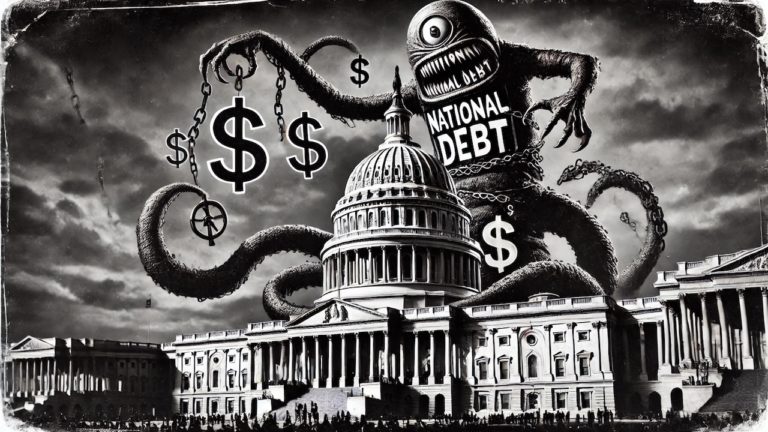
(Andrew Rice, The Center Square) The United States federal budget deficit totaled $1 trillion in the first five months of fiscal year 2026, according to the Congressional Budget Office.

The latest federal deficit estimate is $142 billion less than the deficit from this time in the previous fiscal year. The CBO saw tariffs raise the amount of money that came into the federal government during the first five months of the fiscal year.

The CBO estimated the government brought in $2.1 trillion in the first five months of the fiscal year, roughly $206 billion more than the same time period last fiscal year.

Maya McGuineas, president of the Committee for a Responsible Federal Budget, called on Congress to decrease federal spending deficits.

“Another month of this fiscal year means another month of borrowing,” McGuineas said. “This cannot be sustainable.”

Collection of customs duties, or money received from tariffs, increased by $109 billion in the first five months of fiscal 2026 compared to the previous fiscal year.

Payments received by corporate income taxes decreased by $33 billion in fiscal year 2026. The government also received a $77 billion increase from income and payroll taxes and a $52 billion increase in withholdings from paychecks.

The government spent $3.1 trillion in the first five months of fiscal year 2026, a $64 billion increase from the same time period last fiscal year.

Spending on Social Security, Medicare and Medicaid made up the largest portions of government expenditures over the last five months. Social Security benefits spending rose by $48 billion, in part due to the enactment of the Social Security Fairness Act that increased payments for certain recipients, beginning in March 2025.

Medicare payments increased by $34 billion, which included a $16 billion settlement for Part D prescription drug plans in November 2025. Medicaid payments increased by $22 billion, due to rising enrollment costs.

February in particular saw a substantial increase in the deficit compared to the same period last year. The federal government took on $308 billion in February 2026, $1 billion more than in February 2025.

The CBO explained this deficit figure would have been substantially larger if payments for the federal government were not changed since Feb. 1 and March 1 fell on weekends. In February, defense spending increased by $6 billion; interest on debt increased by $6 billion; and Social Security increased by $10 billion. 

Overall, CBO projected the government would see a $1.9 trillion deficit for fiscal year 2026, with the debt to surpass records by 2030. MacGuineas called on Congressional leaders to take a firm approach against deficit spending and enact a 3% deficit-to-GDP target.

“Our fiscal problems will not solve themselves,” MacGuineas said. “We need policymakers to come together, agree to reduce deficits – a 3% deficit-to-GDP target would be a great start – and put our national debt on a downward sustainable path as a share of the economy.”

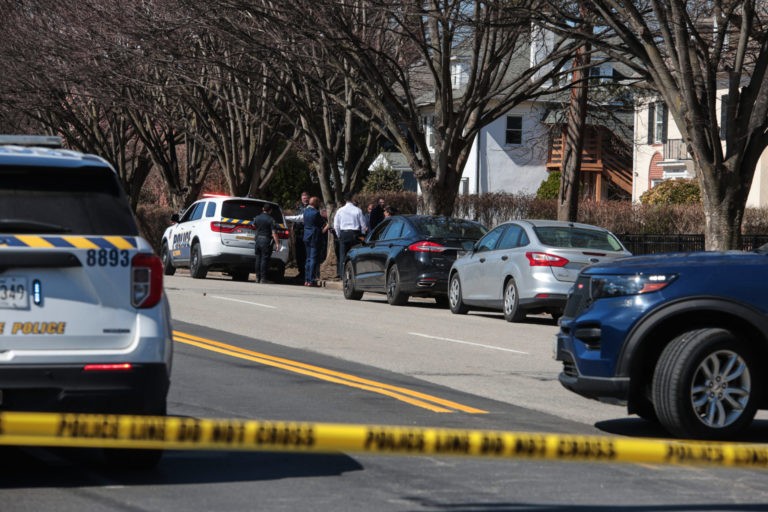
Baltimore Police Officer Wounded, Gunman Killed During Midday Burglary Call

(Headline USA) A police officer responding to a burglary call in Baltimore was shot in the leg Tuesday by a gunman who was killed by another officer, authorities said.

A woman jumped out of a window during the tense confrontation and another woman was held at gunpoint by the man before he was shot, Police Commissioner Richard Worley said.

“It was relatively quick because he was firing on our officers,” Worley said.

The officer with a leg wound was in stable condition at University of Maryland Shock Trauma Center. Dr. Thomas Scalea praised a “buddy” who applied a tourniquet at the scene.

“We’re just so thankful that the officer or any other folks in that neighborhood were not severely harmed,” Baltimore Mayor Brandon Scott told reporters. “Our thoughts are with him and his family, and even the family of the deceased.”

The man who died was related to people at the home, Worley said.

No names were released. The Baltimore Fraternal Order of Police, a union that represents officers, said “all involved members are in good spirits.”

Adapted from reporting by the Associated Press

Ex-NYPD Officers Accused of Stealing a Brothel Key and Robbing a Sex Worker Face Federal Charges

(Headline USA) Two former New York City police officers who prosecutors say stole a brothel key and then robbed and groped a sex worker are now facing federal charges after their initial state charges were dismissed on a technicality.

Former patrol officers Justin McMillan and Justin Colon were indicted Tuesday on charges of felony conspiracy against rights and willfully depriving an individual of her constitutional rights in connection with the July 2024 incident, the U.S. Attorney for the Eastern District of New York’s office announced.

Prosecutors say the two were responding to a report of prostitution inside a building in Queens when they shut off their bodycams, approached a woman leaving the building and took a key to the residence from her, as well as cash from her purse.

The officers returned eight hours later, unlocked the door and found a woman having sex with a man, who immediately fled, prosecutors said.

McMillan, 26, of Long Island, then stole about $200 from the woman’s purse and groped her while Colon, 24, of Queens, kept watch.

The woman ran away and eventually called 911, prosecutors said. The officers, meanwhile, returned to their station house without reporting the incident.

McMillan and Colon were initially charged in state court last March with burglary, forcible touching and official misconduct, but a judge dismissed the case and sealed the prosecution in December after the Queens District Attorney’s office failed to meet the court’s speedy trial rules.

Both men were suspended after their arrests and have since resigned from the department, police have said. They’re due to be arraigned later Tuesday in Brooklyn federal court. Their lawyers didn’t immediately respond to emails seeking comment.

Adapted from reporting by the Associated Press

Canadian Police Investigate Gunfire at US Consulate in Toronto

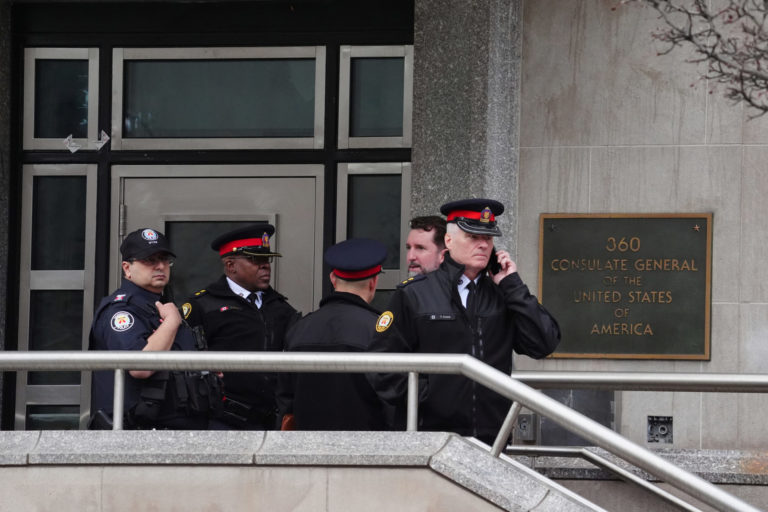
(Headline USA) Canadian police are investigating after the United States consulate in downtown Toronto was hit by gunfire early on Tuesday morning. Nobody was injured.

Royal Canadian Mounted Police Chief Superintendent Chris Leather called it a national security incident and said the national police force is working with Toronto police to understand the motive. Leather said the U.S. and Israeli consulates, as well as embassies in Ottawa, will see an increase in security.

“It is extremely concerning,” Canadian Prime Minister Mark Carney said. “We will use the full weight of our resources to ensure that the perpetrators feel the full weight of justice.”

Toronto Police Deputy Chief Frank Barredo said two individuals emerged from a white Honda CRV SUV at around 4:30 a.m. and fired multiple shots at the building before fleeing.

“There were people inside the building. However, this building is highly secured and highly fortified and there were no injuries,” he said.

Barredo said both suspects were involved in the discharge of the firearm. He said there were shell casings as well as damage outside but said bullets did not penetrate the building.

“It is very secure. The glass and the walls are reinforced and so I don’t believe there was any penetration into the building. It’s quite possible that people in the building would not have even noticed,” he said.

Police released a picture of the white SUV, but there was no further information about the suspects.

Ontario Premier Doug Ford called it “an absolutely unacceptable act of violence and intimidation aimed at our American friends and neighbors,” and he hinted at a possible link to the war in Iran.

“This is just me speaking. I believe that there are sleeper cells all over the world as we know. They are in the U.S., they are in Canada here. We have to weed these people out and hold them accountable,” Ford said.

“This is my personal opinion and I don’t think I’m too far off with saying that. It’s a different world now that we are facing with turmoil happening everywhere.”

A State Department official, who spoke on condition of anonymity because the investigation is still underway, said there were no injuries to consulate staff and that the department is cooperating with Canadian officials who are investigating.

The shooting comes after two Toronto-area synagogues were struck by gunfire last weekend.

“This cannot stand. Toronto’s Jewish community has the right to practice their faith and culture and to live their day-to-day lives without fear, intimidation or violence,” Toronto Mayor Olivia Chow said. “As we have seen too many times, antisemitic incidents spike when international incidents rise. It is never acceptable to target the Jewish community.”

Chow said there is a heavy police presence on Tuesday at both the U.S. and Israeli consulates in Toronto.

Toronto has a large Iranian community and the war in Iran has prompted demonstrations outside the U.S. consulate, both in support and in protest. The consulate is often the site of protests.

Carney also expressed relief that no one was injured. He noted in a post on social media that the federal government’s Incident Response Group met over the weekend to review potential changes to “the threat landscape” in Canada and discuss ways to improve domestic security.

Adapted from reporting by the Associated Press

Pope Announces Resignation of US Bishop Accused of Embezzling $270K from California Parish

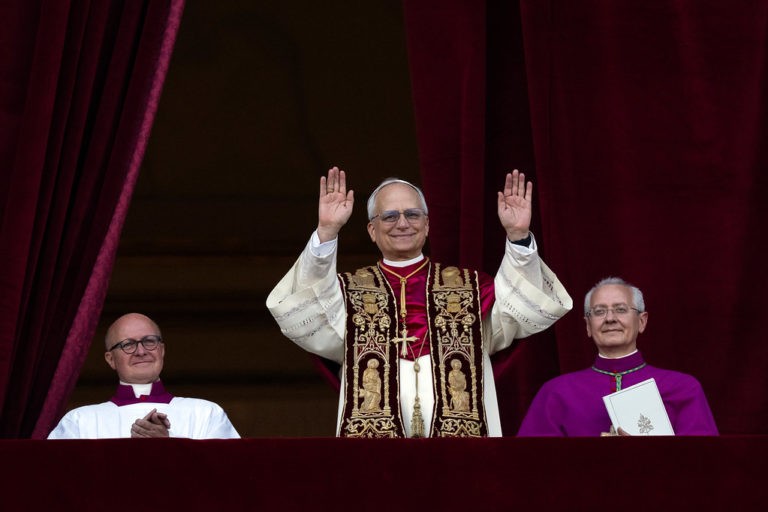
(Headline USA) The bishop of a small Chaldean Catholic community in the San Diego area has resigned amid charges that he embezzled $270,000 from his parish, Pope Leo XIV announced Tuesday.

Bishop Emanuel Shaleta pleaded not guilty to 17 felony charges, including money laundering, during a hearing attended by many of his supporters.

Shaleta, 69, is accused of embezzling from the St. Peter Chaldean Catholic Cathedral in El Cajon, east of San Diego.

He was arrested Thursday at San Diego International Airport while trying to leave the country, according to the San Diego County Sheriff’s Office, which didn’t say where he was allegedly heading. Someone from Shaleta’s church provided a statement and documentation “showing potential embezzlement from the church,” it said.

Prosecutor Joel Madero said the allegations against Shaleta are connected to monthly rental payments of more than $30,000 from a tenant of the church’s social hall that allegedly were missing. He said there were discrepancies in church accounts and that Shaleta “provided completely unreasonable tales of where that money was going.”

The judge set bail at $125,000. Madero said Shaleta was a flight risk, but the bishop’s attorney said Thursday’s flight had been planned for a while.

During a recent Mass, Shaleta addressed allegations against him, saying he has never “abused any penny of the church money.”

“On the contrary, I have done my best to preserve and manage the donations of the church properly,” he said at the time.

Shaleta’s attorney, Sharon Appelbaum, said she planned to show that the allegations were false. The priests of the Chaldean Catholic Eparchy of St. Peter the Apostle released a statement expressing solidarity with Shaleta.

The Vatican said in its daily bulletin Tuesday that Leo had accepted Shaleta’s resignation under the code of canon law for Eastern Rite churches, which allows for the pope to agree if a bishop asks to step down.

Leo actually accepted the resignation when Shaleta presented it in February, but an announcement was not made until this week, according to the Vatican embassy in Washington. The Holy See appears to have waited to announce the decision to avoid interfering with the police investigation.

Leo named Bishop Saad Hanna Sirop as a temporary administrator.

Shaleta was ordained a priest of the Chaldean Catholic Church in Detroit in 1984. He was named to the San Diego branch of the Eastern Rite Catholic Church in the U.S. in 2017.

The Chaldean Catholic Church represents more than a million Aramaic-speaking Christians who are primarily from Iraq. While its beliefs align with Roman Catholic doctrine, including the Trinity and the divinity of Jesus, the church maintains its own distinct, ancient Eastern traditions and identity.

Adapted from reporting by the Associated Press

New Rule Allows Indian Equity Funds to Allocate 35% to Gold and Silver

(Mike Maharrey, Money Metals News Service) Rule changes announced by Indian regulators could further boost demand for precious metals in the country.

India ranks as the world’s second-largest gold market behind China. It is also one of the top silver-consuming nations.

Under the new regulations announced by the Securities and Exchange Board of India (SEBI), equity funds can now invest up to 35 percent of their assets in gold and silver instruments.

According to the Economic Times of India, the new rules are part of broader reforms aimed at making “mutual fund schemes more flexible and diversified.” Other changes will allow equity funds to invest in units of infrastructure investment trusts.

According to Bloomberg, India has $385 billion in actively managed stock funds. These funds primarily invest in publicly traded stocks, providing investors with exposure to a wide range of equities without having to purchase individual stocks. In practice, your money is pooled with other investors, and a fund manager uses the money to create a (hopefully) diversified portfolio. There are various types of equity funds, including index funds, sector funds, and growth funds.

According to Bloomberg, the new Indian rules will give fund managers a “broader toolkit.”

“The change could also create a new source of demand for gold and silver, which have attracted robust investor interest amid a blistering rally.”

An Indian asset manager told the Times that the new regulations will give fund managers more flexibility and make funds more stable in periods of turmoil.

“A higher allocation to precious metals can help reduce downside risk during equity market stress, but it may also moderate returns when equity markets are strongly bullish.”

Another fund manager noted that the rule will provide a place to park idle cash where it will not be subject to inflationary devaluation.

Indians have historically preferred physical gold and silver. Over the last decade, Indian investors have snapped up 1,800 tonnes of gold coins and bars, highlighting Indian passion for the yellow metal.

However, there has been growing interest in paper gold and silver over the last year. In December 2023, Indian ETFs held a modest 42.3 tonnes of gold. As of January 2026, Indian gold-backed funds held 110.5 tonnes of gold, a 161 percent increase.

Investor participation has also grown by leaps and bounds. In January, Indian funds reported another 1.2 million accounts, pushing the total number of gold ETF folios to 11.4 million.

A gold ETF is backed by a trust company that holds metal owned and stored by the trust. In most cases, investing in an ETF does not entitle you to any amount of physical gold. You own a share of the ETF, not gold itself. ETFs are a convenient way for investors to play the gold market, but owning ETF shares is not the same as holding physical gold.

Last month, investors put more money into gold ETFs than they did into stock funds. Bloomberg called this “a rare reversal that underscores the growing appeal of bullion amid market uncertainty.”

The new regulations will allow equity funds to gain more exposure to gold, diversifying sources of demand in the country.

Analysts say the new rules won’t likely substantially boost overall Indian gold demand. However, it may lead to even higher demand during periods of strong demand as fund managers strategically deploy gold and silver as a hedge during times of geopolitical and economic uncertainty.

“In reality, fund managers are likely to use this flexibility selectively during uncertain market phases, such as periods of geopolitical tension or when equity valuations appear stretched. Overall, exposure to commodities will remain limited and tactical, with equities continuing to form the dominant portion of portfolios,” fund manager Chirag Muni told the Times.


Mike Maharrey is a journalist and market analyst for Money Metals with over a decade of experience in precious metals. He holds a BS in accounting from the University of Kentucky and a BA in journalism from the University of South Florida.

Could the Iran War Give a Long-Term Boost to Gold Bulls?

(Mike Maharrey, Money Metals News Service) Could the U.S./Israel war against Iran provide additional long-term support to the gold bull market?

Analysts at Metals Focus think it might.

Historically, wars have had little impact on the gold market beyond initial safe-haven buying. Typically, other factors, such as central bank monetary policy, come to dominate the market as the war drags on.

As Metals Focus notes, there tends to be an initial boost to gold prices at the onset of a war.

“Looking back in history, the boost that gold tends to enjoy because of geopolitical tensions or shocks rarely lasts. Indeed, this is largely the case for most markets, leaving aside, of course, assets favorable supply/demand fundamentals. Even in cases when conflicts have been prolonged, investor fatigue has soon set in, and appetite for safe-haven assets dissipated.”

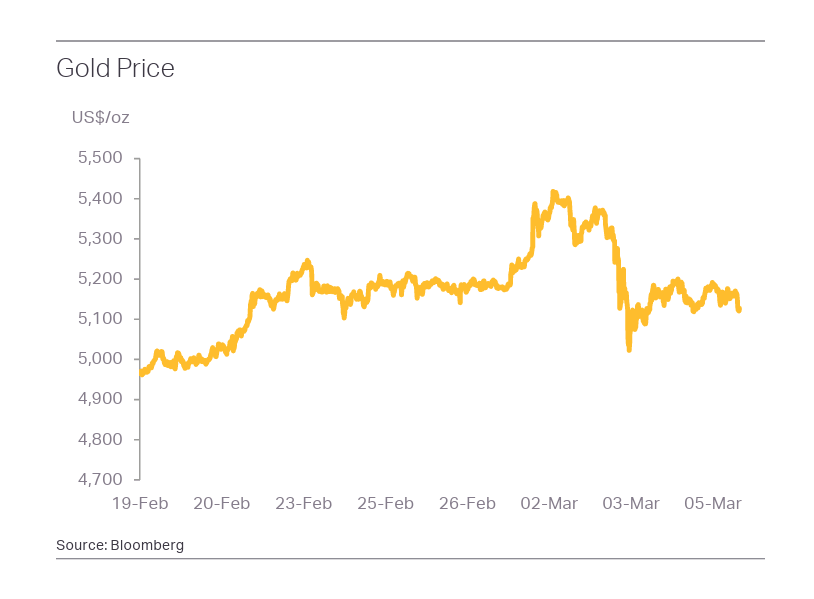
The safe-haven phase was particularly short after the U.S. and Israel launched their attack on Iran. Gold surged, eclipsing $5,400. However, the safe-haven spike quickly corrected, along with everything else, leaving significant price volatility in its wake as everybody tries to sort through the propaganda and figure out how exactly the war might play out.

In the near term, Metals Focus analysts expect frequent price rallies driven by war headlines; however, they don’t expect the price to scale all-time highs due to the war itself.

“As the market consensus oscillates between this and the sort of complacency we have seen develop this week towards the war, corrections are also on the cards, resulting in a period of heightened volatility.”

The Metals Focus analysts say gold could get a bigger boost if the situation spirals out of control or if “one or more of the fat-tail risks instead crystallize.”

“Either way, sooner or later, the impact of the war on the gold price will wane. Whether this is due to de-escalation or the investor fatigue that tends to develop, some of the conflict-related safe-haven bid for gold will dissipate.”

Could This War Give Gold Bulls a Long-term Boost?

While wars don’t typically have a longer-term impact on the gold market, Metals Focus argues that this time could be different, identifying “a sizeable tail risk that, due to the specifics of the conflict.”

Analysts specifically note that the location of the war and the potential for Iran to significantly restrict the global flow of oil, plunging the entire world into economic chaos.

But even without the worst-case scenario, Metals Focus analysts say they have “no doubt” that it is going to contribute to “the wider positive sentiment towards gold and its investment case.

They base their conclusion on three key factors.

Broader U.S. Foreign Policy Implications

U.S. foreign policy has grown increasingly interventionalist, and this raises geopolitical uncertainty.

The U.S. government has effectively overthrown two regimes in the last two months. As Metals Focus notes, whether you agree with this aggressive foreign policy or not, “It comes with lasting implications regarding the country’s foreign policy.

“It signals an appetite to induce regime or political change, using hard power, if necessary, to meet its strategic objectives.”

Analysts also point out that the U.S. did not do much to coordinate the attack with its traditional European allies, signaling a shift toward “unilateralism.”

“On balance, such shifts in the world’s largest economy and leading military power amplify geopolitical uncertainty.”

The Potential for Long-term Instability in the Middle East

Regime change does not guarantee a better regime.

In fact, Mojtaba Khamenei has taken over the mantle of leadership in Iran. The son of former “supreme leader” Ayatollah Ali Khamenei, Moktaba has been described by some as “his father on steroids.”

Of course, U.S. and Israeli forces may well take the second Khamenei out, but there is still no guarantee that the war will stabilize the region. As Metals Focus analysts point out, the new Iranian administration could “become yet more radicalized and adversarial.”

“The possibility of internal turmoil that spills over into neighboring countries can also not be ruled out, as the various factions in what is an ethnically diverse country compete for power, following a potential regime collapse.”

This kind of geopolitical chaos is bullish for gold.

Treasuries Have Failed as a Safe Haven

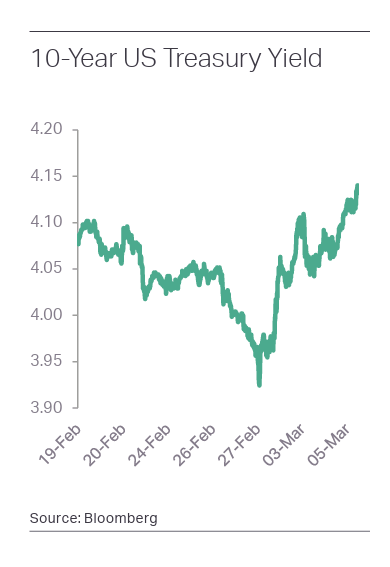
Treasuries have historically served as one of the go-to safe havens in times of uncertainty. Not anymore. The yield on the 10-year Treasury has nudged up since the Iran war commenced, indicating sagging demand.

This effectively leaves gold as the last haven standing.

As the Metals Focus analysts call the waning lack of Treasury safe-haven appeal “clearly a positive for gold, both directly, as it competes with treasuries for safe-haven investment flows, and indirectly, due to the impact these concerns are having on the U.S. dollar.

The only thing certain about war is uncertainty. Regardless of how things play out, we can expect ongoing price volatility as the markets try to make sense out of the daily war moves. Long-term, the war will undoubtedly change the current geopolitical landscape. And of course, this will play out in a broader context of ongoing inflationary pressure, a giant Debt Black Hole, and a central bank caught in a Catch-22 when it comes to the trajectory of monetary policy.

Given all of these factors, I agree that the bullish case for gold is arguably increased by the war, but investors should expect significant price volatility in the weeks ahead.


Mike Maharrey is a journalist and market analyst for Money Metals with over a decade of experience in precious metals. He holds a BS in accounting from the University of Kentucky and a BA in journalism from the University of South Florida.

Epstein Guard Googled Him Minutes Before Body Found

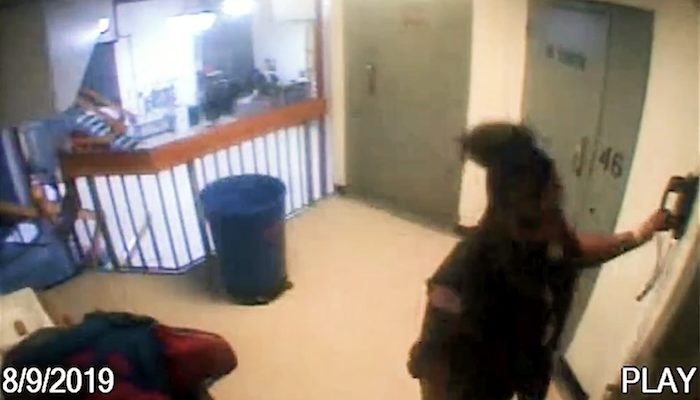
(José Niño, Headline USA) A federal correctional officer assigned to monitor Jeffrey Epstein conducted internet searches about the convicted sex offender just moments before his body was discovered and received thousands of dollars in cash deposits in the weeks preceding his death, newly released Justice Department documents show.

Tova Noel worked as one of two Metropolitan Correctional Center employees who authorities later accused of fabricating logs claiming they had conducted required welfare checks on Epstein throughout the overnight hours before his August 10, 2019 death. Both guards lost their jobs, though prosecutors eventually dismissed criminal charges against them.

According to FBI forensic analysis of Bureau of Prisons computers, Noel entered the search term “latest on Epstein in jail” at 5:42 a.m. and repeated the query ten minutes later at 5:52 a.m. Her fellow officer Michael Thomas located the financier hanging in his cell at 6:30 a.m., less than 40 minutes after her final search.

Prosecutors stated that during the overnight shift, the 37-year-old Noel browsed furniture websites and slept rather than performing the required inmate checks every half hour. Thomas spent time looking at motorcycle listings online.

The New York Post reported that federal investigators produced a 66-page forensic report examining the desktop computers used by both officers. The Epstein related search was the sole query that the FBI chose to highlight in its analysis.

During sworn questioning by Justice Department officials in 2021, Noel disputed the FBI’s findings. “I don’t remember doing that,” she stated in the transcript. She characterized the federal records as not “accurate. I don’t recall looking him up.”

Noel also asserted that the failure to conduct proper monitoring was widespread at the Manhattan detention facility. “I’ve never worked in the Special Housing Unit and actually done rounds every 30 minutes,” she informed investigators.

Separate DOJ files reveal that Chase Bank submitted a “suspicious activity report” to the FBI in November 2019 regarding cash transactions in Noel’s account. The financial institution documented a total of 12 deposits starting in April 2018, with the largest single transaction of $5,000 occurring on July 30, 2019, just 11 days before Epstein died.

Available bank records beginning in December 2018 document seven separate cash deposits amounting to $11,880. Noel began her assignment in the Special Housing Unit where Epstein was held on July 7, 2019, approximately one month before his death.

Records indicate Noel operated a 2019 Land Rover Range Rover valued at $62,000. DOJ interviewers never questioned her about the cash transactions, according to the documents.

An internal FBI briefing contained in the released files indicates the bureau concluded that Noel was most likely the unidentified orange figure visible in grainy security camera footage near Epstein’s cell at approximately 10:40 p.m. on the night before his death.

“At approximately 10:40 pm, a correctional officer, believed to be Tova Noel, carried linen or inmate clothing up to the L-Tier, last time any correctional officer approached the only entrance to the SHU tier,” federal agents documented. Investigators determined that Epstein used strips of orange fabric to hang himself.

In her sworn testimony, Noel, who had been working consecutive shifts that day, stated she last observed Epstein alive “somewhere around after 10” that evening. She maintained that she “never gave out linen, ever” or clothing to inmates, asserting that such distributions occurred during earlier shifts.

The blurred orange shape captured on video has fueled speculation and conspiracy theories since the FBI made the footage public last summer. An inspector general report from 2023 described the figure only as “unidentified correctional officers,” making these newly released FBI documents the first official record to connect a specific name to the image.

Noel stated she could not explain why Epstein possessed additional bedding in his cell. She noted that Thomas, the other officer on duty, was asleep from 10 p.m. until midnight. Facility protocols prohibit staff members from entering the cell area without accompaniment, according to prison employees.

Legal representatives for Noel offered no comment. When investigators directly asked whether she played any role in Epstein’s death, Noel answered “no.”

As the New York Post reported, Noel currently faces a civil lawsuit in Westchester County Supreme Court alleging she committed assault while employed as a medical office assistant at Montefiore Einstein Advanced Care.

José Niño is the deputy editor of Headline USA. Follow him at x.com/JoseAlNino

FBI Seizes Arizona Voter Data in Apparent Probe over Election Fraud

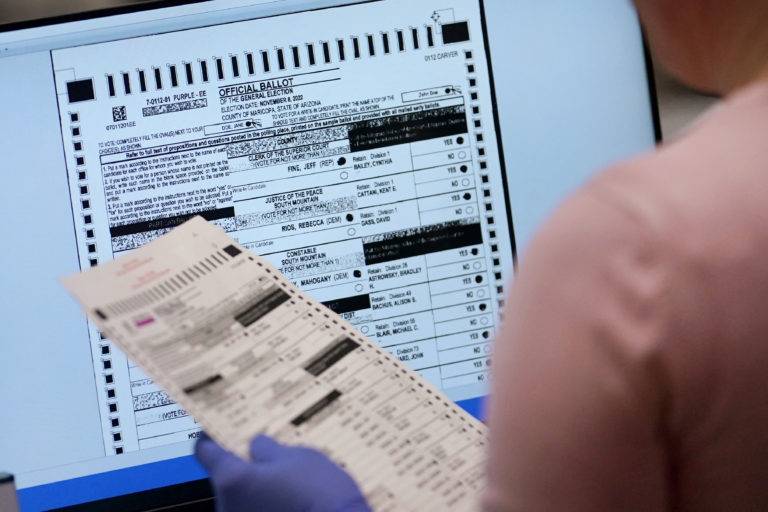
(José Niño, Headline USA) Federal investigators have broadened their criminal inquiry into potential election irregularities by using a grand jury subpoena to quietly obtain a substantial collection of voting records from Arizona’s largest county, according to multiple individuals with knowledge of the matter who spoke to Just the News.

Sources requesting anonymity due to grand jury secrecy requirements indicated that bureau agents are obtaining gigabytes of digital election information from Maricopa County. The action follows by roughly one month the FBI’s raid on an Atlanta area storage facility where agents seized ballots from the 2020 vote in Fulton County, Georgia’s most populous jurisdiction.

Federal agents received information about a document prepared by a pair of election monitors, one Republican and one Democrat, who said they witnessed potential problems during the November 2024 vote at an Arizona facility where unfilled and completed mail ballots were being stored together. House Administration Committee Chairman Bryan Steil stated that lawmakers are “working hand in glove with federal partners to make sure that the law was followed in every jurisdiction in the country.”

According to Just the News, sources anticipate the FBI will pursue search warrants and subpoenas targeting jurisdictions in states other than Georgia and Arizona within the coming weeks.

The court filing supporting the Fulton County operation revealed investigators are examining potential violations of federal statutes requiring election officials to adhere to state law. FBI Special Agent Hugh Raymond Evans informed the court that bureau investigators have “substantiated” certain significant irregularities in vote tabulation within Georgia’s largest metropolitan area following the 2020 election.

“Some of those allegations have been disproven while some of those allegations have been substantiated, including through admissions by Fulton County,” the agent documented. “This warrant application is part of an FBI criminal investigation into whether any of the improprieties were intentional acts that violated federal criminal laws.”

The federal action arrives half a decade after Republican legislators in Arizona’s upper chamber completed an extensive review of the 2020 election and determined that meaningful irregularities had occurred.

Among the most significant discoveries was a calculation suggesting that upwards of 200,000 ballots bearing signatures that did not match voter records may have been tabulated in Maricopa County without undergoing the required verification process.

The ballot records can be found here:

gov.uscourts.gand_.355087.22.1.pdf

José Niño is the deputy editor of Headline USA. Follow him at x.com/JoseAlNino.