What’s Up With the Treasury Market? Why Is Gold the Last Safe-Haven Standing?

(Mike Maharrey, Money Metals News Service) Gold seems to be the last safe-haven standing. While one would expect U.S. Treasuries to get a boost from the geopolitical uncertainty inherent in a war, they have not. In fact, the 10-year Treasury yield has jumped from 3.96 percent the day before the U.S. and Israel launched their attack to 4.22 percent on the morning of March 12.

The 30-year yield has taken a similar trajectory, nudging up from 4.63 percent on Feb. 26 to 4.87 percent today.

This indicates tepid demand for U.S. debt.

Meanwhile, gold was the go-to safe-haven when news of the war hit the presses. The yellow metal surged above $5,400 an ounce before giving back most of those gains a few days into hostilities.

Why aren’t U.S. Treasuries catching a safe-haven bid?

I think there are two reasons. One is specific to the dynamics of this war, and the other is a more fundamental shift away from U.S. dollar assets.

Bonds and Oil

Forest for the Trees founder and respected macroeconomic analyst Luke Groman told Kitco News the problems in the Treasury market can be traced to the outsized role oil is playing in the conflict with Iran. He said the sudden oil shock exposes the limitations of a global financial system built on dollars.

The fact that the world’s oil market runs on dollars means every country in the world depends on the U.S. currency. Global investors hold around $27 trillion in dollar-denominated assets, including U.S. Treasuries. Groman said that with oil prices surging, foreign nations are stuck between a rock and a hard place.

“They have to have energy, they have to have food, they have to have these commodities. And so, they will sell dollar assets starting with treasuries because they’re the deepest and most liquid, to essentially buy oil.”

Who Wants to Lend More Money to Uncle Sam?

The war is playing out on a larger game board. Treasuries have been struggling for months because a lot of countries simply don’t want any more exposure to U.S. fiscal malfeasance. The national debt has surged to $38.9 trillion.  Meanwhile, the federal government has shown zero interest in reining in spending. On top of that, it is blowing through an additional $1 billion per day to fight the war.

Would you want to lend your drunk uncle, who has maxed out all his credit cards, more money?

If not, you understand how the rest of the world feels about Uncle Sam.

So, it’s not surprising that many countries are anxious to minimize their exposure to the dollar. We see this reflected in accelerating de-dollarization and the fact that gold recently climbed above Treasuries as the world’s biggest foreign reserve asset. When times get tough, you don’t want rapidly devaluing dollars backed by a spend-happy U.S. government. You want real money – gold – backed by nobody.

Many countries are also concerned about the weaponization of the U.S. currency. In an article published by the Atlantic Council, Kimberly Donovan and Maia Nikoladze point out that “central banks that are worried about getting sanctioned, want to protect themselves from a potential global financial crisis, or both have been stacking up gold at record levels.

Make no mistake. This is a big problem for the U.S. because it depends on the global demand for dollars supported by its reserve status to underpin its massive government.

The only reason Uncle Sam can borrow, spend, and run massive budget deficits to the extent that it does is the dollar’s role as the world’s reserve currency. It creates a built-in global demand for dollars and dollar-denominated assets. This absorbs the Federal Reserve’s money creation and helps maintain dollar strength despite the Federal Reserve’s inflationary policies.

If the world needs fewer dollars, they will begin to return to the U.S., causing a dollar glut. This will increase inflationary pressure domestically as the value of the U.S. currency further depreciates. In the worst-case scenario, the dollar could collapse completely, leading to hyperinflation.

Groman pointed out a sobering reality.

“Iran doesn’t have to beat the U.S. military, if it even could, which I doubt. All it has to beat is the bond market.”


Mike Maharrey is a journalist and market analyst for Money Metals with over a decade of experience in precious metals. He holds a BS in accounting from the University of Kentucky and a BA in journalism from the University of South Florida.
CPI Steady as Inflation Keeps Increasing

(Mike Maharrey, Money Metals News Service) The headline Consumer Price Index was steady in February as inflation continues to rise.

How could this be?

Because the CPI doesn’t measure “inflation” (as properly defined). It simply reflects the price movements of a basket of goods dreamed up by the BLS. Yes, this does give some indication of the trajectory of price inflation. However, price inflation is just one symptom of monetary inflation.

February CPI By the Numbers

Based on the February CPI, one can argue that price inflation is holding steady. However, it remains stubbornly stuck above the Federal Reserve’s mythical 2 percent target.

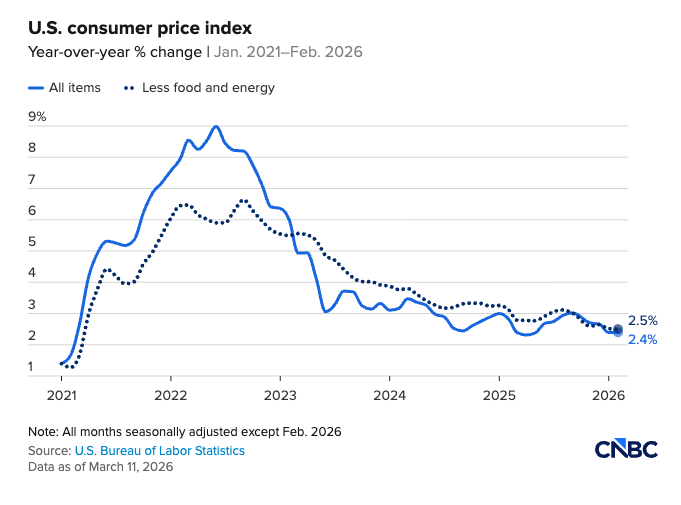
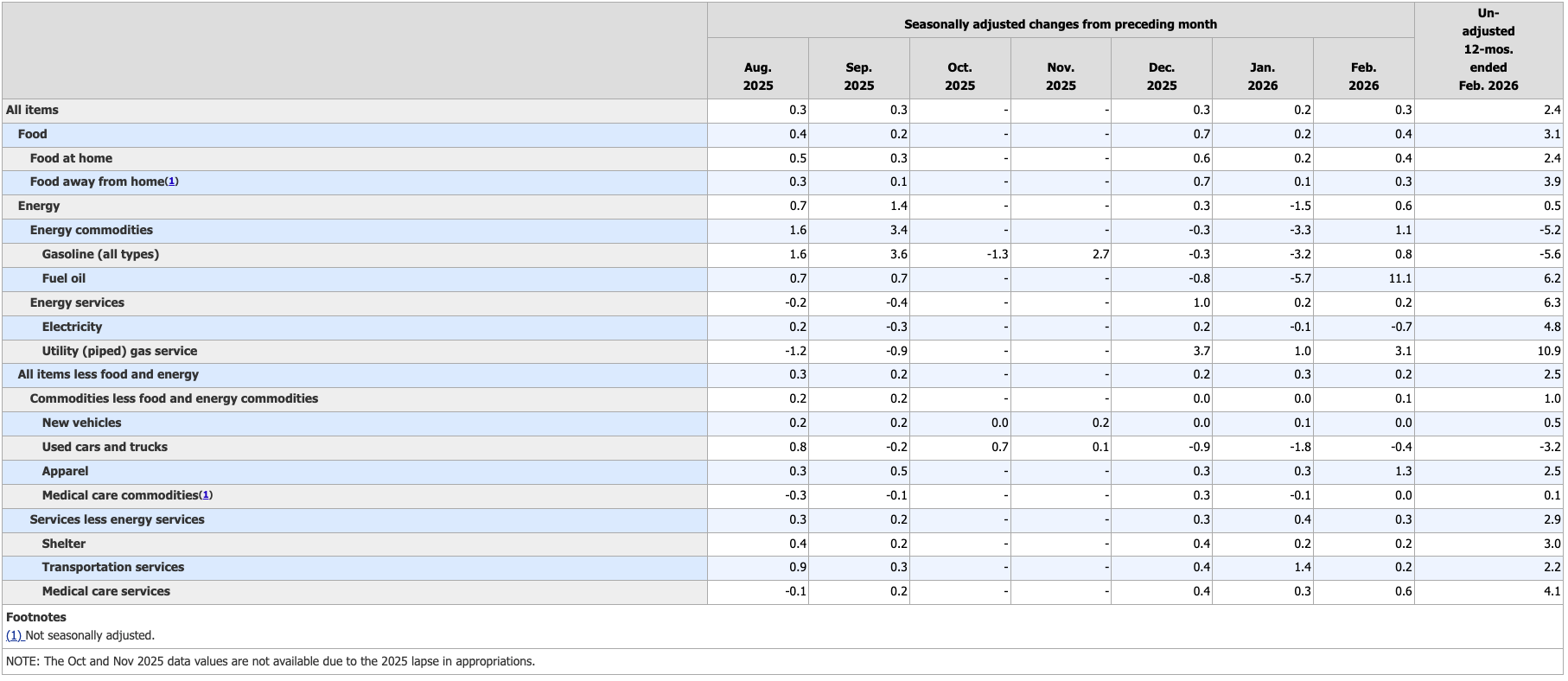
According to the most recent CPI data released by the BLS, prices rose 2.4 percent over the last 12 months. That was the consensus forecast and identical to the January reading. It was also the same rate the BLS reported in May 2025, the month after President Trump announced his aggressive tariff policy.

On a monthly basis, price inflation was a little hotter, rising by 0.3 percent.

Stripping out more volatile food and energy prices, core CPI prices cooled modestly, rising 0.2 percent month on month, after a 0.3 percent increase in January.

The annual core CPI held steady at 2.5 percent.

However, over the last six readings (with no October data), core CPI has increased by 0.3, 0.2, 0.2, 0.2, 0.3, and 0.2 percent, annualizing to 2.8 percent. Core CPI has been mired in this range for well over a year.

Looking at the details, rent (a convoluted BLS formula that tells us little about the actual cost of rent in the real world) hit the lowest level (0.1 percent month-on-month) since January 2021. That drove cooling prices in the overall shelter category, which rose by 0.2 percent. Shelter has been one of the biggest CPI drivers over the last several months.

Even as shelter costs moderated (based on the convoluted CPI formula), food prices heated up, rising by 0.4 percent during the month.

Energy prices also nudged up (even before the U.S./Israel attack on Iran), with gasoline prices up 0.8 percent in February. Even with the boost to gas prices, they are still down over 5 percent compared to the same period in 2025.

Apparel prices jumped sharply. Analysts attributed this to tariff costs.

Service prices continue to run hot, rising by 0.3 percent last month after a 0.4 percent gain in January. On an annual basis, service prices have gone up 2.9 percent.

As I mentioned, any time I report on government CPI data, it’s important to take this (and every) CPI report with a grain of salt. It is still factoring in November data that they basically just made up. And the constant revisions to the labor data should also make you skeptical of government numbers.

You also need to remember that the CPI data understates price inflation by design. The government revised the CPI formula in the 1990s so that it understated the actual rise in prices. Based on the formula used in the 1970s, CPI is closer to double the official numbers. So, if the BLS used the old formula, we’d be looking at CPI closer to 6 percent. And using an honest formula, it would probably be worse than that.

However, this government data drives decision-making, so we need to pay attention to what it tells us.

CPI May Be Steady, But Inflation Is Heating Up

So, what is the data telling us?

CNBC summed it up like this:

“The annual rates were unchanged from January, indicating that inflation was holding above the Federal Reserve’s 2 percent target but not getting worse.”

However, as I’ve already mentioned, CPI only measures price inflation, one symptom of monetary inflation (which is what economists and pundits used to mean when they talked about inflation).

If we look at the money supply, we find that inflation is heating up.

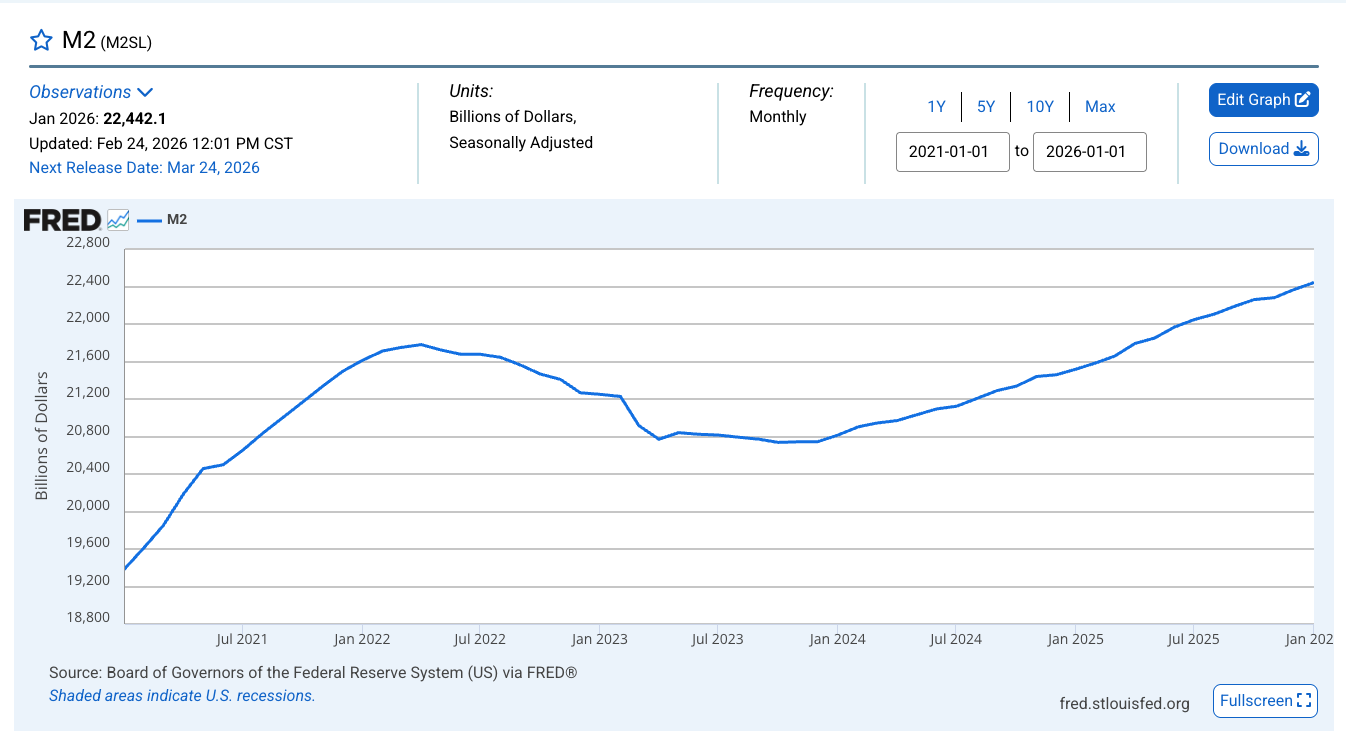
As the Federal Reserve revs up the money-creating machine even higher, the money supply is already growing at the fastest rate since July 2022, in the early stages of the tightening cycle.

After peaking in April 2022, the money supply began to decline as the Fed hiked rates that year. The money supply bottomed in October 2023 and began increasing again. The money supply is now well above the pandemic peak.

And money creation has accelerated over the last several months.

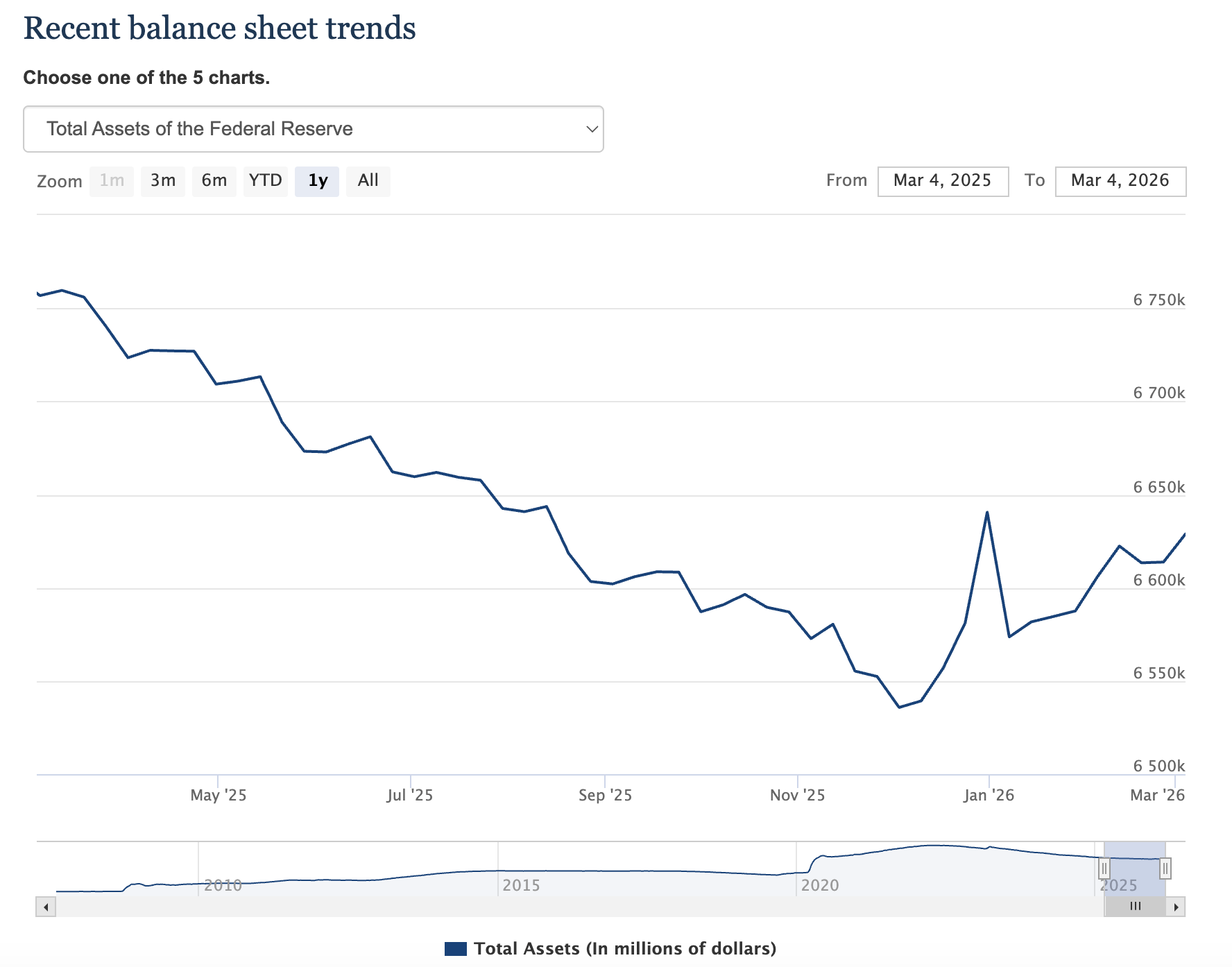
We also know inflationary pressures are increasing because the Federal Reserve is once again expanding its balance sheet.

While you’ll never hear anybody at the Fed utter the term, the central bank relaunched quantitative easing in December. That means they are once again buying U.S. Treasuries using money created out of thin air.

Ultimately, this monetary inflation will work its way through the economy. It will either manifest in rising asset prices or rising consumer prices. Ultimately, it is devaluing your money (by design).

War and Inflation

Market reaction to the February CPI data was muted. Everybody is sitting on pins and needles waiting for surging oil prices to show up in the CPI data.

When they do, keep in mind that it’s not “inflation” as technically defined. It is a price shock.

That’s not to say it won’t impact the economy. That’s not to say higher energy costs won’t be passed on through the price of other products. That’s not to say it won’t cause consumer pain. It’s only to say that rising oil prices due to a war are fundamentally different than rising prices due to inflation. It’s important to disambiguate and untangle these phenomena, or you’ll never get a clear understanding of what’s happening in the economy and the financial system.

Because, make no mistake – the war will cause inflation – on top of the oil shock.

Analysts say Uncle Sam is spending around $1 billion every day to fight the war. I will remind you that the federal government is broke and is already running massive deficits month after month. The war will widen the budget gap and require more borrowing. The Fed is already running stealth QE to prop up the sagging Treasury market. As the U.S. is required to issue more debt, it is likely the Fed will have to step in even more aggressively because there is no significant demand for U.S. Treasuries, despite geopolitical uncertainty that would historically create a safe-haven bid.

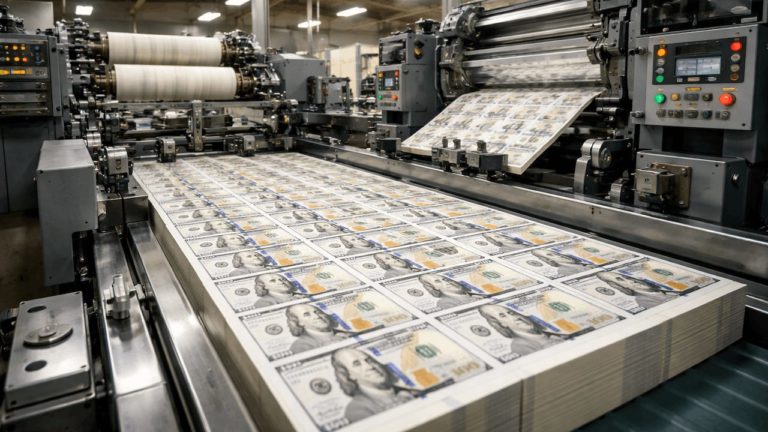
The bottom line is more money-printing.

And that IS by definition inflation.


Mike Maharrey is a journalist and market analyst for Money Metals with over a decade of experience in precious metals. He holds a BS in accounting from the University of Kentucky and a BA in journalism from the University of South Florida.
Why “Dead Investors” Beat the Market as Gold Surges Past $5,000

(Money Metals News Service) In a recent episode of the Money Metals Midweek Memo, host Mike Maharrey discussed how investors can easily lose focus in fast-moving markets. He compared the experience to watching his kitten hunt lizards on the pool deck. The kitten begins stalking a target but quickly becomes distracted by birds or squirrels.

Maharrey suggested that investors often behave the same way when reacting to the constant stream of news headlines, particularly during periods of geopolitical tension such as the current war with Iran.

The pace of headlines has accelerated as the conflict unfolds, and markets have responded with significant volatility. Maharrey warned that reacting emotionally to every news update can lead to poor investment decisions. The modern information environment creates constant distractions that tempt investors to respond immediately instead of stepping back and evaluating the bigger picture.

Why “Dead Investors” Often Perform Better

Maharrey referenced research from firms including Dalbar, Fidelity, and Vanguard that has shown an unusual pattern. Some of the best-performing investment accounts belong to people who either forgot about them or have passed away. These investors did nothing and therefore avoided making emotional decisions that might damage their portfolios.

Financial psychologist Brad Klontz has argued that human behavior represents the biggest threat to portfolio performance. Investors tend to sell when they panic and buy when they become overly enthusiastic.

Barry Ritholtz of Ritholtz Wealth Management has explained that large market swings can trigger the same fight or flight response that once helped humans survive in dangerous environments. That instinct may have helped people escape predators on the savannah, but it can cause significant damage in financial markets where impulsive decisions often produce poor outcomes.

Maharrey emphasized that investors should not completely ignore their portfolios. Adjustments are sometimes necessary. However, reacting to every short-term headline or market movement can destroy both savings and peace of mind. Trying to time markets based on the nonstop stream of news updates rarely produces good results.

Gold Prices and the Iran War

The ongoing war between the United States and Iran has contributed to significant volatility in precious metals markets. Shortly after the United States and Israel launched attacks on Iran, gold briefly surged above $5,400 per ounce before retreating. Since the correction earlier in the year, gold has largely traded between about $5,000 and $5,200 per ounce with frequent swings of $50 to $100 as investors react to new developments.

Research from Metals Focus indicates that geopolitical conflicts often create an initial safe haven surge in gold prices. Historically, that effect tends to fade as investor fatigue develops and attention shifts back to broader economic fundamentals. Analysts expect continued volatility driven by war headlines, but do not expect the conflict alone to push gold to new all-time highs unless the situation escalates dramatically.

Factors That Could Support Gold After the War

Metals Focus believes that several longer-term dynamics related to the conflict could support gold demand even after the immediate safe-haven surge fades. One issue involves broader changes in the United States foreign policy. The Trump administration has pursued a more interventionist approach that has already resulted in the overthrow of two regimes within two months. Analysts believe this shift increases geopolitical uncertainty and may strain relationships with traditional allies since the recent attacks were carried out with limited coordination with European partners.

Another factor involves the potential for long-term instability in the Middle East. Regime change does not necessarily produce a more stable political environment. In Iran, leadership has reportedly shifted to Mohammad Kamani, the son of the former supreme leader, who has been described by some observers as even more hardline than his predecessor. Maharrey noted that historical examples such as Afghanistan, Iraq, Syria, Libya, and Somalia demonstrate how foreign intervention often produces prolonged instability.

A third development involves the apparent decline of United States Treasury securities as a safe-haven asset. Historically, investors moved into Treasuries during times of uncertainty. During the current conflict, the yield on the 10-year Treasury has actually increased, indicating weak demand for government debt. Concerns about the rapidly growing national debt and fiscal deficits have reduced confidence in United States bonds. If Treasuries continue losing their safe-haven status, gold may increasingly fill that role.

War Spending and the Debt Problem

Maharrey also argued that the conflict may intensify underlying economic forces that were already pushing precious metals higher. The United States is dealing with what he described as a debt black hole. National debt continues to rise while household borrowing and corporate debt have also reached record levels. Increasing delinquency rates suggest that many households are already struggling to keep up with their obligations.

The war itself adds another layer of financial pressure. Estimates suggest that the conflict is costing roughly $1 billion per day. Because the federal government does not have these funds available, the spending will be financed through additional borrowing. Maharrey warned that rising debt levels typically lead to increased money creation, which reduces the purchasing power of the dollar and strengthens the long-term case for gold and silver.

Geopolitical tensions may also accelerate the global shift toward de-dollarization. Some countries have grown wary of holding dollar-denominated assets because the United States increasingly uses financial systems as tools of foreign policy. If more nations diversify away from the dollar, demand for gold reserves could continue increasing.

Logistics Disruptions in the Global Gold Trade

The war has also disrupted the logistics of the global gold market. With significant portions of Middle Eastern airspace closed and many flights cancelled, shipments of bullion have become difficult. Large quantities of gold are currently stranded in Dubai, which serves as one of the world’s most important refining and export hubs. In 2024, approximately 1,392 tons of gold flowed through the United Arab Emirates.

Mining companies often send partially refined doré bars containing between 60 percent and 90 percent gold to refineries in the UAE. These refineries process the metal into bullion bars or jewelry-grade gold before exporting it to Asian markets. Because transportation routes have been disrupted, some dealers in the UAE have reportedly sold gold at discounts of about $30 per ounce to avoid storage costs and logistical complications.

This bottleneck has created supply tightness in other regions. India, the world’s second-largest gold market after China, has experienced shipment delays as bullion remains stranded in the Middle East. Some refiners have reported difficulty securing doré supplies, while new supply contracts from other regions carry logistics costs that are 60 percent to 70 percent higher.

Although the gold market is larger and less vulnerable to shortages than the silver market, prolonged disruptions could still create localized price spikes. Silver markets remain particularly sensitive because global demand has exceeded supply for five consecutive years.

Keeping the Big Picture in Mind

Maharrey concluded that investors should remain focused on long-term fundamentals rather than reacting emotionally to daily headlines. Wars may create temporary volatility in precious metals markets, but the larger drivers remain government debt, monetary policy, inflation, and declining confidence in traditional financial safe havens.

In his view, these factors continue to support the long-term case for owning physical gold and silver. While headlines about the war may dominate the news cycle, the broader economic environment still points toward ongoing currency depreciation and rising demand for assets that can preserve purchasing power.

White House Abandoning Mass Deportation Policy

(José Niño, Headline USA) According to an Axios report, White House Deputy Chief of Staff James Blair privately advised House Republicans on Tuesday to drop the phrase “mass deportations” from their talking points and instead center their rhetoric on the removal of violent criminals, sources with knowledge of the closed door meeting said.

The instruction represents a notable pivot for an administration that built its 2024 campaign around promises of sweeping immigration enforcement. A Politico poll released in January showed that nearly half of Americans view Donald Trump’s deportation efforts as too aggressive, with one in five of the president’s own 2024 supporters sharing that assessment.

Blair made the remarks during a policy listening session at the House Republican retreat in Doral, Florida. He pushed members to highlight the deportation of violent offenders rather than mount a defense of mass removals as a general policy. The recommendation suggests mounting anxiety within GOP circles that Democrats have managed to cast Trump’s immigration agenda as sweeping and indiscriminate.

Following the Axios report, right-wing streamer Nick Fuentes said Wednesday that not only has the White House stopped pushing mass deportations as a political talking point; the administration has abandoned the policy altogether.

“Going forward, the mass deportations are officially over,” Fuentes said. “Going forward, the only people that will be deported are people with a prior criminal record.”

Immigration enforcement has served as a defining issue for the Trump administration and congressional Republicans over the past year. The White House has moved aggressively on enforcement since returning to power. However, the killing of two U.S. citizens in Minneapolis this year and accounts of American citizens being swept up in detention have muddied the political waters.

House Republicans have gathered this week to chart their legislative course and craft a plan for defending their majority in the November midterms. Blair also encouraged members to seek out “real Americans” to showcase the successes of the expansive legislative package enacted last summer.

José Niño is the deputy editor of Headline USA. Follow him at x.com/JoseAlNino 

Epstein Claimed He Had a Child, Newly Released Files Show

(Luis CornelioHeadline USA) Late convicted sex offender Jeffrey Epstein appears to have alluded to being a father in remarks to one of his alleged victims, according to newly released files. 

The documents include a 2020 interview with an Epstein victim who said he pointed to a photograph of a blonde woman inside his New York City home and identified her as the mother of his child. 

“This is the mother of my child,” Epstein said, according to the woman’s account in an interview with the FBI. 

The bureau conducted the interview five months after Epstein was found dead in his cell in a New York federal jail while facing sex trafficking charges, according to the Daily Mail, which first reported on the mention Wednesday.

According to the documents, the woman told the FBI that she met Epstein on at least five occasions in 2005.  

She said she was an aspiring model who had emigrated from a redacted country and met Epstein through mutual contacts, according to the Mail. 

The disturbing account also states that she was a virgin when she met Epstein, who later described her in crude terms as the “best d*** sucker.” 

She also recalled that in another suite of Epstein’s residence, there was a photograph of a blonde woman standing on a beach. 

According to the file cited by the Mail, investigators recorded the following statements from the victim: 

“Epstein told (redacted) that this was the mother of his child.”  

“There was a torso sculpture, like a mold – Epstein said this mold was of this woman.” 

“Epstein told that this woman was perfect. Epstein told that her husband will be very lucky.” 

The Mail’s reporting on the newly released documents comes after Epstein’s brother, Mark Epstein, dismissed rumors that the disgraced millionaire had children. 

“He doesn’t have any kids,” Mark Epstein said in remarks to the Daily Beast in February. 

His comments came after emails from September 2011 showed former Duchess of York Sarah Ferguson congratulating Epstein on having a “baby boy.” 

“Don’t know if you are still on this BBM [BlackBerry Messenger] but heard from The Duke that you have had a baby boy. Even though you never kept in touch, I am still here with love, friendship and congratulations on your baby boy. Sarah xx” she wrote. 

Mark Epstein suggested Ferguson’s message may have been intended for someone else. 

“Fergie was the only person on the planet that saw Jeffrey had a fictitious kid,” he added. 

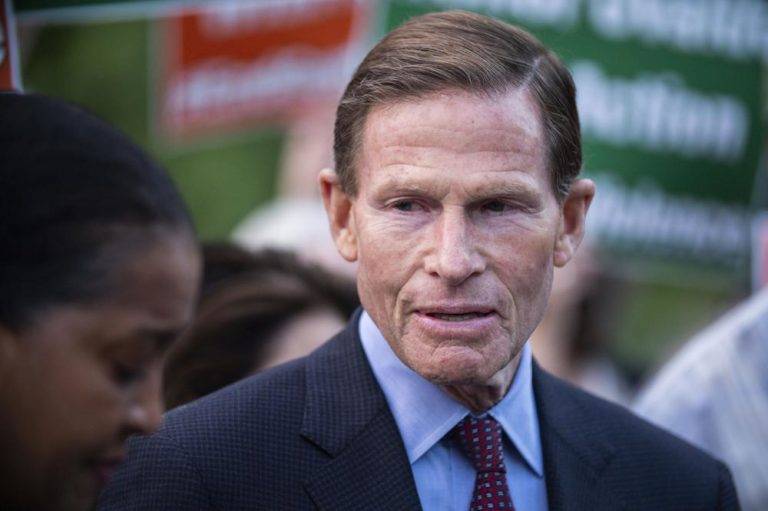
Sen. Blumenthal Says US ‘Seems To Be on a Path’ Toward Putting Troops in Iran

(Dave DeCamp, Antiwar.com) Sen. Richard Blumenthal (D-CT) said on Tuesday that the US “seems to be on a path” toward deploying troops to Iran, comments he made after a classified briefing for members of the Senate Armed Services Committee.

“We seem to be on a path toward deploying American troops on the ground in Iran to accomplish any of the potential objectives,” the senator told reporters.

Blumenthal said that he left the briefing “as dissatisfied and angry, frankly, as I have from any past briefing in my 15 years in the Senate.” He added that he had “more questions than answers, especially about the cost of the war.”

President Trump and his top officials have refused to rule out “putting boots on the ground” in Iran, and while a full-scale invasion doesn’t seem to be on the table, the US is reportedly considering sending in special operations teams, potentially to secure Iran’s stockpile of enriched uranium, though it may be buried under the rubble after the June 2025 US airstrikes that hit Iran’s nuclear facility.

Another option under consideration is to capture Kharg Island, an Iranian island in the Persian Gulf through which the vast majority of Iran’s oil exports pass.

Blumnethal, a Russia hawk and strong supporter of the proxy war in Ukraine, also raised the issue of Russia and China potentially helping Iran with intelligence. “Literally, Russia seems to be aiding our enemy, actively and intensively with intelligence, and perhaps with other means, and China also may be assisting Iran,” he said.

The senator described the conflict with Iran as “a war of choice made by this president, not chosen by the American people with potentially huge consequences to American lives.”


This article originally appeared at Antiwar.com. 

US Responsible for Bombing Iranian Elementary School: Preliminary Investigation

(Dave DeCamp, Antiwar.com) The US is responsible for bombing an elementary school in Minab, southern Iran, during the opening hours of the US-Israeli war against Iran on February 28, a strike that massacred 175 children, the vast majority being young schoolgirls and schoolboys, according to a preliminary US military investigation.

People briefed on the investigation told The New York Times that it appeared that US Central Command had created target coordinates for the strike using outdated information from the Defense Intelligence Agency.

Photo released by Iran of graves being dug for the children killed at the Minab school.

The school building was previously part of a nearby Islamic Revolutionary Guard Corps (IRGC) base but was separated and turned into a school sometime between 2013 and 2016, meaning the US military may have used information that was over a decade old. 

The US military has been using Artificial Intelligence to help with targeting, but the Times report said it appeared the strike on the school was likely the result of “human error.”

The Times said it reviewed satellite imagery showing that watchtowers that once stood near the building had been removed, three public entrances were opened to the school, ground was cleared, play areas, including a sports field, were painted on asphalt, and walls were painted blue and pink.

Middle East Eye reported that the school was hit by two separate strikes and that the second one hit children who were sheltering in a prayer hall after their parents were killed following the first attack. “When the first bomb hit the school, one of the teachers and the principal moved a group of students to the prayer hall to protect them,” an Iranian Red Crescent medic told MEE.

“The principal called the parents and told them to come and pick up their children. But the second bomb hit that area as well. Only a small number of those who had taken shelter survived,” the medic added.

So far, there’s been no confirmation or acknowledgement from US officials that the school was struck twice. The Times report said that based on its analysis, the IRGC base was struck again within two hours of the initial strikes.

It’s been clear since the day after the bombing that the US was likely responsible for the massacre at the school, and footage shows what appears to be a US-made Tomahawk missile striking the IRGC base during the attack. But President Trump has tried to pass the blame onto Iran and even falsely claimed that Iran has Tomahawk missiles, though when pressed on his claim, the president admitted he “didn’t know enough about it.”

US Secretary of War Pete Hegseth wouldn’t back up Trump’s claim that Iran was responsible but has also refused to comment on the massacre besides saying it’s “under investigation.” Throughout the US and Israeli bombing campaign, Hegseth has said the US military is operating without “stupid rules of engagement” and “without mercy.”

This article originally appeared at Antiwar.com.  

Trump Threatens ‘Consequences Never Seen Before’ If Iran Mines the Strait of Hormuz

(Dave DeCamp, Antiwar.com) President Donald Trump on Tuesday threatened Iran with “consequences never seen before” if its forces lay mines in the Strait of Hormuz, as the Trump administration appears to be scrambling on how to deal with the war’s impact on the global oil market.

“If Iran has put out any mines in the Hormuz Strait, and we have no reports of them doing so, we want them removed, IMMEDIATELY!” Trump wrote on Truth Social.

“If for any reason mines were placed, and they are not removed forthwith, the Military consequences to Iran will be at a level never seen before. If, on the other hand, they remove what may have been placed, it will be a giant step in the right direction!” the president added.

Not long after the initial post, Trump took to Truth Social again to claim that US forces “have hit, and completely destroyed, 10 inactive mine laying boats and/or ships, with more to follow!”

The president’s posts about the Strait of Hormuz came after US Energy Secretary Chris Wright claimed in a now-deleted tweet that the US Navy had escorted an oil tanker through the strategic waterway, a claim that turned out not to be true. The price of oil dropped after Wright’s post, then rose again after it was revealed to be false.

Iran’s Islamic Revolutionary Guard Corps (IRGC) has said that the Strait of Hormuz, through which about 31% of seaborne oil passed in 2025, is effectively closed and that any vessel wishing to pass must obtain Tehran’s permission.

“The claim of an oil tanker passing through the Strait of Hormuz with a U.S. military escort is utterly false,” Alireza Tangsiri, the commander of the IRGC’s Navy, said in a post on X on Tuesday. “Any passage of the US fleet and its allies will be halted by the net of Iranian missiles and suicide drones.

This article originally appeared at Antiwar.com.  

Steve Witkoff Admits He Doesn’t Know How Iran War Ends

(Dave DeCamp, Antiwar.com) US Middle East envoy Steve Witkoff acknowledged on Tuesday that he doesn’t know how the war with Iran will end as US-Israeli airstrikes on the Islamic Republic and Iranian counterattacks continue.

“I don’t know, Sara,” Witkoff told CNBC host Sara Eisner when asked how the conflict ends. “I know this, that President Trump is the wrong guy to go up against. That’s what I know.”

Witkoff and Jared Kushner, President Donald Trump’s son-in-law, led the negotiations with Iran in the weeks leading up to the opening of US-Israeli attacks on Iran, which began days before more talks were supposed to be held, marking the second time within one year that Iran was attacked while engaged in negotiations with the US.

After the war started, Witkoff claimed that during the first round of talks, Iranian officials said they had enough nuclear material to build 11 nuclear bombs and that they were “proud of it,” but a diplomat involved in the negotiations said that never happened.

“I can categorically state that this is inaccurate,” a Persian Gulf diplomat involved in the negotiations told MS Now.

Witkoff was referring to Iran’s stockpile of uranium that’s enriched to 60%, which is believed to be buried under rubble following the June 2025 airstrikes on Iran’s nuclear facilities, and is still below the 90% needed for weapons-grade uranium. The night before the US and Israel began bombing Iran, Oman’s foreign minister, who mediated the negotiations, said Iran was willing to give up its stockpile of enriched uranium to reach a deal.

During the negotiations, Witkoff also made the false claim that Iran could have material to make a bomb within a week despite the fact that Iran is unable to enrich uranium following the June 2025 strikes that President Trump said “obliterated” Tehran’s nuclear program. Trump has also repeated similar claims and said on Monday that he launched the war based on the advice of Witkoff, Kushner, Secretary of War Pete Hegseth, and Secretary of State Marco Rubio.

“In my opinion, based on what Steve and Jared and Pete, and others were telling me, Marco, that I thought they were going to attack us,” Trump said. The day after the US and Israel started the war, Pentagon officials told Congress that there was no indication Iran was planning to strike the US or Israel without being attacked first.

This article originally appeared at Antiwar.com.  


As Many as 150 US Troops Wounded in Iran War So Far

(Dave DeCamp, Antiwar.com) As many as 150 US troops have been wounded in the war with Iran since it was launched by the US and Israel on February 28, Reuters reported on Tuesday.

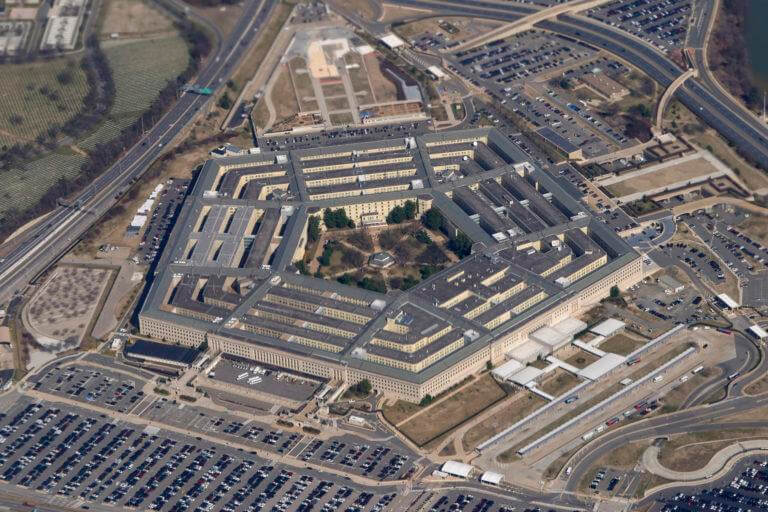
Prior to the report, the Pentagon had only said that eight US soldiers were “seriously wounded” and confirmed the deaths of eight US service members, including seven killed by Iranian counterattacks and one who died during an unspecified “medical emergency.”

After the Reuters report was published, the Pentagon acknowledged that at least 140 US troops had been injured. “Since the start of Operation Epic Fury, approximately 140 U.S. service members have been wounded over 10 days of sustained attacks,” said Pentagon spokesman Sean Parnell.

“The vast majority of these injuries have been minor, and 108 service members have already returned to duty. Eight service members remain listed as severely injured and are receiving the highest level of medical care,” he added.

Fox News reporter Jennifer Griffin said that she learned that the eight soldiers who are designated as “seriously injured” face life-threatening injuries.

Throughout the war, the message from President Trump and his top officials is that Americans should expect more US troops to be killed.

This article originally appeared at Antiwar.com.