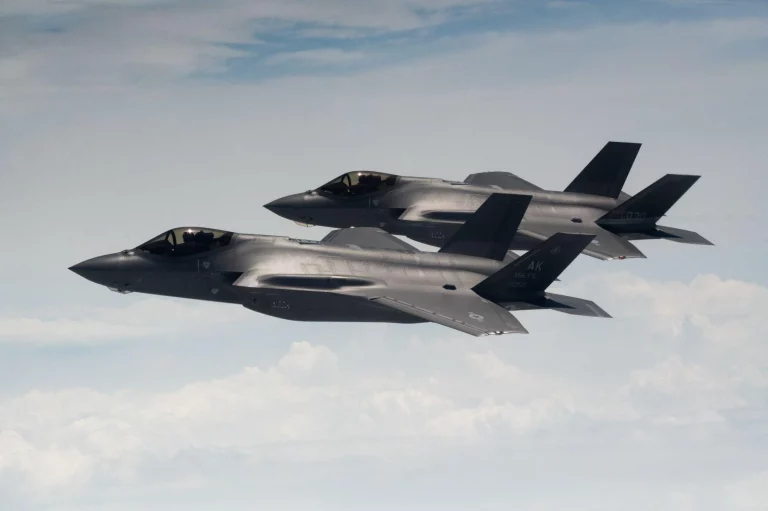
(Headline USA) A U.S. Air Force training jet crashed Tuesday in west Alabama with both pilots ejecting safely, military officials said.
Military officials said a T-38 Talon II aircraft from Columbus Air Force Base in Mississippi was involved in a mishap at noon on Tuesday.
“The cause of the mishap is currently unknown and will be investigated by a Safety Investigation Board,” according to a news release from base officials.
The public affairs office at the Columbus Air Force Base said it could not provide information about the condition of the pilots other than to say they safely ejected.
The base is home to the 14th Flying Training Wing, which trains pilots on a variety of aircraft. The T-38 Talon is a supersonic jet trainer.
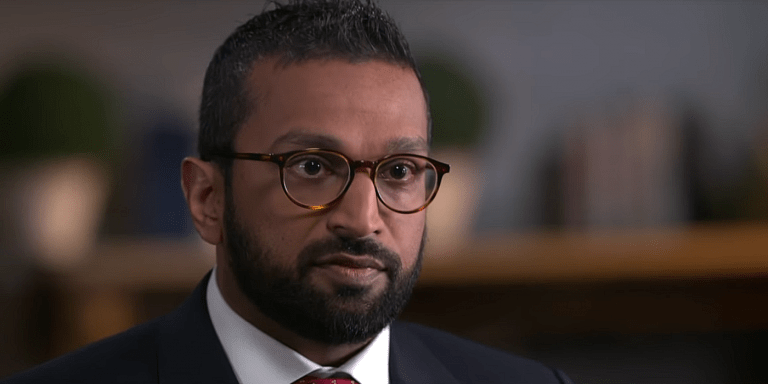
(Headline USA) FBI Director Kash Patel angrily lashed out at a Democratic lawmaker at a budget hearing Tuesday, calling allegations that he drinks excessively on the job and has been unreachable at times to his staff “unequivocally, categorically false.”
“I will not be tarnished by baseless allegations,” Patel told Sen. Chris Van Hollen when the Maryland Democrat confronted him about a recent article in The Atlantic magazine that painted an unflattering portrait of his leadership of the nation’s premier federal law enforcement agency. Patel has sued over the story. The Atlantic has said it stands by its reporting and would vigorously defend against the “meritless lawsuit.”
In a heated exchange during a Senate hearing on Tuesday, FBI Director Kash Patel denied allegations of frequent drinking when asked by Sen. Chris Van Hollen (D-MD) about a recent report by The Atlantic magazine which included allegations that Patel often drinks to excess. "It's a… pic.twitter.com/SSzWhxFOPA
Patel shouted over Van Hollen and sought to turn the tables by accusing him of “slinging margaritas” in El Salvador, a reference to a visit the Democrat paid last year to Kilmar Abrego Garcia while he was jailed there following his arrest in Maryland.
The testy exchange occurred at an annual Senate committee budget hearing featuring Patel and other senior law enforcement leaders.
(Headline USA) A man previously convicted of shooting at police strode down a busy road outside Boston, firing an assault-style rifle at passing cars, shooting two drivers and sending others scrambling until he was wounded when a state trooper and a former Marine opened fire, authorities said.
Multiple witnesses describe seeing a man armed with a rifle shooting into busy traffic along Memorial Drive in Cambridge on Monday afternoon.
As bullets tore through at least a dozen cars, including a state police cruiser, panicked motorists abandoned their vehicles or hid under them for cover, according to prosecutors and state police. Authorities said the gunman fired more than 60 rounds during the Monday afternoon attack in which two victims suffered life-threatening injuries.
The shooting happened on a heavily traveled road along the Charles River in Cambridge, home to Harvard University and the Massachusetts Institute of Technology. Sidewalks and riverside paths in the area are often crowded with pedestrians, joggers and cyclists.
“While people were jumping from their cars, scattering in various directions … both that trooper and that civilian, rather than going in one direction, went toward the suspect with their weapons to try to end that situation,” Middlesex District Attorney Marian Ryan said at a news conference Monday night.
The suspect, identified by prosecutors as 46-year-old Tyler Brown of Boston, was shot multiple times in the extremities and is expected to face charges including two counts of armed assault with intent to murder and other gun offenses.
“What happened today cannot stand,” the district attorney said.
In 2020, Brown was arrested after firing several rounds at Boston police officers, according to the Suffolk County District Attorney’s office. Prosecutors at the time said he should serve at least 10 years in prison, due to the “level of brazen violence” and because he was on probation for a 2014 conviction on assault and witness intimidation charges. Suffolk Superior Court Judge Janet Sanders instead ordered Brown to serve five to six years in state prison and three years of probation with credit for the nearly 18 months he’d spent in custody.
At the time, the judge’s decision sparked outrage and criticism among local officials concerned that violent offenders weren’t being held accountable. Those same concerns returned after Monday’s shooting.
“Talk about a ball drop,” said the Boston Police Patrolmen’s Association in a statement posted on social media. “The fact that the judicial system thought it was prudent to show leniency to a wannabe cop killer 5-years ago is not only the definition of insanity but an undeniable insult to those who put their lives on the line everyday.”
Rachael Saveriano said she was trapped in her car Monday as other vehicles tried to make U-turns in front of her when she saw Brown walking toward her, waving his gun.
The man authorities later identified as a former Marine helped her escape, she told The Boston Globe.
“I didn’t know what to do. It doesn’t feel like you should get out of the car when there is a shooter coming toward you, but there was a man next to me,” she said. “He opened my car door, pulled me out, and told me to run. He made a barricade with the door and I just started running.”
Saveriano said she saw the man shooting at Brown before she ran into a nearby hotel.
“He is an incredible hero,” she said. “He was so calm, and he didn’t hesitate.”
Ryan said investigators found no connection between Brown and the people targeted in the shooting. She renewed her call for harsher penalties on people who fire weapons without regard for the risk of serious injury.
Brown was not medically ready to go to court for an arraignment, the Cambridge District Court said Tuesday. The Committee for Public Counsel Services has been appointed to defend him, and a message seeking comment was left with the agency on Tuesday. A message was also left at a phone number listed for Brown and a potential family member, while another possible relative said they didn’t know him.
(Bethany Blankley, The Center Square) Over the past seven years, Border Patrol agents working in the U.S. Customs and Border Protection Detroit Sector have seized the greatest volume of drugs at the northern border.
The CBP Detroit Sector area of responsibility covers four states: Illinois, Indiana, Michigan and Ohio. It spans 863 maritime miles of international water boundaries as well as more than 3,800 miles of lakeshores and riverbanks.
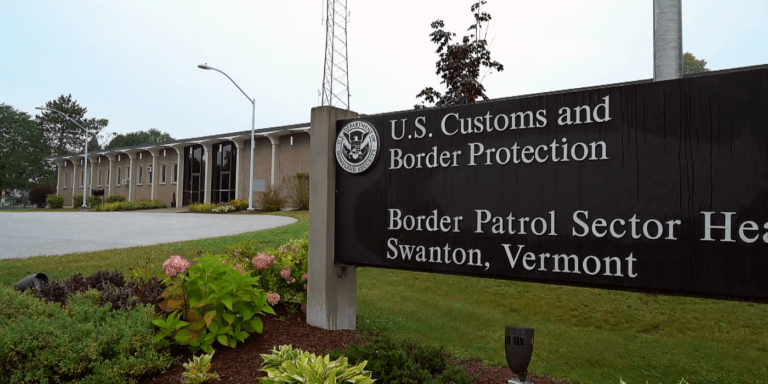
Under the Biden administration, a record number of illegal border crossers were reported and apprehended, primarily in the Swanton Sector in Vermont, New Hampshire and upstate New York, The Center Square reported. However, drug and weapons seizures were higher in the Detroit Sector, CBP notes, with most seizures occurring inbound to Canada.
According to a General Accountability Office analysis of northern border security published this year, from fiscal years 2019 through March 31, 2026, Detroit Sector Border Patrol agents recorded 681 narcotics seizures, more than any of the other eight northern border sectors.
According to CBP data over the last two fiscal years, Detroit Sector Border Patrol agents averaged 150 narcotics seizures per year.
“Ours is a challenging environment, with both narrow waterways and the expansive Great Lakes, as well as high traffic corridors near major population centers and transportation routes that are attractive to smuggling and criminal organizations,” Border Patro Detroit Sector’s Acting Chief Patrol Agent Javier Geronimo Jr. said. “No matter the challenge, Detroit Sector agents continue to collaborate with our local, state, and federal partners to safeguard our communities and uphold the security of the United States.”
The GAO report analyzed eight sectors in 12 northern border states where Border Patrol agents are responsible for covering 4,000 land miles and 2,400 nautical miles, including the Great Lakes system, St. Lawrence River and Strait of Juan de Fuca. Norther Border sectors from west to east include Spokane, Blaine, Havre, Grand Forks, Detroit, Buffalo, Houlton and Swanton.
The top drug seized at the northern border, including in the Detroit Sector, was marijuana, followed by methamphetamine and cocaine, according to CBP data analyzed in the GAO report. Over the same time-period analyzed, Border Patrol agents reported a 137% increase in cocaine seizures and a 746% increase in fentanyl seizures, according to the data.
From 2019 to 2024, Border Patrol agents also reported a 495% increase in weapons seizures, primarily in the Detroit and Spokane sectors, with the majority of foiled attempts inbound to Canada, according to the data.
The seizures in Michigan are notable because Border Patrol agents are primarily patrolling waterways near major cities and highway corridors, CBP explains. They’re responsible for patrolling international boundaries in four Great Lakes (Erie, Huron, Michigan and Superior) as well as Lake Saint Clair and the Detroit, Saint Clair and Saint Mary’s rivers.
“The lakes and rivers which compose the international border in Michigan allow easy waterway access into the United States from Canada for nine months out of the year. During the rest of the year many of those waterways freeze over, impeding navigation by boat. In many places, however, ‘ice bridges’ are created which allow for illegal crossings by foot or snowmobile,” CBP explains.
Overall, Detroit Sector Border Patrol agents are responsible for covering 83 counties and 57,000 square miles in Michigan; roughly seven million acres of state and national forests in the northern half of Michigan’s lower peninsula and most of its upper peninsula; and 22,000 square miles in its lower peninsula.
(Ken Silva, Headline USA) This author, Headline USA editor Ken Silva, has published a book on the Trump assassination attempts—providing readers with the most comprehensive account to date of the Butler, Pennsylvania and Palm Beach, Florida incidents, as well as several other plots against the president.
Chapter 1 of the book—the Trump Assassination Plots: What the Investigations Missed, and Why It Matters—provides a minute-by-minute account of what happened in Butler on July 13, 2024. The chapter is underpinned by bodycam and cellphone footage, radio communications, and thousands of pages of interview transcripts from the agents and officers who were there.
Chapter 2 then rewinds to the week before Butler, exposing the shoddy security planning that led to disaster.
Chapter 3 delves into the aftermath, including the congressional hearings that took place in late July and August 2024, the initial reports, and the conspiracy theories that proliferated at the time.
After that, Chapter 4 looks at the curious case of Ryan Routh, the man who tried to kill Trump at his Palm Beach golf course on Sept. 15, 2024. The chapter gives an unprecedented view of Routh’s life leading up to that attempt, including his long criminal rap sheet and adventures as a volunteer in Ukraine.
The book then turns to the so-called Iranian assassination plots on Trump—real and imagined. Contrary to the mainstream media accounts of the plots, Chapter 5 shows how they were fomented by undercover FBI agents and informants.
The book takes an even darker turn in Chapter 6, when the author sheds light on the murky world of online extremism. Starting with the disturbing early 2025 incident involving a young man who killed his parents in a hairbrained plot to assassinate Trump, the book asks: Might the alleged would-be Butler assassin, Thomas Crooks, have a similar backstory?
Speaking of Crooks, Chapter 7 goes into his history. While numerous questions still remain, the chapter provides the most complete biography of Crooks to date.
The book finishes with Chapter 8, which details the new Trump administration’s bizarre silence about the assassination attempts. The chapter ends with some unanswered questions about Crooks, Routh and others who may have been involved.
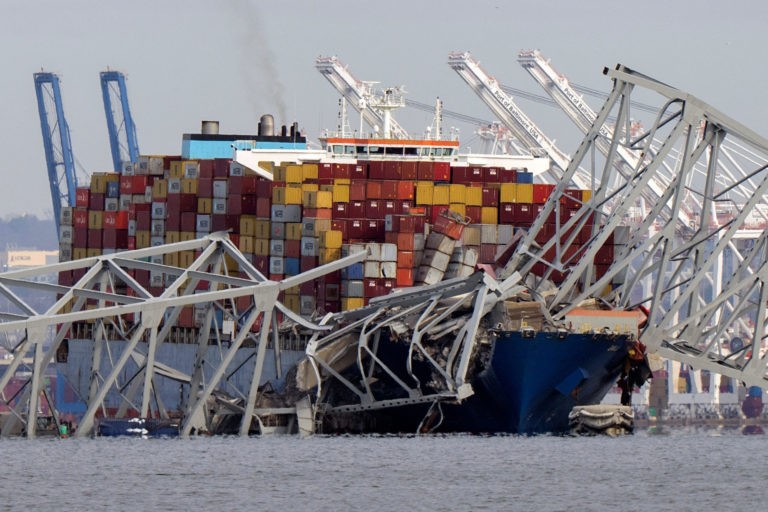
(Headline USA) Federal prosecutors announced charges Tuesday in the 2024 collapse of Baltimore’s Francis Scott Key Bridge, accusing the Singapore-based operator of a ship and a key employee of making critical decisions that led to the disaster and the deaths of six people.
The indictment names Synergy Marine Pte Ltd., based in Singapore, and Synergy Maritime Pte Ltd., based in Chennai, India. Radhakrishnan Karthik Nair, 47, an Indian national who was technical superintendent for the Dali container ship, was also charged.
The Dali crashed into the Francis Scott Key Bridge on March 26, 2024, killing six construction workers who had been filling potholes.
“The collapse of the Francis Scott Key Bridge was a preventable tragedy of enormous consequence,” said Acting Attorney General Todd Blanche.
The companies and Nair are charged with conspiracy, willfully failing to immediately inform the U.S. Coast Guard of a known hazardous condition, obstruction of an agency proceeding and false statements.
An FBI investigation into the crash focused on the vessel’s operations and whether the crew knew of critical systems issues before leaving port.
The National Transportation Safety Board found last year that two electrical blackouts — one caused by a loose wire aboard the Dali and another by problems with a fuel pump — disabled the controls of the huge cargo ship before it crashed into the bridge.
The Dali was leaving Baltimore bound for Sri Lanka when its steering failed because of the power loss. The ship crashed into a supporting column of the bridge at about 1:30 a.m.
Maryland officials estimate it could cost between $4.3 billion and $5.2 billion to replace the bridge, which is expected to be open to traffic in late 2030.
But the true cost of the collapse was far greater, according to the Maryland Attorney General’s Office. It halted shipping at the Port of Baltimore, disrupted the livelihoods of thousands, rerouted road traffic through communities already bearing disproportionate burdens and triggered economic problems statewide.
The indictment comes on the heels of a settlement in principle between the State of Maryland, Synergy Marine and Grace Ocean Private Limited, the Singapore-based ship owner, Attorney General Anthony Brown announced in April.
That lawsuit alleged the crash was the result of negligence, mismanagement and the reckless operation of a vessel that was not seaworthy and should never have left port. Plaintiffs include the families of the six construction workers who died, owners of cargo that was on the ship and local governments seeking damages for economic losses. The details of the settlement haven’t been disclosed and some portions of the lawsuit remain unresolved.
The state sought damages on behalf of its agencies for the destruction of the bridge, harm to the Patapsco River and surrounding environment, lost revenues and economic losses to Maryland and its residents.
The settlement does not resolve any claims the state has against the shipbuilder, Hyundai, the attorney general’s office said in April.
The bridge, a longstanding Baltimore landmark, was a vital piece of transportation infrastructure that allowed drivers to easily bypass downtown. The original 1.6-mile (2.6-kilometer) steel span took five years to build and opened to traffic in 1977.
(Headline USA) President Donald Trump’s plan to put weapons in space — pitched as a “Golden Dome for America” missile defense program — is estimated to cost $1.2 trillion, according to a new analysis from the Congressional Budget Office, a far heftier sum than the initial $175 billion price tag he gave last year.
The nonpartisan CBO report, published Tuesday, is described as an analysis that reflects “one illustrative approach rather than an estimate of a specific Administration proposal.”
The futuristic system was ordered by Trump in an executive order during his first week in office. He said then that he expected the system to be “fully operational before the end of my term,” which wraps up in January 2029.
“Over the past 40 years, rather than lessening, the threat from next-generation strategic weapons has become more intense and complex with the development by peer and near-peer adversaries of next-generation delivery systems,” Trump said in his executive order, justifying the need for the missile defense system.
The concept for the missile system is at least partly inspired by Israel’s multitiered defenses, often collectively referred to as the “Iron Dome,” which played a key role in defending it from rocket and missile fire from Iran and allied militant groups as it prosecutes the war on Iran alongside the U.S.
The U.S. Golden Dome is envisioned to include ground and space-based capabilities able to detect, intercept and stop missiles at all major stages of a potential attack.
Congress has already approved roughly $24 billion for the missile defense initiative through Republicans’ massive tax and spending measure signed into law last summer.
Last May, the president said the Golden Dome would cost $175 billion. The CBO last year estimated that just the space-based components of the Golden Dome could cost as much as $542 billion over the next 20 years.
(Mike Maharrey, Money Metals News Service) No matter how you slice the data, it keeps coming up inflation.
The April CPI data did nothing to allay fears of renewed inflationary pressure as rising energy prices continued to impact the economy.
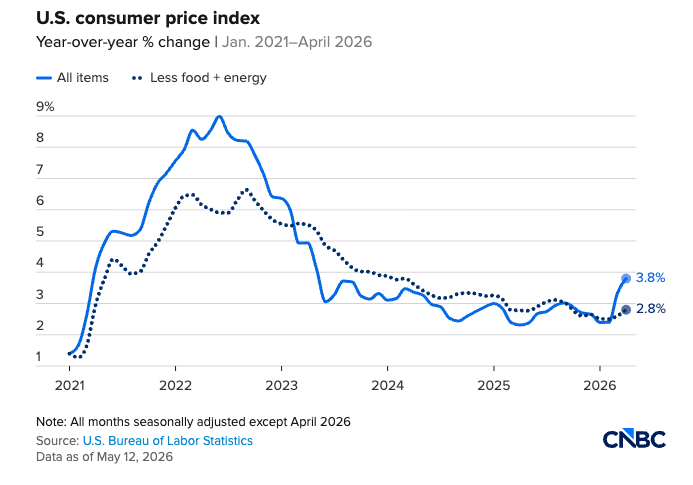
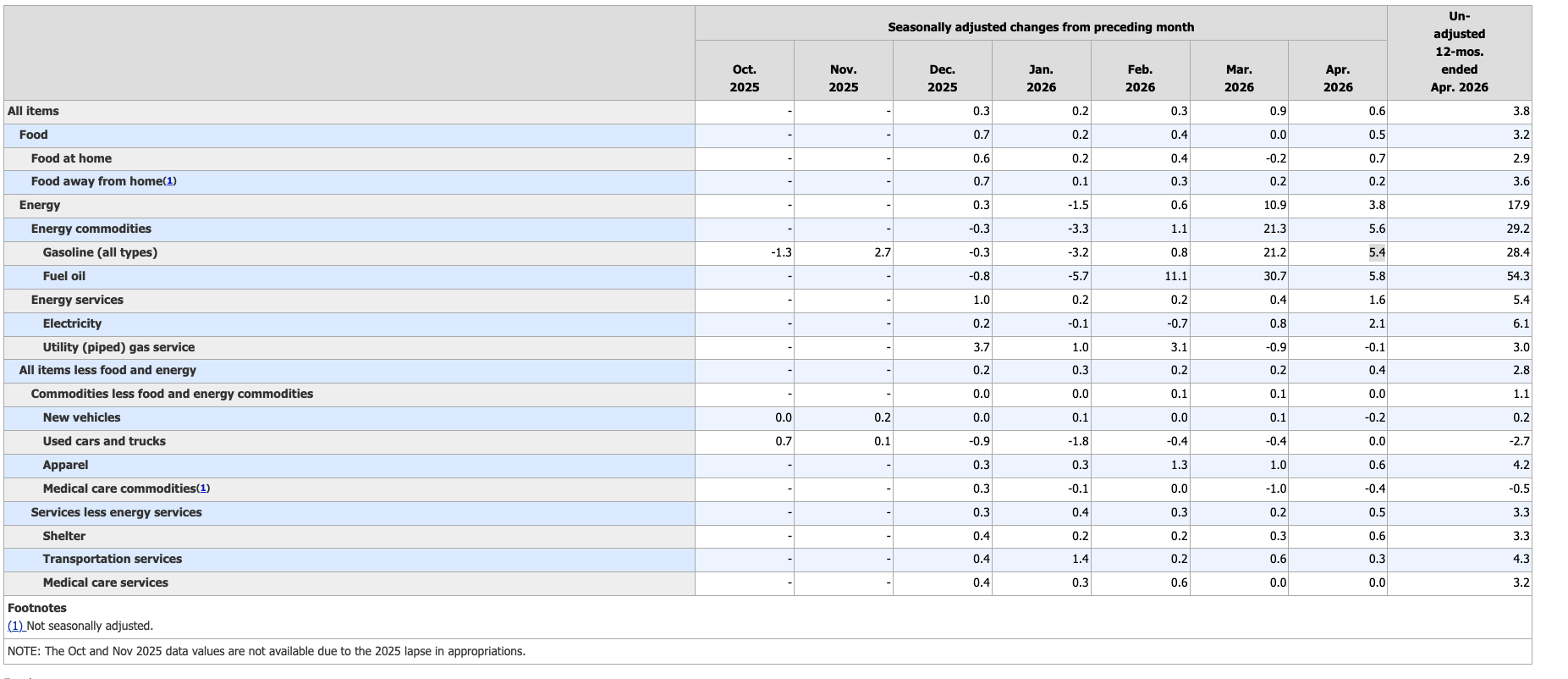
On a monthly basis, the CPI rose 0.6 percent, adding to the 0.9 percent rise in prices in March. That drove the annual CPI to 3.8 percent, the highest level since May 2023.
The monthly increase was as forecast, with the annual CPI coming in just above expectations.
Unsurprisingly, spiking energy costs as the Iran war drags on had a significant impact on the overall CPI, contributing about 40 percent to the overall jump. The energy index rose 3.8 percent last month, driven by a 5.4 percent increase in gasoline prices. Gasoline is up 28.4 percent from one year ago.
More concerning is that we’re starting to see prices tick up in other categories. Core CPI, stripping out more volatile food and energy costs, rose 0.4 percent in April, pushing annual core CPI to 2.8 percent.
It’s important to point out that core CPI remains above the Fed’s stated 2 percent target and has been mired in this range for well over a year. This indicates that recent price inflation isn’t merely reflecting an oil shock. There is underlying inflationary pressure in the system (more on that in a moment).
Breaking down the data, we find food prices rose 0.5 percent in April, and the shelter index spiked by 0.6 percent. Service price (less energy services) also rose 0.5 percent.
As I mentioned, any time I report on government CPI data, it’s important to take this (and every) CPI report with a grain of salt. It is still factoring in November data that they basically just made up. And the constant revisions to the labor data should also make you skeptical of government numbers.
You also need to remember that the CPI data understates price inflation by design. The government revised the CPI formula in the 1990s so that it understated the actual rise in prices. Based on the formula used in the 1970s, CPI is closer to double the official numbers. So, if the BLS used the old formula, we’d be looking at CPI closer to 6 percent. And using an honest formula, it would probably be worse than that.
However, this government data drives decision-making, so we need to pay attention to what it tells us.
The Underlying Inflation Story
The CPI doesn’t tell the full inflation story. It simply reflects the price movements of a basket of goods made up out of thin air by the number crunchers at the BLS. Yes, this does give some indication of the trajectory of price inflation. However, it tells us little to nothing about the inflation trajectory as economists have historically defined it.
Inflation is not “rising prices.” Increasing consumer prices are one symptom of inflation, defined as an increase in the supply of money and credit. Rising consumer prices are a symptom of this monetary inflation.
Other factors – such as oil shocks – also raise a lot of prices. We see that in the current CPI data. However, this is fundamentally different from monetary inflation, which is only caused by one thing – government/central bank money creation.
And if we look at the money supply, we find that inflation (properly defined) is heating up, with or without an oil shock.
In fact, if we use the economic definition of inflation as an increase in the money supply, the inflation rate is much higher – double the CPI.
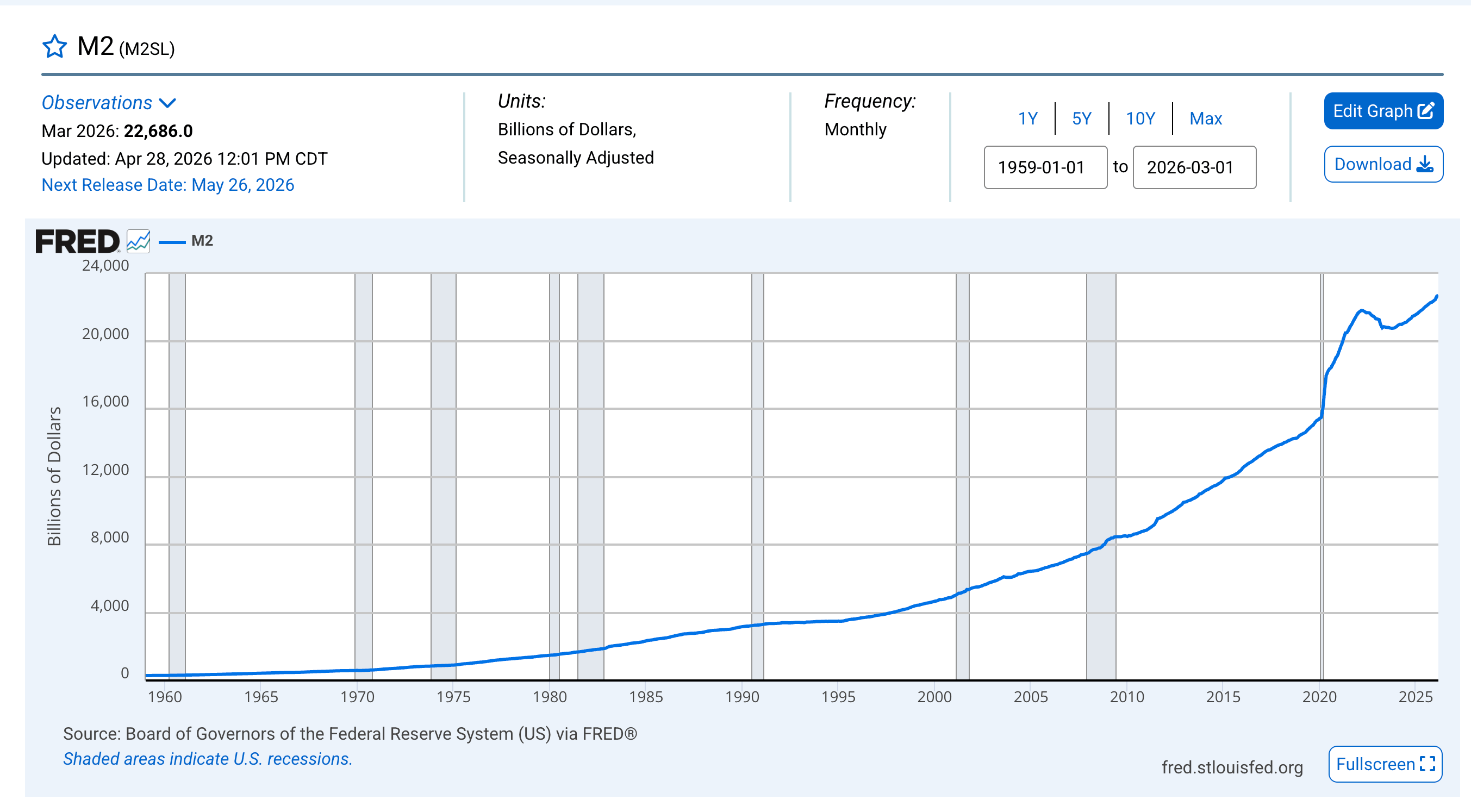
Based on the Fed’s M2 data, the money supply increased from $21.61 trillion in February 2025 to $22.67 trillion in February 2026, a 4.9 percent increase.
In other words, we have an actual inflation rate of nearly 5 percent.
The M2 money supply increased by another $57 billion in March.
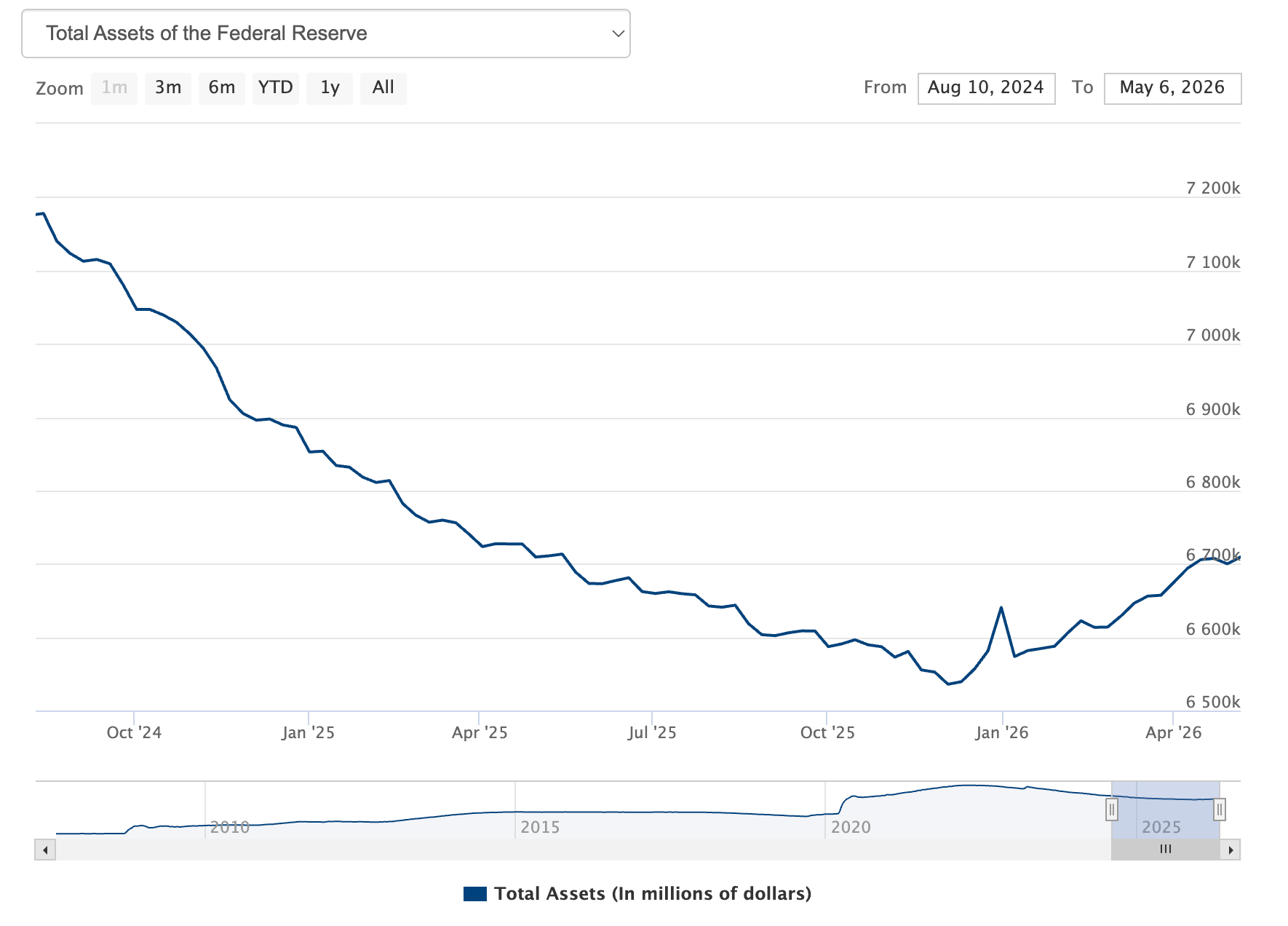
We also know inflationary pressures are increasing because the Federal Reserve is once again expanding its balance sheet.
While you’ll never hear anybody at the Fed utter the term, the central bank relaunched quantitative easing in December. That means they are once again buying U.S. Treasuries using money created out of thin air.
Ultimately, this monetary inflation will work its way through the economy. It will either manifest in rising asset prices or rising consumer prices. Ultimately, it is devaluing your money (by design).
If the U.S. and Iran can negotiate a permanent end to hostilities, this oil shock will quickly pass. The pundits and prognosticators will claim the inflation problem is gone. It won’t be. As long as the government keeps creating money, the inflation problem will persist.
Plan accordingly.
Mike Maharrey is a journalist and market analyst for Money Metals with over a decade of experience in precious metals. He holds a BS in accounting from the University of Kentucky and a BA in journalism from the University of South Florida.
(Mike Maharrey, Money Metals News Service) Are we in the early stages of a fundamental shift in global monetary history?
Analysts at Deutsche Bank Research Institute think we are. They see a future where the dollar plays a much smaller role.
As the USSR’s empire crumbled, Francis Fukuyama proclaimed that humanity had reached “the end of history.” The U.S. was the unchallenged global hegemon with unprecedented military and economic power. Central banks sold gold and accumulated dollars.
Things have changed in recent years, and there has been an undeniable de-dollarization trend.
Even before Russia invaded Ukraine, many central banks were accumulating gold. With the U.S. weaponization of the dollar after the Russian invasion, the pace accelerated.
In a detailed research report, Deutsche Bank analysts Mallika Sachdeva and Michael Hsueh argue that “the end of history has come to an end.”
“The world is back in a superpower struggle; the U.S. is retreating from free trade, alliances, and security provision; the Great Economic Moderation is behind us; and the dollar banking system has been weaponized. The ‘return of history’ has big implications for gold and the dollar.”
Is De-Dollarization Real?
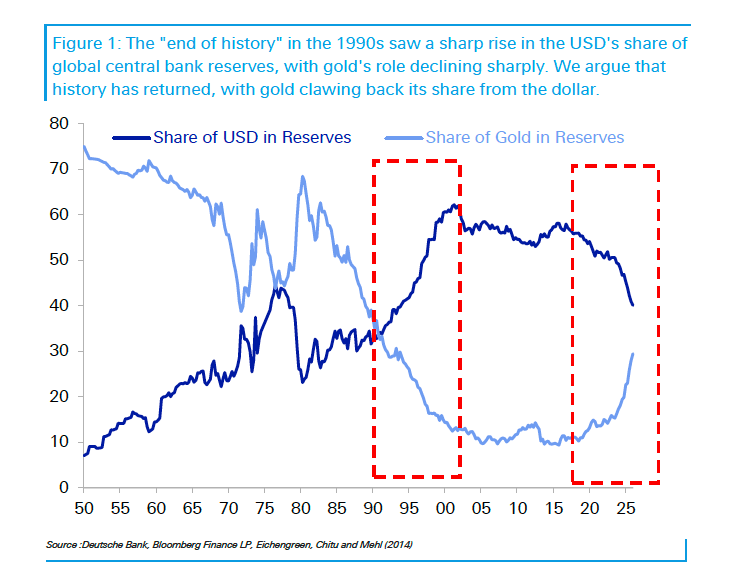
Some people claim the de-dollarization trend his overhyped, but the data is hard to ignore. The share of dollars in global central bank reserves has dropped sharply from around 60 percent to around 40 percent today. Meanwhile, the share of gold has doubled in the last four years to around 30 percent.
“Before the 1990s, gold had consistently been a larger share of central bank reserves than the fiat dollar. But by the end of the 1990s, the dollar was over four times the share of gold. This seems to now be going in reverse, with gold clawing back its share rapidly. What happened in the 1990s and why is this unwinding today? How far can it go and to what end?”
De-dollarization skeptics counter that the rapid rise in the share of gold reserves is purely a function of rising prices. But Sachdeva and Hsueh argue that the rise in gold price is at least partly a function of central bank gold buying.
“There is a genuine volume driver underlying this: central bank purchases have arguably themselves been behind significant price momentum. There is indeed a close relationship between official purchases and sales of gold and the change in the real gold price. Volume and prices are thus endogenously related and are both doing the legwork of gold’s rising share.”
Virtually all the central bank gold buying has come from emerging markets. Since 2008, emerging market central banks have gobbled up 225 million ounces of gold. Sachdeva and Hsueh expect the trend to continue, noting that even with the recent pace of purchases, EM central banks still hold half the amount of gold as developed market banks.
The End of History
Sachdeva and Hsueh believe that the decline of gold and the rise of the dollar weren’t solely due to the end of Bretton Woods. They think it was driven more by geopolitical shifts.
“It was not a transition in the monetary system – which had occurred two decades prior – but a shift in the geopolitical environment that changed the role of gold.”
With the USSR gone, the U.S. was not only the biggest kid on the block; it was virtually the only kid in the neighborhood with any muscle at all.
“The U.S. thus became an uncontested hegemon in what appeared to be a geopolitically unipolar world. Japan, which had been the U.S.’s closest economic competitor, was well within the US security and dollar system, and China was still a decade from joining the WTO.”
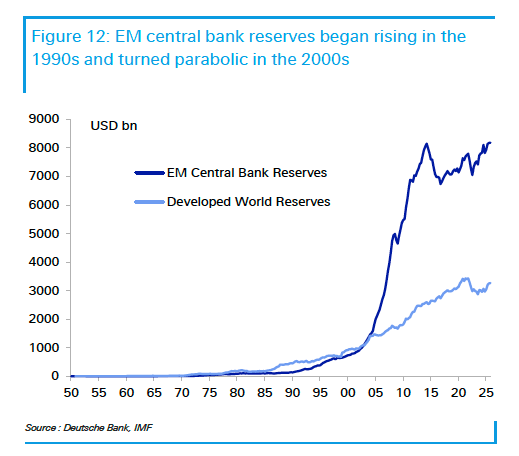
In this environment, everybody wanted dollars. EM central bank dollar reserves went parabolic around 2000.
“In sum, the biggest driver of gold’s decline in global reserves in the 1990s was the rise of EM FX reserves accumulated in USD. This was in turn a function of dramatic globalization, in a US-driven neo-liberal unipolar order, amidst sound and improving economic fundamentals in the U.S.”
De-Dollarization Ramifications
Things have changed. Many countries are now wary of holding dollars. They don’t want to be subject to U.S. foreign policy bullying, and they are concerned about America’s fiscal malfeasance. The 2008 financial crisis was a canary in a coal mine. Aggressive sanctioning of Russia after it invaded Ukraine may have been the final straw.
Sachdeva and Hsueh point out several trend reversals from the 90s that seem to be driving de-dollarization.
The U.S. is stepping back from free trade and fracturing traditional alliances.
The relationship between the U.S. and emerging markets is reversing. In the past, the U.S. outsourced manufacturing while EM countries outsourced security and savings. Today, the U.S. is onshoring more critical manufacturing, while many EM regions like Asia and the Gulf will be reconsidering their need for strategic autonomy in areas like energy and defense.
The U.S. has lost control of its inflation dragon.
“The end of history has itself come to an end, with significant implications for gold and the dollar, which are becoming increasingly apparent.”
This is a fancy way of saying that if de-dollarization and EM gold accumulation continue, it could drive the gold price even higher. According to Sachdeva and Hsueh, for every 1 million ounces of gold purchased by central banks, the price rises by 1 percent.
Sachdeva and Hsueh ran four different scenarios with varying levels of de-dollarization and central bank gold buying. They determined that “even in an environment where EM FX reserves decline to $5 trillion, gold prices could still rise to $8,000 over the next five years, if EM countries all target a 40 percent gold share.”
It could also signal a fundamental shift in the global monetary order.
“In sum, while EM central bank diversification into gold likely has much to do with preserving the value and accessibility of their foreign savings in a changing geopolitical climate, it may also – in the long run – play a role in anchoring a monetary order that builds independence from the dollar.There is, of course, a very long way to go. EM central banks as a whole still only hold half the physical gold of advanced economy central banks. But there is a world where gold returns to the center of a future monetary system with different leaders.”
As I’ve mentioned over and over, even a modest de-dollarization spells big trouble for the U.S. economy.
Since the global financial system runs on dollars, the world needs a lot of them, and the United States depends on this global demand to underpin its bloated government. The only reason the U.S. can borrow, spend, and run massive budget deficits to the extent that it does is the dollar’s role as the world reserve currency. It creates a built-in global demand for dollars and dollar-denominated assets. This absorbs the Federal Reserve’s money creation and helps maintain dollar strength despite the Federal Reserve’s inflationary policies.
But what happens if that demand drops? What happens if BRICS nations and other countries don’t need as many dollars?
A de-dollarization of the world economy would cause a dollar glut. The value of the U.S. currency would further depreciate. At the extreme, global de-dollarization could spark a currency crisis. You and I would feel the impact through more price inflation, eating away at the purchasing power of the dollar. In the worst-case scenario, it could lead to hyperinflation.
Mike Maharrey is a journalist and market analyst for Money Metals with over a decade of experience in precious metals. He holds a BS in accounting from the University of Kentucky and a BA in journalism from the University of South Florida.
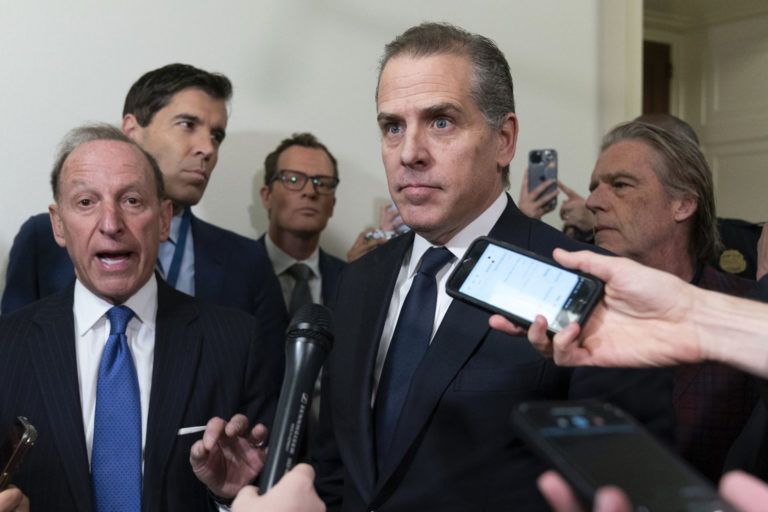
(Luis Cornelio, Headline USA) Newly released internal DOJ files appear to implicate President Joe Biden’s disgraced son, Hunter Biden, in alleged prostitution-related activity, corroborating accusations raised years earlier by Senate Republicans.
The files, obtained Monday by the Senate Judiciary Committee and the Senate Permanent Subcommittee on Investigations, showed Hunter exchanging text messages with several women discussing payments, travel arrangements and extended meetings.
Some of the exchanges appeared to raise potential issues under the Mann Act. This federal law prohibits interstate prostitution and other sex trafficking-related offenses, according to Senate Judiciary Chairman Chuck Grassley, R-Iowa.
Notably, Grassley was among the Senate Republicans who previously warned in a September 2020 report that Hunter may have paid Eastern European women for prostitution or interacted with individuals potentially tied to a human trafficking ring.
The messages reviewed by Headline USA also referenced payment methods including Zelle, Venmo, Cash App and wire transfers.
In November 2018, Hunter appeared to have booked a flight for an unidentified woman from Los Angeles to an undisclosed location.
On March 22, 2019, a presumed woman told Hunter that a ticket cost $560. Hunter replied: “I’m going to send you money and you buy ok.”
Another message later stated: “Sent you 750 by cash app,” while a separate exchange read: “And I will have another 3K for you in cashmere [sic].”
Additional messages appeared to discuss payments tied to extended periods. In one exchange, Hunter appeared to ask how much an individual would charge for “an extra eight hours,” prompting the recipient to reply: “5000.”
Hunter also appeared to reference discounts for “anything over 4,” seemingly referring to hours.
In another exchange, after Hunter offered $9,000, the recipient replied: “9500 ok.” Hunter then responded he would “wire money at 2 pm all of it thanks love.”
Separate January 2019 messages showed a recipient repeatedly complaining that money had not arrived. Hunter replied that he had sent two certified checks to a New York P.O. Box address.
Other exchanges appeared to reference the availability of individuals in different parts of the country.
According to Grassley, the DOJ possessed the files but declined to pursue prostitution- or sex-related charges against Hunter.
Prosecutors instead focused on tax violations and false statements Hunter made on a federal firearm purchase form regarding his drug addiction.
Before leaving office, Joe Biden issued Hunter a sweeping blanket pardon covering any federal offenses potentially committed between January 1, 2014, and Dec. 1, 2024. This was the first time in U.S. history a sitting president issuing such a broad pardon to his own child.