(Headline USA) The cigarette smoking rate among U.S. adults dropped to another all-time low last year, with 1 in 11 adults saying they were current smokers, according to government survey data released this week.
The preliminary findings from the Centers for Disease Control and Prevention were based on survey responses from more than 24,200 adults. In the survey, CDC officials defined current cigarette smoking as smoking at least 100 cigarettes in a lifetime and now smoking every day or some days.
In the mid-1960s, 42% of U.S. adults were smokers. The rate has been gradually dropping for decades, due to cigarette taxes, tobacco product price hikes, smoking bans, public education campaigns and changes in the social acceptability of lighting up in public.
In 2024, the percentage of current adult smokers fell below 10% for the first time. Last year, it was 9%, according to the new survey.
The use of electronic cigarettes has been inching up among adults, but has held about steady in 2025, at about 7%.
“The continued decline in smoking is a monumental public health achievement that has saved millions of lives and billions in healthcare costs,” said Yolonda Richardson, president and chief executive of the Campaign for Tobacco-Free Kids, a Washington, D.C.-based advocacy and research organization.
Richardson said current smoking-prevention efforts have been set back by cuts President Donald Trump’s administration made that eliminated the Centers for Disease Control and Prevention’s Office on Smoking and Health and its “Tips from Former Smokers” advertising campaign.
She cited estimates that the “Tips” campaign alone helped more than 1 million Americans quit smoking and saved over $7.3 billion in healthcare costs.
“This critical work must be restored and sustained to continue reducing smoking-related disease, death and healthcare costs nationwide,” Richardson said.
(Money Metals News Service) In a recent episode of the Money Metals Podcast, host Mike Maharrey sat down with Kai Hoffmann, founder and managing director of SOAR Financial, to discuss the recent turbulence in gold and silver markets, inflation concerns, central bank policy, and the outlook for mining stocks. Hoffmann, who has more than 15 years of experience in capital markets and the mining sector, acknowledged that recent price action in precious metals has puzzled even seasoned market observers.
According to Hoffmann, gold’s movements have become increasingly difficult to interpret. While geopolitical tensions and developments in the Middle East have clearly influenced market sentiment, he believes recent price swings have been driven more by headlines than by any fundamental change in the long-term investment case for gold. He noted that gold has reacted inconsistently to both peace talks and escalating tensions, making it difficult to draw straightforward conclusions from daily market moves.
Despite short-term volatility, Hoffmann emphasized that the core investment thesis for gold remains unchanged. He pointed to examples such as Turkey selling gold reserves to help stabilize its currency as evidence that gold continues to serve as both a safe-haven asset and a source of liquidity during periods of financial stress. He also highlighted ongoing purchases by central banks and major buyers such as Tether, suggesting institutional demand remains strong even as retail investors are shaken out of the market.
(Interview Starts Round 6:28 Mark)
America’s Debt Problem Is Being Ignored
One of the central themes of the discussion was the growing disconnect between market attention and America’s fiscal realities. Hoffmann argued that concerns over the U.S. national debt have largely disappeared from public debate despite the debt approaching $40 trillion. He estimated the total federal debt at roughly $39.3 trillion and rising rapidly.
While inflation and interest rates dominate financial headlines, Hoffmann believes the debt issue has simply been pushed aside. Efforts to control spending have largely failed, and he suggested that further monetary expansion remains likely. In his view, investors are overlooking not only rising government debt but also the expansion of the Federal Reserve’s balance sheet through ongoing quantitative easing measures.
The combination of expanding debt and monetary creation continues to support the long-term case for gold ownership. Yet Hoffmann noted that, unlike previous years, when debt ceiling debates regularly captured headlines, fiscal concerns have become secondary to geopolitical developments and military conflicts.
Why the Federal Reserve Faces an Impossible Balancing Act
The conversation also explored the difficult position facing central bankers. Hoffmann acknowledged that Federal Reserve officials often receive heavy criticism but argued that the reality of policymaking is more complicated than many investors appreciate.
He pointed out that many of the indicators the Fed relies upon—including inflation reports and employment data—are lagging indicators rather than leading indicators. This means policymakers are often reacting to economic developments after they have already begun rather than anticipating them in advance. Hoffmann specifically mentioned Kevin Warsh and expressed interest in whether future Fed leadership might adopt a more proactive approach.
Although inflation remains elevated, Hoffmann noted that current conditions are nowhere near the extremes experienced during the pandemic era. He referenced producer price inflation running near 6% annually while emphasizing that official inflation remains well below the approximately 9% levels seen during the COVID period. He also suggested that if geopolitical tensions ease and oil prices decline, inflation pressures could quickly moderate, potentially reviving the much-criticized concept of “transitory” inflation.
Contrary to many critics, Hoffmann believes the Federal Reserve has performed reasonably well over the past two to three years, given the information and tools available to policymakers. While not perfect, he argued that officials have largely succeeded in navigating an exceptionally uncertain environment.
Europe Is Not Facing an Energy Crisis—At Least Not Yet
With energy prices once again becoming a focus for investors, Maharrey asked Hoffmann about conditions in Europe. Hoffmann dismissed concerns about imminent jet fuel shortages, citing comments from Ryanair CEO Michael O’Leary, whose airline transports approximately 220 million passengers annually and ranks among the world’s largest carriers.
According to Hoffmann, major industry participants such as airlines and energy companies continue to report adequate fuel supplies. While headlines have raised concerns about shortages, he believes much of the discussion amounts to fear-driven speculation rather than evidence of an actual supply crisis.
Nevertheless, Hoffmann acknowledged that Europe remains structurally vulnerable due to its energy policies. He argued that the continent became overly dependent on Russian energy supplies and subsequently weakened its energy security through policy decisions that reduced domestic nuclear power capacity. While these long-term issues remain unresolved, he does not currently see evidence of an immediate fuel shortage.
Different Reasons, Same Love of Gold
The discussion turned to cultural attitudes toward precious metals, with Hoffmann highlighting notable differences between European and American investors.
In Germany, he explained, gold ownership is deeply influenced by historical memory. The hyperinflation of the 1920s remains embedded in the national consciousness, creating a strong preference for gold as a store of wealth and protection against currency debasement. Germans, he said, remember the stories of wheelbarrows full of nearly worthless currency and continue to view gold as a safeguard against similar outcomes.
American investors, by contrast, often approach gold from a more libertarian perspective. Hoffmann suggested that many U.S. buyers value gold because it offers independence from financial institutions and government control. The appeal lies not only in wealth preservation but also in the absence of counterparty risk and the ability to hold an asset outside the traditional financial system.
Although the motivations differ, Hoffmann believes investors on both sides of the Atlantic ultimately arrive at the same conclusion: gold provides security during uncertain times.
Drawing on his frequent attendance at mining conferences around the world, Hoffmann offered a bullish assessment of the mining sector.
He recently attended the Canaccord Conference and observed that while sentiment remains highly positive, the industry has not yet entered a phase of speculative euphoria. Capital continues flowing into junior mining companies, financing activity remains healthy, and investors are still willing to fund promising projects. However, he noted the absence of excessive optimism often associated with market tops.
One of the most interesting developments, according to Hoffmann, is that many mining stocks have recently refused to follow gold lower. While miners often lead recoveries in the precious metals market, they have not fully participated in recent downside moves. He views this divergence as a potentially constructive signal for the sector.
The economics of gold mining also remain exceptionally strong. Hoffmann estimated that first-quarter average gold prices were around $4,800 per ounce and expects second-quarter averages to remain near $4,500 per ounce. With many producers operating at all-in sustaining costs between roughly $1,800 and $2,000 per ounce, profit margins remain substantial even after recent price declines.
He suggested that margins of approximately $2,500 per ounce remain extraordinarily healthy and argued that investors may be overreacting to modest margin compression from record levels. Even if gold were to fall to $4,000 per ounce, he believes most producers would continue generating robust profits.
The Most Misunderstood Sector in Investing
Perhaps Hoffmann’s strongest argument centered on what he sees as a widespread misunderstanding of the gold mining industry among mainstream investors.
He cited a recent CNBC interview in which a fund manager claimed not to invest in non-cash-flowing companies when discussing Agnico Eagle, one of the world’s largest gold producers. Hoffmann expressed astonishment at the comment, noting that Agnico Eagle generates billions of dollars in free cash flow annually.
According to Hoffmann, many investors still fail to appreciate how financially healthy the mining sector has become. Major producers such as Barrick and Newmont are now sitting on net cash positions, paying higher dividends, repurchasing shares, and generating significant free cash flow. These are exactly the characteristics that traditionally attract institutional investors.
He believes pension funds and generalist investors are beginning to rediscover the sector, but widespread participation has not yet arrived. For that reason, Hoffmann sees the current environment as an opportunity for investors to gain exposure before a larger wave of capital enters the market.
Gold’s Enduring Value
As the interview concluded, Hoffmann returned to a theme that ran throughout the conversation: gold’s ability to prove its value repeatedly across different economic and geopolitical environments.
Whether discussing Turkey’s use of gold reserves to support its currency, Russia’s financial resilience, or the continued accumulation of bullion by central banks, Hoffmann argued that gold remains uniquely positioned as a trusted store of value. While market narratives may shift from inflation to war to interest rates, the underlying role of gold remains remarkably consistent.
For Hoffmann, the precious metals bull market is not being driven by short-term headlines alone. Rather, it is being supported by long-term structural forces, including rising government debt, ongoing monetary expansion, persistent geopolitical uncertainty, and growing recognition of gold’s role as a financial anchor in an increasingly unstable world.
(Luis Cornelio, Headline USA) Embattled Rep. Ilhan Omar, D-Minn., announced Friday that she is running for re-election despite mounting federal investigations and a proposed bill seeking to ban her from Congress.
Omar represents Minnesota’s 5th Congressional District, a heavily Democratic area centered around Minneapolis. First elected in the so-called blue wave of 2018, Omar announced her 2026 candidacy by posting a photo of herself filing the necessary paperwork.
“Filed for reelection. Excited to continue representing the incredible people of Minnesota’s Fifth District,” Omar wrote via X.
Filed for reelection. Excited to continue representing the incredible people of Minnesota’s Fifth District. ❤️ pic.twitter.com/V5GZiRlGNR
Her announcement came just a week after Vice President JD Vance said the DOJ launched a criminal investigation into allegations that Omar committed immigration fraud in connection with a marriage to her alleged brother.
Separately, Omar is facing a proposed constitutional amendment that seeks to ban foreign-born individuals from serving in the U.S. Congress. Omar was born in Somalia.
Led by Rep. Nancy Mace, the proposed amendment would also require federal judges and Senate-confirmed officeholders to be natural-born citizens, mirroring the same standard required for presidential and vice presidential candidates.
“The people writing America’s laws, confirming America’s judges, and representing America on the world stage should have one loyalty: America. Not any other country,” Mace said in a statement.
“For too long we have allowed foreign born members to hold seats in this government while making clear they are America last, not America first,” Mace added.
In response to Mace’s proposed amendment, Omar said in an interview on Fox News: “Good luck to her.”
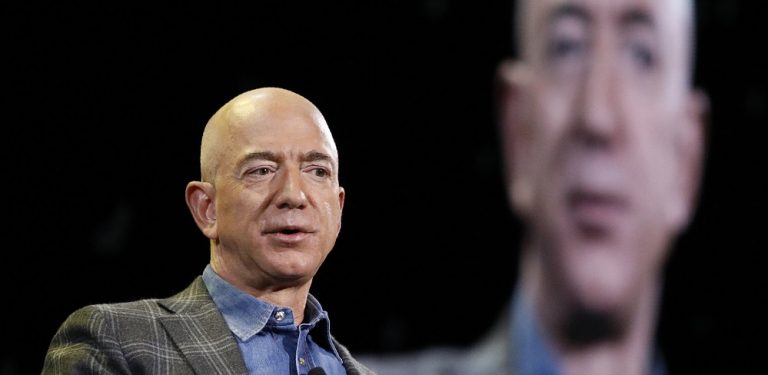
(Headline USA) Jeff Bezos’ Blue Origin is assessing damage to its launch pad after a rocket exploded during a test firing, creating a giant orange fireball seen and felt for miles around.
The company fueled the hulking New Glenn rocket Thursday night, hoping to briefly ignite the engines ahead of a satellite launch next week. But the 321-foot, rocket blew up, taking part of the pad with it.
Aerial views on Friday revealed heaps of crumpled structures on the ground, with just one tower and the water tank still standing. Emergency officials warned the public to avoid any wreckage that might wash ashore and to instead call 911. There were no reported deaths or injuries.
It’s a major setback for Blue Origin, coming just one month after the entire New Glenn fleet was grounded because of an upper-stage engine issue that dumped a satellite in the wrong orbit.
Here's our video of the explosion at Launch Complex 36. It happened about 9 pm ET (0100 UTC) as Blue Origin was beginning a static fire test of its New Glenn rocket.
Named after John Glenn, the first American in orbit, New Glenn is the rocket that Blue Origin plans to use to launch landers to the moon under NASA’s Artemis program that aims to build a sprawling base near the moon’s south pole. The goal is to land the first Artemis moonwalkers as early as 2028. Earlier this week, the space agency awarded a new contract to Blue Origin worth hundreds of millions of dollars.
One of the biggest rockets to reach orbit, New Glenn has seven first-stage engines fueled by liquid oxygen and liquefied natural gas, which is essentially methane. It has flown three times.
None of the assigned 48 Amazon Leo satellites were on board the newest rocket when the blast occurred. Another batch of Amazon Leo satellites — competing with SpaceX’s Starlinks to provide internet service to remote locales — awaited liftoff several miles away at Cape Canaveral Space Force Station, courtesy of United Launch Alliance’s Atlas V rocket.
Within 12 hours of the explosion, SpaceX launched more Starlinks to orbit Friday morning. CEO Elon Musk has two Florida pads in action, one on the Space Force side where the latest Falcon 9 lifted off and the other at NASA’s Kennedy Space Center.
Blue Origin has just one Florida pad: Launch Complex 36 dating back to the early 1960s. NASA’s Mariner and Pioneer interplanetary probes rocketed away from there, as well as the moon-bound Rangers and Surveyors. The Washington state-based Blue Origin spent more than $1 billion rebuilding the launch complex — taking it from double pads to a single — after leasing it from the Air Force in 2015.
The company’s smaller New Shepard rockets soar from Texas, skimming space for a few minutes with tourists and science experiments. Those suborbital hops were paused in January so the company could focus on New Glenn and upcoming moonshots. All that is now on hold, pending the investigation into the explosion.
NASA Administrator Jared Isaacman said late Thursday that the space agency will evaluate near-term impacts to the Artemis program, which saw four astronauts fly around the moon in April. That Artemis II mission was hoisted by NASA’s Space Launch System rocket.
Before the explosion, Blue Origin was on track to launch a prototype lunar lander to the moon on a New Glenn this fall, with another lander due to rocket into orbit around Earth in 2027 for docking practice by the soon-to-be-announced Artemis III crew.
A touchdown by two astronauts on Artemis IV — using a Blue Moon lander or SpaceX’s Starship, whichever is ready first — was targeted as early as 2028.
(Headline USA) The former superintendent of Iowa’s largest school district, who turned out to be an illegal immigrant, was sentenced Friday to two years in prison.
Ian Roberts is likely to be deported to his native Guyana in South America once he serves the sentence. He pleaded guilty in January to falsely claiming to be a U.S. citizen and illegally possessing firearms, which together carry a maximum sentence of 20 years in prison. His lawyers had proposed that he be put on probation “to facilitate his removal from the United States,” but prosecutors had argued that his likely deportation should not be a factor.
Prosecutors alleged Roberts knowingly lacked employment authorization for nearly all of his two-decade career in urban education and submitted a counterfeit Social Security card when he was hired as superintendent of the Des Moines public school district, which serves 30,000 students.
UPDATE ON DES MOINES PUBLIC SCHOOL SUPERINTENDENT ARRESTED BY ICE
ICE Des Moines arrested Ian Andre Roberts, a criminal illegal alien from Guyana, in possession of a loaded handgun, $3,000 in cash and a fixed blade hunting knife, after he tried to evade arrest. ⬇️ https://t.co/wE49Gb5waZpic.twitter.com/n2vn2HR4xG
— U.S. Immigration and Customs Enforcement (@ICEgov) May 27, 2026
Roberts’ stunning case bookended the school year. His September arrest occurred as President Donald Trump’s administration was sending increased numbers of federal immigration officers into American cities to round up illegal immigrants.
Des Moines Public Schools said last month that it revised its conflict-of-interest policy after an audit found Roberts awarded district business to a consulting firm he worked for.
Roberts was in his school-issued vehicle when officers stopped him on Sept. 26 in a targeted U.S. Immigration and Customs Enforcement operation. He allegedly fled before he was located with the help of state troopers. Authorities said a loaded handgun was wrapped in a towel under the seat and $3,000 in cash was in the car. Three other weapons were recovered during a search of his home.
In recommending a three-year sentence, prosecutors described a yearslong and deliberate misrepresentation of his legal status. Prosecutors said a reduced sentence is not appropriate just because Roberts is likely to be deported.
They said they do not know what documents Roberts presented to show eligibility for work dating back to 2008, years before he was approved for temporary status in 2018, but he “deliberately obtained employment without work authorization at school after school, within state after state.”
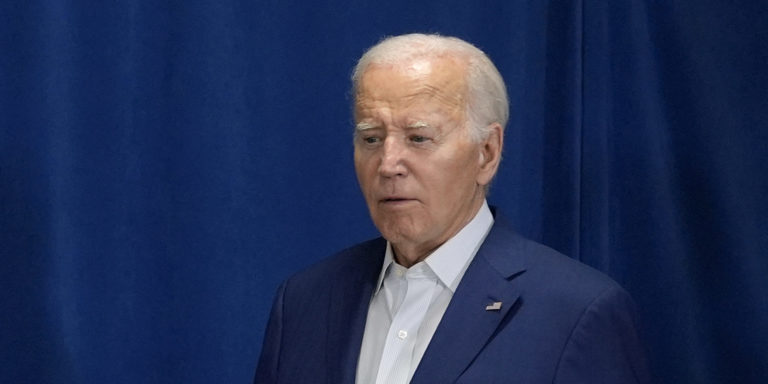
(Ken Silva, Headline USA) Former President Joe Biden has sued the Justice Department to prevent it from releasing transcripts and audio of interviews he conducted with his ghostwriter, Mark Zwonitzer, for his 2017 memoir.
The DOJ obtained the interview materials in 2023 as part of then-Special Counsel Robert Hur’s investigation into Biden for mishandling classified documents. Hur eventually declined to press charges, in part because he thought Biden would present himself to a jury as a “sympathetic, well-meaning, elderly man with a poor memory.”
Since the investigation is now closed, the House Judiciary Committee and the Heritage Foundation have both sought the transcripts and audio of Biden’s interviews with Zwonitzer. But Biden said in his lawsuit, filed Tuesday in federal court, that disclosing those materials would violate his privacy.
The conversations reflected in these audio recordings and transcripts were part of the writing process for President Biden’s 2017 memoir, Promise Me, Dad: A Year of Hope, Hardship, and Purpose, in which he recounted the politically consequential and personally painful year of his life that began on Thanksgiving in 2014,” Biden’s lawsuit says.
“The public and private dimensions of President Biden’s life have always been intertwined, but perhaps never more so than during that difficult year. President Biden and Zwonitzer recorded their conversations for use in writing Promise Me, Dad, and they both understood that they were speaking privately.”
Even if Biden’s lawsuit is ultimately unsuccessful, it’s unclear how much material remains from his interviews with Zwonitzer. That’s because the ghostwriter destroyed recordings once he found out that Hur was investigating Biden, as Bloomberg revealed in June 2024.
Indeed, according to a heavily redacted transcript of the FBI’s interview with Zwonitzer, agents accused him of obstruction because he destroyed recordings. But because of the heavy redactions of the FBI’s interview transcript, it’s unclear how exactly the line of questioning went, or what Zwonitzer destroyed.
Hur said in a February 2024 report that he didn’t charge Zwonitzer, either, because “the ghostwriter offered plausible, innocent reasons for why he deleted the recordings.”
Ken Silva is the editor of Headline USA. Follow him at x.com/jd_cashless.
(Alan Wooten, The Center Square) Security members of a Charlotte hotel, some with extensive criminal records and documentation as gang members, sold narcotics and firearms to investigating law enforcement officers, the U.S. Department of Justice says in a federal complaint.
Five people face federal charges in drug trafficking and firearms violations following the probe by the FBI and the Charlotte-Mecklenburg Police Department, and 10 people total were arrested. A warrant has been issued for an 11th. The activity happened at the Garden Inn & Suites, commonly known as the Garden Inn, in the Sugar Creek corridor in northeastern Charlotte.
The hotel racked up, at a minimum, 57 arrests and 590 police calls in 29 months climaxing with a Wednesday morning raid.
“This hotel property has functioned as a stronghold for illicit activity, operating as a distribution hub for illegal firearms and narcotics,” said Chief Estella D. Patterson of the Charlotte-Mecklenburg Police Department. “The data tells a stark, undeniable story: in 2025, CMPD officers responded to over 240 calls for service at this single location – a staggering, nearly 20% increase compared to the year prior. When local, state, and federal agencies align their power, we do not just disrupt criminal enterprises – we dismantle them.”
Six of those arrested are facing state charges for drugs and firearms.
The U.S. Attorney’s Office filed a civil forfeiture action against the Garden Inn. It says the property was a site for and facilitated significant illegal drug trafficking.
For six months, lawmen investigated. Prosecutors in the office of Russ Ferguson, the U.S. attorney for the Western District of North Carolina, say fentanyl, cocaine base, other narcotics and illegal firearms were distributed in and around the hotel.
In addition to the arrests since Wednesday’s raid, lawmen made 47 arrests while being called to the hotel 590 times between Jan. 1, 2024, and May 18 of this year.
“The hotel itself serves almost like a farmers market for drugs and guns,” Ferguson said. “There are multiple rooms on multiple levels where people are buying drugs and guns. And those innocent people living there were duped.”
The “duped” comment is a reference to Garden Inn advertising “24/7 security.”
Ferguson said hotel owner Jessica Woodard didn’t cooperate with local police wishing to view surveillance footage after a shooting on the property. Charlotte-Mecklenburg police met with Woodard to share concerns about her hired security, he said.
“They created the crime there instead of stopping it, and that’s why we filed our action today to seize the hotel,” Ferguson said. “If you’re working with the side of the criminals instead of the side of the police, we are going to use our federal asset forfeiture power to take your hotel.”
Criminal indictments unsealed include:
• Justin Lamont Day, 29, is charged with distribution of fentanyl, possession of a firearm in furtherance of a drug trafficking crime, and possession of a firearm by a felon.
• Michael Boatwright, 37, of Charlotte, is charged with two counts of distribution of fentanyl.
• Marcus Logan, 39, of Gastonia, N.C., is charged with possession of a firearm by a felon.
• Naquan Smith, 43, of Charlotte, is charged with possession of a firearm by a felon.
Logan was the head of the security team.
Six others facing state charges are:
• Octavius Elmore, possession of a stolen firearm.
• Dameion Ikard, possession with the intent to sell or distribute marijuana and possession with the intent to sell and distribute cocaine.
• Nelson Lewis, possession of firearm by felon, possession of stolen firearm, possession with the intent to sell or distribute marijuana, possession with the intent to sell or distribute cocaine.
• Anthony Logan, possession of a firearm by felon, felony possession of marijuana, possession of drug paraphernalia.
• Krysti White, trafficking methamphetamine, carrying a concealed weapon.
• Destiny Ikard, simple possession of a scheduled II substance.
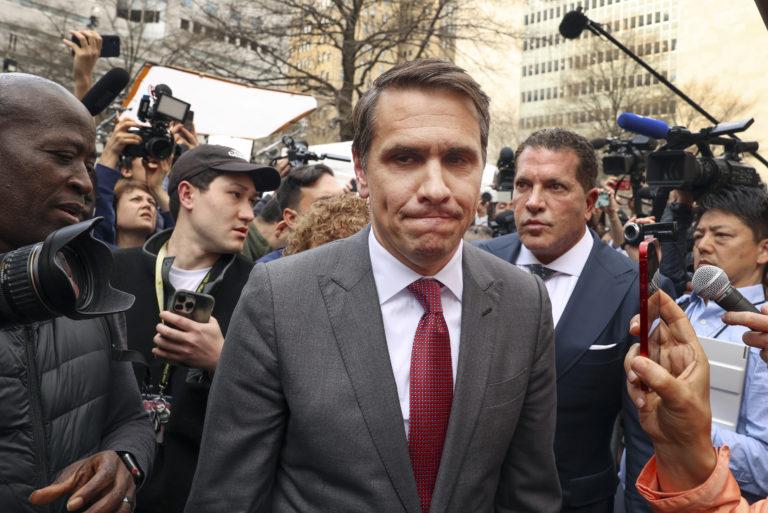
(Headline USA) Former Attorney General Pam Bondi blamed her successor, Todd Blanche, for the botched rollout of the Jeffrey Epstein case files while testifying Friday behind closed doors to House lawmakers.
“Acting AG Blanche was managing the entire investigation,” Bondi said during the questioning, according to lawmakers who spoke to reporters afterward.
Pam Bondi has now admitted she was never truly in charge of the Epstein files and was merely a puppet while Todd Blanche ran the entire operation behind the scenes.
Blanche is accused of helping bury the names of Epstein’s most powerful associates tied to the child trafficking… pic.twitter.com/3AqEQy22NX
Bondi, who arrived Friday morning on Capitol Hill for her closed-door interview, was defiant in previous public testimony when she was confronted by lawmakers about the Epstein investigation. In her opening statement, she kept to the same tack and said that Deputy Attorney General Todd Blanche, now the acting attorney general, had overseen the process to release the Epstein case files as mandated by a law passed by Congress and signed by Trump last year.
The transcribed Bondi interview gave lawmakers a chance to dig for information on the Trump administration’s handling of the Epstein files and other related matters, including the prison sentence of Epstein’s former girlfriend and confidant, Ghislaine Maxwell.
But Democratic lawmakers said that Bondi told them she would not speak about the president in the interview and, consulting with a lawyer from the Department of Justice, cited her ability to decline questions because she agreed to appear before the committee voluntarily.
Epstein purportedly killed himself in a New York City jail cell in 2019 while awaiting trial. Maxwell, a British socialite, was convicted in 2021 of luring teenage girls to be sexually abused by Epstein but has insisted she’s innocent, arguing she never should have been prosecuted. The Justice Department moved Maxwell from a federal prison in Florida to a prison camp in Texas last August.
After the interview, Rep. Robert Garcia, D-Calif, said Bondi also blamed Blanche for Maxwell’s transfer.
“We asked Bondi questions about Ghislaine Maxwell and the transfer, and she referred those questions to Todd Blanche and the Bureau of Prisons. So we have many questions for Mr Blanche that Republicans are refusing to ask. Why was she transferred to a less secure facility?” Garcia asked reporters.
Garcia: "We asked Bondi questions about Ghislaine Maxwell and the transfer, and she referred those questions to Todd Blanche and the Bureau of Prisons. So we have many questions for Mr Blanche that Republicans are refusing to ask. Why was she transferred to a less secure… pic.twitter.com/pP5plkJXP0
Lawmakers are trying to find out what decisions prosecutors have made about investigating Epstein associates, how the Justice Department handled the congressional mandate to release the Epstein case files and whether President Donald Trump was involved in the process.
Bondi told lawmakers in her opening statement that releasing the Epstein case files was “an enormously complicated and labor-intensive process” and conceded that the department had made redaction errors. But she mostly defended the Justice Department’s work, saying that it had complied with the law and demonstrated “an unprecedented commitment to transparency.”
Bondi, who revealed this week that she is being treated for thyroid cancer, has stayed within the Republican president’s orbit even after being ousted from her job in early April.
Trump appointed Bondi to a White House panel on artificial intelligence this week, and she will be accompanied Friday by Justice Department officials, including Harmeet Dhillon, who heads the department’s Civil Rights Division, acting as her counsel.
Democrats say that arrangement is a conflict of interest.
Bondi was central to the Epstein saga
Bondi has been central to the political firestorm over Epstein, initially raising expectations for the full release of what’s known as the Epstein files, only to later backtrack. That reversal prompted Congress to step in and pass a law requiring the release.
Bondi faced even more backlash when the Justice Department’s release of the files was delayed and then included personal information and nude photos of several potential victims. She has insisted in congressional hearings that she was trying to follow the law.
The House Oversight Committee, meanwhile, has been conducting a wide-ranging investigation into Epstein that spans multiple presidential administrations.
The interview format is already contentious
Bondi was subpoenaed by the committee in March in a bipartisan vote, but she tried to head off that demand by holding a closed-door meeting with lawmakers that month. The maneuver only added to the enmity between Bondi and Democrats on the committee.
Bondi’s departure from the Justice Department also raised doubts about the enforcement of the congressional subpoena. After the committee’s Democrats maneuvered to press for a civil contempt of Congress resolution against Bondi, she agreed to sit for a transcribed interview rather than a sworn deposition.
Democrats on the Oversight panel have criticized that arrangement, saying that it allowed Bondi to decline to answer questions. They also objected to Comer’s decision not to video the interview.
“We continue to be incredibly disappointed of the decision to not have this interview videotaped and then released to the American public,” said Rep. Robert Garcia, the top Democrat on the panel.
Comer has said he is allowing Bondi to sit for a transcribed interview rather than a deposition as an incentive to cooperate. Previously, he had enforced a subpoena on former President Bill Clinton and former Secretary of State Hillary Clinton after they resisted the demand. Both of their depositions were video-recorded.
Still, Comer said Bondi could face prosecution if she lies to Congress. He said the committee would also release a transcript of the interview.
When I was a kid, my mom used to tell me I’d better do my homework, or I would end up digging ditches for a living. In retrospect, there could have been worse fates than digging ditches. However, at nearly 60, I’m glad I’m not depending on my back to make a living. Mad respect to those of you who are!
But no. I have no desire to stick a shovel in the dirt, hunting for gold.
Now, to be fair, this is partly a function of the fact that there isn’t any gold to dig for nearby. Florida is not exactly a hotbed for prospecting. If there were gold nearby, perhaps I would be more motivated to dig.
Because I do want gold!
Most people do. In fact, I think it would be safe to say that the vast majority of the people in the world want gold. After all, gold is money – no matter where you are. And unlike me, some people are willing to go to great lengths to get it.
With gold prices up 119 percent from where they were in January 2024, there is a bit of a gold rush going on in Australia.
Matthew Carkeek owns a concrete construction firm, and he’s caught gold fever. He’s paid over $1.5 million on land, equipment, and permits. And he’s operating on a bare-bones budget.
“What I’m going for is about as simple as you can get. There’s no treatment plant, there’s no wash plant, no chemicals or anything like that. It’s literally dig, doze and detect.”
Sounds like high risk and a lot of work.
The Morning Herald doesn’t exactly make it sound appealing.
“Finding gold is often hot, hard, dirty, physical work involving lots of walking and digging in remote and difficult-to-get-to locations, prospectors say.”
Doesn’t sound like a fun way to spend a Saturday.
And the truth is, there’s a strong likelihood Carkeek will never see a return on that investment. The president of Sydney’s prospector club concedes this reality.
“[People] join the club, and they quickly realize it’s not as easy as it looks. You probably spend more money looking for gold than actually finding gold.”
West Australia’s Association of Mining and Exploration Companies CEO Warren Pearce called gold a “misery metal.”
And yet the promise of gold draws Carkeek and thousands of others to take the risk and make the sacrifice.
According to the Morning Herald, applications for miners’ rights licenses in Victoria surged by 40 percent last year. Based on the number of permits issued, there are 113,000 active prospectors in the Australian state.
Fossickers need a government-issued miner’s right to keep any gold they find.
Yes. Fossicker is a word. It is a term used in Australia for a recreational prospector who searches for gold, gemstones, or fossils by sifting through gravel, rivers, and waste piles. Think of a fossicker as an amateur miner.
Anyway, I get it. These folks can literally dig money out of the ground – real money.
Sound money.
Pearce understands exactly why gold has suddenly found itself in the spotlight. Sure, the price is attractive, but there is something more fundamental going on right now.
“The reality is this safe haven asset does very well when things are going wrong in the world, when there are multiple conflicts and a real lack of confidence around the global economy.”
All of that sounds about right, doesn’t it?
It’s almost enough to motivate me to start digging.
The good news is I don’t have to. I can get gold by simply calling 800-800-1865 or perusing the Money Metals website. It’s much less work, and it’ll probably save me money!
Mike Maharrey is a journalist and market analyst for Money Metals with over a decade of experience in precious metals. He holds a BS in accounting from the University of Kentucky and a BA in journalism from the University of South Florida.
(Mike Maharrey, Money Metals News Service) I often see mainstream headlines touting the resilience of the American consumer. These stories almost always refer to strong retail sales figures signaling Americans’ willingness to keep spending money. However, there is a dark side to this spending pattern that often goes unnoticed.
There is a difference between spending because you can and spending because you have to. When prices rise, spending necessarily rises with them, and that’s exactly what is happening to the American consumer.
Rising retail sales figures aren’t inflation-adjusted, meaning they reflect both the number of items sold and the price of those items. When gasoline prices spike, retail sales necessarily spike right along with them. So, when the cost of everyday necessities rises, people have little choice but to spend more. After all, you still have to buy groceries and put gasoline in your car.
What is a cash-strapped consumer to do?
Drain your savings and turn to Visa and Mastercard.
This is exactly what Americans have done. They’ve blown through their savings and buried themselves in debt.
Blowing Through Our Savings
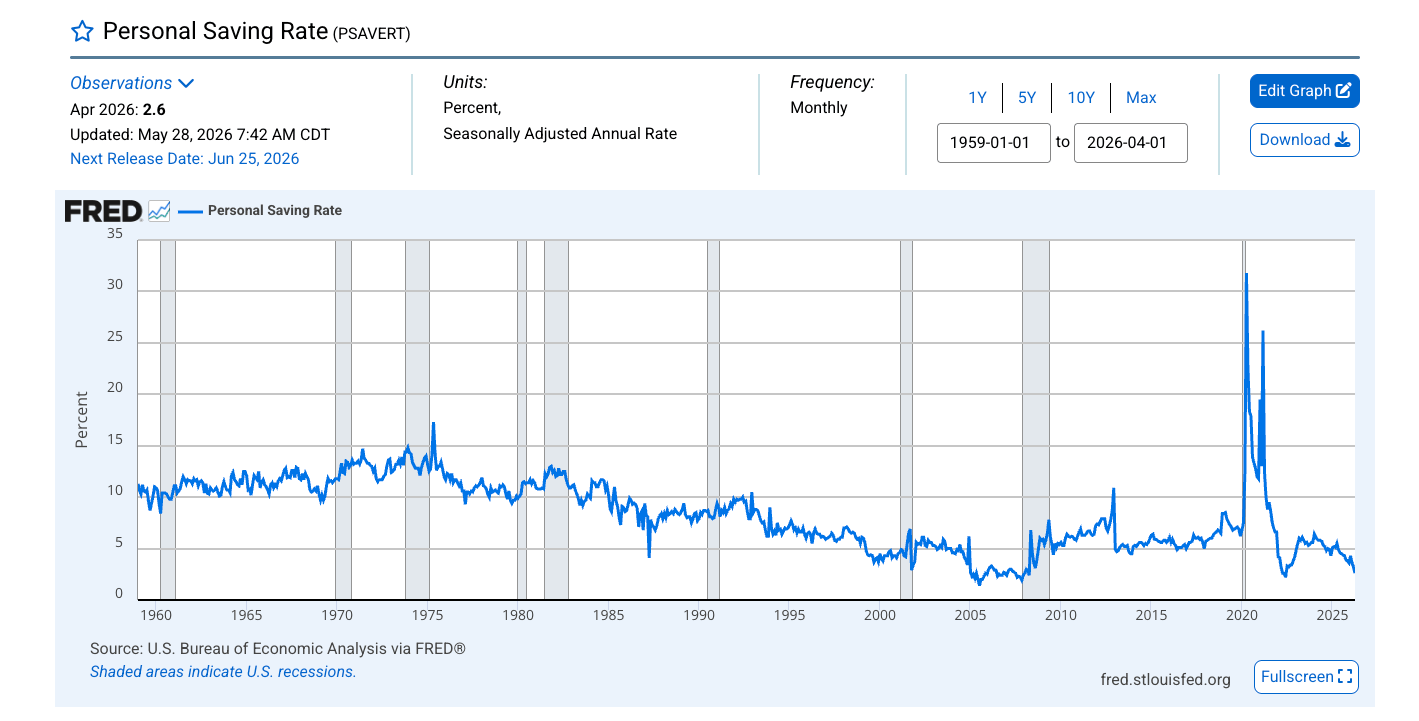
As Americans endured the COVID era locked in their homes, they managed to save a lot of money. In April 2020, the personal saving rate skyrocketed to 31.8 percent. It was by far the highest level since the 1960s.
Now the savings are gone.
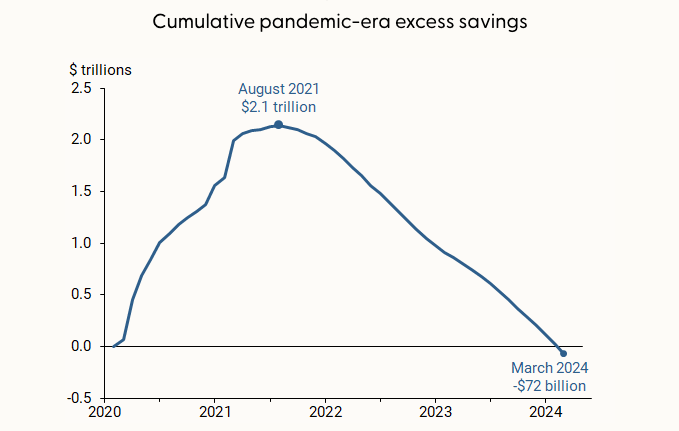
Aggregate savings peaked at $2.1 trillion in August 2021. By June 2023, the San Francisco Fed estimated that aggregate savings had dropped to $190 billion.
In other words, Americans blew through $1.9 trillion in savings in just two years.
By March 2024, the San Francisco Fed estimated that the entirety of those excess savings was gone.
And Americans aren’t replacing that savings cushion.
In April, the personal savings rate plunged to 2.6 percent. That’s the lowest level since just before the 2008 Financial Crisis and the Great Recession. It is getting close to the all-time low of 1.4 percent in July 2005.
Note that the savings crash preceded the Great Recession.
Burning Up the Plastic
So, what do you do when prices are soaring, you’ve tightened your budget as much as you can, and you still can’t make ends meet?
As Americans were beefing up their savings during the pandemic, they also paid down credit card debt. Revolving debt dropped below $1 trillion in 2020.
Mainstream analysts tend to look at various data points in isolation. They see strong retail sales numbers and immediately conclude the consumer is doing well. But when you start putting things together, a different picture emerges.
For instance, March retail sales surged by 1.5 percent as gasoline prices skyrocketed. Yay! But that same month, revolving debt also surged, growing by 9.1 percent. That seems to indicate that a large percentage of March’s surging retail sales were paid for with credit cards.
This does not scream “resilient consumer.” In fact, it smacks of desperation.
The big jump in consumer debt in March broke a trend of slowing debt growth. This may indicate that consumers are getting close to their credit limits.
American Consumers Under Stress
They are certainly struggling with the growing debt burden and higher prices.
U.S. credit card delinquencies spiked in April. According to the latest New York Fed data, 13.1 percent of credit card balances are at least 90 days overdue. That’s the highest level since the late stages of the Great Recession.
Serious credit card delinquencies have climbed by 5.5 percent since the third quarter of 2022. That’s a faster deterioration pace than what we saw during the 2007-2010 period.
According to NY Fed data, credit card balances ticked down in Q1 2026. This indicates that consumers have slowed their pace of debt accumulation (It’s hard to charge it when you’ve hit your credit limit) even as they are struggling to service their existing debt.
Lower-income Americans are feeling the biggest pinch. However, affluent areas are also charting a rise in delinquency.
LegalShield’s Consumer Stress Legal Index (CSLI) reflects the strain. As a spokesperson put it, “Financial strain has settled into a new normal for American households.”
The CSLI dipped in Q1 2026 compared to the fourth quarter of 2025. However, the index was 11.6 percent higher than a year ago.
According to the report, the quarter-on-quarter dip was “largely due to seasonal tax refund relief in the Consumer Finance sector.”
“The index remains at an elevated level consistent with sustained, broad-based financial distress.”
The LegalShield Bankruptcy subindex was up 2 percent in Q1, charting an 8 percent increase year over year. According to LegalShield, its bankruptcy data has historically served as a leading indicator, preceding actual non-business bankruptcy filings by two quarters with a .95 correlation since 2006.
The Foreclosure subindex was up 20.3 percent year-over-year. That was the highest level since the onset of the pandemic in March 2020. LegalShield called it “the sharpest signal of distress in the current economy.”
“Homeowners are facing severe payment shock driven by escrow resets. National homeowners’ insurance premiums rose 70 percent between 2019 and 2025, now accounting for 14 percent of the average monthly mortgage payment. The principal isn’t the problem; the total monthly obligation has quietly reset higher.”
So, when you see mainstream reports touting the “strong consumer,” take them with a grain of salt. Ask yourself, “What data points are they missing or just ignoring?” Because taken as a whole, the data points to a consumer at the end of his proverbial rope.
This underscores a broader point. An economy built on borrowing and spending money for stuff isn’t sustainable. At some point, consumers will crack under the pressure, taking this debt-riddled bubble economy down with them.
Mike Maharrey is a journalist and market analyst for Money Metals with over a decade of experience in precious metals. He holds a BS in accounting from the University of Kentucky and a BA in journalism from the University of South Florida.