Amazon Joins Exclusive Club, Hitting $2T in Stock Market for 1st Time

(Headline USA) Amazon joined the exclusive $2 trillion club Wednesday after Wall Street investors pushed the value of the e-commerce giant’s stock past that threshold.

Shares in Amazon.com Inc. finished the day up almost 4%, giving the Seattle-based company a stock market valuation of $2.01 trillion. Its stock has gained 52% in the past 12 months, partly driven by enthusiasm for the company’s investments in artificial intelligence.

Amazon now joins Google’s parent Alphabet, software behemoth Microsoft, iPhone maker Apple and chip maker Nvidia among companies with valuations of at least $2 trillion.

Last week, Nvidia hit $3 trillion and briefly became the most valuable company on Wall Street. Nvidia’s chips are used to power many AI applications and its valuation has soared as a result.

Amazon has also been making big investments in AI as global interest has grown in the technology. Most of the focus has been on business-focused products, including AI models and a chatbot called Q, which Amazon makes available to businesses that use its cloud computing unit AWS.

“A big part of the valuation boost has been cloud and AI,” said Wedbush tech analyst Dan Ives. “Amazon is going to be a major player in the AI revolution.”

In April, Amazon CEO Andy Jassy said that AI capabilities have reaccelerated AWS’ growth and that it was on pace for $100 billion in annual revenue. The unit’s growth slowed last year as companies cut down on costs amid high inflation.

Amazon has also invested $4 billion in the San Francisco-based AI company Anthropic to develop so-called foundation models that underpin generative AI systems. In addition, Amazon makes and designs its own AI chips.

Outside of its cloud business, Amazon has cut costs significantly since late 2022, laying off more than 27,000 corporate employees across several divisions.

It reported revenue and profits for the first quarter of the year, aiding by growth in AWS as well as its core retail business and advertising. All those things are boosting investor sentiments, said Neil Saunders, the managing director at GlobalData Retail.

“Certainly, there are downsides, but these are mostly external—such as the threat from the FTC,” Saunders said, alluding to the federal agency’s antitrust lawsuit against the company.

But, he said, “investors see these clouds as a long way off so they are not dampening the current valuation.”

Adapted from reporting by the Associated Press

Where to Invest: Let’s Break Down 3 Major Asset Classes…

(Mike Gleason, Money Metals News Service) As voters weigh their options for President, investors are weighing their options among the major asset classes.

As to presidential politics, voters are left with only two options – at least among those who have been allowed into the debates and have a realistic chance of winning. Donald Trump or the Democrat nominee.

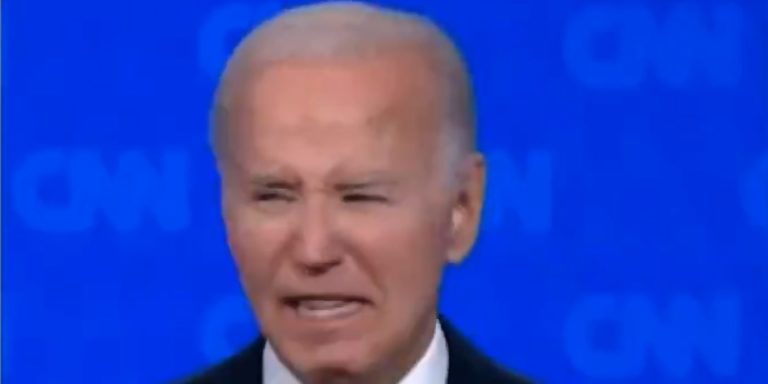
After Joe Biden’s debate performance Thursday night, many prominent Democrats are panicking over the 81-year-old incumbent’s verbal struggles and vacant appearance. A panel of liberal commentators on CNN practically begged Biden to step aside now so that Democrats can nominate somebody more viable.

We will have to wait and see what transpires as the Biden campaign descends into turmoil ahead of the Democrats’ nominating convention in August. By November, voters will still be left with a binary choice between a Democrat and a Republican.

Investors, meanwhile, can choose from a myriad of ways to allocate their wealth. But it comes down to three major asset classes.

Firstly, they can own debt obligations. These include bonds, certificates of deposit, money markets, and other vehicles that promise to pay interest denominated in fiat currency.

Secondly, they own businesses or shares in publicly traded companies that have the potential to generate earnings denominated in fiat currency.

And thirdly, they can own tangible assets. These include land, collectibles, and of course precious metals.

Conventional financial advisors tend to neglect or ignore entirely the benefits of adding hard assets to a well-diversified investment portfolio. But the benefits are clear: precious metals, unlike financial assets, have no counterparty risk. They cannot default or go bankrupt. And their value cannot be inflated away by central bankers.

Far from being a risky investment, gold has proven to be a reliable store of value over time. And far from being a safe investment, bonds have proven to be a losing investment in recent years. Gold has outperformed U.S. Treasuries over the past 1- year, 3-year, 5-year, 10-year, and 20-year periods.

The outlook for government bonds isn’t looking any brighter going forward. Inflation risk, credit risk, and interest rate risk are likely to weigh on returns as federal budget deficits soar with no end in sight.

Investors shouldn’t put much hope in the next administration fixing the nation’s financial problems. If the Democrats stay in power, it will be more of the same. If Trump re-takes the White House, he will inherit a borrow-and-spend trajectory that cannot be reversed without politically impossible cuts to entitlement and defense spending.

That said, the election result will surely have consequences for investors. And while Americans are focused on politics, sound money advocates are aiming to raise awareness of the need for fundamental reform of the monetary system – even if none of the presidential debate moderators want to bring up that topic.

A handful of politicians out there do get it on the issue of unsound fiscal policy being enabled by unsound monetary policy. Could Donald Trump’s running mate be one of them?

Political oddsmakers now put North Dakota governor Doug Burgum as the favorite to be Trump’s pick for Vice President. Until recently, Burgum was little known outside his home state. And in terms of his views on U.S. fiscal and monetary policy, question marks remain.

Burgum has blamed Joe Biden for stoking inflation pressures. The Red State governor wants to cancel some of the Biden spending boondoggles that have ballooned the federal deficit. But it’s not clear whether Burgum favors any meaningful changes to the

Federal Reserve system, which is ultimately responsible for inflating the currency supply.

Burgum’s home state ranks 14th out of 50 on the Money Metals’ authoritative Sound Money Index. North Dakota gets good marks for not imposing sales taxes on legal tender coins and the most common forms of precious metals bullion production.

Unfortunately, though, the state’s Sound Money ranking suffers from its income tax provisions. Nominal capital gains from precious metals transactions are subject to taxation in North Dakota.

Governor Burgum has pushed to abolish the state’s income tax entirely. If that were to happen, then exchanging sound money in the form of gold and silver for fiat Federal Reserve notes would no longer trigger any tax consequences at the state level.

The sound money movement – led by Money Metals and the Sound Money Defense League — continues to focus most policy efforts on enacting change at the state level.

Thanks also to the help of Money Metals’ customers, these efforts have paid off in several states that have eliminated taxes on precious metals or taken further steps to recognize gold and silver as legal tender.


Mike Gleason is a Director with Money Metals Exchange, a national precious metals dealer with over 500,000 customers. Gleason is a hard money advocate and a strong proponent of personal liberty, limited government, and the Austrian School of Economics. A graduate of the University of Florida, Gleason has extensive experience in management, sales, and logistics, as well as precious metals investing. He also puts his longtime broadcasting background to good use, hosting a weekly precious metals podcast since 2011, a program listened to by tens of thousands each week.


Landmark SCOTUS Decision Strips Power from Unelected Bureaucrats

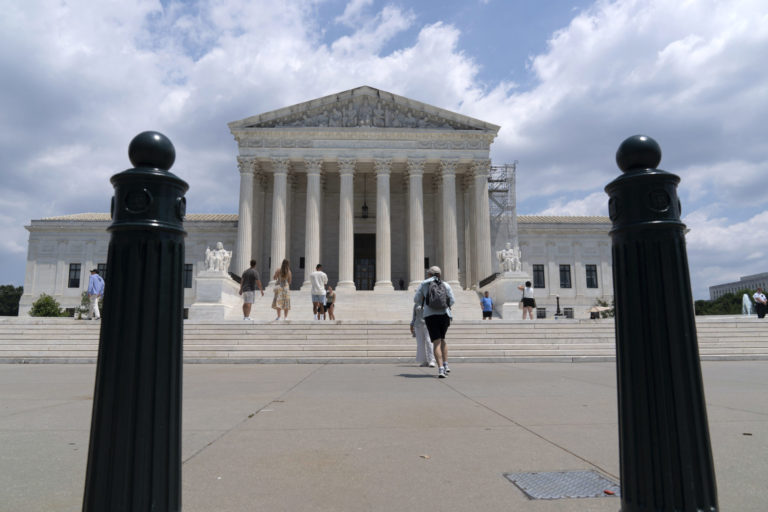
(Headline USA) As conservatives were still celebrating Donald Trump’s decisive victory over incumbent Joe Biden in the presidential debates and the Supreme Court overturning a law weaponized against Jan. 6 protestors, SCOTUS delivered an arguably an even more significant win by limiting the country’s unelected bureaucracies’ rule-making power.

The court’s 6-3 ruling on Friday overturned a 1984 decision colloquially known as Chevron that has instructed lower courts to defer to federal agencies in interpreting certain laws passed by Congress.

The heart of the Chevron decision says federal agencies should be allowed to fill in the details when laws aren’t crystal clear. Opponents of the decision argued that it gave power that should be wielded by judges to experts who work for the government.

“Courts must exercise their independent judgment in deciding whether an agency has acted within its statutory authority,” Chief Justice John Roberts wrote for the 6-3 conservative majority.

The SCOTUS decision stems from Atlantic herring fishermen suing over federal rules requiring them to pay for independent observers to monitor their catch. The fishermen argued that the 1976 Magnuson-Stevens Fishery Conservation and Management Act did not authorize officials to create industry-funded monitoring requirements and that the National Marine Fisheries Service failed to follow proper rulemaking procedure.

Conservative and business interests strongly backed the fishermen’s appeals, betting that a court that was remade during Republican Donald Trump’s presidency would strike another blow at the regulatory state.

The court’s conservative majority has previously reined in environmental regulations and stopped the Democratic Biden administration’s initiatives on COVID-19 vaccines and student loan forgiveness.

The justices hadn’t invoked Chevron since 2016, but lower courts had continued to do so.

Opponents of the Chevron doctrine argue that judges applied it too often to rubber-stamp decisions made by government bureaucrats. Judges must exercise their own authority and judgment to say what the law is, the court said Friday, adopting the opponents arguments.

SCOTUS’s decision drew celebrations from free-market conservatives and libertarians.

“The Supreme Court just struck down the Chevron Doctrine which has poisoned our country in recent decades. This is a *seismic* ruling. The people we elect to make the laws aren’t the ones who actually make the laws today, it’s unelected bureaucrats in the administrative state,” said former GOP presidential candidate Vivek Ramaswamy.

“That’s because an older, awful ruling said U.S. courts have to defer to administrative agencies’ interpretations of the law. As of today, that’s no longer the case & America is better off for it.”

Former Uvalde Police Chief INDICTED Over Response to Robb Elementary Shooting

(Headline USA) The former Uvalde schools police chief was indicted over his role in the slow police response to the 2022 massacre at a Texas elementary school that left 19 children and two teachers dead, the local sheriff said Thursday.

Pete Arredondo was indicted by a grand jury on 10 counts of felony child endangerment/abandonment and briefly booked into the county jail before he was released on bond, Uvalde Sheriff Ruben Nolasco told the Associated Press in a text message Thursday night.

The Uvalde Leader-News and the San Antonio Express-News reported that former school officer Adrian Gonzales also was indicted on multiple similar charges. The Uvalde Leader-News reported that District Attorney Christina Mitchell confirmed the indictment.

Mitchell did not return phone and email messages from the Associated Press seeking comment. Several family members of victims of the shooting did not respond to phone messages seeking comment.

The indictments make Arredondo, who was the on-site commander during the attack, and Gonzales the first officers to face criminal charges in one of the deadliest school shootings in U.S. history. A scathing report by Texas lawmakers that examined the police response described Gonzales as one of the first officers to enter the building after the shooting began.

The indictments were kept under seal until the men were in custody. It was unclear when Arredondo’s indictment would be publicly released.

Over two years ago, an 18-year-old gunman opened fire in a fourth-grade classroom, where he remained for more than 70 minutes before officers confronted and killed him. In total, 376 law enforcement officers massed at Robb Elementary School on May 24, 2022, some waiting in the hallway outside the classroom, even as the gunman could be heard firing an AR-15-style rifle inside.

“The families of the victims deserve to know what happened. And they will know what happened,” Governor Greg Abbott of Texas stated after reacting to the footage of Uvalde police officers failing to respond to the shooting, which he referred to as “shocking”

The office of a former attorney for Arredondo said they did not know whether the former chief has new representation. The AP could not immediately find a phone number to reach Gonzales.

Arredondo lost his job three months after the shooting. Several officers involved were eventually fired, and separate investigations by the Department of Justice and state lawmakers faulted law enforcement with botching their response to the massacre.

Whether any officers would face criminal charges over their actions in Uvalde has been a question hanging over the city of 15,000 since the Texas Rangers completed their investigation and turned their findings over to prosecutors.

Mitchell’s office has also come under scrutiny. Uvalde city officials filed a lawsuit in 2022 that accused prosecutors of not being transparent and withholding records related to the shooting. Media outlets, including the AP, also sued Uvalde officials for withholding records requested under public information laws.

But body camera footage, investigations by journalists, and damning government reports have laid bare how for over an hour, a mass of officers went in and out of the school with weapons drawn but did not go inside the classroom where the shooting was taking place. The hundreds of officers at the scene included state police, Uvalde police, school officers, and U.S. Border Patrol agents.

In their July 2022 report, Texas lawmakers faulted law enforcement at every level with failing “to prioritize saving innocent lives over their own safety.” The Justice Department released its own report in January that detailed “cascading failures” by police in waiting far too long to confront the gunman, acting with “no urgency” in establishing a command post, and communicating inaccurate information to grieving families.

Uvalde remains divided between residents who say they want to move past the tragedy and others who still want answers and accountability. During the first mayoral race since the shooting, locals voted in a man who had served as mayor more than a decade ago over a mother who sought restrictions on Second Amendment rights. The residents of Uvalde County additionally overwhelmingly voted for Republican candidates in the elections following the shooting.

Robb Elementary School is now permanently closed. The city broke ground on a new school in October 2023.

Adapted from reporting by the Associated Press

BREAKING: SCOTUS Overturns Weaponized Obstruction Law in Major Win for J6ers

(Ken Silva, Headline USA) The U.S. Supreme Court has overturned the “obstruction of an official proceeding” charge that the Justice Department wielded against hundreds of Jan. 6 protestors, ruling that the DOJ’s interpretation of the law would criminalize peaceful protest and other democratic activism.

The law in question was passed by Congress in the wake of the 2001 Enron scandal. The law was designed to punish business executives for altering financial documents. But in the wake of the Jan. 6, 2021, Capitol Hill uprising, the DOJ used the statute to target protestors who interrupted the proceedings.

SCOTUS put an end to the DOJ’s dubious charge once and for all in its Friday decision, though it’s still unclear how the decision will affect the sentences of J6ers.

“The Government’s theory would also criminalize a broad swath of prosaic conduct, exposing activists and lobbyist to decades in prison,” wrote Chief Justice John Roberts for the 6-3 majority. Justices Amy Comey Barret, Sonia Sotomayor and Elena Kagan were the three to dissent.

“As the Solicitor General acknowledged at oral argument, under the Government’s interpretation, a peaceful protester could conceivably be charged under §1512(c)(2) and face a 20-year sentence. And the Government would likewise have no apparent obstacle to prosecuting under (c)(2) any lobbying activity that ‘influences’ an official proceeding and is undertaken ‘corruptly,’” Roberts added later in his decision.

The obstruction charge, which carries up to 20 years behind bars, was among the most widely used felony charges brought in the massive federal prosecution following the Jan. 6, 2021, protest—when a throng of Trump supporters entered the U.S. Capitol to petition the Joint Session of Congress to redress their grievances over the heavily disputed election.

At least 152 people have been convicted at trial or pleaded guilty to obstructing an official proceeding, and at least 108 of them have been sentenced, according to an Associated Press review of court records.

A lower court judge had dismissed the charge against Joseph Fischer, a former Pennsylvania police officer, and two other defendants, ruling it didn’t cover their conduct. The justices agreed to hear the appeal filed by lawyers for Fischer, who faced a seven-count indictment for his actions on Jan. 6, including the obstruction charge.

The other defendants are Edward Jacob Lang, of New York’s Hudson Valley, and Garret Miller, who has since pleaded guilty to other charges and was sentenced to 38 months in prison. Miller, who’s from the Dallas area, could still face prosecution on the obstruction charge.

Other defendants, including Trump, are separately challenging the use of the charge.

Ken Silva is a staff writer at Headline USA. Follow him at twitter.com/jd_cashless.

Rep. Thomas Massie’s Wife Tragically Dies

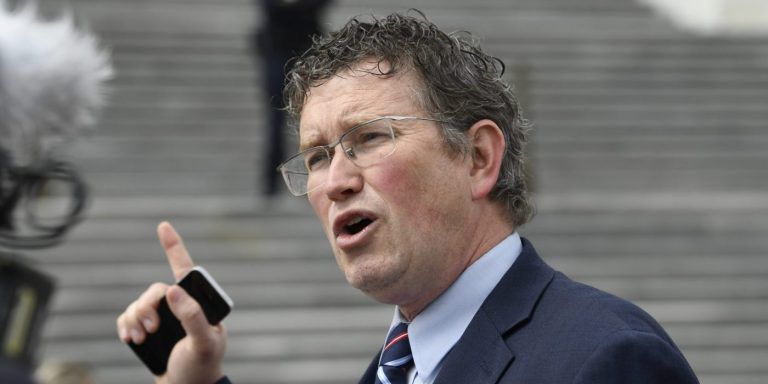
(Ken Silva, Headline USA) Rep. Thomas Massie, R-Ky., announced Friday that his wife Rhonda has tragically died, sparking an outpouring of condolences for the libertarian stalwart.

“Yesterday my high school sweetheart, the love of my life for over 35 years, the loving mother of our 4 children, the smartest kindest woman I ever knew, my beautiful and wise queen forever, Rhonda went to Heaven. Thank you for your prayers for our family in this difficult time,” Massie said on Twitter.

Massie also shared numerous photos of Rhonda, who was their high school’s valedictorian and who earned a mechanical engineering degree from MIT.

Massie didn’t reveal a cause of death. His announcement sparked an outpouring of condolences online.

“This is truly heartbreaking. I didn’t know Rhonda well, but I know her husband,” said Sen. Mike Lee, R-Utah. “And based on that alone, and on what you’ve told me about her, I know she was an amazing woman. Sharon and I mourn with you today, and will keep you in our prayers.”

The Ron Paul Institute for Peace and Prosperity, which counts Massie as a board member, also published a tribute to Rhonda.

“Today all people of goodwill, and especially the pro-peace and pro-liberty community, come together with our thoughts and prayers for the Massie family on the sad news of the death of Thomas Massie’s wife Rhonda yesterday,” said Ron Paul Instititue Director Daniel McAdams.

“It is with a heavy heart and tear-filled eyes that I write these words, imagining the pain felt by the large Massie family, which includes children and grandchildren,” he said.

“Thomas Massie is not only a Board Member of the Ron Paul Institute, he is a friend and mentor to me and a good friend to Dr. [Ron] Paul. We both pray the family is granted strength and that our Lord will heal their sorrow.”

Ken Silva is a staff writer at Headline USA. Follow him at twitter.com/jd_cashless.

What in the World Happened in 1971?

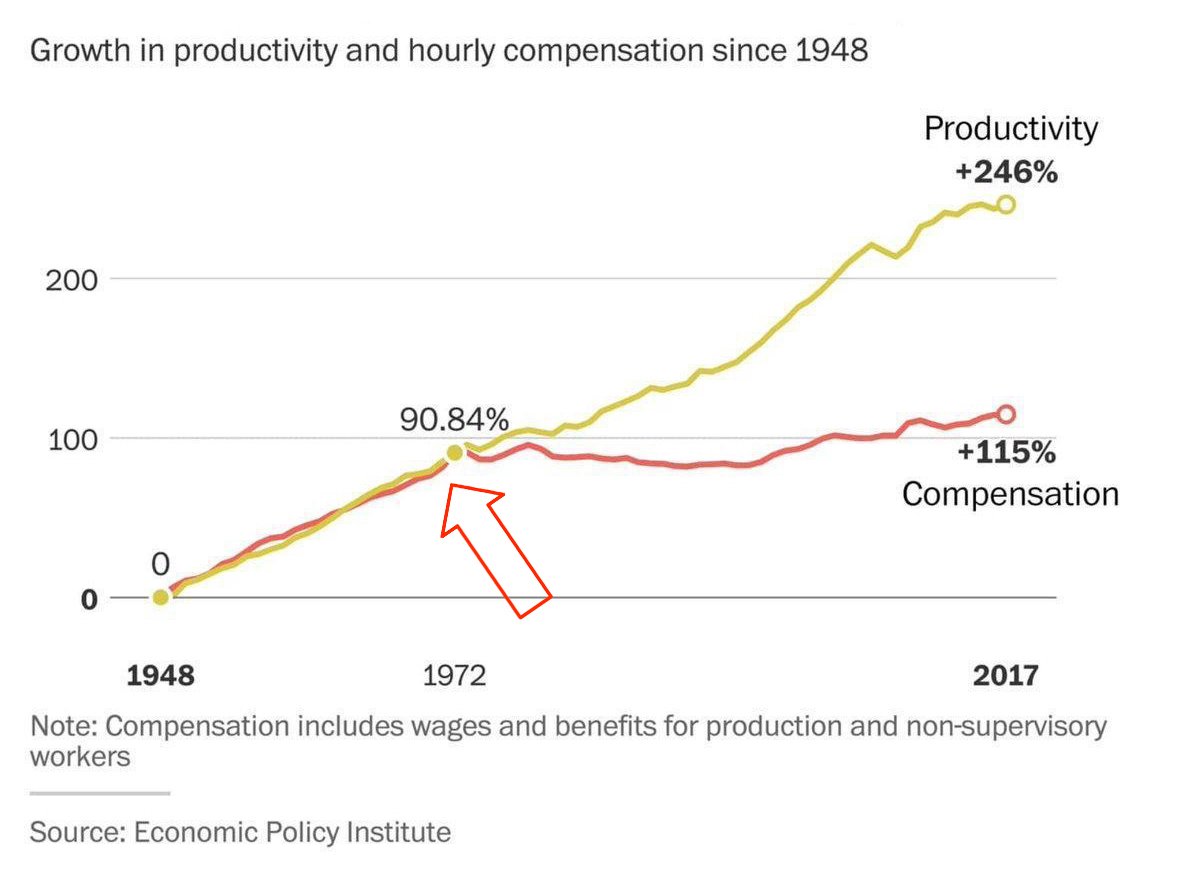
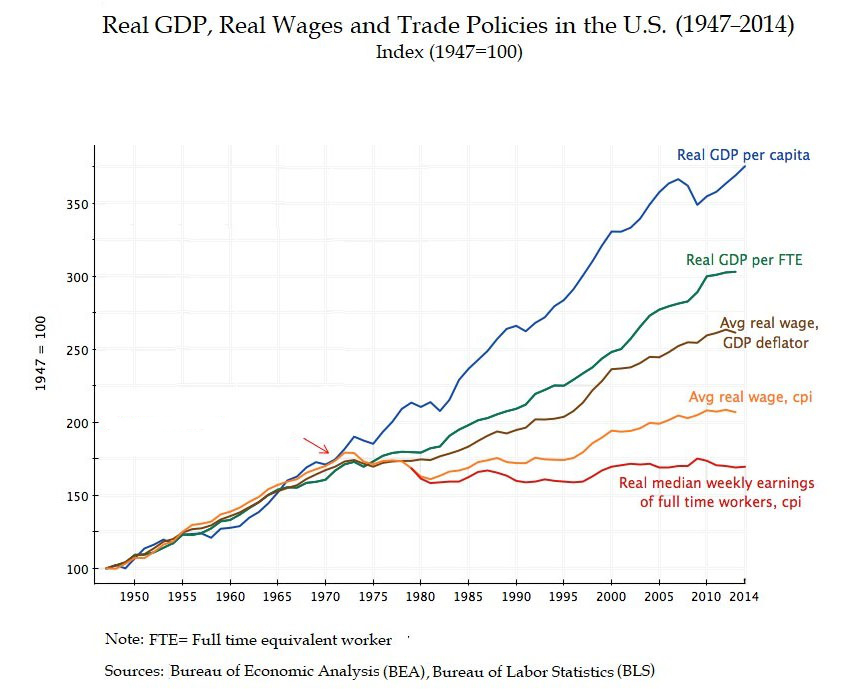
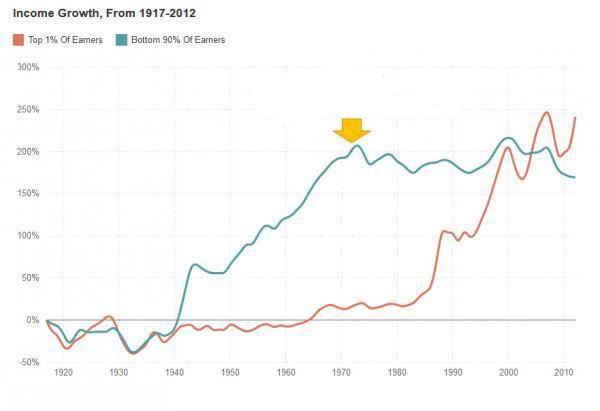
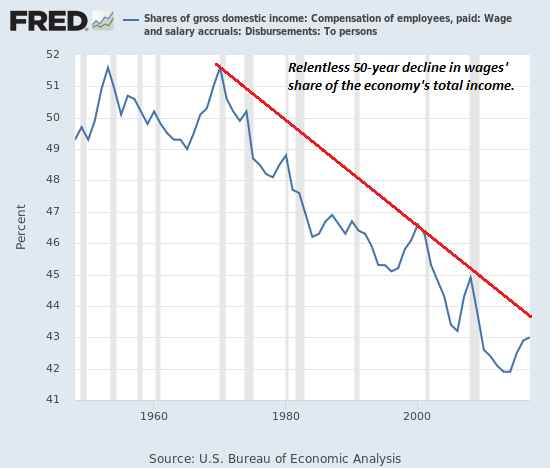
(Mike Maharrey, Money Metals News Service) A colleague recently discovered a website called “WTF Happened in 1971?” The entire main page is filled with charts and graphs. All of them show some kind of significant shift beginning in 1971. There are over 75 of them!

Here are just a few examples:

Here is some more data from graphs on the website:

  • African-American incomes virtually stopped catching up to white incomes in 1971.
  • Median male income has flatlined compared to real GDP per capita since 1971.
  • The number of 2-income families has surged since 1971.
  • Price inflation has surged since 1971.
  • A can of Campbell’s tomato soup has undergone significant shrinkflation since 1971. 
  • Housing prices have skyrocketed since 1971.

Clearly, something significant happened in 1971 causing a tremendous economic shift. 

What was it?

President Richard Nixon severed the dollar’s last connection with the gold standard, making it a purely free-floating fiat currency.

Nixon ordered Treasury Secretary John Connally to uncouple gold from its fixed $35 price and suspended the ability of foreign banks to directly exchange dollars for gold. During a national television address, Nixon promised the action would be temporary to “defend the dollar against the speculators.”

Nixon’s order was the end of a path off the gold standard that started during President Franklin D. Roosevelt’s administration. June 5, 1933, marked the beginning of a slow death of the dollar when Congress enacted a joint resolution erasing the right of private creditors in the United States to demand payment in gold. The move was the culmination of other actions taken by Roosevelt that year, including his infamous “gold confiscation” order.

While American citizens were legally prohibited from redeeming dollars for gold after Roosevelt’s policy changes, foreign governments maintained that privilege. In the 1960s, the Federal Reserve initiated an inflationary monetary policy to help monetize massive government spending for the Vietnam War and Pres. Lyndon Johnson’s “Great Society.” With the dollar losing value due to these inflationary policies, foreign governments began to redeem dollars for gold.

This is exactly how a gold standard is supposed to work. It puts limits on the amount the money supply can grow and constrains the government’s ability to spend. If the government “prints” too much money, other countries will begin to redeem the devaluing currency for gold. This is what was happening in the 1960s. As gold flowed out of the U.S. Treasury, concern grew that the country’s gold holdings could be completely depleted.

Instead of insisting on fiscal and monetary discipline, Nixon simply severed the dollar from its last ties to gold, allowing the central bank to inflate the money supply without restraint.

When he announced the closing of the gold window, Nixon said, “Let me lay to rest the bugaboo of what is called devaluation,” and promised, “Your dollar will be worth just as much as it is today.”

This was clearly a lie. That’s what all the charts on WTF Happened in 1971 reveal. 

According to the Consumer Price Index data released by the Bureau Labor of Statistics, the dollar has lost well over 80 percent of its value since Nixon’s fateful decision. Meanwhile, the dollar value of gold has gone from $35 an ounce to about $2,300.

And it decimated the middle class, creating significant socio-economic shifts.

You’ll only find one blurb of text on the WTF Happened in 1971 website. It’s a quote by economist F.A. Hayek.

“I don’t believe we shall ever have a good money again before we take the thing out of the hands of government, that is, we can’t take it violently out of the hands of government, all we can do is by some sly roundabout way introduce something that they can’t stop.”

Check out the work of the Sound Money Defense League to see what’s happening at the state level to do just that.


Mike Maharrey is a journalist and market analyst for MoneyMetals.com with over a decade of experience in precious metals. He holds a BS in accounting from the University of Kentucky and a BA in journalism from the University of South Florida.

As War Rages Next Door, Poles Seek Safety in Gold

(Mike Maharrey, Money Metals News Service) As war wages across their eastern border, Poles seek safety. And they’re finding it in gold.

Russian troops stormed across the Ukrainian border on Feb. 24, 2022. It was Fat Tuesday; a day Poles typically line up for jelly-filled donuts called pączki. Instead, they lined up to buy gold.

Piotr Kokik is the manager of a shop that sells gold bars and gold coins produced by the Mint of Poland. 

“On that day there were longer lines for gold at our store than for donuts at the bakery,” Kozik told the Associated Press.

There aren’t lines today, but demand for gold in Poland remains robust. It’s been that way since the COVID-19 pandemic.

In fact, the physical gold market in Poland has been among the strongest in Europe over the last three years.  

Marcin Grzesiak lives near the Belarus border where Poland is dealing with an influx of refugees. He recently traded 29,000 Polish zlotys ($7,000) in cash for three gold coins. He told the AP he’s worried about the geopolitical situation and he wants to diversify his investments. He also expressed concern about potential cyberattacks disrupting the global financial system. 

“We are living in turbulent times. I didn’t expect Russia to attack Ukraine. Even my friends from Ukraine didn’t expect Russia would attack them. Anything can happen.”

Mint of Poland head of precious metals trade Marta Bassani-Prusik said gold sales skyrocketed during the pandemic. The war next door juiced gold sales again “because everybody was afraid of what was happening.”

Gold sales also got a boost with post-pandemic price inflation rising as high as 18 percent.

Poles are no stranger to geopolitical fear. The county serves as a crossroads between Eastern and Western Europe, and it has seen more than its fair share of war and strife. Memories of German occupation during World War II and Russian domination in the years that followed linger in the Polish psyche.

Many families remember stories about gold coins and jewelry meaning the difference between life and death during World War II. It bought food and sometimes an escape.

Bassani-Prusik said these stories made a big impression on many of her clients.

“They say that they are alive only because of the gold, because their grandparents had a gold bar or a gold coin.”

Having real physical gold is important 38-year-old entrepreneur Radoslaw Paklikowski told the AP.

“I don’t mean a ton of gold, but an amount that will help you cross the border or make your family safe if anything will happen.”

Paklikowski said he invests about 5 percent of his assets in precious metals.

The Polish central bank has also joined the gold rush. 

In 2021, Bank of Poland President Adam Glapiński announced a plan to expand the country’s gold reserves by 100 tons. The central bank reached its goal in September 2023 and kept buying.

Poland ranked as the second-biggest gold buyer in 2023, only trailing China. Between April and November, the Polish central bank bought 130 tons of gold, increasing its gold holdings by 57 percent, to 359 tons. 

Glapiński recently indicated the Bank of Poland will continue to add gold to its holdings and that appears to be the case.

“This makes Poland a more credible country, we have a better standing in all ratings, we are a very serious partner and we will continue to buy gold. The dream is to reach 20 percent,” Glapiński said.

When he announced the plan to expand its gold reserves, Glapiński said holding gold was a matter of financial security and stability.

“Gold will retain its value even when someone cuts off the power to the global financial system, destroying traditional assets based on electronic accounting records. Of course, we do not assume that this will happen. But as the saying goes – forewarned is always insured.

“And the central bank is required to be prepared for even the most unfavorable circumstances. That is why we see a special place for gold in our foreign exchange management process.”

The Polish central bank has continued to add gold to its reserves this year.

It’s clear Poles have learned lessons from history. They understand the value of gold and the financial security it provides. It’s a lesson people in the U.S. would do well to learn.


Mike Maharrey is a journalist and market analyst for MoneyMetals.com with over a decade of experience in precious metals. He holds a BS in accounting from the University of Kentucky and a BA in journalism from the University of South Florida.

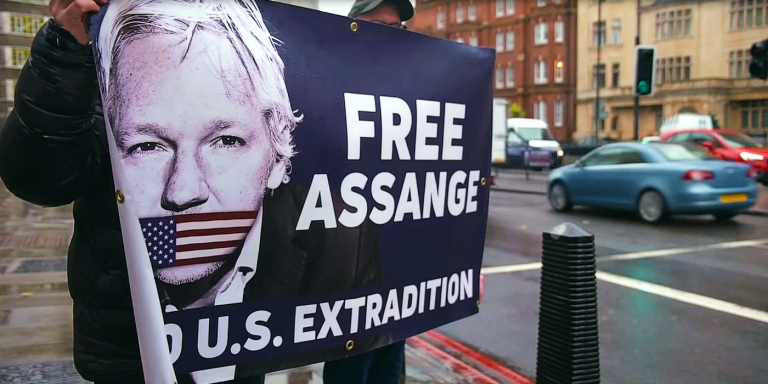
Assange Agreed to Destroy Unpublished Wikileaks Material as Part of Plea Deal

(Ken Silva, Headline USA) While much of the world is celebrating WikiLeaks founder Julian Assange’s recent release from prison, there was a downside the the plea deal Assange struck with the Justice Department.

As per his plea deal with the DOJ, Assange must destroy the unpublished classified material still in WikiLeaks‘ possession. Assange agreed this week to plea guilty to an Espionage Act charge in exchange for time served. He had spent the last five years in a high-security British prison while fighting to avoid extradition to the U.S. to face charges of illegally obtaining classified information.

Assange’s plea deal states: “The Defendant shall take all action within his control to cause the return to the United States or the destruction of any such unpublished information in his possession, custody, or control, or that of WikiLeaks or any affiliate of WikiLeaks.

“The Defendant further agrees that, if the forgoing obligation requires him to instruct the editor(s) of WikiLeaks to destroy any such information or otherwise cause it to be destroyed, he shall provide the United States (or cause to be provided to the United States) a sworn affidavit confirming the instruction he provided and that, he will, in good faith, seek to facilitate compliance with that instruction prior to sentencing,” the plea deal states.

Assange’s lawyer reportedly downplayed the significance of the agreement.

“The materials we are talking about are now more than a decade old. I don’t know to what extent any still existed or what possible value they might have, certainly no national security value,” said Barry Pollack, Assange’s US lawyer, according to Consortium News.

“In fact, the United States court in Saipan yesterday conceded, and the judge found that there is no evidence that any harm has befallen any individual anywhere in the world as a result of Mr. Assange’s publications,” Pollack reportedly said.

“That being said, they did insist that he issue an instruction to the editor of WikiLeaks to destroy any materials they might have that were not published and Julian has complied with that provision and issued that instruction.”

The plea agreement comes months after President Joe Biden said he was considering a request from Australia to drop the U.S. push to prosecute Assange. The White House was not involved in the decision to resolve Assange’s case, according to a White House official who was not authorized to speak publicly and spoke to the Associated Press on condition of anonymity.

Manning was sentenced to 35 years in prison after being convicted of violating the Espionage Act and other offenses for leaking classified government and military documents to WikiLeaks. President Barack Obama commuted the sentence in 2017, allowing Manning—who underwent a gender transition to become female while in prison—release after about seven years behind bars.

Assange has been heralded by many around the world as a hero who brought to light military wrongdoing in Iraq and Afghanistan. Among the files published by WikiLeaks was a video of a 2007 Apache helicopter attack by American forces in Baghdad that killed 11 people, including two Reuters journalists.

Ken Silva is a staff writer at Headline USA. Follow him at twitter.com/jd_cashless.

SELLERS: Dems Pull Off a Shocking Surprise Win in 1st (and Only) 2024 Debate

(Ben Sellers, Headline USA) Is there ever a way to beat the house if a game is rigged from the start? Probably not.

Likewise, the Democrats’ master plan has long been sealed, possibly since well before the COVID-19 pandemic derailed the Obama machine’s first plan to run against Trump by engineering a series of nationwide race riots (as Headline USA predicted in April 2019, more than a year before the George Floyd incident).

Perhaps the candidate will not be Michelle Obama but another proxy. At this point, however, Democrats may already be facing limited options with Biden having secured the nomination, depending on his health and willingness to play ball.

Those “variables,” of course, have likely also been accounted for in this high-stakes game.

Biden admitted during his 2020 debates with Trump that he saw himself as a “transitional” president, and he has certainly succeeded in bridging the gap in America between democracy and the socialist revolution that the Obamas may have originally envisioned but lacked the political will to enact once they became accustomed to the glamorous lifestyle.

For much of his life, Obama was groomed to be the quintessential patsy, the avatar for special interest organizations like the Muslim Brotherhood and the Weather Underground, all linked back to various international socialist movements, and bound together with financing by billionaire oligarchs and foreign nations who recognized the inherent vulnerabilities in America’s pro-capitalist representative democracy.

Now, the Obamas may have the luxury of choosing the next patsy to serve as an empty vessel in the Oval Office, but it will need to be someone for whom minimal campaigning is necessary under the circumstances, who can sit back and allow the system to work, as Biden did in 2020.

Although the outcome of Thursday night’s debate was always hiding in plain sight, it is remarkable how easy it is to get swept up into the fanciful ideas that a juiced up Biden, despite having no notes to work from, might have colluded with CNN to ambush Republican contender Donald Trump.

Perhaps that was Trump’s plan all along, recognizing that if he had been bullied onstage it would only have helped him more.

As it stands, Trump may have lost the debate by winning, by stumbling into a cake walk and suddenly realizing that Republicans should be doing everything possible to force Biden not onto the debate stage but onto the stage at Chicago in August for the Democratic National Convention.

What remains clear is that this is no time for the GOP to take its eye off where the ball is heading. With the Biden panic—over things that conservative media have spent months warning about—suddenly capturing the headlines, it is the perfect time for another sleight of hand.

What’s next? Take down Trump, of course.

The Supreme Court rulings that will drop in the Jan. 6 and presidential immunity cases will provide the perfect vehicle for that. As of this writing, they have yet to be revealed, and I have no advance knowledge of the disposition, but I can assure the reader that they will play to the political advantage of the Democrats’ master plan.

Why? Because it doesn’t matter which way the decision goes, just as it didn’t matter which Biden or which Trump showed up for the debate. The contingency plan takes both into account, and the trap has been laid in such a way that no matter what happens it will be a win.

If the courts rule in their favor, Democrats send Trump to jail. If they waver in any way, we will suddenly realize what the months of negative media about Clarence Thomas and Samuel Alito have been for as the same social-justice warriors they mobilized to protest on college campuses start to converge on the courts, ready to wage an intimidation campaign that will become central to the election.

Democrats will note that they switched out their candidate and insist that Republicans should do the same, for the sake of “democracy.”

Republicans know to hold steadfast, and don’t get taken in by the misdirection. But as Thursday’s debate shows, that is easier said than done when dealing with master gaslighters of the highest order.

Ben Sellers is the editor of Headline USA. Follow him at twitter.com/realbensellers.