

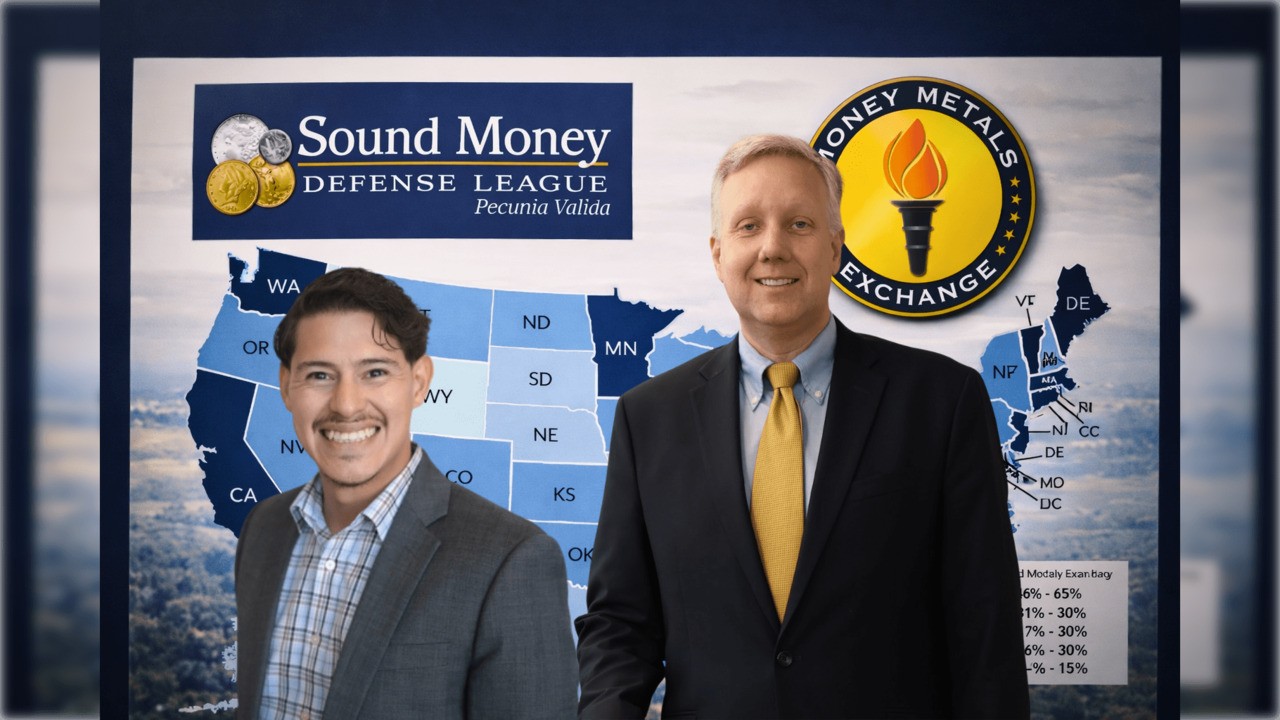
(Money Metals News Service) In a recent episode of the Money Metals podcast, host Mike Maharrey sits down with Money Metals CEO Stefan Gleason and Sound Money Defense League Executive Director Jp Cortez to look back on 2025’s explosive precious-metals market and the growing push to restore sound money policies across the United States.
Rather than treating rising prices as a simple story of “more buying,” the guests describe a market that changed character during the year. They argue the biggest story isn’t just what gold and silver did, but who drove the move, who lagged behind, and why the political and monetary consequences are now spilling into public policy.
(Interview Starts Around 4:51 Mark)
A Bull Market Driven by Asia and Central Banks
Stefan Gleason frames the last two years as a turbulent backdrop for gold and silver, citing dislocations, tariffs, war, bank runs, a change in administration, and even assassination attempts. In his view, the metal markets have been reacting to a world that keeps delivering fresh instability.
He describes gold’s move from $2,000 to $4,000 over the last two years as primarily an Asia-and-central-bank story. For much of that rise, he says the West was not the driver, and U.S. retail investors were not the main force pushing prices higher.
That dynamic mattered for dealers. Gleason says Money Metals saw an extraordinary amount of selling back to them compared to prior years, as disciplined holders took gains—especially during the period when gold was outpacing silver.
Dealer Reality: Selling, Inventory, and a Late-Summer Shift
Gleason draws a sharp contrast between online dealers and many local coin shops (LCS). He describes local shops as “choking on inventory,” overwhelmed by the volume of people unloading metal, forcing them to move product quickly and sometimes at discounts.
Money Metals, he says, experienced a more balanced flow, partly because some sellers prefer the immediacy of walking into a local shop, getting paid the same day, and leaving with cash—even if that convenience comes at a cost.
He argues that the tone changed around late summer. Over the last two to three months, he says, new demand began showing up in a significant way, with more first-time buyers calling in, asking basic questions, and seeking education rather than hype. In his telling, the U.S. public has started to recognize “serial devaluation,” and the retail market is finally waking up.
Mainstream Finance Starts to Talk About Gold Again
The conversation turns to a moment both Maharrey and Gleason see as an inflection point: the CIO of Morgan Stanley publicly criticizing the traditional 60/40 portfolio and recommending that investors shift 20% of their bond holdings to gold. Gleason calls that message “huge,” not because it is novel to precious-metals advocates, but because it arrived from an institutional voice that many investors take seriously.
Gleason emphasizes how underowned gold remains in the United States, saying only “one or 2% of US investors have any gold at all,” and that most Americans don’t have 10–20% exposure to gold, silver, or miners. That gap, he suggests, explains why even small shifts in institutional or retail behavior can matter.
He also shares a personal anecdote about a conservative financial advisor admitting he suffers from the same bias most institutional investors have against precious metals. The advisor’s hesitation, in Gleason’s view, reflects a broader Wall Street mindset that is now being challenged by clients who can no longer ignore price signals and currency realities.
What the Sound Money Defense League Does
Mike Maharrey asks Jp Cortez to explain the Sound Money Defense League’s purpose for listeners who may be unfamiliar with the organization. Cortez describes it as a project that began with Money Metals and, since 2014, has focused on “remonetizing gold and silver” through legislation, activism, and education.
Cortez says the strategy is to remove disincentives that make it harder for individuals to hold or use precious metals as money. He frames the effort as part of bringing state laws into better alignment with Article I, Section 10 of the Constitution, which references gold and silver as money.
He ties the policy push to the same macro forces Gleason discussed: geopolitical tension, central bank behavior, and what he calls perpetual dollar devaluation driven by politicians and monetary authorities. In that environment, Cortez argues, people and even governments are increasingly drawn to “inflation-proof” and “politically neutral” assets.
2025 Legislative Results and the 2026 Sound Money Index
Cortez calls 2025 a year that “completely changed the game.” He says more than 65 pieces of legislation were introduced in more than 31 states, which he interprets as more than 70% of the United States actively considering sound money-related policy changes.
He highlights several wins as examples of how far the movement has spread. Kentucky ended the sales tax on precious metals. Idaho passed what he calls the state’s largest sales or income tax cut in history, which included eliminating the capital gains tax on precious metals. Wyoming established a $10 million gold reserve held as physical gold stored within the state and carried on the state’s balance sheet.
Cortez points listeners to the newly released 2026 Sound Money Index, an annual 50-state scorecard ranking states by pro- or anti-sound-money policy. He notes that some states have climbed steadily over a decade, while others have fallen sharply after reversing course. He points to Washington and Maryland reimposing a sales tax on precious metals, saying those states dropped to 47th and 50th, respectively.
Federal Action: Auditing and Refining America’s Gold
Cortez shifts from state victories to federal efforts, pointing to Representative Thomas Massie introducing the Gold Reserve Transparency Act in June. He argues the nation’s gold has not been comprehensively audited in decades and criticizes what he characterizes as audits focused on seals and locks rather than verifying the contents of depositories.
He cites a figure of 261 million ounces of gold allegedly held by the United States and says the bill would require a full inventory, assaying, and disclosure of transactions, including any leases or encumbrances.
Cortez says Senator Mike Lee introduced an identical bill with an additional provision calling for the refinement of America’s gold. He claims much of the reserve consists of 90% melt bars produced during the FDR confiscation of 1933 and argues that this does not meet modern global market standards. In his view, refinement would improve liquidity and readiness, even if the ideal scenario is never needing to sell reserve gold.
A Warning About “Pro-Gold” Bills That Expand Surveillance
Cortez also warns that rising interest in precious metals has produced legislation that presents itself as pro-gold or pro sound money but, in practice, introduces anti-privacy regulations and surveillance structures. He argues that some proposals effectively create a government-mediated system that undermines gold’s core advantages, including privacy and the lack of counterparty risk.
He pushes back on the idea that precious-metals owners should route transactions through systems that can track, approve, or deny spending. He also expresses skepticism about state-run depositories, citing the historical precedent of government gold seizures and arguing that private options are often more secure and more trusted than government-run facilities.
In Cortez’s telling, many lawmakers are not acting out of malice so much as misunderstanding. He says the fix is education and a redirection toward reforms that empower individuals more directly, such as removing taxes and reducing friction rather than building new regulatory machinery.
Scholarships, Fellowships, and the Launch of Sound Money Review
Cortez describes the Sound Money Defense League as an education engine as well as a legislative organization. He says the League offers Sound Money Scholarships and Fellowships in coordination with Money Metals, providing thousands of dollars and even tens of thousands of dollars annually to students and researchers producing essays and analysis on gold, silver, and monetary history.
He also announces a new project: the prestigious Sound Money Review, a scholarly journal launched this year. Cortez says it will publish fellows’ work while also resurfacing older, “timeless” essays and writings that have been archived or forgotten, aiming to bring them back into circulation at a time when more people are paying attention to the weaknesses of fiat money.
Money Metals Depository and the “One-Stop Shop” Vision
Maharrey tees up a discussion of the company’s storage services, and Gleason details what he calls a major expansion in Money Metals’ Depository footprint. He says the company has been in the depository business since 2016 and built a smaller Idaho facility in 2017, but demand—especially around COVID and beyond—made it clear that a much larger buildout was necessary.
Gleason describes the new Idaho facility as the largest depository west of New York, claiming it is twice the size of Fort Knox, with 8,500 square feet of Class 3 vault space inside a 40,000 square foot facility that can expand to 70,000 square feet. He says the site is in a favorable jurisdiction, positioned near local law enforcement, supported by armed retired police and military personnel, and protected by layered physical and electronic security with dual controls.
He frames the depository as part of a broader platform: buying, selling, storing, and even lending against gold and silver. Gleason says Money Metals offers gold-backed loans at rates “well under 10%” in the single digits, positioning them as more comparable to conventional borrowing than pawn-style pricing.
He also highlights a monthly savings plan designed to automate purchases and make accumulating metals a default behavior rather than a sporadic decision. In his view, these services, combined with education and policy advocacy, distinguish Money Metals from firms he characterizes as merely selling “gold widgets.”
Looking Into 2026: Reorient the Lens and Engage the Fight
As the episode closes, Maharrey asks each guest for a single message heading into 2026. Gleason urges listeners to reorient the way they measure financial progress, arguing that viewing everything through the dollar lens is increasingly deceptive in an era of continual currency devaluation. He encourages people to think in terms of gold and silver as reference points and suggests silver may be entering a new pricing regime after being capped near the $50 level for 45 years.
Cortez closes with a political message: inflation and financial erosion are not accidents, he says, but intentional policy choices. He argues that people still have power—especially at the state level—and that grassroots participation has been the Sound Money Defense League’s most effective tool for a decade. He invokes Everett Dirksen’s line that politicians must “feel the heap before they can see the light,” urging listeners to make calls, send emails, and stay engaged rather than falling into resignation.
Maharrey wraps by directing listeners to soundmoneydefense.org for League updates and to moneymetals.com and moneymetals.com/news for products and coverage, ending on a forward-looking note for 2026.
 2025 recap from the Money Metals podcast: why gold and silver surged, why U.S. buyers showed up late, and how states are rolling out sound money laws; plus the new 2026 Sound Money Index.)