

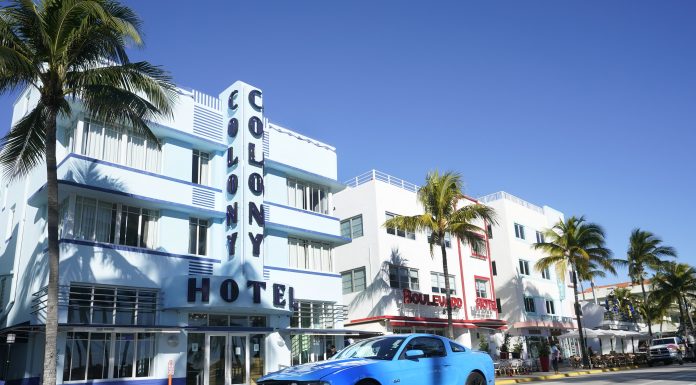
(José Niño, Headline USA) Two Miami Beach, Florida detectives showed up at Raquel Pacheco’s door last Monday, asking about a Facebook comment she wrote criticizing Mayor Steven Meiner. The visit has triggered fierce condemnation from civil rights organizations and ignited national debate about First Amendment protections.
The controversy began when Pacheco, a U.S. Army National Guard veteran and former political candidate, responded to Meiner’s Facebook post earlier this month claiming Miami Beach ranks as the nation’s most tolerant city. She wrote that the mayor “consistently calls for the death of all Palestinians, tried to shut down a theater for showing a movie that hurt his feelings, and REFUSES to stand up for the LGBTQ community.”
Six days later, two Intelligence Unit detectives arrived at her South Beach residence. Per a report by CBS News, Pacheco recorded the encounter, capturing her response when officers questioned her about the post. “Am I being charged with a crime? OK, you are here to investigate a statement that I allegedly made on Facebook,” she told them, refusing to answer without legal representation.
According to the civil liberties organization The Foundation for Individual Rights and Expression, detectives explained their visit by stating the “concerning part” was that her Palestine comment could “probably incite somebody to do something radical.” They advised her to “refrain from posting things like that because that could get something incited.”
The Miami Herald reported that police spokesperson Christopher Bess confirmed the mayor’s office flagged Pacheco’s comment. According to CBS Austin, police Chief Wayne Jones defended the visit, citing “real, ongoing national and international concerns surrounding antisemitic attacks” and claiming he had “serious concerns that her remarks could trigger physical action by others,” per a report by The Forward.
FIRE sent a scathing letter to Chief Jones last Wednesday, calling the visit “an egregious abuse of power” that violates constitutional principles. Director of public advocacy Aaron Terr wrote that “law enforcement officers making a surprise appearance on an individual’s doorstep to convey official disapproval of her protected expression represents an egregious abuse of power.”
FIRE’s analysis applied the Supreme Court’s Brandenburg standard, which holds that inflammatory speech loses First Amendment protection only if directed at inciting imminent lawless action and likely to produce such action. “By no stretch of the imagination did Pacheco call for any unlawful action, and there is certainly no evidence that anyone was likely to engage in such action after reading her post, let alone immediately,” FIRE stated.
The incident represents the third major First Amendment controversy involving Miami Beach and Mayor Meiner in less than two years. In March 2025, Meiner attempted to evict O Cinema for screening “No Other Land,” an Oscar-winning documentary about Palestinian displacement. In September 2025, Jewish Voice for Peace filed a federal lawsuit alleging Miami Beach violated First Amendment rights by passing an anti-protest ordinance.
Pacheco described the police visit’s impact powerfully. “My overwhelming feeling was that freedom of speech as I know it died at my front step yesterday. It’s an incredibly, incredibly sad thing,” she told CBS News Miami. She characterized the encounter as “an intimidation tactic” designed to silence criticism.
The Miami Herald reported that Pacheco has hired attorney Miriam Haskell and filed public records requests to determine who complained and who ordered the police visit.
José Niño is the deputy editor of Headline USA. Follow him at x.com/JoseAlNino
