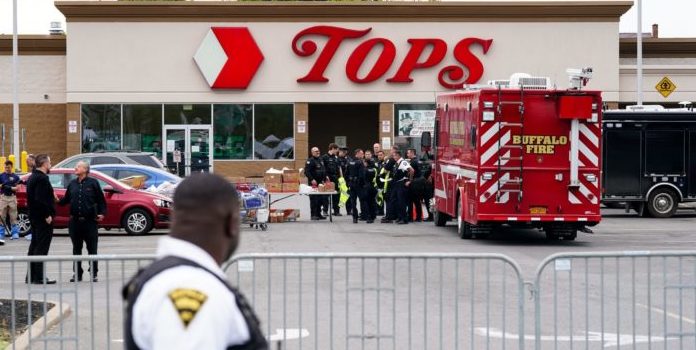
(Ken Silva, Headline USA) The Justice Department has disclosed that there’s classified information in the case of Payton Gendron, the mass shooter who killed 10 people at a Buffalo supermarket on May 14, 2022. The DOJ wants to keep that information hidden at Gendron’s federal trial, which is set to begin next month.
Gendron already pled guilty to state murder charges years ago, but federal prosecutors are seeking the death penalty.
The DOJ disclosed the existence of classified information in an April 14 court filing, telling the presiding judge that it intends to keep such evidence secret on national security grounds. The filing was first reported by local journalist Gary Craig.
Gendron’s lawyers responded on April 28, asking for a summary of the evidence.
“Without some information, defense counsel cannot adequately respond to the government’s requested procedures or timeline other than to lodge general objections and provide the Court with unnecessarily expansive information about possible guilt and penalty phase defenses,” the defense lawyers said.
🚨The DOJ says there's classified information in Buffalo mass shooter Payton Gendron's case.
I wonder if it has anything to do with him communicating w/ a "retired federal agent" right before his attack?
First reported by @gcraig1 https://t.co/9MnLQESeIZ pic.twitter.com/KwiWP2dPBk
— Ken Silva (@JD_Cashless) May 8, 2026
The DOJ doesn’t even want to give the defense team a summary. Federal prosecutors said Wednesday that the law “does not authorize a defendant to be provided with a summary of the information at issue.”
It’s unclear why classified information would exist in a domestic mass shooting case. However, it’s been reported that Gendron may have been communicating with a “retired” federal agent as little as 30 minutes before his shooting spree.
The Buffalo News first reported in May 2022 that the FBI was “tracking down and interviewing the six people, including the retired agent,” all of whom may have had contact with Gendron in an online chatroom 30 minutes before his shooting. Headline USA filed a Freedom of Information Act request in early 2023 for records about the FBI’s investigation into this matter—including for a copy of the bureau’s interview summary, or “FBI 302,” with the retired federal agent who spoke with the mass shooter.
The FBI has apparently interviewed at least some of the six people linked to Gendron in the chatroom. The bureau told Headline USA that records related to this are “located in an investigative file”—but that it couldn’t disclose the records due to pending law enforcement proceedings.
Classified Cases
The Buffalo shooting is one of a slew of high-profile cases involving classified information.
Last August, for instance, Judge Aileen Cannon allowed the FBI to keep an untold amount of classified evidence secret from Ryan Routh, the man who was found guilty of attempting to kill Trump at his Palm Beach golf course in September 2024. Judge Cannon didn’t elaborate in her ruling, saying simply that disclosing classified information in Routh’s case “could cause serious damage or exceptionally grave damages to the national security of the United States.”
The DOJ was also allowed to keep 1.6 million items of classified evidence secret in the case of Asif Merchant, the Pakistani man who was convicted earlier this year of working for Iran in a plot to assassinate Donald Trump in 2024.
CIPA Abuses
The DOJ has used the Classified Information Procedures Act, or CIPA, in the past to keep damning government scandals from the public.
A prominent example of CIPA abuse stemmed from the June 2016 Pulse nightclub shooting, in which 29-year-old Omar Mateen shot and killed 49 people and wounded 53 others in revenge for U.S. bombings in the Middle East.
In January 2017, the DOJ charged Mateen’s wife, Noor Salman, with aiding and abetting his slaughter. At first, the DOJ said that there was no classified information involved in Salman’s case. But when her attorneys moved to call Mateen’s father, Siddique Mateen, as witnesses, prosecutors changed their tune. They contacted the defense and stated that they were authorized to disclose that Siddique Mateen had been an undercover informant for the FBI both during the attack, as well as when defense attorneys had interviewed him during pretrial proceedings earlier.
The presiding judge declined to toss the case despite the government’s deception, but a jury wound up acquitting Salman anyway.
A less deadly, but equally egregious, case of CIPA abuse occurred in the prosecutions stemming from the 2015 mass shooting in Garland, Texas, where Islamic extremists Elton Simpson and Nadir Soofi allegedly intended to shoot up a Prophet Mohammed cartoon contest. In that incident, local cops stopped the shooters before they could kill anyone — though they did shoot and injure a security guard.
Shockingly, an undercover FBI agent dressed in Muslim attire was at the same event as Simpson and Soofi, apparently monitoring them. His presence might never have been known had local cops not arrested him because they thought that he was one of the attackers. Other FBI agents intervened immediately, placing a hood over the undercover agent’s head and whisking him away to another location before confiscating footage of the incident from bystanders. It was later revealed that the same undercover agent had told Simpson to “tear up Texas.”
More than 10 years later, one of Simpson and Soofi’s alleged coconspirators is still appealing his convictions on the grounds that much of the FBI’s shady undercover activities weren’t revealed until after he was convicted in August 2016.
“I was shocked,” Daniel Maynard, who represented Kareem, told CBS’s 60 Minutes in March 2016. “I was shocked that the government hadn’t turned this over. I wanted to know when did he get there, why was he there?”
Kareem’s current appeal doesn’t argue that his convictions should be overturned due to the undercover agent’s actions per se. Rather, his lawyers contend that the U.S. government violated his right to a fair trial by withholding exculpatory evidence, including about the undercover agent.
Moreover, the FBI still has yet to produce a trove of other information, including about its investigation of Simpson in spring 2015; whether Simpson’s 2010 gun purchase or Soofi’s 2012 gun purchase were authorized by agents working the failed “Fast and Furious” gun-running operation; and more information on the attack and the undercover agent’s involvement, according to Kareem’s November 2024 appeal brief.
The Muslim Legal Fund of America filed an amicus brief on Kareem’s behalf, outlining many of the above-mentioned issues — and urging the presiding judge to allow Kareem’s lawyers to see the classified evidence the government has kept hidden. The legal fund argued that CIPA has allowed the FBI to run roughshod over the Constitution.
“As Kareem’s case highlights, when it comes to relevant information about the undercover informants and employees, including their identity, credibility, bias, and even presence, CIPA is not working as designed,” the group said in the November 2024 brief.
“The root of the problem is that the determination as to what information is relevant is being controlled primarily by intelligence agencies (the FBI) rather than the trial court, with inputs from the prosecution and defense.”
The U.S. Court of Appeals for the Ninth Circuit has yet to rule on the matter.
Ken Silva is the editor of Headline USA. Follow him at x.com/jd_cashless.