


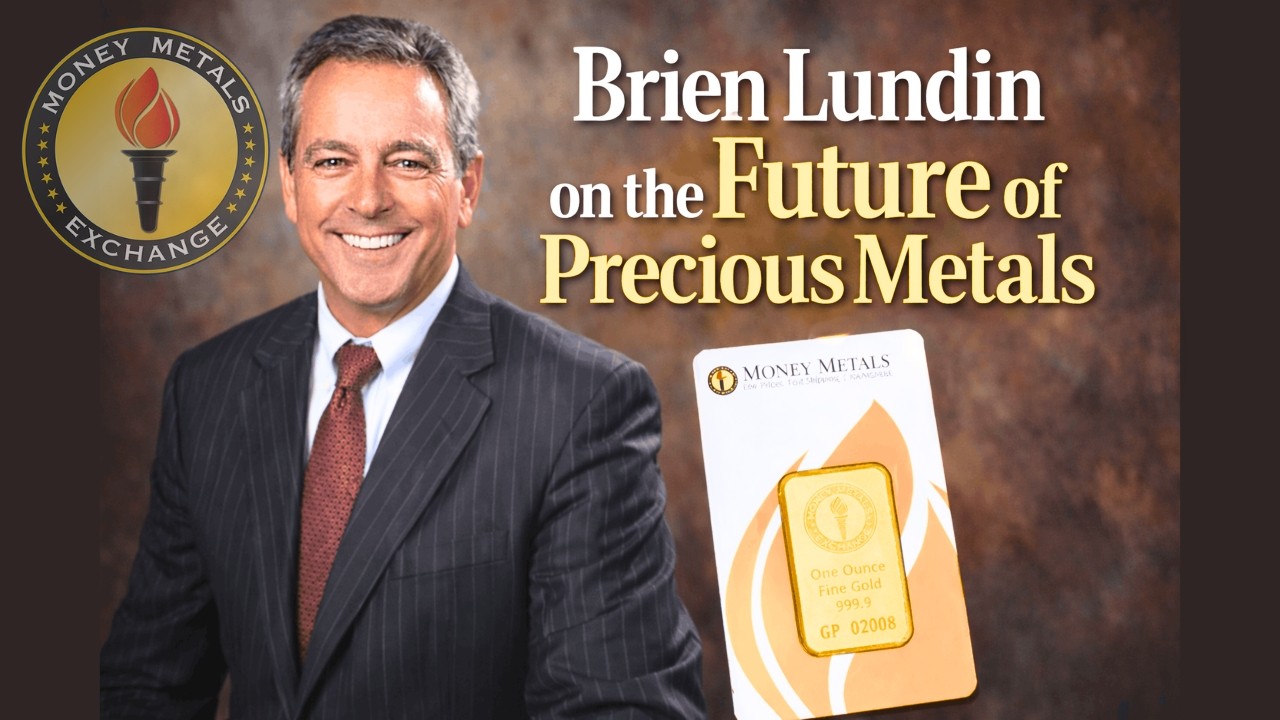
(Money Metals News Service) In a recent episode of the Money Metals podcast, host Mike Maharrey sat down with Brien Lundin, president and CEO of Jefferson Financial, editor of The Gold Newsletter, and host of the long-running New Orleans Investment Conference. Their conversation explored the forces currently shaping the gold and silver markets, including geopolitical tensions, government debt, inflation, central bank buying, and shifting investor sentiment.
While headlines surrounding global conflict have dominated the news cycle, Lundin argues that the most important drivers of precious metals prices remain rooted in long-term monetary trends rather than short-term geopolitical events.
(Interview Starts Around 6:54 Mark)
War Headlines vs. the Real Drivers of Gold
At the time of the discussion, markets were reacting to escalating tensions involving Iran, which briefly pushed gold prices higher. According to Maharrey, gold surged to roughly $5,400 per ounce when the conflict began before pulling back toward $5,200 as markets absorbed the news.
Lundin emphasized that geopolitical shocks typically create only temporary moves in gold prices. Traders often rush into gold during the early days of a crisis, only to exit just as quickly once the initial excitement fades.
In his view, wars may trigger short-term speculation, but they rarely determine the long-term trajectory of precious metals.
Instead, Lundin says the primary reason to own gold remains simple and consistent across history: protection against the loss of purchasing power in fiat currencies.
He argues that the current environment—marked by rising government debt, persistent deficit spending, and central bank intervention—represents the late stages of a long-running monetary cycle. According to Lundin, gold’s current rally reflects that structural reality more than any specific geopolitical event.
Long-Term Trends Still Favor Precious Metals
Despite headline volatility, Lundin believes the underlying bull market in gold remains intact.
He pointed out that the current gold bull market is now roughly two years old, and unlike previous cycles, it has experienced surprisingly few major corrections. Over that period, the market has seen only two drawdowns of roughly 10 percent, a relatively modest level of volatility for such a strong rally.
One major reason for this stability is persistent central bank demand. Governments around the world have been accumulating gold as a hedge against financial and geopolitical risks, particularly concerns surrounding the weaponization of the U.S. dollar in global politics.
Lundin also noted that the entry of Western investors into the market since late summer has introduced greater price volatility. When large institutional funds enter the sector, they tend to move in large waves—both when buying and when selling.
Even so, he expects the broader upward trend to continue.
Technically speaking, Lundin believes gold is currently trading sideways, consolidating gains before its next breakout. Based on recent price patterns and technical indicators such as Bollinger Bands, he suggested that the market could remain range-bound for two to three weeks before attempting another move higher.
Inflation, Debt, and the Real Monetary Problem
Much of the discussion focused on the deeper monetary forces driving the gold market—particularly the explosion of government debt.
Lundin highlighted a striking statistic: interest payments on U.S. federal debt now exceed the nation’s defense spending. With government borrowing continuing to rise, he sees little chance of fiscal discipline emerging in the near future.
If deficits continue to expand, the government will ultimately need to fund them through monetary creation.
From an Austrian economics perspective, Lundin stressed that inflation is fundamentally an increase in the supply of money and credit—not simply rising consumer prices. Price inflation is merely a symptom of that deeper monetary process.
This distinction helps explain why gold often moves before visible inflation appears.
For example, during the massive stimulus programs that followed the COVID-19 pandemic, gold prices surged rapidly as markets anticipated future inflation. Consumer prices did not rise significantly until roughly 18 months later, but gold had already responded to the coming wave of liquidity.
In Lundin’s view, gold acts as one of the most sensitive forward indicators of monetary instability.
Measuring Wealth in Gold Instead of Dollars
During the conversation, Lundin referenced insights from Robert Prechter, founder of Elliott Wave International, who highlighted an unusual market phenomenon.
According to Prechter’s analysis, major stock indexes reached both an all-time high and a 12-year low simultaneously in 2025, depending on how they are measured.
When priced in U.S. dollars, stock markets appear to be at record highs. But when priced in gold, they are far lower.
This contrast reflects the declining purchasing power of fiat currencies rather than genuine increases in wealth.
Lundin cited research showing that when prices are measured in gold, the S&P 500 currently trades at levels comparable to the 1930s and 1940s.
He also noted that the cost of an Ivy League education is roughly the same today as it was in the 1930s when priced in gold. Even everyday goods like a Big Mac have declined in gold terms since the 1980s.
These comparisons suggest that gold remains a relatively stable benchmark of value, while currencies fluctuate around it as governments expand the money supply.
Silver’s Unique Supply Dynamics
While gold is primarily a monetary metal, silver occupies a hybrid role that includes both investment demand and industrial consumption.
This dual nature complicates silver’s outlook, particularly during periods of economic uncertainty.
Maharrey noted that a prolonged global conflict or recession could weaken industrial demand, potentially creating headwinds for silver. However, Lundin believes the long-term fundamentals remain exceptionally strong.
For the first time in modern history, he argues that industrial users are competing directly with investors for limited silver supplies.
Historically, industries that used silver—such as photography—had little difficulty obtaining the metal because above-ground stockpiles were plentiful. Today, however, years of deficits have significantly reduced available inventories.
As a result, companies that require silver for manufacturing—especially in sectors like solar energy—must now compete with investors accumulating physical metal.
Because silver is essential for many industrial processes, manufacturers often have no choice but to pay whatever price is necessary to secure supply.
Lundin suggested that this structural shift could push silver prices significantly higher over time. Some industry reports indicate that prices in the range of $125 to $135 per ounce could begin affecting the economics of solar panel production.
The “Debasement Trade” and Institutional Money
One of the most powerful forces now entering the precious metals market is what Wall Street has begun calling the debasement trade.
After years of dismissing gold investors as fringe thinkers, institutional investors are increasingly acknowledging the risks associated with massive government debt and currency devaluation.
According to Lundin, global financial markets now contain roughly three times more investable capital than existed in 2008. Even a small shift in asset allocation toward precious metals could have a dramatic impact on prices.
Large funds do not need to allocate large percentages of their portfolios to move the market. A shift from 0 percent exposure to just 1 percent or 2 percent in gold and mining stocks can inject enormous capital into a relatively small sector.
This gradual rotation into precious metals, combined with continued central bank buying, could drive a powerful multi-year rally.
The New Orleans Investment Conference
Toward the end of the interview, Lundin discussed the New Orleans Investment Conference, which he hosts each year. Founded by gold pioneer Jim Blanchard in 1974, the event is the oldest investment conference in the world and has long been a focal point for precious metals investors.
The conference brings together more than 40 leading experts in fields ranging from macroeconomics to mining, markets, and geopolitics.
The 2026 conference will take place October 28–31 in New Orleans, concluding on Halloween. Lundin emphasized that attendees not only gain access to leading analysts but also have the opportunity to interact directly with speakers and fellow investors.
The event has developed a reputation for presenting ideas and perspectives that often appear months or years ahead of the mainstream financial narrative.
The Bottom Line
Although geopolitical conflicts may create short-term volatility, the long-term outlook for precious metals remains anchored in deeper economic realities.
Rising government debt, persistent monetary expansion, growing central bank demand, and increasing institutional interest are all converging to support the sector.
As Brien F. Lundin noted during the discussion, the precious metals market may simply be entering a phase where the broader financial world is finally recognizing trends that gold investors have been watching for decades.
In his words, gold has moved from being dismissed as “tinfoil” thinking to becoming what many investors now see as “TINA” — there is no alternative.

 Mike Maharrey interviews Brien Lundin on gold and silver trends, inflation, central bank buying, and why currency debasement—not war—is driving the precious metals bull market.)