


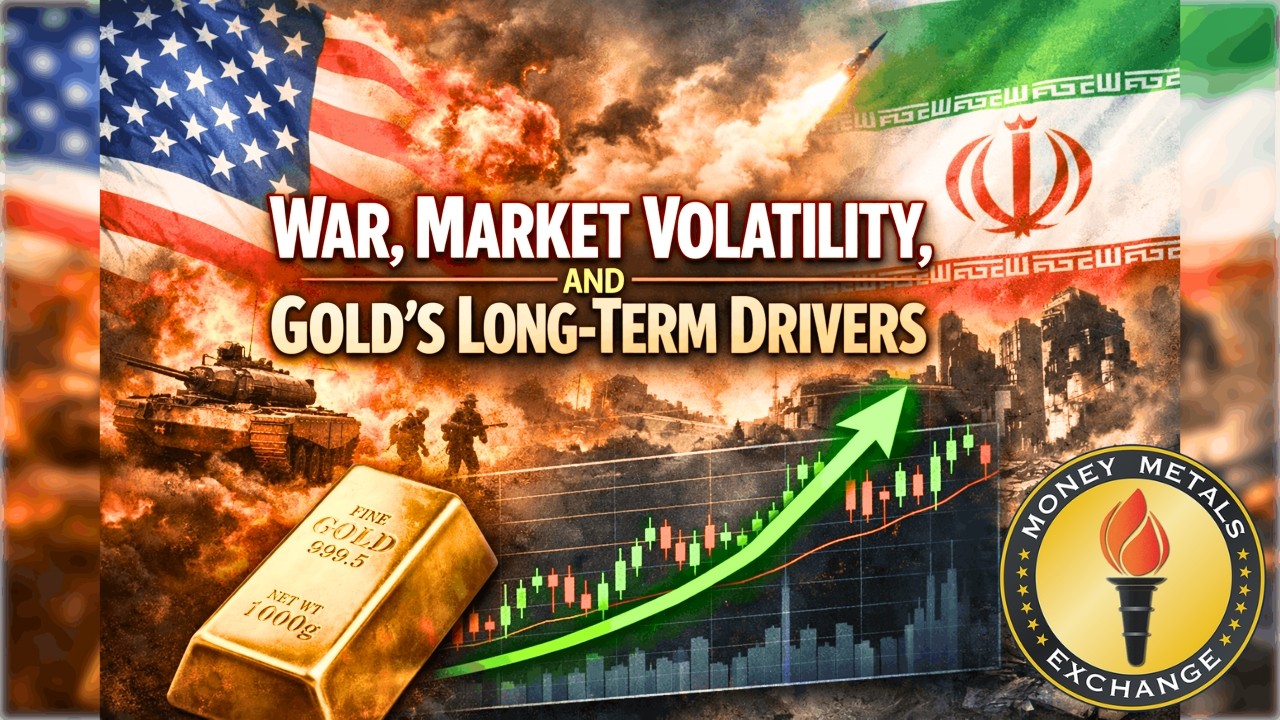
(Money Metals News Service) In a recent episode of the Money Metals Midweek Memo, host Mike Maharrey discussed volatility in the gold and silver markets amid escalating geopolitical tensions and broader financial market turmoil. Maharrey opened by criticizing mainstream financial media coverage of a recent selloff that occurred as markets reacted to a conflict involving Iran.
He pointed to a CNBC headline claiming that “the momentum trades of 2026 are breaking with gold, silver, and South Korea down big.” Maharrey argued that the headline ignored the larger context. Stocks, Bitcoin, and even U.S. Treasuries declined during the same trading session, indicating a broad-based market selloff rather than a specific collapse in precious metals.
According to Maharrey, gold and silver often decline alongside other assets during the early stages of market stress because investors liquidate positions to cover margin calls and other losses. These temporary declines should not be interpreted as evidence that the precious metals bull market has ended.
Gold and Silver Hold Strong Despite Volatility
Despite the sudden drop, Maharrey noted that precious metals remain historically strong. Gold closed just above $5,100 per ounce after the selloff, roughly the same level seen on February 20. Silver briefly dipped below $80 before recovering and closing back above that level.
The decline largely erased gains from the previous day when markets first reacted to the outbreak of hostilities. Gold briefly traded above $5,300 per ounce during that initial safe haven surge before reversing as broader market forces took hold.
Inflation Concerns and Interest Rate Expectations
Market psychology also played a role in the selloff. Rising oil prices raised concerns about renewed inflation, which in turn led some investors to believe the Federal Reserve might keep interest rates higher for longer.
Because gold is widely viewed as a non-yielding asset, some traders assume that higher interest rates reduce the appeal of holding precious metals. Maharrey argued that this interpretation reflects a misunderstanding of inflation itself.
Historically, inflation referred to an expansion in the supply of money and credit rather than simply rising consumer prices. By that definition, Maharrey said inflation has already been increasing for months due to monetary expansion, government borrowing, and structural debt pressures within the U.S. economy.
The Debt Black Hole and Federal Reserve Policy
Maharrey emphasized that the Federal Reserve faces a structural dilemma driven by what he described as a debt black hole. The modern U.S. economy carries so much debt that it struggles to function under normal interest rate conditions.
Because of this, he believes the Federal Reserve will ultimately be forced to loosen monetary policy and cut interest rates regardless of short-term inflation concerns. Even if geopolitical developments temporarily delay policy changes, Maharrey argued that the underlying debt burden will eventually push policymakers toward monetary easing.
How War Historically Impacts Gold Prices
The episode also explored how gold historically performs during wartime. Maharrey explained that gold often experiences its strongest gains before hostilities begin rather than during the conflict itself.
He cited the buildup to Operation Desert Shield in 1989 as an example. During the deployment of forces to the Middle East, gold gained roughly 15 percent to 20 percent. When the United States launched Operation Desert Storm, prices briefly surged another 10 percent before later giving up those gains after the short conflict ended.
A similar pattern occurred during the 2003 invasion of Iraq and during Russia’s invasion of Ukraine in February 2022. In the Ukraine conflict, gold surged above $2,000 per ounce at the onset of the war but later retreated after the Federal Reserve began raising interest rates on March 16, 2022. By October 2022, gold had fallen below $1,650 per ounce.
Monetary Policy Drives Long-Term Gold Trends
Over longer periods, Maharrey said gold’s largest price movements are driven primarily by monetary policy rather than battlefield developments.
Between 2001 and 2011, during the wars in Afghanistan and Iraq, gold surged from roughly $250 per ounce to more than $1,900. Maharrey argued that the rally was fueled primarily by Federal Reserve monetary easing, the 0 percent interest rate environment, and quantitative easing programs following the 2008 financial crisis.
War Spending and Economic Consequences
Maharrey warned that prolonged conflict can intensify economic pressures by increasing government borrowing and spending. He quoted James Madison, who warned that war produces armies, debts, and taxes that can threaten public liberty and expand executive power.
If the current conflict with Iran becomes prolonged, Maharrey suggested it could produce economic consequences similar to those seen during the Vietnam era. War spending combined with domestic programs during the 1960s contributed to the stagflation that dominated the 1970s.
Given the current level of government debt and structural economic weakness, Maharrey argued that the modern economy may be even more vulnerable to similar pressures.
Growing Institutional Interest in Precious Metals
The episode concluded with a critique of mainstream financial advisers who dismiss gold as an investment. Maharrey referenced comments from finance professor Peter Rakuti, who told USA Today that he remains skeptical that gold is ever a good investment.
Maharrey contrasted that perspective with a recent recommendation from Morgan Stanley CIO Michael Wilson. Wilson suggested that investors consider shifting away from the traditional 60 percent stocks and 40 percent bonds portfolio structure and instead adopt a portfolio that includes a 20 percent allocation to precious metals.
According to Maharrey, even modest increases in precious metals allocations could significantly increase demand. Most investors currently hold little or no exposure to gold and silver, and any shift toward higher allocations could create substantial new buying pressure in the market.
He concluded that investors should focus on underlying economic fundamentals rather than short-term headlines when evaluating the outlook for gold and silver.

 Mike Maharrey explains how war, Fed policy, inflation, and debt shape gold prices, arguing that monetary policy and fundamentals matter far more than wartime headlines.)