


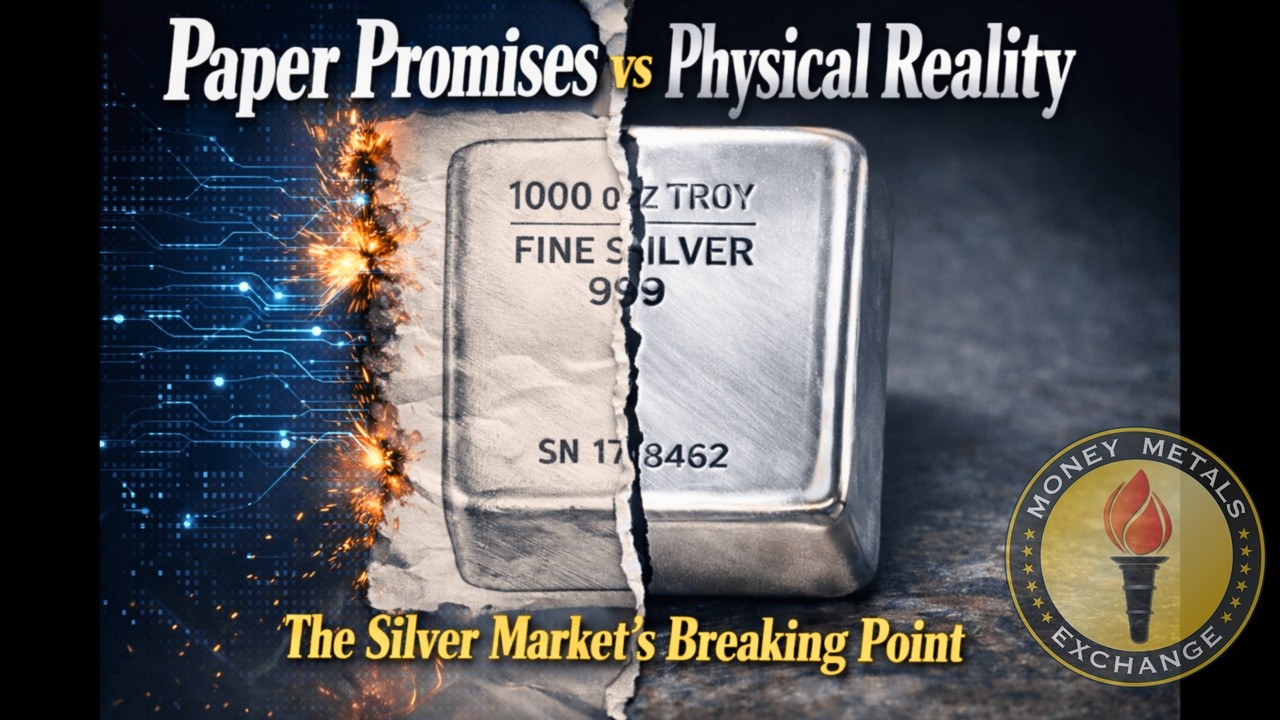
(Money Metals News Service) In a recent episode of the Money Metals Midweek Memo, host Mike Maharrey opened with a blunt reminder from Thomas Paine that cuts straight to the heart of today’s monetary debate.
“Money is money and paper is paper. All the inventions of man cannot make them otherwise.” -Thomas Paine
Paine’s warning was simple but devastating. Gold and silver come from nature. Paper comes from political design. One is limited by geology. The other is limited only by policy.
Paine argued that real money must derive its value from outside human control. He wrote, “The value of gold and silver is ascertained by the quantity which nature has made in the earth. We cannot make that quantity more or less than it is. And therefore, the value being dependent upon the quantity depends not on man.”
That constraint is the point. Governments cannot manufacture more gold and silver at will. Paper, by contrast, carries none of those limitations.
As Paine put it, “Paper, considered as a material whereof to make money, has none of the requisite qualities in it. It is too plentiful and too easy to come by.”
Maharrey argues that modern markets have repeated the same mistake Paine condemned. Even in gold and silver, investors have created a paper-dominated system. Now, that structure is being tested.
The 356-to-1 Paper Silver Problem
The silver market has long been driven by futures contracts that promise delivery of metal at a future date. The scale of paper claims compared to real metal is staggering.
According to analyst Faysal Amin, cited by FX Street, the paper-to-physical silver ratio sits near 356-to-1 (i.e., 356:1). That means for every ounce of real silver, there are 356 paper ounces claiming exposure.
The system resembles fractional reserve banking. As long as most participants do not demand delivery, the structure holds. If too many holders want physical metal at once, the imbalance becomes visible and destabilizing.
Silver briefly skyrocketed to $120 per ounce in January, then corrected sharply into the $75-$80 range, recently trading around $77. Despite the correction, the core issue remains. There is not enough physical silver to satisfy demand.
The lesson echoes Paine’s critique. Paper claims can multiply indefinitely. The underlying metal cannot.
COMEX Inventories Under Pressure
The stress is becoming measurable.
As of February 11, total registered silver at the COMEX fell below 100 million ounces, landing at 98,138,050 ounces. Registered silver is the metal officially available for delivery against futures contracts.
That threshold is both psychologically and structurally significant.
An additional 4.7 million ounces were withdrawn from the eligible category, which consists of silver stored in vaults but not designated for delivery. This suggests more metal is being repositioned to meet physical claims.
Macro analyst David Morgan, publisher of The Morgan Report, told Kitco News that the drawdown signals strain. In his words, the physical market is taking control over whatever the paper price is.
When delivery demand begins draining vault inventories, the gap between paper representation and physical reality becomes harder to ignore.
Shanghai’s $10 Premium and the East-West Shift
Much of the demand pressure is emerging in Asia.
Shanghai’s silver benchmark is currently trading at roughly a $10 per-ounce premium to Western spot prices. That premium reflects a shortage. In theory, arbitrage should pull silver from the West to China. The spread has not fully closed.
Morgan noted that logistics and capital controls are creating friction. London inventories have been tight for months, especially after tariff concerns last spring prompted metal transfers to the United States. Then an explosion in Indian demand last fall intensified pressure.
The result was what Maharrey calls the first modern silver squeeze, pushing prices above $50 per ounce for the first time.
In 2025, silver surged 140 percent, including a 70 percent gain in January alone. That was not retail speculation. That was industrial demand.
Industrial users require 1,000-ounce bars, the standard commercial unit tied to futures contracts. When those bars become scarce, the paper market loses some of its dominance.
Industrial Buyers Versus Paper Traders
Shanghai’s market is more industrially oriented than New York or London. When industrial users begin taking delivery of 1,000-ounce bars, the dynamic shifts.
Morgan emphasized that once industrial needs were not met, the physical market began dictating price. This dynamic has appeared sporadically in history. This time, he suggested, it was the real deal.
Even Money Metals shipped pallets of 1,000-ounce silver bars to India, illustrating just how tight the market became. A single pallet of those bars, even before the surge, was worth well over $1 million.
Despite physical strength, futures markets remain powerful. The CME Group recently raised margin requirements, forcing traders to put up more capital. That move flushed out leveraged speculation and contributed to the correction back toward the $75-$80 range.
The struggle now is clear. Paper leverage is colliding with physical scarcity.
Paine’s words apply as much to silver futures as to fiat currency. “Money is money and paper is paper.”
A contract is not the same thing as the metal itself.
A Structural Silver Deficit
Underlying the volatility is a simple structural imbalance.
According to preliminary data from the Silver Institute, silver demand exceeded supply by approximately 95 million ounces last year. That marked the fifth consecutive annual deficit.
Over five years, cumulative deficits have surpassed 800 million ounces, roughly the equivalent of an entire year of global mine output.
The Silver Institute projects a sixth consecutive deficit this year of around 67 million ounces, even assuming higher prices dampen some industrial demand.
Metal cannot be printed. Futures contracts can.
The imbalance between physical supply and paper exposure is not theoretical. It is cumulative and growing.
CPI, Inflation, and the Monetary Reality
Maharrey then shifted to inflation, tying the silver story back to Paine’s broader critique of paper money.
The latest CPI report showed headline annual inflation falling to 2.4 percent, nearing the Federal Reserve’s 2 percent target. Mainstream commentary celebrated the result.
Maharrey disagreed.
Even at 2 percent, purchasing power erodes by more than 10 percent every five years. That is not price stability. That is managed debasement.
He argues that CPI is merely a symptom. True inflation is an increase in the money and credit supply.
After peaking in April 2022, the money supply declined during rate hikes and quantitative tightening, bottoming in October 2023. It has since resumed accelerating and now exceeds pandemic peaks.
The Federal Reserve quietly relaunched quantitative easing in December, expanding its balance sheet again and purchasing United States Treasuries with newly created money.
This is precisely the danger Paine described. Paper is too plentiful and too easy to come by.
The Fed faces a catch-22. It needs to cut interest rates and provide liquidity to support a debt-riddled economy. At the same time, higher rates are needed to restrain price inflation. It cannot do both. According to Maharrey, it is choosing inflation.
A 10-Year-Old Gold Investor in China
To close the episode, Maharrey shared a story that illustrates inflation’s real-world impact.
A 10-year-old girl in China began buying gold at age seven using Lunar New Year lucky money. Each year, she received about 4,000 yuan, roughly $580 at current exchange rates.
She purchased gold at approximately 460 yuan per gram. By February, the price had risen to 1,100 yuan per gram, delivering a 139 percent return.
She has accumulated about 30 grams of gold and has not sold, even during January’s correction. She plans to buy more.
Whether or not she understands monetary policy, she understands preservation of value. She intuitively understands what Paine articulated centuries ago. Money is money. Paper is paper.
The Bottom Line
The silver market is locked in a battle between leveraged paper claims and finite physical supply. COMEX inventories have dipped below 100 million ounces. Shanghai trades at a $10 premium. Five consecutive annual deficits have removed more than 800 million ounces from available supply.
That is what a market under structural strain looks like.
A true breaking point would not necessarily arrive with a headline. It would show up as widening premiums, delivery delays, persistent price gaps between East and West, or a failure of paper contracts to settle smoothly into physical metal. It would show up when the futures market can no longer suppress the reality of tight supply.
We are not there yet. But the ingredients are visible.
Paper can be created endlessly.
Metal cannot.
As Paine warned long ago, “Money is money and paper is paper.” When paper promises multiply faster than real metal can be mined, the breaking point becomes a matter of time, not theory.

 Silver’s paper market is clashing with physical shortages as demand outpaces supply. COMEX inventories fall, Asia pays premiums, and inflation rises. Can paper pricing hold?)