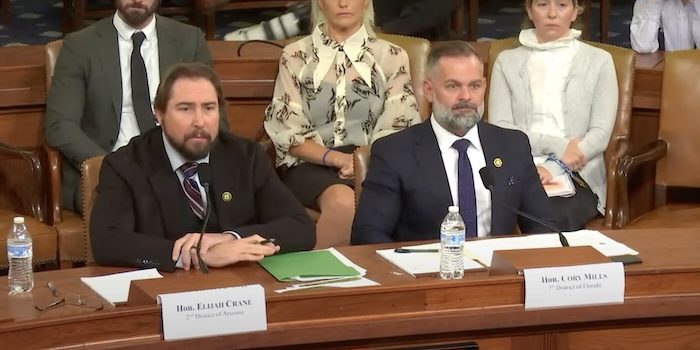
(José Niño, Headline USA) While publicly denouncing military aid to Ukraine as corrupt, Rep. Cory Mills, R-Fla., was privately selling millions of dollars in grenades to a Ukrainian government firm now under investigation, according to an explosive investigation by journalist Roger Sollenberger.
Mills has emerged as a leading voice against federal assistance to Ukraine. “This is but one example of U.S. tax dollars that has been corruptly stolen by the Ukrainian government,” Mills declared in a February 2024 social media statement, referencing Pentagon audit findings and lamenting “millions in suitcases, shoe boxes, kickback from companies to procurement heads.”
During this same period, however, Mills’s weapons manufacturer PACEM was conducting private grenade sales to SpetsTechnoExport (STE)—a Ukrainian state-run defense procurement firm currently facing government investigation over corruption allegations dating back more than 10 years. The organization has gained notoriety for involvement in money laundering schemes.
Mills established PACEM in 2014 and maintains ownership according to his financial records. Defense industry specialists explained to Sollenberger that eliminating federal military assistance to Ukraine wouldn’t damage Mills’s commercial interests. Such a policy shift would compel Kiev to depend more substantially on private weapons suppliers like PACEM, creating potential financial advantages for Mills.
NEW: Rep. Cory Mills owns a defense company that appears to have been illegally exporting weapons to Ukraine—while Mills sits on the committee with oversight of those sales. This has gone unreported and for a long time unknown in Congress. My latest here:https://t.co/myyFQ5ztrd pic.twitter.com/wnuXREdqj4
— Roger Sollenberger (@SollenbergerRC) December 19, 2025
The congressman represents an unprecedented case in that he is apparently the first sitting member of Congress actively engaged in the arms trade. Mills holds positions on both the House Armed Services and Foreign Affairs committees while PACEM executes direct commercial weapons transactions—an opaque segment of the defense industry that critics characterize as lacking adequate transparency and effective oversight mechanisms.
Sollenberger noted that House Ethics Committee investigators are examining PACEM’s federal contracting activities following an Office of Congressional Conduct determination that such arrangements likely violated legal standards. Legal professionals and federal regulations suggest PACEM’s international commercial sales face identical legal obstacles: corporations under complete ownership by active congressional representatives cannot lawfully participate in such business activities.
The situation grows more complex when examining Mills’s professional network. PACEM’s long-serving chief legal officer is Joseph E. Schmitz, a former Pentagon inspector general who left under controversy and later served as Blackwater’s COO. Schmitz’s background includes an attempted weapons sale to Syrian rebel groups and participation in Erik Prince’s unsuccessful proposal to establish a $10 billion private military force for Ukraine.
Prince’s proposal also involved Andrii Artemenko, a contentious pro-Russia Ukrainian entrepreneur currently residing in Florida. Multiple sources confirmed to Sollenberger that Artemenko functioned as PACEM’s Ukrainian operations director, with banking documents from 2020 referencing agreements valued at $5 million.
Legal filings reveal PACEM secured authorization for exporting 800,000 grenades to Ukraine last November—carrying a price tag of $66.4 million, precisely matching the company’s outstanding obligations to a foreign creditor. Mills provided personal financial guarantees for this debt without filing mandatory congressional disclosures, potentially violating federal requirements.
“I was elected to represent America and not Zelenskyy and his corrupt band of officials,” Mills wrote in that February statement. Yet shortly before, he participated in a congressional hearing advocating for reduced federal oversight of private international arms transactions.
PACEM currently faces foreclosure proceedings over nearly $66.4 million in unpaid debts. The company has ceased operations and discontinued employee compensation. During this period, Mills has engaged in substantial personal expenditures while allegedly omitting disclosure of multiple PACEM-related entities to Congress, including subsidiary corporations and international operations in Canada, Dubai, and Pakistan.
Brad Moss, a specialist in national security law who examined PACEM’s export documentation and applicable statutes, noted the unprecedented nature of a serving congressional representative conducting private international arms sales. Given Mills’s concurrent positions, “it certainly appears that Mills would be ineligible,” Moss concluded.
Mills’s office reportedly did not respond to requests for comment from Sollenberger.
Mills has traveled to Syria multiple times this year, including a September individual visit featuring meetings with Syria’s Minister of Finance and Information Technology. No disclosure documents have been submitted identifying the funding source for this trip.
Neither Mills, PACEM, nor his congressional office provided responses to inquiries. In previous statements, PACEM has rejected allegations of impropriety, asserting that Mills established adequate separation through a “blind” trust arrangement—though Sollenberger’s prior investigation questioned whether this trust meets blindness standards.
At some point after June 4, Mills modified his automated PACEM business email response to include: “I will not be engaged in Pacem business as long as I am serving in Congress.”
José Niño is the deputy editor of Headline USA. Follow him at x.com/JoseAlNino