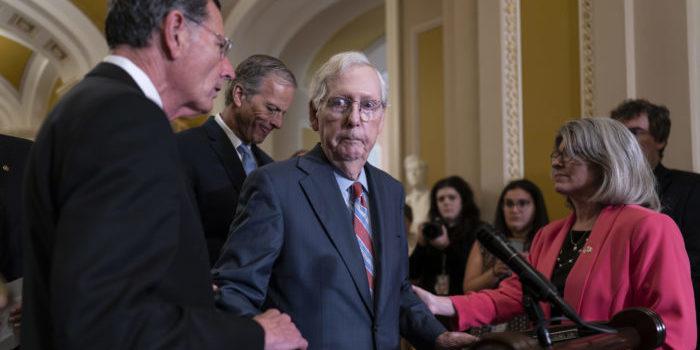
(Ben Sellers, Headline USA) After nearly a monthlong absence, the mysteries surrounding the health status of Sen. Mitch McConnell, R-Ky., are just as opaque as when he was found unresponsive on June 14.
Video released Friday by CNN showed McConnell, the longtime Senate majority leader and frequent Trump obstructionist, being carted to an ambulance on a stretcher with no oxygen mask, fueling speculation that he may have been dead on arrival.
The surprising departure of his wife, former Trump Transportation Sec. Elaine Chao, for a trip to China raised even more concerns.
Establishment Republicans — including a spokesperson for current Senate Majority Leader John Thune, R-S.D. — sought to tamp down on rumors by insisting that the two RINOs recently had a “lengthy and substantive conversation that covered a variety of topics,” but made no mention of McConnell’s expected return.
CNN analyst Scott Jennings, who was McConnell’s former campaign manager, also claimed to have been in contact with the 84-year-old senator during his convalescence.
“I spoke to my old friend Mitch McConnell this morning, the senior Senator from Kentucky. He’s still recovering in the hospital. We talked for just shy of 20 minutes,” Jennings wrote on Tuesday via X.
I spoke to my old friend Mitch McConnell this morning, the senior Senator from Kentucky. He’s still recovering in the hospital. We talked for just shy of 20 minutes … about IRAN, UKRAINE, the unfolding situation in MAINE, my visit to the TR Presidential Library, and even a…
— Scott Jennings (@ScottJenningsKY) July 7, 2026
But without actual proof of life, few skeptics were assuaged.
Indeed, the matter was made worse after Jennings’s own network ran a post from a fake lawmaker whose spoof account appeared to be mocking the original post.
CNN’s extreme leftwing bias exposed pic.twitter.com/5YEbGToOA7
— Rep. Jack Kimble (@RepJackKimble) July 8, 2026
Meanwhile, McConnell critics, including Federalist CEO Sean Davis, have pointed out that there are specific protocols in the Senate for an extended leave of absence, and that Thune did not appear to be enforcing them.
“Rather than communicating through secret phone calls or anonymous sources, McConnell has an obligation to disclose to the Senate the reason(s) for his extended absence and to request permission of the Senate to grant him the privilege of continued absence,” Davis wrote in a Thursday X post after anonymous sources insisted McConnell wasn’t clinically braindead.
Under paragraph 2 of Rule VI of the Standing Rules of the Senate, “No Senator shall absent himself from the service of the Senate
without leave.”Rather than communicating through secret phone calls or anonymous sources, McConnell has an obligation to disclose to the Senate the… https://t.co/5qgI3SlUYe pic.twitter.com/AukB3nbqc7
— Sean Davis (@seanmdav) July 9, 2026
Many Trump supporters would prefer that McConnell, who is serving out his final term, simply make a graceful exit — if indeed he is still alive.
The lame-duck lawmaker, often seen being carted around by staffers in a wheelchair and appearing to have stroke-like symptoms when speaking publicly, has nonetheless proven to be a roadblock in efforts to pass the pro-election-integrity SAVE America Act, which would mandate voter ID and clean voter rolls.
Although Sen. Susan Collins, R-Maine, signaled a willingness to supply the 50th vote to give the GOP a simple majority needed to pass the measure through a reconciliation bill, Collins was unwilling to support all of the elements sought by the Trump administration, including restrictions on transgender students in girls’ sports.
She likewise has been a steadfast opponent to modifying the Senate rules to end the filibuster.
Unlike other states in which the governor is tasked with filling a vacancy, Kentucky’s Democrat Gov. Andy Beshear has no such power after its GOP legislature — anticipating a McConnell health crisis — stripped him of that power in 2024. Thus, the seat would remain empty until a special election was held.
Nonetheless, Beshear also urged McConnell and his handlers to be more forthcoming about his health status.
“Over the last several weeks, Kentuckians have grown increasingly concerned about the current state of your health and wellbeing, and ability to hold office in the United States Senate,” Beshear wrote in a letter to McConnell on Wednesday.
“As Governor, I request that you fully update Kentuckians regarding the current status of your health,” he continued. “As public officeholders, we have made a commitment to our constituents to do our best to represent them and to always be transparent. I believe this requires clear communication about one’s ability to serve.”
McConnell’s situation mirrors several other recent health crisis that brought attention to what some have called a geruntocracy of octogenarian leaders, many having clung to power for decades.
Former Sen. Dianne Feinstein, D-Calif., was frequently criticized for refusing to give up her seat despite a clear cognitive decline, and the same was true of President Joe Biden, whose insistence on running in 2024 contributed to his party’s defeat that year.
Republicans might hope, however, for a situation more like that of Sen. John Fetterman, D-Pa. Although elected in 2022 despite recovering from a severe stroke and suffering a cripping depression (that spurred rumors he was braindead), Fetterman not only made a full recovery but has since become the lone voice of reason within the Senate’s Democratic caucus.
Ben Sellers is a freelance writer and former editor of Headline USA. Follow him at x.com/realbensellers.