Kari Lake Thanks Supporters in Political Adieu, but Stops Short of Conceding Dubious Race

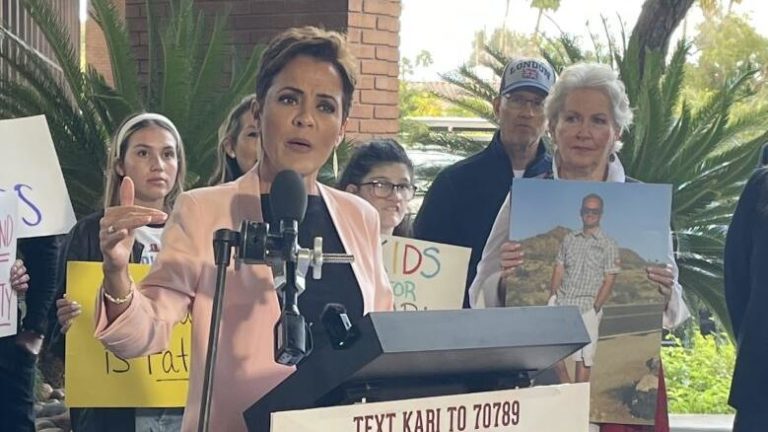
(While not a concession, Republican Arizona U.S. Senate candidate Kari Lake released a video Wednesday thanking Arizonans for supporting her throughout her attempt at a political career and spreading support for President-elect Donald Trump’s win, in addition to a Republican majority in both chambers of Congress.

“As for me? Well, I can say for certain that truth will never stop mattering to me,” Lake said. “You will never stop mattering to me. These memories that we’ve made together will never go away. They will grow sweeter over time and I will never stop fighting for the state I love.”

Lake was declared the loser of the race for Kyrsten Sinema’s U.S. Senate seat, with Democrat Ruben Gallego ahead by 79,102 votes at 99% of precincts reporting.

Lake started her political journey by running for Arizona governor in 2022, but the office instead went to then Secretary of State Katie Hobbs. Lake has yet to accept that loss, resulting in years of litigation that have not concluded in her favor.

Prior to this, Lake worked as a TV anchor for three decades before walking away from the fake news.

“For 30 years you trusted me to bring the news into your homes, to tell you the truth,” Lake said. “About three years ago, I walked away from a seven figure contract in the fake news because I couldn’t lie to you. What good is money if it comes at the cost of your soul?”

Lake has run her campaign on a MAGA campaign, being endorsed by Trump and while Trump won Arizona in the presidential election, pollsters have attributed this split ticket to Lake’s inability to garner support from Independent and undecided voters.

“Arizona is a light red state—no matter how you measure it—party registration, party identification, recalled past vote – it’s just a red state,” said NPI CEO and Founder Mike Noble in a post-election report.

“So someone like Gallego needed to post exceptional numbers among Independents and Democrats while peeling off some Republicans. Our polling showed Gallego doing just that,” he claimed. “We found, across many surveys, that Lake was closing the gap as Election Day neared – but that it wouldn’t be enough to erase Gallego’s lead. He’s cemented himself as a national player with this performance.”

Some have continued to raise doubts about the validity of the final count, particularly given the amount of time it took for the tally and the fact that the final vote counts in several counties continued to fluctuate after Election Day.

Arizona’s dubious election-integrity safeguards have raised suspicion in the past two election cycles, when Hobbs was secretary of state, resulting in a litany of lawsuits and an audit commissioned by the state Senate, which found significant evidence of irregularities in Maricopa County during the 2020 election.

Nonetheless, due to county officials’ refusal to cooperate in the discovery process, neither the Lake-led lawsuits or the audit firm CyberNinjas could substantiate any actual legal evidence of fraud that could easily be redressed or acted upon without closing the legislative loopholes.

Even with Lake’s loss, Republicans were able to maintain a 53-47 majority in the U.S. Senate. Lake has yet to announce where she intends to set her sights in the future, political or otherwise.

Headline USA’s Ben Sellers contributed to this report.

Trump to Leverage Federal Funds in Bid to End ‘Wokeness,’ ‘Indoctrination’ in Schools

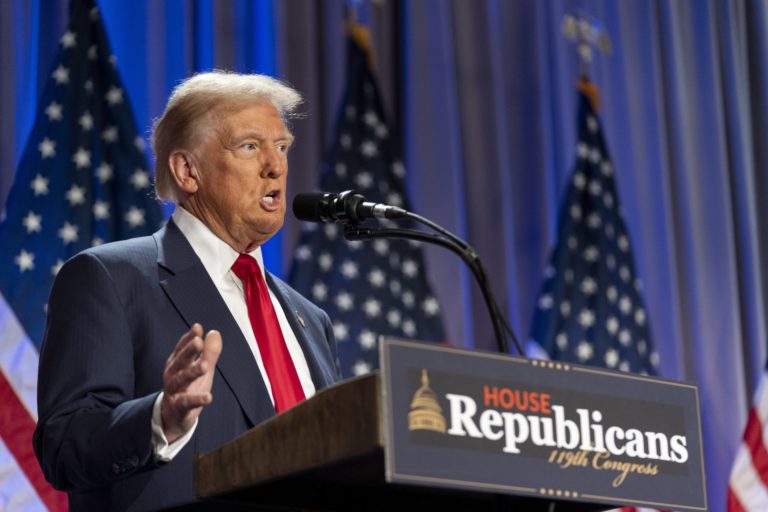
(Headline USA) President-elect Donald Trump’s vision for education largely revolves around a single goal: to rid America’s schools of “wokeness ” and “left-wing indoctrination.”

Trump wants to keep transgender athletes out of girls’ sports. He wants to forbid classroom lessons on gender identity and Marxist concepts like critical race theory. He wants to abolish diversity and inclusion offices.

Throughout his campaign, the Republican depicted public education as a political battleground to be won back from the radical Left. Now that he’s won the White House, he plans to use federal money as leverage to advance his vision of education across the nation.

Trump’s education plan pledges to cut funding for schools that defy the will of the public on a multitude of issues.

On his first day in office, Trump has repeatedly said he will cut money to “any school pushing critical race theory, transgender insanity, and other inappropriate racial, sexual or political content on our children.”

On the campaign trail, Trump said he would “not give one penny” to schools with vaccine or mask requirements.

He said it would be done through executive action, though even some of his supporters say he lacks the authority to make such swift and sweeping changes.

Trump’s opponents insist that the type of leftist indoctrination he rails against is a fiction.

“There is no evidence that our American education system is full of maniacs,” claimed Wil Del Pilar, senior vice president for the activist group Education Trust.

Trump’s platform calls for “massive funding preferences” for states and schools that end teacher tenure, enact universal school choice programs and allow parents to elect school principals.

Perhaps his most ambitious promise is to shut down the U.S. Education Department entirely, a goal of conservative politicians for decades, saying it has been infiltrated by “radicals.”

America’s public K-12 schools get about 14% of their revenue from the federal government, mainly from programs targeting low-income students and special education. The vast majority of schools’ money comes from local taxes and state governments.

Colleges rely more heavily on federal money, especially the grants and loans the government gives students to pay for tuition.

Trump’s strongest tool to put schools’ money on the line is his authority to enforce civil rights—the Education Department has the power to cut federal funding to schools and colleges that fail to follow civil rights laws.

The Biden and Obama administrations both have similarly leveraged funding to schools in order to bow to their demands on controversial policies.

The president can’t immediately revoke money from large numbers of districts, but if he targets a few through civil rights inquiries, others are likely to fall in line, said Bob Eitel, president of the conservative Defense of Freedom Institute and an education official during Trump’s first term.

That authority could be used to go after schools and colleges that have DEI offices or those accused of anti-Semitism, Eitel said.

“This is not a Day One loss of funding,” Eitel said, referencing Trump’s campaign promise. “But at the end of the day, the president will get his way on this issue, because I do think that there are some real legal issues.”

Trump also has hinted at potential legislation to deliver some of his promises, including fining universities over diversity initiatives.

To get colleges to shutter diversity programs—which Trump says amount to discrimination—he said he “will advance a measure to have them fined up to the entire amount of their endowment.”

His platform also calls for a new, free online university called the American Academy, to be paid for by “taxing, fining and suing excessively large private university endowments.”

During his first term, Trump occasionally threatened to cut money from schools that defied him, including those slow to reopen during the COVID-19 pandemic and colleges he accused of curbing free speech.

He succeeded in getting Congress to add a tax on wealthy university endowments, and his Education Department made sweeping changes to rules around campus sexual assault.

Universities fear their relationship with the administration will be antagonistic.

“Education has been an easy target during the campaign season,” said Peter McDonough, general counsel for the American Council on Education, an association of university presidents. “But a partnership between higher education and the administration is going to be better for the country than an attack on education.”

Trump’s threats of severe penalties seem to contradict another of his education pillars—the extraction of the federal government from schools. In closing the Education Department, Trump would return “all education work and needs back to the states,” he said on his website.

“We’re going to end education coming out of Washington, D.C.,” Trump said.

In his platform, he pledged to ensure schools are “free from political meddling.”

However, taking a neutral stance and letting states decide wouldn’t deliver Trump’s campaign promises, said Max Eden, a senior fellow at AEI, a conservative think tank.

For example, Trump plans to rescind guidance from President Joe Biden’s administration that extended Title IX gender-equity protections to LGBT students. And Trump would go further, promising a nationwide ban on transgender women in women’s sports.

“Trump ran on getting boys out of girls’ sports. He didn’t run on letting boys play in girls’ sports in blue states if they want to,” Eden said.

Trump also wants a say in school curriculum, vowing to fight for “patriotic” education. He promised to reinstate his 1776 Commission, which he created in 2021 to promote patriotic education. The panel created a report that called progressivism a “challenge to American principles” alongside fascism.

Adding to that effort, Trump is proposing a new credentialing body to certify teachers “who embrace patriotic values.”

Few of his biggest education goals can be accomplished quickly, and many would require new action from Congress or federal processes that usually take months.

More immediately, he plans to nullify executive orders issued by Biden, including one promoting toxic identity politics across the federal government. He’s also expected to work quickly to revoke or rewrite Biden’s Title IX rules, though finalizing those changes would require a lengthier rulemaking process.

Trump hasn’t detailed his plans for student loans, though he has called Biden’s controversial loan-amnesty efforts illegal and unfair.

Most of Biden’s signature education initiatives have been paused by courts amid legal challenges, including a proposal for widespread loan cancellation. Those plans could be revoked or rewritten once Trump takes office.

Adapted from reporting by the Associated Press

Woke Disney Actress Forced to Apologize after Attacking Trump Supporters Online

(Headline USA) Woke Disney actress Rachel Zegler was forced to apologize this week after going on an expletive-ridden rant against President-elect Donald Trump and his supporters.

“I would like to sincerely apologize for the election post I shared on my Instagram last week,” the “Snow White” star wrote on social media. “I let my emotions get the best of me. Hatred and anger have caused us to move further and further away from peace and understanding, and I am sorry I contributed to the negative discourse.”

Immediately after Trump’s victory, Zegler wrote in an Instagram story that she was disgusted with the tens of millions of Americans who voted for him.

Trump’s voters have a “deep sickness,” she claimed.

“May Trump supporters and Trump voters and Trump himself never know peace,” she added. “F*** Trump.”

Zegler, 23, has come under fire several times for pushing radically leftist views.

Earlier this year, for example, after Disney released the official trailer for the upcoming Snow White remake, Zegler posted “Free Palestine” in an apparent snub of her Israeli co-star Gal Gadot.

Conservative commentator Megyn Kelly blasted Zegler this week, calling on Disney to fire her.

“There’s something wrong with this person,” Kelly said on the Ruthless podcast. “Hello, Disney, you’re going to have to redo your film again, because this woman is a pig. You’re going to put out a Disney film with Snow White, a beloved American character, with a woman who hates more than half the country, the half that just elected Donald Trump?”

Kelly also pointed out that Disney fired actress Gina Carano, who starred in The Mandalorian, for much less.

Carano filed a lawsuit against Disney earlier this year with the help of tech mogul Elon Musk, alleging the company wrongfully terminated her and violated her right to free speech after she expressed conservative political views.

Post-Election Surprise: Hochul Revives Controversial NYC Congestion Pricing Plan

(Democratic New York Gov. Kathy Hochul is resurrecting plans to implement congestion pricing that will hike tolls to enter downtown Manhattan, but the new program faces an uncertain future with Republicans vowing to kill the program.

On Thursday, Hochul announced that she is unpausing the New York City program with a reduced base fare of $9—down from the original plan of $15—and plans to implement it on Jan. 5, just days before President-elect Donald Trump is set to take over the White House.

The lower toll will help the state meet its climate change reduction goals and drum up more money for public transit “without putting an extra strain on those who can least afford it,” Hochul claimed at a press conference Thursday afternoon

“I always have and I always will fight to put more money in the pockets of everyday New Yorkers,” she added. “No New Yorker should have to pay a penny more than necessary.”

The governor’s office said the retooled plan includes discounts for low-income drivers making less than $50,000 annually. These drivers will receive a 50% discount after hitting their 10th toll each month.

The controversial tolling program, which was set to start June 30, called for a $15 toll on drivers entering the core of Manhattan to generate about $1 billion annually for public transit system upgrades. The Metropolitan Transportation Authority, which operates New York City’s subways, buses and trains, had planned to leverage the funds to borrow $15 billion to upgrade subway signals and stations, among other projects.

But in June, Hochul abruptly hit the brakes on congestion pricing, announcing that she directed the MTA to “indefinitely” pause the program. She cited the impact on commuters who would be forced to pay higher tolls.

Others promptly pointed to the upcoming election, noting that New York appeared to be veering toward Trump, a Republican, who held surprisingly large rallies in the South Bronx and at Madison Square Garden.

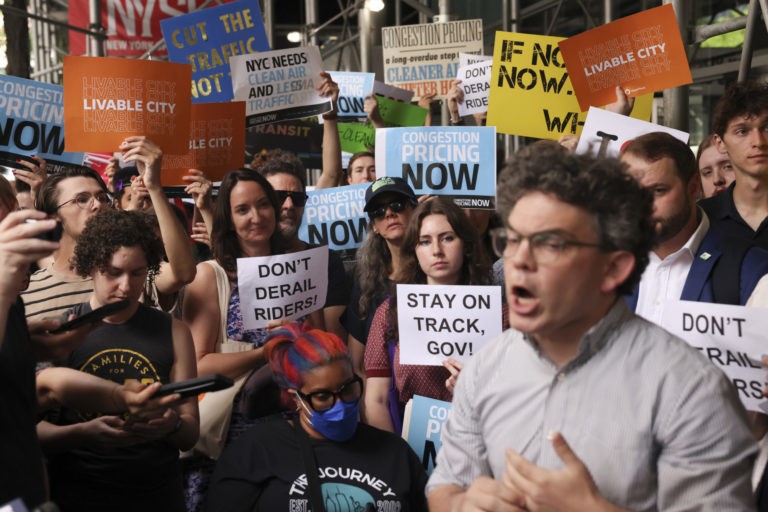
Transit advocates and environmental groups protested the move and filed lawsuits against the Hochul administration, arguing that the governor lacked the authority to make the changes unilaterally. New York was also facing lawsuits from New Jersey and a group of Republican lawmakers seeking to block the congestion pricing program.

Trump, a native New Yorker, is among those who oppose congestion pricing and pledged on the campaign trail to “terminate” the programs during his “first week” in office.

Members of New York’s congressional delegation are also vowing to kill any alternative plan Hochul devises. On Wednesday, Rep. Mike Lawler said he and other Republican lawmakers plan to propose legislation “to stop this program dead in its tracks, period.”

“Governor Hochul’s congestion pricing scheme is nothing more than a massive new tax on working families, daily commuters, college students, and local residents who just want to travel within the city they call home,” Lawler said in a statement.

Lawler and fellow New York Republican Reps. Nicole Malliotakis and Andrew Garbarino sent a letter to Trump earlier this week urging him to take immediate steps when he returns to the White House in January to block the “absurd congestion pricing cash grab once and for all.”

In New Jersey, Gov. Phil Murphy, a fellow Democrat, also blasted Hochul’s plans to revive the congestion pricing plan in the final days of the Biden administration. He urged her and other New York officials to reconsider the move.

“All of us need to listen to the message that voters across America sent last Tuesday, which is that the vast majority of Americans are experiencing severe economic strains and still feeling the effects of inflation,” Murphy, a Democrat, said in a statement. “There could not be a worse time to impose a new $9 toll on individuals who are traveling into downtown Manhattan for work, school, or leisure.”

ISIS-Linked Houston Man Arrested, Charged w/ Planning 9/11-Style Terrorist Attack

(A 28-year-old man in Houston, Anas Said, has been indicted and arrested on charges he attempted to provide material support to the Islamic State of Iraq and al-Sham, a federally designated foreign terrorist organization.

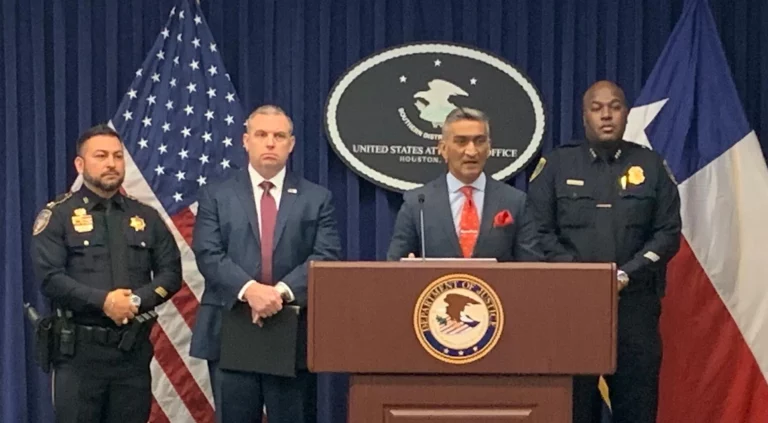
U.S. Attorney Alamdar Hamdani and FBI Special Agent in Charge Douglas Williams Jr. announced the details of the case in a news conference on Thursday.


Said was born in Houston, Hamdani said, but lived in Lebanon until he was roughly 14 years old, where his family is from. He returned to the U.S. roughly 10 years ago.

After the Oct. 7, 2023, Hamas terrorist attacks against Israel, he was allegedly motivated to plan a terrorist attack on local military recruiting centers in Houston, provide a “sanctuary” to ISIS operatives from his Houston apartment, bragged that he would commit a 9/11-style terrorist attack if given the resources, said he wanted to harm the Israeli community in Houston, and plotted to harm former President George W. Bush, according to a multi-agency investigation.

“Today is a great day because we’ve taken a suspected terrorist off the streets of Houston, Texas, and that’s something we at the FBI don’t get to publicly say very often,” Williams said. “Said was accused of attempting to provide material support to ISIS … and by his own admission was planning a terrorist attack on U.S. soil from his apartment here in southwest Houston.”

Said has been on the FBI-Houston’s Joint Terrorism Task Force radar since 2017 under the Trump administration, Williams said.

JTTF’s early investigation found that he frequently viewed ISIS literature and other online propaganda and “held a deep affinity for high-ranking ISIS personnel and even ordered custom propaganda to outwardly show his support for ISIS.”

FBI agents interviewed him multiple times since he first came to their attention, but after the Oct. 7 Hamas attacks, his “behavior began to mobilize towards violence … and jumped to the top of our list of national security threats,” Williams said.

After law enforcement officials executed searches of Said’s residence, vehicle and electronic devices, they uncovered additional links between him and ISIS, including a plot to harm former President Bush, according to court documents.

Investigators uncovered multiple social media accounts that showed his continued support for ISIS and that he was “searching for ways to commit violent acts in the United States … right here in Houston,” Williams said. “He admitted to discussing how best to conduct an attack on local military recruiting centers. He admitted to wanting to use explosives to commit a mass killing here in Houston. He offered his home as a state sanctuary to ISIS operatives. He bragged that he would commit a 9/11 style attack if he only had the resources. He expressed the desire to join the U.S. military just so he could commit an act once he was inside their ranks.”

“JTTF partners stopped Said’s plans from becoming a reality,” he said.

Hamdani described the violent acts perpetrated by ISIS, explaining that it recruits followers through social media, which is what Said was allegedly doing.

Said allegedly communicated with ISIS’s official media outlet, created ISIS propaganda videos and flyers and edited at least five videos and two images that he then sent to an alleged ISIS social media and web designer, Hamdani said.

The materials were allegedly disseminated to other ISIS supporters, including videos and images promoting ISIS violence. Still images from the videos were presented at the press conference.

Said also allegedly “discussed his desire to travel overseas to commit violent jihad in his messages and … commit violent acts in Houston.”

Documents show he allegedly was researching how to make a bomb and build an explosive belt, Hamdani said.

Said is charged with one count of attempting to provide material support to a foreign terrorist organization, ISIS, which carries a maximum sentence of 20 years in federal prison and up to a 250,000 fine.

“Individuals or groups cannot use social media to provide material support to ISIS or other terrorist organizations,” Hamdani said.

Those who do are considered national security threats, he said. Hamdani also warned “wannabe terrorists who believe they can hide behind the encrypted apps or anonymous social media profiles … we will find you and we will hold you to account.”

Said was arrested on Nov. 8 and his detention hearing was held Thursday afternoon.

FBI Houston’s Joint Terrorism Task Force conducted the investigation, receiving assistance from the Houston and Sugar Land police departments and Harris County Sheriff’s Office.

The case is being prosecuted by Hamdani’s office and the National Security Division’s Counterterrorism Section trial attorneys.

DOGE Chiefs Musk, Ramaswamy List Possible Areas for Cutting Gov’t Waste

(Billionaires Elon Musk and Vivek Ramaswamy will take over a new effort to make the government more efficient.

President-elect Donald Trump’s new “Department of Government Efficiency,” or DOGE, is a government efficiency effort that has turned a public spotlight onto government waste and duplication in a way not done for years.

While journalists and nonprofits have been writing about examples of government waste during that time, very little of it actually got much attention.

Musk created a DOGE account on X where he is asking followers for suggestions.

The site also said it was accepting applications to staff the department, which technically will have a mere advisory role and not official government authority, likely working with official government agencies like the Office of Personnel Management and the Office of Management and Budget.

Only those with verified “blue check” X accounts were able to communicate directly with the DOGE account, however, which may have been a way of suggesting that X-owner Musk issued the post as a joke more than a genuine hiring call.

Aside from lopping off entire agencies, here are some examples of controversial federal spending that, based on Musk and Ramaswamy’s recent comments, could be in the line of fire for coming cuts:

  • Billions to maintain office buildings, many of which are empty as employees work from home.
  • $6 million for United States Agency for International Development to
    boost tourism in Egypt.
  • $400 million of taxpayer dollars for presidential campaigns.
  • $2.6 million in taxpayer dollars to fund a critical race theory program that trains students to promote CRT.
  • Millions to train school teachers in DEI.
  • Hundreds of millions of FEMA dollars for migrants.
  • Tens of millions per year for DEI at the Pentagon.
  • Nearly $32 million in COVID funding for luxury cars.
  • $1.2 million in taxpayer dollars to find evidence that racism is to blame for poor sleep in minority communities.
  • $426,250 for an app to encourage Latino men to exercise.
  • $28 million for camouflage uniforms that you can see.
  • Billions in improper payments of COVID funds to businesses.
  • $100 million for projects in wealthy Manhattan.
  • $1 million for the West Harlem “Environmental Justice Center.”
  • $50 million via “Environmental Justice” grant to anti-Israel group.
  • $3 billion overall for “Environmental Justice” grants to groups, many of which are accused of partisanship.
  • Part of New York’s $9 billion in federal COVID funding went to train staff in ‘culturally responsive sustaining instruction’ and ‘privilege’ and to recognize ‘equity warriors.’”
  • $200,000 spent by the Department of Defense on Starbucks espresso machines
  • Millions to study COVID “misinformation.”

Biden Admin. Goes on Spending Bender Before Trump Claws Back Unused Tax Dollars

(Headline USA) Biden administration officials are working to dole out billions in grants before President-elect Donald Trump takes office in January.

“Let’s make every day count,” President Joe Biden said in an address to the nation last week after Vice President Kamala Harris conceded defeat to Trump in the presidential race.

Trump has pledged to rescind unspent funds in Biden’s landmark climate and health care law and stop clean-energy development projects.

“There’s only one administration at a time,” Transportation Secretary Pete Buttigieg told reporters at a news conference Thursday.

“That’s true now, and it will also be true after Jan. 20,” he continued. “Our responsibility is to make good use of the funds that Congress has authorized for us and that we’re responsible for assigning and disbursing throughout the last three years.”

But Trump will control more than the purse strings come January. His administration also can propose new regulations to undo some of what the Biden administration did.

Biden administration officials hope that projects funded under the $1 trillion infrastructure law and $375 billion climate law will endure beyond Biden’s term and are attempting to ensure that money from the landmark measures continues to flow.

On Friday, Buttigieg announced over $3.4 billion in grants for projects designed to improve passenger rail service, help U.S. ports, reduce highway deaths and support domestic manufacturing of sustainable transportation materials.

”We are investing in better transportation systems that touch every corner of the country and in the workers who will manufacture materials and build projects,″ he said. “Communities are going to see safer commutes, cleaner air and stronger supply chains that we all count on.″

Announcements of major environmental grants and project approvals have sped up in recent months in what White House officials describe as “sprinting to the finish” of Biden’s four-year term.

The Environmental Protection Agency recently set a nationwide deadline for removal of lead pipes and announced nearly $3 billion to help local water systems comply.

The Energy Department, meanwhile, announced a $544 million loan to a Michigan company to expand manufacturing of high-quality silicon carbide wafers for electric vehicles.

The loan is one of 28 deals totaling $37 billion granted under a clean-energy loan program that was revived and expanded under Biden.

Pentagon press secretary Sabrina Singh told reporters this week that Biden wants to “spend down the authority that Congress has allocated and authorized before he leaves office. So we’re going to work very hard to make sure that happens.”

The Biden administration would have to rush $7.1 billion in weapons—$4.3 billion from the 2024 supplemental and $2.8 billion that is still on the books in savings due to the Pentagon recalculating the value of systems sent—from the Pentagon’s stockpiles in order to spend all of those funds obligated before Trump is sworn in.

There’s also another $2.2 billion available to put weapons systems on long-term contracts.

However, recent aid packages have been much smaller in size, around $200 million to $300 million each.

Adapted from reporting by the Associated Press

Biden Admin. Kicks Off FY2025 w/ Yet Another Big Budget Deficit

(Mike Maharrey, Money Metals News Service) After running the third-largest budget deficit in history in fiscal 2024, the Biden administration kicked off fiscal 2025 in a similar manner.

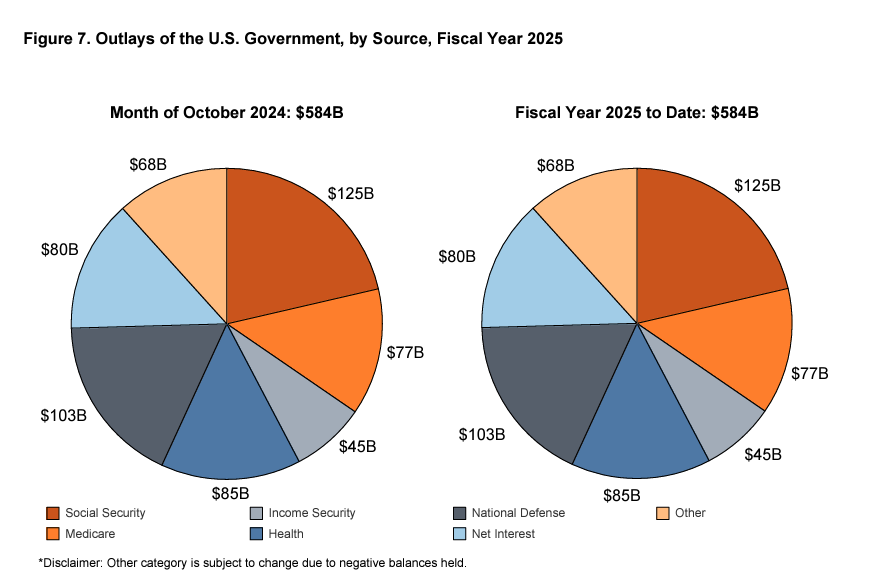
The federal government ran a $257.45 billion budget shortfall to start the new fiscal year, with revenue down and spending up, according to the latest statement from the Department of Treasury.

That was a 287 percent increase over the October 2023 deficit.

Federal receipts came in at $326.77 billion. That was down about 19 percent compared to October 2023. A one-time influx of tax payments deferred due to wildfires last year boosted October 2023 revenues.

As has been the case for months, the big problem is on the spending side of the ledger.

The Biden administration blew through $584.22 billion last month. That was a 24 percent year-on-year increase. Outlays for Social Security, Medicare, and national defense all increased.

You might recall that President Biden promised that the [pretend] spending cuts would save “hundreds of billions” with the debt ceiling deal (aka the [misnamed] Fiscal Responsibility Act).

That never happened.

The federal government continues to find new reasons to spend money, whether for natural disasters at home or wars overseas. The Biden administration spent a staggering $6.75 trillion in fiscal 2024, a 10 percent increase over 2023 outlays.

The federal government spent $82 billion on interest expenses last month. That was a modest 8 percent decline, the first annual drop in interest expense since August 2023. The Treasury Department said the decline was driven by a $12 billion reduction in payouts for inflation-protected securities thanks to a lower CPI.

Net interest expense came in at $80 billion. That was a $4 billion increase over October 2023.

Uncle Sam paid $1.13 trillion in interest expense in fiscal 2023. It was the first time interest expense has ever eclipsed $1 trillion.

Interest payments were up 28.6 percent over fiscal 2023 levels.

Don’t let the small decline in interest expense last month fool you. The general trend remains upward. Even with the recent Federal Reserve rate cuts, Treasury yields are pushing upward as demand for U.S. debt sags. Since Trump’s electoral victory, the yield on the 10-year Treasury is up 15 basis points.

Much of the debt currently on the books was financed at very low rates before the Federal Reserve started its hiking cycle. Every month, some of that super-low-yielding paper matures and has to be replaced by bonds yielding much higher rates.

Impact of the Debt

We see these big deficits month after month, but most people don’t bat an eye. There seems to be a sense that spending more than you take in month after month isn’t really a problem.

But anybody who says “deficits don’t matter” is deluded.

As the Bipartisan Policy Center points out, the growing national debt and the mounting fiscal irresponsibility undermine the dollar.

“Confidence in U.S. creditworthiness may be undermined by a rapidly deteriorating fiscal situation, an increasing concern with federal debt set to grow substantially in the coming years.”

This could lead to lower economic growth, higher unemployment, and less investment wealth.

Lack of confidence in the U.S. fiscal situation could also lower demand for U.S. debt. This would force interest rates on U.S. Treasuries even higher to attract investors, exacerbating the interest payment problem.

The national debt continues to spiral upward at a dizzying pace. It will officially top $36 trillion within days. According to the national debt clock, that represents 122.85 percent of GDP. Studies have shown a debt-to-GDP ratio of over 90 percent retards economic growth by about 30 percent.

The debt will likely be one of the biggest problems facing President Trump as he takes the reins of power. With Republicans controlling both chambers of Congress and the White House, there is an opportunity to tackle the spending problem, but whether the GOP has the political will to make substantial cuts remains to be seen.

Gold-Backed or Bust: Judy Shelton’s Plan to Tame the Fed and Restore the Dollar

(Paul D. Mueller, Money Metals News Service) Judy Shelton has spent her career advocating for sound money.

Her latest book, Good as Gold: How to Unleash the Power of Sound Money, makes an up-to-date case for reinstituting a gold standard. Her intriguing conclusion is that the dollar can be reconnected to gold by simply issuing federal treasury bonds with gold-redeemability clauses.

The book also addresses recent events and important current debates about monetary systems, like whether central bankers should have wide policy discretion, whether fixed or floating exchange rates are better for economic growth, and what happens when countries manipulate their currencies to boost exports.

Dr. Judy Lynn Shelton engages these questions in the context of academic debates, but she also uses the lens of rational economic planning to evaluate how the monetary system contributes to or detracts from economic growth. At the end of the day, the case for sound money rests on the claim that it will generate more stable and greater long-run economic prosperity. Dr. Shelton believes sound money will do just that. But what would such a sound money regime look like?

Although Dr. Shelton would prefer a system along the lines of a classical gold standard, she would probably be content with other monetary systems that dramatically reduced the discretion of policymakers. The real problem with our current monetary regime is not primarily technical. It is behavioral. Because public officials have strong incentives to inflate the currency, bail out various corporations, and underwrite extensive government borrowing, they do a poor job conserving the value of fiat currency or providing a predictable, stable system of interest rates, credit, liquidity, etc.

In the first couple chapters of Good as Gold, Dr. Shelton takes the Federal Reserve to task. The wide discretion Fed officials can exercise makes monetary policy unpredictable. Although Fed officials argue that their decisions are countercyclical, that may not always be the case. As Milton Friedman famously noted, the effects of monetary policy decisions have “long and variable” lags. Despite claims to being “data-driven,” Federal Open Market Committee (FOMC) decisions remain unpredictable. Data can change rapidly and unpredictably, which can make policy change rapid and unpredictable, too.

Another problem is that the “data-driven” mantra invokes the assumption that the data always clearly indicate what ought to be done. In fact, this is rarely the case. Not only do a wide variety of inflation measures exist, but there are also a wide range of time intervals over which to compare inflation trends. But that’s not the worst of it!

Employment, unemployment, GDP, and a host of other economic numbers suggest different things are going on in the economy. Retailers expect strong record spending this holiday season, while the NY Fed just released a study where the number of people reporting concern about their ability to make debt payments hit its highest level since 2020. How to weigh these various factors is far from clear.

Another problem with Fed policy is the rapid change in its interest rate targets. Three years ago, the short-run interest rate was ~.5 percent. Within two years, it was over 5 percent. That rapid change created many issues in the economy, only some of which we have recognized. The rate-hike cycle created significant turmoil in the banking industry, with Silicon Valley Bank and Signature Bank failing entirely while many large regional banks shrank or were enfolded into larger national banks.

The commercial real estate market has also been upended. While the owners of office buildings were already facing strong headwinds from the pandemic’s normalization of remote work, the Fed delivered a one-two punch when it raised interest rates. Most large commercial real estate investors use variable-rate debt to finance their portfolios – which means the interest rate they pay moves with the market.

Adding a couple percentage points to one’s debt rapidly changes the viability of a venture. In addition to higher debt-servicing costs, commercial real estate investors saw the market value of their holdings decline precipitously as buyers disappeared, financing costs rose, and future potential cash flows were more heavily discounted.

The previous rate-hike cycle in 2006 and 2007 preceded a major recession and financial crisis. Even as the Fed creates disruptions in markets, it has also overseen the relentless decline in the value of the dollar – ironically in the name of pursuing their mandate to maintain price stability. A dollar in 2024 is worth what a quarter was in 1980 and what a dime was in 1965. And a 2024 dollar is worth about what a penny was worth in 1900.

This downward march in the value of the dollar creates problems. It drives up asset prices, favoring those who have investment savvy while eating away at the value of people’s savings and undermining the prosperity of those on fixed incomes. The steady fall of the dollar also distorts price calculations and expectations.

I’ve argued elsewhere that the Fed has been a prime culprit in boosting housing prices and, as a result, creating a “transitional gains trap” where homeowners with significant equity, juiced in large part by easy money, have organized to protect their equity by putting up local legal barriers to building new housing.

But Good as Gold includes much more than criticism of the Fed. Dr. Shelton points out that unstable money and exchange rates create costs to doing business. International firms must devote time, energy, and money to protect themselves from erratic fluctuations in currency exchange rates. Creating these “hedges” to protect their profitability from exchange-rate risk necessitates additional classes of assets and asset traders – contributing to greater “financialization” of the economy. While the services being offered create real value for corporations, they come at a price and would not be needed under more stable monetary arrangements.

Besides the frictions and costs that unstable money introduces into day-to-day business operations, it also creates long-term consequences when it comes to investing. If certain exchange rates can move 15 percent, 30 percent, or more in a single year, Dr. Shelton asks, then how can investors rationally allocate capital based on real factors and comparative advantage? The structure and mix of capital investment we currently have across countries and within the same country looks very different than it would in a world of stable money.

Dr. Shelton makes this point indirectly in a fascinating chapter about the monetary debate between Milton Friedman and Robert Mundell. Both were staunch advocates of free markets, but they differed in what monetary regime they thought best. Friedman argued in favor of freely floating exchange rates set by market participants. In this world, governments would feel pressure from markets in the form of capital outflows if they engaged in domestic monetary policy shenanigans.

Mundell, on the other hand, favored more stability in exchange rates that would require domestic prices to adapt to changes in trade and capital flows. Friedman and Mundell both agreed, however, that government officials and central bankers should have very little discretion in how they manage a country’s monetary system.

In a later chapter, Shelton offers the problem of “currency manipulation” as a reason for implementing a sound money regime. Her argument basically asserts that countries that actively depreciate or weaken their domestic currency experience short-run benefits (in the form of more competitive exports) and long-term costs (in the form of inflation and capital outflows). Other countries, however, feel short-run pain as their exports decline and their factories shut down – even though they also receive cheaper goods and reallocate much of the displaced labor and capital. I find this line of reasoning a bit curious.

Shelton rightly champions free trade and argues that it works best when countries do not artificially manipulate the value of their currencies. No objection here. But I am not convinced that a sound money regime, even a gold standard, would change other countries’ incentives to devalue their currency. Gold convertibility of one currency does not prevent the issuer of a different fiat currency from issuing large amounts of that fiat currency to reduce the relative price of its exports.

I suppose one could argue (and Dr. Shelton does) that currency manipulation becomes easier to discern because currencies will be valued in terms of a fixed standard (gold) rather than in terms of another fluctuating fiat currency. For example, the price of gold in terms of dollars increased by 77 percent from May 2014 to May 2024.

The currencies of the largest trade partners with the US lost far more value relative to gold in that period: Euros (129 percent), Mexican Peso (131 percent), Canadian dollar (122 percent), Chinese yuan (105 percent), and Japanese yen (165 percent). But that probably matters relatively little to the devaluing regime. Using gold as a benchmark might reveal relative changes in the value of currencies better. It could also defuse the language of “currency manipulation.”

Instead of attributing motives to foreign central bankers, policymakers could set relatively straightforward criteria for when another country’s currency declines in a distortive way. Shelton suggests that some level of tariffs should be imposed in response to another country’s currency devaluation to offset the monetary distortion to international trade.

This idea may not be crazy from a purely technical standpoint, yet I would hesitate to recommend it because of the likely distortions and co-opting of such policies by special interests. I also question whether the costs of not imposing tariffs on depreciating currencies are as high as Dr. Shelton believes.

Sound money advocates like Shelton must explain how we could get to a sound money regime. On the one hand, advocating a gold standard seems archaic and implausible. On the other hand, it would not be technically difficult to implement. And, in fact, given the dominance of the US dollar, if another major currency, such as the Euro, also chose to move back to gold redeemability, it is not hard to imagine other major currencies (Yen, Yuan, Pound, etc.) following suit. The political difficulty, of course, is getting the US to take the first step and then getting the EU to follow suit.

The odds of successful reform are highest when pursuing the easiest path to transition the current system to a sound monetary regime. Abolishing the Federal Reserve is not on that path. So, tying dollars back to gold using the Fed makes more sense than moving back to a pre-Fed world. Similarly, constraining the FOMC seems far more plausible than abolishing it.

It may be worth raising a few other important secondary questions. At what price will the currency be convertible into gold? Dr. Shelton has suggested that incorporating a gold clause in Treasury bonds could be a good method for discovering the right price of convertibility. In fact, putting gold convertibility into government bond contracts may be sufficient, in and of itself, to tie dollars back to gold.

After all, depreciation of dollars would create consequences for the federal government and the Federal Reserve, the very institutions primarily responsible for managing the dollar and maintaining the monetary system. Shelton also makes the important point that currency should be seen as being like a weight or measure – something standardized for the public to use. It should not be viewed as a policy instrument or lever for managing the economy. This simple point rarely arises in modern commentary on the Fed and on monetary policy – yet it has deep legal and historical roots in the American founding and beyond.

Another benefit of moving to gold redeemability for US bonds is that it utilizes US gold reserves more effectively. Currently, the US is the largest holder of gold in the world. But ironically, that gold is severely undervalued on the government’s ledger. Its book value is less than two percent of its market value (i.e., on the ledger, the gold is valued at less than $50/oz when its market value is over $2700/oz). Offering gold redeemability might also open up the option for extremely long-dated debt (50 years or more) and lower interest rates because the most significant risk to lending to the federal government, the devaluation of future dollars, has been taken off the table.

The likely benefits of such bonds are so significant that it may seem surprising that they have not been implemented. The problem, of course, is that this form of bond would reveal the man behind the curtain. It would show that government officials can and do play fast and loose with the dollar and with the US financial system to enable themselves and their friends a free hand to borrow and spend and to actively “manage” the economy.

Dr. Shelton’s proposed changes will be vigorously resisted by those who benefit from the existing status quo – large commercial banks and financial institutions, Federal Reserve officials and bureaucrats, politicians and regulators – everyone who benefits from the Fed’s tendency to loose monetary policy.

Still, advocates of freedom and prosperity should continue to make the arguments and offer proposals for moving to a sound monetary regime.

And that is exactly what Dr. Shelton does in Good as Gold.

Originally Published on AIER’s The Daily Economy.

Ex-Homeland Security Official, Who Now Works for Ag. Dept., Pleads Guilty to $844K PPP Fraud

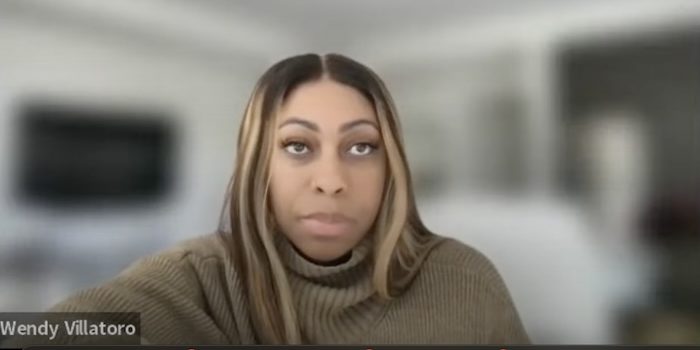
(Ken Silva, Headline USA) A former DC Homeland Security official, who now works for the U.S. Department of Agriculture, has pled guilty to one count of bank fraud—a charge stemming from her perpetrating an $880,000 fraud on the COVID-era Paycheck Protection Program.

The DOJ announced the plea from Wendy Nicole Villatoro, 40, formerly of Washington, D.C., on Thursday.

According to the DOJ, from March 2020 to April 2021, Villatoro submitted eight PPP loan applications with various financial institutions, and 15 Economic Injury Disaster loans with the Small Business Administration—all of which contained materially false statements.

The DOJ said Villatoro submitted loans on behalf of fake businesses and inflated the number of employees, the average monthly payroll, the gross yearly revenue, or the cost of goods sold.

“In doing so, the DOJ said she tried to steal between $2.6 million and $5.5 million,” the DOJ said in a press release.

“While most of Villatoro’s loan applications were denied, she successfully secured over $844,000 in PPP and EID funds. Villatoro used the funds to pay off her student loans, pay off the car loan on a BMW SUV, and buy luxury items,” the DOJ said.

As part of her plea deal, Villatoro has agreed to pay $844,415.24 in restitution to the U.S. government, and to forfeit items purchased with proceeds of the offense—including over 70 pieces of designer clothing and jewelry and a BMW SUV.

She faces a maximum sentence of 30 years in prison. Her sentencing hearing is set for Feb. 25.

But meanwhile, she’s still apparently still collecting paychecks from the government. The DOJ’s Thursday press release specifically says she’s a “current employee with the U.S. Department of Agriculture.”

Before that, she was a D.C. Homeland Security Commissioner. According to a LinkedIn account with her name, she was a “senior expert publicly confirmed as Commissioner by the District of Columbia City Council to provide recommendations to the Mayor on improvements in security preparedness.”

She also said she’s a Doctoral Candidate in cybersecurity.

“I am a disruptor with expertise in sustainability, strategy, program management, logistics, homeland security, disaster management, and technology,” her LinkedIn bio states.

Ken Silva is a staff writer at Headline USA. Follow him at x.com/jd_cashless.