

Dems Ask Minn. Supreme Court to Meddle in Legislative Standoff over Definition of ‘Quorum’

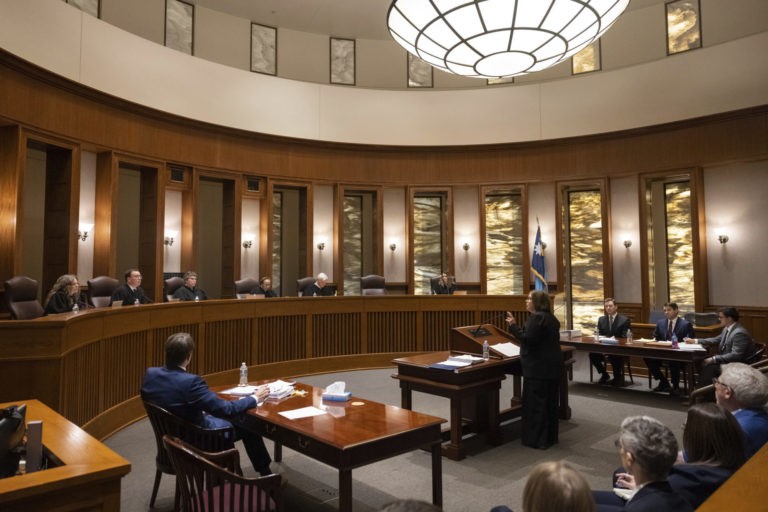
(Headline USA) The Minnesota Supreme Court heard arguments Thursday on how deeply it should intervene in a power struggle between Democrats and Republicans over who should control the state House of Representatives.

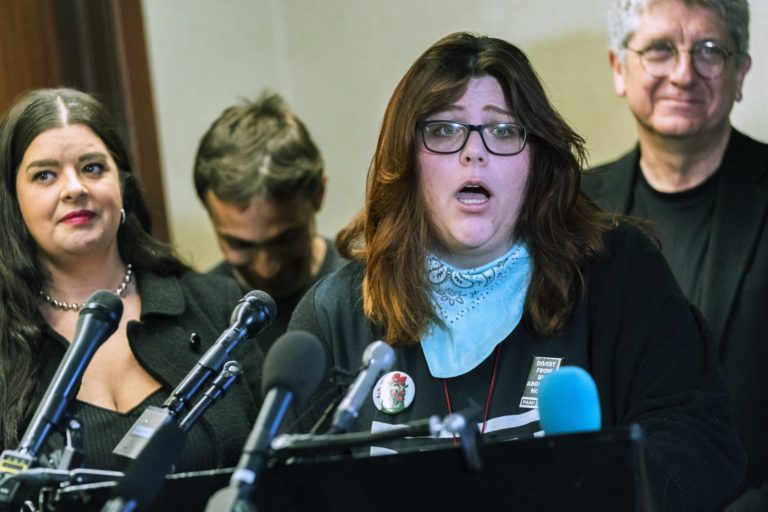
Democratic representatives have stayed away from the state capitol since the 2025 legislative session opened Jan. 14 in an effort to prevent the House from getting the quorum that it needs to conduct normal business.

Republicans, who hold a temporary one-seat majority, say they already have a quorum and have pressed forward with electing their top leader as speaker, introducing legislation and holding hearings.

Democrats contend those are sham actions that have no legal force. Instead, it hopes the state Supreme Court—where all the justices were appointed by Democrats—will step in to assert itself as an impartial arbitrator.

The main dispute before the state’s highest court is whether a quorum in the House is 68 members as Democrats contend because there are 134 seats, or 67, as Republicans argue, because one seat is open.

The state constitution says a “majority of each house constitutes a quorum to transact business.” But lawyers for both sides pointed Thursday to various passages in the state and federal constitutions, statutes, case law and rules in Congress and other states to show that it’s not necessarily a simple question.

Chief Justice Natalie Hudson told Solicitor General Liz Kramer, who represented Democratic Secretary of State Steve Simon, that it seemed to her like the Democrats’ reading of the quorum language in the state constitution “is certainly a reasonable one. It’s a plain-language, straight sort of statutory interpretation.”

But she added that it also seemed to her that the GOP position “is at least equally reasonable.”

Nicholas Nelson, an attorney for House GOP leaders, argued that the court does not have the authority under the constitutional separation of powers to review how the Legislature organizes itself or its leadership choices. That’s the Legislature’s prerogative, he said, so the Democrats should not be allowed to use the court’s authority “to address an alleged quorum problem that is of their own making.”

Hudson responded that while the courts are rightfully hesitant to dabble in the business of another branch of government, there are also times when the courts are required to intervene.

“What we have is a co-equal branch of government that is completely dysfunctional, that is not doing the will and the work of the people of Minnesota,” she said. “Isn’t that an instance where, if not the judicial branch, who? Who steps in to resolve that?”

The justices took the case under advisement. Hudson said they would rule “in due course” without specifying when.

The November election resulted in a 67-67 tie in the House. A power-sharing agreement between the chamber’s top Democratic and Republican leaders fell apart after a Ramsey County judge ruled that the Democratic winner of a Roseville-area seat didn’t really live in his district and was ineligible. So the session started with a 67-66 GOP majority pending a special election to fill that seat—now expected in mid-March—which is likely to restore the tie because it’s a heavily Democratic district.

House Democrats say they won’t return until Republicans agree to a power-sharing deal and promise not to refuse to seat Democratic Rep. Brad Tabke, of Shakopee, who won reelection by just 14 votes in a swing district where the GOP would stand a good chance of winning a low-turnout special election. Republicans have refused to give that assurance, even though a Scott County judge declared Tabke the legal winner. Denying Tabke his seat would lock in the GOP majority until it could be filled.

While the standoff is unusual for Minnesota, lawmakers have blocked quorums many times in other states, even going into hiding to prevent state troopers or sergeants-at-arms from dragging members back to ensure they are present to conduct business.

Texas Democrats were celebrated by the mainstream media for their “civil disobedience” in preventing the state legislature from passing an election-integrity law in 2021, but they eventually were rounded up and forced to return.

In Oregon, Republicans boycotted the legislature in 2023, forestalling several key laws from the radical leftist lawmakers. They were later punished by the state Supreme Court, which ruled that they could not seek reelection as a result of the stunt.

As for the current Minnesota standoff, the fear of being hauled in has subsided a bit among House Democrats, who argue that their chamber is not legally organized yet and that Republicans therefore don’t have the legal authority to order the sergeant-at-arms to round them up. They say they’re hard at work in the meantime, meeting with constituents and local officials in their districts until the dispute gets settled.

By contrast, the Minnesota Senate, which is tied 33-33, is operating smoothy under a power-sharing agreement pending a Jan. 28 special election to fill the seat of a senator from a heavily Democratic district who died in December.

Adapted from reporting by the Associated Press
Trump Signs Exec. Order to Develop AI ‘Free from Ideological Bias’

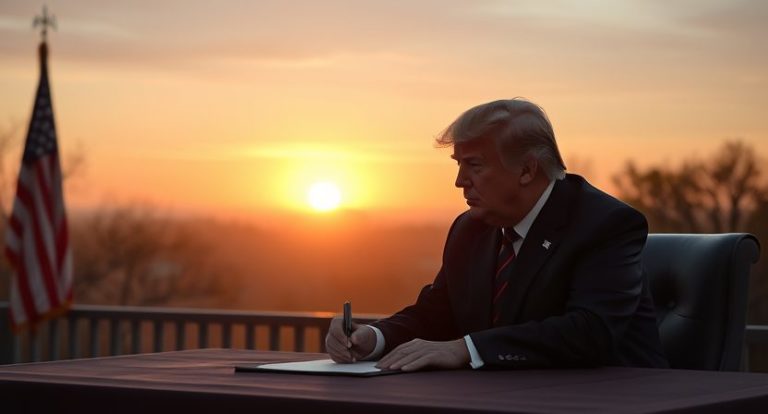
(Headline USA) President Donald Trump signed an executive order on artificial intelligence Thursday that will revoke past government policies his order says “act as barriers to American AI innovation.”

To maintain global leadership in AI technology, “we must develop AI systems that are free from ideological bias or engineered social agendas,” Trump’s order says.

The new order doesn’t name which existing policies are hindering AI development but sets out to track down and review “all policies, directives, regulations, orders, and other actions taken” as a result of former President Joe Biden’s sweeping AI executive order of 2023, which Trump rescinded Monday.

Any of those Biden-era actions must be suspended if they don’t fit Trump’s new directive that AI should “promote human flourishing, economic competitiveness, and national security.”

Last year, the Biden administration issued a policy directive that said U.S. federal agencies must show their artificial intelligence tools aren’t harming the public, or stop using them.

Trump’s order directs the White House to revise and reissue those directives, which affect how agencies acquire AI tools and use them.

Biden’s executive order, the Trump administration said, “established unnecessarily burdensome requirements for companies developing and deploying AI that would stifle private sector innovation and threaten American technological leadership.”

Trump’s order also calls for the development of an AI action plan within 180 days. Leading the work will be a small group of White House tech and science officials, including a new Special Advisor for AI and Crypto—a role Trump has given to venture capitalist and former PayPal executive David Sacks.

Trump repealed Biden’s 2023 guardrails for fast-developing AI technology just hours after returning to the White House on Monday.

The new actions threaten to erase some of the Biden administration’s efforts — championed by then-Vice President Kamala Harris — to curb government use of the kinds of AI tools that have been found to unfairly discriminate based on race, gender or disability, from medical diagnosis chatbots spouting false information to face recognition technology tied to wrongful arrests of Black men.

Until Thursday, it wasn’t clear if Trump planned to replace Biden’s signature AI policy with his own order.

Trump had also signed executive orders on AI in his previous term, including a 2019 order directing federal agencies to prioritize research and development in AI that is still on the books.

Alondra Nelson, former acting director of the White House Office of Science and Technology Policy under Biden, said Trump’s order seemed “backward looking” because agencies would be tasked with reviewing initiatives “that are already helping people, with an implicit intent to unwind them.”

The Biden administration’s AI policies, she added, were aimed at protecting both innovation and the public.

“In 60 days, we’ll know which Americans’ rights and safety the Trump Administration believes deserves to be protected in the age of AI, and if there will be a level playing field for every technologist, developer, and innovator or just the tech billionaires,” Nelson said.

Much of Biden’s 2023 order set in motion a sprint across government agencies to study AI’s impact on everything from cybersecurity risks to its effects on education, workplaces and public benefits, with an eye on ensuring AI tools weren’t harming people. That work is largely done.

One major piece that remained—until Trump rescinded it Monday—was a requirement that tech companies building the most powerful AI models share details with the government about the workings of those systems before they are unleashed to the public.

The Trump order’s focus on “human flourishing” echoes the language of his campaign’s long-held promise to cancel Biden’s AI policy once back in the White House.

It’s also in line with ideas espoused by Trump adviser Elon Musk, who has warned against the dangers of what he calls “woke AI” that reflects liberal biases.

In a statement, Americans for Responsible Innovation, a nonprofit organization, said Trump has “made it clear from day one that his top priority on AI is out-innovating the rest of the world.”

“Today’s executive order is a placeholder until the administration has a chance to develop a full strategy for executing that vision,” said the organization’s executive director, Eric Gastfriend.

Agencies had already frozen work on AI policies initiated by the last administration following Trump’s repeal of Biden’s executive order on Monday, Gastfriend said.

“This new instruction shouldn’t come as a surprise,” he said.

Adapted from reporting by the Associated Press
Putin Confirms that Biden’s Diplomatic Ineptitude Was to Blame for Ukraine War

0

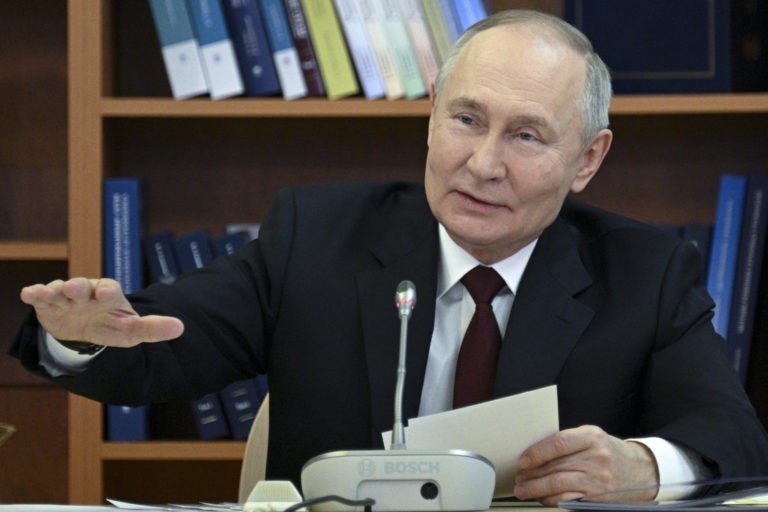
(Headline USA) Russian President Vladimir Putin on Friday confirmed the commonly held view, echoed by U.S. President Donald Trump, that Trump’s successor/predecessor in the White House, Democrat Joe Biden, was the driving force in the Russian leader’s decision to escalate a long-simmering territorial dispute at the Ukraine border into full-fledged war.

Putin said the conflict in Ukraine could have been prevented had Trump been in the White House in 2022. He also said Moscow was currently ready for talks with the U.S. on a broad range of issues.

In an interview with Russian state television, Putin praised Trump as a “clever and pragmatic man” who is focused on U.S. interests.

“We always had a business-like, pragmatic but also trusting relationship with the current U.S. president,” Putin said. “I couldn’t disagree with him that if he had been president, if they hadn’t stolen victory from him in 2020, the crisis that emerged in Ukraine in 2022 could have been avoided.”

Trump also has said repeatedly he wouldn’t have allowed the conflict to start if he had been in office because his leadership projected strength while Biden’s put his incompetence on full display—most notoriously with the botched withdrawal from Afghanistan.

On Thursday, Trump told Fox News that Ukrainian President Volodymyr Zelenskyy should have made a deal with Putin to avoid the conflict.

Putin emphasized Friday that he’s open to talks but pointed to Zelenskyy’s 2022 decision to rule out negotiations with Moscow.

“How is it possible to conduct talks if they are banned?” Putin said. “If the talks start in the existing legal framework, they would be illegitimate and the results of those talks could also be declared illegitimate.”

He also said the U.S. and Russia have many other items on their agenda, including nuclear arms control and economic issues.

“We can have quite a lot of points of contact with the current administration and search for solutions to key issues of today,” Putin said.

He said the sanctions against Russia introduced during Trump’s first term and under Joe Biden’s administration had hurt U.S. interests, undermining the dollar’s role in global financial system.

Trump is “not only clever, but a pragmatic man,” Putin said.

“I find it hard to imagine that he would make decisions that would hurt the American economy,” Putin continued. “We’d better meet and have a calm conversation on all issues of interest to both the United States and Russia based on today’s realities.”

He noted that as top oil producers and major industrial powers, Russia and the U.S. aren’t interested in global oil prices being either too low or too high. “We have things to talk about,” Putin said.

Speaking by video from the White House to the annual World Economic Forum in Davos, Switzerland on Thursday, Trump said the OPEC+ alliance of oil exporting countries shares responsibility for the nearly 3-year-old conflict in Ukraine because it has kept oil prices too high.

“If the price came down, the Russia-Ukraine war would end immediately,” he said. Energy sales form a large part of Russia’s earnings.

Asked about Trump’s comments, Kremlin spokesman Dmitry Peskov affirmed Moscow’s view that the conflict was triggered by the West’s refusal to take into account Russian security interests.

“The conflict doesn’t depend on oil prices,” Peskov said in a conference call with reporters.

“The conflict is ongoing because of the threat to Russia’s national security, the threat to Russians living on those territories and the refusal by the Americans and the Europeans to listen to Russia’s security concerns,” he continued. “It’s not linked to oil prices.”

Peskov’s comments echoed Putin’s statements that he had to send troops into Ukraine to fend off a threat to Russia’s security resulting from plans for Ukraine to join NATO and to protect Russian speakers living there. Ukraine and the West have denounced Moscow’s action as an unprovoked act of aggression.

On Wednesday, Trump threatened to impose stiff tariffs and sanctions on Russia if an agreement isn’t reached to end the fighting in Ukraine.

Peskov said the Kremlin was closely following Trump’s statements and noted he imposed a slew of sanctions in his first term. He said Moscow “remains ready for an equal dialogue, for a mutually respectful dialogue.”

“This dialogue took place between the two presidents during Trump’s first presidency. And we are waiting for signals that we have not received yet,” Peskov said.

Adapted from reporting by the Associated Press

DOJ Drops Charges against Doctor Who Blew Whistle on Child Genital Mutilation

(Ken Silva, Headline USA) The Justice Department has dropped its charges against the medical doctor who exposed Texas Children’s Hospital for conducting secret sex changes on children.

U.S. Attorney John Pearson filed a motion to dismiss the indictment against Dr. Eithan Haim on Friday, putting an end to the Biden administration’s politically motivated prosecution.

Dr. Haim contacted journalist Christopher Rufo in 2023, blowing the whistle the hospital for lying about terminating the transgender medicine program. Dr. Haim also disclosed that doctors were continuing to perform sex-change procedures on children as young as 11.

Rufo reported on Dr. Haim’s disclosure, causing Texas to immediately ban transgender medical procedures for minors.

But Rufo’s story also put Dr. Haim on the DOJ’s radar.

“On the morning in June 2023 that Haim was to graduate from Texas Children Hospital’s residency program, federal agents knocked on his door. They had identified him as a potential ‘leaker,’ presumably through forensic examination of the hospital’s computer systems. Shortly thereafter, Assistant U.S. Attorney Tina Ansari began threatening Haim with prosecution,” Rufo wrote in an article last June.

“Now, Ansari has made good on those threats. Earlier this week, U.S. marshals appeared at Haim’s home and summoned him to court to face an indictment on four felony counts of violating HIPAA.”

Dr. Haim faced up to 10 years in federal prison and a $250,000 maximum possible fine before the DOJ dropped the case on Friday.

The whistleblower has a GiveSendGo page to pay for his legal fees. He’s raised over $1.2 million to date.

“The outpouring of support is more than we would have ever thought possible,” Dr. Haim said earlier this month. “It means more than we can express in words. Thank you all for everything!”

Ken Silva is a staff writer at Headline USA. Follow him at x.com/jd_cashless.

Notoriously Woke Target Caves to Anti-DEI Trend as Trump ‘Golden Era’ Claims Major Victory

0

(Headline USA) Big-box store chain Target said Friday that it would join rival Walmart and a number of other prominent American brands in scaling back diversity, equity and inclusion initiatives that have come under attack from conservative activists and, as of this week, the White House.

The Minneapolis-based retailer said the changes to its “Belonging at the Bullseye” strategy would include ending a program it established to give special advantages to black stakeholders following the death of George Floyd in 2020.

The program singled out black employees for support in building meaningful careers, improved the experience of black shoppers and helped to promote black-owned businesses.

Target, which operates nearly 2,000 stores nationwide and employs more than 400,000 people, said it already had planned to end the racial program this year. The company said Friday that it also would conclude the DEI goals it previously set in three-year cycles.

The employee memo shared Friday also said Target would no longer would participate in surveys designed to gauge the effectiveness of its actions, including an annual index compiled by the Human Rights Campaign, a gay-rights activist group that uses commercial pressure to force compliance with its sweeping LGBT agenda.

Target said it would further evaluate corporate partnerships to ensure they’re connected directly to business objectives, but declined to share details.

Kiera Fernandez, Target’s chief community impact and equity officer, described the DEI decisions as a “next chapter” in the company’s decades-long process to create “inclusive work and guest environments that welcome all” in a memo to employees.

“Many years of data, insights, listening and learning have been shaping this next chapter in our strategy,” Fernandez wrote in the memo, which Target shared Friday. “And as a retailer that serves millions of consumers every day, we understand the importance of staying in step with the evolving external landscape, now and in the future.”

Target previously put itself on the front lines as one of the standard bearers in pushing a “woke” agenda, most notoriously by declaring it would allow transgender men in women’s restrooms, as well as foisting LGBT and transgender products onto unwitting customers with in-your-face displace, including “tuck friendly” swimsuits for children.

As transgender rights became a more prominent issue in 2016, the company declared that “inclusivity is a core belief at Target” and said it supported transgender employees and customers using whichever restroom or fitting room “corresponds with their gender identity.”

But after backlash, the company said that more stores would make available a single-toilet bathroom with a door that could be locked.

Nonetheless, Target’s over-the-top virtue-signaling eventually drew boycotts from conservative customers who demanded the ability to shop free from political grandstanding. After its sales and stock value dropped, the company backpedaled some but continued to supply the more controversial products.

The company decided last year not to stock Pride Month products at every U.S. store.

A 2023 U.S. Supreme Court decision that outlawed affirmative action in college admissions emboldened conservative groups to bring or threaten lawsuits targeting corporate initiatives pushing a leftist identity-politics agenda.

However, some of the most prominent companies to succumb to pressure have been those who count blue-collar, middle-America conservatives as a significant portion of their clientele, fearing that the negative optics could lead them to become the next Bud Light.

Walmart, McDonald’s, Ford, Harley–Davison and John Deere are among the well-known consumer brands that reduced or phased out their DEI commitments in recent months.

President Donald Trump this week signaled his administration’s agreement with conservatives who argue that policies singling out individuals for special treatment through factors such as race, gender and sexual orientation were unconstitutional.

On his first day in office, Trump signed an executive order aimed at ending DEI programs across the federal government. The order calls for revoking all DEI mandates, policies, preferences and activities, along with the review and revision of existing employment practices, union contracts, and training policies or programs.

Still, some prominent companies have resisted public pressure to retreat from their diversity plans. On Thursday, Costco shareholders rejected a proposal urging the wholesale club operator to evaluate any risks posed by its DEI practices.

According to preliminary results shared by Costco executives, more than 98% of shares voted against the proposal submitted by a conservative think tank based in Washington. Costco’s board of directors had recommended a no vote.

Apple’s board and the CEO of JPMorgan bank also have expressed a commitment to preserving their companies’ DEI activities.

Adapted from reporting by the Associated Press
Nearly 8 Years Later, Charlottesville Torch Marcher Sentenced to 5 Years Imprisonment

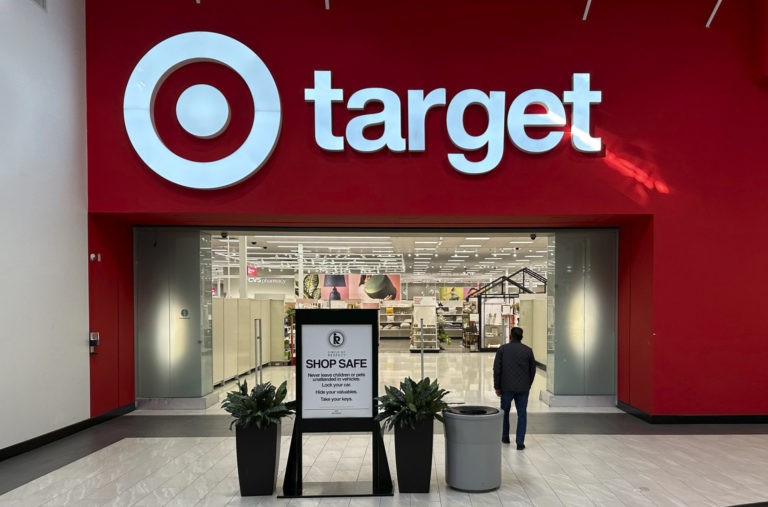
(Ken Silva, Headline USA) While hundreds of Jan. 6 protestors were pardoned by newly inaugurated President Donald Trump, a tiki torch marcher from the infamous 2017 Charlottesville Unite the Right rally was just sentenced to a shocking five years imprisonment.

The defendant, Augustus Sol Invictus (who was born Austin Mitchell Gillespie), will reportedly have to serve about nine months in jail, with the remainder of his sentence having been suspended by a judge earlier this month.

Invictus, who was allegedly the author of the “official manifesto” of the 2017 Unite the Right rally, was charged in July 2023 with a little-used law that makes it a crime to burn objects with intent to intimidate.

Another torch marcher, Jacob Joseph Dix, had his case tossed last July after a jury was gridlocked, but Invictus wasn’t as unfortunate. He was found guilty last October and sentenced on Jan. 10. Along with having to serve nine months in jail, he must serve two years of supervised probation when he gets out.

The Charlottesville rally turned deadly the day after the torch march, when a 20-year-old Ohio man rammed his vehicle into a group of counterprotesters and killed a local activist. The driver, James Alex Fields Jr., was convicted of murder and given life imprisonment.

The law being used to pursue the peaceful protestors from the night before was enacted by the state in 2002 in response to Ku Klux Klan cross-burnings.

It was challenged all the way to the Supreme Court, which ultimately found the law constitutional in a 6-3 vote.

Charlottesville’s Soros-backed D.A Jim Hingeley made it a campaign promise in 2019 to prosecute torch-carriers. His predecessor, Robert Tracci, had declined to press charges.

According to The Daily Progress, the main prosecutor of the torch marchers, W. Lawton Tufts, was found to have a relationship with groups such as Black Lives Matter and Showing Up for Racial Justice. Tufts reportedly has offered to research legal issues for people and groups that opposed Unite the Right.

Ken Silva is a staff writer at Headline USA. Follow him at x.com/jd_cashless.

Ramaswamy to Face Tough Primary Competition from State AG in Ohio Gov. Race

(Headline USA) Republican Attorney General Dave Yost announced Thursday that he is running to be the next governor of Ohio—wedging the news between the departure from the race of a top rival and the expected entry as soon as next week of a new one.

Yost, 68, seeks to succeed two-term Ohio Gov. Mike DeWine, a fellow Republican, who is term-limited in 2026.

He had teased his plans in a black-and-white video posted to the social platform X in November.

The formal announcement comes less than a week after DeWine appointed a one-time top contender for the job, former Lt. Gov. Jon Husted, to the U.S. Senate seat formerly held by Vice President JD Vance—and ahead of an expected campaign launch by Vivek Ramaswamy, the Cincinnati-born biotech entrepreneur who recently left President Donald Trump’s federal government efficiency project.

He previously described himself as “a principled conservative” and advocate for Ohio families, business and taxpayers and said he had worked to advance Trump’s agenda at the state level.

Among his actions have been joining an anti-trust lawsuit against Google, fighting the Biden administration’s border policy, and urging the U.S. Supreme Court to get involved when lower courts restricted access to guns.

Yost also brought state-level charges against imprisoned former Ohio House Speaker Larry Householder and others in conjunction with the Justice Department’s corruption investigation into a legislative bailout of two nuclear power plants known as House Bill 6.

One of the men the state charged, former Public Utilities Commission of Ohio Chairman Sam Randazzo, had pleaded not guilty before dying by suicide.

In announcing his gubernatorial bid, Yost said the state’s prosecution saved Ohio taxpayers more than $1 billion.

“After receiving a groundswell of support from voters across the state and much prayer and consultation, I am answering the call to duty,” Yost said. “I will be faithful. I will not falter, and I will not fail.”

Dr. Amy Acton, the former Ohio health director who helped the state through the early months of the COVID-19 pandemic, is running for governor as a Democrat.

Yost was first elected attorney general in 2018 and reelected in 2022. He had previously served two terms as state auditor. Before entering state politics, he served as Delaware County prosecutor, was a lawyer in private practice and worked as a journalist.

Adapted from reporting by the Associated Press
Trump Pardons Pro-Life Activists Targeted by Biden DOJ for Praying in Front of Abortion Clinics

(Headline USA) President Donald Trump announced Thursday he would pardon pro-life activists convicted of blockading abortion clinic entrances.

Trump called it “a great honor to sign this.”

“They should not have been prosecuted,” he said as he signed pardons for “peaceful pro-life protesters.”

The people pardoned were involved in the October 2020 incident at a Washington clinic.

Lauren Handy was sentenced to nearly five years in prison for leading the protest by directing participants to link themselves together with locks and chains to block the clinic’s doors.

Trump pardoned Handy and her nine co-defendants: Jonathan Darnel of Virginia; Jay Smith, John Hinshaw and William Goodman, all of New York; Joan Bell of New Jersey; Paulette Harlow and Jean Marshall, both of Massachusetts; Heather Idoni of Michigan; and Herb Geraghty of Pennsylvania.

In the first week of Trump’s presidency, pro-life advocates have ramped up calls for Trump to pardon protesters charged with violating the Freedom of Access to Clinic Entrances Act, which is designed to allow unfettered access to and from abortion clinics.

Trump specifically mentioned Harlow in a June speech criticizing former President Joe Biden’s Department of Justice for pursuing charges against protesters involved in blockades.

“Many people are in jail over this,” he said in June, adding, ”We’re going to get that taken care of immediately.”

Abortion lovers slammed Trump’s pardons as evidence of his opposition to abortion, despite his attempts to find a middle ground on the campaign trail between pro-life allies and those who embrace abortion.

“Donald Trump on the campaign trail tried to have it both ways—bragging about his role in overturning Roe v. Wade while saying he wasn’t going to take action on abortion,” said Ryan Stitzlein, vice president of political and government relations for the pro-abortion activist group Reproductive Freedom for All. “We never believed that that was true, and this shows us that we were right.”

SBA Pro-Life America President Marjorie Dannenfelser thanked Trump for “immediately delivering on his promise” to pardon the protesters, arguing their prosecutions were political.

The legal group Thomas More Society argued the FACE Act defendants they represent had been “unjustly imprisoned” in a January letter to Trump.

The group had assured the defendants that Trump would review their cases and pardon them when he took office, according to the letter.

“Today, freedom rings in our great nation,” Steve Crampton, senior counsel for the Thomas More Society, said Thursday, adding, ”What happened to them can never be erased, but today’s pardons are a huge step towards restoring justice.”

Sen. Josh Hawley, R-Mo., among Trump’s most loyal supporters, called the prosecution of anti-abortion protesters “a grotesque assault on the principles of this country” and urged Trump to pardon them while reading the stories of such protesters on the Senate floor Thursday.

He highlighted Eva Edl, who was involved in a 2021 Tennessee clinic blockade and whose story has garnered attention from the largest national pro-life groups.

Hawley said he “had a great conversation” Thursday morning with Trump about the protesters.

The news of the pardons comes ahead of Friday’s annual March for Life in Washington, where the president was expected to address the crowd in a video.

Adapted from reporting by the Associated Press
Putin: Ukraine War Probably Wouldn’t Have Happened if Dems Didn’t Steal 2020 Election

(Ken Silva, Headline USA) In an interview excerpt circulating online Friday, Russian President Vladimir Putin said that he might not have invaded Ukraine in February 2022 if Donald Trump were still U.S. President at the time.

“If the victory wasn’t stolen from him in 2020, maybe the Ukrainian crisis that arose in 2022 would never [have] appeared,” Putin said, according to an English translation that appeared on the Russian media outlet RT.com.

While some may brush off Putin’s statement as a negotiating tactic, it’s certainly the case that he invaded Ukraine during the Obama and Biden presidencies—but not Trump’s.

His remarks come as Trump seeks to end the war in Ukraine.

On the campaign trail last year, Trump repeatedly vowed to end the Ukrainian war on the first day of his administration. But after winning the election in November, he and his advisors suggested that peace negotiations could take longer. Trump has also threatened stronger sanctions against Russia, much to the chagrin of peace activists.

On Thursday, Trump renewed his calls for peace at the World Economic Forum in Davos, Switzerland.

“It’s so important to get that done. That is an absolute killing field. Millions of soldiers are being killed. Nobody has seen anything like it since World War II,” he said, as reported by antiwar.com.

Trump also called for denuclearization with Russia and China.

“We were talking about denuclearization of our two countries, and China would have come along. China right now has a much smaller nuclear armament than us, or field, than us, but they’re going to be catching [up] at some point,” Trump reportedly said.

“I will tell you that President Putin really liked the idea of cutting back on nuclear, and I think the rest of the world, we would have gotten them to follow, and China would have come along too. China also liked it. Tremendous amounts of money are being spent on nuclear, and the destructive capability is something that we don’t even want to talk about. It’s too depressing,” he reportedly added.

Ken Silva is a staff writer at Headline USA. Follow him at x.com/jd_cashless.

Trump’s Gulf Renaming Puts Some Mapmakers into Uncharted Territory

(Headline USA) The water bordered by the Southern United States, Mexico and Cuba will be critical to shipping lanes and vacationers whether it’s called the Gulf of Mexico, as it has been for four centuries, or the Gulf of America, as President Donald Trump ordered this week.

North America’s highest mountain peak will still loom above Alaska whether it’s called Denali, as ordered by former President Barack Obama in 2015, or changed back to Mount McKinley as Trump also decreed.

“It is in the national interest to promote the extraordinary heritage of our Nation and ensure future generations of American citizens celebrate the legacy of our American heroes,” Trump wrote in his executive order—titled “Restoring Names That Honor American Greatness.”

“The naming of our national treasures, including breathtaking natural wonders and historic works of art, should honor the contributions of visionary and patriotic Americans in our Nation’s rich past,” he added.

But Trump’s territorial assertions, in line with his “America First” worldview, sparked a round of rethinking by mapmakers and teachers, snark on social media and sarcasm by at least one other world leader.

And though Florida Gov. Ron DeSantis put the Trumpian “Gulf of America” on an official document and some other gulf-adjacent states were considering doing the same, it was not clear how many others would follow Trump’s lead.

Mexican President Claudia Sheinbaum joked that if Trump went ahead with the renaming, her country would rename North America “Mexican America.”

On Tuesday, she toned it down: “For us and for the entire world it will continue to be called the Gulf of Mexico.”

A new twist on an old debate

Map lines are inherently political. After all, they’re representations of the places that are important to human beings—and those priorities can be delicate and contentious, even more so in a globalized world where multiple nations often share the same maps.

There’s no agreed-upon scheme to name boundaries and features across the Earth.

“Denali” is the mountain’s preferred name for indigenous Alaskans, while “McKinley” is a tribute to President William McKinley, designated in the late 19th century by a gold prospector.

Likewise, the countries surrounding what the United States calls the South China Sea have multiple names for the same body of water.

The Persian Gulf has been widely known by that name since the 16th century, although usage of “Gulf” and “Arabian Gulf” is dominant in many countries in the Middle East. The government of Iran—formerly Persia—threatened to sue Google in 2012 over the company’s decision not to label the body of water at all on its maps.

Many Arab countries don’t recognize Israel and instead call it Palestine. And in many official releases, Israel calls the West Bank—inhabited mostly by culturally Arab Palestinians—by its biblical name, “Judea and Samaria.”

Americans and Mexicans diverge on what to call another key body of water—the river that forms the border between Texas and the Mexican states of Chihuahua, Coahuila, Nuevo Leon and Tamaulipas. Americans call it the Rio Grande; Mexicans call it the Rio Bravo.

But what to call the gulf with the 3,700-mile coastline?

“It is, I suppose, an internationally recognized sea, but (to be honest), a situation like this has never come up before so I need to confirm the appropriate convention,” said Peter Bellerby of London company Bellerby & Co. Globemakers.

Bellerby said he was talking over the issue with the company’s cartographers. “If, for instance, he wanted to change the Atlantic Ocean to the American Ocean, we would probably just ignore it.”

For some, it’s decision time

As of Thursday afternooon, map applications for Google and Apple still called the mountain and the gulf by their old names. Spokespersons for those platforms did not immediately respond to emailed questions.

A spokesperson for National Geographic, one of the most prominent map makers in the U.S., said this week that the company does not comment on individual cases and referred questions to a statement on its web site, which reads in part that it “strives to be apolitical, to consult multiple authoritative sources, and to make independent decisions based on extensive research.”

National Geographic also has a policy of including explanatory notes for place names in dispute, citing as an example a body of water between Japan and the Korean peninsula, referred to as the Sea of Japan by the Japanese and the East Sea by Koreans.

The Associated Press, which disseminates news around the world to multiple audiences, will refer to the Gulf of Mexico by its original name while acknowledging the name Gulf of America.

AP will, however, use the name Mount McKinley instead of Denali; the area lies solely in the United States, and as president, Trump has the authority to change federal geographical names within the country.

At the Interior Department, a spokesman said Thursday that staff were working to comply with the president’s executive order quickly.

In discussion on social media, one thread noted that the Sears Tower in Chicago was renamed the Willis Tower in 2009, though it’s still commonly known by its original moniker.

Pennsylvania’s capital, Harrisburg, renamed its Market Street to Martin Luther King Boulevard and then switched back to Market Street several years later—with loud complaints both times.

In 2017, New York’s Tappan Zee Bridge was renamed for the late Gov. Mario Cuomo to great controversy. The new name appears on maps, but “no one calls it that,” noted another user.

“Are we going to start teaching this as the name of the body of water?” asked one Reddit poster on Tuesday.

“I guess you can tell students that SOME PEOPLE want to rename this body of water the Gulf of America, but everyone else in the world calls it the Gulf of Mexico,” came one answer. “Cover all your bases—they know the reality-based name, but also the wannabe name as well.”

Wrote another user: “I’ll call it the Gulf of America when I’m forced to call the Tappan Zee the Mario Cuomo Bridge, which is to say never.”

Adapted from reporting by the Associated Press