“It is untrue that we are not allowing people to come to CPAC because of their involvement with J6. In fact, CPAC has been a constant supporter of this persecuted community and we support wholeheartedly President Trump’s pardons of the J6 victims,” CPAC said Thursday on Twitter/X. “The registration link is active and tickets will be sold out very soon.”
CPAC’s response came a day after Jan. 6 provocateur Jake Lang accused the conference of kicking him out for political reasons. While Lang claimed without evidence that there was a cabal of establishment Republicans colluding against him, other J6ers soon reported being in a similar situation.
Other J6ers that were allegedly prevented from attending CPAC included Oath Keepers founder Stewart Rhodes, former Proud Boys leader and FBI informant Enrique Tarrio, and Richard Barnett, who famously put his feet up on Nancy Pelosi’s desk on Jan. 6.
Barnett and others said Thursday that they’re now permitted to attend CPAC. Barnett did dispute CPAC’s denial, saying that he was prevented from attending despite being pre-registered.
“This is a lie. They are targeting pre registered J6. I have my pre approval email and QR code,” he said on Twitter/X, posting a photo of his pre-registration.
Meanwhile, it’s not clear whether Lang returned to CPAC. On Thursday, he continued to post about being kicked out of the event, but didn’t indicate if he was let back in.
Ken Silva is the editor of Headline USA. Follow him at x.com/jd_cashless.
(Headline USA) Republican Sen. Mitch McConnell is announcing on Thursday that he won’t seek reelection next year, ending a decadeslong tenure as a conniving, pro-war politician.
McConnell, the longest-serving Senate party leader in U.S. history, chose his 83rd birthday to share his decision not to run for another term in Kentucky and to retire when his current term ends.
His announcement begins the epilogue of a career as a cunning politician, one in which he helped forge a conservative Supreme Court and steered the Senate through tax cuts, presidential impeachment trials and fierce political fights.
“Seven times, my fellow Kentuckians have sent me to the Senate,” McConnell said in prepared remarks provided in advance to the AP. “Every day in between I’ve been humbled by the trust they’ve placed in me to do their business here. Representing our commonwealth has been the honor of a lifetime. I will not seek this honor an eighth time. My current term in the Senate will be my last.”
McConnell, first elected in 1984, intends to serve the remainder of his term ending in January 2027. The Kentuckian has dealt with a series of medical episodes in recent years, including injuries sustained from falls and times when his face briefly froze while he was speaking.
His dramatic announcement comes almost a year after his decision to relinquish his leadership post after the November 2024 election. South Dakota Sen. John Thune, a top McConnell deputy, replaced him as majority leader.
McConnell’s looming departure reflects the changing dynamics of the Trump-led GOP. He’s seen his power diminish on a parallel track with both his health and his relationship with Trump, who once praised him as an ally but has taken to criticizing him in caustic terms.
In Kentucky, McConnell’s departure will mark the loss of a powerful advocate and will set off a competitive GOP primary next year for what will now be an open Senate seat. Kentucky Democratic Gov. Andy Beshear, seen as a rising star in his party for winning statewide office in Republican territory, has said he has no interest in the Senate, though he is widely viewed as a contender for higher office.
McConnell, a diehard adherent to Ronald Reagan’s brand of traditional conservatism and muscular foreign policy, increasingly found himself out of step with a GOP shifting toward the fiery, America-first rhetoric espoused by Trump.
NEW: Senator Mitch McConnell has to get physically hoisted into a waiting SUV after he took yet another fall last week.
McConnell still champions Joe Biden’s proxy war against Russia, even as Trump works to bring peace to the region. The senator made it clear Thursday that war remains at the forefront of his agenda.
McConnell and Trump were partners during Trump’s first term, but the relationship was severed after McConnell blamed Trump for “disgraceful” acts in the Jan. 6, 2021, Capitol protest. A momentary thaw in 2024 when McConnell endorsed Trump didn’t last.
Last week, Trump referred to McConnell as a “very bitter guy” after McConnell opposed Robert F. Kennedy Jr.’s confirmation as the nation’s top health official. McConnell referred to Trump as a “despicable human being” and a “narcissist” in a biography of the senator by The Associated Press’ deputy Washington bureau chief, Michael Tackett.
Before their falling out, Trump and McConnell pushed through a tax overhaul largely focused on reductions for businesses and higher-earning taxpayers. They joined forces to reshape the Supreme Court when Trump nominated three justices and McConnell guided them to Senate confirmation, tilting the high court to the right.
McConnell set a new precedent for hardball partisan tactics in 2016 by refusing to even give a hearing to Democratic President Barack Obama’s pick of Merrick Garland to replace the late Supreme Court Justice Antonin Scalia. Putting the brakes on the Senate’s “advise and consent” role for judicial nominees, McConnell said the vacancy should be filled by the next president so voters could have their say. Trump filled the vacancy once he took office, and McConnell later called the stonewalling of Garland’s nomination his “most consequential” achievement.
Later, when liberal Justice Ruth Bader Ginsburg died weeks before the 2020 presidential election won by Democrat Joe Biden, McConnell rushed Amy Coney Barrett’s confirmation through the Senate, waving off allegations of hypocrisy.
McConnell also guided the Senate — and Trump — through two impeachment trials that ended in acquittals.
In the second impeachment, McConnell joined all but seven Republicans in voting to acquit. McConnell said he believed Trump couldn’t be convicted because he’d already left office, but the senator also condemned Trump as “practically and morally responsible” for the insurrection.
McConnell over the years swung back and forth from majority to minority leader, depending on which party held power. He defended President George W. Bush’s handling of the Iraq war and failed to block Obama’s health care overhaul.
McConnell, the longest-serving senator ever from Kentucky, ensured that the Bluegrass State received plenty of federal funding. Back home he was a key architect in his party’s rise to power in a state long dominated by Democrats.
(Jesse Colombo, Money Metals News Service) Gold has momentarily paused just below $3,000, catching its breath while building momentum for its next move. With energy accumulating, a breakout above $3,000 could be just around the corner.
Gold has been on an impressive run lately, making life easy for us gold investors—a great problem to have! Now, it’s all about monitoring its progress, watching key levels, and being aware of the fundamentals pointing to even higher prices.
As gold climbs, expect more naysayers—likely those who missed the rally—claiming it has risen too far, too fast, and is due for a drop. But that’s just part of a classic bull market, which always climbs a ‘wall of worry.’
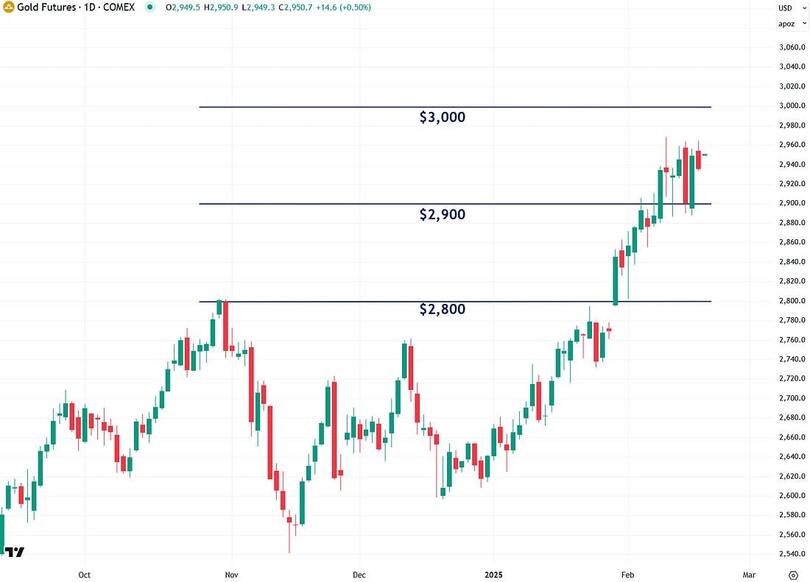
Starting with the basics, as I’ve mentioned before, I closely watch $100 increments in COMEX gold futures because they often act as key support and resistance levels. For example, $2,800 marked the peak in late October, and once gold broke above it about a month ago, it signaled a strong bullish breakout.
Tracking these key levels isn’t voodoo or pseudoscience—it has a solid logical basis. These price points hold significant psychological value, with investors closely watching them and placing stop and limit orders around them more than at other random levels.
Additionally, they often align with strike prices in the options market that see the highest activity. The combination of these factors is why these $100 increments frequently serve as important floors and ceilings in gold.
As you can see from the chart below, gold has broken above both $2,800 and $2,900—an encouraging sign. Last week, gold tested the $2,900 support multiple times, including during Friday’s sharp pullback, and each time, it rebounded quickly.
This kind of resilience is a strong indicator of gold’s underlying strength.
Right now, I want to see $2,900 hold as support, with the next key hurdle being gold’s push toward—and eventual breakthrough of—$3,000, a level of major psychological significance and strong resistance.
There’s a high probability this will happen because round numbers like $3,000 tend to act as price magnets, drawing asset prices toward them.
If gold can close convincingly above $3,000, we enter serious ‘blue sky’ territory, where there’s no significant resistance overhead. That’s when I believe we’ll see a parabolic surge—one far more aggressive than anything we’ve witnessed so far. I’m talking about massive $100 up days as momentum accelerates.
An interesting and encouraging development in gold over the past week is the formation of a potential bull flag pattern—a continuation pattern that signals further gains upon a confirmed breakout.
However, for this to be valid, gold must break out to the upside with strong volume. I take a rather-than-predictive approach in these scenarios, waiting for confirmation before making conclusions.
If this pattern successfully plays out, it would provide the momentum gold needs to slice through $3,000.
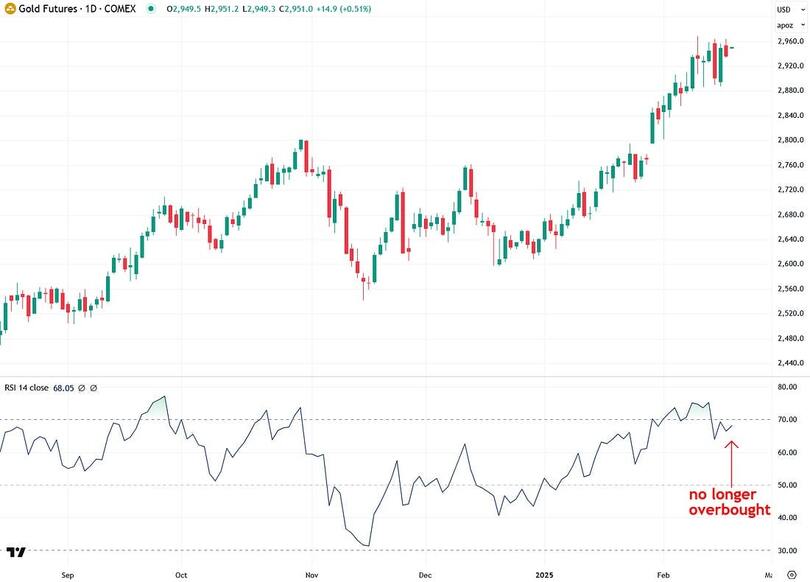
After gold’s sharp rally since the start of the year, it became overbought according to the widely followed Relative Strength Index (RSI), a key momentum indicator. While this is typical behavior in bull markets and a sign of strength, it often signals a period of consolidation to ease the overbought condition.
Fortunately, the recent pause over the past week has helped moderate this extreme, which is a positive sign. Gold may need a bit more time to consolidate further and cool off before making its next push toward $3,000+.
Gold miners are gaining momentum, though not as quickly as gold itself. That’s perfectly fine. I remain highly optimistic about them, but it may take gold surpassing $3,000 for sentiment to truly ignite.
It’s also important to recognize that gold’s bull market has been largely fueled by Asian central banks and investors, while Western investors have yet to join in. Instead, they’ve been preoccupied with chasing ‘Fartcoin’ and Dot-com Bubble 2.0 stocks—assets that are destined to implode.
Most gold mining stocks and ETFs trade on Western exchanges, meaning their lackluster performance so far is simply a reflection of Western investors’ disinterest in gold. However, I expect that to change very soon.
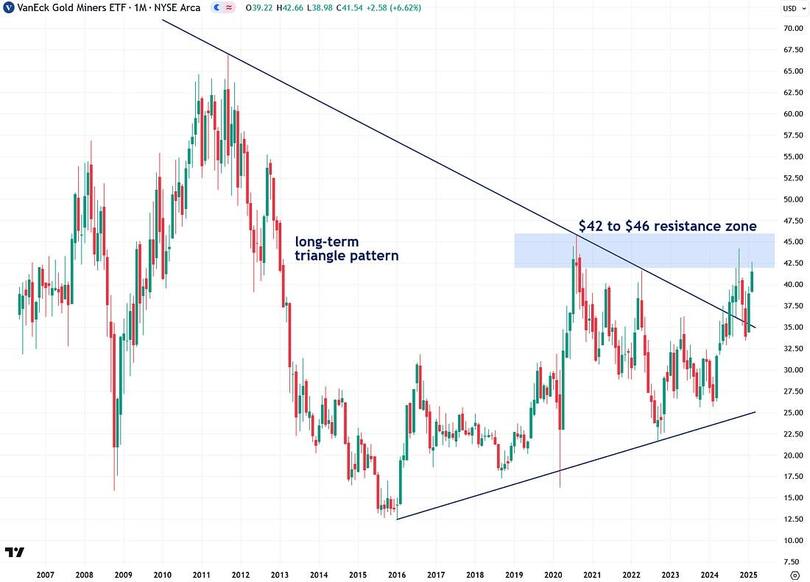
The large-cap VanEck Gold Miners ETF (GDX) broke out of a long-term triangle pattern about a year ago—a strong signal that a major bull market is underway. Now, for this rally to gain real momentum, GDX needs to decisively close above the key $42 to $46 resistance zone overhead.
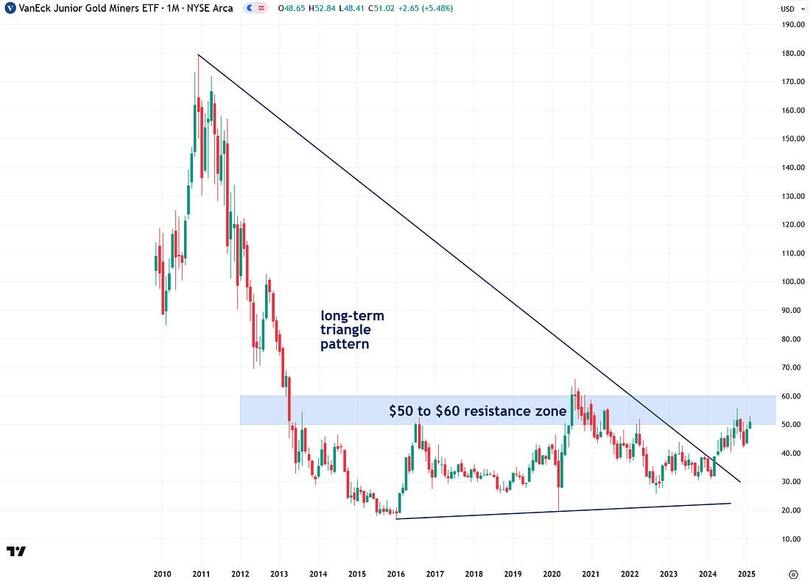
For full confirmation, I’m now watching for a decisive close above the key $50–$60 resistance zone, which would solidify the bullish trend and open the door for much further upside.
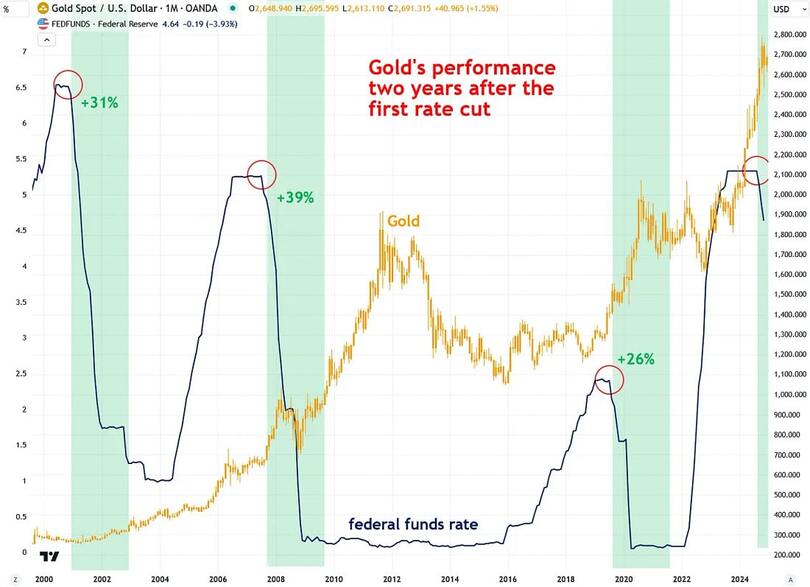
One of the many signs that gold’s bull market still has plenty of upside is its historical performance following the first Fed funds rate cut in a rate-cutting cycle.
If gold follows the pattern of the last three cycles, it suggests a climb from $2,940 (at the time of writing) to around $3,380.
Another key reason gold’s bull market is still in its infancy is the massive bubble in the U.S. stock market, which will end in a significant bear market. This downturn will lead to a substantial transfer of capital from stocks into gold.
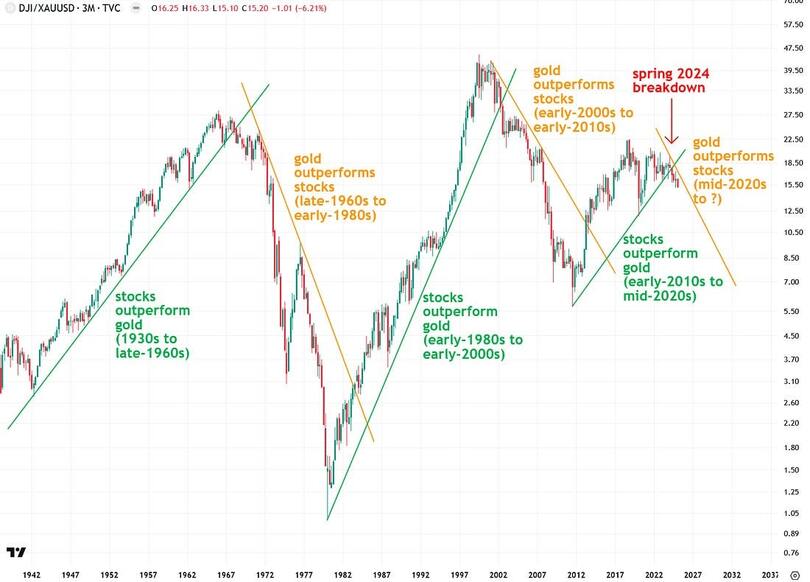
Notably, the Dow-to-Gold ratio broke below its uptrend line in the spring of 2024, signaling that the rotation of capital from stocks to gold has already begun. This shift will gain momentum as the stock market bubble inevitably bursts.
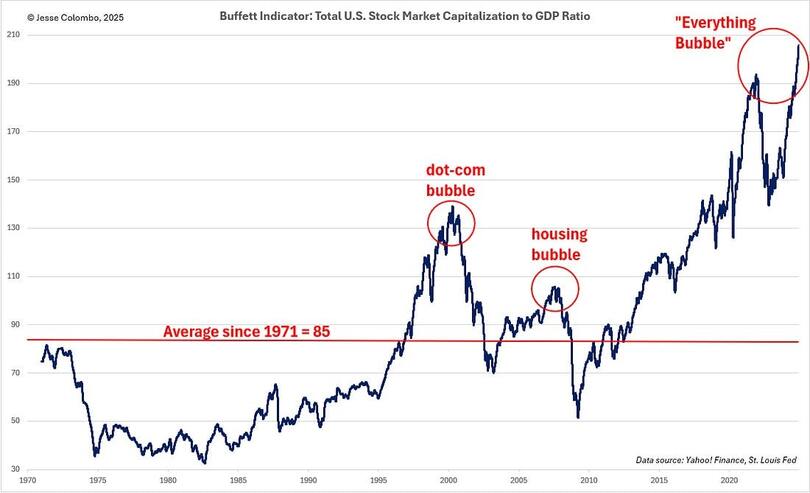
Gold still has an enormous amount of fuel left to propel it to $5,000, $10,000, or even $15,000 and beyond. One key factor is that the U.S. is currently experiencing the largest stock market bubble in history by several measures—including the total U.S. stock market capitalization-to-GDP ratio.
This metric, often called the ‘Buffett Indicator,’ has been described by Warren Buffett himself as ‘the best single measure of where valuations stand at any given moment.’ With the equity market stretched to extreme valuations, gold’s upside potential remains massive.
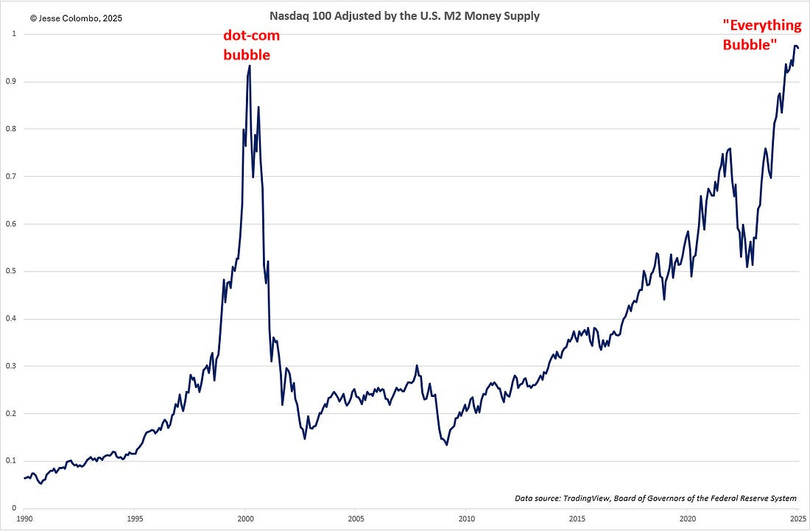
If the Buffett Indicator isn’t enough to convince you, consider the Nasdaq 100 adjusted for the U.S. M2 money supply.
This metric reveals that we’re in a bubble even worse than the late 1990s dot-com bubble, which ended in disaster. While that’s a terrifying prospect for tech stock investors, it’s fantastic news for precious metals investors.
In summary, gold remains in a strong technical position, and I’m watching for it to break out of its recent bull flag pattern and make a run for $3,000. A decisive close above this level would confirm the breakout and likely propel gold’s bull market into a much more powerful phase.
Beyond the technicals, gold still has plenty of room to run, fueled by the looming burst of the U.S. stock market bubble. When that happens, we can expect a significant capital rotation from equities into gold, silver, and mining stocks.
This is an incredibly exciting space to be in, so buckle up and enjoy the ride!
Jesse Colombo is a financial analyst and investor writing on macro-economics and precious metals markets. Recognized by The Times of London, he has built a reputation for warning about economic bubbles and future financial crises. An advocate for free markets and sound money, Colombo was also named one of LinkedIn’s Top Voices in Economy & Finance. His Substack can be accessed here.
(Mike Maharrey, Money Metals News Service) Gold demand in China continued to show signs of growth last month despite the relentless climb in prices.
China ranks as the world’s largest gold market.
As Jesse Colombo reported, aggressive Chinese futures traders on the Shanghai Futures Exchange (SHFE) helped drive last year’s gold bull run, even as Western investors remained largely on the sidelines. Now it appears they are stepping up to the plate again.
“Fresh off the week-long Chinese Lunar New Year holiday, these traders are reentering the market—just as gold was already heating up without them.”
Part of the reason gold was heating up in January was improved physical demand in China, even as prices continued to push to record highs.
The price of gold climbed by about 5 percent in January in yuan terms. This compares to an 8 percent increase in dollar terms. A strengthening yuan along with fewer trading days due to the Chinese New Year accounts for gold’s relative underperformance in yuan terms.
Even with surging prices, wholesale gold demand rose by about 3 percent month-on-month in January. The Shanghai Gold Exchange shipped out 125 tons of gold. According to the World Gold Council, seasonal stock replenishment from jewelry retailers, banks, and other market participants ahead of the Chinese New Year drove the increase in wholesale demand.
Even with the improvement, wholesale demand remains below levels seen in past years as the higher price continues to put a drag on jewelry demand.
World Gold Council surveys in the hub of China’s gold wholesaling and manufacturing region found a “weaker-than-usual sentiment” among gold jewelry retailers.
“With the gold price soaring and the past year’s demand picture reminding them of potential sustained weaknesses, gold jewelry retailers lowered their expectations for the holiday sales and stocked up less than previous years.”
On the other hand, surging prices, along with gold purchase announcements by the Chinese central bank and yuan volatility, have driven investor interest in gold. World Gold Council analyst Ray Jia pointed out that online searches for gold topped their previous peak seen in 2013 when gold demand in China surged to the highest in history.
“Our conversations with market participants indicate that gold bar sales maintained their stunning pace seen in 2024, even leading to inventory shortages for some.”
Jia said he anticipates “continued strength in bar and coin demand while the soaring gold price may weigh on gold jewelry sales in tonnage terms – although consumer spending may not change much.”
Chinese gold ETFs reported outflows of 4.7 tons of gold in January. Jia said this was likely due to profit-taking ahead of the Chinese New Year holiday to avoid additional volatility from international markets while the local market was closed, and investor sentiment toward gold remains largely positive.
Chinese gold import data lags by a month. Based on the most recent Chinese customs data, the country imported 84 tons of gold in December. That pushed the yearly total to 1,225 tons, a 14 percent year-on-year decline. However, Q4 imports were up 160 percent quarter-on-quarter.
Jia said he thinks the recent positive trend in the gold market will continue.
“In tonnage terms, demand for gold jewelry may stay tepid – although value-preserving motives will provide some support – but bar and coin sales should remain hot – and any gold price adjustment could be viewed as a good opportunity to enter.”
Mike Maharrey is a journalist and market analyst for MoneyMetals.com with over a decade of experience in precious metals. He holds a BS in accounting from the University of Kentucky and a BA in journalism from the University of South Florida.
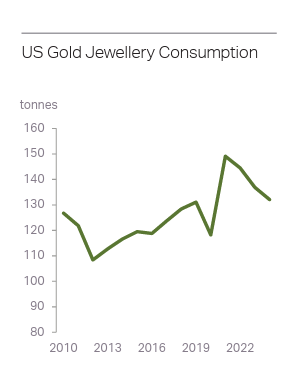
One might expect these higher prices to put a drag on demand for gold jewelry, but surprisingly, the impact has been minimal, at least so far in the United States.
Metals Focus surveyed gold jewelry demand in the U.S. and found it has “held up better than expected” given the high price of gold.
The U.S. is the third-largest gold jewelry market in the world, behind China and India. It also tends to be the most price-sensitive. But despite the rising price of gold, jewelry demand only fell by about 4 percent in weight terms in the fourth quarter of 2024.
In value terms, gold jewelry demand set a record of $4 billion in Q4, according to the World Gold Council.
Metals Focus pinpointed several factors that sustained gold jewelry demand.
A still robust jobs market.
The ‘need’ to buy for Christmas, even with strained household budgets.
For much of Q4, the presidential election was out of the way
Analysts also believe there was some level of “acceptance” of higher prices.
Additionally, Metals focus found there was little structural change in the U.S. gold jewelry market. For example, there was almost no movement from the dominant 14-carat jewelry to less expensive 10-carat pieces.
However, Metals Focus analysts said there was a lag in sales in heavier pieces, a move from solid to hollow chains, and an element of “light-weighting” across all product categories.
“That said, chunky designs are popular from a fashion perspective, and the trend for ring stacking remains strong.”
You might expect the rapidly rising price of gold to drive a shift toward silver jewelry. However, Metals Focus researchers said their contacts rarely noted this trend.
Many analysts view the silver jewelry market as “distinct” from the gold jewelry market, “with pieces often bought by different consumers (often younger) for different reasons (typically more closely tied to fashion).”
Silver jewelry consumption in the U.S. dipped about the same as gold – by around 4 percent in weight terms.
Last year also saw a continuation of the swing from generic to higher-margin branded silver.
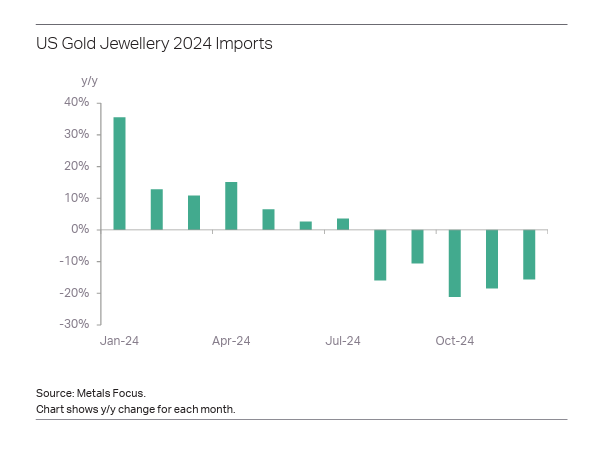
The relatively resilient gold jewelry demand was not reflected in imports, which fell throughout 2024.
“Even if retail stocks in general were not seen as too low, those areas of the supply pipeline covered by imports do appear to have reacted to the price. It will, therefore, be interesting to see if early 2025 enjoys a bounce back for imports.”
Silver jewelry imports also charted a steep drop of around 18 percent. However, the value of imports rose by 6 percent.
Looking ahead, Metals Focus researchers said they were “cautious” about jewelry demand through the rest of 2025.
“Even if we do see engagement numbers recover, the industry will still have to manage a growing share of pieces being ticketed at yet higher prices, and political uncertainties have scarcely eased. As such, the full year could end up 13 percent down on the 2021 peak and even dip below 2019 levels.”
Mike Maharrey is a journalist and market analyst for MoneyMetals.com with over a decade of experience in precious metals. He holds a BS in accounting from the University of Kentucky and a BA in journalism from the University of South Florida.
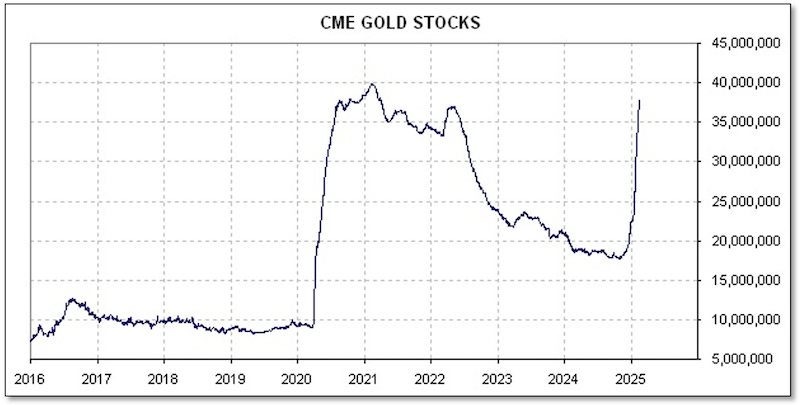
Those mysterious flows, generally blamed on concerns over potential U.S. tariffs on gold and silver, have combined with other factors to indicate that something much deeper and more compelling is happening.
The following two charts, courtesy of our friend Nick Laird at his highly recommended GoldChartsRUs site, paint a remarkable picture. The first chart shows how gold from around the world, and primarily from London, is flooding into the New York vaults of Comex:
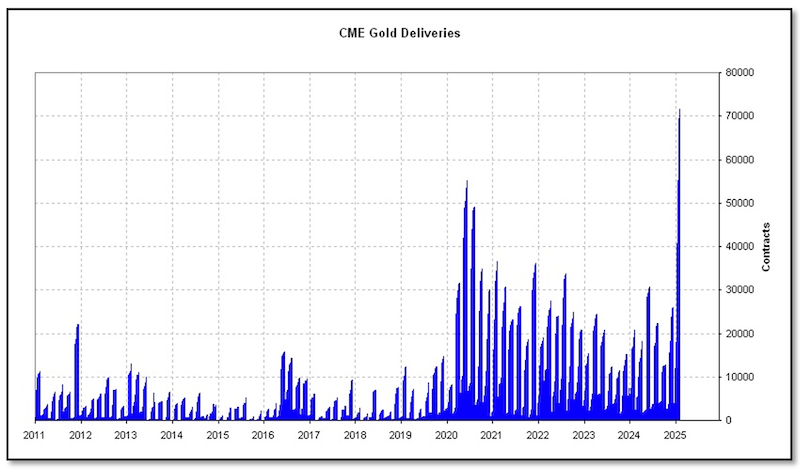
The second chart shows that this gold is immediately being pulled out of those vaults through a stunning surge in physical deliveries:
Now, the flow of gold from the London Bullion Market Association vaults into Comex could be explained away by the threat of tariffs… but that doesn’t explain the coincident surge of deliveries — physical demand — from Comex.
Or the tremendous levels of gold demand now being seen from central banks, institutions, and individuals around the world.
Again, these moves smell of desperation… and they have helped propel gold to record price levels in a historic new bull market.
That leaves us to wonder whether these developments are a sign that the huge central bank gold sales of the 1990s, which resulted in thousands of tonnes of official reserves being sold and replaced by IOUs, are now being desperately reversed.
Or is it an indication that the fragile paper gold and paper silver fractional reserve schemes are finally cratering under the weight of massive physical demand?
Or both?
More generally, is the shadowy global gold market, long hidden from prying eyes and accountability, now rushing to cover its tracks as the “new sheriff in town” yanks one curtain after another open?
The bottom line is that President Trump and his team have become veritable bulls, rampaging through the establishment’s china shop.
It’s been exciting, entertaining, and occasionally scary. And this is only the beginning.
To get Brien Lundin’s ongoing commentary on the markets at no charge, click here to subscribe to his free Golden Opportunities newsletter.
Brien Lundin is the publisher and editor of Gold Newsletter, the publication that has been the cornerstone of precious metals advisories since 1971. Mr. Lundin covers not only resource stocks but also the entire world of investing. He also hosts the annual New Orleans Investment Conference.To get Brien Lundin’s ongoing commentary on the markets at no charge, click here to subscribe to his free Golden Opportunities newsletter.
(Money Metals News Service) In the latest episode of the Money Metals Midweek Memo, host Mike Maharrey dives deep into the Federal Reserve’s ever-changing stance on inflation, the reality behind rising consumer prices, and a seemingly unrelated yet important development—the end of the U.S. penny.
Through sharp analysis and historical comparisons, Maharrey explains why the government’s monetary policy continues to erode the value of the dollar while reinforcing the importance of holding physical gold and silver.
Inflation: The “Transitory” Illusion
Maharrey opens with a reference to Monty Python’s famous Dead Parrot sketch, drawing a humorous but telling analogy between the Federal Reserve’s handling of inflation and the pet shop owner’s refusal to admit the bird was dead.
He points out how, back in 2022, Fed Chair Jerome Powell and other officials insisted that inflation was “transitory.” However, as consumer prices surged beyond expectations, the Fed was forced to change its narrative. By mid-2023, officials hinted that inflation had been “beaten,” and markets reacted with optimism.
Yet, Maharrey reminds listeners that he repeatedly warned against this overly optimistic view, arguing that the Fed never did enough to fully suppress inflation. As recent CPI (Consumer Price Index) data now shows, inflation remains persistently high, proving the so-called victory over rising prices was, in itself, transitory.
Breaking Down the CPI: Rising Prices Are Hard to Ignore
Reviewing the latest inflation data, Maharrey highlights several key figures from the December 2024 and January 2025 CPI reports:
The steady rise in CPI over the past few months challenges the notion that inflation is under control. Notably, core CPI (which excludes volatile food and energy prices) surged 0.4% in January, pushing the annual core CPI to 3.3%—a level that has remained stubbornly high since mid-2024.
Despite these figures, Maharrey emphasizes that the official CPI underreports true inflation. If the government used the methodology from the 1970s, current inflation would be closer to 6% or higher, meaning the cost of living is rising much faster than reported.
The Fed’s Dilemma: Raise Rates or Cut Them?
With inflation running hotter than expected, the Federal Reserve faces a difficult choice:
So far, the Fed has taken a middle-ground approach, pausing rate hikes but delaying anticipated cuts. Markets had initially expected rate reductions by March 2025, but the latest CPI report has pushed that expectation to at least September.
Maharrey warns that while inflation data suggests rates should rise, the economy remains addicted to artificially low interest rates. Ultimately, he predicts that when financial markets start to crack under pressure, the Fed will revert to its old playbook—cutting rates and injecting liquidity through quantitative easing (QE), leading to even more inflation.
The Death of the Penny: A Symbol of a Worthless Dollar
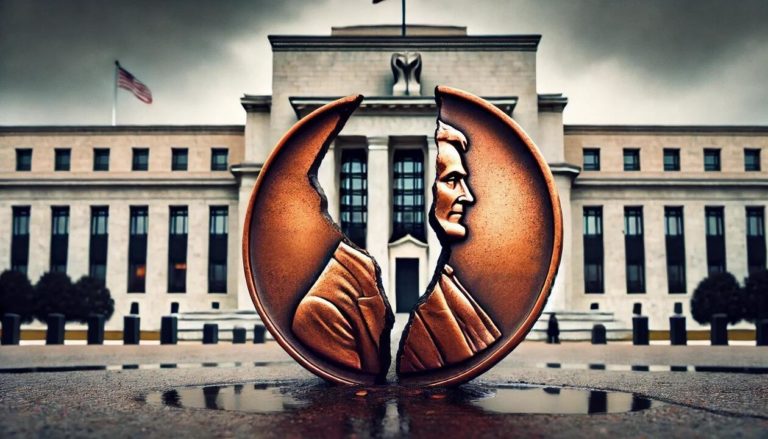
In a move that might seem trivial on the surface, former President Donald Trump recently announced the end of the U.S. penny, citing the excessive cost of minting it. According to the U.S. Mint, each penny now costs 3.69 cents to produce, resulting in an annual loss of over $85 million in 2024.
The real issue, Maharrey argues, is not the penny itself but what it represents. The declining value of small-denomination coins is a direct reflection of how inflation has eroded the purchasing power of the U.S. dollar. He recalls a time when a single penny could buy multiple gumballs, while today, even a quarter barely covers the cost.
The U.S. government has already taken similar steps in the past to devalue its currency:
With inflation continuously eating away at the dollar’s value, Maharrey predicts that other small coins, like the nickel, may soon disappear as well.
The Solution: Gold and Silver as Sound Money
Maharrey closes the episode with a clear message: The best hedge against inflation and monetary devaluation is physical gold and silver.Unlike fiat currency, which loses value over time, precious metals maintain purchasing power.
He points out that pre-1965 silver quarters (commonly referred to as junk silver quarters), once worth only 25 cents, now carry a real value 23 times their face value due to their silver content. With analysts predicting gold could surpass $3,000 per ounce in 2025, now is the time to secure real money before the next inflation-driven crisis unfolds.
For those interested in buying gold and silver, he directs listeners to Money Metals Exchange, where they can purchase online or speak with a precious metals specialist at 1-800-800-1865.
Final Thoughts
The latest Money Metals Midweek Memo highlights a sobering reality: inflation is far from under control, and the Federal Reserve’s actions suggest deeper economic problems ahead. Meanwhile, the government’s decision to eliminate the penny is yet another sign of the dollar’s ongoing devaluation.
As Maharrey warns, the best way to protect wealth is to own real assets—gold and silver—before the next financial storm hits.
(Ken Silva, Headline USA) Billionaire Elon Musk called out Ukrainian President Volodymyr Zelenskyy on Wednesday for killing an American journalist who criticized his regime last year.
“Zelensky killed an American journalist!” Musk said on Twitter/X, referring to Gonzalo Lira, a U.S. reporter who died in a Ukrainian prison last January after nearly eight months of imprisonment.
While Zelenskyy may not have been directly involved in Lira’s death, Musk is almost certainly correct about Lira having died due to his criticism of that regime.
Before his arrest and subsequent murder, Lira had been living in Ukraine for several years. He became prominent following Russia’s invasion of Ukraine in February 2022, when he began blogging about the war.
His harsh criticisms of the Ukrainian regime and analysis that Russia was winning the war made him a marked man.
Tucker Carlson, who covered the Lira story, released a statement on the tragic death.
“Gonzalo Lira, Sr. says his son has died at 55 in a Ukrainian prison, where he was being held for the crime of criticizing the Zelensky and Biden governments,” Carlson said.
The notion that Ukraine’s government killed Lira is not a right-wing conspiracy theory.
Independent reporter Alex Rubinstein said last year that he received a note from Lira’s father, who blamed Joe Biden and Zelenskyy for his son’s death.
“I cannot accept the way my son has died. He was tortured, extorted, incommunicado for 8 months and 11 days and the US Embassy did nothing to help my son,” Lira’s father said in the note. “The responsibility of this tragedy is the dictator Zelensky with the concurrence of a senile American President, Joe Biden.”
According to Rubenstein, Lira suffered from multiple ailments in prison in the months leading up to his death. Ukrainian authorities allegedly ignored Lira’s illnesses until it was too late.
Reporter Liam Cosgrove, who heroically questioned the State Department about Lira last year, also reported on the tragic death.
Never forget that Gonzalo Lira was a United States citizen, our government knew about it and our State Department allowed him to die.
" I will say in general, that we are aware of the report. We obviously support the exercise of freedom of speech anywhere in the world and I… pic.twitter.com/FH040tKAs4
“My pain is unbearable. The world must know what is going on in Ukraine with that inhuman dictator Zelensky,” Lira’s father told Cosgrove.
“IF YOU BELIEVE IN DEMOCRACY AND DECENCY, MAKE THE WORLD KNOW WHAT THEY HAVE DONE TO A DECENT AND VERY INTELLIGENT MAN WHO PREDICTED THAT UKRAINE WOULD NEVER WIN A WAR AGAINST RUSSIA AND THE FINANCIAL PUNISHMENTS WOULD BACKFIRE ON THE USA.”
Lira’s father also provided files on his son’s case, which can be found here. He said the files show how Biden greenlit his son’s death.
Ken Silva is the editor of Headline USA. Follow him at x.com/jd_cashless.
According to a memo obtained by the Post, Hegseth’s order calls for an 8% cut to the Pentagon budget each year for five years. The Pentagon budget for 2025 is about $850 billion, and an 8% cut for five years would bring it down to roughly $560 billion, a reduction of $290 billion.
Hegseth wants the proposed cuts to be drawn up by February 24, and the memo included a list of 17 categories that would be exempt from the spending cuts.
The Post report said the exemptions include operations at the southern border, modernization of nuclear weapons and missile defense, and acquisition of submarines, one-way attack drones, and other munitions.
The Pentagon has also been targeted by Elon Musk’s Department of Government Efficiency (DOGE). The Washington Postreported on Tuesday that the Trump administration ordered the Pentagon to hand over a list of its probationary employees with the expectation that many may be fired, which came as DOGE workers arrived at the Pentagon.
The news of the plan to cut the Pentagon budget comes after President Trump suggested he wanted a major reduction in US military spending, saying he wanted to cut it in half as part of a deal with Russia and China.
While the Pentagon budget for 2025 is about $850 billion, total US military and national security spending for the year is expected to reach $1.77 trillion, according to veteran defense analyst Winslow Wheeler.
Wheeler’s estimate accounts for military-related spending from other government agencies not funded by the National Defense Authorization Act, such as the Department of Veteran Affairs and Homeland Security. It also includes the national security share of the interest accrued on the US debt and other factors.
(Headline USA) President Donald Trump said Wednesday that he likes the idea of giving some of the savings from Elon Musk’s Department of Government Efficiency back to U.S. citizens as a kind of dividend.
He said at an investment conference in Miami that the administration is considering a concept in which 20% of the savings produced by DOGE’s cost-cutting efforts goes to American citizens and another 20% goes to paying down the national debt.
🚨TRUMP: "We're considering giving 20% of the DOGE savings to American citizens and 20% to paying down the debt. By doing this Americans will be telling us where there is waste, they'll be reporting it themselves. They'll be participating in saving money." pic.twitter.com/R43rQC1Jbb
Trump also said the potential for dividend payments would incentivize people to report wasteful spending.
“They’ll be reporting it themselves,” Trump said. “They participate in the process of saving us money.”
Later, as he flew back to Washington aboard Air Force One, he was asked by a reporter about the plan floated by Musk.
“I love it,” the Republican president told reporters on the plane.
A day earlier, Musk wrote on his social media platform that he “will check with the President” in response to a suggestion that Trump and Musk should announce a ”DOGE Dividend” that would send a $5,000 refund to taxpayers from part of the savings created by DOGE. Its efforts have already led to thousands of federal government employees being fired or laid off.
While some jumped at the idea of receiving a $5,000 check from Trump, others pointed out that the proposal would cost the country some $1.4 trillion—arguing that they’d rather see the savings go towards paying down the national debt.