Mamdani Wants ICE Abolished After Fatal Houston Stop

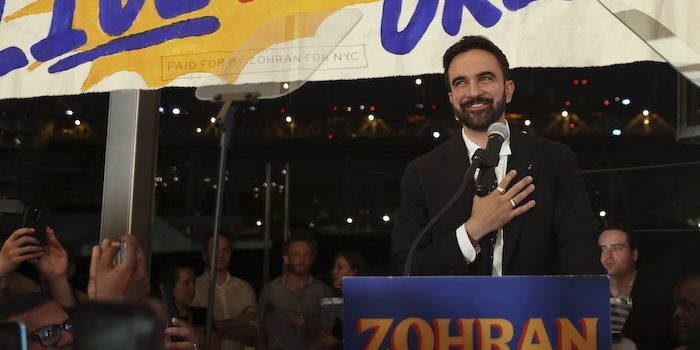
(José Niño, Headline USA) Immigration and Customs Enforcement should cease to exist, New York City Mayor Zohran Mamdani declared Thursday, seizing on a lethal encounter in Texas to press one of the progressive left’s oldest demands, Just the News reported.

An agent shot Lorenzo Salgado Araujo, 52, shortly before 7 a.m. on Tuesday as officers worked what the agency called a targeted enforcement operation in Houston’s East End. Salgado Araujo later died at a hospital. Within two days the mayor of a city 1,600 miles from Canal Street made the case his own, The Hill reported.

“Lorenzo Salgado Araujo called Houston home for 35 years. On Tuesday, an ICE agent shot and killed him. His family learned of his death from a video before anyone bothered to knock on their door,” Mamdani wrote on X/Twitter.

“New York City stands with the Salgado family in demanding a full, independent investigation and real accountability,” he added. “To the Salgado family and any immigrant family in this city living in fear: we grieve with you and we will continue to stand beside you in the pursuit of justice. Abolish ICE.”

The Trump administration describes a wholly different scene. A spokesperson for the agency said that, drawing on “information we are receiving,” Salgado Araujo drove into a federal vehicle, brushed off repeated commands and “weaponized his vehicle in an attempt to run over an ICE law enforcement officer resulting in our officer firing his weapon in self-defense.”

Holes have since opened in that narrative. County pathologists classified the manner of death a homicide and traced it to a gunshot wound of the torso. The Department of Homeland Security later conceded that agents never sought Salgado Araujo at all, explaining that a passenger resembled a wanted Guatemalan man. No agent on scene carried a body camera, a lapse DHS pinned on two government shutdowns. Three men taken into custody that morning told a lawyer the federal version simply did not happen.

Inspectors general, FBI agents in Houston and the Harris County district attorney all launched reviews, while members of Congress echoed the family’s call for scrutiny.

José Niño is the deputy editor of Headline USA. Follow him at x.com/JoseAlNino 

Archaeologists in Greece and Thailand Find Ancient Gold Jewelry

(Mike Maharrey, Money Metals News Service) Archaeologists in Greece have unearthed 3,500-year-old gold jewelry. Meanwhile, scientists in Thailand dug up two gold rings estimated to be 2,000 years old.

Archaeological discoveries like this serve as a reminder of the enduring value and beauty of gold.

Think about it: how many things in your house could you bury today and dig up 3,000 years from now in virtually the same condition as when you buried them?

The Greek Cultural Ministry announced the discovery of more than 30 gold pieces, ranging from disc-shaped amulets to gold beads. Archaeologists made the find during 2025 excavations at Kolona on the Greek island of Aegina. The researchers said the gold was in “remarkable” condition. Scientists think the 32 gold pieces were all part of a single necklace.

Archaeologists found the gold near the remains of a wall surrounding an “inner suburb” of the Middle Bronze Age settlement, and it is likely around 3,500 years old.

It just goes to show how long humans have been enamored with gold. Its beauty, coupled with its scarcity, captivates. There are two of the reasons gold is so valuable.

Jewelry remains one of the most common uses for gold today. Last year, jewelry production consumed 1,542.3 tonnes of the yellow metal.

Apart from its beauty, gold’s physical characteristics make it ideal for jewelry. It is malleable and can be melted over and over again without damaging its fundamental structure. It is also virtually indestructible. It doesn’t tarnish and retains its beauty even after 3,500 years in the ground.

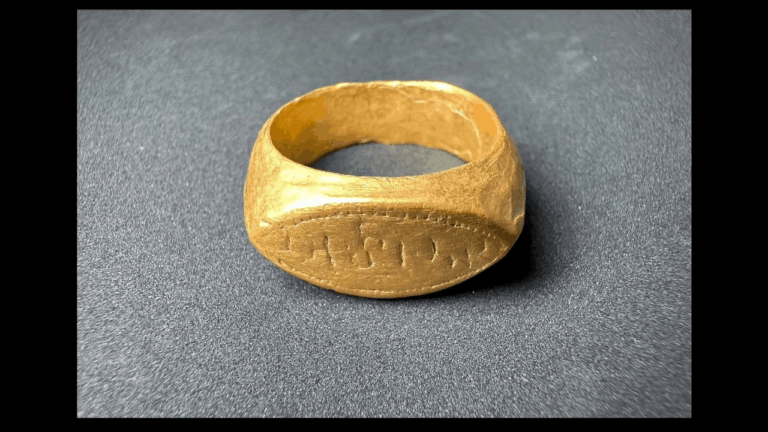
In Thailand, archaeologists found two gold rings, one bearing inscriptions that scientists said seem to reference an auspicious zodiac sign in Indian or Vedic astrology.

Archaeologists found the rings along with human remains at the Don Yai archeological site about 80 miles southwest of Bangkok.

One of the two rings was engraved in Brahmi script. According to Smithsonian Magazine, Brahmi likely derived from Aramaic. Many modern scripts and alphabets in South and Southeast Asia evolved from Brahmi.

According to an Associated Press report, the script reads “pusarakhitasa,” translated to mean “the one protected by Pushya.” A spokesperson for the Thai government’s Fine Arts Department told the AP that Pushya is one of the most auspicious zodiac signs in Indian or Vedic astrology.

It’s almost mind-boggling to think that I could wear a 2,000-year-old gold ring today, and people would think it is just as beautiful as it was then. I could also sell the gold virtually anywhere in the world today. The rings discovered in Thailand and the jewelry dug up in Greece are as valuable today as it was thousands of years ago – even if you don’t factor in the intangible historical value.

Photo courtesy of the Thailand Fine Arts Department


Mike Maharrey is a journalist and market analyst for Money Metals with over a decade of experience in precious metals. He holds a BS in accounting from the University of Kentucky and a BA in journalism from the University of South Florida.

Israel Tells Trump About Another Iranian Conspiracy to Kill Him

(Ken Silva, Headline USA) The Wall Street Journal reported Thursday that Israel briefed the U.S. with purported intelligence about another Iranian plot to assassinate President Donald Trump.

The Journal’s story cited anonymous sources and didn’t provide any details about the purported plot. Trump did appear to reference Iranian threats against him when speaking to reporters Wednesday in Turkey.

“They want to take out the U.S. leader—me,” he said, as reported by the Journal. “I’m on every list. I saw this morning, I’m on every single one of their lists. And so far, I guess I’ve been a little bit lucky, but that maybe doesn’t last very long.”

Officials have yet to provide any evidence of a credible Iranian assassination attempt against Trump.

There were two assassination attempts against Trump in 2024. One occurred on July 13, 2024, in Butler, Pennsylvania, when 20-year-old Thomas Crooks allegedly shot him in the ear from a rooftop during a campaign rally. The other occurred about two months later at Trump’s Palm Beach golf course, where North Carolina man Ryan Routh was spotted by Secret Service hiding in the bushes with an SKS-style rifle a mere few hundred yards away from Trump.

Additionally, a gunman tried storming the White House Correspondents’ Dinner event earlier this year in an apparent attempt to kill Trump and other officials. Trump was on a separate floor from the alleged gunman, Cole Allen, when law enforcement apprehended him.

There’s no evidence that any of those attempt were sponsored by Iran.

The FBI did arrest a Pakistani national named Asif Merchant on July 12, 2024—the day before Trump was shot—for murder-for-hire in an alleged plot to assassinate U.S. officials, including possibly Trump.

However, Merchant’s actions can hardly be called an assassination attempt. Rather, the available evidence suggests that Merchant was the target of a highly controlled FBI sting operation, and that he never posed a threat to Trump.

Indeed, the U.S. was monitoring Merchant before he even entered the U.S. in April 2024, and officials let him into the country to track him and see where he’d go.

Moreover, an FBI informant drove Merchant around while he was here, and introduced him to two undercover agents posing as “hitmen.” Merchant allegedly paid those two agents $5,000 as a downpayment for his plot—which also included staging a protest and stealing documents—and he was arrested as he was attempting to leave the country.

Merchant was found guilty in March.

The FBI did accuse one other man of being involved in an Iranian plot against Trump in a criminal complaint filed in November 2024. In that case, there’s arguably even less evidence of a credible threat to Trump.

Indeed, the defendants in that case—Farhad Shakeri, 51, of Iran; Carlisle Rivera, also known as Pop, 49, of Brooklyn, New York; and Jonathon Loadholt, 36, of Staten Island, New York—were not accused of conspiring to kill any politicians, let alone Trump. Rather, they were charged with plotting to kill a U.S. journalist of Iranian origin.

While Shakeri is one of the defendants, the government’s criminal complaint shows that he appears to have been snitching to the FBI in recent months. According to the charging papers, Shakeri participated in phone interviews with the FBI from Iran on September 30, October 8, October 17, October 28 and November 7—ostensibly trading information in exchange for a sentence reduction for an unidentified individual.

In one of those interviews, Shakeri—who was deported from the United States in 2008 after serving fourteen years in prison for robbery—told the FBI that an Iranian Revolutionary Guard Corps official was pushing him to assassinate Trump.

Shakeri further told the FBI that the IRGC official told him on October 7 that he had to provide a plan to kill Trump within seven days. Shakeri said he was unable to do so, and so Iran decided to pause its plans to kill Trump until after the election—which would have made it easier to kill him if he lost.

The FBI admitted in the charging papers that Shakeri is a liar, but said his claims about Trump “appear to be truthful.” Nevertheless, when the Justice Department secured indictments in the case a month after the criminal complaint was filed, there was no mention of the allegation against Trump.

Loadholt and Rivera both pled guilty to conspiring against the journalist, while Shakeri remains at-large in Iran.

Ken Silva is the editor of Headline USA. Follow him at x.com/jd_cashless.

‘Mysterious’ Airstrikes Target Iran

(Headline USAA series of mysterious, unclaimed airstrikes that hit Iran after the U.S. said it finished its attacks have again raised questions of who else may be targeting the Islamic Republic.

The strikes Thursday, just as Iran prepared to bury the late Supreme Leader Ayatollah Ali Khamenei, hit areas across southern Iran. The country’s theocracy hasn’t directly blamed anyone for the strikes, though one lawmaker issued a warning to the United Arab Emirates over allegedly providing support to the United States in its campaign against Iran.

Gulf Arab states, which repeatedly have been targeted by Iran since the war began Feb. 28, did not immediately respond to requests for comment Friday over the strikes. The attacks come as they and the U.S. insist the Strait of Hormuz must be open and free to ships to transit. Iran insists the strait, through which about a fifth of all oil and natural gas passes, must now be under its sole control and that vessels should begin to pay fees to Tehran — even though the world for decades has considered it an international waterway.

Iran’s grip on the strait during the conflict led to a global energy crisis, though oil prices have sharply dropped since wartime highs of $120 a barrel.

Israel, which took part in the Iran war, also has not claimed any recent attacks on Iran.

Unclaimed strikes came after US ended its attacks

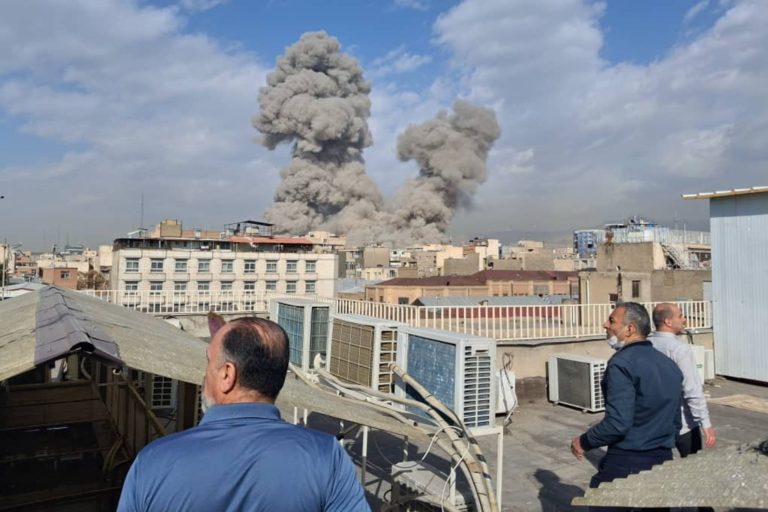
The U.S. military’s Central Command said Thursday around 6:30 a.m. local Iran time that it had concluded a round of strikes that saw some 90 targets hit. Shortly after that, Iranian news outlets and state media reported a series of airstrikes and explosions targeting the country’s Bushehr and Sistan and Baluchestan provinces, the cities of Ahvaz and Chabahar and other areas.

Central Command did not respond to a request for comment over the additional strikes.

Iran responded to the strikes Thursday by launching a wider volley of attacks across the Mideast, targeting Bahrain, Jordan, Kuwait and Qatar. Missile alert sirens sounded in the four countries, sending people to seek shelter. One person was reportedly hurt in Kuwait as air defense systems targeted the incoming fire across the region.

The leader of the UAE, Sheikh Mohammed bin Zayed Al Nahyan, traveled to Kuwait immediately after the Iranian attack for a meeting with the small, oil-rich nation’s ruling emir. Gulf Arab countries also held calls with Qatar’s foreign minister, who has been deeply involved along with Pakistan in mediating talks between Iran and the U.S. over the interim deal now in place to halt the return of open warfare.

During the Iran war, officials say both Saudi Arabia and the UAE launched airstrikes targeting Iran, after Tehran struck energy sites in their countries.

Israel, which under Prime Minister Benjamin Netanyahu has engaged in an intense campaign against Iran, has not attacked the Islamic Republic since June. Israel also broadly immediately claims its attacks on Iran.

Israel’s government said Netanyahu spoke with Trump on Thursday night, with Trump updating Netanyahu “on American moves in the Gulf.”

Israel Katz, Israel’s defense minister, also renewed threats that his nation stood ready to confront Iran if needed.

The Israel military “is on alert and ready to renew the campaign, to reestablish aerial superiority, and to carry out a blue-white (Israeli) strike in Iran to remove threats, even for a third time,” Katz told a military ceremony. “If we will have to return, we will return with even greater force.”

Iran keeps up its threats

On Friday, Iranian state media quoted Esmail Kousari, a member of the Iranian parliament’s national security committee and a former commander in the paramilitary Revolutionary Guard, as warning the UAE would “pay the price for its cooperation with the United States.” He accused the Emirates of having a “behind-the-scenes” role in the recent U.S. attacks.

Iran repeatedly accused Gulf Arab states of actively supporting the U.S. war effort, something they denied during the war. The U.S. since the 1991 Gulf War has maintained a broad footprint of military bases across the Gulf Arab states, including in Bahrain, which is home to the U.S. Navy’s 5th Fleet headquarters.

Meanwhile, Iran insists it must be the sole controller of the Strait of Hormuz. But the U.S. is continuing to urge mariners to travel on a southern route through Oman’s territorial waters to avoid Iran.

The Joint Maritime Information Center, a multinational body overseen by the U.S. Navy, issued a new advisory Friday urging ships to travel that route. A similar message for ships to use that route sparked an Iranian attack on Tuesday that saw three vessels hit.

“Notwithstanding recent unprovoked attacks on merchant vessels, mariners are reminded that the southern route of the (strait) has been expanded and remains available for all traffic,” the maritime center said.

Adapted from reporting by the Associated Press

Alleged Charlie Kirk Killer’s Roommate ‘Wishes He Hadn’t Done It”

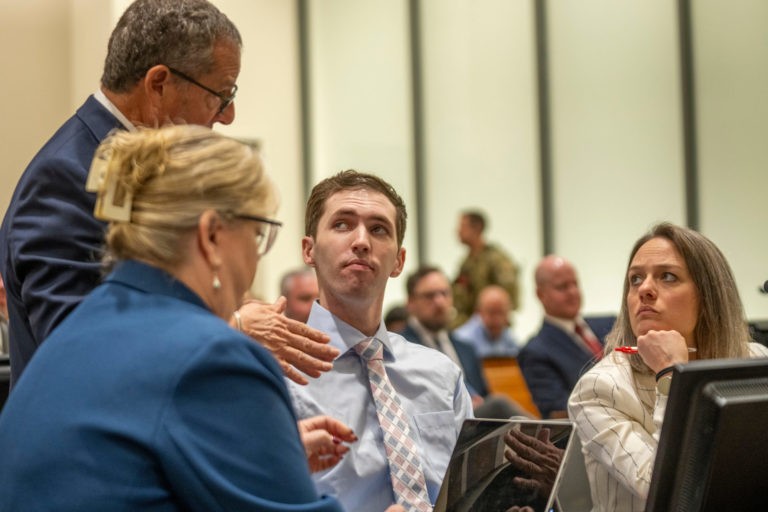
(Headline USAThe defendant in Charlie Kirk’s killing told his roommate “he wishes he hadn’t done it” the day after the conservative activist was shot in the neck while speaking at Utah Valley University, a recording played in court revealed Thursday.

Lance Twiggs, who was also defendant Tyler Robinson’s romantic partner, said in an interview with law enforcement that the teary interaction with Robinson happened in their apartment in southern Utah, more than 200 miles from where Kirk was shot.

Later that same day — and only about an hour before turning himself in — Robinson posted “it was me at UVU yesterday,” in a chat room on the Discord instant messaging platform, according to investigators and messages shown by prosecutors.

Robinson is charged with aggravated murder and has not entered a plea. He turned himself in a day after the Sept. 10 shooting of Kirk, a close ally of President Donald Trump credited with helping galvanize young voters for the Republican in the 2024 election.

Ammunition found in the gun used to kill Kirk had engravings that included “Hey Facist! CATCH!” and “If you Read This, You Are GAY,” according to prosecutors, who are seeking the death penalty.

Robinson appeared to furrow his brow and smirk when text messages he sent to Twiggs about the engraved bullets were displayed in the courtroom Thursday.

Robinson’s family sat behind him, and his mom cried as the Discord messages were read aloud. She rubbed the shoulder of one of Robinson’s brothers, who listened with his head bowed.

Defense attorneys unsuccessfully fought the public release of the statements from Twiggs and the chat room messages. They argued prosecutors would characterize the material as a confession, undermining Robinson’s right to a fair trial.

After prolonged debate that included an attorney for Kirk’s family arguing for the material to be publicly released, state District Judge Tony Graf allowed a redacted version of Twiggs’ video interview to be played. Some parts were blacked out, with only audio.

Graf is weighing whether prosecutors have enough evidence to bring Robinson to trial. He won’t rule until after both sides present arguments on Sept. 1.

Notes and text exchanges were shown in court

Robinson’s attorneys have not commented on his guilt or innocence but have sought to get the death penalty taken off the table, so far unsuccessfully.

Defense attorney Michael Burt tried to inject doubt into the prosecution’s case by challenging the reliability of ballistics tests on a bullet fragment recovered from Kirk’s body. Authorities sought to tie the fragment to the suspected murder weapon, but the results were inconclusive.

“Saying anything but inconclusive was inappropriate,” said Samantha Karner with the Bureau of Alcohol, Tobacco, Firearms and Explosives, a federal law enforcement agency.

The defense earlier in the week had questioned the reliability of DNA evidence that investigators said linked Robinson to the scene. Experts say the science behind DNA testing is sound.

Prosecutors allege Robinson confessed in a handwritten note to Twiggs that read: “I had the opportunity to take out Charlie Kirk, and I took it.” The note, shown in full for the first time Thursday, continued, “I wish we could have lived in a world where this did not feel necessary.”

Robinson also allegedly sent a text to Twiggs saying he targeted Kirk because he “had enough of his hatred.”

State Bureau of Investigation Agent Brian Davis recounted the messages exchanged between Twiggs and Robinson under questioning by a prosecutor Thursday. Included were texts from Robinson worrying about leaving fingerprints on a rifle that belonged to his grandfather, which authorities believe he used to shoot Kirk.

Twiggs spoke to authorities on Sept. 12 — two days after Kirk was assassinated while speaking to a crowd of thousands — and again on April 20, Davis said. He was given immunity for the statements, meaning what Twiggs said cannot be used against him in a potential criminal case.

Prosecutors contend the shooting endangered others at Kirk’s campus event — an aggravating circumstance that could make the crime punishable by death under Utah law. Robinson also faces possible sentence enhancements based on claims by prosecutors that he targeted Kirk because of his political views.

Twiggs said in the April interview that Robinson sometimes talked about politics, including Trump. But Twiggs said he never heard Robinson talk about Kirk before the shooting. The defendant also did not talk much about LGBTQ rights, Twiggs testified.

Kirk’s friends react to new evidence

Kirk’s parents and widow, Erika, sat a few rows back from Robinson’s family on Thursday. U.S. Sen. Mike Lee, a Utah Republican, also was in attendance.

Brandon Tatum, a conservative media personality and close friend of Kirk, said he was “shocked at how much relevant evidence” Twiggs’ shared in his interview. He left court Thursday feeling confident about prosecutors’ case but had mixed feelings about the judge’s decision to hold off ruling until after a September hearing.

“I think the family’s waited long enough, but I’d rather it be done right and done in confidence than for it to be hastily done the next day without being thoroughly, I guess, bulletproof,” Tatum said.

Another conservative activist, Jack Posobiec, said he got emotional seeing photos of the bullet fragments that hit his friend. “But you have to push through that pain and push through all of that to be able to get justice,” he said.

Investigators say Robinson went to a rooftop near where Kirk was speaking and shot him once in the neck while the activist was taking questions from a crowd of several thousand people. Kirk, 31, was declared dead after being taken to a hospital.

Adapted from reporting by the Associated Press

Sen. Grassley Says Jack Smith’s Team Mishandled Classified Material

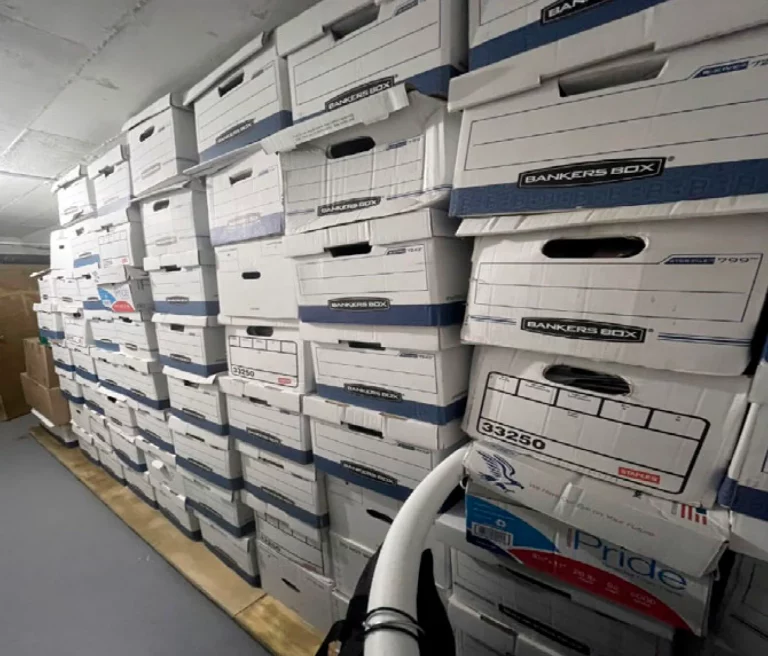
(Luis CornelioHeadline USA) Federal officials who investigated President Donald Trump in the Mar-a-Lago classified documents case may have themselves mishandled classified material, according to newly released documents.

The alleged mishandling by officials within the Biden-era DOJ and the office of Special Counsel Jack Smith suggests “hypocritical” and “careless behavior,” according to Senate Judiciary Committee Chairman Chuck Grassley.

Grassley revealed the allegations in a Wednesday press release after obtaining documents from the Trump administration’s DOJ.

In the release reviewed by Headline USA, Grassley said internal Biden-era documents indicate that an individual was granted access to classified materials without first confirming they had the required “need to know.”

Another document suggests that the Biden DOJ could not account for the “potential movement” of classified materials housed inside a Sensitive Compartmented Information Facility, or SCIF.

Grassley also revealed that the Biden DOJ left a SCIF unsecured overnight and potentially longer.

The Biden DOJ’s alleged mishandling of classified materials is at odds with its aggressive prosecution of Trump over the Mar-a-Lago case.

Through Smith’s office, the Biden administration launched a criminal investigation into Trump after he left office in 2021.

Smith later secured a 40-count indictment against Trump in July 2023, though the case was ultimately dismissed.

In a letter to Acting Attorney General Todd Blanche, Grassley urged the DOJ to investigate the matter further and release more documents.

Grassley said he wants to know whether any classified materials were altered and whether anyone was held accountable for the potential security mishaps.

In a statement, Grassley blasted what he described as “yet another example of double standard of justice.”

“Talk about the pot calling the kettle black,” Grassley said. “According to these messages, Biden DOJ personnel may have committed the very offense for which Jack Smith was prosecuting President Trump.”

Grassley also pointed to Hillary Clinton, the twice-failed presidential candidate, and Joe Biden, the former president, arguing that both escaped “accountability for mishandling highly classified information,” all while prosecutors painted “Trump as a felon.”

“These and other records I’ve made public show the Biden Justice Department was unquestionably careless, not to mention highly hypocritical,” Grassley added.

Sen. McConnell’s Source Anonymously Rebuts ‘Brain Dead’ Rumors

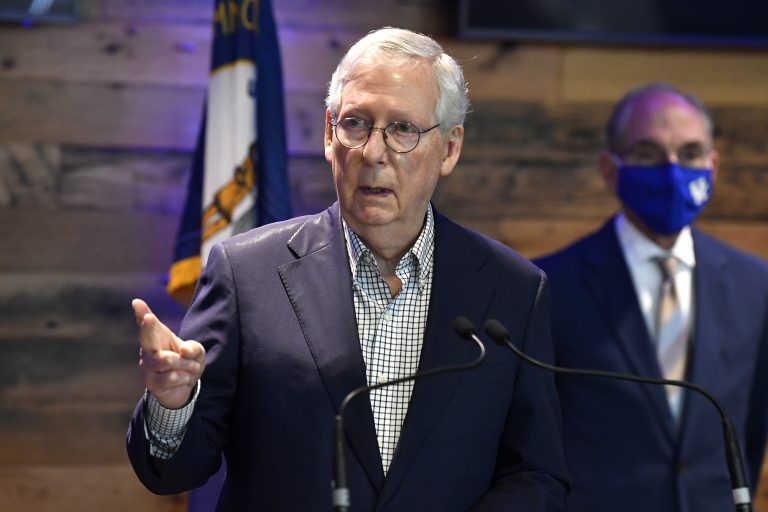
(Luis CornelioHeadline USA) An anonymous source familiar with Sen. Mitch McConnell’s health pushed back Thursday against swirling rumors that the 84-year-old Kentucky lawmaker may be “brain dead.”

The individual, without identifying themselves, told NewsNation that McConnell is “alive” and “not brain dead.”

“With his condition, he needs time to physically recover. But mentally he’s fine. The doctors want to make sure he’s okay,” said the source, described by NewsNation as someone “familiar with the situation.”

The source described McConnell’s return to the Senate next week both as possible but unlikely.

McConnell has been at the center of speculation since last month, when his office revealed that he had been hospitalized beginning June 14.

An EMS dispatch call, revealed by journalist Desirée Townsend, showed that first responders were sent to McConnell’s Washington, D.C., home that morning to attend to an individual who was found unconscious and potentially suffering cardiac arrest. Reports indicate that the individual was McConnell.

Podcast host Laura Loomer claimed earlier this week that a White House source had confided in her that McConnell was “brain dead” and “not coming back.” Townsend echoed Loomer’s claims.

Headline USA could not independently verify the allegations.

McConnell’s office has declined to provide details about the senator’s condition and has instead referred journalists to its June 14 statement on his hospitalization.

Three Republicans — commentator Scott Jennings, Senate Majority Leader John Thune and Senate Majority Whip John Barrasso — have said they spoke with McConnell for approximately 20 minutes after the “brain dead” claims emerged online.

Trump Says He Supports Ukraine’s Long-Range Attacks Inside Russia

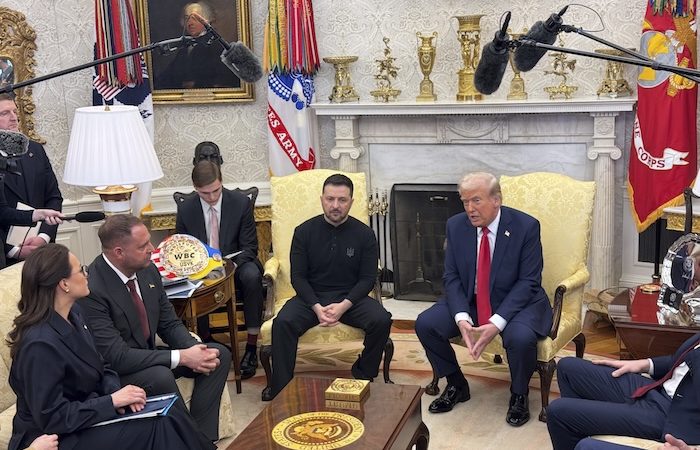
(Dave DeCamp, Antiwar.com) President Donald Trump heaped praise on Ukrainian President Volodymyr Zelensky at the NATO summit in Ankara on Wednesday, expressed support for Ukraine’s long-range attacks inside Russia, and said he would allow Ukraine to produce Patriot missile interceptors.

When asked about Ukraine’s strikes on Russian oil refineries, the president said, “It’s an escalation, but it’s also an escalation that could help lead to an end.”

Ukraine’s long-range drone attacks rely on intelligence provided by the US, and Ukrainian officials told The Financial Times this week that the Ukrainian military was able to strike multiple Russian oil refineries recently because US intelligence has allowed it to find the optimal flight path for its drones to get through Russia’s air defenses.

On top of Ukraine’s success in striking Russian oil refineries, there has also been a significant spike in Russian civilian casualties in Ukraine’s drone attacks. Russian officials have cited the civilian deaths when justifying Russia’s ramped-up bombardments of Ukrainian cities, which have led to an increase in Ukrainian civilian casualties.

Discussing the Patriot missiles, Trump told Zelensky, “We’re going to give a license to you to make Patriot missiles. That’s pretty cool. This way, you can’t complain that we’re not giving them enough. I said, ‘Make them yourself.’ We haven’t informed the company of that yet, but that’ll work out all right.”

Trump’s approval of Ukraine manufacturing Patriots marks another escalation of US support for Ukraine, and Russia will almost certainly attempt to target any Patriot factories that are established on Ukrainian territory.

Overall, Trump spoke very highly of Zelensky, a reversal from the start of his administration when the two clashed during a contentious Oval Office meeting. “We’ve actually developed a good relationship. It’s hard to believe,” Trump said, adding that Zelensky has “done an amazing job” and “been very effective” in the war.

This article originally appeared at Antiwar.com.  

Trump Calls American Military Operation in Iran a ‘Tremendous Military Success’

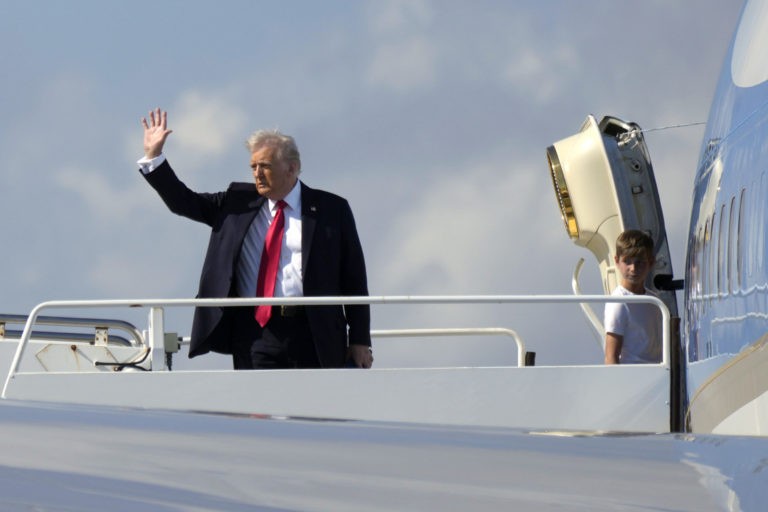
(Morgan Sweeney, The Center Square) President Donald Trump called the American military operation in Iran a “tremendous military success” on Wednesday at a news conference concluding his time at the 2026 NATO Summit.

He also called the conflict a war, though it has yet to be declared a war by Congress.

This week, the president said that the ceasefire with Iran – and the memorandum of understanding that was supposed to be a precursor to a longstanding peace deal between the countries – was over and indicated there would likely be strikes on Iran Wednesday night. Those strikes have begun.

Less than one month ago, the U.S. signed the 14-point agreement establishing conditions for both countries to abide by until a legally binding long-term deal was made. Those conditions included a commitment to halt all fighting for the interim and for Iran to fully reopen the Strait of Hormuz. But Iran attacked three commercial ships this week, saying that the U.S. had violated the conditions of the agreement.

“Now, the United States, despite the explicit provision of the fifth clause of this memorandum – which emphasizes the Islamic Republic of Iran’s responsibility in determining arrangements for the safe passage of ships through the Strait of Hormuz – has challenged this clause,” wrote Iran’s Foreign Ministry spokesperson Esmail Baghaei on X, “and in practice, violated the agreement’s structure through its unilateral actions and also aggressive attacks against Iran.”

The BBC and others have reported that the UN’s International Maritime Organization, the U.S. and its regional allies have been using a shipping route along the coast of Oman that isn’t the route Iran advised.

“The Islamic Republic of Iran will steadfastly pursue the protection of its national interests and the exercise of its sovereignty,” Baghaei added.

When asked about the conflict Wednesday, however, Trump said the U.S. has denuclearized the Islamic Republic and the conflict has changed the country.

“I was there for one reason: that Iran cannot have a nuclear weapon…. And that’s happened. They will never have a nuclear weapon,” Trump said. “That stuff is so far down under a mountain… [it would] take months to get it out.”

He also talked about how the U.S. has “decimated” Iran’s military and the conflict has caused “350% inflation,” up from 5% or 6% at the start of the operation.

“They were the bully of the Middle East, so they’re a much different country now,” he continued.

At an address he gave at the World Economic Forum in January – about one month before the U.S. launched Operation Epic Fury – the president said the U.S. had “wiped out the Iran nuclear threat like nobody can believe,” referencing the June 2025 mission that struck three Iranian nuclear facilities.

Feds Buy Two Immigration Detention Centers for $1.5 Billion

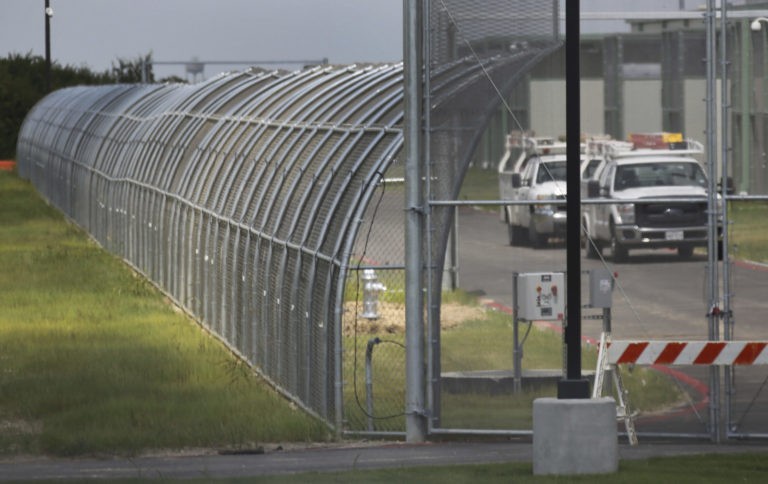
(Chris Woodward, The Center Square) Private prison operator CoreCivic has sold two Southern California immigration detention centers to the federal government for $1.5 billion.

Under the deal, the U.S. Department of Homeland Security takes ownership of the Otay Mesa Detention Center in San Diego County for $739.2 million and the California City Detention Facility in Kern County for $732.6 million. CoreCivic owned and operated the centers, which were used to detain illegal immigrants under contracts with U.S. Immigration and Customs Enforcement.

Now DHS will own the properties. But CoreCivic will continue to run day-to-day operations under its existing contracts with ICE. CoreCivic’s contracts for California City run through 2027. The Otay Mesa contracts are through 2029.

Ryan Gustin, senior director of public affairs at CoreCivic, said both facilities were purpose-built and specifically designed to care for individuals in a secure environment. Gustin added that asset transactions of this nature are not uncommon for government.

“The process was marked with rigor and integrity,” Gustin told The Center Square Wednesday, answering questions by email. “The facility valuations were established through the federal government’s required appraisal process, which is designed to determine objective fair market value.”

For these specialized properties, Gustin said independent appraisers used a transparent cost-based methodology grounded in current replacement cost, depreciation, land value and other market-based factors, with the appraisals then reviewed by the government for compliance with federal standards.

The centers are in two vastly different locations. The Otay Mesa facility is in a San Diego foothills area next to the U.S.-Mexico border. California City is a community of about 15,000 people in the northern Antelope Valley, located 100 miles north of Los Angeles. The community is known for its vast open spaces stretching into the surrounding desert.

Lauren Bis, acting assistant secretary for public affairs and deputy assistant secretary for media relations at DHS, said this purchase was made possible by the One Big Beautiful Bill Act, which allowed ICE to expand detention space to fulfill President Donald Trump’s promise of mass deportations. Unlike in states like Florida and Oklahoma, Bis said ICE cannot rely on local state and county partners for detention space in California.

“The state’s sanctuary politicians continue to push legislation to outlaw or make private prisons financially infeasible,” Bis told The Center Square Wednesday, answering questions by email. “Now, with federal ownership of these detention centers, which are crucial to ICE’s detention network on the West Coast, ICE retains the detention capacity needed to arrest, detain and remove illegal aliens.”

California has passed laws to phase out privately owned detention centers and allow for local or state oversight of private facilities.

One such law is Assembly Bill 32.

Signed in 2019 by Democratic Gov. Gavin Newsom, the legislation prohibited California’s Department of Corrections and Rehabilitation from entering into or renewing contracts with private, for-profit prison operators. The timetable to end such contracts is Jan. 1, 2028.

California has also enacted laws requiring private facilities to be held to specific standards of care. That includes private facilities that operate as federal contractors.

DHS’ decision to purchase the detention centers follows California’s enactment of these laws.

Many individuals and organizations oppose immigrant detention centers for various reasons. National Immigrant Justice Center has raised concerns about inadequate healthcare, while the American Civil Liberties Union has mentioned substandard facilities. Migration Policy Institute has stated that private prison corporations are “profiting from enforcement.”

In a press release regarding the California City facility, the organization known as Freedom for Immigrants called it an “abuse-ridden ICE detention center.” Freedom for Immigrants also warned that the detention center’s operations “pose serious practical challenges for local residents, threatening to impact local water, sewer and road systems.”

Tammy Glenn, director of the communications office at San Diego County, said the county is committed to people’s health and safety, including inmates at the Otay Mesa Detention Center and other local detention facilities.

“We appreciate a recent ruling by a federal judge recognizing San Diego County Public Health’s authority to conduct a health and safety inspection,” Glenn told The Center Square in an email. “The health and environmental inspection was conducted on June 12, 2026, and a report about the inspection is expected to be released to the public soon.”

People on the other side of the argument said these types of detention facilities are necessary.

Ira Mehlman, media director at the Federation for American Immigration Reform, said ICE needs the detention facilities to be able to hold people.

“You can’t detain people if you can’t hold them pending their removal,” Mehlman told the Center Square during a phone interview. “We’ve seen how this plays out in the past where they would make arrests, there would not be sufficient detention facilities. They’d release them and have to go find them again.”

Pointing to the deal between CoreCivic and the federal government, Mehlman said this ensures that they will be able to hold people. It also becomes a “deterrent” for people to come to the United States illegally.

“The best, most humane, most effective form of law enforcement is convincing people not to break the laws in the first place,” said Mehlman.