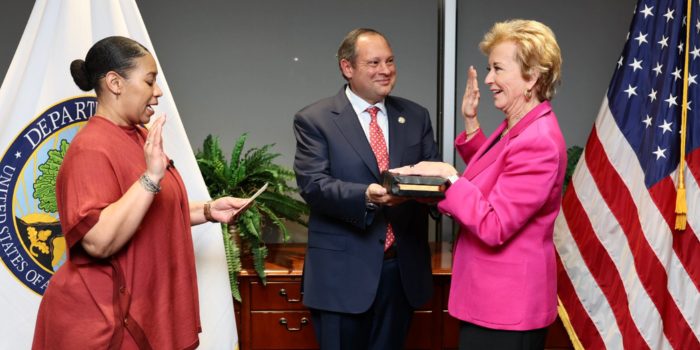
Lawmakers voted 51-45 to approve Linda McMahon, who led the Small Business Administration in Trump’s first term and is a long-time advocate of school choice.
McMahon’s background in education includes her appointment to Connecticut’s State Board of Education in January 2009, where she served 15 months. She also served as a member of the Board of Trustees at Sacred Heart University.
“The Education Department’s bloated bureaucracy has failed to improve the nation’s education system, and likely even made it worse,” U.S. Sen. Bill Cassidy, R-La., said on X. “Ms. McMahon has committed to righting the ship of American education.”
The Department of Education oversees education policy for schools that receive federal funding, enforces Title IX rules, manages FAFSA, and administers Pell Grants and less than 10% of public school funding, among other things.
McMahon’s confirmation comes as Trump is planning to drastically reduce the department’s workforce and potentially dismantle the department entirely, returning education to the state and local level. The Biden administration had come under fire for pushing schools to adopt LGBT and DEI initiatives into their curriculum and policies via the Department of Education.
“School districts and individual schools have different needs, and every student has his or her own needs and aspirations too,” Senate Majority Leader John Thune, R-S.D., told lawmakers Monday. “I’m glad that Linda McMahon plans to work in a way that empowers those closest to the student – because they are in the best position to do what’s right for those individual needs.”
A Marist poll released Monday shows that 63% of U.S. residents either oppose or strongly oppose getting rid of the U.S. Department of Education, while 37% of residents either strongly support or support abolishing the department.
(Ken Silva, Headline USA) A consortium of investors led by the controversial firm BlackRock has reportedly agreed to buy a majority stake in Panama Canal ports for $23 billion.
“The deal would bring the key ports under American corporate ownership, from Hong Kong-based CK Hutchison … BlackRock has briefed the Trump administration and Congress on the deal,” the Wall Street Journal reported Tuesday, citing a person familiar with the matter. “If completed, the BlackRock deal could go a long way toward easing concerns about China’s influence over the canal.”
The move comes after President Donald Trump alleged Chinese interference with the operations of the critical shipping lane.
“China is operating the Panama Canal, and we didn’t give it to China,” Trump said on Inauguration Day.
In a filing, CK Hutchison Holding said it would sell all shares in Hutchison Port Holdings and all shares in Hutchison Port Group Holdings. The two units hold 80% in the Hutchison Ports group that operates 43 ports in 23 countries.
The consortium, comprised of BlackRock, Global Infrastructure Partners and Terminal Investment Limited, will acquire 90% interests in Panama Ports Company, which owns and operates the ports of Balboa and Cristobal in Panama, according to the filing.
Trump supporters met the news with mixed reactions. Conservatives have long criticized BlackRock for, among other things, abusing its market power to push leftist policies. BlackRock was also part of the Democrats’ scheme to rebuild Ukraine after its war with Russia.
“Oh yeah, that’s much better. Americans are whipped into a jingoistic fervor. ‘We’re gonna take …. blah … blah … blah.’ You’re not taking anything. BlackRock is going to take it,” remarked Chris Rossini, a senior fellow at the Ron Paul Institute.
BlackRock has recently backed away from its diversity, equity, and inclusion policies—perhaps a gesture towards the new Trump administration.
According to the Journal, BlackRock has removed references to its “three pillar DEI strategy.”
“Gone also was a statement that “BlackRock views transparency and measurement as critical to its strategy,” and a breakdown of its U.S. employees by gender and self-disclosed ethnicity,” the Journal reported last week.
Correction: This article originally reported that BlackRock is purchasing the Panama Canal. While the purchase will give BlackRock control over key ports, Panama will continue to own the canal itself.
The Associated Press contributed to this report.
Ken Silva is the editor of Headline USA. Follow him at x.com/jd_cashless.
Teleperformance aims to use the technology in real time as well as using background noise cancellation. The new technology is dubbed accent translation.
The operator provides services to Apple, TikTok and Samsung. However, Teleperformance did not disclose which companies would be implementing the AI technology.
Palo Alto-based startup Sanas developed it after Teleperformance gave the company a $13 million investment, according to Techspot.
Today, in dystopia:
The world's largest call center operator is using AI to make its staff sound less Indianhttps://t.co/kDnNbhidxC
“During the conversion, the software modifies intonation, stress patterns, and phoneme pronunciation to align with the target accent,” the outlet stated. “The system employs text-to-speech (TTS) technology to synthesize the phonetic pattern and convert the text into a synthesized voice that maintains the speaker’s original tone, emotion, and identity.”
The startup said its goal while creating the technology was to reduce “accent-based discrimination.”
“When you have an Indian agent on the line, sometimes it’s hard to hear, to understand,” Deputy-Chief Executive Officer Thomas Mackenbrock told Bloomberg. “[This technology can] neutralize the accent of the Indian speaker with zero latency, [creates] more intimacy, increases the customer satisfaction, and reduces the average handling time.”
Mackenbrock described it as “a win-win for both parties.”
The technology is also being used for Filipino accents with other accents soon to follow.
“AI will be ubiquitous, it is already today,” Mackenbrock told the outlet. “But in order to build connections, customer experience, branding awareness, the human element will be incredibly important.”
Teleperformance expects to invest up to $104 million in AI technology during the course of 2025, Techspot reported.
The call-center operator is the exclusive reseller of the product Sanas created.
(Maire Clayton, Headline USA) Minnesota Representative Alicia “Liish” Kozlowski tried to claim it is “state-sanctioned genocide” if biological males are not allowed to compete against females.
The statement was made during an over two hour debate Monday where the Minnesota House ultimately decided to vote against the “Preserving Girls’ Sports Act” bill.
The bill, which was brought in by GOP Rep. Peggy Scott, states “only female students may participate in an elementary or secondary school level athletic team or sport that an educational institution has restricted to women and girls.”
“They aren’t going to stop being transgender just because you stripped them from sports,” Kozlowski said. “Make no mistake that this is just another version of state-sanctioned bully and genocide.”
Kozlowski also attempted to claim it was “European colonizers” who began the scientific fact of there only being two genders.
“It was only when European colonizers arrived that the idea of two genders were even imposed on us,” the Democrat continued. “First to diminish the voice and roles of women and second to vilify people whose genders were not man or woman.”
Kozlowski has since deleted X since the comments started to go viral on social media.
“Democrats have no idea how much support they have lost due to them pushing this,” one user wrote on X.
There was a rally before the vote with included former collegiate swimmer and activist Riley Gaines and Rep. Peggy Scott. Both spoke at the event.
“Minnesota for too long has turned its back on women and girls,” Gaines said. “The concept of gender identity and the reality of sex are in direct conflict.”
The bill fell short by one vote and was tabled for later consideration.
President Donald Trump previously signed an executive order that stopped biological men from competing in women’s sports. However, a few groups including Minnesota State High School League have attempted to go against Trump’s order.
(Mike Maharrey, Money Metals News Service) Official central bank gold buying started 2025 the same way it ended 2024 – strong.
Globally, central banks added a net 18 tonnes of gold to their holdings in January.
A World Gold Council analyst said, “The sustained buying highlights the strategic importance of gold in official reserves, particularly as central banks navigate heightened geopolitical risks.”
The Central Bank of Uzbekistan was the biggest buyer in January, adding 8 tonnes of gold to its reserves. The Uzbek central bank holds the bulk of its reserves in gold (82 percent). Like other central banks that buy significantly from domestic gold production, the Central Bank of Uzbekistan tends to shift back and forth between buying and selling.
The People’s Bank of China publicly returned to the table in November after a six-month pause in reporting gold purchases. The Chinese central bank was the second-biggest buyer in January, adding another five tonnes of gold to its official reserves. That pushed its official gold holdings to 2,285 tonnes, about 6 percent of its total reserves.
Notice the emphasis on “official.”
The Chinese likely hold significantly more gold than they publicly disclose. Jan Nieuwenhuijs reported that the People’s Bank of China secretly bought large amounts of gold, even as official buying was on pause. The renowned Money Metals researcher has shown that the Chinese central bank covertly purchases gold in the London Bullion market through bullion banks.
Kazakhstan added 4 tonnes of gold to its reserves in January. The National Bank of Kazakhstan is another central bank that swings back and forth between buying and selling.
Poland was the biggest gold buyer in 2024, and it continued to add to its reserves in January, with another 3 tonnes in purchases. Last year, the Polish central bank expanded its gold holdings by 90 tonnes, boosting gold to about 18 percent of its total reserves.
Last year, National Bank of Poland Governor Adam Glapiński indicated the central bank plans to increase its gold holdings to 20 percent of its reserves.
“This makes Poland a more credible country, we have a better standing in all ratings, we are a very serious partner, and we will continue to buy gold.”
India continued to add gold to its reserves with a modest 3-tonne purchase in January. The Reserve Bank of India was ranked third in gold buying last year, adding 73 tonnes to its holdings.
An Indian economist told the Times of India that the push to accumulate gold was based on both political and economic reasons. He said that the “reliability” of the U.S. dollar has “diminished.” He noted the “noticeable decline” in the confidence in U.S. dollar assets. Another economist told the Times, “It makes a lot of sense (to invest in gold), given the increased volatility in the FX market, elevated interest rates in the U.S., and, of course, also as the central banks in each economy would like to diversify the asset classes in which they are parking their reserves.”
The Czech National Bank added 2 tonnes of gold to its reserves, and the Qatar Central Bank added 1 tonne.
There were three notable sellers in January. Russia and Jordan both reduced gold reserves by 4 tonnes, and the National Bank of Kyrgyz sold 2 tonnes.
Official central bank gold demand topped 1,000 tonnes for the third straight year in 2024. To put that into perspective, central bank gold reserves increased by an average of just 473 tonnes annually between 2010 and 2021.
On net, central banks officially increased their gold holdings by 1,044.6 tonnes last year. It was the 15th consecutive year of expanding gold reserves.
Last year was the third-largest expansion of central bank gold reserves on record, coming in just 6.2 tonnes lower than in 2023 and 91 tonnes lower than the all-time high set in 2022. (1,136 tonnes). 2022 was the highest level of net purchases on record dating back to 1950, including since the suspension of dollar convertibility into gold in 1971.
The World Gold Council summed up the current central bank demand.
“Central banks continue to play a pivotal role in global gold demand, with their purchasing patterns influenced by both economic and geopolitical shifts. The shift from armed conflict to broader economic tensions has reinforced their net buying trend, especially apparent since 2022. Many central banks appear to have strategically leveraged temporary price pullbacks as buying opportunities, while sales have remained limited and largely tactical during price rallies.”
Mike Maharrey is a journalist and market analyst for MoneyMetals.com with over a decade of experience in precious metals. He holds a BS in accounting from the University of Kentucky and a BA in journalism from the University of South Florida.
(Mike Maharrey, Money Metals News Service) Silver imports into India rose sharply last month, hitting the highest January level since Metals Focus began tracking the data in 2008.
Silver imports rose by 37 percent year on year to 875 tonnes.
This jump in imports happened despite higher prices.
Hot Indian Silver Investment Demand
According to Metals Focus, continued strength in investment offtake is fueling Indian silver demand.
Analysts say Indian investors anticipate a price rebound in silver due to it lagging during an impressive rally that drove gold prices to new records in rupee terms last month.
This is reflected in a gold-silver ratio that has climbed to over 91-1.
The gold-silver ratio tells you how many ounces of silver it takes to buy one ounce of gold given the current spot price of both metals. While industrial demand has a much bigger impact on the price of silver than gold, silver is still fundamentally a monetary metal, and its price tends to track with gold over time. The gold-silver ratio reflects this relationship.
In the modern era, the gold-silver ratio has averaged between 40-1 and 60-1. The current ratio running so much wider than that historical spread indicates that silver is underpriced and is a bargain compared to gold.
As with most averages, the gold-silver ratio tends to eventually return to the mean when it gets significantly out of whack. Over the last few decades, this snap-back has tended to happen very quickly.
The silver price began climbing again last fall. In October, silver surpassed the key psychological level of ₹100,000/kg. However, according to Metals Focus, the import duty cut restored confidence in the market and investors to continue to buy aggressively into any price dip.
Improving rural consumption has also boosted Indian silver demand. According to Metals Focus, rebounding silver sales in the countryside reflect a general improvement in the rural Indian economy. Rural silver consumption accounts for around two-thirds of total Indian demand.
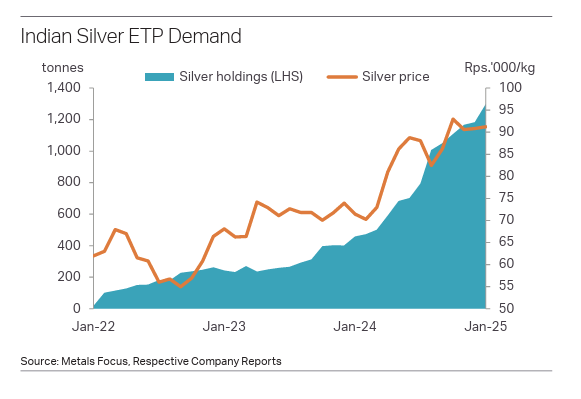
Along with robust demand for silver bars and coins, we can see Indian investment interest in silver reflected in silver-backed ETFs. Around 800 tons of metal flowed into Indian-based funds last year. They added another 114 tons of silver in January.
According to Metals Focus, “The strength of this demand has helped keep domestic silver prices at a premium to the landed cost, with an average premium of $0.2/oz last month. This contrasts sharply with gold, which has remained in a persistent discount in India.”
Higher Prices Creating Headwinds for Jewelry and Silverware
Higher silver prices have started to drag on the demand for jewelry and silverware in India.
Higher gold prices have also indirectly impacted the silver jewelry market, causing foot traffic in jewelry stores to drop.
According to Metals Focus, “Some seasonal support could emerge with the upcoming wedding season (from March to May), it is unlikely to fully offset the price-related decline in demand. It is also worth noting that silverware is mostly bought as a gift, and so high prices tend to encourage a shift towards lighter pieces.”
Metals Focus expects silver demand in India to remain robust, despite headwinds from higher prices that will likely continue to put a drag on jewelry and silverware sales and incentivize some profit-taking in the investment space.
We tend to associate India with gold, but Indians also have a love affair with silver. Over the last decade, investors have accumulated over 17,500 tons of silver in the form of coins and bars.
Many analysts thought rising prices would motivate Indian investors to liquidate their extensive silver holdings. However, according to Metals Focus, selling has been “trivial,” even as the price eclipsed ₹100,000.
“Our research suggests that investors are still accumulating physical silver to participate in the bull run. This is primarily driven by still positive price expectations.”
Mike Maharrey is a journalist and market analyst for MoneyMetals.com with over a decade of experience in precious metals. He holds a BS in accounting from the University of Kentucky and a BA in journalism from the University of South Florida.
(Jesse Colombo, Money Metals News Service) Back in December, while much of the country was riding a wave of optimism over Donald Trump’s presidential victory, I warned that we were hurtling toward a recession—and saying that it may have already begun. I also noted that the increasing likelihood of a recession would drive up gold prices—and the recent surge is clear confirmation of that.
My prediction wasn’t driven by political bias but by hard data and reliable recession indicators, which had signaled economic trouble long before Trump’s win. And now, as expected, a growing body of evidence confirms that the odds of an imminent U.S. recession are surging.
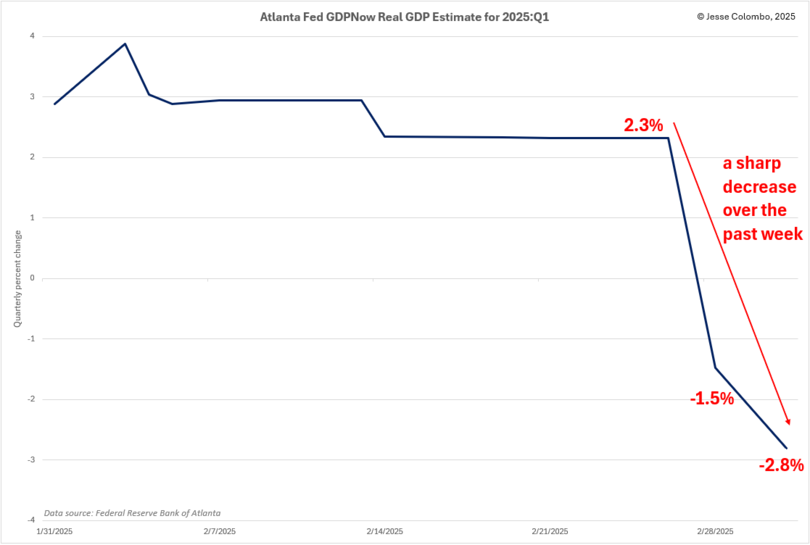
One key indicator signaling an imminent recession is the Atlanta Fed’s GDPNow forecasting model, which updates in real time as new economic data arrives. Just last Thursday, the model projected a 2.3% annual growth rate for the first quarter of 2025. However, after Friday’s economic data releases, that estimate plummeted to a recessionary -1.5%.
Then, on Monday, additional data sent the forecast tumbling even further to a staggering -2.8%, reinforcing the recession warning and silencing skeptics who doubted Friday’s sharp decline.
When the GDPNow estimate for first-quarter 2025 growth plunged to -1.5% on Friday, some skeptics argued that the drop was skewed by a temporary surge in imports. U.S. importers had been front-loading shipments ahead of impending tariffs, they claimed, creating an anomaly that would soon normalize.
While there is some truth to that, it’s only part of the story. A major contributing factor to the declining GDP estimate is weakening consumer spending, which drives more than two-thirds of U.S. economic activity.
Additionally, Monday’s sharp drop in the GDPNow estimate for first-quarter 2025 growth was largely driven by a steep decline in residential investment—spending on new housing and home renovations.
What’s striking is that today’s plunge to a -2.8% GDP contraction marks the worst forecast since the COVID lockdowns in 2020.
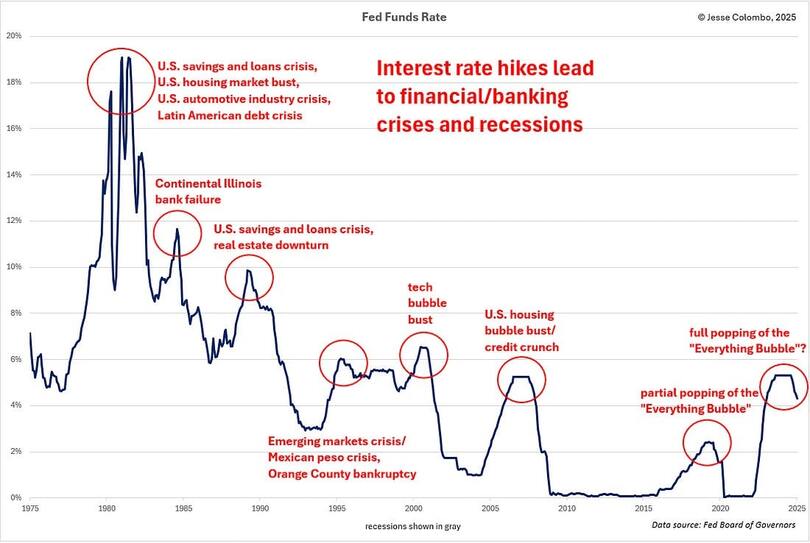
One of the key reasons I’ve been warning about a recession in recent months is that predicting one isn’t all that complicated—especially given historical patterns. The most significant factor is the near inevitability of recessions following rate-hiking cycles, as shown in the chart below.
In general, the Federal Reserve raises rates until “something breaks,” and that something is typically industries or speculative booms that flourished in the prior low-rate environment.
Over the past three years, the Federal Reserve has embarked on an aggressive rate-hiking cycle, pushing the fed funds rate from near zero to a peak of 5.3%—the fastest increase since the early 1980s.
Recently, they’ve cut rates to 4.3% amid growing signs of economic weakness. The tightening cycle had been even more extreme than the mid-2000s hikes that helped trigger the housing market downturn and the subsequent Great Recession.
While many economists and investors remain hopeful for a soft landing, history shows that such outcomes are rare—especially after rate hikes of this scale.
This time, I expect the U.S. economy to be dragged into a downturn by the bursting of what I call the “Everything Bubble”—a term I coined in 2014 to describe the multiple asset and financial bubbles inflated during the era of unprecedented quantitative easing (QE) and zero interest rate policy (ZIRP) after 2008.
In the U.S., this includes bubbles in housing, equities, tech startups, AI, much of the cryptocurrency space, healthcare, higher education, and auto loans. Beyond the U.S., similarly fragile housing bubbles in Australia, Canada, and Western Europe add to the global economic risks.
Make no mistake, there are many other risks likely lurking beneath the surface, waiting to be exposed in the coming downturn. As the billionaire investor Warren Buffett famously remarked, “Only when the tide goes out do you discover who’s been swimming naked.”
Several key indicators are flashing warnings of an imminent recession—or even suggesting that we may already be in one.
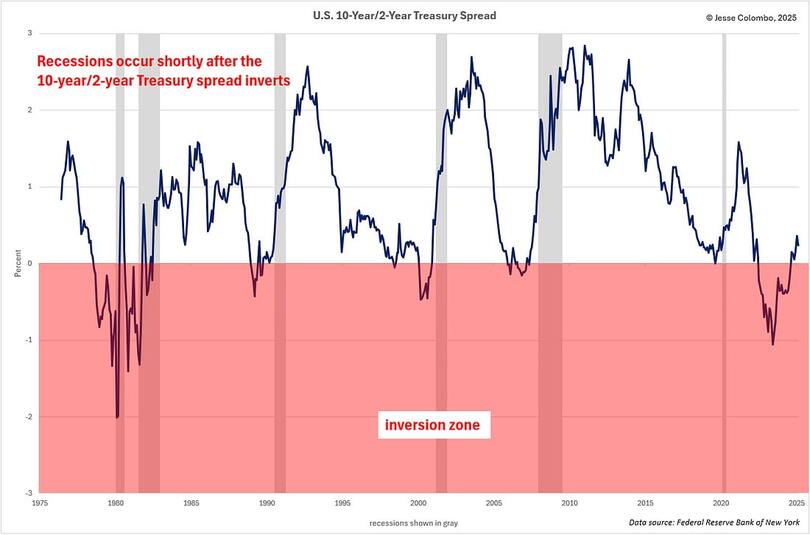
Among the most reliable is the 10-year/2-year yield spread, which is calculated by subtracting the yield of the 2-year Treasury note from the 10-year Treasury note. This measure has accurately predicted the last six recessions. When the spread falls below 0%, it signals an inverted yield curve—one of the strongest predictors of an impending recession.
As shown in the chart below, the shaded gray areas represent past recessions, clearly illustrating the historical correlation between yield curve inversions and economic downturns.
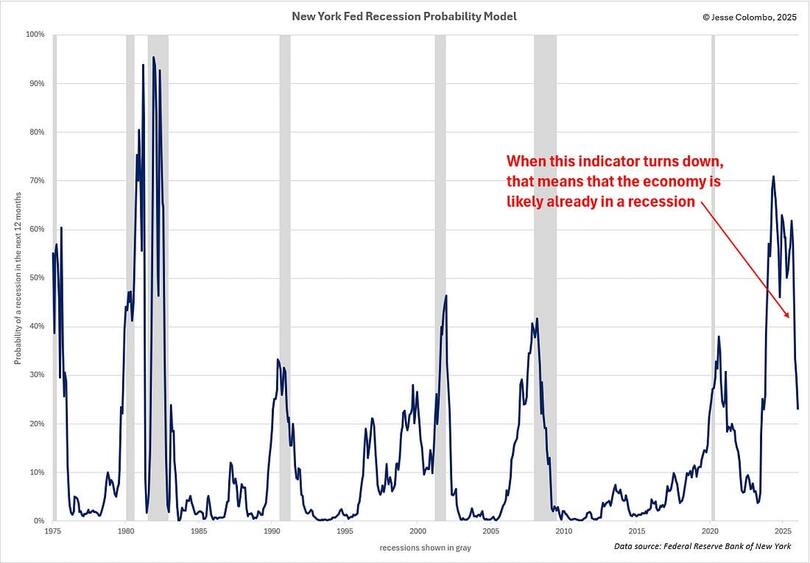
Another yield curve-based recession indicator is the New York Fed Recession Probability Model, which estimates the likelihood of a recession within the next 12 months. As this indicator rises, so does the probability of a recession.
However, when it starts to decline, it coincides with the yield curve’s uninversion—a signal that the economy is likely already in a recession.
Over the past year, this indicator has turned downward, suggesting that the U.S. economy is, unfortunately, already in a recession.
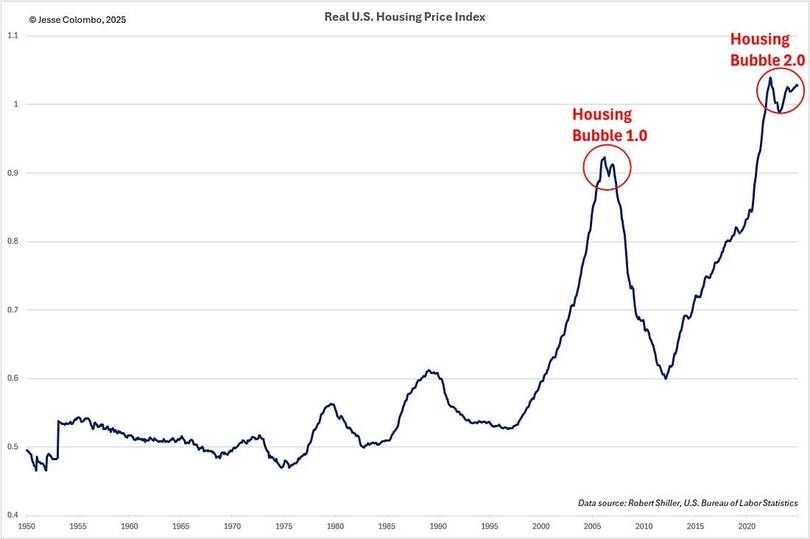
As discussed earlier, I believe the U.S. is in the midst of another housing bubble—what I call Housing Bubble 2.0—and I expect its collapse to be a major trigger for the coming recession.
Simply put, inflation-adjusted U.S. home prices have now surpassed the peak of the mid-2000s housing bubble that led to the 2008 crash. Remember The Big Short? We’ve made the same mistake all over again.
Housing has become so overpriced that, to afford the median-priced home of $433,100, Americans now need an annual income of $166,600—yet the median household income is just $78,538, as Fortune recently reported.
This level of imbalance is unsustainable, and history has shown us exactly how it ends: a housing market crash.
The severe unaffordability of housing in recent years has driven existing home sales to their lowest levels since 1995 despite the U.S. population growing by 80 million over that period.
This is a clear sign of a deeply dysfunctional market—one that cannot sustain itself indefinitely. Sooner or later, something has to give, and that something will be housing prices crashing back down to reality.
The Fed’s pandemic-era stimulus artificially inflated housing prices to irrational levels, fueling a surge in home construction.
Now, as those newly built homes hit the market, an oversupply is emerging—particularly in the Sun Belt region. This kind of excess inventory is a classic warning sign that often precedes a housing downturn.
As home sales stagnate due to unaffordability and inventory continues to build—with even more in the pipeline—housing starts, or the initiation of new residential construction, have entered a downturn. This decline is a classic recession indicator, signaling broader economic weakness ahead.
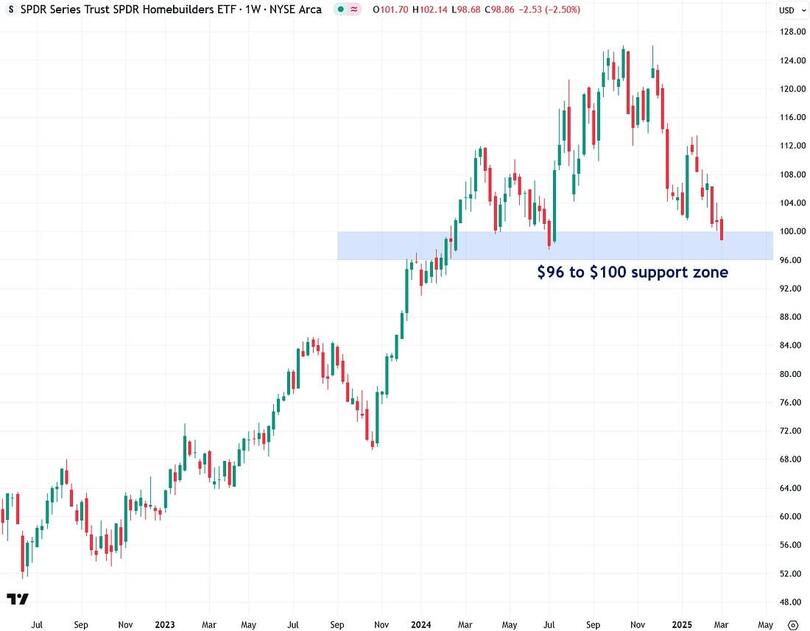
Another key indicator of the U.S. housing market’s health is homebuilder stocks, tracked by the SPDR Homebuilders ETF (XHB). Right now, these stocks are beginning to roll over—just as they did in 2005, ahead of the housing market downturn that followed a couple years later.
A decisive close below the $96 to $100 support zone would signal the onset of a deeper bear market in housing and homebuilder stocks—one that will ripple through the broader U.S. economy, accelerating the downturn.
Beyond housing, another major bubble I expect to burst is the one in U.S. stocks. Numerous indicators confirm that the stock market is dangerously overvalued and primed for a mean reversion—a correction that will drag down inflated stock prices and serve as both a symptom and a catalyst of the coming recession.
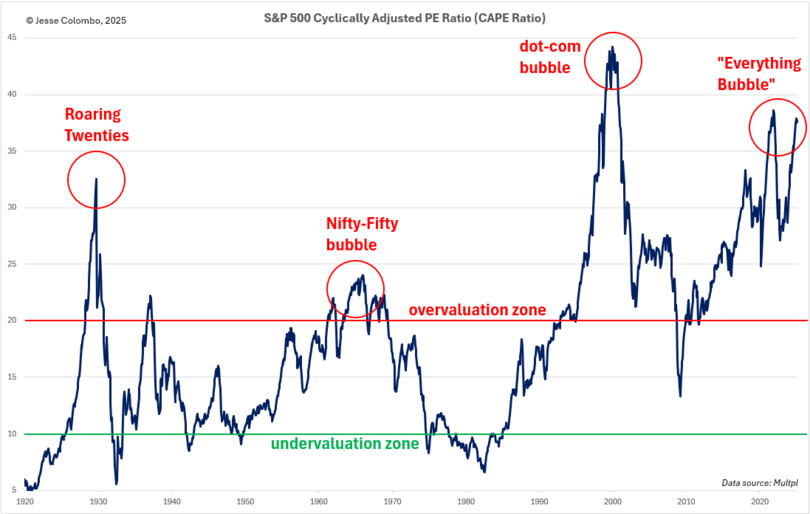
One of the clearest signs of this excessive valuation is the S&P 500’s cyclically adjusted price-to-earnings (CAPE) ratio, which compares the current price of the S&P 500 to its average earnings over the past 10 years.
Historically, when this metric reaches extreme levels (20 and higher), sharp market declines tend to follow.
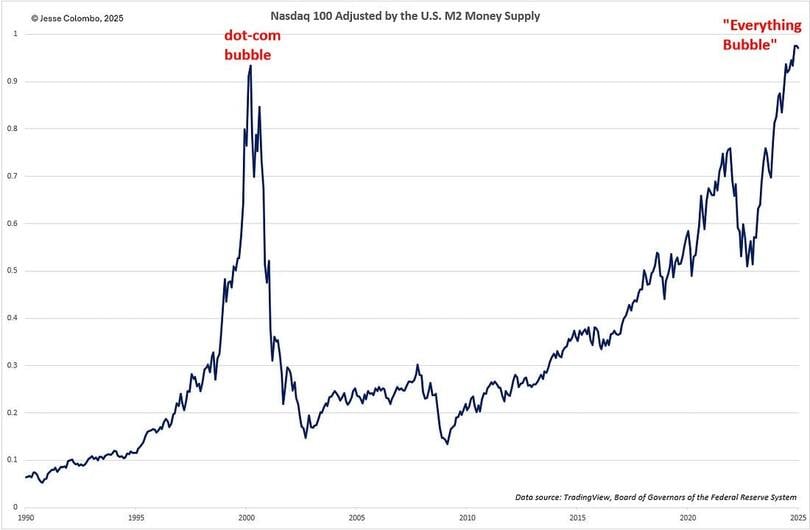
Tech stocks, in particular, are wildly inflated, as evidenced by the Nasdaq 100 adjusted by the U.S. M2 money supply, which represents the total amount of dollars in circulation. This metric reveals that the Nasdaq 100—and tech stocks as a whole—are now even more overvalued than they were during the late-1990s dot-com bubble, which ended in a spectacular crash.
When the “Everything Bubble” bursts, triggering a severe recession (or more realistically, a depression), the U.S. Federal Reserve and government will pull out all the stops to prop up the economy.
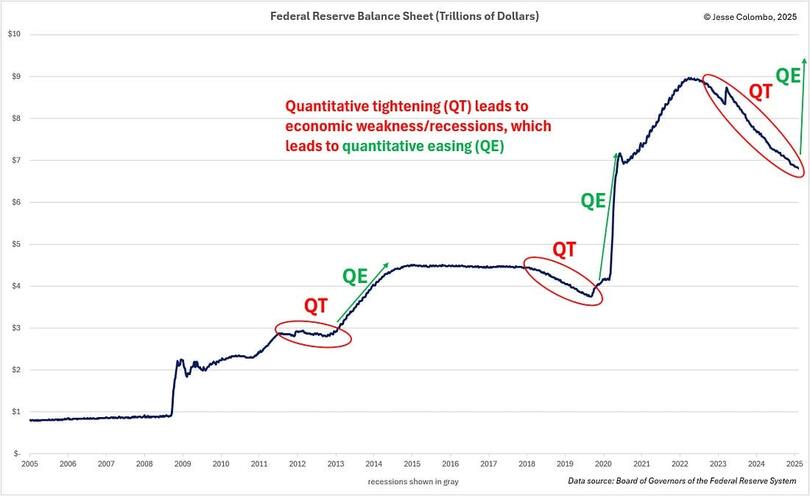
This will include slashing interest rates back to zero—and even into negative territory—while abruptly ending the current quantitative tightening (QT) policy and reviving quantitative easing (QE).
In doing so, they will digitally create hundreds of billions—eventually trillions—of new dollars in a desperate attempt to stabilize financial markets and the broader economy.
Gold has a remarkable ability to anticipate recession risks and the monetary stimulus that typically follows—both of which are highly favorable for its price. This is one of the key reasons gold has surged over the past year, leaving many puzzled.
As the coming recession unfolds, I expect gold to continue its upward trajectory, with silver eventually catching up as it historically tends to lag before making its move.
In summary, the risk of a U.S. recession is rising rapidly, and I expect it to involve the bursting of several bubbles within the “Everything Bubble”—most notably in housing and stocks.
Unfortunately, this economic downturn was already set in motion long before Trump won the election, leaving him with little ability to prevent it.
This looming recession will result in serious pain for mainstream investors heavily exposed to overcrowded trades like housing, stocks, and cryptocurrencies.
However, for those positioned in precious metals—a small but savvy minority—it will be highly profitable and beneficial.
Jesse Colombo is a financial analyst and investor writing on macro-economics and precious metals markets. Recognized by The Times of London, he has built a reputation for warning about economic bubbles and future financial crises. An advocate for free markets and sound money, Colombo was also named one of LinkedIn’s Top Voices in Economy & Finance. His Substack can be accessed here.
(Ken Silva, Headline USA) The Justice Department disclosed in a Monday court filing that Ryan Routh is no longer considering an “insanity defense” against the allegations that he attempted to assassinate Donald Trump last September on his Florida golf course.
The DOJ first disclosed Routh’s potential insanity defense last December, and Routh’s attorneys were given until Feb. 3 to file a formal notice to pursue that defense. On Monday, the DOJ said that the defense missed that deadline.
“The defense did not provide any ‘notice of an insanity defense, notice of expert evidence of a mental condition, or motion for mental competency or for relief related to Defendant’s mental condition’ by the Court’s deadline of February 3,” prosecutors said. “As the Court explained, this deadline was ‘necessary to ensure a just, orderly, and speedy trial and is reasonable given the procedural history of this case.’ So those issues, at least, are off the table for trial.”
🚨KEY UPDATES in the Ryan Routh attempted assassination case. Let's start with something potentially significant: Law enforcement just searched Routh's Nissan Xterra mere weeks ago on Jan. 30. Routh fled Trump's golf course in this Xterra. It's unclear whether this was the first… https://t.co/PMu2NAuyClpic.twitter.com/K97SmcMsX1
The DOJ further aired other previously unpublicized discovery issues, including that law enforcement searched Routh’s Nissan Xterra just weeks ago on Jan. 30. Routh used a Nissan Xterra to flee the golf course on Sept. 15. It’s unclear whether the Jan. 30 search was a follow-up search.
The DOJ also said investigators found “potential destructive device components” inside a gray Sterilite bin placed by the Routh at a private residence in Greensboro, North Carolina. The components had the potential to “kill or seriously injure a human being,” according to the DOJ.
Additionally, the DOJ disclosed that the FBI has interviewed over 200 witnesses—a disclosure the DOJ said it wasn’t even obligated to make. Another disclosure was that the FBI used the Israeli spyware firm Cellebrite to access Routh’s 17 cell phones. Cellebrite is the same company used to access alleged Trump shooter Thomas Crooks’s devices.
The DOJ concluded its status report by complaining about the lack of discovery from defense counsel.
“Routh’s refusal to provide information to us on a rolling or ‘as available’ basis, makes this Court’s timetable for pre- trial motions virtually impossible for the Government to meet. For example, the Government cannot realistically be expected to prepare and file Daubert motions to exclude any proposed defense experts – at least motions of the quality and helpfulness this Court should expect – in the short time (five business days) between March 28 and the current motions deadline of April 7,” prosecutors said.
Prosecutors have accused Routh, 58, of Hawaii, of stalking Trump for a month before he built a sniper’s nest near the Trump International golf course in West Palm Beach.
Federal prosecutors charged Routh with possession of a firearm by a felon, possession of a firearm with an obliterated serial number, and attempted assassination of a major presidential candidate.
Routh has pleaded not guilty. His trial is set for September.
Ken Silva is the editor of Headline USA. Follow him at x.com/jd_cashless.
(Luis Cornelio, Headline USA) The federal government, now led by President Donald Trump, may finally compensate the grieving family of Ashli Babbitt—a veteran and MAGA activist who was fatally shot inside the U.S. Capitol on Jan. 6, 2021.
Judicial Watch, a conservative non-profit, sued the federal government for $30 million in wrongful death damages on behalf of Babbitt’s estate and husband, Aaron. The Biden administration had fought tooth and nail to dismiss the case until President Donald Trump took office in January.
A document filed by federal attorneys and Judicial Watch on Feb. 25 stated that the “parties have agreed to work in good faith to narrow or resolve issues in this case.”
In an interview with the Washington Examiner, Judicial Watch President Tom Fitton did not delve into the case’s details but said, “All we want is justice and we hope the Justice Department under President Trump would share that goal ultimately.”
Fitton’s comments and the federal government’s filing mark the first time since the lawsuit was filed that the federal government has suggested that a settlement is under way.
The sudden shift comes on the heels of Trump’s sweeping pardons and commutations for those prosecuted in the Jan. 6 protest.
While Democrats have described that day as a dangerous insurrection and even a terrorist attack, Babbitt was the only person killed. She was seen climbing a door with cracked glass leading to the Speaker’s lobby before being fatally shot by police officer Michael Byrd.
Other individuals who died that day did so of natural causes. Kevin Greeson and Benjamin Phillips passed due to cardiovascular disease, while Rosanne Boyland, another Trump supporter, died due to an accidental overdose. Capitol Police officer Brian Sicknick, meanwhile, suffered stroke and died eight hours after the protest.
Shortly after Biden took office, his DOJ cracked down on anyone who entered the U.S. Capitol to protest. Biden’s heavy-handed enforcement prompted the Supreme Court to intervene, ruling that the DOJ had illegally used a law to prosecute some of the Jan. 6 defendants.
Trump undid Biden’s mishaps by pardoning those who were prosecuted by the Biden administration. The pardons occurred just days after Biden commuted the death sentences of all death-row inmates.
Biden also became the first president in U.S. history to pardon his siblings and son, shielding them from accountability for crimes committed over an 11-year period.
(Headline USA) An Illinois man pleaded guilty Monday to killing seven people and injuring dozens more when he opened fire on a 2022 Independence Day parade in a Chicago suburb, a stunning development moments before opening statements in his trial on murder and attempted murder charges.
Appearing in a Lake County circuit courtroom, Robert E. Crimo III, 24, withdrew his earlier not-guilty plea in the Highland Park shooting.
Crimo’s guilty plea means that evidence from his case may never see the light of day. That matters because—among other reasons—there’s compelling evidence that there may have been multiple shooters at Highland Park on July 4, 2022 (see here). There are also reasons to believe that Crimo may have been groomed (see here).
I can’t figure out why he chose to change his plea. For 2 1/2 years he held strong, despite both state prosecutors and his public defenders railroading him daily to plead guilty. He told his dad, “that’s for guilty people.”
Prosecutors initially charged him with 21 counts of first-degree murder — three counts for each person killed — as well as 48 counts of attempted murder. Prosecutors dropped 48 less serious counts of aggravated battery before jury selection last week.
On Monday, Judge Victoria Rossetti read the charges to Crimo and asked questions to be sure he understood before accepting the plea. He was sitting next to his lawyers wearing a dark suit.
“Is that what you went over with your attorneys?” Rossetti asked.
“Yes,” Crimo replied.
He gave mostly one-word answers to her follow-up questions. His mother, Denise Pesina, had a brief outburst at the news and the judge gave her a warning.
“We’re going to move forward,” the judge said to her. “You are not a party to this proceeding. If you would like to stay in the courtroom please have a seat and be quiet.”
She was allowed to stay.
The judge said with the plea change, there would be no trial or further motions. Jurors were never even let into the courtroom.
Sentencing will come April 23, but Crimo is certain to spend the rest of his life behind bars. Each count of first-degree murder carries a maximum natural life prison sentence. Prosecutors said survivors would get the chance to address Crimo at the sentencing.
Crimo didn’t further address the court before leaving the courtroom.
His public defenders did not address reporters after the hearing.
Security was tight at the courthouse, with bag checks and observers required to lock up their phones.
The change of plea shocked those gathered in the courtroom, including survivors and their families.