(Headline USA) Allegations of sexual abuse and exploitation in U.N. peacekeeping and political missions topped 100 for the third time in the last 10 years in 2024, according to a U.N. report released Tuesday, which said 65 of the allegations involved women who gave birth after saying they were raped and were seeking child support.
U.N. Secretary-General Antonio Guterres said in the report to the General Assembly that the allegations identified 125 victims — 98 adults and 27 children. This was fewer than the 145 victims identified in 2023, he said.
According to the report, two U.N. peacekeeping missions accounted for 82% of the 102 allegations — Congo with 44 and the Central African Republic with 40. The United Nations has long been in the spotlight over allegations of child rape and other sexual abuses by its peacekeepers, especially by those based in the two African countries.
But sexual misconduct also was reported at U.N. peacekeeping missions from South Sudan to Lebanon, and at political missions in Haiti, Colombia and Afghanistan.
The secretary-general also reported 190 allegations of sexual exploitation and abuse against staff of U.N. agencies, funds and programs — a decline from 284 allegations in 2023 — and 382 allegations related to non-U.N. staff who work with organizations implementing U.N. programs.
Guterres has made combating sexual abuse and exploitation a high priority since he became U.N. chief in 2017 and he has promoted enforcement of the U.N.’s “zero-tolerance” policy for sexual misconduct. He has initiated a series of changes to U.N. peacekeeping to speed up investigations, and appointed a victims’ advocate to help victims of sexual abuse.
But the latest report found that while U.N. training on sexual misconduct is mandatory, a 2024 survey of 64,585 U.N. staff found that 3.65% — 2,360 staffers— said it was acceptable to pay for sex. And close to 1% — 555 staffers — said “it was acceptable to engage in sexual activity with a child.”
It said that “alarmingly” the 2024 U.N. survey also found a significant rise in distrust toward U.N. leadership, with 6% of respondents — 3,700 staff members — expressing a lack of confidence in the ability of leaders to address sexual exploitation and abuse, double the 3% in 2023.
“This underscores an urgent need for leaders to demonstrate stronger, more visible and accountable leadership to foster trust among the staff of the United Nations system and the communities they serve,” the report said.
Since 2006, the report said, approximately 750 paternity and child support claims involving U.N. peacekeeping personnel have been reported, but more than 500 are still pending.
All claims are referred to the peacekeeper’s home country to resolve, but the report said most have not taken meaningful action.
The secretary-general urged countries “to take decisive action” to hold their nationals accountable and to ensure that children born as a result of sexual exploitation and abuse receive the rights they are entitled to, including citizenship.
“I will examine ways to bring even greater attention to this critical issue, ensuring senior United Nations officials are held personally accountable when addressing sexual exploitation and abuse,” Guterres said.
(Money Metals News Service) We get lots of questions from the public about precious metals. Some people are curious about the basics.
Others are skeptical about the case for owning gold and silver. Still, others are longtime customers who have highly specialized inquiries.
Here are two very common questions…
QUESTION: What’s Money Metals’ overall philosophy as to what precious metals products one should buy?
ANSWER: We encourage folks to focus on the lower premium items so virtually all their investment goes into acquiring the metal itself.
Most importantly, that means avoiding so-called “rare,” graded, or proof coins which generally carry high premiums, mostly unrecoverable upon a later sale.
You will almost certainly be better off if you stick with bullion coins, bars, and rounds where the cost is mostly determined by the spot price. Within that group, bars and rounds almost always offer the best value.
QUESTION: What are the reasons to own physical gold and silver versus owning mining stocks?
ANSWER: Gold or silver bullion and mining stocks are two entirely separate asset classes.
Bullion is money itself, a tangible asset with eternal value. You own it for insurance against a collapsing financial and monetary system. The profit – and there certainly can be great gains when measured in both nominal and real terms – is gravy.
When times get difficult, though, the action in the gold and silver mining stocks can get quite ugly.
These stocks are typically the most volatile area of the entire stock market. They are not for the short-term risk averse. They are for those who believe the potential long-term rewards are worth the risk.
Bullion functions better than the mining sector as a portfolio diversifier (physical gold is less correlated with the stock and credit markets). Over the long-term, gold bullion also performs better on a risk-adjusted basis (similar expected returns with a fraction of the volatility).
Start by owning physical bullion – whether it be gold or silver.
Build a solid foundation in the metals themselves before even considering the purchase of mining shares, which aren’t suitable for all investors.
You own gold and silver mining companies not for their eternal value (they could go bankrupt), not for insulation from the financial system (they are financial assets which are affected by credit conditions and general market volatility), but for their profit potential as operating businesses.
There can be more upside on your investments in mining shares during a bull market (and more downside in a bear market), but you also take on an array of risks, such as:
rising energy and labor costs
political risk (including threat of nationalization)
wider economic/financial turmoil
credit market tightness
peculiarities affecting profitability in the industry
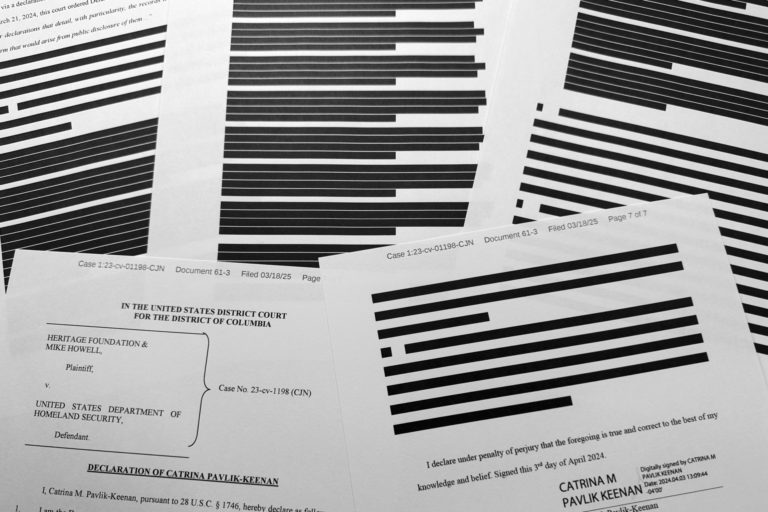
(Headline USA) Heavily redacted court filings released Tuesday shed no fresh light on the circumstances under which Prince Harry entered the United States, the latest development in a legal fight by a conservative group that is pushing to find out whether Harry lied about past drug use on his immigration forms.
U.S. Department of Homeland Security officials responded to a request from U.S. District Judge Carl Nichols by saying the records were being “withheld in full” and that all records are deemed “categorically exempt from disclosure.”
The case has centered on the circumstances under which Harry — the Duke of Sussex and the son of King Charles III — entered the U.S. when he and his wife Meghan Markle moved to Southern California in 2020. The Heritage Foundation sued after DHS largely rejected its Freedom of Information Act request to release Harry’s records. Harry is not a party in the lawsuit.
Heritage has argued there is “intense public interest” in knowing whether Harry received special treatment during the application process, particularly after his 2023 memoir Spare revealed past drug use. Harry has not consented to having his records made public, said Shari Suzuki, an official handling Freedom of Information Act requests for DHS and Customs and Border Protection.
“To release (Prince Harry’s) exact status could subject him to reasonably foreseeable harm in the form of harassment as well as unwanted contact by the media and others,” another official, DHS chief FOIA officer Jarrod Panter, wrote.
Panter wrote that the Heritage Foundation bears “the burden of establishing that the public interest in disclosure outweighs an individual’s personal privacy interests in their information and that a significant public benefit would result from the disclosure of the individual’s records.”
Panter’s statement to the court includes multiple pages that are entirely blacked out.
Harry wrote in Spare that he took cocaine several times starting around age 17. He also acknowledged using cannabis and psychedelic mushrooms.
“It wasn’t very fun, and it didn’t make me feel especially happy as seemed to happen to others, but it did make me feel different, and that was my main objective. To feel. To be different,” he wrote.
The U.S. routinely asks about drug use on its visa applications, a query that has been linked to travel headaches for celebrities, including chef Nigella Lawson, singer Amy Winehouse and model Kate Moss. Acknowledgment of past drug use doesn’t necessarily bar people from entering or staying in the country, but answering untruthfully can have serious consequences.
In a February hearing on the issue, Judge Nichols said he was seeking to strike a balance between revealing too much information in the DHS statements and redacting them to the point of meaninglessness.
“There’s a point where redactions would leave just a name or a date,” he said.
(Headline USA) Attacks on property carrying the logo of Elon Musk’s electric-car company are cropping up across the U.S. and overseas. While no injuries have been reported, Tesla showrooms, vehicle lots, charging stations and privately owned cars have been targeted.
There’s been a clear uptick since President Donald Trump took office and Musk began to oversee a new Department of Government Efficiency that’s slashing government spending. Experts on domestic extremism say it’s impossible to know yet if the spate of incidents will balloon into a long-term pattern.
In Trump’s first term, his properties in New York, Washington and elsewhere became a natural place for protest. In the early days of his second term, Tesla is filling that role.
“Tesla is an easy target,” said Randy Blazak, a sociologist who studies political violence. “They’re rolling down our streets. They have dealerships in our neighborhoods.”
Musk critics have organized dozens of protests at Tesla dealerships and factories across North America and Europe. Some Tesla owners, including a U.S. senator who feuded with Musk, have vowed to sell their vehicles.
But the attacks are keeping law enforcement busy.
Prosecutors in Colorado charged a woman last month in connection with attacks on Tesla dealerships, including Molotov cocktails thrown at vehicles and the words “Nazi cars” spray-painted on a building.
And federal agents in South Carolina last week arrested a man they say set fire to Tesla charging stations near Charleston. An agent from the Bureau of Alcohol, Tobacco, Firearms and Explosives wrote in an affidavit that authorities found writings critical of the government and DOGE in his bedroom and wallet.
“The statement made mention of sending a message based on these beliefs,” the agent wrote.
Some of the most prominent incidents have been reported in left-leaning cities in the Pacific Northwest, like Portland, Oregon, and Seattle, where anti-Trump and anti-Musk sentiment runs high.
An Oregon man faces charges after allegedly throwing several Molotov cocktails at a Tesla store in Salem, then returning another day and shooting out windows. In the Portland suburb of Tigard, more than a dozen bullets were fired at a Tesla showroom last week, damaging vehicles and windows, the second time in a week that the store was targeted.
Four Cybertrucks were set on fire in a Tesla lot in Seattle earlier this month. On Friday, witnesses reported a man poured gasoline on an unoccupied Tesla Model S and started a fire on a Seattle street.
In Las Vegas, several Tesla vehicles were set ablaze early Tuesday outside a Tesla service center where the word “resist” was also painted in red across the building’s front doors.
Authorities said at least one person threw Molotov cocktails — crude bombs filled with gasoline or another flammable liquid — and fired several rounds from a weapon into the vehicles.
“Was this terrorism? Was it something else? It certainly has some of the hallmarks that we might think — the writing on the wall, potential political agenda, an act of violence,” Spencer Evans, the special agent in charge of the Las Vegas FBI office, said at a news conference. “None of those factors are lost on us.”
Tesla was once the darling of the left. Helped to viability by a $465 million federal loan during the Obama administration, the company popularized electric vehicles and proved, despite their early reputation, that they didn’t have to be small, stodgy, underpowered and limited in range.
Musk continues to run Tesla — as well as X and the rocket manufacturer SpaceX — while also serving as Trump’s adviser.
Tesla stock doubled in value in the weeks after Trump’s election but has since shed all those gains.
Trump gave a boost to the company when he turned the White House driveway into an electric-vehicle showroom. He promoted the vehicles and said he would purchase an $80,000 Model S, eschewing his fierce past criticism of electric vehicles.
Tesla didn’t respond to a request for comment. Musk briefly addressed the vandalism Monday during an appearance on Sen. Ted Cruz’s podcast, saying “at least some of it is organized and paid for” by “left-wing organizations in America, funded by left-wing billionaires, essentially.”
“This level of violence is insane and deeply wrong,” Musk wrote Tuesday on X, sharing a video of burning Teslas in Las Vegas. “Tesla just makes electric cars and has done nothing to deserve these evil attacks.”
The progressive group Indivisible, which published a guide for supporters to organize “Musk Or Us” protests around the country, said in a statement that all of its guidance is publicly available and “it explicitly encourages peaceful protest and condemns any acts of violence or vandalism.”
Trump has said Tesla vandalism amounts to “domestic terror,” and Trump has threatened retribution, warning that those who target the company are “going to go through hell.”
Attorney General Pam Bondi said she’d opened an investigation “to see how is this being funded, who is behind this.”
“If you’re going to touch a Tesla, go to a dealership, do anything, you better watch out because we’re coming after you,” Bondi said Friday on Fox Business Network. In a statement Tuesday, she vowed to “continue investigations that impose severe consequences,” including for “those operating behind the scenes to coordinate and fund these crimes.”
(Ken Silva, Headline USA) The popular craft retailer JoAnn Fabrics is going out of business, and crafters around the country are flocking to their local store to “panic shop” before its doors close for good.
Apparently, the deals at JoAnn are so good that an alleged ISIS fighter asked a judge to modify the conditions of her house arrest so she could go shopping.
“Ms. Salman spends much of home incarceration creating crocheted items, a hobby shared by her family members. Her local JoAnn Fabrics store is closing,” said a letter earlier this month from Halima Salman, who was caught in Syria by forces fighting ISIS in 2019.
“Ms. Salman would like to go to the JoAnn Fabrics store in Belmont, New Hampshire, on a date and time to be set by Pretrial Services, to shop for yarn before the store goes out of business. She would be accompanied by her mother and grandmother,” said the letter to U.S. District Judge Natasha Merle.
A woman who was trained by ISIS in Syria asked a U.S. judge earlier this month to modify conditions of her house arrest, so that she can attend a Joann Fabrics bankruptcy sale. The Biden-appointed judge denied that request, but allowed the alleged ISIS fighter to attend a crafts… pic.twitter.com/JdMZnjMOkd
“These requests are excessive and unnecessary under the terms of home incarceration—they are not an attorney visit, court appearance, or necessary medical treatment,” prosecutors said in response to the request, reminding the judge that Salman “sought out training after she turned 18 years old and after marrying an ISIS fighter.”
Judge Merle sided with the DOJ on the JoAnn Fabrics issue. However, the judge has allowed Salman to attend a crafts fair from April 5-12. Salman was also allowed to attend an additional hour of her GED class, and to enroll in an early childhood development course, as per the judge’s March 7 order.
The Biden-appointed judge previously allowed Salman to attend another crafts fair last November.
According to the DOJ’s criminal complaint, Salman received training regarding the handling and operation of an AK-47 in Syria around March 2018, when she was 17. She had travelled from New York to Turkey, and entered Syria from there. She was captured by forces fighting ISIS in 2019, charging documents state.
Salman was interviewed by the FBI in Syria in November 2023, when she told agents that she did not attend any type of training, never owned a weapon, and was never involved in any ISIS activities.
Salman and 10 other Americans, including five minors, were repatriated to the U.S. from Syria last year, and Salman was released on $500,000 bond after being charged with receiving military-type training from a foreign terrorist organization—a crime that carries up to a 10-year prison sentence.
Meanwhile, JoAnn said last month that the dates for store closures or changes to the website will be posted as soon as possible, and it said it expects it will take a “number of weeks to complete our final sales.”
Joann previously sought Chapter 11 in March 2024 and later emerged as a private company. But after operational challenges continued to pile up, Joann filed for bankruptcy again in January.
“Joann leadership, our board, advisors and legal partners made every possible effort to pursue a more favorable outcome that would keep the company in business,” Joann said in a statement posted on its website. “We are committed to working constructively with the winning bidder to ensure an orderly wind-down of operations that minimizes the impact on all our stakeholders.”
The Associated Press contributed to this report.
Ken Silva is the editor of Headline USA. Follow him at x.com/jd_cashless.
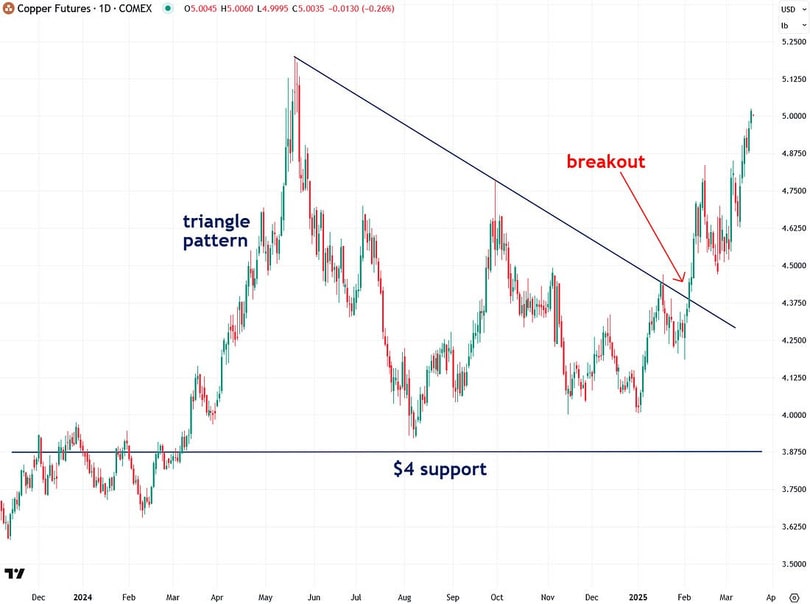
(Jesse Colombo, Money Metals News Service) The stars are aligning for copper, which has surged 25% after breaking out of its triangle pattern and now sits just below the key $5–$5.20 resistance zone.
For months, I’ve been bullish on copper. I predicted copper would rebound and enter a long-term bull market, pulling silver higher due to their strong correlation and the influence of arbitrage algorithms reinforcing that price relationship.
When I first shared my bullish outlook, copper was struggling at $4 per pound. Since then, it has surged to $5—a substantial 25% increase in just a few months. And based on current trends, copper’s bull market may just be getting started, as I’ll explain in this update.
Copper has been surging since the start of the year for several key reasons, including the pullback in the U.S. dollar (as I’ll show shortly), expectations of tariffs on U.S. copper imports, China’s special action plan to boost spending by increasing incomes, and strong demand across multiple sectors, particularly the electrical grid, electric vehicles (EVs), and renewable energy technologies.
Let’s dive into copper’s technicals, starting with the daily chart. In late 2024, copper found strong support at the key $4 per pound level, rebounded, and then broke out of a triangle pattern at the start of February.
That breakout signaled a major surge, and the uptrend remains solid and intact. Given the current momentum, I believe copper still has plenty of fuel left to climb higher.
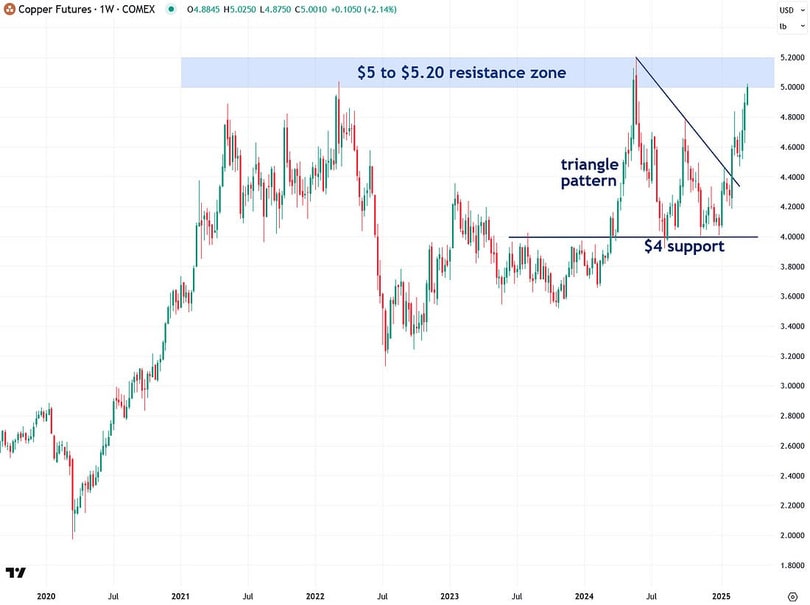
Copper’s weekly chart reveals a major resistance zone between $5 and $5.20, a level that has held firm for the past three years.
However, if copper manages to close above this range, it will break into blue-sky territory, surging to a new all-time high and fully launching into a powerful bull market.
Stepping back to the monthly chart, a bullish ascending triangle pattern has been forming over the past several years. Once it breaks out, it should trigger a bull run similar to the 2020 rally that preceded it.
Based on the measured move principle in technical analysis, this breakout could drive copper up by $3 per pound, reaching $8—a potential 60% gain from current levels.
Copper’s likely upcoming bull market would align with the outlook of French billionaire and commodities trader Pierre Andurand, who predicted that copper prices could soar to $40,000 per tonne in the coming years—a more than fourfold increase from the current price of $9,853 per tonne.
Explaining his bullish stance, Andurand stated, “We are moving towards a doubling of demand growth for copper due to the electrification of the world, including electric vehicles, solar panels, wind farms, as well as military usage and data centers.”
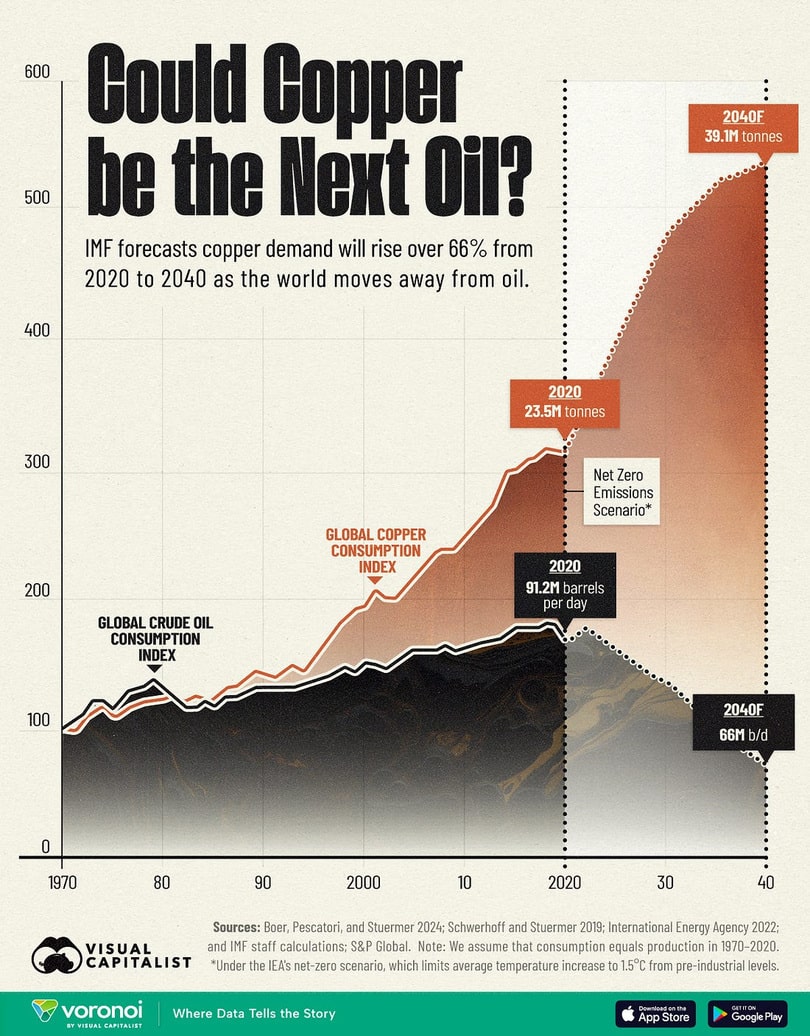
Goldman Sachs has dubbed copper “the new oil” due to its essential role in clean energy technologies, and Visual Capitalist recently published a fascinating infographic on this theme.
Copper earns this title because its demand is expected to surge in the coming decades, while oil consumption is projected to decline as the world transitions away from fossil fuels. Reflecting this shift, the IMF forecasts a 66% increase in copper demand between 2020 and 2040.
As a commodities investor, I closely follow copper not only on its own merits but also as a silver investor and analyst, given their strong correlation. The last time I ran the numbers a few months ago, their correlation stood at a solid 0.771 (out of 1).
This relationship exists for several reasons: both are industrial metals, both trade inversely to the U.S. dollar, and trading algorithms further reinforce their price connection. This high correlation makes copper just as important for silver investors to watch as gold.
Once I recognized copper’s significance in understanding silver’s price movements—and how silver behaves as a hybrid of gold and copper—I developed an indicator called the Synthetic Silver Price Index (SSPI) to better validate silver’s price trends.
This index combines the average prices of gold and copper, with copper adjusted by a factor of 540 to prevent gold from disproportionately influencing the calculation.
Despite silver itself not being an input, the SSPI closely tracks silver’s price movements, providing valuable insight into its price action.
For several months, I’ve been closely watching the SSPI as it struggled to break above the critical 2,600 to 2,640 resistance zone, repeatedly emphasizing that a breakout above this level would be a strong bullish confirmation for silver.
Thanks to recent impressive rallies in both copper and gold, that long-anticipated breakout has finally occurred, signaling that a significant move in silver is likely imminent.
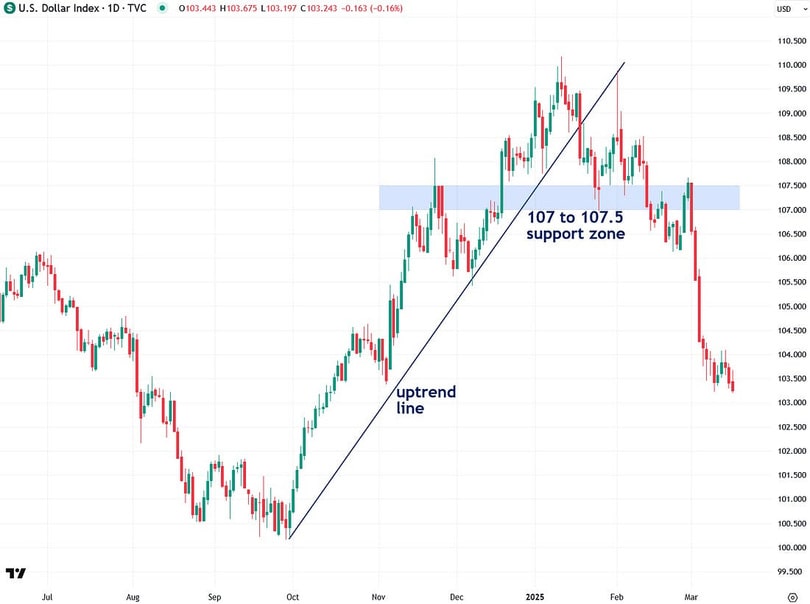
One of the key drivers behind the surge in copper, silver, and gold since the start of the year has been the sharp decline in the U.S. Dollar Index.
Since the Dollar Index and precious metals have an inverse relationship, a weakening dollar typically fuels bullish momentum in gold and silver, while a strengthening dollar applies downward pressure.
The dollar’s surge leading up to and following the U.S. presidential election triggered a steep drop in gold and silver, leading many to believe the rally was over—but as I pointed out at the time, that wasn’t the case.
There is a high probability of further significant declines in the U.S. Dollar Index, as it currently sits at one of its most overvalued levels relative to other fiat currencies in over 120 years of data—the last instances being 1933 and 1985, both of which were followed by sharp dollar weakness.
If history repeats, this would be extremely bullish for the entire commodities sector, including copper, gold, silver, and mining stocks, given the strong inverse relationship between the dollar and commodities.
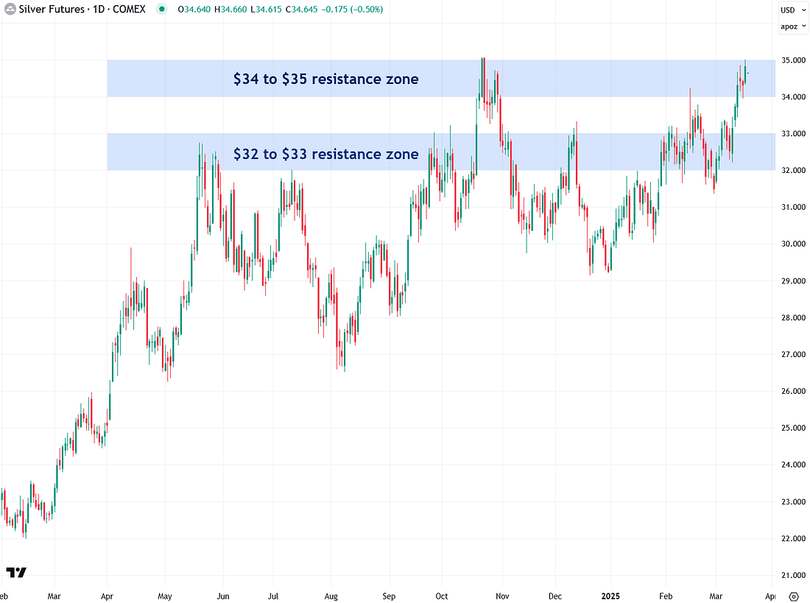
Finally, let’s examine where silver stands after its strong gains since the start of the month. COMEX silver futures have successfully broken above the critical $32–$33 resistance zone, which had acted as a ceiling for much of the past year—a highly bullish development.
The next key hurdle is the $34–$35 resistance zone just overhead. Once silver clears this level, I believe it will enter a powerful bull market, rapidly climbing to $40, $50, $60, and beyond.
While many silver investors are feeling pessimistic after watching gold surge while silver struggled over the past year, I see things differently.
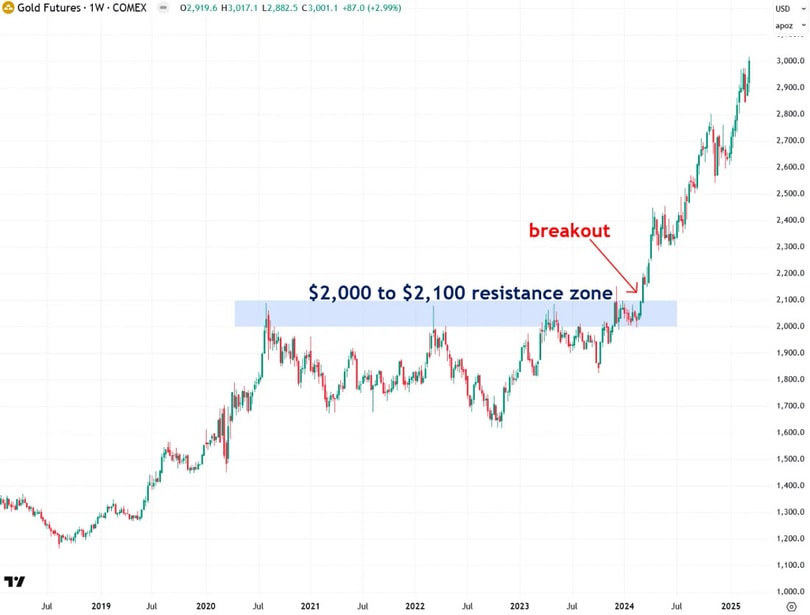
I see a strong parallel between silver’s $32–$33 resistance zone, which has acted as a ceiling for much of the past year, and gold’s $2,000–$2,100 resistance zone, which capped its upside from 2020 until 2024.
In summary, the stars are aligning for copper, which has surged 25% after breaking out of its triangle pattern and now sits just below the key $5–$5.20 resistance zone—a breakout above should ignite a full-fledged bull market.
This would also be highly bullish for silver, given their strong correlation and the trading algorithms that link their movements.
Additionally, with the overvalued U.S. dollar likely to normalize soon, the entire commodities sector, including copper, silver, gold, and mining stocks, should explode higher. This is an exciting moment for hard asset investors.
Jesse Colombo is a financial analyst and investor writing on macro-economics and precious metals markets. Recognized by The Times of London, he has built a reputation for warning about economic bubbles and future financial crises. An advocate for free markets and sound money, Colombo was also named one of LinkedIn’s Top Voices in Economy & Finance. His Substack can be accessed here.
(José Niño, Headline USA) Trump’s Justice Department apparently does not believe suppressors are protected by the Second Amendment.
In the case of United States v. Peterson, Acting U.S. Attorney Michael Simpson filed a brief on March 17, 2025, arguing that firearm suppressors are not protected under the Second Amendment. He argued that suppressors do not constitute “arms” as defined by the Second Amendment.
Firearms suppressors, also known as silencers or sound moderators, are muzzle devices designed to reduce the noise and flash generated when a gun is fired.
Simpson’s contention aligns with the Fifth Circuit’s earlier decision on Feb. 6, 2025, which held that suppressors are not protected “arms” under the Second Amendment. Simpson claimed that the National Firearms Act’s regulation of suppressors is consistent with historical firearm regulations and does not infringe on constitutional rights.
Gun Owners Foundation, the legal arm of Gun Owners of America published a post on X criticizing Simpson’s brief, declaring “Suppressors are absolutely ‘arms’ under the 2A and there is no legal reason to ban any accessory. This ruling sets a dangerous precedent.”
@GunOwners,@GunOwnersCA and other 2A orgs filed an amicus in support of Peterson in US v. George Peterson.
Suppressors are absolutely “arms” under the 2A and there is no legal reason to ban any accessory. This ruling sets a dangerous precedent
GOF, @GunOwners, @GunOwnersCA and other 2A orgs filed an amicus in support of Peterson in US v. George Peterson.
Suppressors are absolutely "arms" under the 2A and there is no legal reason to ban any accessory. This ruling sets a dangerous precedent. pic.twitter.com/jV2rq8BU0U
The case in question deals with George Peterson, a firearm business owner who was indicted for possessing an unregistered suppressor under the National Firearms Act (NFA) after law enforcement carried out a raid on his home. Peterson challenged the constitutionality of the NFA’s suppressor registration mandate.
The Fifth Circuit decided that suppressors do not constitute “arms” as outlined by the Second Amendment. Chief Judge Jennifer Walker Elrod wrote that a suppressor “by itself, is not a weapon” and without being attached to a firearm, “it would not be of much use for self-defense.”
José Niño is the deputy editor of Headline USA. Follow him at x.com/JoseAlNino
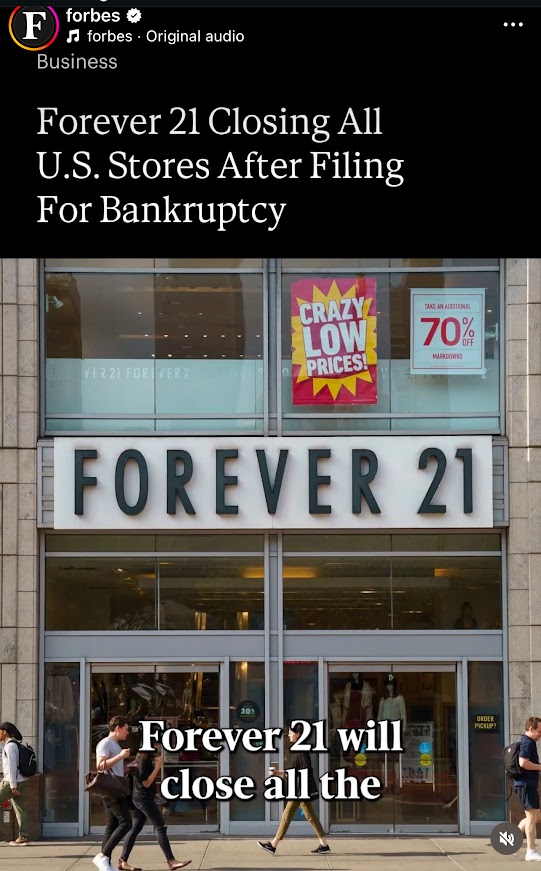
Forever 21 recently filed for bankruptcy – again. The clothier reorganized back in 2019. Now it is shutting down for good. According to recent reporting, the company plans to close all 354 stores in what the company calls “an orderly wind down” of its operations.
This is yet another hiccup revealing that the undercarriage of the U.S. economy is rickety.
Forever 21 isn’t drowning alone. Corporate bankruptcies reached a 14-year high last year. Party City, Kohl’s, JCPenney, and Joann Fabrics are among the retailers filing bankruptcies in recent months.
Goldman Sachs survey found that 91 percent of small business owners are struggling with the current economic impact on their industries. More than half (56 percent) reported that the situation has worsened since the beginning of the year.
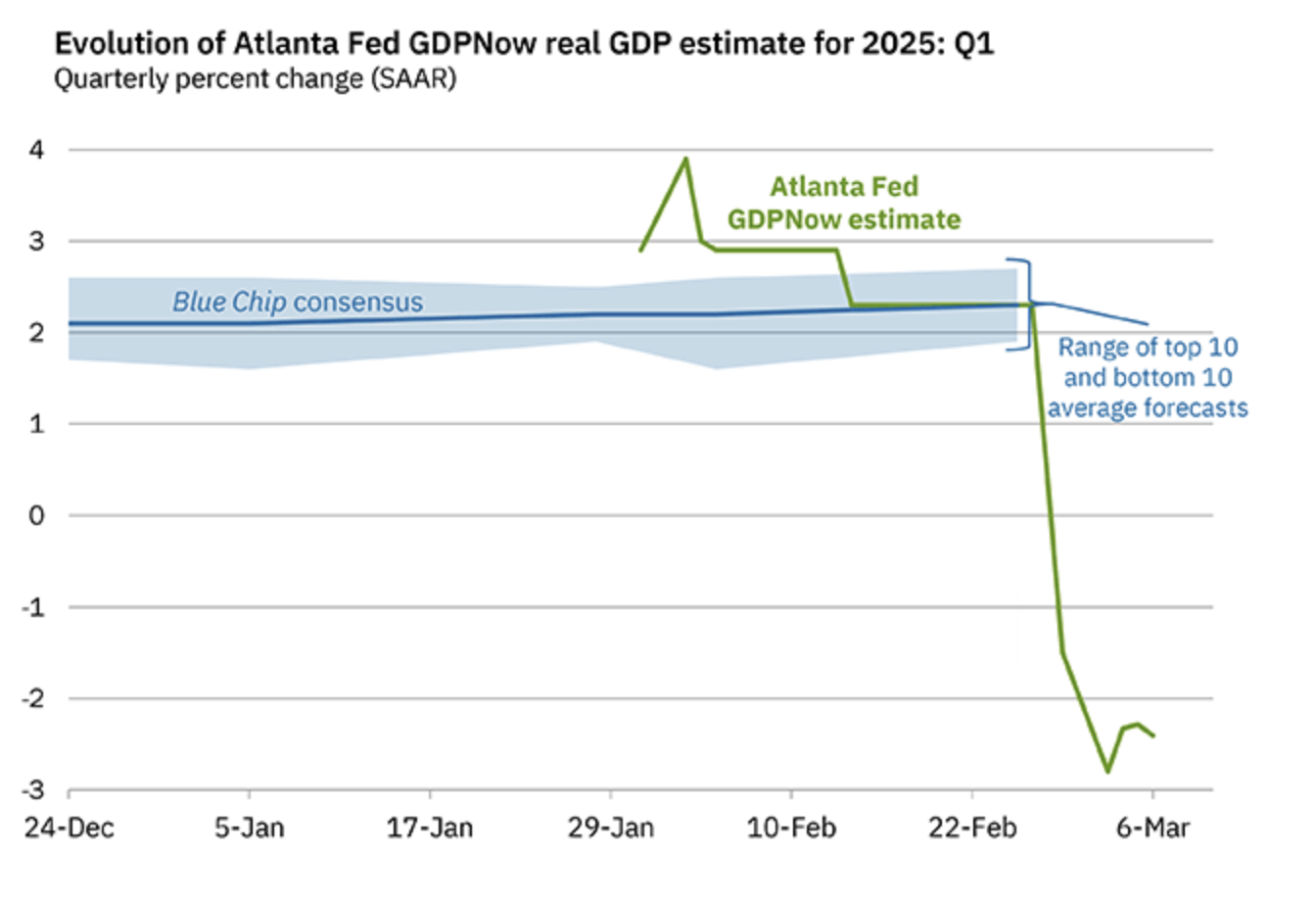
The problems are getting hard to ignore. After insisting the economy is booming for months, the mainstream suddenly developed a case of the yips, and we’re hearing chatter about a potential recession. The Atlanta Fed’s GDPNow forecast plunged from a 2.3 percent growth rate in late February to -2.8 percent within a matter of weeks.
Mainstream analysts tend to blame the trade war for the sudden recession worries, but the economy has been poised for a downturn for well over a year. Decades of easy money in the wake of the 2008 financial crisis created significant distortions and malinvestments in the economy, along with a massive debt bubble. The central bank was forced to take the easy money drug away due to price inflation. However, this economy is not built to operate in a normal interest-rate environment. This is why the markets are desperate for rate cuts.
A Sign of the Times
In an article published by the Mises Wire, economist Mark Thornton called the surge in business closures “a sign of the times,” emphasizing this is the inevitable consequence of central bank monetary malfeasance.
“It was not long ago when signs for ‘Help Wanted’ seemed to be in every store window. That is starting to be replaced in 2024 and 2025 with ‘Store Closing’ signs. This switcheroo tells us volumes about how people and the economy are adjusting to the Fed’s money-printing business. While the government and the wealthy elite benefit from the money printing, consumers and workers only seem to suffer.”
Thornton argues that the shifts we see in the economy are reflecting the response of entrepreneurs and business people as they adjust to monetary moves.
“According to the [Austrian Business Cycle Theory], firings, mass layoffs and closures are late-stage events that are predictable from the previous stages starting with the Fed’s money printing. It is not the result of some random or mysterious psychological process. Sure, managers make plenty of what appear to be bonehead decisions, but I don’t envy them for the tough decisions they have to make every day.
“We know it’s a Fed-caused business cycle because the trends happen in stages along with spikes in the data, rather than in a normal fashion, with no spikes and correlation—so large numbers of ‘Help Wanted’ signs followed later by large numbers of ‘Store Closure’ signs. The time of adjustment with business cycles is uncertain. We don’t know exactly how much time will be involved or exactly how events will unfold. We do know that Trump’s tariffs will make things worse, but not by how much.
“The ways in which people have been adapting are particularly illuminating to the cause of the cycle—the Fed’s money supply expansion, but also to the fact that it causes, not just higher prices, but that it does cause a cyclical disturbance and that it creates winners and losers, and that, above all else, paper money is not neutral!”
Thronton points out that store closures are visible signs of the times, however, entrepreneurs and managers have been working tirelessly trying to keep the economy afloat despite the monetary malfeasance.
“Business closures and startups are visible, but entrepreneurs and managers have been working at a frantic pace to keep companies operational and profitable enough to stay in business and expand. Staffing and shift changes, input mixes, technological fixes, product lines, and operating hours are just some of the noteworthy aspects or ‘margins’ of the business that have been changing at revolutionary speed compared to normal conditions. Of course, customers don’t like price hikes, surcharges, and automated tipping, but—under the circumstances—it is completely understandable.”
The reality is the malinvestments and debt bubbles incentivized by decades of easy money have to unwind eventually. While we have dealt with a surge of price inflation due to the rapid infusion of money into the economy during the pandemic, we still haven’t reckoned with the economic rot caused by well over a decade of easy money.
As Thornton summed it up, “The main source of our frustrations as consumers is the Federal Reserve.”
The markets are clamoring for deeper rate cuts hoping that it will save us from a recession. While more of the easy money drug might kick the can down the road for a while, it will also mean more inflation. And eventually, they will run out of road. We enjoyed a long easy money boom. Booms always come with a bust. And the bust is generally commensurate with the boom.
It’s likely too late for rate cuts to bail out the economy. The damage has been done, and it’s only a matter of time before we have to pay the price for those decades of monetary malfeasance. The economy is like a dry grassland during a drought. All it needs is a spark to catch fire. The trade war could be that spark.
This puts the Federal Reserve in a Catch-22. Given the escalating inflationary pressure, it needs to push hold rates steady or even push them higher. After all, it never did do enough to slay the inflation monster. The bottom line is that the inflation dragon isn’t dead. Sure, the Fed might have knocked it to the mat. But it’s not down for the count.
This is bullish for gold.
On the other hand, the central bank needs to cut rates because the economy is addicted to easy money. Given the levels of debt and the amount of malinvestment, the economy can’t function in this higher interest rate environment. It needs its easy money drug.
This is also bullish for gold.
Mike Maharrey is a journalist and market analyst for Money Metals with over a decade of experience in precious metals. He holds a BS in accounting from the University of Kentucky and a BA in journalism from the University of South Florida.
(Luis Cornelio, Headline USA) Have you bought a Tesla recently? Your phone number and home address, along with that of DOGE staffers, may have been posted on an online hit list.
Dubbed DOGEQuest, the hitlist features a U.S. map pinpointing the addresses of DOGE staffers, Tesla dealerships and charging stations, and even Tesla vehicles—presumably locating where they can be found.
DOGEQuest’s cursor sports a Molotov cocktail icon and appears to encourage users to vandalize Tesla vehicles, making clear its violent intent.
The website mocks its stated purpose: to connect “like-minded Tesla owners with one another, facilitating a vibrant community through shared contact information.”
The hitlist then encourages violence against Tesla vehicles, saying, “If you’re on the hunt for a Tesla to unleash your artistic flair with a spray can, just step outside—no map needed!” Though, it later clarifies that “DOGEQUEST neither endorses nor condemns any actions.”
Those who want their information removed must submit documentation proving they sold their Tesla. The website anticipates it will be taken down and even encourages users to copy its content.
As if that weren’t enough, the site appears to dox FBI Director Kash Patel, exposing his home and email addresses.
Musk described the website as “extreme domestic terrorism.”
Encouraging destruction of Teslas throughout the country is extreme domestic terrorism!! https://t.co/8TCNIbrQxA
The hitlist’s launch comes amid a series of violent attacks targeting Tesla vehicles and dealerships. The FBI and ATF are investigating damage to Cybertrucks at a dealership in Kansas City.
Moreover, hundreds of rioters gathered outside Tesla dealerships on Saturday in protest of Musk’s involvement in President Donald Trump’s DOGE task force.
Trump warned that those carrying out violence against Teslas could be charged with domestic terrorism, declaring: “I do think this is an act of domestic terrorism. When we catch those people, you will find out that they were paid by people who were very highly political on the left.”
🚨 President Trump on Attacks on Tesla:
"I do think this is an act of domestic terrorism. When we catch those people, you will find out that they were paid by people who were very highly political on the left." pic.twitter.com/p5mRuXyy9F
(Ken Silva, Headline USA) Previously classified documents related to the 1963 assassination of President John F. Kennedy were released Tuesday evening following an order by President Donald Trump shortly after he took office.
The 1,123 files were posted on the website of the U.S. National Archives and Records Administration. The vast majority of the National Archives’ collection of over 6 million pages of records, photographs, motion pictures, sound recordings and artifacts related to the assassination have previously been released.
Researchers were still poring over the new records as of the publication of this article.
One particular record—where Kennedy’s son, John F. Kennedy Jr., apparently called former President Joe Biden a traitor—went viral. That particular record, a Sept. 16, 1994, FBI report, references a handwritten letter from JFK Jr. to then-Sen. Biden.
“Dear Sen. Biden: You are a traitor …,” the letter stated, according to the FBI.
No more details have been released about that FBI report. While the record went viral Tuesday evening, it has been public since at least 2018. According to historyhub.history.gov, the letter may not even have been from JFK Jr.
“The FBI records indicate that despite recovering four latent fingerprints the FBI and Capitol Hill Police were never able to determine the actual identity of the author of the letter,” a post on the government-run forum stated in 2018.
“The letter appears to have been written by an impostor or possibly someone else who shared the name of John F. Kennedy, Jr. If it had been written by the son of JFK then it would have been a simple matter to match the fingerprints to him. Instead, the case was closed with no suspect identified.”
Back to the new documents: Larry J. Sabato, director of the University of Virginia Center for Politics and author of “The Kennedy Half-Century,” said he had a team that started going through them, but it may be some time before their full significance becomes clear.
“We have a lot of work to do for a long time to come, and people just have to accept that,” he said.
Trump told reporters Monday that has administration will be releasing 80,000 files, though it’s not clear how many of those are among the millions of pages of records that have already been made public.
“We have a tremendous amount of paper. You’ve got a lot of reading,” Trump said while visiting the John F. Kennedy Center for the Performing Arts in Washington.
Researchers have estimated that 3,000 or so files had not been released, either in whole or in part. And last month the FBI said it had discovered about 2,400 new records related to the assassination.
Many who have studied what’s been released so far by the government say the public shouldn’t anticipate any earth-shattering revelations from the newly released documents, but there is still intense interest in details related to the assassination and the events surrounding it.
Trump’s January order directed the national intelligence director and attorney general to develop a plan to release the records.
Kennedy was killed on Nov. 22, 1963, on a visit to Dallas. As his motorcade was finishing its parade route downtown, shots rang out from the Texas School Book Depository building. Police arrested 24-year-old Lee Harvey Oswald, who had positioned himself from a sniper’s perch on the sixth floor. Two days later, nightclub owner Jack Ruby fatally shot Oswald during a jail transfer.
In the early 1990s, the federal government mandated that all assassination-related documents be housed in a single collection in the National Archives and Records Administration. The collection was required to be opened by 2017, barring any exemptions designated by the president.
Trump, who took office for his first term in 2017, had said that he would allow the release of all of the remaining records but ended up holding some back because of what he called the potential harm to national security. And while files continued to be released during President Joe Biden’s administration, some remained unseen.
Sabato said that his team has a “long, long list” of sensitive documents it is looking for that previously had large redactions.
“There must be something really, really sensitive for them to redact a paragraph or a page or multiple pages in a document like that,” he said. “Some of it’s about Cuba, some of it’s about what the CIA did or didn’t do relevant to Lee Harvey Oswald.”
The Associated Press contributed to this report.
Ken Silva is the editor of Headline USA. Follow him at x.com/jd_cashless.