New York’s Casino Sweepstakes Could Put $115M in Donald Trump’s Pocket

(Headline USA) A high-stakes contest to decide who gets to build a casino in New York City could potentially result in a $115 million jackpot for President Donald Trump.

The Republican stands to win big if state officials award one of three available gaming licenses to Bally’s Corp., which wants to open a casino at a city-owned golf course that used to be run by Trump’s company.

In 2023, Bally’s paid Trump $60 million for the rights to operate the public 18-hole course on the Bronx shoreline, near where the East River meets the Long Island Sound.

The gaming company promptly took down the massive “Trump Links” sign that was, at one time, all but impossible to miss for drivers going the Whitestone Bridge, and renamed the course Bally’s Golf Links at Ferry Point.

But under a little-noticed side deal, Bally’s promised to pay Trump another $115 million if Bally’s were to get a license to open a casino on site.

The letter disclosing that deal was included as an evidence exhibit in a trial over New York state’s allegation that Trump habitually lied about the worth of his assets in financial statements given to banks. The letter says the $115 million payment would be nonrefundable and describes it as a “gaming event fee.”

Bally’s did not return requests for comment.

Trump’s interest in Bally’s project could be a wildcard in New York’s casino sweepstakes.

At least 11 bidders have said they are competing for the right to build what would be the first, full-service casino in the city and its nearest suburbs.

The race has drawn in big players: Caesars Palace has a plan to build a casino in Times Square; the company that owns Saks Fifth Avenue wants to put a casino atop their luxury department store in Manhattan; and Steve Cohen, the owner of the New York Mets, is proposing a casino right outside the baseball team’s home stadium in Queens.

Another two bidders are hoping to expand on existing operations. MGM Resorts wants to do a major upgrade of its existing Empire City “racino,” located at a horse track in the suburb of Yonkers. The gaming company Genting wants to do a multibillion expansion of its Resorts World racino adjacent to the Aqueduct horse track in Queens. Those two gambling venues are now limited by law to slot machines and certain other machine-run games.

It is unclear how Trump’s link to one of the bidders might affect the selection process.

Applications are supposed to be submitted to a state board by late June. First, they will be considered by community advisory committees made up of appointees of the governor, mayor and state and local officials. Their job will be to weigh any local support or opposition. The proposals then go back to the state’s gaming board, which expects to award the licenses by the end of the year.

Applicants also have to get various zoning or land-use approvals depending on the location and scope of their projects. Bally’s project is also expected to require the state Legislature to pass a bill allowing the company to build their casino on public parkland.

The federal government does not play any role in the state’s casino license selection process. The Trump Organization did not immediately return an emailed request for comment.

Trump remains highly unpopular among many public officials in New York who will be in a position to influence the process, and it is possible that antipathy could wind up being a handicap for Bally’s bid.

There’s also a chance someone might try to use Trump’s financial interest as a bargaining chip.

New York Gov. Kathy Hochul has clashed with the Trump administration over immigration policy, federal funding for the city’s subway system and a tolling program in Manhattan.

The Trump administration is also trying to revive a plan to build a natural gas pipeline through New York that was halted in 2017 by state environmental regulators.

New York City Mayor Eric Adams, meanwhile, has been under intense pressure to prove his political independence after the Justice Department moved to drop his corruption case so he could assist with the Trump administration’s immigration agenda.

Trump, whose Trump Organization runs more than a dozen golf courses around the world, first acquired the rights to manage Ferry Point in 2012.

The city spent more than $120 million to build the Jack Nicklaus-designed course on an old landfill, envisioning an East Coast version of the famed Pebble Beach links in California and major championships that never materialized.

Adapted from reporting by the Associated Press
Moody’s Warns of Deteriorating U.S. Creditworthiness

(Mike Maharrey, Money Metals News Service) Would you loan money to Uncle Sam? That’s becoming a pertinent question as the U.S. government’s fiscal situation continues to deteriorate.

The national debt surged over $36 trillion last fall, and despite some cutting by DOGE, there is no sign that the spending is going to slow down. The proposed federal budget for next year would add trillions to the already massive deficits.

This malfeasance has grabbed the attention of the folks over at Moody’s Ratings.

Last week, Moody’s released a pessimistic report on America’s creditworthiness.

“The US’s fiscal strength is on course for a continued multiyear decline, driven by widening federal budget deficits, a rising debt burden and falling debt affordability.”

In November 2023, Moody’s lowered its outlook on the U.S. government credit from “stable” to “negative.” This is often a prelude to a downgrade in the country’s AAA credit rating.

Moody’s is the last of the major credit rating agencies to keep U.S. debt at a AAA rating. Standard & Poor’s (S&P) cut the U.S. sovereign rating a notch from AAA to AA+ way back in 2011. Fitch followed suit last year, citing “the expected fiscal deterioration over the next three years.”

In its most recent outlook, Moody’s said U.S. fiscal disorder would be a problem even in the absence of a trade war and the potential for an economic downturn due to rising interest rates.

“Even in a very positive and low probability economic and financial scenario, debt affordability remains materially weaker than for other AAA-rated and highly rated sovereigns.”

Interest on the national debt cost $85.87 billion in February. That brought the total interest expense for the fiscal year to $478.05 billion, up 10.3 percent over the same period in 2024.

So far in fiscal 2025, the federal government has spent more on interest on the debt than it has on national defense ($399 billion) or Medicare ($443 billion). The only higher spending category is Social Security.

Uncle Sam paid $1.13 trillion in interest expenses in fiscal 2023. It was the first time interest expense has ever eclipsed $1 trillion. Projections are for interest expense to break that record in fiscal 2025.

Much of the debt currently on the books was financed at very low rates before the Federal Reserve started its hiking cycle. Every month, some of that super-low-yielding paper matures and has to be replaced by bonds yielding much higher rates. And even with the recent Federal Reserve rate cuts, Treasury yields have pushed upward as demand for U.S. debt sags.

The dollar’s status as the world’s reserve currency and its overall strength globally has allowed the federal government to maintain its credit rating despite the irresponsible borrowing and spending in Washington D.C. However, Moody’s asserts that the dollar’s status is getting shaky, and the trade war drama further complicates the U.S. debt picture.

“We see diminished prospects that these strengths will continue to offset widening fiscal deficits and declining debt affordability.”

The Bipartisan Policy Center recently pointed out that the growing national debt and the mounting fiscal irresponsibility undermine the dollar.

“Confidence in U.S. creditworthiness may be undermined by a rapidly deteriorating fiscal situation, an increasing concern with federal debt set to grow substantially in the coming years.”

We can see the shakiness in the dollar’s status through escalating de-dollarization efforts around the world.

Many seem optimistic that the U.S. can get its fiscal house in order. They cite the success of DOGE in ferreting out wasteful spending. But Moody’s said DOGE cuts will be “small relative to mandatory spending and unlikely to result in significant savings over the near term.”

The reality is that even if the Trump administration manages to slash discretionary spending as promised, it only accounts for 27 percent of total spending. The vast majority is for entitlements, and there is little political will to take the scissors to Social Security or Medicare.

Making matters worse, Congress seems reluctant to get on board based on its proposed budget and the recent continuing resolution that fully funded much of the spending pinpointed by DOGE.

Given the gloomy Moody’s report, it might not be long before the agency downgrades U.S. debt, giving U.S. politicians another black eye.


Mike Maharrey is a journalist and market analyst for Money Metals with over a decade of experience in precious metals. He holds a BS in accounting from the University of Kentucky and a BA in journalism from the University of South Florida.

Should Germany Pull Its Gold Out of the U.S.?

(Mike Maharrey, Money Metals News Service) Can the U.S. be trusted with German gold? That’s a question being asked by some German officials.

Germany ranks second in gold reserves behind the U.S. It officially holds 3,352 tonnes of gold with about 1,236 tonnes (37 percent) held in Federal Reserve vaults in the U.S.

Some are wondering whether holding over €100 billion in gold so far away is wise, given the geopolitical climate.

European Taxpayers’ Association spokesperson Michael Jäger told The Bild that Germany should bring that gold home.

“The Bundesbank and the federal government must show foresight in this phase of global political power shifts and immediately bring back German gold from the USA. Especially at a time when immense new debt is being discussed in Berlin and Brussels, we need immediate access to all gold reserves in an emergency.”

Jäger said at the very least, the German government should “conduct a review of the reserves” held in New York and run physical tests on the bars.

This echoes calls from many in the U.S. for an audit of U.S. gold reserves stored in Ft. Knox.

A European parliament member is also calling for an audit of German gold. Markus Ferber told The Bild, “I demand the regular control of the German gold reserves. To do this, official representatives of the Bundesbank must personally count the bars and document their results.”

However, Bundesbank President Joachim Nagel has played down concerns, saying, “We have a trustworthy and reliable partner in the Fed in New York for the storage of our gold holdings.”

“It does not keep me awake at night. I have complete confidence in our colleagues at the American central bank.”

This may sound like a lot of political posturing, but Germany started bringing some of its gold home in 2013. The goal was to hold at least half of its reserves back within its borders by 2020. By the end of 2017, it had repatriated 674 tonnes of gold – 300 from New York and 374 from Paris.

Germans Aren’t Alone in Wanting Gold Closer to Home

Germans aren’t the only ones worried about keeping gold outside their borders. Several countries have repatriated gold over the last several years.

In 2019, Poland brought home 100 tons of gold. Hungary and Romania also repatriated some of their gold reserves around that same time. In 2015, Australia launched efforts to bring half of its reserves home. The Netherlands and Belgium have also initiated repatriation programs.

When Poland brought its gold home, National Bank of Poland Governor Adam Glapiński said that gold “symbolizes the strength of the country.”

More recently, the Reserve Bank of India brought 100 tonnes of gold home last year.

This gold repatriation trend underscores the importance of holding physical gold free from counterparty risk.

Anxiety has increased given the way the U.S. has weaponized the dollar as a foreign policy tool. This has made many world leaders wary of keeping financial assets outside of their direct control.

According to a World Gold Council survey in 2023, a “substantial share” of central banks expressed concern about potential sanctions after the U.S. and other Western countries froze almost half of Russia’s $650 billion gold and forex reserves in the wake of its invasion of Ukraine. According to the WGC, 68 percent of the banks surveyed said they plan to keep their gold reserve within their country’s borders. This was up from 50 percent in 2020.

One anonymously quoted central bank official told Reuters, “We did have it [gold] held in London… but now we’ve transferred it back to our country to hold as a safe haven asset and to keep it safe.”

Invesco head of official institutions Rod Ringrow told Reuters this reflects a widely held view.

“‘If it’s my gold, then I want it in my country,’ has been the mantra we have seen in the last year or so.”

There has been speculation that countries have been moving gold and other assets out of the U.S. in the wake of economic sanctions on Russia. Still, it’s been difficult to confirm because of a lack of transparency.

Simply put, the Federal Reserve refuses to release detailed information on the amount of gold in its vaults.

Last year, Fed Chairman Jerome Powell evaded questions about the central bank’s foreign gold holdings posed by Rep. Alex Mooney (R-W.Va). The U.S. central bank has also declined to comply with a Freedom of Information Act request for records about such holdings.

As investigative reporter Ken Silva wrote, Headline USA filed a FOIA request with the Fed for records reflecting how much gold the Federal Reserve Bank of New York currently holds in its vault, as well as records reflecting the ownership stake that each of FRBNY’s central bank/government clients have in that gold following Powell’s evasive response. The FOIA request also sought records about the Fed’s gold holdings before Russia’s February 2022 invasion of Ukraine.

The Fed denied the request.

At this point, the Bundesbank seems content with the status quo, but voices calling for the gold to come home aren’t going away. Given the geopolitical turmoil caused by the trade war, we will likely hear these voices getting louder.


Mike Maharrey is a journalist and market analyst for Money Metals with over a decade of experience in precious metals. He holds a BS in accounting from the University of Kentucky and a BA in journalism from the University of South Florida.

Swap U.S. Gold Reserves for Bitcoin… Seriously?

(Clint Siegner, Money Metals News Service) Washington D.C. is still a prime breeding ground for bad ideas. One of the dumbest, and more dangerous, is the idea of swapping U.S. gold reserves for Bitcoin.

In fairness, we should first mention we are encouraged by the growing acceptance by a handful of policymakers of alternative, non-government forms of currency.

U.S. Senator Cynthia Lummis of Wyoming began advocating for swapping U.S. gold for Bitcoin shortly after Donald Trump won the election last fall. It was music to the ears for a number of young crypto enthusiasts who, in their overwhelming zeal, have attempted to position Bitcoin as a superior alternative to gold.

alt_text

Bitcoin and gold may share some of the honest money fanbase, but that is about as far as any similarities go. One is tangible and time-tested. The other is entirely digital and relatively brand new. Both assets have their own strengths and weaknesses.

However, it’s a little bizarre to see people pitching Bitcoin as a replacement for gold, and it’s a little suspicious.

Why so much effort to convince gold investors that Bitcoin is better and divide the honest money crowd? Shouldn’t there instead be a focus on bringing new people into the movement – the overwhelming majority of people who hold neither gold nor Bitcoin?

Bitcoin was designed as an alternative to fiat money, not gold. The creator of the project, known by the pseudonym Satoshi Nakamoto, wanted a currency which is used by everyone and outside the control of Wall Street banks, central banks, and governments.

Instead of pressing for Satoshi’s vision, people like Senator Lummis want to see the federal government simply swap gold for Bitcoin. But she ought to consider whether making it a “reserve” asset is of any benefit whatsoever to the cryptocurrency or for her constituents.

Start with a look at history.

Gold is the original reserve asset.

The reason the U.S. government has more than 8,000 tonnes is that the dollar was once redeemable in gold. The Treasury therefore needed a stockpile or reserve. Then the government abandoned the gold standard and defaulted on the promise to redeem.

There is little reason to believe any reserve asset, including BTC, will be used for public benefit.

Pretty much nobody is advocating for dollars to be redeemable in Bitcoin, which makes the argument for holding it as a reserve somewhat disingenuous.

Proponents simply believe the token will outperform gold as an investment. They want to see the Treasury dump thousands of tonnes of gold and place a massive speculative bet in crypto markets.

Setting aside the dangers of such speculation, we wonder exactly what the “Bitcoin reserve” crowd expects will happen if Bitcoin turns out to be a home-run investment for the Treasury.

Will they simply feel better when the federal government has trillions of dollars worth of Bitcoin on the books – or are they expecting officials to do something with it?

Maybe they imagine officials will do something positive, like use the massive trove of Bitcoin to pay off federal debt. If so, they probably won’t be pleased when the Treasury floods the market with BTC in order to raise cash so they can do so.

Senator Lummis suggests a Bitcoin reserve might help “financial innovation” and promote “economic security.” She doesn’t provide details, so we’re supposed to take that on faith.

Politicians prefer fiat money and expanded government control. Theories which incorporate this history will be far more plausible than whatever the Bitcoin reserve proponents are hoping for.

We’ll offer one such theory, by way of example. Officials are already discussing the next evolution in fiat money — a Central Bank Digital Currency (CBDC). CBDC tokens can be created without limit, like fiat money, but provide transaction tracking and control.

Perhaps Bitcoin (and maybe the gold reserves too) will be used in a “basket” of assets to add legitimacy and appeal to the CBDC officials are planning.

Suffice it to say that Bitcoiners should take a lesson many goldbugs learned long ago. It’s probably not a good idea for governments to get involved in any system of money.


Clint Siegner is a Director at Money Metals Exchange, a precious metals dealer recently named “Best in the USA” by an independent global ratings group. A graduate of Linfield College in Oregon, Siegner puts his experience in business management along with his passion for personal liberty, limited government, and honest money into the development of Money Metals’ brand and reach. This includes writing extensively on the bullion markets and their intersection with policy and world affairs.

Brits Selling Gold Dental Work to Pay Bills

(Mike Maharrey, Money Metals News Service) Have you ever thought, “I’d give my eye teeth for some money?” Apparently, some people in the United Kingdom have gotten to that level of desperation.

According to an article in The Sun, people are selling gold dental work to pay bills.

Jon White said the gold company he works for is buying as much as £100,000 in gold a day as the price climbs, and many Brits are struggling economically.

 “Some have resorted to removing gold crowns to raise cash to pay bills, which is distressing.”

He went on to explain that many people’s bills go up in April, and they are strapped for cash.

“Trading in their gold is a good option.”

Along with “a steady increase in gold teeth,” Gold Traders is buying wedding rings, gold chains, bracelets, and gold sovereign coins.

Other gold dealers have reported a significant increase in the number of people selling gold. The online marketplace Bullion Vault told the Telegraph that investors selling gold increased by 65 percent month-on-month in January.

“Shops have been drowning in customers selling back over the past 18 months to take profit as prices jump, whether in the UK, US or even Germany.”

The price of gold is up over 17 percent so far this year and has set multiple records along the way. That’s on top of a 26.5 percent gain in 2024.

The rising gold price isn’t just driving selling. Many investors in the UK are buying gold, hoping to cash in on a continued bull run. The Royal Mint has reported “intense demand” for the yellow metal.

A Lifeline

The uptick in Brits selling gold to pay bills underscores one of the benefits of holding the yellow metal – it can serve as a lifeline in a time of financial stress.

For instance, gold helped many Indians weather the economic storm caused by government shutdowns during the pandemic.

The government’s response to COVID-19 ravaged the Indian economy. As a result, many banks were reluctant to extend credit due to default worries. To make ends meet, many Indians used their stashes of gold to secure loans.

Using gold as collateral for loans has a long history in India. For generations, farming communities and rural households used gold as a means of financing, often pledging it as collateral to raise funds to plant the following year’s crops. Today, Indians in urban settings often use gold loans to meet expenditures for healthcare, business, education, and marriage.

In a nutshell, gold provides liquidity for people when they wouldn’t have it otherwise.

And unlike fiat currency, gold’s value does not depreciate over time. If you hold cash for an emergency, you’ll have less purchasing power when you need it. However, gold will maintain its value, and during bull runs, it can even increase.

Gold was also a major source of liquidity in 2016 when the Indian government launched a demonetization scheme. In November of that year, the Indian government declared that 1,000 and 500 rupee notes would no longer be valid. They gave the public just four hours’ notice. At the time, 1,000 and 500 rupee notes made up 86 percent of the currency in circulation. With a single pronouncement, the Indian government made virtually all of the cash in India valueless.

The bottom line is that gold is money. It has been money for 5,000 years and will continue to be money long after fiat currencies meet their demise. No matter where you are in the world, you will be able to find somebody willing to transact business in gold – even if you have to pull it out of your mouth.


Mike Maharrey is a journalist and market analyst for Money Metals with over a decade of experience in precious metals. He holds a BS in accounting from the University of Kentucky and a BA in journalism from the University of South Florida.

BRICS Nations Pushing Forward With Alternative Global Payment System

(Mike Maharrey, Money Metals News Service) BRICS continues to develop a cross-border payment system that would provide an alternative to SWIFT and minimize reliance on the dollar. Success in the endeavor would accelerate de-dollarization and create significant problems for the U.S. economy.

Russia has been pushing particularly hard for the BRICS bloc to consider an alternative payment network to replace the dollar-denominated SWIFT system. It’s an ambitious plan easier said than done. After the BRICS fall summit in Kazan, Russian President Vladimir Putin conceded that there was no immediate plan, saying the economic bloc “have not and are not” creating such a system.

However, it appears that BRICS has pushed forward with plans and is making headway.

BRICS is an economic cooperation bloc originally made up of Brazil, Russia, India, China, and South Africa. As of January 1, 2024, the bloc expanded to include Egypt, the UAE, Iran, and Ethiopia. Saudi Arabia has also been formally invited to join but has yet to accept the invitation formally. Turkey, Azerbaijan, and Malaysia have formally applied to become members.

Last week, Russian Finance Minister Anton Siluanov emphasized that the buildup of financial infrastructure is crucial for the development of trade and the broader economies of BRICS nations.

“We are considering our various financial innovations on the BRICS floor, including the cross-border payment system that can be based, further to bilateral settlements, on national currencies with consideration of digital technologies and digital financial assets.”

According to an article published by MSN, the weaponization of the dollar by the U.S. and its Western allies has accelerated the development of BRICS-Pay. The system facilitates trade in national currencies, cutting the dollar out of the loop.

As the balance of global economic power shifts, BRICS nations are moving to reshape the international financial system, challenging the dominance of the U.S. dollar.

The article went on to assert, “The initiative aims to strengthen BRICS’s financial infrastructure and reduce reliance on the U.S. dollar.”

U.S. foreign policy has significantly sped up de-dollarization efforts.

The U.S. and other Western countries aggressively sanctioned Russia in the wake of its invasion of Ukraine. America and its allies locked Russia out of the SWIFT financial system and froze around $300 billion in Russian central bank assets.

Other countries took notice.

Using dollars as weapons may seem like an effective way to keep the “bad guys” in line, but it comes with risks.

Consider this: if you recognize something that makes you vulnerable, what do you do?

You take steps to eliminate or minimize the vulnerability.

So, if you’re worried that the U.S. and its allies might cut off your access to dollars, what would you do?

Minimize your dependence on dollars.

In other words, if you are concerned that the U.S. could pull the “dollar rug” out from under you, why not pull out from the dollar system first?

This is exactly what BRICS is trying to do.

MSN put it this way: “As U.S. sanctions and soaring debt pressure global economies, BRICS nations and other Global South economies are intensifying efforts to establish financial mechanisms that reduce their exposure to U.S. sanctions and dollar volatility.”

The economic bloc has not developed a unified currency, but BIRCS Pay could expand the use of digital versions of the yuan and the Russian ruble in international trade.  According to the MSN article, 95 percent of trade between Russia and China is already settled in rubles and yuan.

Why It Matters

The U.S. needs the world to need its dollars.

Since the global financial system runs on dollars, the world needs a lot of them, and the United States depends on this global demand to underpin its bloated government. The only reason the U.S. can borrow, spend, and run massive budget deficits to the extent that it does is the dollar’s role as the world reserve currency. It creates a built-in global demand for dollars and dollar-denominated assets. This absorbs the Federal Reserve’s money creation and helps maintain dollar strength despite the Federal Reserve’s inflationary policies.

But what happens if that demand drops? What happens if BRICS nations and other countries don’t need as many dollars?

A de-dollarization of the world economy would cause a dollar glut. The value of the U.S. currency would further depreciate. At the extreme, global de-dollarization could spark a currency crisis. You and I would feel the impact through more price inflation eating away at the purchasing power of the dollar. In the worst-case scenario, it could lead to hyperinflation.

The world doesn’t have to completely abandon the dollar to create negative impacts. Even a modest drop in the demand for dollars will ripple through the U.S. economy.


Mike Maharrey is a journalist and market analyst for Money Metals with over a decade of experience in precious metals. He holds a BS in accounting from the University of Kentucky and a BA in journalism from the University of South Florida.

The Coinage Act of 1792: Then and Now

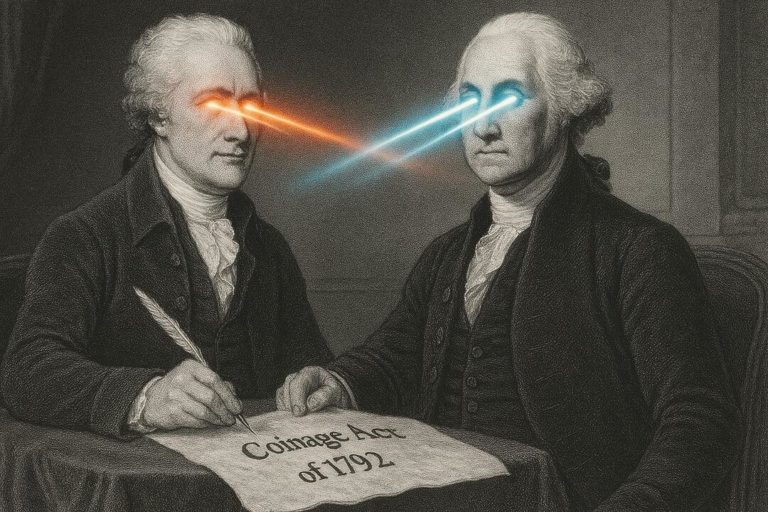
(Joshua D Glawson, Money Metals News Service) Long before fiat currency, digital dollars, or cryptocurrency, America’s Founders sought to anchor the young nation’s economy in gold and silver, i.e. sound money.

In fact, on April 2, 1792 – 233 years ago – President George Washington signed legislation that established America’s monetary system.

Also known as the Mint Act and officially titled An Act Establishing a Mint and Regulating the Coins of the United States, The Coinage Act of 1792 is regarded as one of the most foundational laws in U.S. history.

Of the Founding Fathers, Thomas Jefferson, James Madison, John Adams, and George Washington each advocated that gold and silver coins should be the money of the nation.

America’s first Treasury Secretary and fellow Founding Father, Alexander Hamilton, advocated for a hard-metal standard and helped design the U.S. dollar based on the widely circulated Spanish milled dollar—also known as the “Spanish real” or “pieces of eight.”Before authoring the Coinage Act, Hamilton warned in 1790, “To emit an unfunded paper as the sign of value, certainly has some advantages of a temporary nature, but it is calculated to produce great mischiefs in the long run.”

It was this seminal sound money law that established the United States Mint in Philadelphia, created a decimal currency system, defined U.S. coins by weight and metal, and authorized a gold and silver standard. It followed the intent of the Constitution itself.

When people refer to “Constitutional money,” they are referring to gold and silver coins.

Article 1, Section 8, Clause 5, of the US Constitution, says of the federal government, “Congress shall have Power… to coin Money, regulate the Value thereof, and of foreign Coin, and fix the Standard of Weights and Measures.”

Article 1, Section 10, Clause 1, says of the states, “No State shall… make any Thing but gold and silver Coin a Tender in Payment of Debts.”

The Coinage Act of 1792 codified this Constitutional wording, establishing gold and silver coins (also known as specie) as official tender instead of paper currency or fiat currency.

The Coinage Act went further by legally fixing the gold-to-silver ratio at 15:1 (meaning 15 ounces of silver is equal to 1 ounce of gold) and then pegged the U.S. dollar (denominated in gold and silver) to this ratio. This bimetallic standard, also known as bimetallism, defined the country’s currency by two precious metals, i.e. gold and silver. It created a uniform and stable coinage system that could compete on an international scale.

For $1 silver coins, the weight was set at 371.25 grains of pure silver, or 416 grains of standard silver (≥89.24% pure silver). This equals around 0.7734 troy ounces of pure silver or 0.8667 troy ounces of standard silver. These weights and purity corresponded with the popularly circulated Spanish reales (“pieces of eight”), which had around 377.1668 grains of pure silver (24.44 grams).

For $10 gold Eagles, the standard weight was 247.5 grains of pure gold, or 270 grains for standard gold (≥91.67% pure gold). This equals around 0.5156 troy ounces of pure gold or 0.5625 troy ounces of standard gold. These measurements were based on the popular coins of the day, including the Spanish 8 escudos doubloon.

With money made from gold or silver, inflation was almost non-existent, the government was far more restricted, and people were able to afford more with less while paying off debts and planning for the future.

Since 1792, there have been at least a dozen changes to the U.S. currency and monetary system, essentially redefining the meaning of the U.S. dollar. The changes were often slow and methodical, but simultaneously detrimental and the antithesis of everything the Constitution and the Founders intended.

The country abandoned bimetallism through the Coinage Act of 1873, widely known as “The Crime of ‘73,” by demonetizing silver as a part of the monetary system. Then in 1900, the country established a gold-only standard under the Gold Standard Act.

By 1933, the U.S. would no longer embrace gold at all, at least domestically, and this would lead to a heavy devaluation of the purchasing power of USD. Per government statistics, this equates to around 96.02% loss of purchasing power since 1933.

In 1965, silver was eliminated from coins, and by 1971, the country adopted a fully fiat currency. $1 purchasing power in 1971 now requires around $8. This means USD has lost around 87.5% purchasing power since 1971.

The monetary policy shift away from gold and silver Constitutional sound money to fiat currency has created widespread adverse inflation, a tyrannically unaccountable governing body, and the cost of living and properly planning for the future has become oppressively burdensome.

The Founders and the Constitution warned against this very thing, which is why Congress established the Coinage Act of 1792.

While this demonstrable currency debasement is an ongoing federal battle, Money Metals and the Sound Money Defense League have been actively fighting to restore sound money policies at the state level since 2014. Together, they have been consistently working to restore the sound money principles enshrined in the Constitution and the Coinage Act of 1792.

In 2024 alone, the Sound Money Defense League directly helped seven states enact sound money policies supporting gold and silver as sound money. These vital steps are bringing us closer to reestablishing gold and silver as honest and reliable money.

To get informed or involved with this grassroots sound money movement and a return to Constitutional money, stay connected with Money Metals and the Sound Money Defense League.


Joshua D. Glawson is Content Manager for Money Metals and is writer on such topics as politics, economics, philosophy, finance, and personal development. He has a Bachelor’s in Political Science from the University of California Irvine.

Tim Walz Admits He Can Be ‘a Train Wreck’

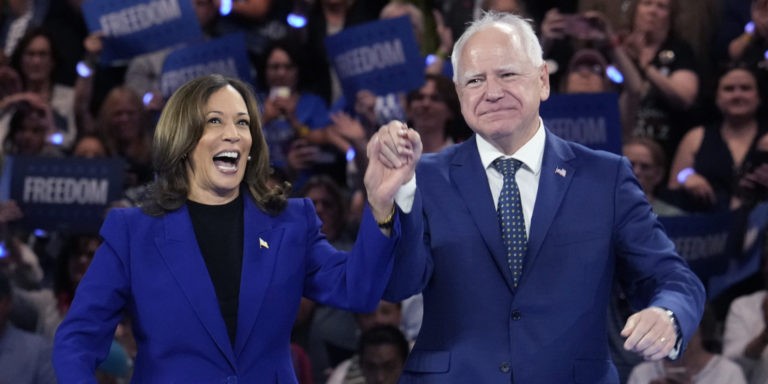
(Maire Clayton, Headline USA) Minnesota Gov. Tim Walz admitted that he can be a bit of “a train wreck” in a recent Monday interview published in New York Magazine.

Walz said he believes Democrats are risk averse and that contributed to the failed presidential campaign of former Vice President Kamala Harris.

“I think we’re cautious by nature. And look, I said this and I told the vice-president, I said I know my strengths and weaknesses,” Walz began.

I said about 90 percent of the time, I can be really good, but about 10 percent of the time, I can be a train wreck because I’m speaking from the heart, like a teacher sitting in a teachers lounge or a laborer sitting at the break table.”

Walz implied he was still shocked over the outcome and tried to act as though voters stayed home.

“I thought they would choose the district attorney and the teacher over the hedge-fund manager and the billionaire,” the failed vice presidential candidate continued.

President Donald Trump captured all swing states in the November 2024 election in addition to receiving the Popular Vote.

Walz stopped short of criticizing Harris’s disastrous campaign.

“Well, I won’t critique the campaign. They need to do what they need to do, but I don’t think Vice-President Harris got to be bold. We were dealing with a short runway,” Walz said.

The Minnesota governor continues to gaffe and make moronic comments.

In late March, Walz thought it was a good idea to say how happy it makes him to watch the Tesla stock go down. After experiencing a wave of backlash over the comments, he unsuccessfully tried to act as though it was a joke.

“I have to be careful about being a smart-ass. I was making a joke,” he later stated. “These people have no sense of humor. They are the most literal people.”

Dog Coats, Manatee Meat and Monkeys among Canada’s Retaliatory Tariffs

(Maire Clayton, Headline USA) Canada decided to impose a long list of retaliatory tariffs with a few obscure and bizarre ones.

The 25% tariffs include products such as dog coats, dog food, and animal meat (camels, primates and manatees), according to CTV News.

Live animals are also going to be hit with tariffs including “primates, camels and manatees,” per the outlet.

CTV News noted more than 6,200 items will soon have tariffs.

“Emus and other birds, decoy birds, and explosive bird-scaring devices,” also made the cut.

It will soon cost Canadians 25% more if citizens decide they want to record their thoughts in a diary as well.

Ian Lee, a professor at Carleton University’s Sprott School of Business, told the outlet the list appears to just be politically motivated.

“Why would you list such a plethora of small, obscure products?” Lee said. “I think it’s being driven by the need to produce visible optics, and so they can say, ‘Look, we’ve got six thousand, two hundred (items), we’re really going at this, we’re really sticking it to Donald Trump and the Americans.'”

Social media users had a wide variety of responses from annoyance with the insanity to making jokes about the nonsensical tariffs.

“This is yet another example of how out of touch government is with the times,” one user wrote.

Another jokingly had follow up questions regarding the manatee meat.

“I noticed you specifically said manatee ‘meat’, so manatee nuggets are exempt? And while we’re on the subject .. can you stop labeling Canadian caught manatees as ‘Florida Manatees’ everyone can taste the difference.”

Economics professor Jason Childs told the Canadian outlet he believes the obscure items are just attempting to make the country’s response more impressive.

“These are some odd items to be sure,” Childs said. “This is likely about things that aren’t going to make too many Canadians mad.”

President Donald Trump’s “Liberation Day” is set to take effect on Wednesday. Trump is expected to issue a long list of tariffs that will take immediate effect, according to the Washington Post.

Trump Administration Doubles Down on Gang Deportations to El Salvador

(Headline USA) On Monday, the Trump administration announced the deportation of 17 additional individuals described as “violent criminals” affiliated with the Tren de Aragua and MS-13 gangs, sending them to El Salvador. This move reinforces a controversial policy of removing people from the United States to third-party countries, despite ongoing criticism regarding transparency and human rights concerns.

According to the State Department, the deportations took place Sunday evening and included individuals accused of murder and rape, although specific details regarding their nationalities or alleged offenses were not provided. However, the office of El Salvador’s President Nayib Bukele confirmed that the group included Salvadoran and Venezuelan nationals.

“These criminals will no longer terrorize our communities and citizens,” Secretary of State Marco Rubio declared in the statement. “Once again, we extend our gratitude to President Bukele and the government of El Salvador for their unparalleled partnership.”

According to the State Department, the men were flown to El Salvador by the U.S. military. Video footage released by the Salvadoran government shows the deportees arriving by bus at a maximum-security prison, where they were changed into standard white T-shirts and shorts and had their heads shaved.

Earlier in March, more than 200 Venezuelan migrants facing deportation were also sent to El Salvador and are being detained in the same maximum-security facility.

The Trump administration has similarly deported individuals from various countries to other Central American nations; however, El Salvador remains the only country to which the U.S. sends deportees explicitly for incarceration.

On Monday evening, Trump praised Bukele and said to reporters, “I got elected on the basis of getting bad people out of our country that shouldn’t be here.”

President Trump has alleged that the Venezuelan gang Tren de Aragua is “invading” the United States, invoking the Alien Enemies Act of 1798—a wartime measure granting the president extensive authority to expedite mass deportations. 

Under this authority, dozens of individuals were previously deported to El Salvador, though further removals were halted by a federal judge. The Trump administration is now petitioning the Supreme Court to permit it to resume these deportations.

The State Department, Department of Homeland Security, and Department of Defense, all of which coordinated Sunday’s deportations, have declined to disclose specific information about the deportees, including their identities, alleged offenses, or the precise legal basis for their removal.

On Friday, a federal judge temporarily halted the administration’s policy of deporting individuals to third countries without first allowing them a meaningful opportunity to argue that such deportations could threaten their safety.

Specifically, the judge ruled that individuals subject to final deportation orders must be granted a substantive chance to demonstrate that being sent to a country other than their homeland would pose substantial risks.

In response, the Trump administration on Sunday asked the court to reverse the ruling and provided updated guidelines outlining how Homeland Security evaluates the deportation of individuals to third-party countries.

Meanwhile, on Monday, lawyers retained by the Venezuelan government to represent citizens deported from the U.S. and currently imprisoned in El Salvador filed a formal request with El Salvador’s Human Rights Ombudsman. 

The lawyers asked the ombudsman to confirm that their clients are detained at the maximum-security prison, assess their medical conditions, and ensure appropriate healthcare.

Neither U.S. nor Salvadoran authorities have publicly provided the names of individuals deported and detained in El Salvador earlier this in March. 

Jaime Ortega, a lawyer representing the detainees, emphasized that the U.S. government has yet to provide evidence demonstrating the criminality of the deportees. 

Last week, Ortega’s law firm filed habeas corpus petitions on behalf of 30 Venezuelans among the more than 200 previously deported; they indicated they have no additional information about the individuals deported on Sunday.

Additionally, on Monday, a federal judge halted the Trump administration’s efforts to terminate temporary legal protections for hundreds of thousands of Venezuelans, just one week before these protections were due to expire.

Adapted from reporting by the Associated Press