An Experimental Alzheimer’s Drug Shows Promise

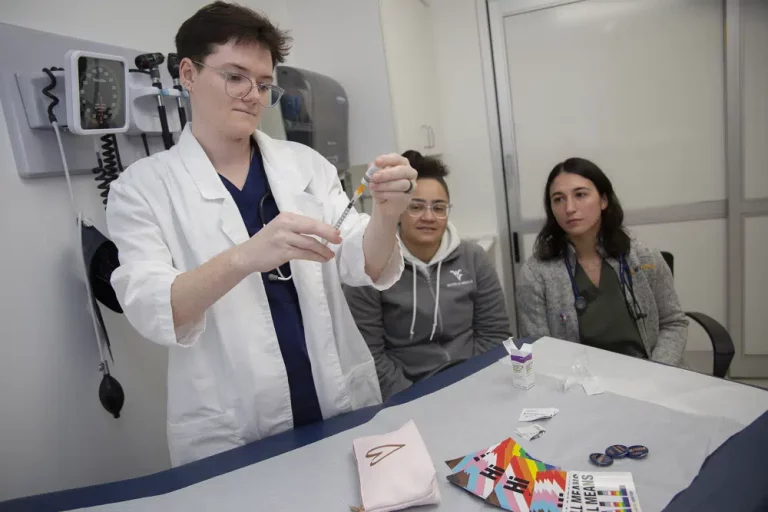
(Headline USA) An experimental drug might help slow early Alzheimer’s disease in a markedly different way than today’s treatments — by lowering levels of a brain protein called tau, researchers reported Tuesday.

Tau is one part of a toxic duo fueling Alzheimer’s but prior attempts to develop drugs that can target the protein have failed. Two Alzheimer’s drugs, lecanemab and donanemab, try to clear buildup of the better-known amyloid protein and can modestly slow cognitive decline.

The new findings suggest Biogen’s diranersen did more than lower tau levels. The study of about 400 people found signs that it also slowed cognitive decline, in one small subset enough to be comparable to amyloid therapy, according to results presented at the Alzheimer’s Association International Conference in London. Biogen is planning a larger study to try to prove the drug’s benefit.

“This is really quite promising if it were to hold up” in that next-step testing, said Jessica Langbaum of the Banner Alzheimer’s Institute in Phoenix, who wasn’t involved with Biogen’s study.

“This is early days,” cautioned Dr. Reisa Sperling of Mass General Brigham, who also wasn’t involved in the study. But “I think it will reinvigorate interest and investment in lots of tau mechanisms, and the field needs that.”

It’s one of multiple novel attempts to fight the mind-destroying disease, including a possible tau vaccine, an experimental heart drug that might do double-duty for some people at high risk of Alzheimer’s, and ways to help medicines more easily get across the so-called blood-brain barrier.

It’s not clear exactly what causes Alzheimer’s, which affects more than 7 million Americans and tens of millions worldwide. That sticky amyloid protein starts building up to form plaques in the brain about two decades before symptoms appear. But amyloid alone isn’t enough to cause Alzheimer’s. Many scientists believe that amyloid buildup eventually triggers an abnormal form of tau to form tangles in neurons, setting off symptoms.

Diranersen is what’s called an antisense oligonucleotide that doesn’t attack tau buildup but instead instructs a tau-producing gene to produce less.

“If you lower tau production, you are lowering the amount of the abnormal tau that needs to be cleared by the microglia, by the clearance mechanism in the brain. And so you are enabling the normal clearance mechanism to have more capacity to clear the tau,” said Dr. Cath Mummery of University College London, who led the new study.

Today’s anti-amyloid drugs are given through the bloodstream via infusions or injections. Diranersen is injected into the fluid surrounding the spinal cord, a straighter path to the brain.

Biogen’s study included people with mild cognitive impairment or mild Alzheimer’s, randomly assigning them to different doses of diranersen or a placebo. Back in May, Biogen and partner Ionis Pharmaceuticals announced that the lowest dose — given every six months — had the strongest effect. That was a counterintuitive surprise and meant the study didn’t meet its planned goal of showing that higher doses brought greater benefits.

Still, scientists had been anxiously awaiting details about how much that twice-a-year spinal shot really helped. Five of six different brain tests showed diranersen recipients’ memory and other cognitive abilities still worsened but more slowly than those given dummy shots, Mummery said. In one test of the lowest dose, that translated to a 26% reduction in cognitive decline — “approximately the same” change seen in earlier tests of amyloid drugs, she said.

Side effects included injection site pain and a temporary state of confusion that could appear a few days after the shot and last about a week, she said. But there were no signs of brain inflammation, which can affect recipients of anti-amyloid drugs.

The University of California, San Francisco, last week opened a first-of-its-kind study known as the Alzheimer’s Tau Platform. Funded by the National Institutes of Health, it will test a variety of experimental anti-tau therapies against and in combination with today’s amyloid treatments. First up is a vaccine called AADvac1 designed to train the immune system to recognize and fight a specific worrisome portion of the tau protein, said UCSF’s Dr. Adam Boxer.

The “platform” approach will expand to locations around the country, allow addition of other tau drugs to test and include people with Alzheimer’s-related protein buildup who aren’t yet showing symptoms, he said.

Researchers told the Alzheimer’s meeting that an experimental cholesterol-lowering drug called obicetrapib might do more than help heart health. They’re exploring if it also might lower buildup of Alzheimer’s-related proteins in people who carry a genetic risk for the disease.

Why? That gene, called APOE4, also affects how the body processes cholesterol. Obicetrapib maker NewAmsterdam Pharma plans to begin a study soon to test if the drug’s cholesterol effects also can mitigate the Alzheimer’s risk in people carrying one or two copies of that gene.

Companies also are trying to get Alzheimer’s drugs into the brain faster and at higher volumes, by penetrating the protective lining meant to protect the brain from harm. Denali Therapeutics’ CEO Ryan Watts describes it as “hitching a ride” with iron that naturally gets into the brain. His company is pursuing drugs that target tau and amyloid using that “transport vehicle” technology.

Adapted from reporting by the Associated Press.
Woke Grad Student Busted For Fake Campus Bomb Threats

(José Niño, Headline USA) Federal agents took a San Jose State University graduate student into custody this week, accusing him of flooding the campus with phony bomb threats and bigoted notes that disrupted operations for months, the U.S. Department of Justice announced Monday, according to Patch.

Ziheng “Tony” Fang, 30, who lives in San Jose, California made his first court appearance Friday and faces a charge of false information and hoaxes, officials told Patch.

An unexpected wrinkle has drawn plenty of eyes. Court records researcher Seamus Hughes pointed out the irony on X, writing, “It made local and national news (and spurred congressional inquiries) when a series of antisemitic and bigoted messages were written on bathroom stalls around San Jose State University last year. No one ever really follows up. On Friday, the feds allege it was, Ziheng Fang, a man with a “100% woke” in his TikTok bio doing it as a hoax.” 

A criminal complaint alleges Fang started fixing threatening notes to the walls of men’s and gender neutral restrooms around campus as early as October 2024. Patch reports that a lot of the notes singled out attack dates and laid out threats of bombs, shootings, and other violence, while showing hate symbols directed at several racial and religious groups.

One note appeared on Nov. 5, 2025, warning of a mass bombing in the coming days. According to the DOJ complaint, that message opened with “!WARNING! MASS BOMB NEXT WEEK” and displayed several swastikas. Investigators told Patch they recovered Fang’s fingerprint from the paper.

Patch reports that campus police tracked more than 20 threatening notes between October 2024 and May 2026. The complaint says Fang’s university key card records placed him in the buildings shortly before officers found 16 of the 18 notes sitting behind key card doors, and video showed him near the restroom areas where several messages later surfaced.

The alleged campaign forced the university to send out warning after warning, Patch reports, and led some professors to call off in person classes or teach online. Campus police took a barrage of calls from anxious students and staff, and the buildings named in the notes stood nearly empty on the dates the threats specified.

Fang, who is working toward a master’s degree in data science at San Jose State, remains in federal custody and was scheduled to appear again Monday, according to Patch. The FBI conducted the investigation with support from the San Jose State University Police Department. A criminal complaint is merely an allegation, and Fang keeps the presumption of innocence unless prosecutors win a conviction.

José Niño is the deputy editor of Headline USA. Follow him at x.com/JoseAlNino 

Buffett Omits Gift to Bill Gates’ Foundation after Microsoft Cofounder’s Epstein Ties Disclosed

(Headline USA) Billionaire Warren Buffett omitted Bill Gates’ foundation from his annual donations this year after disclosures of the Microsoft co-founder’s ties to convicted sex offender Jeffrey Epstein. He will donate about $6 billion to four foundations connected to his own family, but did not mention Gates in his announcement Tuesday.

Buffett also said in his statement that he wants all of his remaining Berkshire Hathaway stock worth more than $140 billion donated to charity by the end of 2034. Previously the plan was for his three children to distribute his remaining fortune within 10 years of the 95-year-old investor’s death.

“Of course, mortality is unpredictable, but my remaining shares will be donated to the four foundations one way or the other by December 31, 2034,” Buffett said in a statement. “The goal is to have the grants grow annually to each of the three foundations managed by each of my children and the annual grant to the Susan Thompson Buffett Foundation grow at a somewhat greater rate.”

Buffett did not immediately respond Tuesday to questions. CNBC said Buffett was scheduled to give the channel an exclusive interview on the topic Wednesday morning.

The Gates Foundation thanked Buffett for his gifts in a statement Tuesday and said the foundation remains in a strong financial position thanks to Gates’ pledge to donate 99% of his remaining fortune to the charity, which plans to close in 2045 after distributing the money.

“The Gates Foundation is grateful to Warren Buffett for his decades of support for our work. His gifts, totaling more than $47 billion, have helped us expand and deliver on the foundation’s mission to improve health and opportunity for people around the world,” the charity said in its statement.

The majority of Buffett’s charitable gifts — worth more than $61 billion — have gone to the Gates Foundation since he announced the plan to give away his fortune in 2006. He has been giving blocks of Berkshire Hathaway stock to the Gates Foundation and the four foundations run by his three children regularly.

Buffett plans to give about $4.5 billion in stock to the Susan Thompson Buffett Foundation this year and about $500 million in shares each to the Sherwood Foundation, Howard G. Buffett Foundation and Novo Foundation, which are run by his children.

So the total amount of donations announced Tuesday is similar to the roughly $6 billion in donations he made last summer, with Buffett’s family foundations getting significantly more than in previous years that would seem to account for the money that would have gone to the Gates Foundation.

Gates denies any knowledge of Epstein’s crimes and has not been accused of any wrongdoing. He said he only met with Epstein because he thought it might help him raise money for charitable causes.

Epstein, who was accused of sexually abusing dozens of underage girls, was found dead at the Manhattan federal lockup in August 2019 and his death was later ruled a suicide by New York City’s medical examiner.

Buffett already said in 2024 that he planned to cut off donations to the Gates Foundation after his death and let his three children decide how to distribute the rest of his fortune. The decision he announced Tuesday will accelerate that plan.

Buffett and Gates used to be exceptionally close friends who talked often, played bridge online and even took vacations together. Gates also served on the board of Buffett’s conglomerate for years and the legendary investor sat on the board of the Gates Foundation. But Buffett told CNBC in March that he hadn’t talked to Gates for months since before the Epstein files were released in the fall of 2025.

In the past, Buffett stood up for Gates. Three years ago, Buffett cut off a man who was presenting a resolution at the Berkshire Hathaway shareholder meeting after he questioned Gates’ character because of his ties with Epstein. Peter Flaherty was arrested that day for trespassing even though he had been approved to make the presentation beforehand. The charge was later dropped, but the incident led to a lawsuit, which is still pending in the courts.

Buffett said to CNBC “it is astounding to me that anybody could be that successful as a con person” but Epstein found a way to exploit the weaknesses of others. Buffett would not discuss Gates’ involvement, but said he doesn’t want to be involved with anything that could be investigated later.

Gates discussed his ties to Epstein with the staff of his foundation recently. Gates appears multiple times in the Justice Department’s release of documents connected to its investigation of the late financier. The Justice Department’s files include email correspondence between Gates and Epstein about philanthropic projects, calendar entries documenting dates they got together, and photos of Gates at events the two men attended.

The foundation announced that it hired someone in March to assess the foundation’s past engagement with Epstein and review its policies to vet any future philanthropic partnerships. Gates and the rest of the foundation’s board expect to get an update on that investigation sometime this summer.

Buffett told CNBC that he’s amazed at how many wealthy and powerful people have been caught up in the Epstein scandal.

“I mean, it, here you had a guy that was a convicted guy, a sensational con man, and the percentage of people that he knocked off,” Buffett said. “I mean, whether it was, he found their weakness. It might have been sex. It might be power, it might be, whatever it might be. And I don’t see how anybody could have pulled that off.”

Buffett said he’s glad Epstein never came to Omaha, where he has lived for more than six decades. Buffett is regarded by many as the world’s greatest investor who built up Berkshire over the years by buying insurance companies like Geico, major utilities, manufacturers and well-known brands like Dairy Queen and the BNSF railroad.

Buffett stepped down as Berkshire CEO in January after 60 years of leading the company, but he remains as chairman and the largest shareholder. Greg Abel is now CEO of Berkshire Hathaway.

Adapted from reporting by the Associated Press

Judge Tosses OKC Bomb Plotter’s Lawsuit

(Ken Silva, Headline USA) Due to an apparent technicality, a federal judge has dismissed a lawsuit filed by a man convicted in 2019 for plotting to bomb a bank in Oklahoma City.

The convicted OKC bomb plotter, Jerry Drake Varnell, filed a lawsuit last December, claiming that he has been sexually assaulted by fellow inmates and abused by prison staff.

In that lawsuit, Varnell was supposed to disclose his previous history of litigation. However, he failed to do so, which is why the judge dismissed his case last month. Varnell claimed that his lack of disclosure was a mistake, but the judge tossed his case anyway.

The judge said Varnell can refile his case.

Varnell’s conviction represents a classic case of terrorism manufactured by undercover FBI informants and agents.

Indeed, the FBI initially determined that Varnell, who is schizophrenic, “does not appear to have the means to actually commit this act.” Nevertheless, in 2017 the FBI had an informant introduce him to an undercover agent, who provided him with a van, barrels, a burner phone, latex gloves, electrical tape, and 1,000 pounds of ammonium nitrate fuel oil.

The agent then picked Varnell up from his house, drove him to a storage unit, and gave him step-by-step instructions on how to assemble an explosive device using the materials the FBI supplied. After that, the undercover agent insisted that Varnell be the one to drive the van downtown, where he was arrested after attempting to detonate the bomb.

Despite those factors, Varnell was convicted in early 2019, and sentenced to 25 years in prison in March 2020.

According to his Dec. 22 lawsuit, in September 2022 he was placed in a cell with an “Afro-American, homosexual male named Deshaun Sellers.” Varnell said he was sexually assaulted by Sellers, who allegedly threatened to kill him if he told anyone.

Varnell still decided to file a complaint, and he was transferred to another unit. However, he said he had a similar experience with another inmate, J. McFadden.

Varnell was again transferred. But this time, he said prison officials saw that he was wearing nipple rings, and forced him to have them removed.

According to the lawsuit, a prison official used plastic sheers, which “tore Plaintiff’s nipple and areolas.”

Additionally, Varnell said he had to shower in front of prison officers, medical staff and other inmates, which further traumatized him.

Ken Silva is the editor of Headline USA. Follow him at x.com/jd_cashless.

Darline Graham, Sister of Lindsey Graham, Chosen to Fulfill Remainder of his US Senate Term

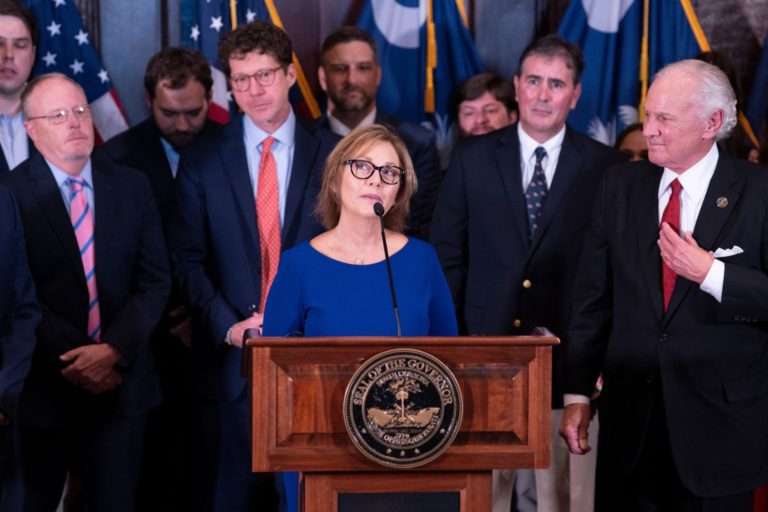
(Headline USA) Lindsey Graham’s sister, Darline Graham, has been named as his temporary replacement in the U.S. Senate after his unexpected death over the weekend.

South Carolina Gov. Henry McMaster announced at a news conference at the Statehouse on Monday that she will serve the remaining months on Graham’s current term, which expires in January. Senate Majority Leader John Thune said afterward that she will be sworn in Tuesday afternoon.

She will be the first woman to represent the state in the Senate.

“It is such an honor,” Darline Graham said as dozens of her brother’s staffers and campaign advisers stood behind her, some with eyes glassy from welling tears. “Lindsey has always been there for me. And now, I will be there for him.”

Graham died on Saturday at age 71. He never married or had a family of his own, but his sister was often by his side for the political touch points of his career, speaking at events and appearing in some of his campaign ads.

After their parents died at a young age, Graham was left to raise his sister, for whom he later became legal guardian. They were very close, and she was there as he filed reelection paperwork earlier this year, along with her children and grandchildren.

“To Lindsey, I miss you more than I can even put into words,” she said, emotion rising in her voice. “But I’m going to do this. I got it.”

Introducing her, McMaster said the two had spoken “in the wee hours of Sunday morning” after Graham’s death, and he asked her to serve.

“I had wondered what you would say, and I was humbled by your quickness to see the duty that you had to serve,” McMaster said. He added that President Donald Trump “thought it was a great idea” when he later told him of his pick. Trump announced his support for Nardone to fill the seat earlier Monday.

Darline Graham has worked as an optician and at various state agencies, including the South Carolina Commission for the Blind and the Department of Employment and Workforce. She lives in Lexington, is a graduate of the College of Charleston and has a master’s degree in rehabilitation counseling.

A special election will be held next month to pick a new Republican nominee in the general election for Lindsey Graham’s seat. He had been seeking a fifth term this year.

The rare open Senate seat has ignited a scramble among South Carolina’s most ambitious conservatives, who have been eager to climb the political ladder.

Republicans just finished a sprawling and bruising contest to figure out their nominee for succeeding McMaster, who is wrapping up his second term. State Attorney General 

Alan Wilson won the nomination, overcoming a field that included Lt. Gov. Pamela Evette, Rep. Nancy Mace and Ralph Norman — all of whom are now eyeing Graham’s seat following his death over the weekend.

According to South Carolina law, a one-week filing period for a special primary election begins on the second Tuesday after the candidate’s death, or July 21.

The special primary election would be held on the second Tuesday after that filing period closes, or Aug. 11. Any necessary runoff would follow two weeks after that, or Aug. 25.

From that point, the new nominee would have just over two months to campaign for the general election on Nov. 3.

All of this is problematic according to federal law, which requires military and overseas ballots to go out 45 days before any federal election. For the special election primary, that would have been June 27. Federal Election Commission officials didn’t immediately return a message seeking clarity about the process.

Graham died on Saturday night, and a preliminary medical examiner report said he suffered a tear in his aorta, known as an aortic dissection.

In the hours after Graham’s death was announced, South Carolina’s Republican circles were already swirling with rumors about possible replacements.

Evette, who has served nearly eight years alongside McMaster and received his endorsement in the governor’s race, is one possibility. She lost the June 23 runoff to Wilson.

Mace and Norman could run in the special primary as well. Neither of them are running for reelection to their House seats.

But another Republican from the state, Rep. Russell Fry, could be a possibility. The two-term lawmaker represents the growing area around Myrtle Beach, and he’s been a top Trump ally.

Businessman Mark Lynch, whom Graham defeated in the primary, may jump into the race. So could Mark Sanford, the state’s former governor who served two separate stints in the House.

Treasury Secretary Scott Bessent, who lived in South Carolina before joining the Trump administration, has fielded calls about potentially replacing Graham but doesn’t have interest in the role and enjoys working for the president, according to a person who insisted on anonymity to describe private conversations.

No Democrat has won a Senate seat in South Carolina in decades, and Republicans in recent history typically take statewide seats by double digits. When Graham last ran in 2020, he defeated his Democratic opponent, Jaime Harrison, by a 10 percentage point margin.

So while history suggests that Graham was en route to a fifth term, Republicans are carefully surveying the landscape.

Charleston pediatrician Annie Andrews won the Democratic nomination last month and has raised more than $8 million in the race, and she had just under $3 million cash on hand at the end of May, according to federal filings. Graham had taken in $6 million, with just over $4 million on hand.

In a statement Sunday, Andrews called on South Carolinians to join her “in setting partisanship aside and offering gratitude” to Graham for his service.

Harrison, noting that he and Graham “had our share of political disagreements,” wrote on social media that he “always appreciated that even in our fiercest political battles, we could still share a conversation, a laugh, and a mutual respect for South Carolina and the institutions we were both privileged to serve.”

Adapted from reporting by the Associated Press.
The Rest of the Inflation Story

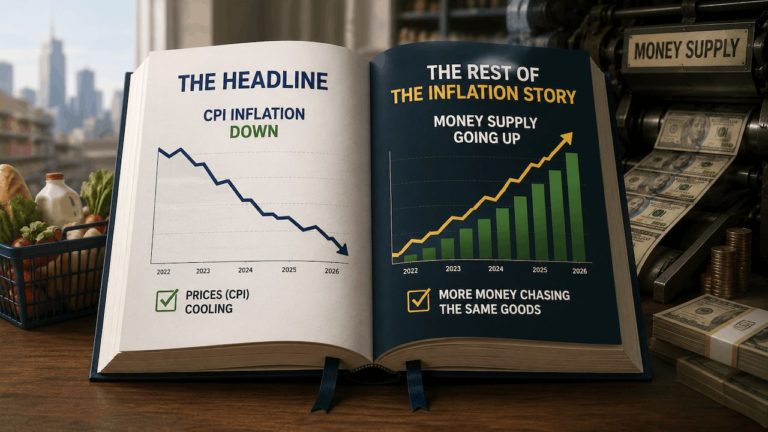
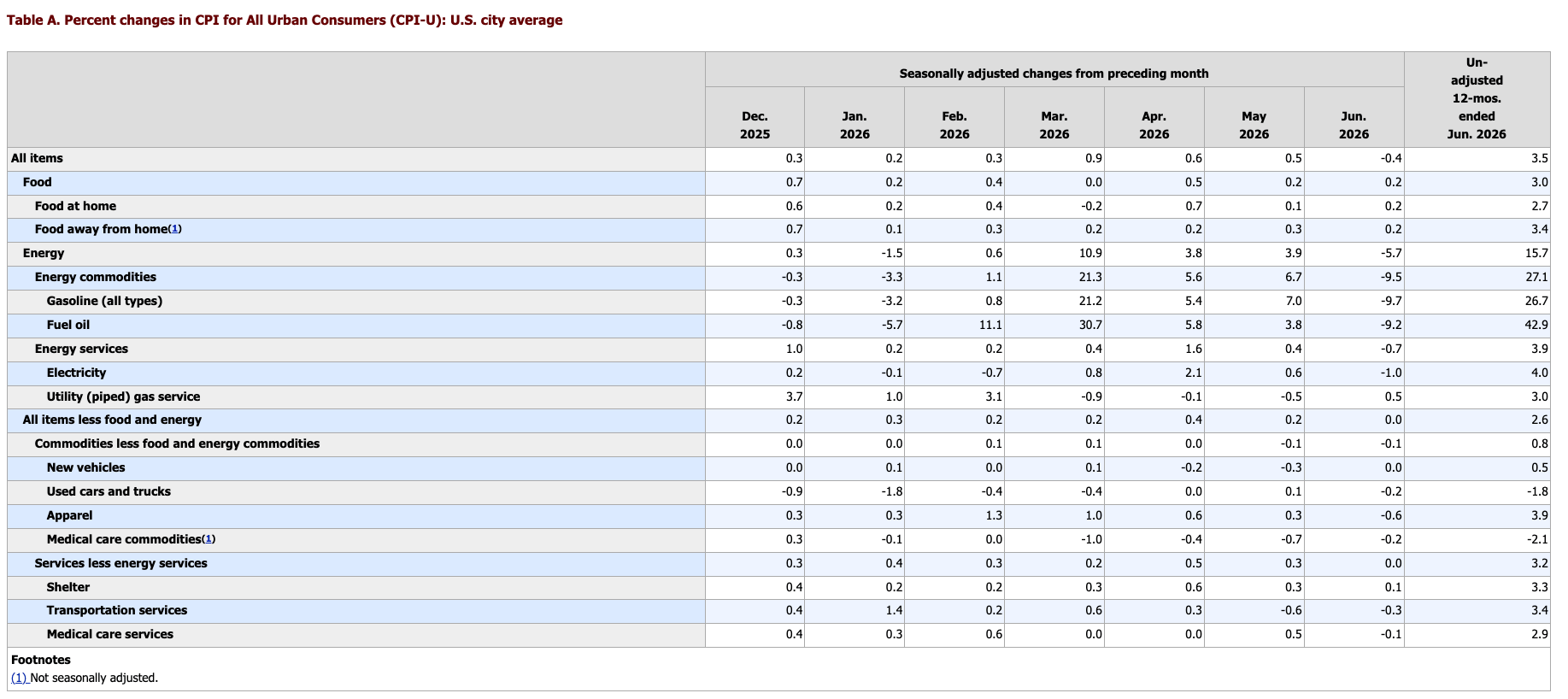
(Mike Maharrey, Money Metals News Service) If you’re reading the headlines, you know that the Consumer Price Index (CPI) came in even cooler than expected. And the expectation was for a much cooler CPI thanks to falling oil prices. However, the CPI doesn’t tell the entire inflation story.

The CPI measures price inflation. That is just one manifestation of monetary inflation (the way economists used to define “inflation”). While price inflation has cooled dramatically, there is still plenty of inflation in the pipeline.

And this better-than-expected CPI print may green-light even more inflation in the near future.

CPI By the Numbers

If we just consider the CPI, the inflation picture looks fantastic.

Month on month, prices fell by -0.4 percent in June. The expectation was for a more modest -0.2 percent decline in prices.

It was the largest monthly price drop since the COVID crash in 2020.

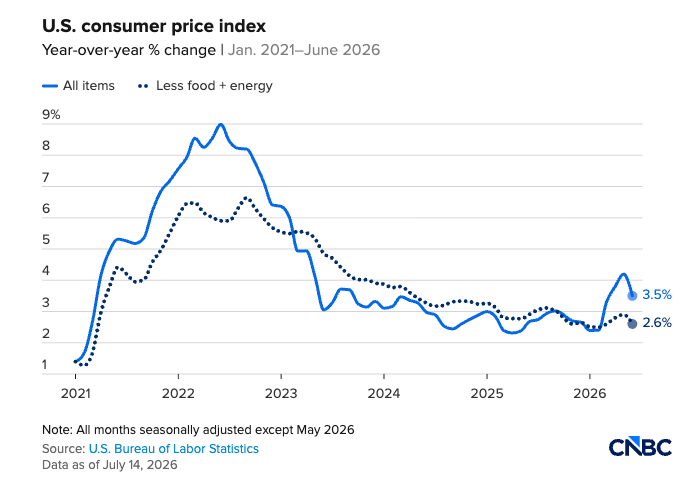
The monthly decline in prices pushed the annual CPI down to 3.5 percent, much better than the 3.8 percent forecast. Keep in mind, this is coming off a 4.2 percent annual CPI in May.

It was the biggest decline in CPI in six years.

A significantly cooler CPI was expected due to plunging gas prices. However, the better-than-expected core CPI numbers were a bit more surprising.

Stripping out more volatile food and energy prices, core CPI was flat. The forecast was for a 0.2 percent increase. With no monthly change in core prices, the annual core CPI fell to 2.6 percent. The forecast was for the annual core CPI to remain flat at 2.9 percent.

Looking at some of the trends creates even more of a cause for optimism. The three-month CPI annualized is just 2.8 percent.

Falling energy prices were the biggest factor driving the overall CPI down. The energy index declined 5.7 percent month-on-month. Gasoline prices fell by 9.7 percent.

Notably, apparel prices, which are heavily impacted by both tariffs and energy costs, dropped by a healthy 0.6 percent month-on-month.

Service prices were flat.

Other sectors reported price increases, including a 2 percent month-on-month rise in food prices.

I should note that despite the victory dance, price inflation remains above the mythical 2 percent target, as it has been for years.

You also need to remember that the CPI data understates price inflation by design. The government revised the CPI formula in the 1990s so that it understated the actual rise in prices. Based on the formula used in the 1970s, CPI is closer to double the official numbers. So, if the BLS used the old formula, we’d be looking at CPI closer to 6 percent. And using an honest formula, it would probably be worse than that.

The Rest of the Inflation Story

The CPI doesn’t tell the entire inflation story. As already mentioned, inflation, properly defined, is an increase in the amount of money and credit. Rising consumer prices are one symptom of this monetary inflation.

Based on the absence of this symptom, one might conclude that inflation is retreating. However, when we look at the money supply’s trajectory, we find that inflation is on the rise.

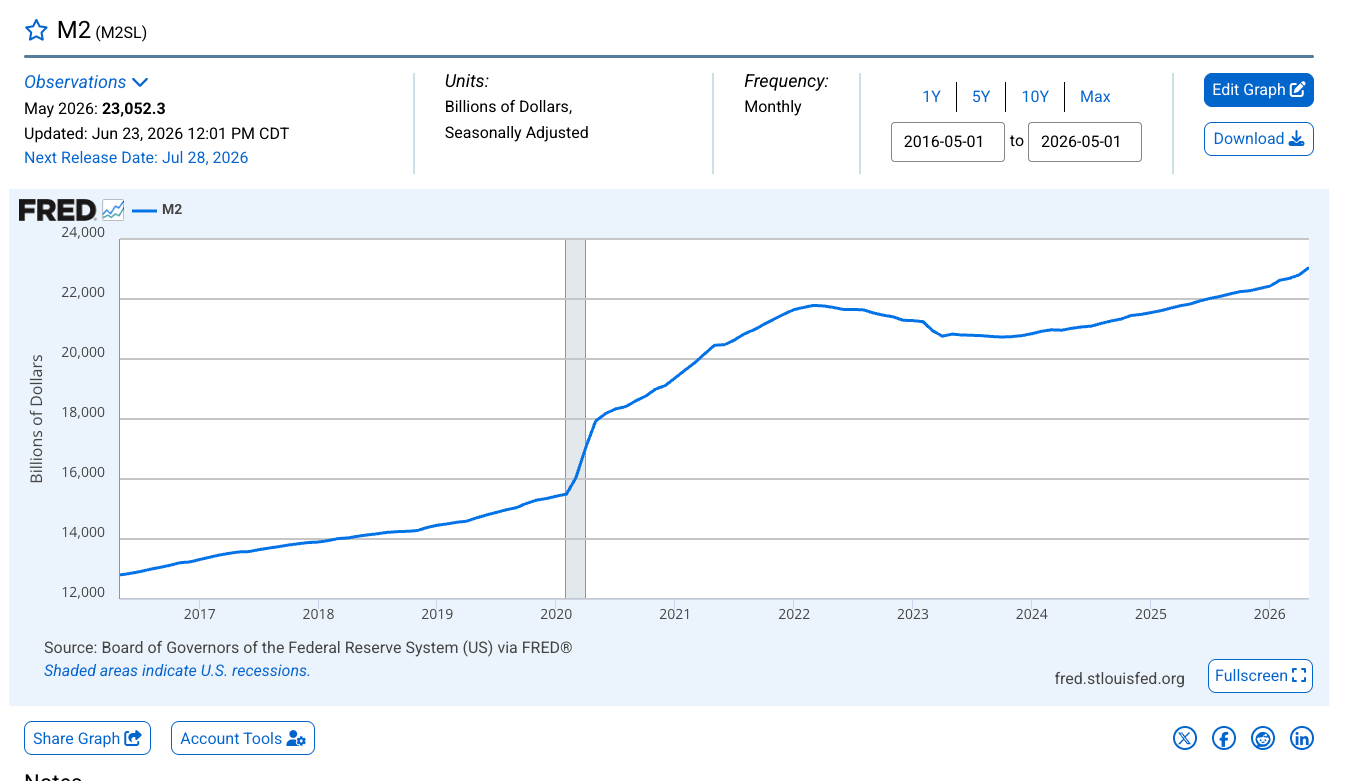
According to the Fed’s M2 data, the money supply increased from $21.83 trillion in May 2025 to $23.05 trillion in May 2026, a 5.6 percent increase.

In other words, we have an actual inflation rate of 5.6 percent.

This monetary inflation will eventually find its way into consumer prices. (It could also manifest in rising asset prices such as real estate and equities.)

Given the Federal Reserve’s tough talk on inflation, many analysts think a good CPI report won’t motivate the central bankers to return to monetary easing. CNBC reported, “Though the inflation readings provided some hope, they are unlikely to motivate Federal Reserve officials to lower interest rates anytime soon, with the central bank broadly expected to raise its benchmark rate in September.

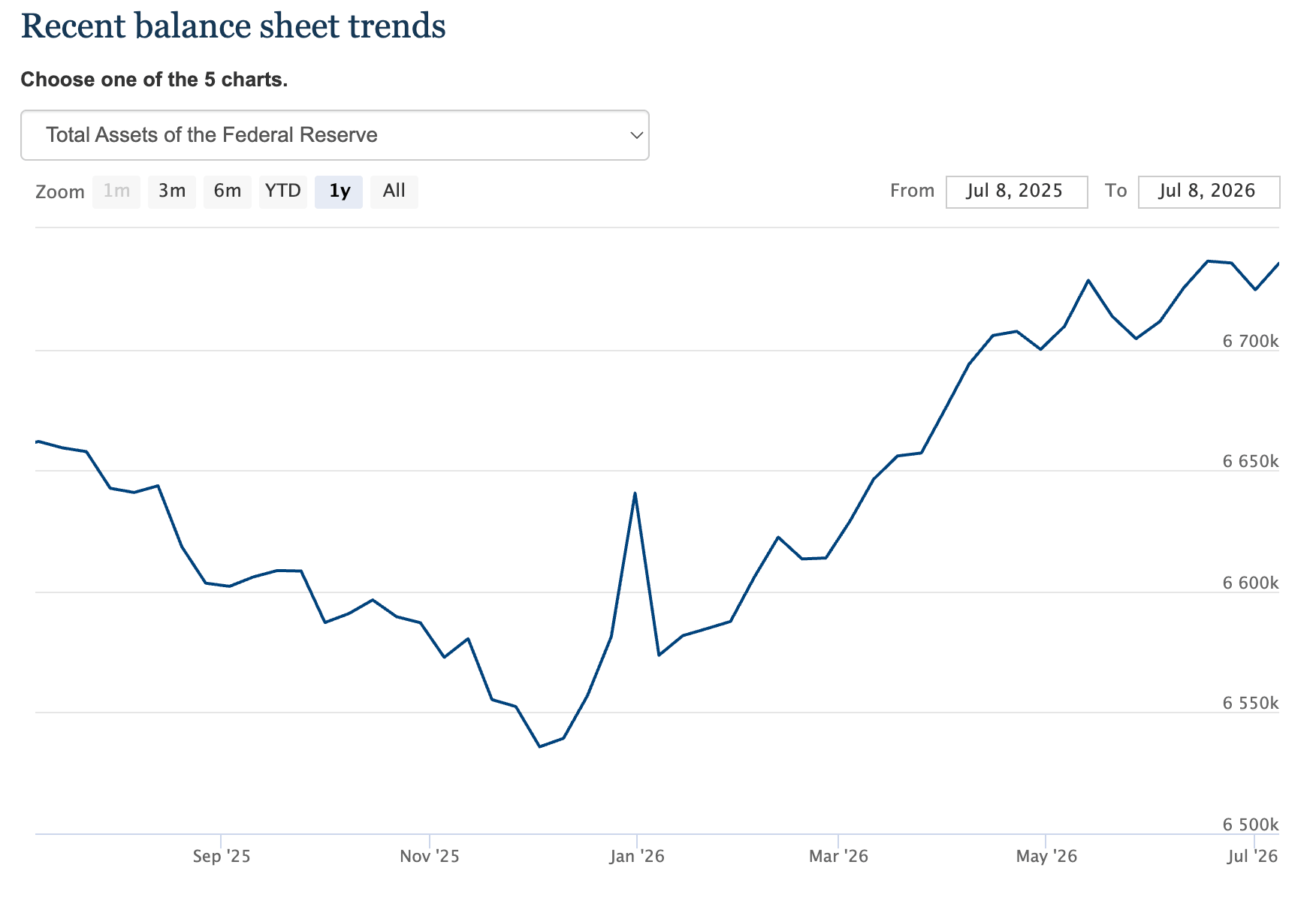
However, the Fed is already delivering monetary easing. The central bank’s balance sheet began ticking up in December, and the upward trend continues today.

This indicates that the Federal Reserve is running quantitative easing (QE) operations as we speak to provide support to the bond market. This involves creating money out of thin air to buy U.S. Treasuries on the open market. This is, by definition, inflation.

A positive CPI print gives the central bankers at the Fed a plausible excuse to cut rates, especially if the economy shows signs of deterioration.

Fed Chair Kevin Warsh & Company will likely keep up the tough inflation talk; however, it will eventually run up against economic reality.

The bottom line is it’s not the time to celebrate inflation’s demise. Absolutely enjoy the lower fuel prices. But remember, there is more inflation in the pipeline. One thing you can count on: the powers-that-be will relentlessly devalue your money – at least by the planned 10-plus percent every five years.


Mike Maharrey is a journalist and market analyst for Money Metals with over a decade of experience in precious metals. He holds a BS in accounting from the University of Kentucky and a BA in journalism from the University of South Florida.

Indian Import Tax Driving Silver Shortage in India

(Mike Maharrey, Money Metals News Service) An increase in the import duty on precious metals has led to a significant shortage of physical silver in India, pushing premiums to six-month highs.

The Indian government announced the 9 percent duty increase in May. The change pushed the import tax on gold and silver from 6 to 15 percent.

As Metals Focus explained, the move was meant to stabilize the rupee as oil prices spiked.

“Amid elevated oil prices, India’s current account deficit (CAD) has widened. To help reduce the CAD, the government has tried to curb precious metals imports (the second largest category in value terms after crude oil), accounting for 7-10 percent of India’s total merchandise imports.”

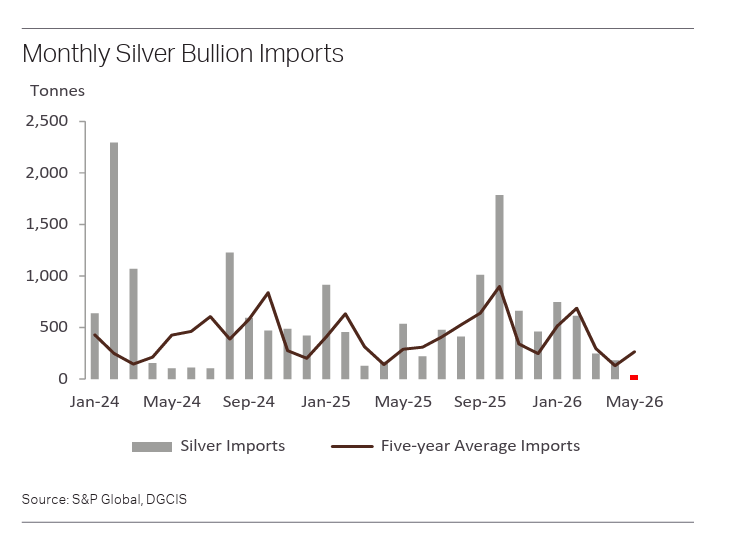
The scheme worked. Silver imports crashed in the wake of the tax hike, collapsing to just 47 tonnes in May. That was the lowest silver import total since July 2023, and down from a peak of over 1,500 tonnes in October last year during the first silver squeeze.

So far in 2026, India has imported 1,837 tonnes of silver, a 16 percent year-over-year decline. Import levels are about 3 percent below the 5-year average.

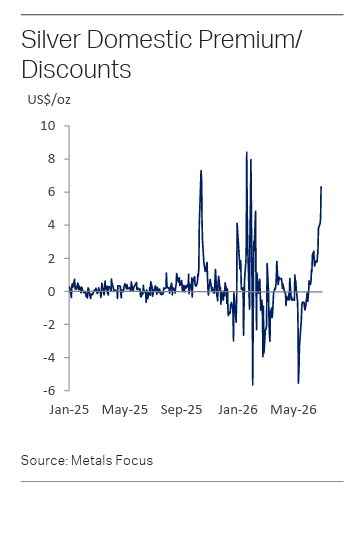
The slowdown in silver imports has created a considerably tight silver market in India. The domestic premium reflects the shortages, having risen from 10 cents an ounce in the first week of June to $6.30 on July 3. Premiums haven’t reached levels seen during the silver squeeze, but they are getting close.

Metals Focus analysts say the situation will likely be exacerbated in the coming months as demand picks up during the festive wedding season.

According to Metals Focus, confusion about import licensing requirements is further restricting imports.

“Our discussions with the trade suggest there is little clarity about the DGFT’s license requirements. There is also some confusion as to whether banks will require the license or traders will first need to apply for one, as importing without a license is not possible. We expect this to remain a significant hurdle in the coming months, which is therefore likely to see the local silver premium climb further.”

Not Enough Silver

While tightness in the Indian market won’t likely impact the global price, it underscores a key dynamic in the silver market. There simply isn’t enough metal to meet demand.

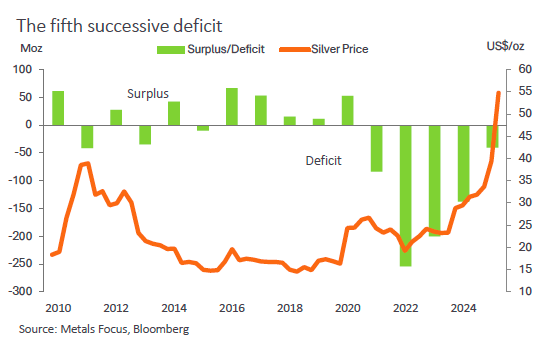
The silver market recorded a supply deficit for the fifth consecutive year in 2026.

Last year, demand outstripped supply by 40.2 million ounces (1,250.36 tonnes). That drove the 5-year market deficit to 716 million ounces. To put that into perspective, total silver mining output last year was 846 million ounces.

Metals Focus forecasts a 46.3-million-ounce supply deficit this year.

With the physical market so tight, it doesn’t take much to send the price hurdling higher. The impact of the import tax on the Indian market bears this out.

It remains to be seen how long India can maintain import restrictions in the face of a growing physical silver shortage. It’s not just about investors. India’s large solar industry, along with its electronics sector, depends on access to a reliable supply of silver.


Mike Maharrey is a journalist and market analyst for Money Metals with over a decade of experience in precious metals. He holds a BS in accounting from the University of Kentucky and a BA in journalism from the University of South Florida.

Trump’s Old Guru Secretly Ran Israel’s MAGA Influence Machine

(José Niño, Headline USA) When the United States and Iran struck a ceasefire on June 17, a senior U.S. official expected President Donald Trump’s supporters to cheer. Instead, as Time reports, MAGA voices online shredded the deal, echoing one another in nearly matching phrasing within minutes.

A few circulated an Israeli opinion piece headlined “You Could Have Been the Greatest President of All—But You Failed.” Others pushed footage of Qatar’s prime minister seeming to brush off Vice President J.D. Vance, spinning it as evidence that regional players mocked the administration’s “naivete.” A handful blasted Trump for caving before he dismantled Iran’s nuclear program. The official started grabbing screenshots, sure the synchronized timing pointed to something deliberate.

Following the trail, the official arrived at an unlikely name, Trump’s onetime campaign chief Brad Parscale. Time, drawing on Foreign Agents Registration Act filings it examined, reports that the ad agency Havas brought on Parscale’s firm Clock Tower X last September to run a digital push for Israel. Terms called for 100 fresh pieces of content monthly, with no less than 80% crafted for Gen Z on TikTok, Instagram, YouTube, and podcasts, alongside “integration of narrative messaging into Salem Media Network properties and aligned distribution channels,” the Christian conservative broadcaster where Parscale holds the chief strategy officer title.

He vowed to hit 50 million impressions a month and to steer how AI tools like OpenAI’s ChatGPT, Anthropic’s Claude, and Google’s Gemini described Israel and the conflict. In return, Israel committed to $1.5 million monthly.

On paper, the operation existed to battle antisemitism online. Yet an Israeli Foreign Ministry official told Time the real target was keeping young conservatives from souring on Israel, and that Parscale sold himself as the uncommon hand who understood both the internet and MAGA.

Parscale sharply denies turning on the President. “I have never funded, organized, or participated in any effort to undermine President Trump—ever—including his MOU or ceasefire proposal,” he told Time. “The claim that I am coordinating an effort to prolong the war is completely false. The only people manufacturing a conflict between President Trump, Israel, and me are anonymous officials using background quotes to make me the bogeyman.”

Three sources close to the effort told Time that Parscale channeled messaging through connected outfits like Campaign Nucleus and Influenceable, handing influencers ready-made language in private group chats and paying them according to reach. An earlier Influenceable run let creators bank as much as $4,250 for a single post. Parscale maintains that not a dollar of the FARA money went to influencers.

The outcome has left Tel Aviv seething. “We are pissed at Brad Parscale,” the Israeli official told Time. “He was supposed to make things better. We have paid him lots of money. But what did he do with it? Things have only gotten worse.” Pew Research found that just 32% of Americans regard the Israeli government favorably, and by April noted that 57% of young Republicans held an unfavorable view of Israel, climbing from 50% the prior year. Antisemitic incidents have climbed 34% since fighting erupted, per the Combat Antisemitism Movement.

Parscale argues the campaign delivered, pointing to a Scott Rasmussen survey in which 73% of voters who favor Trump style policies view Israel favorably. “The audience we were tasked with reaching didn’t abandon Israel. It rallied behind it,” he told Time.

Within the White House, aides watched a paid foreign effort slam into the President’s campaign to close out the war. “We’re talking about American influencers who are being paid by a foreign country, then trying to build momentum to change the President’s view, or the views of others around him,” a senior intelligence official told Time. “It can’t be dismissed as inconsequential by any means.”

The tactic had surfaced before. In March, conservative Nick Sortor flagged a nearly identical Influenceable operation working for the soda industry. Moscow, Tehran, and Beijing all wage such campaigns, Time observes, but this one zeroed in on the President’s own faithful. “It’s important to recognize that if there’s one Brad Parscale out there, there are others,” the official said.


José Niño is the deputy editor of Headline USA. Follow him at x.com/JoseAlNino

U.S. House to Vote on Bill Making Daylight Savings Time Permanent

(The Center Square) The U.S. House will vote this week on a bill making daylight savings time permanent, despite warnings from medical, education and safety organizations.

The Sunshine Protection Act of 2025, which would end the nearly nationwide biannual clock changing and make daylight savings time permanent year-round, advanced out of committee Monday afternoon.

States that use standard time year-round – currently only Arizona and Hawaii – before the law goes into effect wouldn’t have to change.

House Energy and Commerce Committee ranking member Frank Pallone, D-N.J., testified in support of the bill, which Rep. Vern Buchanan, R-Fla., introduced.

Pallone argued that changing the clocks every year is widely unpopular with Americans and that making daylight savings time permanent would boost the tourism industry.

“The real question is, why do we still change our clocks?,” Pallone said. “It’s getting harder and harder to justify.”

Besides the U.S. tourism industry, retail and golfing industries have long lobbied Congress to permanently set the clocks an hour ahead.

“Our industry is uniquely tied to daylight, and the number of playable hours directly affects the number of rounds we can offer, the staff we employ, and the revenue we generate, especially in the late afternoon and early evening,” National Golf Course Owners Association CEO Jay Karen told lawmakers in 2025.

“We ask the Senate to consider the practical and economic consequences of losing evening daylight.”

The U.S. Chamber of Commerce, National Retail Federation, National Association of Convenience Stores, the American Farm Bureau Federation and others have expressed support for making daylight savings time permanent.

But medical professionals, education advocates and safety professionals overwhelmingly support making standard time permanent instead.

“By artificially shifting the clock time an hour forward, daylight saving time causes a misalignment between clock time and solar time, interfering with our circadian timing and resulting in a condition known as ‘social jet lag,’’ the American Academy of Sleep Medicine stated in its opposition to the bill.

“This condition is associated with an increased risk of obesity, metabolic syndrome, cardiovascular disease, and depression. If daylight saving time becomes permanent, then Americans will be living with social jet lag year-round.”

The American Medical Association, American College of Occupational Medicine, National Sleep Foundation, American Federation of Teachers, National School Boards Association, National Safety Council, and dozens of other organizations have endorsed permanent standard time.

Congress tried to implement permanent daylight savings time in the 1970s.

The two-year trial lasted less than a year, however — in a 1974 speech on the Senate floor, the former U.S. senator for Kansas Bob Dole said the change “is a classic example of the Congress legislating blindfolded”

“It has caused great inconvenience and in some cases hazard. It appears to me that the better part of wisdom might be outright repeal,” Dole said. “After spending the first 3 weeks of winter daylight time in Kansas, I became more convinced than ever that its hardships, inconvenience, and real hazards are too great to justify its continuation.”

If the Sunshine Protection Act does pass the House on Tuesday, its future in the Senate is uncertain as it will need at least 60 votes to pass.

SCOTUS Justices to Testify Before Congress on Increasing Security Funding

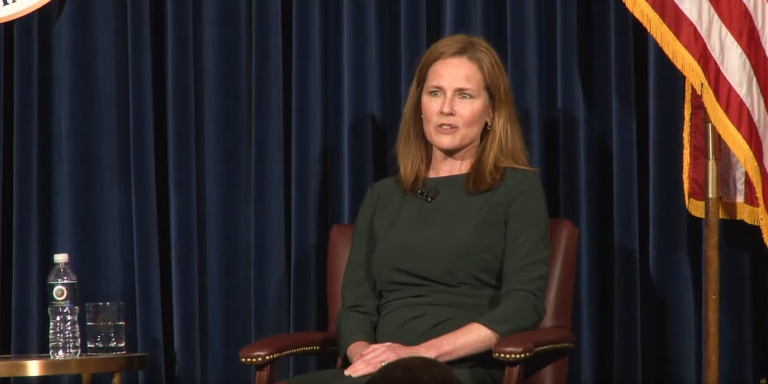
(Headline USASupreme Court Justices Elena Kagan and Amy Coney Barrett will make a rare appearance before Congress Tuesday, weeks after the end of a historic term.

The justices are appearing before a House appropriations panel as the court seeks millions of dollars to beef up security amid a rise in threats to the judiciary.

Judges around the country have seen a rise in threats of violence and intimidation, including a fake swatting call to police about Barrett’s home in May.

The hearing comes two weeks after the conservative-majority court finished handing down a series of major opinions, including a decision that increased President Donald Trump’s power over federal regulatory agencies and another that rejected his wide-ranging tariffs, sparking harsh personal criticism.

It’s the first time justices have testified before Congress since 2019, and the two justices could face wide-ranging questions as they seek to keep focus on the budget.

Security is central to the Supreme Court’s budget request

The Supreme Court requested a total of $228 million for next fiscal year, a roughly 10% increase over the year before. Nearly $15 million of that would go to expanding personal protection for justices, with six more agents for each.

Another $2 million would fund an off-site residential security post aimed at making emergency responses faster, as well as increasing the number of Supreme Court police officers.

The U.S. Marshals Service, responsible for protecting judges, reported 564 threats in the government fiscal year that ended in September, an increase from the year before.

That total includes threats to the hundreds of federal judges around the country, though the nine-member Supreme Court has not been immune.

In May, Barrett’s security detail worked with police to quickly deal with the call determined to be swatting, or a fake 911 call designed to provoke a police response. Last year, her sister was the victim of a bomb threat in Charleston, South Carolina, police said. No bomb was found.

In 2022, shortly after the leak of a draft opinion overturning the Roe v. Wade abortion decision, a would-be assassin was arrested near the home of Justice Brett Kavanaugh with weapons and zip ties.

Chief Justice John Roberts has condemned the threats to all U.S. judges, saying during a speech in March that criticism of judicial opinions is understandable, but personally directed hostility is “dangerous, and it’s got to stop.”

Adapted from reporting by the Associated Press