Israel To Receive ‘Major’ New Weapons Shipment from the US

(Dave DeCamp, Antiwar.com) The Israeli military is set to receive a “major new weapons shipment” from the US in the coming weeks to help prepare it for continued operations in Gaza and a potential attack on Iran, the Israeli news site Ynet reported on Monday.

The details of the arms shipment are unclear, but Ynet said it would include 3,000 munitions for Israel’s Air Force. The report said the bomb shipment was recently approved by the Trump administration.

The Pentagon’s Defense Cooperation Agency said on Monday that the State Department approved a $180 million arms deal for Eitan Powerpack Engines that will go to Israel, but it did not announce any new bomb shipments.

The Ynet report said the new weapons shipment will help prepare the Israeli military for a new “large-scale campaign” in Gaza and that it comes in addition to over 10,000 munitions that are expected to replenish Israeli stockpiles soon.

The Trump administration has approved a series of arms deals and weapons shipments for Israel, totaling more than $12 billion, including tens of thousands of 2,000-pound bombs, which Israel has dropped on densely populated civilian areas of Gaza.

Trump officials have claimed that the Biden administration placed a “partial arms embargo” on Israel, but President Biden provided more military aid to Israel in a single year than any other US president in history.

Besides fueling Israel’s genocidal war on Gaza, US military aid to Israel also supports Israel’s stepped-up military operations in the West Bank and its occupations of southern Lebanon and southern Syria.

China Ups Gold Import Quotas in Response to Strong Demand

(Mike Maharrey, Money Metals News Service) Demand for gold is so strong in China that the government has allocated additional gold import quotas for commercial banks.

According to a Bloomberg article, strong haven demand from institutional and retail investors led to the move.

China ranks as the world’s largest gold market.

The government uses import quotas to limit the amount of gold flowing into the country. According to unnamed sources in China, the government upped the quotas last week to satisfy the significantly increased appetite for bullion. Officials say commercial banks requested the additional quotas.

The Bloomberg article notes that the gold price has doubled in yuan terms since 2022.

“Trade tensions have only heightened appetite for bullion, which has repeatedly touched records over the last few months.”

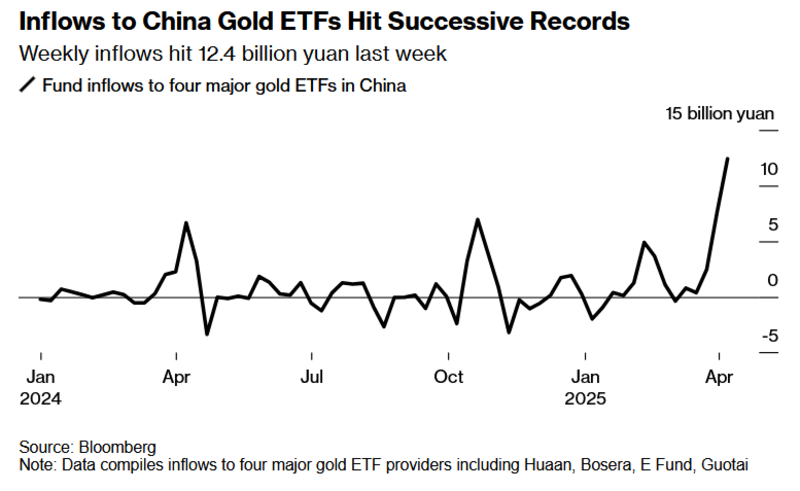
The surge in demand is reflected in a significant inflow of gold into Chinese gold-backed ETFs.

There has also been a boost in Chinese gold demand in response to a pilot program that allows insurance funds to invest in gold.

State Street Global Advisors’ strategist Aron Chan described it as a “multi-layered demand base,” noting that it helps support and stabilize the price even in the midst of extreme volatility.

“This demand is less speculative and more strategic or culturally embedded, which means it is stickier and more resilient.”

Another Bloomberg article described it as “a gold-trading frenzy.”

A Chinese analyst with Jinrui Futures told Bloomberg that Chinese investors favor gold as a safe-haven asset and a long-term portfolio diversifier, especially when equities and bonds come under pressure.

“I expect investment and hedging demand in China to remain resilient as policy flip-flops in the U.S. create more uncertainty.”

Another analyst said ongoing de-dollarization is also driving gold investment. This could accelerate if the trade war continues to heat up.

“China may be encouraged to continue moving forward more actively to diversify its reserves away from the U.S. dollar and treasuries given that it is at the epicenter of the trade war. The desire to reduce exposure to the US may see China buying more gold to bolster its reserve.”

Money Metals analyst Jesse Colombo points out that Chinese demand has been a big part of this gold rally from the beginning.

“Since last fall, I’ve been advancing a theory that China’s aggressive futures traders—who were behind gold’s initial $400 breakout one year ago that launched this bull market—would soon reassert themselves and help drive gold from around $2,500 to $3,000 and beyond.

“Sure enough, I’m pleased to report that my thesis is unfolding exactly as anticipated—evidenced by a surge in gold futures trading volume on the Shanghai Futures Exchange (SHFE), a renewed rise in Chinese domestic gold premiums over international spot prices, and gold now entering its parabolic, nearly vertical phase.”

There is no reason to think Chinese demand is going to slow down any time soon and that means the gold bull likely has plenty of legs left.


Mike Maharrey is a journalist and market analyst for Money Metals with over a decade of experience in precious metals. He holds a BS in accounting from the University of Kentucky and a BA in journalism from the University of South Florida.


Who Pumped Up This Bubble Economy?

(Mike Maharrey, Money Metals News Service) The American economy is a bubble. The thing about bubbles is that they eventually pop.

All they need is a pin.

Tariff policy might be the pin that pops this bubble, but even if it isn’t, there is a pin out there with this bubble’s name on it.

I’ve been calling this a “debt-riddled, bubble economy” for months (years, really), but this isn’t a term you often hear bandied about in the mainstream media. So, I was surprised to run across a Reuters article last week headlined, “There’s no easy escape from the U.S. bubble economy.”

As with most mainstream economic analysis, the article focused on Trump administration policies, calling them “an existential threat to the American bubble economy.”

The article did a good job describing a bubble economy.

“A bubble economy is one in which the financial sector crowds out the real economy. Asset prices become severely inflated and detached from their underlying fundamentals. Companies are managed to maximize financial returns rather than market share. As asset prices rise, capital gains replace genuine savings. A bubble economy is sustained by continuously rising debt, which is mostly used for financial purposes rather than investment. Credit growth also boosts corporate profits.”

This is the U.S. economy in one paragraph.

There is little question that the stock market is extremely overvalued. In December, CurrentMarketValuation.com called the S&P 500 “strongly overvalued” based on the price-earnings ratio.

We also see the overvaluation in the historically high Dow-to-gold ratio.

On the debt side of the equation, we find government, consumer, and corporate debt at record levels. Last year, total debt (private, public, and financial) exceeded $100 trillion. That represents more than three times the U.S. national income.

We see the bubble in the foundation of the economy as well. Reuters pointed out, the contribution of the financial and insurance sector to GDP growth has doubled since 1945, even as manufacturing declined by more than half.

Make no mistake – bubbles benefit a lot of people, especially those in the financial sector. The problem is they’re not sustainable. As the Reuters article succinctly put it, “The bubble economy is inherently fragile.”

It goes on to assert that the Trump team is trying to pop the bubble on purpose.

“Neither Trump nor his economic advisers explicitly acknowledge that they are trying to pop the bubble economy. But that’s what their actions amount to.”

The idea is supposedly to flip the script and bring prosperity to Main Street. As MacroStrategy Partnership analyst Julian Garran put it in a recent note, “If Trump is serious about unwinding the long-running squeeze on blue-collar workers, this means unwinding decades of policies that have been super-friendly to financial capital.”

Whether it’s intentional or not, a lot of people are worried about the air coming out of the bubble. According to a recent survey of more than 300 CEOs, over 60 percent said they expect a recession or economic downturn within the next six months. Meanwhile, the Atlanta Fed GDPNow forecast calls for -2.4 percent GDP growth in Q1.

What Blew Up the Bubbles?

The Reuters report did a good job of explaining the bubble economy and why it’s a problem, but it didn’t answer a key question: How did the bubble inflate to begin with?

Reuters mentions that capital inflows from foreign countries have helped finance U.S. debt, and it notes that the U.S. privilege of issuing the world reserve currency helps keep the bubble inflated. But it never mentions the key player – the Federal Reserve.

The central bank pumps air into the bubble economy in the form of easy money.

Simply put, without money creation, there is no bubble.

The Fed injects money into the economy directly through quantitative easing (QE) and indirectly by keeping interest rates artificially low and incentivizing debt. This is, by definition, inflation, and this inflation of the money supply blows up bubbles.

When we talk about inflation, most people immediately think of rising consumer prices. But inflation typically manifests in the financial sector first. It blows up asset bubbles in stocks, real estate, art, and other sectors. That’s what happened during the easy money era of the Great Recession. It wasn’t until the central bank doubled down on the easy money drug during the pandemic that inflation began to spill over into consumer prices.

Consider the amount of inflation the Fed has created since the 2008 financial crisis. It pumped over $9 trillion into the economy through QE alone. On top of that, it suppressed interest rates for well over a decade.

That’s a lot of inflation, and it blew up some mighty big bubbles.

This isn’t the first time the Fed has gotten into the bubble-blowing business. It pumped up the dot-com bubble in the 90s. It pumped up a real estate bubble in the early ’00s.

What happened to those bubbles?

They popped.

In the wake of the 2008 Financial Crisis, the Fed went to work reinflating the bubble yet again. The air started to come out in 2018 after the central bank made a half-hearted effort to normalize monetary policy. You might remember the stock market crash that fall. And what did the central bank do? It cut interest rates and relaunched quantitative easing. Keep in mind, this was before COVID-19 reared its ugly head.

The pandemic gave the Fed an excuse to double down and blow the bubble up to an epic proportion.

Here we are today with a massive bubble economy that not even Reuters can ignore.

And there’s no reason to think this one won’t pop, too.


Mike Maharrey is a journalist and market analyst for Money Metals with over a decade of experience in precious metals. He holds a BS in accounting from the University of Kentucky and a BA in journalism from the University of South Florida.

Trump Suggests Iran Slow-Walking Talks, Repeats Threat of Military Action

(Dave DeCamp, Antiwar.com) President Trump on Monday suggested that Iran was slow-walking talks with the US and repeated his threat of military action if a deal on Tehran’s nuclear program isn’t reached.

The US and Iran held indirect negotiations in Oman over the weekend and are set to hold another round in Rome this coming Saturday.

“Iran wants to deal with us, but they don’t know how. They really don’t know how. We had a meeting with them on Saturday. We have another meeting scheduled next Saturday, I said, ‘that’s a long time,’ so I think they might be tapping us along,” Trump told reporters at the Oval Office while meeting with El Salvador President Nayib Bukele.

Trump said that Iran has to “get rid of the concept of a nuclear weapon, they cannot have a nuclear weapon.” Iran has made clear that it’s willing to reaffirm its pledge that it doesn’t seek nuclear weapons, and US intelligence agencies recently said in their annual threat assessment there’s no evidence that Tehran is building a nuclear bomb or that Iranian Supreme Leader Ali Khamenei has reversed his 2003 fatwah that banned the production of weapons of mass destruction.

Despite the conclusion from US intelligence agencies, Trump has repeatedly threatened to bomb Iran if a deal isn’t reached on its nuclear program. “If we have to do something very harsh, we’ll do it,” he said. “And I’m not doing it for us. I’m doing it for the world. These are radicalized people, and they cannot have a nuclear weapon.”

When asked if the options include a strike on Iran’s nuclear facilities, the president said, “Of course.”

Trita Parsi, an Iran expert and Executive Vice President of the Quincy Institute, believes that a deal could be reached if it is narrow and the US doesn’t demand the total dismantlement of Iran’s civilian nuclear program. Iran hawks in the US and Israel could try to sabotage the process, and there’s a chance the US could add more demands related to Iran’s ballistic missiles and its support for its allies in the region, issues Iran doesn’t want to include in any deal with the US.

The World Is Selling America

(Brien Lundin, Money Metals News Service) The world is worried. And typically in such an environment, investors across the globe rush to three safe havens: the U.S. dollar, U.S. Treasuries, and gold.

This time is different — because they’re dumping the greenback and Treasuries… and buying gold hand over fist.

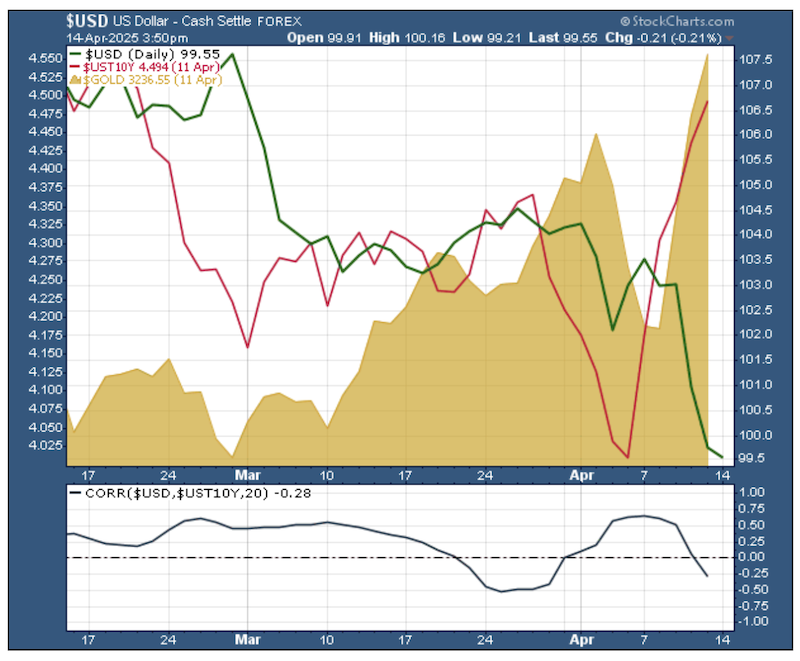
This dynamic isn’t just unusual, it’s unprecedented…and illustrated in the chart below.

In this chart, the Dollar Index is in green, the 10-year Treasury yield is in red, and gold, of course, is the gold area in the background. The bottom panel is the 20-day rolling correlation between the dollar and Treasury yields.

In normal times, the dollar and yields are positively correlated, with the correlation line above zero. That brief dip in the correlation in late March merely reflects some back-and-forth, trendless action earlier in the month.

Now note the sharp divergence over the last week when, counter to the Trump administration’s hopes and plans, their harsh tariff policies sent the world running from the U.S…..and toward the one remaining safe haven of gold.

The dollar sank, Treasury yields jumped and the gold price soared.

Put simply, the rest of the world is selling America.

Importantly, as the chart also shows clearly, that flight from U.S. safe havens into gold ended the metal’s brief correction and sent the price skyward, wiping out much of its overbought status in the process.

On Monday, gold was slammed on the U.S. open, as investors flocked back to U.S. equities because President Trump delayed his reciprocal tariffs and exempted electronics exported from China from his most onerous levies.

The steady-state demand from central banks along with investors and institutions around the world is still in place, though, and sparking a rebound from the early-session price lows.

Mining Stocks Take Off

A soaring gold price is nothing new — we’ve seen this kind of action over and over since February of last year.

What’s different this time is that Western investors are now coming to the party…finding the move in gold far advanced…and deciding to play the trend via gold mining stocks.

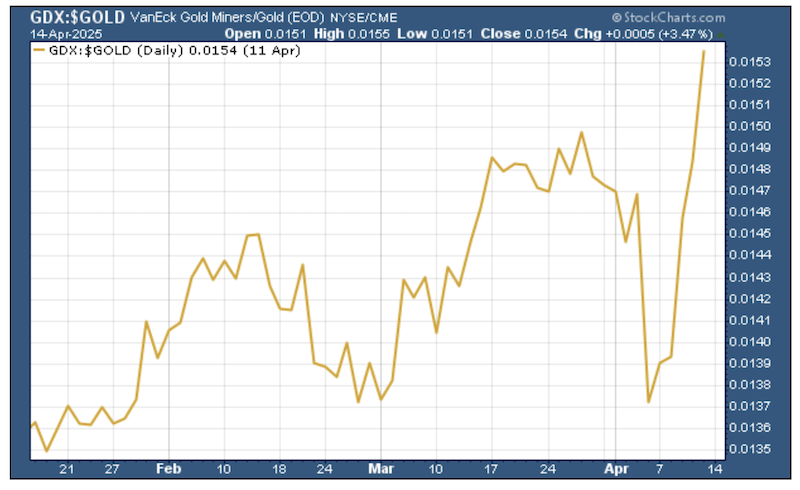
The result is that, even with gold rocketing higher, the gold stocks have been doing even better. This chart of the GDX gold mining index/gold price ratio shows the dramatic outperformance of the miners.

Even more impressive, the gold stock indices are up again, even with gold down about 1%.

It’s an amazing time — fraught with risks and tremendous opportunities.

To get Brien Lundin’s ongoing commentary on the markets at no charge, click here to subscribe to his free Golden Opportunities newsletter.


Brien Lundin is the publisher and editor of Gold Newsletter, the publication that has been the cornerstone of precious metals advisories since 1971. Mr. Lundin covers not only resource stocks but also the entire world of investing. He also hosts the annual New Orleans Investment Conference. To get Brien Lundin’s ongoing commentary on the markets at no charge, click here to subscribe to his free Golden Opportunities newsletter.

Secret China Trading Is Fueling Recent Gold Rallies

(Jesse Colombo, Money Metals News Service) My expectations are being fully confirmed as Chinese gold trading activity and prices both surge—and now even Bloomberg has taken notice with a fascinating article on what’s unfolding.

Since last fall, I’ve been advancing a theory that China’s aggressive futures traders—who were behind gold’s initial $400 breakout one year ago that launched this bull market—would soon reassert themselves and help drive gold from around $2,500 to $3,000 and beyond.

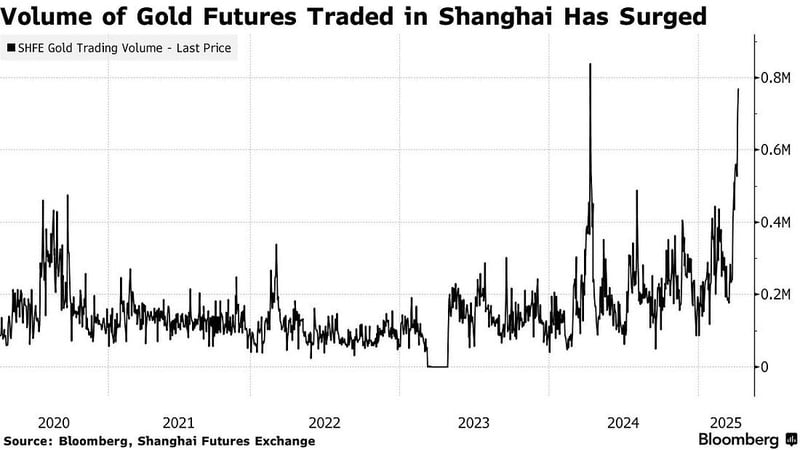
Sure enough, I’m pleased to report that my thesis is unfolding exactly as anticipated—evidenced by a surge in gold futures trading volume on the Shanghai Futures Exchange (SHFE), a renewed rise in Chinese domestic gold premiums over international spot prices, and gold now entering its parabolic, nearly vertical phase.

Now, the mainstream media is finally catching on. Bloomberg just published a piece today titled “Gold-Trading Frenzy Erupts in China as Tensions With US Escalate,” confirming that a full-blown Chinese gold boom is underway as investors flock to safety amid a brewing trade war between the world’s two largest economies.

The Bloomberg article includes some fascinating commentary and charts that I want to share with you—starting with insights from Bloomberg’s Chinese sources, who explained the key reasons behind the surge in gold demand among Chinese investors:

“Investors continue to favor gold as a safe-haven asset and long-term portfolio diversifier, as domestic bonds and equities come under pressure,” Zijie Wu, a Shenzhen-based analyst at Jinrui Futures said. “I expect investment and hedging demand in China to remain resilient” as policy flip-flops in the US create more uncertainty, he added.

“China may be encouraged to continue moving forward more actively to diversify its reserves away from the US dollar and treasuries given that it is at the epicenter of the trade war,” said Vasu Menon, managing director of investment strategy at Oversea-Chinese Banking Corp. The desire to reduce exposure to the US may see China “buying more gold to bolster its reserve,” Menon said.

The first chart in the Bloomberg article highlights the surge in gold futures trading volume on the SHFE:

The Shanghai Futures Exchange saw trading volumes of the precious metal hit the highest level in a year last week. That was thanks to investors and industry players — refineries, traders, and retailers — that have ramped up hedging activities as global markets gyrate in response to trade policy changes in the US and China.

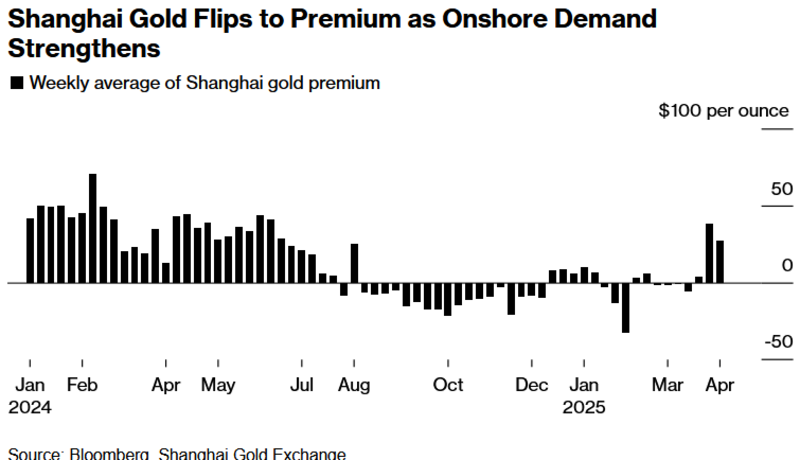
The second chart in the article shows a sharp spike in China’s domestic gold premiums—a telltale sign of surging investor demand and booming sentiment among Chinese gold buyers:

The buying frenzy in China has seen prices move to a premium of around $20 an ounce over international prices, reversing a discount it saw for the majority of the past year when domestic demand was weak, according to Bloomberg calculations.

The country’s central bank added around 2.8 tons in March, the fifth monthly addition in a row, and heightened global tensions may spur more bullion purchases. In 2019, the People’s Bank of China added more than 100 tons of gold in reserves after relations with the US worsened during US President Donald Trump’s first term.

The third chart reveals that inflows into gold bullion-backed exchange-traded funds (ETFs) in China have surged recently, highlighting them as a major source of demand and a key driver behind gold’s rising price:

Bullion-backed exchange-traded funds have also become a popular investment option in a market that traditionally favors physical holdings. Inflows to onshore ETFs, driven by retail investors, have set new records week after week. Last week’s flow topped 12.4 billion yuan ($1.7 billion), almost doubling the previous week’s peak.

Much of the onshore strength comes from the demand for investment bars, inflows to ETFs, and banks’ gold accumulation plans – an investment product that allows retail investors to accumulate gold on a regular basis, said Zijie Wu, a Shenzhen-based analyst at Jinrui Futures Co.

Anyway, the Chinese gold mania I’ve been forecasting and writing about for the past seven months is now playing out exactly as I expected—and I have to say, I love it when a plan comes together.

This emerging frenzy out of China is a major driver behind gold’s recent transition from a steady climb to a full-blown parabolic rally.

And here’s the exciting part: this parabolic phase is likely only just beginning. When markets catch fire like this, the upside can be fast, furious, and shocking—especially as more investors pile in and momentum takes over.

That’s one of the key reasons why Goldman Sachs’ recent bullish gold forecast of $3,880 by year-end 2025 could very well become a reality. One thing’s for sure: things are about to get very interesting, and I’m thrilled to be heavily positioned in gold right now.

If you found this report valuable, click here to subscribe to The Bubble Bubble Report for more content like it.


Jesse Colombo is a financial analyst and investor writing on macro-economics and precious metals markets. Recognized by The Times of London, he has built a reputation for warning about economic bubbles and future financial crises. An advocate for free markets and sound money, Colombo was also named one of LinkedIn’s Top Voices in Economy & Finance. His Substack can be accessed here.

Budget Group Says the Actual Federal Debt is $158.6 trillion

(Casey Harper, The Center Square) As Americans file their taxes at the last minute this April 15, the federal debt – and Americans’ federal debt burden – continues to grow. 

While the federal government reports a national debt nearing $37 trillion, one budget watchdog says the figure is actually much higher: $158.6 trillion, amounting to $974,000 for each federal taxpayer.

Truth in Accounting, a nonprofit budget accountability group that emphasizes a different approach to government accounting, released those figures, arguing that they more accurately represent the fiscal situation of the federal government.

TIA’s report includes $51.6 trillion for Medicare and $67.1 trillion for Social Security for benefits that have been promised to recipients down the road but are not considered in the ordinary national debt conversation. 

“These numbers come from the Social Security and Medicare Trustees Reports, which include calculations of the present value of projected benefits over the next 75 years, offset by the dedicated receipts expected over that period,” TIA Founder and CEO Sheila Weinberg told The Center Square. “Our calculations focus only on current participants – we do not include receipts or benefits from future participants.

“For Medicare specifically, in addition to the estimates based on current law, the actuaries also provide projections under the ‘Illustrative Alternative Scenario’… This scenario includes more realistic assumptions about future physician payment rates, and we use the IAS in our estimates.”

For instance, current government debt levels do not take into account the future payments for Social Mecurity and Medicare in the coming years, some of the nation’s biggest and most problematic financial obligations. 

“The Treasury Department only included a fraction, $241 billion, of the Social Security and Medicare liabilities on the federal balance sheet because unknown to most people, according to government documents, recipients do not have the right to any benefits beyond the benefits to be paid next month, and laws to reduce or stop future benefits can be passed at any time,” reads TIA’s report, first obtained by The Center Square. 

Budget experts have raised the alarm for years about the federal government’s runaway spending – under both political parties – and the threat it poses to the U.S.

 “Our country’s financial condition continues to spiral out of control, and taxpayers are left holding the bag,” Weinberg said.

TIA argues current federal accounting downplays the severity of the U.S. debt problem.

“Nontransparent, flawed budgeting and accounting techniques currently produce inaccurate amounts, making the federal government’s finances difficult, if not impossible, to manage,” the report said. “The first step in managing the nation’s finances should be presenting accurate and transparent figures through full accrual budgeting and accounting that includes the costs and growth in the liabilities related to the two programs our seniors rely on the most, Social Security and Medicare. This would enable Congress, the President, and the American people to make better-informed tax and spending decisions.”

Chicago Teachers Union members approve deal to push average salary over $114,000

(Jim Talamonti, The Center Square) Chicago’s public school teachers have overwhelmingly approved a four-year labor contract to raise their average salary to more than $114,000 per year.

Chicago Teachers Union leaders announced Monday that 85% of CTU members participated in the election, and 97% of those who voted cast ballots in favor of the tentative agreement.

CTU president Stacy Davis Gates cited the union’s democratic process and thanked members for their robust participation.

“Last Thursday and Friday, they voted in overwhelming, historic levels to ratify this (tentative agreement) to a contract. This agreement was bargained by 65 rank-and-file members of our union, people who are educating your children right now,” Gates said.

Mailee Smith, senior director of labor policy and staff attorney at the Illinois Policy Institute, said CTU spent years pushing for this kind of massive contract and taxpayers will be stuck paying for it.

“They bankrolled [Chicago Mayor Brandon] Johnson into office in order to get a sweet deal, and it’s to the tune of $1.5 billion on the backs of taxpayers,” Smith told The Center Square.

CTU financial secretary Maria Moreno said the election was conducted by paper ballot at over 500 CPS schools and central locations. Moreno said the results showed historic support and unity.

“That’s what it means to care about your schools. That’s what it means to see that what we won is coming out to vote,” Moreno said.

In order to cast a ballot, voters were required to present state-issued identification and proof of CTU membership.

The Chicago Board of Education can make the labor contract official at its next meeting, which is scheduled for April 24. The average salary for CPS teachers would rise to $114,429 before the deal expires.

Union leaders aimed criticisms at both Washington D.C.  Republicans and Chicago Democrats at Monday’s CTU press conference.

Chicago Federation of Labor President Bob Reiter said President Donald Trump and U.S. Secretary of Education Linda McMahon are deconstructing education infrastructure.

“And what that means is, we’re no longer gonna be able to depend on the Department of Education to lead us nationally,” Reiter said.

Gates was asked if she was worried about Chicago potentially losing education funding from federal taxpayers due to recommendations by the Department of Government Efficiency and changes at the Department of Education.

“Let me tell you why I’m not worried. What DOGE and Elon Musk are doing to America is what Paul Vallas, Arne Duncan, Rahm Emanuel already did in Chicago,” Gates said.

“Think about everything that we’ve been fighting: school closings, the privatization of schools, the firing of women, Black women in particular,” Gates said.

Gates criticized Duncan and Emanuel several times during the news conference.

Duncan served as CPS CEO before becoming U.S. Secretary of Education under President Barack Obama. Emanuel was a U.S. congressman and Obama’s chief of staff before serving as mayor of Chicago from 2011 to 2019.

Vallas is a former CPS CEO who lost the 2023 mayoral runoff election to Brandon Johnson.

If the school board approves the contract, current Chicago Public Schools CEO Pedro Martinez said the board would have to pass an amendment to fund the first year of the deal.

Martinez said the agreement gives teachers their largest annual raises in over 13 years and allows the district to add hundreds of additional staff members.

CPS currently spends about $20,000 in taxpayer funds per student annually. 

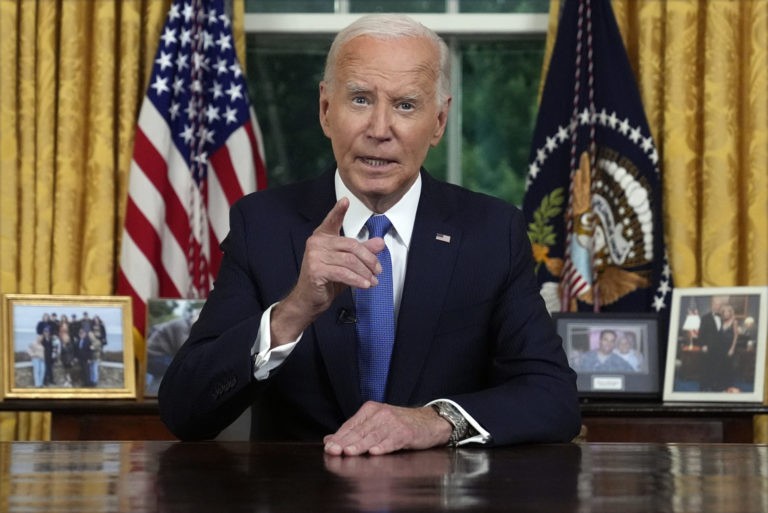
Joe Biden to Give a Speech Tonight

(Headline USA) Former President Joe Biden is making a comeback… sort of.

The 82-year-old Democrat returns to the national stage Tuesday to elevate liberal concerns that President Donald Trump’s agenda is threatening Social Security.

Biden has largely avoided speaking publicly since leaving the White House in January, which is typically the tradition for immediate past presidents. 

Biden is expected to give early evening speech to the national conference of Advocates, Counselors and Representatives for the Disabled in Chicago. While Biden has made a handful of public appearances in recent weeks, Tuesday’s high-profile address focuses on a critical issue for tens of millions of Americans that could define next year’s midterm elections.

“As bipartisan leaders have long agreed, Americans who retire after paying into Social Security their whole lives deserve the vital support and caring services they receive,” said Rachel Buck, executive director of the ACRD.

Trump almost immediately began slashing the government workforce upon his return to the White House, including thousands of employees at the Social Security Administration.

Along with a planned layoff of 7,000 workers and controversial plans to impose tighter identity-proofing measures for recipients, the SSA has been sued over a decision to allow Elon Musk’s Department of Government Efficiency to access individuals’ Social Security numbers and other personally identifiable information.

At the same time, Social Security recipients have complained about long call wait times as the agency’s “my Social Security” benefits portal has seen an increase in outages. Individuals who receive Supplemental Security Income, including disabled seniors and low-income adults and children, also reported receiving a notice that said they were “not receiving benefits.”

The agency said the notice was a mistake. And the White House has vowed that it would not cut Social Security benefits, saying any changes are intended to reduce waste and fraud.

Biden will be joined in Chicago by a bipartisan group of former elected officials, including former Sen. Roy Blunt, R-Mo., former Sen. Debbie Stabenow, D-Mich., and former Social Security Administrator Martin O’Malley.

Biden is not expected to make frequent public appearances as he transitions into his post-presidency. He still maintains an office in Washington, but has returned to Delaware as his regular home base. Trump has revoked his security clearances.

While Biden may be in position to help his party with fundraising and messaging, he left the White House with weak approval ratings. Biden also faces blame from some progressives who argue he shouldn’t have sought a second term. Biden ended his reelection bid after his disastrous debate performance against Trump and made way for then-Vice President Kamala Harris, who lost to Trump in the fall.

Just 39% of Americans had a favorable opinion of Biden in January, according to a Gallup poll taken shortly after Trump’s inauguration.

Views of the Democratic former president were essentially unchanged from a Gallup poll taken shortly after the November election. They broadly track with the steadily low favorability ratings that Biden experienced throughout the second half of his presidential term.

Adapted from reporting by the Associated Press.

U.S. Army to Have Base on Mexico Border

(Headline USA) A long sliver of federal land along the U.S.-Mexico border that President Donald Trump is turning over to the Department of Defense would be controlled by the Army as part of a base, which could allow troops to detain any trespassers, including migrants, U.S. officials told The Associated Press.

The transfer of that border zone to military control — and making it part of an Army installation — is an attempt by the Trump administration to get around a federal law that prohibits U.S. troops from being used in domestic law enforcement on American soil.

But if the troops are providing security for land that is part of an Army base, they can perform that function. However, at least one presidential powers expert said the move is likely to be challenged in the courts.

The officials said the issue is still under review in the Pentagon, but even as any legal review goes on, the administration’s intent is to have troops detain migrants at the border.

The corridor, known as the Roosevelt Reservation, is a 60-foot-wide federal buffer zone that ribbons along the border from New Mexico to California, except where it encounters tribal or privately owned land. It had been run by the Interior Department until Trump directed control be transferred to the Defense Department in a presidential memo released Friday night.

For the next 45 days, the Defense Department will test taking control of a section of the Roosevelt Reservation in New Mexico, east of Fort Huachuca, which is an Army installation in Arizona, one of the U.S. officials said. During that period, the Army will put up additional fencing and signs warning people not to trespass.

People not authorized to be in that area could be arrested by the Army’s security forces, the officials said, who spoke on condition of anonymity to provide details not yet made public.

Any migrants in the country illegally who are detained by military personnel on those lands would be turned over to local civilian law enforcement agencies, the officials said.

It was not clear if the added land would require the military to deploy additional forces to the border. There are about 7,100 active duty troops under federal control currently assigned to the border and about 4,600 National Guard troops under state control.

Troops are prohibited from conducting civilian law enforcement on U.S. soil under the Posse Comitatus Act. An exception known as the military purpose doctrine allows it in some cases — but would not apply here and would likely be challenged in the courts, said Elizabeth Goitein, an expert on presidential emergency powers at the Brennan Center for Justice.

That’s because even though troops would be on land designated as an Army installation, they would have to prove that their primary mission there was not to conduct border security and law enforcement — and the whole point of Trump’s order transferring the Roosevelt Reservation to the military’s control is to secure the border, she said.

The military purpose doctrine “only applies if the law enforcement aspect is incidental,” Goitein said. “Does this (area) have a military purpose that has nothing to do with enforcing customs and security at the border?”

Adapted from reporting by the Associated Press