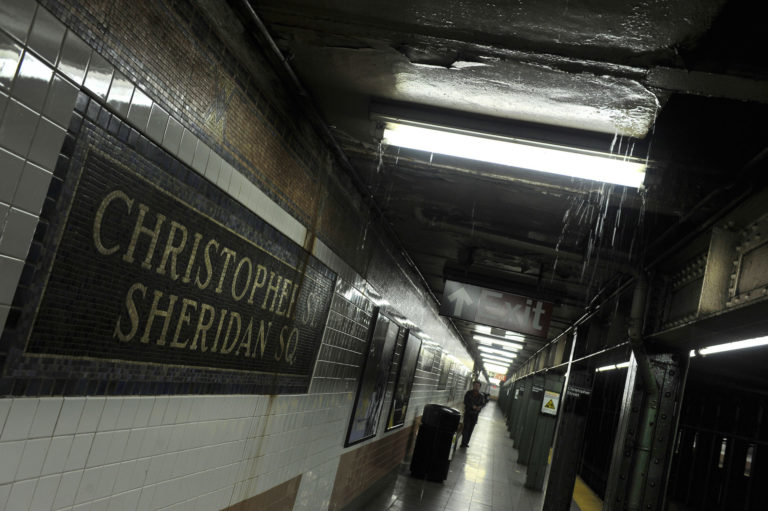
(Headline USA) A man was stabbed to death during the morning rush hour in the New York City subway system Friday after a dispute with another rider who had stepped on the man’s shoes, police said, adding it was the first homicide in the subway this year.
Police and medical personnel responded to the Brooklyn Bridge-City Hall subway station in lower Manhattan shortly after 8:30 a.m. for a 911 call about a person being stabbed. The victim, 38, was found unresponsive with multiple stab wounds to his torso and brought to a nearby hospital, where he was pronounced dead, police said.
🚨BREAKING: Another stabbing occurred on the NYC subway. The 38-year-old victim succumbed to his injuries.
He was later identified by police as John Sheldon of Brooklyn. He had been mistakenly identified by police earlier in the day as Sheldon John.
Authorities said they were searching for the other rider, who they described as in his 20s or 30s and who was dressed in black and wearing black headphones.
Police said the two men got into an argument on a train after the other man stepped on Sheldon’s shoes. Sheldon was stabbed on the train and in the subway station after the two got off, police said.
Earlier this month, Police Commissioner Jessica Tisch said there had been no homicides in the transit system during the first three months of the year for the first time in seven years. She added that subway crime from January to March had decreased to the second-lowest level in the first quarter in 27 years.
Recent high-profile subway attacks, such as a woman being set on fire and people being shoved onto the tracks, have left some riders on edge.
Last month, the Trump administration threatened to pull federal funding from the city’s transit system if it didn’t provide a plan to address crime.
City officials responded that there were plans in place to reduce crime on the subways and pointed to statistics showing that crime was down.
(Headline USA) Before dawn on Oct. 18, 2017, FBI agents broke down the front door of Trina Martin’s Atlanta home, stormed into her bedroom and pointed guns at her and her then-boyfriend as her 7-year-old son screamed for his mom from another room.
Martin, blocked from comforting her son, cowered in disbelief for what she said felt like an eternity. But within minutes, the ordeal was over. The agents realized they had the wrong house.
On Tuesday, an attorney for Martin will go before the U.S. Supreme Court to ask the justices to reinstate her 2019 lawsuit against the U.S. government accusing the agents of assault and battery, false arrest and other violations.
A federal judge in Atlanta dismissed the suit in 2022 and the 11th U.S. Circuit Court of Appeals upheld that decision last year. The Supreme Court agreed in January to take up the matter.
The key issue before the justices is under what circumstances people can sue the federal government in an effort to hold law enforcement accountable. Martin’s attorneys say Congress clearly allowed for those lawsuits in 1974, after a pair of law enforcement raids on wrong houses made headlines, and blocking them would leave little recourse for families like her.
FBI Atlanta spokesperson Tony Thomas said in an email the agency can’t comment on pending litigation. But lawyers for the government argued in Martin’s case that courts shouldn’t be “second-guessing” law enforcement decisions. The FBI agents did advance work and tried to find the right house, making this raid fundamentally different from the no-knock, warrantless raids that led Congress to act in the 1970s, the Justice Department said in court filings starting under the Biden administration.
In dismissing Martin’s case, the 11th Circuit largely agreed with that argument, saying courts can’t second-guess police officers who make “honest mistakes” in searches. The agent who led the raid said his personal GPS led him to the wrong place. The FBI was looking for a suspected gang member a few houses away.
Martin, 46, said she, her then-boyfriend, Toi Cliatt, and her son were left traumatized.
“We’ll never be the same, mentally, emotionally, psychologically,” she said Friday at the neat, stucco home that was raided. “Mentally, you can suppress it, but you can’t really get over it.”
She and Cliatt pointed out where they were sleeping when the agents broke in and the master bathroom closet where they hid.
Martin stopped coaching track because the starting pistol reminded her of the flashbang grenade the agents set off. Cliatt, 54, said he couldn’t sleep, forcing him to leave his truck driving job.
“The road is hypnotizing,” he said of driving tired. “I became a liability to my company.”
Martin said her son became extremely anxious, pulling threads out of his clothes and peeling paint off walls.
Cliatt initially thought the raid was a burglary attempt, so he ran toward the closet, where he kept a shotgun. Martin said her son still expresses fear that she could have died had she confronted the agents while armed.
“If the Federal Tort Claims Act provides a cause of action for anything, it’s a wrong-house raid like the one the FBI conducted here,” Martin’s lawyers wrote in a brief to the Supreme Court.
Other U.S. appeals courts have interpreted the law more favorably for victims of mistaken law enforcement raids, creating conflicting legal standards that only the nation’s highest court can resolve, they say. Public-interest groups across the ideological spectrum have urged the Supreme Court to overturn the 11th Circuit ruling.
After breaking down the door to the house, a member of the FBI SWAT team dragged Cliatt out of the closet and put him in handcuffs.
But one of the agents noticed he did not have the suspect’s tattoos, according to court documents. He asked for Cliatt’s name and address. Neither matched those of the suspect. The room went quiet as agents realized they had raided the wrong house.
They uncuffed Cliatt and left for the correct house, where they executed the warrant and arrested the man they were after.
The agent leading the raid returned later to apologize and leave a business card with a supervisor’s name. But the family received no compensation from the government, not even for the damage to the house, Cliatt said.
Martin said the most harrowing part of the raid was her son’s cries.
“When you’re not able to protect your child or at least fight to protect your child, that’s a feeling that no parent ever wants to feel,” she said.
The Houthis, officially known as Ansar Allah, are known for their resilience, having survived a US-backed Saudi/UAE war from 2015 to 2022, which involved heavy airstrikes, a ground campaign, and a blockade. The Yemeni group was also not deterred by a US-UK bombing campaign conducted under President Biden from January 2024 to January 2025.
The only thing that was able to stop Houthi attacks on Israel and Red Sea shipping was the Gaza ceasefire that went into effect on January 19. After Israel violated the deal by imposing a blockade on humanitarian aid and all other goods entering Gaza, the Houthis announced they would re-impose their blockade on Israeli shipping. It was in response to that announcement that the US began bombing Yemen again.
Houthi leader Abdul-Malik al-Houthi said on Thursday that the new US bombing campaign has failed to impact Yemeni military capabilities and that a blockade was in effect for Israeli and US shipping in the Red Sea.
“The ships of the Israeli enemy, along with the Americans, have become completely absent in the Red Sea, Bab al-Mandeb, the Gulf of Aden and the Arabian Sea, and there is no navigational activity of the Israelis and Americans at all, but there is a complete halt,” al-Houthi said, according to Yemen’s SABA news agency.
Al-Houthi also pointed to the fact that Yemeni air defenses have taken out multiple US MQ-9 Reaper drones, which are worth $30 million each, downing seven in the month of April alone. The Houthis have also continued to launch missile and drone attacks on Israel and on US warships in the region.
The US has been bombing Yemen using two aircraft carriers in the region and B-2 bombers stationed at Diego Garcia in the Indian Ocean. The Pentagon has shared virtually no details about its war, which has not been authorized by Congress, but it’s likely the bombing campaign has already cost billions in just over one month.
A senior member of Ansar Allah’s political bureau has said the Houthis would stop attacks on US warships if the US stopped bombing Yemen, but there’s no sign the US is considering the offer since the campaign is really about ensuring Israel can continue its genocidal war on Gaza.
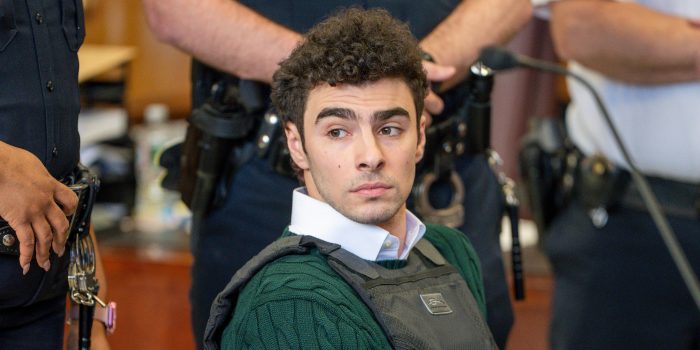
(Headline USA) Luigi Mangione pleaded not guilty Friday to a federal murder charge in the killing of UnitedHealthcare CEO Brian Thompson. Prosecutors formally declared their intent to seek the death penalty, and the judge warned Justice Department officials to refrain from making public comments that could spoil his right to a fair trial.
Mangione, 26, stood between his lawyers and leaned toward a tabletop microphone as he entered the plea in Manhattan federal court. He responded “yes” when U.S. District Judge Margaret Garnett asked if he understood the indictment that charges him with gunning down Thompson outside a midtown hotel last December.
Asked how he wished to plead, Mangione said simply “not guilty” and sat down.
A cause célèbre for people upset with the health insurance industry, Mangione’s federal arraignment drew dozens of people to court, including former Army intelligence analyst Chelsea Manning, who served prison time for leaking classified diplomatic cables about U.S. war crimes.
Outside the courthouse, Manning said he’s worried about the government “speed-running justice” in a death-penalty case.
Chelsea Manning speaks outside NYC court supporting Luigi Mangione, who pleaded "Not Guilty."pic.twitter.com/lcDSdf8ezg
Some lined up for hours in front of the courthouse steps, trying to snag a seat inside. Others rallied across the street as a pair of advertising trucks drove around playing videos denouncing the health insurance industry and the death penalty.
Mangione, an Ivy League graduate from a prominent Maryland real estate family, faces separate murders in federal and state court, where he faces a maximum punishment of life in prison.
Prosecutors had expected the state case go to trial first, but Mangione’s lawyers said Friday that they want the federal case to take precedent because it involves the death penalty. Because of the many legal issues involved in capital cases, Mangione’s federal case will move at a slower pace than non-death penalty prosecutions.
Mangione is next due in federal court on Dec. 5, a day after the one-year anniversary of Thompson’s death. His next appearance in the state case is set for June 26. No trial date has been set in either case.
Mangione, held in a federal jail in Brooklyn since his arrest, arrived to court Friday in a mustard-colored jail suit and chatted with one of his lawyers, death penalty counsel Avi Moskowitz, as they waited for the arraignment to begin.
Late Thursday night, federal prosecutors filed a required notice of their intent to seek the death penalty. That came weeks after U.S. Attorney General Pam Bondi announced that she would be directing federal prosecutors to seek the death penalty for what she called “an act of political violence” and a “premeditated, cold-blooded assassination that shocked America.”
It was the first time the Justice Department said it was pursuing capital punishment since President Donald Trump returned to the White House on Jan. 20 with a vow to resume federal executions after they were halted under the previous administration.
Mangione’s lawyers argue that Bondi’s announcement — which she followed with posts on Instagram account and a TV appearance — was a “political stunt” that violated long-established Justice Department protocols, corrupted the grand jury process and deprived him of his constitutional right to due process.
After Mangione lawyer Karen Friedman Agnifilo raised the issue again on Friday, Garnett instructed federal prosecutors to convey to Bondi and other Justice Department officials that court rules prohibit any pretrial publicity that could interfere with a defendant’s right to a fair trial.
Mangione’s federal indictment includes a charge of murder through use of a firearm, which carries the possibility of the death penalty. The indictment also charges him with stalking and a gun offense.
Surveillance video showed a masked gunman shooting Thompson from behind as the executive arrived for UnitedHealthcare’s annual investor conference. Police say the words “delay,” “deny” and “depose” were scrawled on the ammunition, mimicking a phrase commonly used to describe how insurers avoid paying claims.
The killing and ensuing five-day search leading to Mangione’s arrest rattled the business community while galvanizing health insurance critics who rallied around Mangione as a stand-in for frustrations over coverage denials and hefty bills.
Mangione was arrested Dec. 9 in Altoona, Pennsylvania, about 230 miles (about 370 kilometers) west of New York City and whisked to Manhattan by plane and helicopter.
Police said Mangione had a 9mm handgun that matched the one used in the shooting and other items including a notebook in which they say he expressed hostility toward the health insurance industry and wealthy executives.
Among the entries, prosecutors said, was one from last August that said “the target is insurance” because “it checks every box” and one from October that describes an intent to “wack” an insurance CEO. UnitedHealthcare, the largest U.S. health insurer, has said Mangione was never a client.
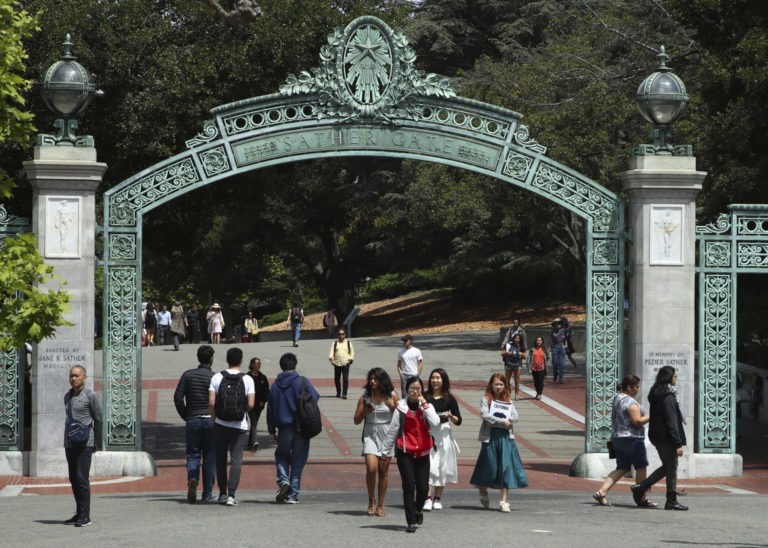
(Headline USA) The Trump administration launched an investigation into the University of California, Berkeley, on Friday centered on foreign funding, making it the latest university to be targeted by the federal government.
The investigation revives criticism from several years ago about the university’s partnership with China’s Tsinghua University. It comes after President Donald Trump earlier this week signed a series of executive orders focused on universities that he views as liberal adversaries to his political agenda.
One order called for harder enforcement of Section 117, a federal law requiring colleges to disclose foreign gifts and contracts valued at $250,000 or more.
The Department of Education’s Office of General Counsel will investigate “UC Berkeley’s apparent failure to fully and accurately disclose significant funding received from foreign sources,” Education Secretary Linda McMahon said in a statement.
UC Berkeley denied the government’s claims, saying that for the last two years “UC Berkeley has been cooperating with federal inquiries regarding 117 reporting issues, and will continue to do so.”
The department cited media reports from 2023 about UC Berkeley failing to disclose “hundreds of millions of dollars in funding from a foreign government” but didn’t mention the country.
On May 2023, the Daily Beast reported that UC Berkeley failed to report it got $220 million from the Chinese government to build a joint Tsinghua-Berkeley Shenzhen Institute, which the University of California, Berkeley, and China’s Tsinghua University opened in 2014 in the city of Shenzhen to focus on “strategic emerging industries,” according to the institute’s website.
Last year, a report by the Republican members of the House Select Committee on the Chinese Communist Party found that U.S. tax dollars have contributed to China’s technological advancement and military modernization when American researchers worked with their Chinese peers in areas such as hypersonic weapons, artificial intelligence, nuclear technology and semiconductor technology.
In response to the report, UC Berkeley said Berkeley’s researchers “engage only in research whose results are always openly disseminated around the world” and the school was “not aware of any research by Berkeley faculty at TBSI conducted for any other purpose.” The university also said then it would unwind its partnership.
The university said Friday it’s no longer affiliated with TBSI.
Last week, the Department of Education demanded records from Harvard over foreign financial ties spanning the past decade, accusing the school of filing “incomplete and inaccurate disclosures.” Trump’s administration is sparring with Harvard over the university’s refusal to accept a list of demands over its handling of pro-Palestinian protests as well as its diversity, equity and inclusion efforts.
(Tate Miller, The Center Square) A nonprofit organization’s investigation tracked down donations equal to over $300 million in funding to diversity, equity, and inclusion initiatives at dozens of colleges and universities across the U.S., while also reporting that the DEI funds still exist after the federal government’s termination efforts and have been simply renamed.
“We have been able to track down over $336,271,100 in donations to fund institution DEI programs, scholarships, and offices,” a report on Defending Education’s investigation stated.
Defending Education is a nonprofit that works to “restore schools at all levels from activists imposing harmful agendas,” according to its website.
The millions of dollars are from 273 different DEI funds in 130 different colleges and universities across 44 states and the District of Columbia, according to Defending Education.
“American universities, especially in the wake of George Floyd and Black Lives Matter, have established funds that focus on the advancement of diversity, equity, and inclusion (DEI) inside the institutions,” Defending Education’s report said.
“The purpose of these funds range from the establishment of identity-based scholarships to funding DEI related programming on campuses,” according to the report.
Defending Education’s report states that often initiatives often are simply renamed.
“In some cases that are captured in this report, universities just rebranded the fund(s) or program,” the report said, giving an example of the University of Nebraska Lincoln’s “Office of Diversity and Inclusion Fund” being renamed to the “Community and Belonging Support Fund,” while retaining the same account number.
“While President Trump’s Executive Orders have incentivized universities to take down webpages and halt DEI related programmings, it does not mean that these institutions are necessarily ending these practices permanently,” the report said.
Trump and his administration have been working to end DEI through executive orders calling for the termination of the philosophy and a Dear Colleague letter stating race-based decisions in education are unlawful.
Defending Education Founder and President Nicole Neily told The Center Square in a statement: “it’s important to remember that this isn’t just a federal issue – states have a role to play in this battle as well.”
“From rescinding state laws mandating minority contracting through to DEI reporting requirements, much of the action and oversight needs to take place at lower levels of government,” Neily said.
Defending Education traced the schools’ DEI funding partly through campaign websites, but mostly through university announcements, webpages, and reports, according to the report. Years covered in the investigation fall mainly between 2021 and the present day.
The report cites examples of the University of Michigan raising over $98 million for DEI initiatives and funds and the University of Delaware raising $21 million “to expand its diversity, equity, and inclusion programming.”
Goldwater Institute Senior Constitutionalism Fellow Timothy K. Minella told The Center Square that “this investigation underscores the need for states to pass targeted legislation that ends DEI programs at public institutions for good, regardless of their funding source.”
“The essence of DEI – treating people differently on account of their race, sexual orientation, and other identity categories – violates the Constitution’s guarantee of the equal protection of the laws,” Minella said.
“Whether the money for these discriminatory programs comes from the state government or private donors, they are still wrong,” Minella said.
“Each state should be following the lead of Texas, Iowa, and many other state governments that have passed Goldwater’s reform to abolish DEI bureaucracies for good,” Minella told The Center Square.
(Thérèse Boudreaux, The Center Square) As America approaches the first 100 days of President Donald Trump’s second term in office, the majority of voters say the nation is on the wrong track, but fewer do than before Trump was reelected.
The Center Square’s Voters’ Voice Poll, conducted April 15-18 by Noble Predictive Insights, surveyed 1,187 Democrats; 1,089 Republicans; and 251 non-leaning Independents. The Center Square Voters’ Voice Poll is one of only six national tracking polls in the United States. It was scheduled to coincide with Trump’s 100th day in office, which is Tuesday, April 29.
Out of the 2,527 respondents, 54% say the country is going in the wrong direction, while 35% say it is headed in the right direction and 11% remain unsure.
But the numbers are more positive than they were in October 2024, when President Joe Biden was still in office, when 60% of voters held a negative view and only 30% held a positive view, as The Center Square reported.
The most recent poll shows that 86% of Democrats think the country is heading in the wrong direction while 9% say it is going in the right direction, with 5% remaining unsure.
Republicans are less unanimous, with 22% say America is on the wrong track and 63% thinking it is on the right track. Fourteen percent are undecided.
Non-leaning independents are the most unsure at 25%, though the majority, 59%, hold a negative view of the country’s direction. Only 16% think the country is headed in the right direction.
“Democrats are feeling really unified and really upset, and Republicans are kind of, [but] not as much, and this happens constantly when a party takes power,” David Byler, head of research at Noble Predictive Insights, said. “As you spend political capital, you unify your opposition and your own base gets complacent.”
The actions have evoked mixed reactions from Republicans and condemnation from Democrats, who have accused Trump of pandering to “his billionaire friends.”
The Voters’ Voice Poll numbers on where the country is headed did not vary significantly based on income bracket. But higher income earners (those earning more than $100,000 annually) were more likely than lower income earners to say that the country is headed in the wrong direction.
Urban and suburban voters were also much more likely to hold negative views of the country’s trajectory than rural voters, with the former saying it’s headed the wrong way by 59% and 57%, respectively, and 42% the latter making the same choice.
(Shirleen Guerra,The Center Square) While thousands of Virginians struggled to afford their energy bills last year, Dominion Energy awarded its CEO a $6.1 million raise—bringing total compensation to more than $17.5 million, according to federal Securities and Exchange Commission filings.
According to federal disclosures, Dominion reported Chairman and CEO, Robert M. Blue’s total 2024 compensation as $17.5 million in its latest proxy filing.
The raise came during a period when state funding for utility assistance dropped by nearly $40 million, and fewer than a quarter of eligible low-income households received help with heating or cooling costs, according to Virginia Department of Social Services records.
Dominion customers are still paying for the Virginia City Hybrid Energy Center, a $1.8 billion coal plant that state regulators have repeatedly said is losing money.
In 2022, filings with the State Corporation Commission showed Dominion planned to collect about $191 million from customers that year to cover the plant’s costs. Regulators also required Dominion to study whether it made sense to keep the plant running long-term and report back within nine months.
At the General Assembly, Dominion backed several energy-related bills that could affect how much it can charge ratepayers moving forward. Senate Bill 1040 amended renewable energy standards while extending cost recovery eligibility for some projects until 2032. Another measure, Senate Bill 1100,authorized pilot programs for “virtual power plants” that help manage electric demand.
The shift comes as Virginia exits the Regional Greenhouse Gas Initiative, a carbon market that once projected up to $1.65 billion for energy efficiency programs through 2030. A 2024 court ruling blocked the state’s administrative repeal, but the program remains on hold pending further legislative action.
With that funding uncertain, Dominion’s future investment strategy is expected to rely more heavily on residential rates and infrastructure riders.
A court ruling in November 2024 found Virginia’s administrative withdrawal from RGGI unlawful, but the state has remained out of the program while it appeals the decision. Without a clear funding source to replace RGGI’s projected $1.65 billion for energy efficiency, Dominion and state agencies face renewed pressure to fund energy initiatives through other means.
“This may be a long battle, but we are ready for it,” said SELC Senior Attorney Nate Benforado in a statement. “Virginia should get back in RGGI. The state’s unlawful removal is already harming its clean energy transition and putting the most vulnerable communities at even more risk.”
Planning documents from 2025 also forecast rising energy costs for consumers. A recent analysis by the Joint Legislative Audit and Review Commission estimated that average household bills could increase by $14 to $37 per month by 2040, driven partly by growing electricity demand from data centers.
In an email to The Center Square, Dominion spokesperson Jeremy Slayton said the company benchmarks executive compensation “to pay fairly and attract and retain the best talent” and that rates are reviewed by state regulators. Slayton also said the Virginia City Hybrid Energy Center is “critically important for reliability during periods of high demand.”
Dominion pointed to programs that help eligible customers with utility costs, including payment plans, virtual energy audits and weatherization assistance through its EnergyShare program.
(Kyle Anzalone, Antiwar.com) A top Russian military commander was killed by a car bomb near Moscow. The attack happened just hours before US envoy Steve Witkoff met with Russian President Vladimir Putin.
On Friday, Lt. Gen. Yaroslav Moskalik was killed by a car bomb in Balashikha, a city near Moscow. He served as deputy chief of the Main Operations Directorate of the General Staff of the Russian Armed Forces.
According to TASS, Russian officials say Moskalik was the only person killed by the blast. Authorities believe the bomb was an IED containing submunitions and had the power of more than 300 grams of TNT.
Russian Foreign Ministry Spokesperson Maria Zakharova called the bombing a “terrorist attack.” “The main question is how to stop the war in the center of Europe, the world. We see so many victims every day,” she said. “Even today, a Russian [general] was killed in a terrorist attack in Moscow.”
The attack came just hours before Trump’s envoy Steve Witkoff met with Putin in Russia. Friday’s talks are the fourth round of negotiations between Witkoff and the Russian President.
Trump has repeatedly stated that he wants to bring the war in Ukraine to an end. In recent days, he has called on Kiev to recognize Moscow’s control over Crimea. Ukrainian President Zelensky firmly rejected this proposal.
On Wednesday, Trump slammed Ukrainian President Volodymyr Zelensky for rejecting the idea of Ukraine. “This statement is very harmful to the Peace Negotiations with Russia in that Crimea was lost years ago under the auspices of President Barack Hussein Obama, and is not even a point of discussion,” Trump wrote on Truth Social.
“[Zelensky] can have Peace, or, he can fight for another three years before losing the whole Country,” he added. “We are very close to a Deal, but the man with ‘no cards to play’ should now, finally, GET IT DONE.”
(Money Metals News Service) On a recent episode of the Money Metals Podcast, host Mike Maharrey sat down with Keith Neumeyer, President and CEO of First Majestic Silver Corporation, for an in-depth discussion on silver markets, mining challenges, and the future of precious metals investing.
Founded 22 years ago, First Majestic has expanded from producing just 25,000 ounces of silver in 2004 to roughly 22 million ounces of silver equivalent in 2024. Approximately 60% of the company’s production last year was silver and 40% gold.
Following the January 2025 acquisition of the Los Gatos silver mine in Chihuahua, Mexico, First Majestic expects to boost output to 31–32 million ounces of silver equivalent this year. With a market capitalization between $3 billion and $3.5 billion and 5,500 employees worldwide, First Majestic is one of the most recognized names in the silver space.
Neumeyer noted that today, First Majestic’s cash flows are the strongest in the company’s history, and its treasury is in a better position than ever before. Despite silver’s solid performance over the past year, rising about 12%, many still perceive it as lagging behind gold, largely because silver has not set new nominal highs the way gold has.
(Interview Starts Around 7:19 Mark)
Silver’s Industrial Strength
When asked about silver’s role, Neumeyer distinguished between gold and silver. Gold, he emphasized, is the granddaddy of all currencies.
Silver, by contrast, is predominantly an industrial metal, with 70% of global output consumed across industries such as electronics, solar energy, and electric vehicles. He pointed out that over 10,000 applications depend on silver.
Today, solar panels and electric vehicles alone account for over 30% of global silver consumption—two sectors that barely existed two decades ago.
Above-ground silver stockpiles are at historic lows, while industrial demand has reached unprecedented highs. Neumeyer insisted that the supply-demand fundamentals are stronger now than when he founded First Majestic, reinforcing his long-held view that triple-digit silver prices are not only possible but increasingly necessary.
Skepticism of Official Silver Data
Neumeyer took sharp aim at the Silver Institute and Metals Focus, two groups often cited as authorities on silver market statistics. First Majestic withdrew from the Silver Institute several years ago, with Neumeyer claiming that these organizations fabricate numbers based largely on incomplete public data. In meetings with refiners and electronics manufacturers worldwide, including recent discussions in Japan, Neumeyer found no evidence that Metals Focus had ever contacted these key industry players.
He argued that both global silver supply and consumption are significantly underestimated. Given the structural secrecy of silver use in manufacturing and the private nature of most refiners and smelters, Neumeyer believes the real annual supply deficits are far larger than officially reported.
An 18-Year Problem and the Need for Higher Prices
With four consecutive years of reported silver market deficits and hundreds of millions of ounces short, Neumeyer warned that silver supply cannot be replaced quickly.
On average, it takes 18 years from the discovery of a new deposit to full-scale production. Rising permitting hurdles, political instability, and financing challenges further complicate new mine development.
Neumeyer stressed that triple-digit silver prices are necessary to motivate new investment in the sector. Without significantly higher prices, mining companies and banks alike will continue to shy away from the risks associated with bringing new silver mines online.
The Suppression Problem in Paper Silver Markets
Turning to market dynamics, Neumeyer highlighted the extraordinary leverage in the paper silver market. He estimates that roughly 1 billion ounces of paper silver trade daily, adding up to 240 billion ounces annually across 240 trading days. With global mine production at just 830 million ounces per year, that implies a paper-to-physical leverage ratio close to 300 to 1.
This massive paper market suppresses physical prices and benefits banks, who often fix long-term silver delivery contracts for industrial buyers like Tesla and BMW. Neumeyer proposed a solution: require paper markets to hold at least 10% of physical metal against outstanding contracts, similar to banking reserve requirements. Such a reform, he argued, would restore at least a measure of transparency and stability.
First Majestic’s Unique Strategy
Unlike most mining companies, First Majestic holds significant amounts of silver and gold on its balance sheet. In 2024, about 5% of its silver production was processed through its own mint in Nevada. That share is expected to grow to 10% in 2025. By retaining physical inventory, First Majestic protects itself from dollar devaluation and market volatility.
Neumeyer emphasized that buying physical metal is about wealth preservation. For him, physical gold and silver are savings vehicles, not trading assets. In contrast, mining stocks offer leverage but come with greater risks and require more precise timing.
The Coming Bull Market in Mining Stocks
Neumeyer believes the mining sector is entering a new multi-year bull market. Drawing a parallel to the early 2000s, when the NASDAQ collapsed by 85% and capital rotated into real assets, he forecasted strong performance for mining stocks from 2025 through 2030. Physical metals, he said, offer stability, but mining equities provide explosive upside potential in a rising market.
He advised investors to focus on companies with strong management teams, significant track records, and projects located in stable jurisdictions. He warned against investing in politically unstable countries where property rights and mining permits are insecure. In his view, North America and Australia offer the best environments for mining investment.
Final Thoughts
Neumeyer encouraged all investors to own physical metals as a foundation of wealth preservation, then add mining equities for additional leverage. Given record-high industrial demand, crumbling inventories, and a broken paper silver market, he believes the coming years could see silver prices rise dramatically.
For more information about First Majestic Silver Corporation, Neumeyer directed listeners to the company’s website at www.FirstMajestic.com and to follow updates on Twitter at @FirstMajestic and @KeithNeumeyer.