(Luis Cornelio, Headline USA) One of 10 released Americans from Kuwait custody recorded an emotional video thanking President Donald Trump for his efforts to secure his freedom.
The hostage, former military contractor Tony Holden, had been imprisoned in 2022 while working in Kuwait as an HVAC technician for Vectrus. He faced dubious charges of drug possession and trafficking, despite testing negative for drug use.His family contended Kuwait officials had attempted to bribe him.
“President Trump, I want to thank you for what you’ve done for me and my family,” Holden said, standing next to his wife, two daughters and grandchild. “I wanted you to meditate on how you’ve affected, personally, lives and the difference that you’ve made.”
10 more Americans are coming home after being imprisoned in Kuwait all thanks to @POTUS! This brings the total to 23 people released since March.
As his wife fought back tears, Holden added, “I’m a 60-year-old grandfather—and father—so I’m just… I can’t put words in how exited, we give our grace and honor to God, but he used his instruments in a lot of people behind the scenes who have done great work.”
“I wanted you to be able to hear that directly from me, and again—God bless you and your family,” he continued.
Holden was one of the 10 newly released detainees freed by Kuwait after Trump took office on Jan. 20, 2025. In total, 23 Americans have been released thanks to the Trump administration.
The releases followed a visit by Adam Boehler, Trump’s current envoy for hostage affairs. Similar efforts have secured releases from Venezuela.
“We flew out, we sat down with the Kuwaitis, and they said, ‘Listen, no one’s ever asked before at this level,” Boehler said in an interview with the Associated Press.
Shockingly, Kuwait did not ask for anything in return.
“They’ve been extremely responsive, and their view is the United States is a huge ally. They know it’s a priority for (President Donald Trump) to bring Americans home,” Boehler added. “I credit it to the Kuwaiti understanding that we’ve stood up for them historically and they know that these things are important for the president.”
(Thérèse Boudreaux, The Center Square) The U.S. House Judiciary Committee’s fiscal year 2025 budget proposal is still a work in progress, but the first markup already reveals potentially major changes to the immigration system and regulatory law.
Under the $5.8 trillion Republican budget instructions, the House Judiciary Committee may spend at least $110 billion to fund priorities of President Donald Trump that fall under its jurisdiction. The committee handles issues related to federal court procedures, immigration and drug policy, antitrust issues, and crime control, among other things.
The committee’s resolution in its current form, which lawmakers debated in a roughly nine-hour markup Wednesday, would increase the federal deficit by an estimated $81 billion over the next decade, well within the instructions of the budget resolution.
More than half of the money, $45 billion, is allotted to U.S. Immigration and Customs Enforcement for building facilities that could detain at least 100,000 illegal immigrants. The bill also directs $8 billion for hiring more border personnel and $500 million to the Department of Justice to combat drug trafficking.
Notably, the Judiciary committee’s plan imposes fees for the first time ever on asylum applications. Asylum seekers and parolees would pay a $1,000 minimum fee, while migrants requesting Temporary Protected Status would have to pay $500. Sponsors of unaccompanied migrant children would be charged $3,500, and many work permits applications would also carry a $550 fee.
Altogether, the investments in border security coupled with the new fees will raise tens of billions of dollars in additional revenue over the next decade if applied.
“This system has left these agencies with funding shortfalls paid for by American taxpayers,” House Judiciary Committee Chairman Jim Jordan, R-Ohio, told lawmakers. “The fees included in this bill will allow agencies to achieve cost recovery and limit their reliance on taxpayer funding.”
Democratic members of the committee blasted the budget blueprint as a “blank check” for Trump’s “authoritarian playbook.”
Another major change made by the plan — which passed the committee on a party-line vote but is still subject to edits — relates to how the executive branch can implement regulatory actions. The bill would require agencies to account for the costs of any proposed rules and also require congressional approval for any major rules that would increase federal revenue.
Republicans have said this will rein in the power of the unelected administrative state and force lawmakers to write better, more detailed laws instead of assuming regulatory agencies will take care of the specifics.
(Mike Maharrey, Money Metals News Service) Central banks continued to stockpile gold in the first quarter.
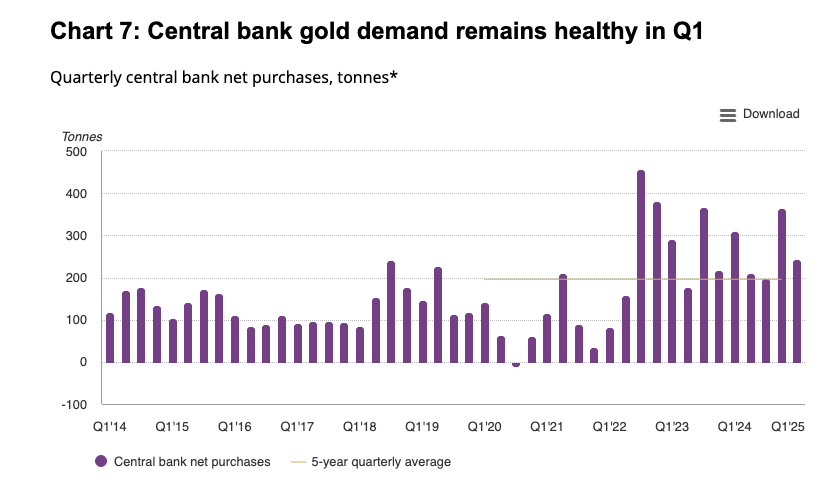
Official net gold purchases came in at 244 tonnes, 21 percent below Q1 2024 (310 tonnes), but 25 percent above the five-year quarterly average. As the World Gold Council put it, central bank gold buying remained “comfortably within the quarterly range of the last three years.”
Official central bank gold demand topped 1,000 tonnes for the third straight year in 2024. To put that into perspective, central bank gold reserves increased by an average of just 473 tonnes annually between 2010 and 2021.
It’s important to note that these numbers represent gold purchases reported to the IMF. The World Gold Council noted, “Akin to recent quarters, reported purchases only accounted for 22 percent of central bank demand in Q1, implying widespread buying interest beyond what was captured by the IMF IFS data. This may be explained by a number of factors, including delays to reporting and purchasing by non-central bank official institutions.”
It can also be explained by countries, including China, buying gold off the books. It is likely that some central banks hold far more gold than they report.
Who Bought Gold in Q1?
The National Bank of Poland was the biggest central bank gold buyer in 2024 and stayed on top with continued purchases through the first three months of 2025, adding another 49 tonnes.
Last year, National Bank of Poland Governor Adam Glapiński indicated the central bank plans to increase its gold holdings to 20 percent of its reserves.
“This makes Poland a more credible country, we have a better standing in all ratings, we are a very serious partner, and we will continue to buy gold.”
Driving toward that goal, the Polish central bank expanded its gold holdings by 90 tonnes in 2024.
With the additional purchases in Q1, the National Bank of Poland has eclipsed Glapiński’s goal, now holding 497 tonnes, representing 21 percent of its reserves.
The Polish central bank began aggressively increasing its gold reserve in 2021 when Glapiński announced a plan to buy 100 tons of the yellow metal. When he announced the initial plan to expand its gold reserves, Glapiński said holding gold was a matter of financial security and stability.
“Gold will retain its value even when someone cuts off the power to the global financial system, destroying traditional assets based on electronic accounting records. Of course, we do not assume that this will happen. But as the saying goes – forewarned is always insured.
“And the central bank is required to be prepared for even the most unfavorable circumstances. That is why we see a special place for gold in our foreign exchange management process.”
Glapiński also pointed out that “Gold is free from credit risk and cannot be devalued by any country’s economic policy. Besides, it is extremely durable, virtually indestructible.”
The People’s Bank of China publicly returned to the table in November after a six-month pause in reporting gold purchases. The Chinese central bank was the second-biggest buyer in Q1, adding another 13 tonnes of gold to its official reserves. That pushed its official gold holdings to 2,292 tonnes, about 6.5 percent of its total reserves.
Notice the emphasis on “official.”
China is one of the central banks that likely holds significantly more gold than it publicly discloses. As Jan Nieuwenhuijs has reported, the People’s Bank of China is secretly buying large amounts of gold off the books. According to data parsed by the renowned Money Metals researcher, the Chinese central bank is currently sitting on more than 5,000 tonnes of monetary gold located in Beijing – more than TWICE what has been publicly admitted.
The National Bank of Kazakhstan added a net 6 tonnes of gold in Q1, despite selling 8 tonnes in February. The Kazakh central bank pivoted back to buying in March, adding 11 tonnes to its holdings. That pushed its official gold reserves to 291 tonnes.
In early April, National Bank of Kazakhstan Deputy Governor Aliya Moldabekova told Bloomberg that the central bank would hold off on gold sales until uncertainty declines and prices stabilize.
It is not uncommon for banks that buy from domestic production – such as Uzbekistan and Kazakhstan – to switch between buying and selling.
As for Uzbekistan, it was the biggest seller in Q1, shrinking its gold holdings by a net 11 tonnes despite being the biggest buyer in January.
The Czech National Bank has been slowly by steadily building its gold reserves for the last several years. The Czechs added another 5 tonnes of gold to their holdings in the first quarter. That pushed its total gold reserves to 56 tonnes, four times higher than at the end of 2021.
After ranking as the third biggest buyer in 2024, the Reserve Bank of India continued adding to its gold reserves in Q1, but at a much slower pace. The RSB added 3 tonnes of gold in Q1. At the end of March, the Indian central bank held 880 tonnes of gold, making up about 12 percent of its reserves.
Other notable buyers in the first quarter included:
Turkey – 4 tonnes
Qatar – 3 tonnes
Egypt – 1 tonne
State Oil Fund of Azerbaijan (SOFAZ) – 19 tonnes
Other notable sellers included:
Russia – 3 tonnes
Kyrgyz Republic – 2 tonnes
The Big Picture
Strong central bank gold buying continued a trend we’ve seen over the last three years.
On net, central banks officially increased their gold holdings by 1,044.6 tonnes in 2024. It was the 15th consecutive year of expanding gold reserves.
Last year was the third-largest expansion of central bank gold reserves on record, coming in just 6.2 tonnes lower than in 2023 and 91 tonnes lower than the all-time high set in 2022. (1,136 tonnes). 2022 was the highest level of net purchases on record, dating back to 1950, including since the suspension of dollar convertibility into gold in 1971.
Looking at the broader perspective, the central bank gold buying trend is now entering its 16th year.
World Gold Council analysts expect the trend to continue, with buying “close to the range seen over the past three years on continued elevated trade-related risks and uncertainty premia in U.S. assets.”
The WGC also noted that “diversification” with “a reduction of U.S. assets” is one of the factors driving central bank gold buying. In other words, de-dollarization.
“We don’t see an end to this narrative unless there is a material shift in geopolitical tensions. The IMF has downgraded growth prospects in the US more than in other major economies, citing policy uncertainty. This suggests that other countries may have leverage in negotiations, although these typically last months and years, not weeks. Hence, we don’t expect any near-term resolutions.”
Mike Maharrey is a journalist and market analyst for Money Metals with over a decade of experience in precious metals. He holds a BS in accounting from the University of Kentucky and a BA in journalism from the University of South Florida.
Oddly enough, despite my penchant for losing stuff, I’m pretty good at finding things other people have lost. I am my wife’s go-to for locating missing items. Sometimes, I find her phone before she even realizes it’s missing.
I also have a pretty good track record of finding things other people have lost. But I’ve never found anything like what a couple of hikers in the Czech Republic stumbled upon.
As the duo was hiking a trail in the Podkrkonosí Mountains, they spotted a small aluminum can and an iron box.
I’m not sure what made them pick them up. The article in Popular Science said, “They didn’t look like much.” However, the hikers’ curiosity was rewarded when they opened the containers and found them packed with gold.
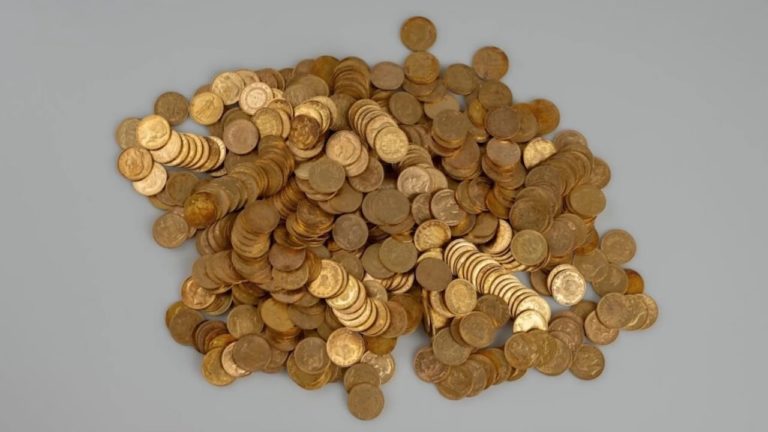
The box contained 16 snuff boxes, 10 bracelets, a wire bag, a comb, a chain, and a powder compact—all gold. And inside the can, there were 598 gold coins.
Now, that’s what I call a find!
Assessors at the Museum of Eastern Bohemia estimate our intrepid duo found about $340,000 in gold.
“When he opened it, my jaw dropped,” head archaeologist Miroslav Novak said.
The dates on the coins ranged from 1808 to 1915, and most of them originated in the Austria-Hungarian Empire under Franz Joseph I.
It’s unclear how they ended up in the mountains of the Czech Republic.
Numismatist Vojtěch Brádle said the coins didn’t likely enter the region directly from the mint in Vienna.
“I found out that these coins did not travel from the Vienna mint to us, but to the Balkans. And there, after the collapse of the monarchy, in the then-Kingdom of Serbs, Croats and Slovenians, marks, so-called countermarks, were minted. … We know that the coins were in Serbia sometime in the 1920s and 1930s, but we have no idea how and when they got to eastern Bohemia.”
A countermark is a symbol, inscription, or mark impressed onto the coin after it was originally minted. This mark is typically added by a different authority or government than the one that produced the coin, generally to confirm its authenticity.
According to experts who examined the coins, some came from several other countries, including France, Belgium, Turkey, Romania, Italy, and Russia.
It’s possible the coins and valuables were buried when the Nazis annexed the region in the 1930s. It’s also possible that German soldiers buried the items when they retreated in the face of Russian forces. A less intriguing possibility is that thieves stole the items and buried them.
Whenever I hear stories like this, it always strikes me that gold and silver are always valuable, no matter how long they have been buried. If the hikers had stumbled across a box full of notes from the Weimar Republic, they would be utterly worthless (except for the historical value.) Heck, notes from the Weimar Republic were worthless when they were in circulation.
Can you imagine a hiker 500 years in the future finding a box of Federal Reserve notes? I have a feeling they won’t be worth much either.
However, gold and silver are money at all times and in all places. Gold and silver don’t decay or degrade. People around the world recognize their value. A hiker is going to be thrilled to find gold coins, whether they are in the Czech Republic, Guatemala, or the Sahara Desert today or 100 years from now.
I can only hope my penchant for finding things someday leads me to a can full of money!
And with that, I think I’ll go hiking.
Photo Credit: Museum of Eastern Bohemia
Mike Maharrey is a journalist and market analyst for Money Metals with over a decade of experience in precious metals. He holds a BS in accounting from the University of Kentucky and a BA in journalism from the University of South Florida.
(Headline USA) Detailed Army plans for a potential military parade on President Donald Trump’s birthday in June call for more than 6,600 soldiers, at least 150 vehicles, 50 helicopters, seven bands and possibly a couple thousand civilians, according to the Associated Press.
The planning documents, obtained by the AP, are dated April 29 and 30 and have not been publicly released. They represent the Army’s most recent blueprint for its long-planned 250th anniversary festival on the National Mall and the newly added element — a large military parade that Trump has long wanted but is still being discussed.
The Army anniversary just happens to coincide with Trump’s 79th birthday on June 14.
While the slides do not include any price estimates, it would likely cost tens of millions of dollars to put on a parade of that size. Costs would include the movement of military vehicles, equipment, aircraft and troops from across the country to Washington and the need to feed and house thousands of service members.
High costs halted Trump’s push for a parade in his first term, and the tanks and other heavy vehicles that are part of the Army’s latest plans have raised concerns from city officials about damage to roads.
Asked about plans for a parade, Army spokesman Steve Warren said Thursday that no final decisions have been made.
Col. Dave Butler, another Army spokesman, added that the Army is excited about the plans for its anniversary.
“We want to make it into an event that the entire nation can celebrate with us,” said Butler. “We want Americans to know their Army and their soldiers. A parade might become part of that, and we think that will be an excellent addition to what we already have planned.”
Others familiar with the documents, who spoke on condition of anonymity because the plans have not been finalized, said they represent the Army’s plans as it prepares for any White House approval of the parade. The White House did not immediately respond to a request for comment.
There has been no formal approval yet. Changes to the plans have been made in recent weeks and more are likely.
What would go into the potential Army parade
Much of the equipment would have to be brought in by train or flown in.
Some equipment and troops were already going to be included in the Army’s birthday celebration, which has been in the works for more than a year. The festival was set to involve an array of activities and displays on the National Mall, including a fitness competition, climbing wall, armored vehicles, Humvees, helicopters and other equipment.
A parade, however, would increase the equipment and troops involved. According to the plans, as many as 6,300 of the service members would be marching in the parade, while the remainder would be responsible for other tasks and support.
The Army’s early festival plans did not include a parade, but officials confirmed last month that the Army had started discussions about adding one.
The plans say the parade would showcase the Army’s 250 years of service and foresee bringing in soldiers from at least 11 corps and divisions nationwide. Those could include a Stryker battalion with two companies of Stryker vehicles, a tank battalion and two companies of tanks, an infantry battalion with Bradley vehicles, Paladin artillery vehicles, Howitzers and infantry vehicles.
There would be seven Army bands and a parachute jump by the Golden Knights. And documents suggest that civilian participants would include historical vehicles and aircraft and two bands, along with people from veterans groups, military colleges and reenactor organizations.
According to the plan, the parade would be classified as a national special security event, and that request has been submitted by the National Park Service and is under review.
And it is expected that the evening parade would be followed by a concert and fireworks.
One of the documents raises concerns about some limitations, which include where troops would be housed and “significant concerns regarding security requirements” as equipment flows into the city. It says the biggest unknown so far is which units would be participating.
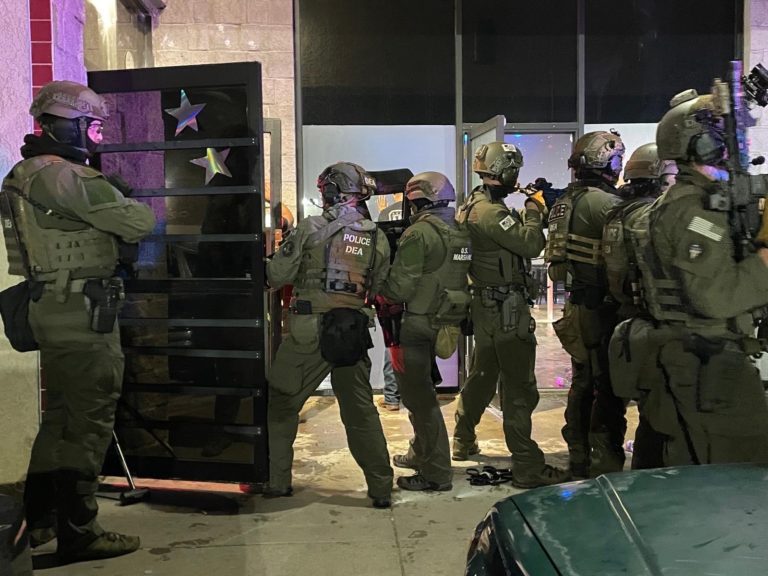
(Headline USA) A soldier present at an after-hours nightclub where more than 100 immigrants suspected of being in the U.S. illegally were taken into custody appeared in court Thursday to face charges that he distributed cocaine.
Staff Sgt. Juan Gabriel Orona-Rodriguez, who is assigned to Fort Carson, an Army post near the illegal club in Colorado Springs, was arrested Wednesday evening, the FBI said.
He allegedly sold cocaine to an undercover agent of the Drug Enforcement Administration days before the raid and is accused of working with others to distribute the drug since around September, according to his arrest affidavit.
Orona-Rodriguez — a member of the 1st Stryker Brigade Combat Team in the 4th Infantry Division — was dressed in camouflage pants and a khaki T-shirt and held court documents in his handcuffed hands during his brief court hearing. He listened as the magistrate judge explained his rights and agreed to appoint a public defender to represent him.
🥂 Part of busting up the underground nightclub in Colorado Springs included the arrest of 114 illegal aliens.#DEA partners and @DHSgov placed patrons (in the U.S. illegally) on buses for processing and likely eventual deportation. pic.twitter.com/aLyQUdy5YN
At the request of Assistant U.S. Attorney Garreth Winstead, Orona-Rodriguez will continue to be held until a hearing to discuss his detention on Tuesday. His lawyer, Josh Lilley, did not address the allegations against him during the hearing and declined to comment after the hearing, citing the public defenders’ policy against speaking to the media.
More than 300 law enforcement officers and officials from multiple agencies participated in Sunday’s operation at the nightclub, which had been under investigation for months, said Jonathan Pullen, special agent in charge of the DEA’s Rocky Mountain Division.
Cocaine was among the drugs found, Pullen said at a news conference in Colorado Springs, whose leaders have declared that it is not a “sanctuary city” for migrants.
Orona-Rodriguez was one of about 17 active-duty U.S. Army service members who were at the club, known as Warike, when it was raided early Sunday, the affidavit said.
He appears to have held a leadership role in a business that provides armed security at nightclubs, including at Warike, according to the document. However, it did not say whether he was working security there at the time of the raid. It notes that he had been warned by his commanding officer this spring that he could not work for the security company.
According to the arrest affidavit, police received 911 calls related to the club “citing a wide variety of alleged crimes, including weapons violations, assault, narcotics, and other violent crime.”
Two people wanted in connection with criminal misdemeanor cases were also arrested during the raid, Colorado Springs police said.
Colorado Springs mayor Yemi Mobolade, a political independent and Nigerian immigrant, has expressed support for the operation, which he said was the “result of clear evidence of serious criminal conduct.”
“Our residents deserve to live in a city where the rule of law is upheld and where illegal behavior is met with firm and decisive action,” he said in a statement.
President Donald Trump posted a link to the DEA video of the raid on his social media site, Truth Social. “A big Raid last night on some of the worst people illegally in our Country — Drug Dealers, Murderers, and other Violent Criminals, of all shapes and sizes,” the president wrote.
Rodriguez received more than a dozen Army awards during his almost nine years in service, including an Army Commendation Medal with combat device, which is earned during a deployment where the soldier was “performing meritoriously under the most arduous combat conditions,” according to Army descriptions of the award.
Of the 17 soldiers who were at the venue at the time of the raid, 16 were patrons and one was working there in a security role, a U.S. official said on the condition of anonymity to provide details not yet made public. Sixteen of the soldiers there were assigned to Fort Carson, the official did not know where the seventeenth was assigned.
Investigators suspect Orona-Rodriguez was getting cocaine from an unidentified Mexican citizen who is “unlawfully present in the United States without admission,” according to the affidavit.
Orona-Rodriguez was charged with two drug-related counts, including conspiracy to distribute cocaine.
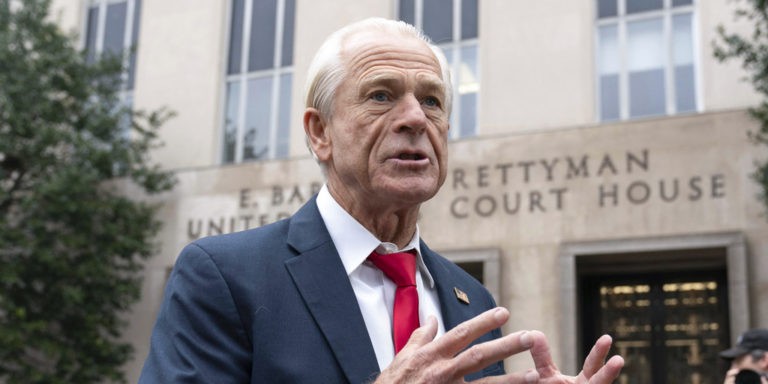
(Luis Cornelio, Headline USA) Newly unearthed emails confirm what the Biden administration had repeatedly denied: It was heavily involved in the 2022 prosecution of Trump trade counselor Peter Navarro.
The emails, released Thursday and obtained by Sen. Chuck Grassley, R-Iowa, showed that the DOJ approved then-U.S. Attorney Matt Graves’s decision to indict Navarro on two contempt of Congress charges, despite the left and legacy media’s claims of independence.
Navarro, one of the top officials in the first Trump White House, had challenged the Jan. 6 Committee’s overreach by invoking executive privilege in refusing to comply with their subpoenas.
It appears the Biden DOJ wanted to make an example of Navarro.
In one email dated May 19, 2022—just days before Navarro was indicted—FBI Special Agent Walter Giardina wrote to fellow agents about instructions from the U.S. attorney for D.C., after the latter’s consultation “with main Justice.”
The email read, “I just spoke with DC USAO, after consultation with main Justice, they are not intending to prosecute Meadows or Scavino. This decision is based on their White House positions and prior DOJ opinions. .. We have been told to cease work on those case. [sic]”
Signaling the government’s intent to go after Navarro, the email continued, “They would like to charge Navarro in the next two weeks however.”
NEW: Emails obtained by Sen Grassley demonstrate the collusion between Biden DOJ, DC US Attorney Matt Graves, and Washington FBI to pursue an indictment and schedule the arrest of Peter Navarro in 2022.
Giardina then ordered agents to “locate” Navarro, obtain a subpoena return from Verizon, issue a preservation letter to Apple, prepare a search warrant for his phone and iCloud account, conduct a “knock and talk interview” and serve a phone search warrant after the interview.
The emails highlight the harrowing treatment of Navarro, who served as director of the Office of Trade and Manufacturing Policy from 2017 to 2021.
He became the subject of a federal investigation under the Biden administration after he argued that his role in the battle for election integrity after the 2020 election was protected by executive privilege and was not subject to congressional subpoenas.
A grand jury returned the indictment in 2022. He was convicted two years later and sentenced to four months in prison—a sentence he called a “death sentence” at age 75.
Navarro is currently appealing his conviction in federal court.
Trump appointed Navarro as his senior counselor for trade and manufacturing after the 2024 presidential election.
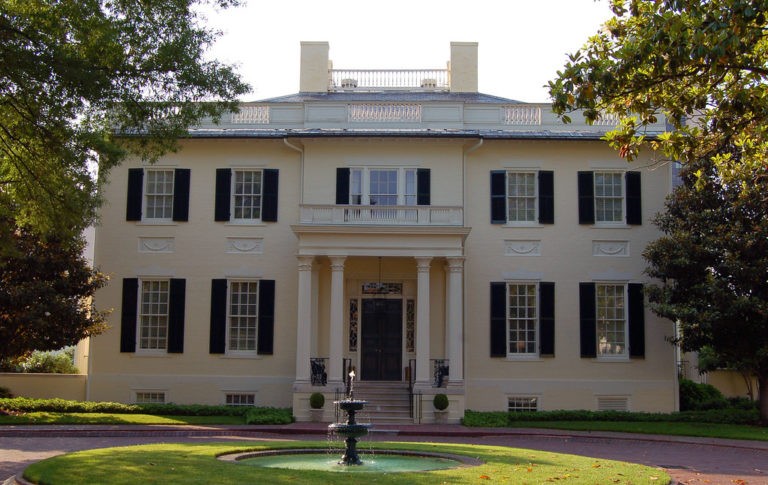
(José Niño, Headline USA) A Republican candidate in Virginia’s statewide elections is facing controversy over alleged ties to a social media account filled with gay pornography, though he claims he is being targeted by an extortion attempt.
John Reid is the first openly homosexual candidate to seek statewide office in Virginia as lieutenant governor.
The controversy began late last month when Gov. Glenn Youngkin’s, R-VA., political advisors identified a Tumblr account under the username “jrdeux,” which matched Reid’s Instagram and Threads handles, according to a report by The Associated Press.
CBS 6 reported that the account, active since at least 2014, contained hundreds of reblogged posts featuring nude male models, sexual acts, and fetish content, though none depicted Reid himself.
A vulnerability study commissioned by Republican operatives flagged the account as a potential liability for Reid’s candidacy.
Toward the end of last month, Youngkin privately urged Reid to withdraw from the race, citing the account’s content as a distraction. Reid refused, asserting the account was fabricated and part of a smear campaign.
The Tumblr page was deleted shortly after media inquiries, but archived screenshots confirmed its existence.
Reid, a conservative radio host, denied ownership of the account in a series of social media videos. He claimed “local religious activists” first alerted him to the allegations in early April, pressuring him to exit the race over photos of him attending a drag show.
“I can tell you that’s not my account,” Reid proclaimed in a video addressing the controversy, as mounting pressure urges him to bow out of the race.
In the video, Reid mentions being approached by individuals who warned that the account could harm his campaign, per a report by The Daily Mail.
“I demanded to see the evidence, and someone created a social media account with my instagram name, a name, which I’ve had for years, but this fake account reposted nude pictures of other people, models and porn models,” he said. “I can tell you, that’s not my account, and anyone on the internet can open accounts with the same or similar names as other people.”
After his sole primary opponent, Pat Herrity, dropped out on April 21 due to health issues, Reid became the uncontested nominee.
He claims Youngkin’s team then escalated efforts to force him out, threatening to weaponize the Tumblr content unless he withdrew.
In a video posted last Monday, Reid accused Matt Moran, Youngkin’s political action committee director, of extortion. “They were told if I dropped out, they would purchase the opposition research and the lies would stop. This is illegal in Virginia,” the homosexual GOP candidate said.
Reid’s legal counsel sent a cease-and-desist letter to Moran, demanding an end to the “smear” attacks.
Moran’s sworn affidavit, released on Wednesday, countered Reid’s claims. He alleged Reid’s campaign manager, Noah Jennings, knew about the Tumblr account beforehand and sought job opportunities during discussions about the vulnerability study.
Moran also stated he shared the findings with Reid in late April, but Reid skipped a scheduled meeting to review the evidence.
As the campaign continues, Reid’s response to these allegations could define his political future.
José Niño is the deputy editor of Headline USA. Follow him at x.com/JoseAlNino
“God did the State of Israel a favor that Biden was the president during this period, because it could have been much worse,” Herzog told Israel’s Channel 13.
“We fought [in Gaza] for over a year, and the administration never came to us and said, ‘ceasefire now.’ It never did. And that’s not to be taken for granted,” Herzog added.
Herzog’s comments contradict claims by President Biden and Vice President Kamala Harris’s allies that they were “tirelessly working” for a Gaza ceasefire. When a truce deal was reached in January, the incoming Trump administration’s Middle East envoy, Steve Witkoff, was seen as the factor that led to the deal, although Israel has since completely violated the agreement with President Trump’s support.
Channel 13 interviewed several former Biden administration officials about Biden’s handling of Israel’s genocidal war in Gaza. Former US Ambassador to Israel Tom Nides said that Biden backed Israel all the way despite enormous political pressure.
“This was the most significant political peril of Joe Biden’s political career. The easiest thing for Joe Biden… to do if he was worried about the votes in Michigan, is to basically get a little soft. He refused to do it,” Nides said.
Despite Biden’s commitment, Republicans in the US and Israeli Prime Minister Benjamin Netanyahu were critical, claiming he wasn’t doing enough to support Israel.
“There was an enormous pressure on [Biden] inside the White House to change his position. So, when I hear comments about [how] he wasn’t good enough, or he didn’t have Israel’s back, am I disgusted by it? 100%. Is it true? 100% no,” Nides added.
The Biden officials said they were frustrated with Netanyahu for attacking the administration for withholding a significant number of weapons, which wasn’t the case. A single shipment of 2,000-pound bombs that the administration was withholding was set to be released in June 2024, but it remained frozen due to Netanyahu’s accusations.
“Yes, we had a disagreement over one shipment, [but] to go out and attack us that way was particularly infuriating,” Ilan Goldenberg, a senior national security aide for the administration, told Channel 13.
Biden often identified himself as a Zionist and a staunch supporter of Israel. Because of that, Nides said the accusations that he wasn’t providing enough support for Israel really “aggravates Biden in a way where you don’t want to be around him when that happens.”
(Dave DeCamp, Antiwar.com) On Wednesday night, Secretary of Defense Pete Hegseth threatened Iran over Tehran’s alleged support for the Houthis amid the US’s heavy Yemen bombing campaign.
“Message to IRAN: We see your LETHAL support to The Houthis. We know exactly what you are doing,” Hegseth wrote on X.
“You know very well what the US Military is capable of — and you were warned. You will pay the CONSEQUENCE at the time and place of our choosing,” he added.
While the Houthis, officially known as Ansar Allah, are aligned with Iran, the Yemeni group has its own domestic missile and drone program, meaning they’re not reliant on Tehran for military support. This has been acknowledged by US officials, including President Trump.
“They’re experts on missiles. I mean, they actually make missiles. Nobody thought that, but they make missiles. It’s highly sophisticated,” President Trump said during an Oval Office meeting with Israeli Prime Minister Benjamin Netanyahu in early April.
The Houthis also operate independently and aren’t likely to take orders from Tehran. Despite these facts, the Trump administration has been blaming Iran for the Houthis’ operations, and Hegseth’s threat comes after a month and a half of US airstrikes on Yemen have failed to deter Ansar Allah. The US has launched over 1,000 strikes on Yemen, killing more than 200 civilians, but the Houthis continue to launch attacks on Israel and on US warships.
Ansar Allah leaders have repeatedly vowed they will only stop attacks on Israel and end their blockade on Israeli shipping if a ceasefire is reached in Gaza. They have offered to stop attacking US warships if the US stops bombing Yemen, but the Trump administration has shown no interest in the offer.
Hegseth’s threat doesn’t bode well for the negotiations between the US and Iran, and the fourth round that was supposed to be held this Saturday has reportedly been delayed.