Dollar’s Decline Meets Rising Dedollarization: The Threat Comes from Within

(Peter C. Earle, Money Metals News Service) The recent weakness in the US dollar has reignited the debate over the durability of the dollar’s dominance in global finance.

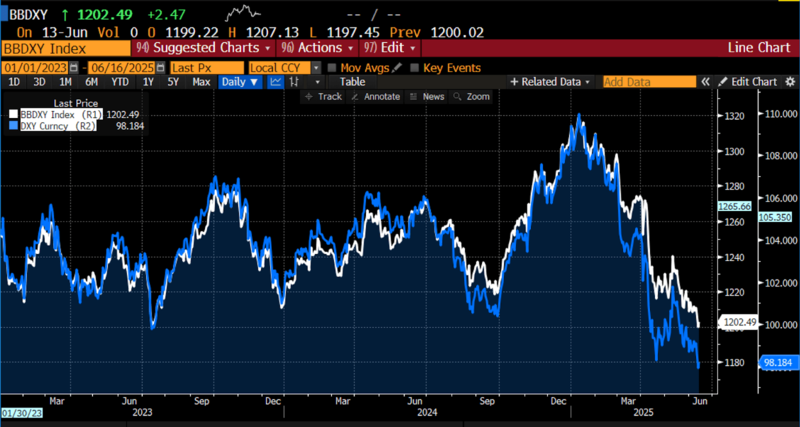
Over the first half of the year, the Bloomberg Dollar Index has fallen nearly 8.5 percent, marking one of the sharpest declines since the mid-1980s.

Yet while this drawdown has fueled widespread commentary about de-dollarization, it is important to distinguish between dollar weakness — a familiar, cyclical phenomenon — and the far more consequential and complex issue of de-dollarization, which concerns the dollar’s standing as the world’s primary reserve currency and medium of international exchange.

Bloomberg Dollar Spot Index & US Dollar Index Spot Rate, 2023- present
(Source: Bloomberg Finance, LP)

The current period of dollar weakness is rooted in several overlapping forces.

Since Donald Trump’s return to the White House, aggressive trade policies, escalating tariff conflicts, and sharp reversals in longstanding diplomatic and economic norms have unnerved international investors.

The dollar index has fallen nearly nine percent since inauguration, the worst such performance since the 1971 Nixon shock, when the US severed the dollar’s convertibility to gold.

Bank of America’s fund manager surveys indicate that bearish sentiment toward the dollar is at its highest level since 2006, while foreign appetite for US assets — particularly Treasurys and equities — has declined meaningfully, with foreign ownership of Treasurys falling to 32.9 percent as of late 2024.

Simultaneously, the fiscal position of the United States has worsened considerably.

The Trump administration’s substantial tax cuts and growing entitlement obligations are threatening to push deficits to alarming levels, while rising interest costs on government debt threaten long-term fiscal stability. These dynamics are now feeding into market pricing and investor expectations.

With global capital increasingly reluctant to finance Washington’s deficits on previous terms, foreign inflows into dollar-denominated assets have moderated.

Many foreign investors, particularly from Europe, are in a sustained “buyers’ strike” on US assets, compounding downward pressure on the dollar.

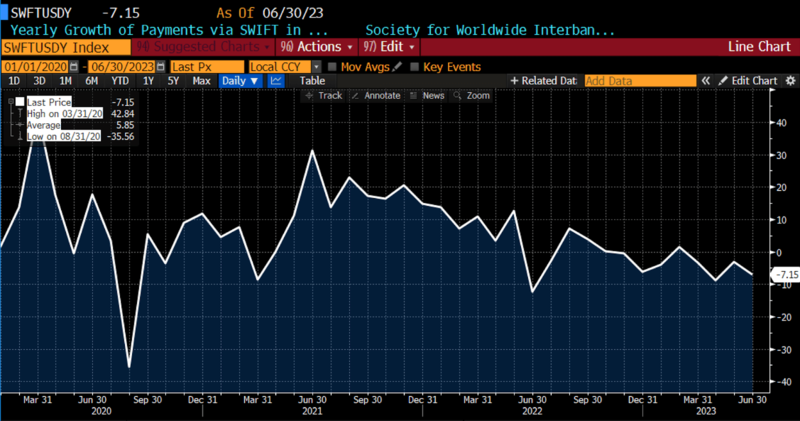
Yearly Growth of Payments via SWIFT in USD, 2020 – present
(Source: Bloomberg Finance, LP)

One of the most noteworthy shifts underlying the dollar’s recent slide has been its emerging role as a funding currency for global carry trades.

In an environment characterized by stable but modest global growth, subdued volatility, and a widening divergence in interest rates across economies, investors have increasingly sold dollars to finance long positions in higher-yielding emerging market currencies such as the Brazilian real, Mexican peso, Chilean peso, and South African rand.

That dynamic introduces a new class of structural dollar sellers, adding both to downward pressure and to heightened volatility.

Becoming a favored funding currency — a role long played by the Japanese yen or Swiss franc — reflects declining confidence in the US growth exceptionalism narrative that once anchored the dollar’s premium valuation.

Yet even as the cyclical bearish case gains adherents, the broader question remains: does dollar weakness equate to de-dollarization?

The short answer is: no, or at least not yet. The dollar still accounts for nearly 60 percent of global foreign exchange reserves, more than 50 percent of global trade invoicing, and nearly 90 percent of global foreign exchange transactions.

Despite short-term market aversion — for central banks, commodity traders, and multinational corporations — the dollar remains indispensable.

Its liquidity, the depth of US capital markets, and the breadth of dollar-denominated instruments such as US corporate bonds, Treasurys, and dollar-pegged financial products continue to make it the default global currency.

Incremental signs of de-dollarization are emerging, particularly in Asia and among members of the expanded BRICS bloc.

The Association of Southeast Asian Nations (ASEAN) has actively committed to increasing the use of local currencies in intra-regional trade, aiming to reduce exposure to dollar volatility and geopolitical leverage.

Countries such as China, India, and South Korea have increased currency swap agreements, promoted bilateral trade settlements in their own currencies, and repatriated portions of their foreign-held assets.

Asian institutional investors, including life insurers and pension funds in Japan and Taiwan, have raised hedge ratios on dollar exposure, gradually shifting portfolio balances toward local currencies.

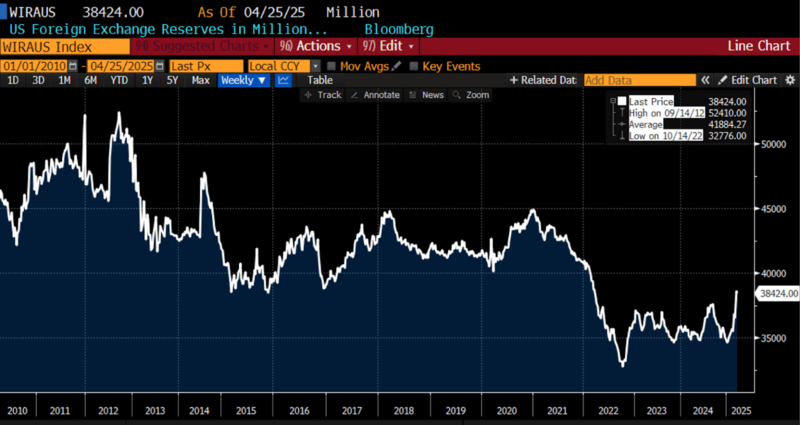
US Foreign Exchange Reserves in Millions of USD, 2010 – present
(Source: Bloomberg Finance, LP)

The BRICS alliance, recently expanded to include members such as Iran, Egypt, the UAE, and Indonesia, has amplified its political push toward de-dollarization.

While the group remains economically diverse and geopolitically fragmented, its growing weight in global energy production, trade flows, and financial architecture reflects a strategic ambition to reduce reliance on the dollar.

Joint liquidity pools, cross-border payment initiatives, and the creation of alternative commodity trading platforms further illustrate the group’s long-term objectives.

Nonetheless, internal frictions within BRICS — particularly between China and India — and the absence of a truly unified financial infrastructure have limited hopes to erode dollar primacy.

A significant development in the de-dollarization narrative is the surge in official sector gold purchases.

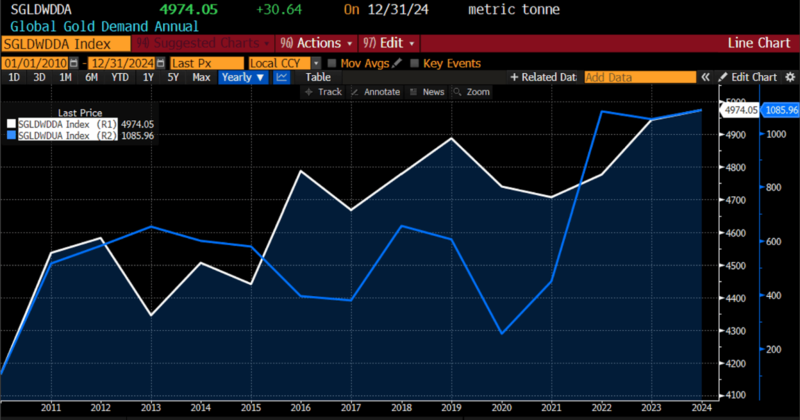
Central banks, particularly those aligned with or adjacent to China and Russia, have accumulated over 1,000 tons of gold annually for three consecutive years — doubling the pace of purchases seen in the 2010s.

The European Central Bank now reports that gold accounts for 20 percent of global reserves, up sharply from previous levels to eclipse holdings of the euro itself.

Meanwhile, the dollar’s share of global reserves has slipped from over 70 percent in 2000 to 57.8 percent in 2024.

Gold’s role as a politically neutral store of value makes it an attractive hedge against both inflation and geopolitical risks, particularly in an environment where financial sanctions and reserve asset weaponization have grown more common.

Global Gold Demand (white) & Global Gold Demand Net Central Bank Purchases (blue), 2010 – present
(Source: Bloomberg Finance, LP)

Still, gold’s structural limitations mean that it is unlikely to fully supplant the dollar’s reserve currency functions.

Even amid recent turmoil, global dollarization continues in many respects, particularly through the rapid expansion of dollar-based nonbank financial intermediation, dollar-denominated debt issuance, and the technological proliferation of dollar-linked stablecoins.

In sum, dollar weakness and de-dollarization are not synonymous.

The recent depreciation of the dollar relative to other currencies reflects a complex interplay of trade disputes, fiscal excesses, cyclical capital flows, and risk sentiment shifts.

True de-dollarization, by contrast, requires the sustained development of viable alternatives that can match the dollar’s liquidity, legal protections, and institutional depth — an outcome that remains distant, though not unimaginable over the long term.

While policymakers and market participants should not dismiss the slow, grinding adjustments occurring at the margins, the dollar nevertheless remains firmly entrenched as the central pillar of global finance.

A more sobering truth is this: the greatest threat to continued dollar dominance comes not from external challengers but within.

Persistent fiscal indiscipline, rising debt-to-GDP ratios, erratic policy shifts, and the politicization of monetary and financial institutions collectively erode the confidence that anchors reserve currency status.

If that erosion continues, the dollar may eventually cede ground — not through a sudden collapse, but through the gradual accumulation of self-inflicted wounds. In the meantime, the world remains tethered to King Dollar, even as it cautiously explores alternatives.

Originally Published on AIER’s The Daily Economy.


Peter C. Earle is an economist who joined AIER in 2018. Prior to that he spent over 20 years as a trader and analyst at a number of securities firms and hedge funds in the New York metropolitan area. His research focuses on financial markets, monetary policy, and problems in economic measurement. He has been quoted by the Wall Street Journal, Bloomberg, Reuters, CNBC, Grant’s Interest Rate Observer, NPR, and in numerous other media outlets and publications. Pete holds an MA in Applied Economics from American University, an MBA (Finance), and a BS in Engineering from the United States Military Academy at West Point.

Complicated Price Discovery In Metals

(Clint Siegner, Money Metals News Service) Price discovery for precious metals is complicated. There are several different markets for gold and silver.

These markets include the retail bullion market, the London spot market, and the COMEX futures market.

Another market is called Exchange of Futures for Physical (EFP).

The EFP process was developed as a means for institutional investors to swap contracts for actual bars outside of the regular COMEX delivery process. EFP insulates the highly leveraged and volatile COMEX market during periods of low supply and high demand for COMEX bars.

For example, buyers who needed to deliver 1,000 oz silver bars early in the year paid as much as $1/oz more than the current London spot price. Institutional investors transferred tons of metal from London to the U.S. to meet the enormous demand for deliverable bars in the U.S.

Retail investors who wanted to sell were left out, unable to capture that premium in either of the markets they had access to.

How Does Exchange of Futures for Physical (EFP) Work?

In EFP trade, one party swaps a futures contract with another party who has actual physical bars. They make the swap without going through the usual COMEX process, where the buyer purchases a contract and then stands for delivery of bars from the seller.

The swap still gets recorded by the exchange, and the trade is ultimately cleared by the exchange, but prices are negotiated privately between the two parties.

The parties get the protection of COMEX oversight, rules, and enforcement, but they don’t have to enter the open market for price discovery.

This is the important bit.

The trade is negotiated between institutions who have bars available and the institutions who need them right away – like manufacturers who need silver as a component for their production.

It is done without the influence of smaller speculators or the retail public reading the signals about supply and demand and jumping in.

It’s Hard to Read the Signals

There is lots of confusion. Many bullion investors are watching gold and silver prices go higher and assume demand for retail bullion products must be strong.

The truth is buying demand in the U.S. has been muted, and there are plenty of sellers.

Dealer inventories of coins, rounds, and bars are plentiful.

The best way to gauge supply and demand in the retail bullion markets is by watching premiums. Those are at the lowest levels in years.

Physical demand for larger exchange-sized bars did surge early in the year as institutional buyers scrambled for inventory, but retail investors had no way to participate.

The COMEX prices for gold and silver can’t be counted on to reflect either weak demand from retail or strong demand from institutions, and the same with the reverse.


Clint Siegner is a Director at Money Metals Exchange, a precious metals dealer recently named “Best in the USA” by an independent global ratings group. A graduate of Linfield College in Oregon, Siegner puts his experience in business management along with his passion for personal liberty, limited government, and honest money into the development of Money Metals’ brand and reach. This includes writing extensively on the bullion markets and their intersection with policy and world affairs.

Three Macro Factors Supporting a Bullish Outlook for Gold

(Mike Maharrey, Money Metals News Service) After setting a record just over $3,500 an ounce in April, gold has consolidated and traded sideways since, and there is some bearish sentiment seeping into the market.

Last week, Citigroup lowered its gold forecast, projecting the yellow metal would fall below $3,000 by the end of the year.

Citi analysts cited easing geopolitical tensions, diminishing gold’s safe-haven appeal. They also hold a relatively sanguine outlook on the direction of the economy, saying there is a growing sense that it can avoid a recession and that inflationary pressures will remain contained.

“We see investment demand for gold abating in late 2025 and 2026, as ultimately, we see President Trump’s popularity and U.S. growth ‘put’ kicking in, especially as the U.S. midterms come into focus.”

Much of Citi’s optimism seems to hinge on a resolution of the trade war. Tariff worries have driven both higher inflation expectations and worries about a looming recession. It is quite possible that President Trump could successfully negotiate an end to excessively high tariffs. That seems to be the strategy. But would an end to trade tensions necessarily abate inflation and recession fears?

Despite some growing bearish sentiment, there are at least three macroeconomic factors that should continue to support the gold market moving forward.

De-Dollarization

There is a growing movement around the world to diversify reserves away from the dollar. A combination of the weaponization of the dollar as a foreign policy tool and concern about the U.S. government’s fiscal mismanagement is driving this trend.

The dollar’s share of global reserve currencies slid further last year. As of the end of 2024, dollars made up 57.8 percent of global reserves. That is the lowest level since 1994, representing a 7.3 percent decline over the last decade. In 2002, dollars accounted for about 72 percent of total reserves.

As the dollar’s share of reserves shrinks, gold’s is increasing. The yellow metal recently replaced the euro as the second-largest global reserve asset.

This de-dollarization trend is reflected in central bank gold buying, which has been a major source of support for the recent gold bull market.

Central banks have gobbled up over 1,000 tonnes of gold for three straight years, and most central bankers think the buying trend will continue.

Last year was the third-largest expansion of central bank gold reserves on record, coming in just 6.2 tonnes lower than in 2023 and 91 tonnes lower than the all-time high set in 2022. (1,136 tonnes). 2022 was the highest level of net purchases on record, dating back to 1950, including since the suspension of dollar convertibility into gold in 1971.

To put that into context, central bank gold reserves increased by an average of just 473 tonnes annually between 2010 and 2021.

There is no indication that central banks will stop adding gold any time soon.

In a recent World Gold Council survey, 95 percent of 73 central bank respondents indicated they believe central bank gold reserves will increase over the next 12 months. A record 43 percent of the respondents indicated they expect their own gold reserves to expand. That was up from 29 percent in 2024.

Reserve diversification will likely continue to support gold, and it may well accelerate as it becomes more evident that the U.S. is unwilling to take the steps necessary to get its fiscal house in order.

Inflation

Despite cooling price inflation as reflected by the CPI, monetary inflation (properly defined) is increasing. Keep in mind that price inflation is just one symptom of the increase in the supply of money and credit.

And monetary inflation has been heating up for more than a year.

During the pandemic, the M2 money supply surged by roughly $6 trillion as the Federal Reserve unleashed massive monetary stimulus. That led to the bout of price inflation we suffered through in 2022.

During the Fed’s inflation fight, the M2 money supply contracted. This is exactly what needs to happen to wring out inflation from the economy. The money supply bottomed a little over a year ago at $20.60 trillion.

Since then, it has crept upward.

As of April, it was at $21.86 trillion. That’s the highest level since June 2022 and approaching the all-time high of $21.72 trillion hit in the spring of that year.

Eventually, this monetary expansion will begin to show up in rising consumer and asset prices.

That means investors will need to maintain an inflation hedge.

It’s also important to keep in mind that inflation isn’t an accident. It’s the policy. The Federal Reserve constantly devalues the dollar. The central bank isn’t trying to end inflation. It just wants to keep it at a level that you don’t notice.

Wise investors should always be aware of the inflationary pressures in the economy, even when everybody claims inflation is dead because of the CPI.

The bottom line is that while we have a reprieve, inflation will almost certainly rear its ugly head again – with or without tariffs. In fact, the Fed never did enough to slay the inflation dragon to begin with.

Recession Worries

Most mainstream analysts seem to think a resolution of the tariff situation will prevent the economy from spinning into a recession. However, we still haven’t reckoned with the monetary malfeasance of the Great Recession and the pandemic.

After the 2008 financial crisis, the Fed launched an era of easy money that lasted well over a decade. This resulted in a stimulus-fueled economic and market boom. The bust was looming in 2018, and the central bank was forced to cut interest rates and relaunch quantitative easing in 2019, a full year before COVID-19 reared its ugly head. The pandemic gave the central bank and the federal government a reprieve, allowing them to double down on the monetary and fiscal stimulus. But that just blew the boom bubble even bigger.

Don’t forget, every boom comes with a corresponding bust. We haven’t reckoned with that yet, and we’re due.

The U.S. economy is buried in debt and riddled with malinvestments. It is basically a bubble in search of a pin. At some point, the bubble will pop, and we will experience the inevitable bust.

Just because we haven’t suffered the consequences of this monetary malfeasance yet doesn’t mean we won’t. Keep in mind that the Federal Reserve started cutting rates in 2006. It took some two years for the collapse to finally manifest.

When the bottom does fall out, the central bank will almost certainly try to reinflate the bubbles with rate cuts to zero and more quantitative easing.

That brings us back to the inflation issue.

It also underscores the fact that the Fed is currently stuck between a rock and a hard place. It needs to keep interest rates higher to keep price inflation at bay. It also needs to cut rates to support the bubble economy.

It can’t do both.

While gold may see some selling pressure in the near term, these factors support a mid to long-term bullish outlook for gold.


Mike Maharrey is a journalist and market analyst for Money Metals with over a decade of experience in precious metals. He holds a BS in accounting from the University of Kentucky and a BA in journalism from the University of South Florida.

Trump May Allow Illegal Migrant Farmers to Stay amid ICE Crackdown

(Luis CornelioHeadline USA) President Donald Trump may soon throw a lifeline to farmers affected by his aggressive illegal immigration crackdowns. 

Speaking to reporters on Friday, Trump said he is open to shielding farmers from ICE raids, as some workers are deported or fail to show up for fear of being detained.

“We’re looking at doing something where, in the case of good, reputable farmers, they can take responsibility for the people that they hire and let them have responsibility, because we can’t put the farms out of business,” Trump said. 

“And at the same time, we don’t want to hurt people that aren’t criminals,” the president added. 

Trump’s latest remarks come as he tries to balance tough immigration enforcement with protecting sectors like agriculture and hospitality from economic fallout. 

“Our great Farmers and people in the Hotel and Leisure business have been stating that our very aggressive policy on immigration is taking very good, long time workers away from them, with those jobs being almost impossible to replace,” Trump wrote on Truth Social on June 12.  

“This is not good. We must protect our Farmers, but get the CRIMINALS OUT OF THE USA. Changes are coming!” the president continued. 

Days later, the administration issued a directive pausing ICE raids on farms, hotels, restaurants and meatpacking plants. Just days after that, the policy was walked back. 

By Wednesday, Trump was still weighing the issue. 

“You have people that have worked on farms for 20 years,” Trump said. “It’s very hard to go in there and say ‘you’re coming out.’ But we’re going to let the farmers take responsibility, they’re great people, they’ll do it. They know the good and the bad.” 

Michelle Obama Couldn’t Stand Raising a Boy Like Barack

(Luis CornelioHeadline USA) Does Michelle Obama resent her husband so much that the idea of raising a boy like him was unbearable? Based on her latest comments, it sure sounds like it. 

The former first lady left many viewers puzzled after saying she was “so glad” she never had a son with Barack Obama because, as she explained, he would have been another “Barack Obama.” 

The eyebrow-raising remark came on Wednesday’s episode of the IMO with Michelle Obama & Craig Robinson podcast, where she interviewed radio personality Angie Martinez.  

Michelle and Martinez discussed parenting and raising boys when Martinez interjected, “You should have [thrown] a boy in the mix.” 

Michelle did not hesitate to reject the proposal, replying: “I’m so glad I didn’t have a boy. Ooh! Ooh! Because he would have been a ‘Barack Obama.’” 

Martinez laughed and said, “Oh my, Baby Barack! It would have been amazing.” 

Michelle, however, was not amused, doubling down: “No. I would have felt for him.” 

The former first lady’s comment appeared to imply that her husband would have been too hard on a son, or that the idea of raising a male version of him was just too bitter a pill to swallow. 

Her brother and podcast co-host, Craig Robinson, seemingly tried to lighten the moment by saying Michelle helped raise his sons like her own. “She just borrowed our boys. She always borrowed ours. I got plenty,” he joked. 

Michelle’s remarks come amid a recent string of candid interviews where she has opened up about the strains in her marriage. 

She and Barack have two daughters, 26-year-old Malia and 24-year-old Sasha. 

In a March appearance on the Not Gonna Lie podcast, Michelle confessed that Barack wanted a third child, an idea she quickly shut down. 

“I was like, ‘I think I’ve been lucky with these two,’” she recalled. “Barack was like, ‘We should have a third,’ and I was like, ‘Dude.’” 

She added, “I’m thinking, ‘We’re gonna get a crazy one.’ It’s just the roll of the dice. So, I admire your courage.” 

Trump Attacks Rep. Massie for Opposing His Illegal Bombing of Iran

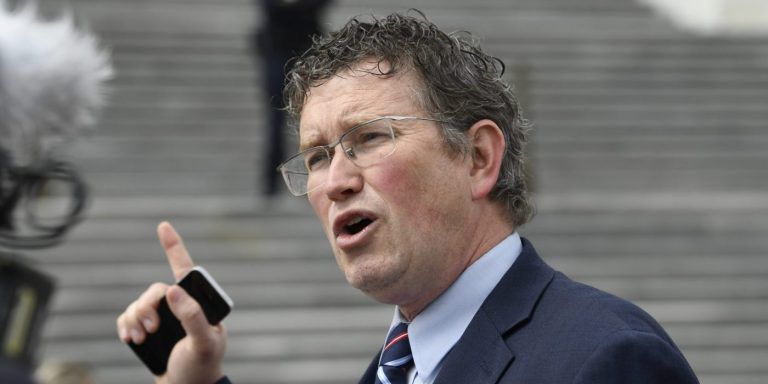
(Dave DeCamp, Antiwar.comOn Sunday, President Trump attacked Rep. Thomas Massie (R-KY) over the congressman’s opposition to his bombing of Iranian nuclear facilities, which was undertaken without any congressional authorization, making it illegal under the Constitution.

“Congressman Thomas Massie of Kentucky is not MAGA, even though he likes to say he is. Actually, MAGA doesn’t want him, doesn’t know him, and doesn’t respect him,” Trump said in a long post on his Truth Social account.

“He’s a simple minded ‘grandstander’ who thinks it’s good politics for Iran to have the highest level Nuclear weapon, while at the same time yelling ‘DEATH TO AMERICA’ at every chance they get,” the president added.

Before Trump bombed Iran, Massie introduced a War Powers Resolution in the House that would direct the president to “remove United States Armed Forces from unauthorized hostilities in the Islamic Republic of Iran.”

Massie introduced the bill with Rep. Ro Khanna (D-CA), and it now has 42 other Democratic co-sponsors. So far, no other Republicans have joined the effort. War Powers Resolutions are privileged, meaning Congress is required to swiftly debate and vote on the measure (contact your House representative and tell them to support the bill).

When Trump first announced the bombing of Iran on Saturday night, Massie said in a post on X that it was “not Constitutional.” In another post, the congressman said the action was an “act of war,” a response to many proponents of the bombing campaign who are claiming the US is not at war with Iran.

“When two countries are bombing each other daily in a hot war, and a third country joins the bombing, that’s an act of war,” Massie said. “I’m amazed at the mental gymnastics being undertaken by neocons in DC (and their social media bots) to say we aren’t at war… so they can make war.”

In his Truth Social post, Trump said Massie’s opposition to another war in the Middle East was “disrespectful” to the US military. “Massie should drop his fake act and start putting America First, but he doesn’t know how to get there — he doesn’t have a clue!” Trump said.

The president has previously targeted Massie over his opposition to the Trump-backed budget bill. Back in 2020, Trump called Massie a “third rate grandstander” for opposing a stimulus package passed in the early days of COVID, which contributed to the spike in inflation in the following years.

Trump is hoping that Massie will lose in the primaries in his next election and has vowed to campaign against him. “The good news is that we will have a wonderful American Patriot running against him in the Republican Primary, and I’ll be out in Kentucky campaigning really hard,” he said.

Axios reported that Trump’s political team has launched a super PAC dedicated to the goal of unseating Massie, called “Kentucky MAGA.” Due to his willingness to vote against pro-Israel legislation, Massie has been the target of the pro-Israel lobby AIPAC, which has spent big on ad campaigns against him.

This article originally appeared at Antiwar.com.

Heightened Alert: Iranians in U.S. Previously Charged w/ Support for Terrorism

(The Center Square) Prior to President Donald Trump authorizing targeted strikes against Iranian nuclear sites on Saturday, federal agents and Texas Department of Public Safety troopers have been arresting Iranian nationals, nearly all men, in the U.S. illegally. In the last few months, federal prosecutors have also brought terrorism charges against Iranians, including those in the U.S. working for the Iranian government.

Iran is a designated state sponsor of terrorism. Iranian nationals illegally in the country are considered “special interest aliens” under federal law.

The U.S. Department of Homeland Security on Sunday issued a warning to all Americans to be on a heightened threat alert.

“The ongoing Iran conflict is causing a heightened threat environment in the United States,” DHS warned. “Low-level cyber attacks against US networks by pro-Iranian hacktivists are likely, and cyber actors affiliated with the Iranian government may conduct attacks against US networks.

“Iran also has a long-standing commitment to target US Government officials it views as responsible for the death of an Iranian military commander killed in January 2020.”

U.S. officials have no idea how many Iranians are in the U.S. illegally because at least two million “gotaways” were recorded entering the U.S. during the Biden administration. Gotaways are those who illegally entered the U.S. between ports of entry who were not apprehended.

Key arrests include an Iranian living in the sanctuary jurisdiction of Natick, Mass., who is charged “with conspiring to export sophisticated electronic components from the United States to Iran in violation of U.S. export control and sanctions laws,” The Center Square reported. Authorities accuse the Iranian of illegally exporting the technological equipment to a company in Iran that contracts with the Islamic Revolutionary Guard Corps (IRGC), a US-designated foreign terrorist organization (FTO). The company allegedly manufactured drones used by the IRGC that killed U.S. soldiers stationed in Jordan.

Texas DPS troopers have arrested dozens of Iranian special interest aliens. Last October, DPS troopers questioned Iranians who illegally entered the U.S. near Eagle Pass, Texas, who said they came through Mexico and were headed to Florida, Las Vegas and San Francisco, The Center Square reported.

Last November and December, DPS troopers arrested Iranians in Maverick County after sounding the alarm about an increase of SIAs they were apprehending, The Center Square reported.

U.S. Customs and Border Protection and Immigration and Customs Enforcement officers also apprehended an Iranian with terrorist ties who illegally entered the U.S. near Buffalo, New York, The Center Square reported.

More recently, in April, two Iranians were charged in New York with conspiring to procure U.S. parts for Iranian drones, conspiring to provide material support to the IRGC and conspiring to commit money laundering. They remain at large. The charges “lay bare how U.S.-made technology ended up in the hands of the Iranian military to build attack drones,” DOJ National Security Division chief Sue Bai said.

Also in April, two Iranians and one Pakistani, were indicted in Virginia “for conspiring to provide and providing material support to Iran’s weapons of mass destruction program resulting in death and conspiring to commit violence against maritime navigation and maritime transport involving weapons of mass destruction resulting in death.” The Pakistani is awaiting trial; the Iranians remain at large.

Their involvement in maritime smuggling off the coast of Somalia led to the death of two Navy SEALs, according to the charges.

Also in April, a naturalized citizen working for the Federal Aviation Administration as a contractor pleaded guilty to charges of “acting and conspiring to act as an illegal agent of the Iranian government in the United States” for a period of five years. He was indicted last December in the District of Columbia for “infiltrating a U.S. agency with the intent of providing Iran with sensitive information,” including exfiltrating sensitive FAA documents to Iranian intelligence.

“The brazen acts of this defendant – acting against the United States while on U.S. soil – is a clear example of how our enemies are willing to take risks in order to do us harm,” U.S. Attorney Edward Martin said. “We want to remind anyone with access to our critical infrastructure about the importance of keeping that information out of the hands of our adversaries. I want to commend our prosecutors and law enforcement partners who secured a guilty plea that will keep our country safer.”

Also in April, an Iranian national was indicted in Ohio for operating a dark web marketplace selling methamphetamine, cocaine, fentanyl, heroin and oxycodone and other drugs; and for stealing financial information, using fraudulent identification documents, counterfeit currencies, and computer malware. Working with German and Lithuanian partners, he was charged, servers and other infrastructure were seized, and drugs and other contraband were stopped from entering the U.S., DOJ Criminal Division head Matthew Galeotti said.

Also in April, ICE Homeland Security Investigations in New York announced a civil forfeiture action halting an Iranian oil sale scheme that went on for years under the Biden administration.

The scheme involved facilitating the shipment, storage and sale of Iranian petroleum product owned by the National Iranian Oil Company for the benefit of the IRGC and Islamic Revolutionary Guard Corps, designated FTOs. The facilitators allegedly claimed the Iranian oil was from Malaysia, manipulated tanker identification information, falsified documents, paid storage fees in U.S. dollars and conducted transactions with U.S. financial institutions. The federal government seized $47 million in proceeds from the sale.

The complaint alleges they provided material support to the IRGC and IRGC-QF because profits support “proliferation of weapons of mass destruction and their means of delivery, support for terrorism, and both domestic and international human rights abuses.”

Last December, a federal court in the District of Columbia ordered the forfeiture of nearly $12 million connected with Iran’s illicit petroleum industry, involving Triliance Petrochemical Company, the IRGC and Quds Forces. FBI Tampa and Minneapolis were involved in the investigation.

Examples also exist of Iranians making false statements when applying for naturalization, including an Iranian in Tampa indicted last year.

DHS Warning to Cops: 830% Increase in Seizures of Chinese Signal Jammers

(The Center Square) There’s been an 830% increase in the amount of U.S. Customs and Border Protection seizures of Chinese-manufactured signal jammers since 2021, posing a threat to law enforcement operations, according to a new Department of Homeland Security warning.

DHS issued the warning to law enforcement saying the increased amount of signal jammers being smuggled into the U.S. poses “a threat to public safety and civilian aviation.” CBP “has seen a roughly 830% increase in seizures since 2021, despite Chinese companies’ attempts to subvert inspection,” it said.

Signal jammers are often used “to disrupt a range of radio frequency channels, and pose a threat to emergency response, law enforcement and critical infrastructure,” the warning states.

Signal jammers are being used by a new organized theft ring that emerged under the Biden administration, South American Theft Groups (SATG). “South American illegal aliens jam calls to local police during home invasions or bank robberies in Florida, Illinois, Ohio, Pennsylvania, Texas, Vermont, and Virginia,” DHS said.

Under the Biden administration, as a record number of illegal border crossers made their way throughout the U.S., law enforcement officials recognized a similar trend of vehicle theft, targeted home burglaries and violent crimes, connecting them to SATG. SATG are believed to be run primarily by Columbian and Chilean nationals who either illegally entered the U.S. or exploited a visa program, law enforcement officials nationwide have found, The Center Square reported.

Officials from across the country testified before Congress about Chilean gang members committing violent crimes in residential neighborhoods only to learn they had been released into the country by the Biden administration, The Center Square reported.

Last year, Florida sheriffs identified SATG members targeting Asian Americans in six counties, The Center Square reported. By December, the NFL issued a security alert to players after professional football players’ homes were being targeted and broken into throughout the Midwest, The Center Square reported.

In Texas, DHS working with local authorities identified an SATG ring operating in Houston and Laredo tied to stolen merchandise in Minnesota, The Center Square reported.

In February of 2025, law enforcement in Texas “recovered a signal jammer while arresting an illegal alien from Chile,” DHS said.

“Signal jammers have been used by illegal aliens across the country to jam communications during police operations, bank robberies, burglaries, and other dangerous crimes,” a DHS spokesperson said.

“Under the vigilance of CBP, national security begins at America’s ports. As Chinese manufacturers attempt to smuggle signal jammers, we will continue to seize these tools of terrorism. President [Donald] Trump and [DHS] Secretary [Kristi] Noem will always protect America’s critical infrastructure and law enforcement.”

Federal law prohibits “the private import, operation, marketing, or sale of any signal jamming equipment that interferes with law enforcement communications, GPS, or radar,” DHS says. Despite the signal jammers being manufactured in China, they are banned in Beijing for public use.

The SATG crime wave exploded in the U.S. as a record nearly 500,000 Columbian nationals illegally entered the U.S. under the Biden administration, The Center Square reported. Chilean national illegal entries also increased because many Haitians who illegally entered the country had Chilean passports and identification because they were living and working there, The Center Square has reported. Under the Biden administration, a record nearly 700,000 Haitians were reported illegally entering the U.S., The Center Square reported.

The DHS warning comes after a U.S. House report identified hundreds of Chinese espionage incidents within three years under the Biden administration, and after the greatest number of Chinese nationals illegally entered the U.S. in recorded history over the same time period – more than 176,000 nationwide, The Center Square exclusively reported.

BREAKING: Judge to Order ‘Maryland Man’ Kilmar Abrego Garcia’s Release before Trial

(Ken Silva, Headline USA) A federal judge in Tennessee plans to order the release of Kilmar Abrego Garcia, the alleged MS-13 member whom mainstream media dubbed “Maryland man” after he was deported to El Salvador, while he awaits a federal trial on human smuggling charges.

But Abrego Garcia is not expected to go free because U.S. Immigration and Customs Enforcement will likely take him into custody and possibly try to deport him.

In a ruling on Sunday, U.S. Magistrate Judge Barbara Holmes denied the U.S. government’s motion to keep Abrego Garcia in detention before his trial. She scheduled a hearing for Wednesday to discuss the conditions of his release.

The U.S. government has already filed a motion to appeal the judge’s decision and is asking the judge to stay her impending release order.

Abrego Garcia pleaded not guilty on June 13 to smuggling charges, which stem from a 2022 traffic stop for speeding in Tennessee during which Abrego Garcia was driving a vehicle with nine passengers. While officers suspected possible smuggling, Abrego Garcia was allowed to go on his way with only a warning.

Body camera footage shows a calm exchange between officers and Abrego Garcia. The officers then discussed among themselves their suspicions of smuggling before letting him go. One of the officers says, “He’s hauling these people for money.” Another says Abrego Garcia had $1,400 in an envelope.

The federal indictment accuses Abrego Garcia of smuggling throughout the U.S. hundreds of people living in the country illegally, including children and members of the violent MS-13 gang.

Abrego Garcia was sent to an El Salvadorian supermax prison in March, in contravention of an immigration judge’s hold on his deportation. He was returned to the U.S. earlier this month to face the human smuggling charges.

The Associated Press contributed to this report.

Ken Silva is the editor of Headline USA. Follow him at x.com/jd_cashless.

More than 700 Iranians Released into the U.S. Under Biden

(The Center Square) More than 700 Iranian nationals who illegally entered the U.S. were released into the country by the Biden administration, according to data The Center Square obtained Sunday from a Border Patrol agent.

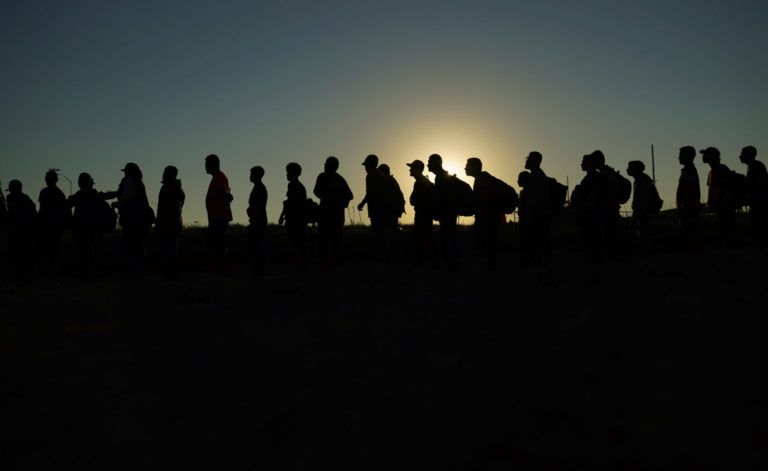
According to the data, from fiscal years 2021 through 2024, Border Patrol agents apprehended 1,504 Iranian nationals who illegally entered the U.S. between ports of entry nationwide. Every year, the numbers increased exponentially.

They include 48 Iranian illegal border crossers apprehended in fiscal 2021; 197 apprehended in 2022; 462 apprehended in 2023; and 797 apprehended in 2024.

Among those apprehended, 729 Iranians were released into the U.S. under the Biden administration. Throughout the administration, the number of Iranians that were released into the U.S. also increased every year.

In 2021, 12 Iranian illegal border crossers were released into the U.S.; in 2022, 40 were released into the U.S.; in 2023, 229 were released into the U.S.; in 2024, 448 were released into the U.S., according to data exclusively obtained by The Center Square. The agent provided the information on condition of anonymity for fear of reprisal.

The Center Square obtained the data after President Donald Trump authorized the use of American-built B2 bombers to strike three nuclear facilities in Iran late Saturday.

The data excludes Iranians apprehended at ports of entry and those who illegally entered the U.S. as gotaways. Gotways is the official term used to describe foreign nationals who illegally enter between ports of entry to intentionally evade capture. More than two million gotaways were reported under the Biden administration, The Center Square exclusively reported.

Throughout the Biden administration, The Center Square received information from Border Patrol agents that wasn’t made public by U.S. Customs and Border Protection related to apprehensions and gotaways.

Under the Trump administration, data on how many Iranian nationals were encountered or apprehended so far this year has also not been made public, according to official CBP data.

CBP officials did not immediately respond to a request for comment on Sunday about the number of Iranians apprehended or encountered under the Trump administration. Nor did it respond to questions about how many Iranian nationals were identified as “special interest aliens” or as known or suspected terrorists (KSTs). SIA information hasn’t been published by any administration, including under the first Trump administration. A bill filed in Congress last year would require federal reporting of the data, The Center Square reported.

To date, no official in the Biden or Trump administration can confirm how many Iranians have illegally entered the U.S. as gotaways. One Iranian gotaway with ties to terrorism was apprehended in Buffalo, New York, by U.S. federal agents, The Center Square reported.

U.S. officials are under heightened alert in light of numerous Iranians already arrested or indicted for material support for terrorism in just the last few months, The Center Square reported.

Under the Biden administration, the greatest number of KSTs were apprehended in U.S. history: 1,903, The Center Square first reported.

The majority, 64%, totaling 1,216, were apprehended at the northern border coming from Canada between fiscal years 2021-2024, according to CBP data.

A record 687 KSTs were reported at the southwest border over the same time period.

Last September, former President Joe Biden extended a 2001-era national emergency due to increased terrorist threats, including Islamic terrorist threats, The Center Square reported.

This was after hundreds of illegal border crossers with ties to the Islamic terrorist group ISIS were released into the country by the Biden administration or evaded capture with ties to an alleged ISIS smuggling ring.

Border czar Tom Homan has long warned that Biden administration policies created the greatest national security threat since 9/11, The Center Square reported. U.S. Sen. Ted Cruz, R-Texas, an avid supporter of Trump’s targeted attack of Iran, told The Center Square that Americans “are at a greater risk for a major terrorist attack than we have been at any point since Sept. 11, 2001” because of Biden administration policies.

Cruz said for years that “Iran has declared a jihad demanding that terrorists murder Americans. Hamas has declared a jihad demanding that terrorists murder Americans. Hezbollah has declared a jihad demanding that terrorists murder Americans. ‘Palestinian Islamic Jihad,’ true to their name, has declared a jihad demanding that terrorists murder Americans.”

The only response, he argues, was for President Trump to take action to protect Americans, including securing US borders and targeting terrorist organizations that have already killed U.S. service members and are committed to killing Americans.