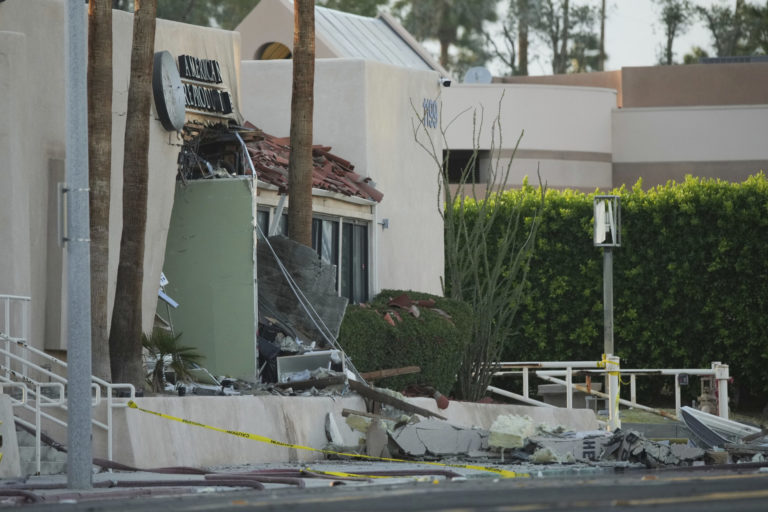
(Ken Silva, Headline USA) The truth about the May 17 bombing of a fertility clinic in California may never be known now that the bomber’s alleged accomplice has died in federal custody just weeks after his arrest.
Prison officials said Tuesday that Daniel Park, 32, was found unresponsive in Metropolitan Detention Center in Los Angeles Tuesday morning and was pronounced dead at the hospital. No cause of death was provided.
BREAKING: Daniel Park, the man accused of aiding in bombing at Palm Springs, California fertility clinic, found dead inside Los Angeles detention center. pic.twitter.com/7EDOqOZYs0
Park, of suburban Seattle, was accused of supplying chemicals to Guy Edward Bartkus of California, the bomber, who died in the May 17 explosion.
The sudden death further obscures an already murky case, in which the FBI was reportedly seen in the bomber’s neighborhood ahead of the attack. At the FBI’s press conference on May 19, a reporter from the area’s local News Channel 3 asked about the matter. The press conference was shut down immediately after her question.
“We had a reporter on scene at the Twentynine Palms area yesterday, and community members were telling her that there was an FBI presence there in the days leading up to that. Can you confirm that?” the reporter asked.
“I cannot,” responded Akil Davis, the assistant director in charge of the FBI’s Los Angeles office.
Another FBI official immediately piped in, ending the conference just as Davis was about to take another question: “OK folks, we’re done here.”
Here's a journalist asking an FBI spokesman whether he can confirm reports from locals that the FBI was in the neighborhood of the Palm Springs bomber in the days before the attack. The FBI guy says he cannot confirm that, then someone offscreen abruptly ends the press conference https://t.co/uU8heVGyoHpic.twitter.com/8UbwqJfgrh
Park and Bartkus allegedly connected in fringe online forums over their shared beliefs against human procreation, authorities told reporters Wednesday. The blast gutted the fertility clinic in Palm Springs and shattered the windows of nearby buildings, with officials calling the attack terrorism and possibly the largest bomb scene ever in Southern California. The clinic was closed, and no embryos were damaged.
Park shipped 180 pounds of ammonium nitrate to Bartkus in January and bought another 90 pounds and had it shipped to him days before the explosion, authorities said. Park purchased ammonium nitrate online in several transactions between October 2022 and May 2025, according to a federal complaint.
Three days before Park visited him in January, Bartkus asked an AI chat application about explosives, detonation velocity, diesel and gasoline mixtures, the complaint said. The discussion centered on how to create the most powerful blast.
Authorities said Park traveled to California to experiment with them in the bomber’s garage months before the attack.
Park was taken into custody at New York’s John F. Kennedy Airport, after he was extradited from Poland, where he fled to four days after the attack. Park had been charged with providing and attempting to provide material support to terrorists.
Ken Silva is the editor of Headline USA. Follow him at x.com/jd_cashless.
(Douglas French, Money Metals News Service) You hear about gas prices every day. The President brags that per-gallon prices have dropped to $1.99 in some places.
After paying over $4.00 here in Las Vegas, I wonder where he is talking about. He ran on bringing down prices at the pump, saying “drill baby drill” constantly at his rallies.
But, in real terms, gas prices have gone down. A line from a Wall Street Journal piece illustrates the point.
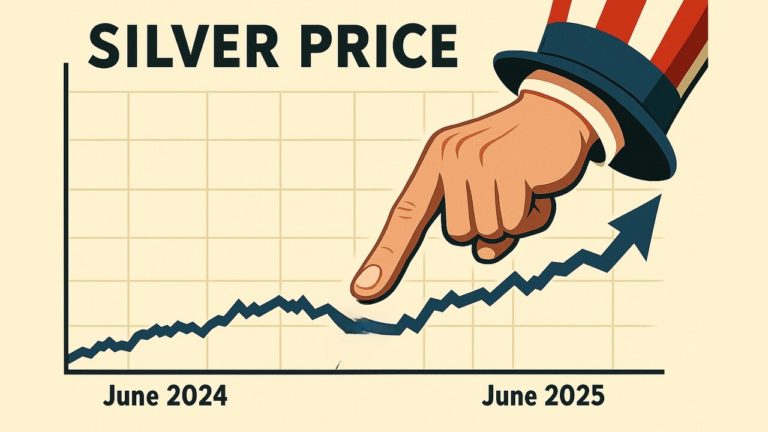
“Silver’s rally has made it worth the effort to sift through coin jars looking for old dimes, quarters and half dollars. The melt value of 25-cent coins minted from before 1965, when they were made of silver, is more than $6.50.”
I’m old enough to remember 25-cent gas. And, someone pumped the gas for you, checked your oil, and the air pressure in your tires.
During lunch with an old friend, he told me his kids don’t know what cash is, let alone pre-1965 quarters.
No wonder monetary matters don’t really matter to Americans, especially young folk.
No one seems concerned about the constant devaluation of the dollar. They blame high prices on whoever is president or corporate greed. The idea that the problem is the constant creation of more money escapes them.
As Ludwig von Mises wrote:
“What people today call inflation is not inflation, i.e., the increase in the quantity of money and money substitutes, but the general rise in commodity prices and wage rates which is the inevitable consequence of inflation. This semantic innovation is by no means harmless.”
The WSJ reports of people selling silver and some that are buying.
“Daniel Herzner, who owns businesses that buy and sell estate jewelry in White Plains, N.Y., said his phone is ringing frequently with customers eager to sell jewelry and flatware that they inherited or no longer need.”
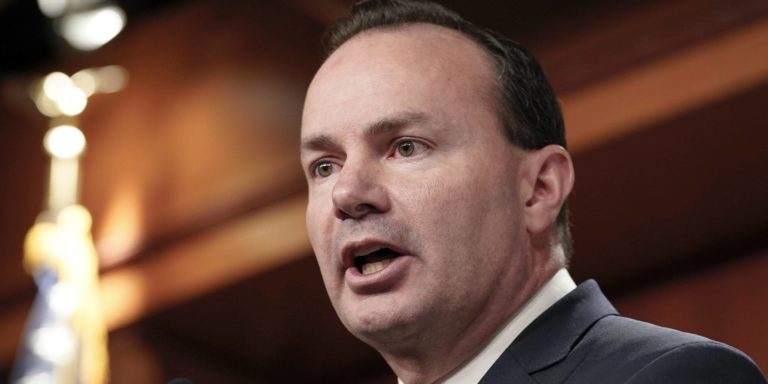
(Headline USA) A plan to sell more than 3,200 square miles of federal lands has been ruled out of Republicans’ big tax and spending cut bill after the Senate parliamentarian determined the proposal by Senate Energy Chairman Mike Lee would violate the chamber’s rules.
Lee, a Utah Republican, has proposed selling millions of acres of public lands in the West to states or other entities for use as housing or infrastructure. The plan would revive a longtime ambition of Western conservatives to cede lands to local control after a similar proposal failed in the House earlier this year.
The proposal received a mixed reception Monday from the governors of Western states. New Mexico Gov. Michelle Lujan Grisham, a Democrat, called it problematic in her state because of the close relationship residents have with public lands.
You could sell all 640M acres of federal land and it would raise less than half what the federal government spends each and every year.
Wyoming Gov. Mark Gordon, a Republican, voiced qualified support.
“On a piece-by-piece basis where states have the opportunity to craft policies that make sense … we can actually allow for some responsible growth in areas with communities that are landlocked at this point,” he said at a news conference in Santa Fe, New Mexico, where the Western Governors’ Association was meeting.
Lee, in a post on X Monday night, said he would keep trying.
“Housing prices are crushing families and keeping young Americans from living where they grew up. We need to change that,” he wrote, adding that a revised plan would remove all U.S. Forest Service land from possible sale. Sales of sites controlled by the U.S. Bureau of Land Management would be significantly reduced, Lee said, so that only land within 5 miles of population centers could be sold.
Environmental advocates celebrated the ruling late Monday by Senate Parliamentarian Elizabeth MacDonough, but cautioned that Lee’s proposal was far from dead.
“This is a victory for the American public, who were loud and clear: Public lands belong in public hands, for current and future generations alike,” said Tracy Stone-Manning, president of The Wilderness Society. “Our public lands are not for sale.”
Carrie Besnette Hauser, president and CEO of the nonprofit Trust for Public Land, called the procedural ruling in the Senate “an important victory in the fight to protect America’s public lands from short-sighted proposals that would have undermined decades of bipartisan work to protect, steward and expand access to the places we all share.”
“But make no mistake: this threat is far from over,” Hauser added. “Efforts to dismantle our public lands continue, and we must remain vigilant as proposals now under consideration,” including plans to roll back the bipartisan Great American Outdoors Act and cut funding for land and water conservation, make their way through Congress, she said.
MacDonough, the Senate parliamentarian, also ruled out a host of other Republican-led provisions Monday night, including construction of a mining road in Alaska and changes to speed permitting of oil and gas leases on federal lands.
While the parliamentarian’s rulings are advisory, they are rarely, if ever, ignored. Lawmakers are using a budget reconciliation process to bypass the Senate filibuster to pass President Donald Trump’s tax-cut package by a self-imposed July Fourth deadline.
Lee’s plan revealed sharp disagreement among Republicans who support wholesale transfers of federal property to spur development and generate revenue, and other lawmakers who are staunchly opposed.
Land in 11 Western states from Alaska to New Mexico would be eligible for sale. Montana was carved out of the proposal after lawmakers there objected. In states such as Utah and Nevada, the government controls the vast majority of lands, protecting them from potential exploitation but hindering growth.
“Washington has proven time and again it can’t manage this land. This bill puts it in better hands,” Lee said in announcing the plan.
Housing advocates have cautioned that federal land is not universally suitable for affordable housing. Some of the parcels up for sale in Utah and Nevada under a House proposal were far from developed areas.
New Mexico Sen. Martin Heinrich, the ranking Democrat on the energy committee, said Lee’s plan would exclude Americans from places where they fish, hunt and camp.
“I don’t think it’s clear that we would even get substantial housing as a result of this,” Heinrich said earlier this month. “What I know would happen is people would lose access to places they know and care about and that drive our Western economies.”
(Mike Maharrey, Money Metals News Service) Should the cost of storing physical gold and silver deter people from considering precious metals as an investment option?
Idaho Governor Brad Little thought so.
Last year, he vetoed a bill that would have given the Gem State an option to invest up to 7.5 percent of the state’s “idle moneys” in physical gold or silver. In effect, it would create a process for the state to hold reserves of gold and silver along with its other investment assets.
The governor’s stated objection to the legislation was “the many additional costs that will be borne by taxpayers for the storage, safeguard, and purchase of commodities such as gold or silver.”
Under current Idaho law, the treasurer is authorized to hold cash, as well as invest “idle moneys” into U.S. bonds, treasury bills, interest-bearing notes, corporate bonds, and money market funds. In other words, paper. And those paper assets not only have counterparty risk, but also their yields tend to be below the rate of inflation. That’s called a “negative real return.”
Last week, an investigative journalist in Idaho published a report showing that Idaho lost out on more than $200 million over the past year because of the state’s failure to own gold. The yellow metal has risen almost 50% since Little’s veto… truly uncanny timing!
The Storage “Problem”
Are Little’s supposed concerns about the cost of precious metals storage justified? And how much does it actually cost to store gold and silver?
Of course, storage costs do exist. But they are not high, and for large holdings, they are really small. And it’s important to remember there are costs associated with investing in any assets, including those already authorized under Idaho state law. Dealer fees on bond offerings are typically way more than the costs associated with storing and insuring gold.
When individuals or entities invest in bonds or equities, they incur broker fees, commissions, account maintenance fees, etc. These costs can vary significantly depending on the broker, the size of the portfolio, and other factors. In general, investors can expect to pay on average between 0.05 to 2 percent of the total assets under management in fees. At the high end, an investor could lose as much as $2,000 annually to fees and other charges on a $100,000 portfolio.
The reality was that Little, a liberal Republican, didn’t do his homework at all. And political insiders assert he actually vetoed the bill out of spite toward the Idaho conservatives who most vocally supported it.
And by failing to properly examine the gold reserves option, Governor Little arguably breached his fiduciary duty to safeguard Idaho taxpayer funds. In retrospect, the governor’s veto in early 2024 looks like quite the blunder today.
The annual average cost of vault storage can vary significantly depending on the provider, the location, and the specific services offered. Generally, the annual costs range between 0.3 percent and 0.75 percent of the total value of the gold being stored.
The storage fees at Money Metals Exchanges’ state-of-the-art bullion depository typically run less than 0.49 percent. That means the cost of storing $100,000 in gold would average around $490 per year. This fee includes “all-risks” insurance coverage for the full value of the metal stored in the vault.
Money Metals’ storage fees for gold or silver held in an IRA are even less at 0.29 percent. And it is likely that a very large investor, such as the state of Idaho, would enjoy much lower storage rates than the average investor.
The Inflation Factor
While the cost of storing gold and silver isn’t zero, it certainly isn’t a bank-breaker. This is especially true when you consider how much is lost due to inflation by holding cash.
The current annual CPI is 2.4 percent. If you accept this data (and you shouldn’t), it means the purchasing power of money sitting in Idaho’s bank accounts is losing 2.4 percent of its purchasing power every single year. When rates are low, the interest paid by banks to account holders often doesn’t even cover this monetary devaluation. When the CPI was in the 9 percent range, real interest rates were deeply negative. Under these conditions, the state was effectively paying banks to hold its money.
This is why it is wise to have gold and silver on the table as an investment option to serve as an inflation hedge. Price inflation is always stealing the value of the dollar.
The state of Idaho couldn’t take advantage of these gains because gold and silver aren’t investment options. And because Little is worried about a less than half a percent cost in storage fees (and the state’s cost would almost certainly be less than that), it won’t be able to take advantage of future gains.
Meanwhile, the state’s cash holdings are earning less than 2 percent (assuming a generous 4 percent return on a money market fund).
Nobody is suggesting that the state of Idaho should put all its funds into precious metals. The bill was intended to expand the state’s investment options and to allow it to shield some of its assets from the pernicious and relentless effects of price inflation. After all, isn’t the most oft-cited bit of financial advice to “diversify” one’s holdings?
Investors always need to factor in various costs associated with a given investment option, including storage fees for precious metals. There may be times it doesn’t make sense to hold a lot of gold and silver. But there are certainly times (such as the last 18 months) when you absolutely want gold and silver — and a lot of it!
It is foolish to take gold and silver off the table simply because of extremely modest storage costs.
Mike Maharrey is a journalist and market analyst for Money Metals with over a decade of experience in precious metals. He holds a BS in accounting from the University of Kentucky and a BA in journalism from the University of South Florida.
(Jesse Colombo, Money Metals News Service) While silver has been relatively quiet in recent weeks following its encouraging breakout, this doesn’t signal failure—rather, it looks like a healthy pause typical of low-volume summer trading.
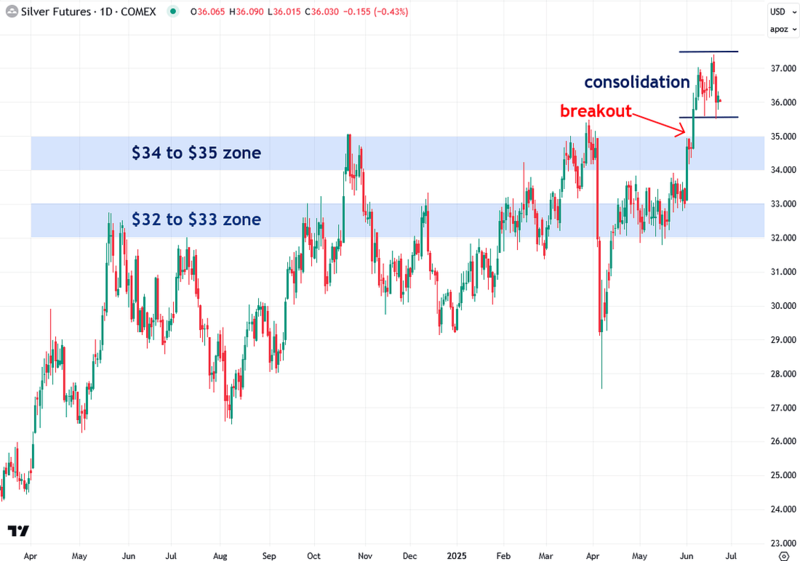
On June 5th, silver finally broke above both the $32–$33 and $34–$35 resistance zones that had capped its upside for the past year, frustrating many silver bulls, including myself.
Despite that stagnation, this breakout is a strong confirmation of that outlook. While silver has since paused, leading some to question the move, I believe it’s likely just consolidating before its next leg higher. In this update, I’ll cover where silver and key related assets stand now, what to watch for, and what’s likely coming next.
Let’s start with the basics: the COMEX silver futures chart, which I closely monitor because it tends to respect $1 increments as key support and resistance levels. Two major resistance zones had capped silver’s progress for much of the past year—$32 to $33 and $34 to $35—until the breakout in early June finally pushed prices through those barriers.
That breakout drove silver as high as $37 before it pulled back slightly to the $36 area. This dip has been driven in part by weakness in related assets like gold and copper, as well as mounting geopolitical tensions involving Israel, Iran, and now the U.S. entering the picture. Unlike gold, which is purely a precious metal and safe haven, silver also responds to industrial demand and economic shifts, making it more sensitive to both fear and economic risk.
Still, despite this modest retreat, the breakout remains intact and technically strong. For now, I view the recent price action as a healthy consolidation. I’m not concerned—but I am watching closely for further confirmation, which I’ll detail in the next set of charts.
I’ve also developed a proprietary indicator called the Synthetic Silver Price Index (SSPI), designed to help validate silver’s price action and filter out potential false breakouts.
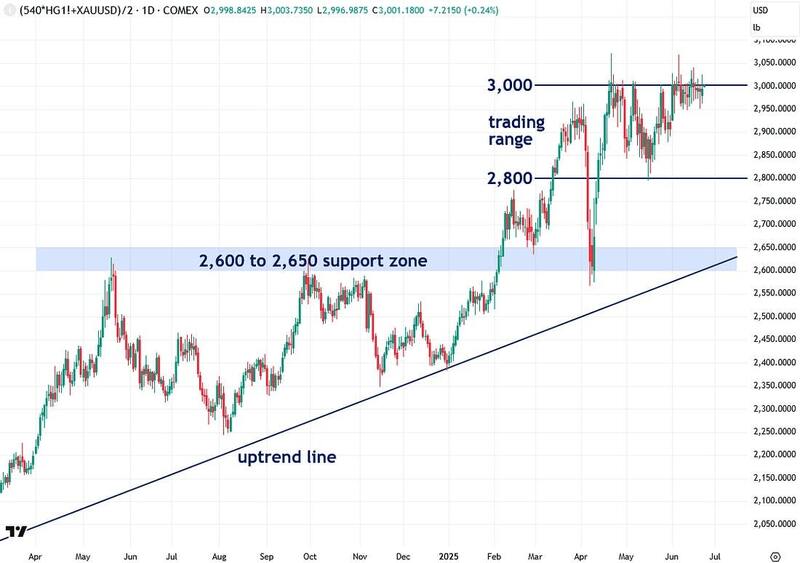
The SSPI is calculated as the average of gold and copper prices, with copper scaled by a factor of 540 to prevent gold from dominating the index. Interestingly, even though silver isn’t part of the calculation, the SSPI closely tracks its movements.
Since March, the SSPI has been trading in a consolidation range between 2,800 and 3,000. I believe that a decisive breakout above the 3,000 level would serve as yet another bullish confirmation for silver, as strength in both gold and copper would provide a supportive tailwind, making it increasingly difficult for silver to stay suppressed.
While the SSPI has made several breakout attempts, it has yet to push through—but that’s no cause for concern. Consolidations and trading ranges are a normal part of healthy bull markets, especially during the quieter summer months when trading activity and news flow typically slow as Wall Street heads out on vacation. I’m continuing to monitor this closely and will be watching for that eventual breakout.
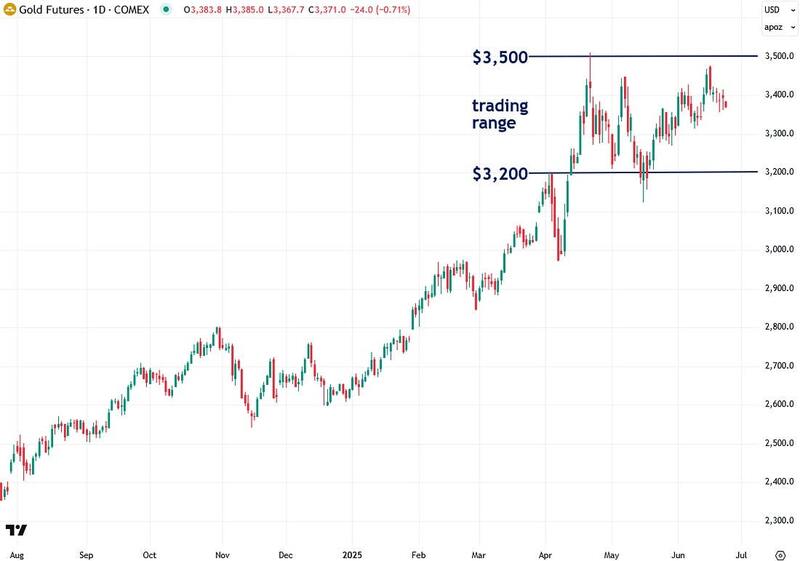
I also like to examine the individual components of the Synthetic Silver Price Index—gold and copper—to get a better sense of where the index, and therefore silver, might be headed next. As I’ve been explaining, gold has been consolidating for the past two months, just as I expected, after briefly touching the key $3,500 resistance level before pulling back.
This consolidation is both normal and healthy following such a strong bullish run, especially during the typically quiet summer months when trading volume tends to decline. In fact, a similar pattern played out last summer before gold resumed its rally in the fall. I’ll continue to monitor this consolidation closely and keep you updated on how it unfolds.
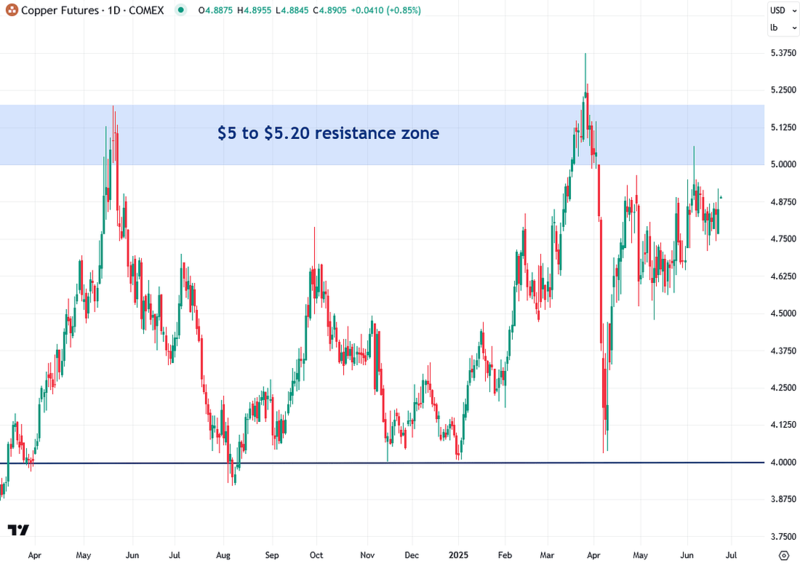
Copper futures continue to consolidate but are holding firm just below the key $5.00 to $5.20 resistance zone. A decisive breakout above that level would contribute to a broader breakout in the SSPI, adding further bullish momentum to silver. There are also several compelling reasons to be bullish on copper, as I outlined in a recent report.
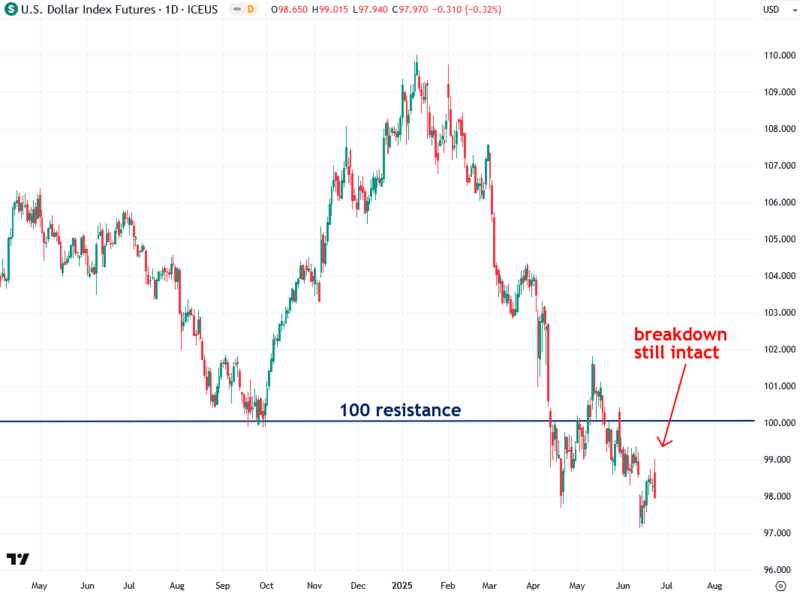
Another key asset I closely monitor to better understand the broader commodity landscape is the U.S. dollar—specifically the U.S. Dollar Index, which has historically moved inversely to commodities, including precious metals. As I’ve recently noted, the Dollar Index broke below the critical 100 support level, which has now flipped into resistance.
This marks a significant technical breakdown that tilts the outlook for the dollar decidedly bearish—while reinforcing a strong bullish backdrop for commodities like gold, silver, platinum, and copper. Notably, the dollar’s weakness amid recent Middle East turmoil—an environment that typically strengthens safe-haven assets like the dollar—signals deeper underlying fragility.
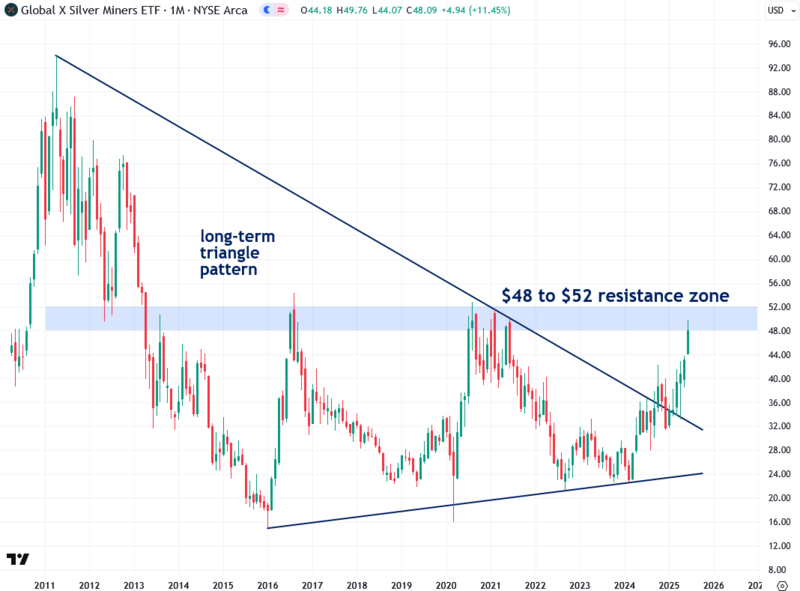
In addition to silver itself, I’m also highly bullish on silver mining stocks and ETFs, which I expect to deliver even larger gains in the coming bull market due to their leverage to the price of silver. Large silver miners, as tracked by the SIL ETF, have been performing strongly after breaking out of a long-term triangle pattern that dates all the way back to 2011.
SIL is now testing a critical resistance zone between $48 and $52—a level that has repeatedly capped rallies since 2016. I believe a decisive breakout above this zone, especially in tandem with a fully confirmed silver bull market, will trigger an explosive move higher in silver mining stocks. I’m watching closely and very excited about the potential upside.
To summarize, while silver has been relatively quiet in recent weeks following its encouraging breakout, that doesn’t mean the move has failed—nor is there reason for frustration or discouragement. I remain optimistic, especially recognizing that summer is often a period of consolidation due to lower trading volumes. That seems to be the case now with silver, gold, and copper all taking a breather.
I’m still watching for additional bullish confirmation, particularly a breakout in silver priced in euros, the Synthetic Silver Price Index, gold, and copper—as well as a continued breakdown in the U.S. dollar, which remains in a technically vulnerable position. I’ll continue to keep you updated as this situation evolves.
If you found this report valuable, click here to subscribe to The Bubble Bubble Report for more content like it.
Jesse Colombo is a financial analyst and investor writing on macro-economics and precious metals markets. Recognized by The Times of London, he has built a reputation for warning about economic bubbles and future financial crises. An advocate for free markets and sound money, Colombo was also named one of LinkedIn’s Top Voices in Economy & Finance. His Substack can be accessed here.
(Caroline Boda, The Center Square) Several major health insurance companies are vowing to make changes to simplify their prior authorization process and improve Americans’ access to timely health care.
U.S. Health and Human Services Secretary Robert F. Kennedy Jr. and Medicare & Medicaid Administrator Dr. Mehmet Oz announced the changes during a news conference Monday afternoon.
“Patients should not be waiting because bureaucratic hurdles are blocking their medical treatment,” Oz said Monday.
Oz and Kennedy announced plans to collaborate with numerous health-care insurers, including UnitedHealthcare, Blue Cross Blue Shield and Kaiser Permanente, to implement grace periods when patients change plans and utilize electronic systems to speed up prior authorization.
“Americans shouldn’t have to negotiate with their insurer to get the care they need,” Kennedy said. “Pitting patients and their doctors against massive companies was not good for anyone.”
These commitments made by health insurance companies were not prompted by federal mandates from HHS or CMS but were rather made on a voluntary basis.
“We applaud these voluntary actions by the private sector, which is how these types of issues should be solved,” Oz said. “CMS will be evaluating progress and driving accountability toward our shared goals as we continue to champion solutions that put patients first.”
Healthcare trade association America’s Health Insurance Plans (AHIP) announced that insurance companies are seeking to launch standardized electronic systems for prior authorization by Jan. 1, 2027.
Insurers are also aiming to decrease the number of health-care claims that require prior authorization screening by Jan. 1, 2026.
“These measurable commitments – addressing improvements like timeliness, scope and streamlining – mark a meaningful step forward in our work together to create a better system of health,” Blue Cross Blue Shield CEO Kim Keck said.
(Brien Lundin, Money Metals News Service) “War, what is it good for? Absolutely nothin’!” — I’ve had the classic Edwin Starr song running in my head ever since news of the U.S. bombing of Iranian nuclear facilities broke Saturday evening.
I was actually alerted to the news by my friend Brent Johnson, who was seated across from me at the speakers’ dinner for the Real Estate Guys Summit in Miami.
I remarked to Brent and the other dignitaries around me that (in addition to the other considerations, of course) it was good that this attack happened over the weekend, with markets closed. This way, the shock of the news would wear off without creating a short-lived spike in the gold price.
These kinds of geopolitical spikes are traps for impetuous gold buyers, and often do more damage to the metal’s price trend by masking the true macroeconomic drivers.
I didn’t need to worry overmuch, however, as gold showed very little reaction at all as markets opened this morning. And neither did any other market.
In fact, as we learned of Iran’s retaliatory attack on U.S. bases in Qatar at midday, gold actually sold off…and U.S. stocks rose…and the price of oil continued to fall!
Shake It Off
There are a few things we can take from this reaction…
First, the markets are accurately and efficiently determining that this conflict is no big deal, Iran is essentially helpless, and little will come from all of this.
I have to say, contrary to a number of my friends and colleagues in the hard money universe who are predicting World War III, I pretty much agree with this assessment.
Second, geopolitical brush fires are almost never a reason to buy gold. The record clearly shows that any reaction is short-lived, and anyone who tries to bet on these events usually ends up holding a bag.
That’s proven to be the case once again.
Andfinally, even our allies who are cheering on from the sidelines (along with, in fact, other area nations that would be vulnerable to nuclear fallout) will look at America’s awesome projection of power and conclude that they need to further insulate themselves from the U.S. hegemony.
In short, they’ll want to buy more gold.
The Bull Is Back
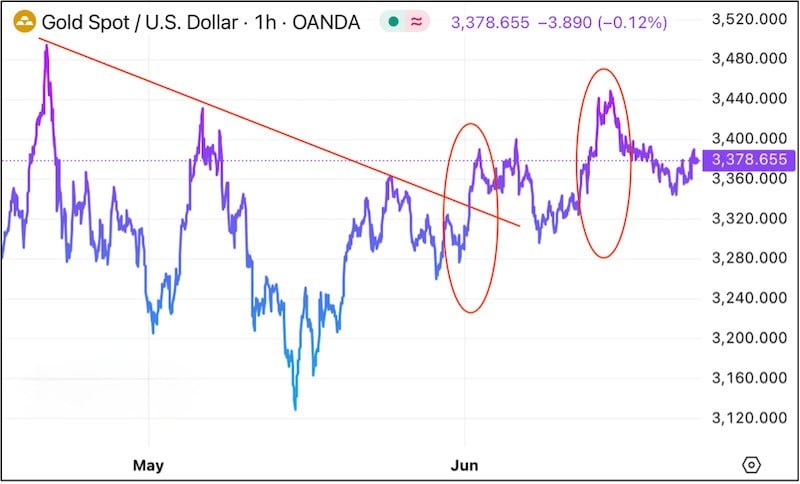
The chart above is quite encouraging for gold bulls.
As you can see, the correction that began in April is marked by a downtrend line that was clearly broken in early June, as I alerted you at the time. That breakthrough, when gold jumped over $80 in one session, is marked by the first oval.
The eruption of the Israel-Iran conflict is marked by the second oval, and there you can see the quick price spike…and then the drop as that geopolitical premium deflated over the following few sessions.
We’re climbing back from that short decline now, as the market is shaking off the U.S. attack and the underlying drivers for this gold bull regain their influence.
To get Brien Lundin’s ongoing commentary on the markets at no charge, click here to subscribe to his free Golden Opportunities newsletter.
Brien Lundin is the publisher and editor of Gold Newsletter, the publication that has been the cornerstone of precious metals advisories since 1971. Mr. Lundin covers not only resource stocks but also the entire world of investing. He also hosts the annual New Orleans Investment Conference. To get Brien Lundin’s ongoing commentary on the markets at no charge, click here to subscribe to his free Golden Opportunities newsletter.
(Bethany Blankley, The Center Square) Attacks against U.S. Immigration and Customs Enforcement officers are now up by 500%, the Department of Homeland Security says, up from 431% earlier in the month.
As attacks increase, assailants continue to be arrested, including members of the terrorist organization Tren de Aragua, a Mexican national who dragged an ICE officer 50 yards by car, and a Salvadoran national charged with attempted murder of a U.S. attorney.
After Hondurans and protestors were arrested for allegedly attacking federal agents during a worksite enforcement action in Omaha, Nebraska, a TdA member and Venezuelan national was arrested for attempted murder of special agents in Bellevue, Nebraska.
On June 18, ICE Homeland Security Investigations-Omaha led an operation to arrest Venezuelan national and alleged TdA member Gabriel Hurtado-Cariaco, in Bellevue. As federal agents attempted to take him into custody, he “launched a brutal and premeditated assault on an ICE HSI special agent” involving throwing the ICE agent to the ground, slamming her head on the pavement, ripping off her body armor, and making “repeated and physical violent contact,” DHS said.
She suffered serious injuries to her head and arm and was transported to the University of Nebraska Medical Center for treatment. She has since been released and is recovering, DHS said. Hurtado-Cariaco also assaulted an FBI agent, DHS said. He fled the scene but was apprehended roughly an hour later, according to DHS. He was charged with attempted murder of a federal officer and assault of a federal officer with infliction of bodily injury.
He illegally entered the U.S. in 2023 and was removed by Border Patrol only to illegally reenter again in 2024, DHS said. This time, he was released into the country with a notice to appear. Now he faces felony charges that could result in years in prison if convicted.
In another case, Albany County Sheriff’s deputies arrested a Salvadoran national illegally in the country, Saul Morales-Garcia, on second degree attempted murder charges. He was arrested on Jun 17 after he allegedly lunged at the U.S. Attorney for the Northern District of New York with a knife, screaming aggressively in Spanish, according to the complaint.
He was charged with attempted murder in the second degree, menacing with a weapon, and criminal possession of a weapon. ICE lodged a detainer request with the sheriff’s office.
Morales-Garcia has an extensive criminal record in Georgia, Pennsylvania, Virginia and New York for charges and convictions including felony grand larceny, misdemeanor petit larceny, theft, DWI, disorderly conduct, among other charges. He was previously deported in 2010 and illegally entered the U.S. as a gotaway, those who intentionally illegally enter between ports of entry to evade capture.
In another case, Mexican national Roberto Carlos Munoz-Guatemala was arrested after he dragged an ICE officer 50 yards with his car in Bloomington, Minnesota, trying to evade arrest, DHS said.
After being pulled over during a traffic stop, he refused to comply with ICE orders to exit his vehicle. Instead, he attempted to flee by putting his car in drive while the ICE officer was still holding his arm inside the vehicle and dragged the officer roughly 50 yards, DHS said.
The officer was hospitalized and expected to make a full recovery.
Munoz-Guatemala, a convicted child sex offender, has a criminal history spanning 15 years, including arrests for domestic assault and multiple driving offenses. He also illegally entered the U.S. as a gotaway, DHS said. ICE first lodged a detainer request on him in 2013 and for the last 12 years he was living illegally in the U.S. and wasn’t deported.
In another case, a Mexican national illegally living in Los Angeles was arrested for spitting on an ICE officer. His extensive criminal history includes a robbery conviction, arrests for murder and assault, among other charges. He was previously deported and illegally reentered.
“This defendant found out the hard way: When you spit, we hit – with a felony charge,” U.S. Attorney Bill Essayli said. “Law enforcement officers risk their lives and safety to uphold the law. To treat them with the disrespect, like this defendant did, mocks our great nation and such behavior will be punished accordingly.”
These are a few of hundreds of charges being brought by U.S. attorneys nationwide for border related crimes, The Center Square has reported.
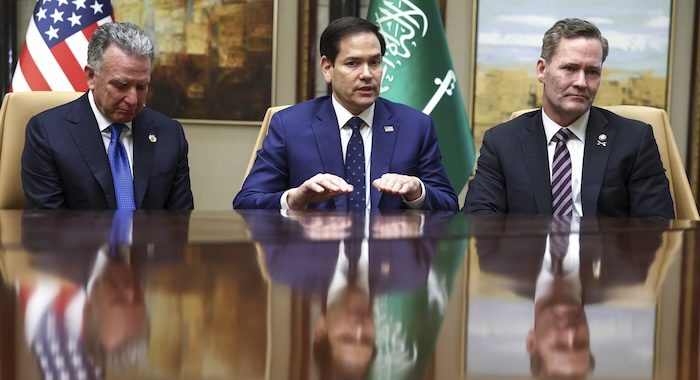
(Dave DeCamp, Antiwar.com) Secretary of State Marco Rubio said Sunday that whether Iran has decided to build a nuclear weapon is “irrelevant,” as he was pressed on the lack of evidence that Tehran has taken steps to weaponize its nuclear program.
Rubio made the comment in an interview with CBS News when asked about the fact that US intelligence has no evidence that Iran was seeking a bomb before Israel launched its war on the country.
“That’s irrelevant. I think that question being asked in the media – that’s an irrelevant question. They have everything they need to build a weapon,” Rubio said.
Rubio pointed to the fact that Iran was enriching uranium at 60%, which is still below the 90% needed for weapons-grade, as evidence that Iran has the capability to build a bomb, since it could quickly increase to the 90% level.
Iran had made clear when it was engaged in negotiations with the US that it was willing to bring its enrichment level back down to 3.67%, but the US decided to back an Israeli attack instead of pursuing such a deal and ultimately bombed three Iranian nuclear facilities.
Iran took the step to start enriching uranium at 60% in 2021 following an Israeli sabotage attack on its Natanz nuclear facility, which was meant to disrupt negotiations between the Biden administration and Iran that were ongoing at the time.