Juvenile with 111 Arrests in 2 years Still Free in Charlotte

(Alan Wooten, The Center Square) Catch and release, says a sergeant in the Charlotte-Mecklenburg Police Department, “does not reduce crime in our community.”

To wit, included in the information released from police in North Carolina’s largest city was arrest history for a 15-year-old. Since August 2023, the juvenile has been arrested 111 times, with seven charges of stolen property, 45 charges of larceny from an auto, and 55 charges of auto theft.

“If that doesn’t make you furious at how broken our justice system is, you’re not paying attention,” said U.S. Rep. Pat Harrigan, R-N.C.

The department released a third-quarter safety report “showcasing a substantial decline in crime citywide.” The report says crime overall is down 8% and violent offenses are down 20%.

Yet the city of just under 950,000 and its judicial policies got a black eye nationally in the aftermath of a stabbing death on a light rail train Aug. 22. Iryna Zarutska’s death fueled multiple probes, including from the state auditor that found the transit system was down 55% in armed security but up 211% in contract value.

The Police Department report summary highlights positive statistics before reaching the 12th paragraph, where Sgt. Todd Martin of the Southeast Service Area Crime Reduction Unit says, “We continue to see a troubling pattern: a disproportionate number of violent incidents and property crimes are being committed by individuals with extensive criminal histories – many of whom continue to cycle through the justice system without facing meaningful consequences. The cycle of catch and release does not reduce crime in our community.”

Violent crimes in Charlotte from Jan. 1 through Sept. 30 number 4,506. Zarutska’s death is one of 62 homicides. Those numbers for the same time period in 2024 were 5,622 and 82.

Charlotte has had increases in commercial burglaries (1,824, up from 1,751) and larcenies from automobiles (7,716, up from 7,697).

Deputy Chief Jackie Bryley, in the summary, says, “Patrol officers are the most visible part of our department. They are in our communities building relationships, deterring crime and providing services to our Charlotte residents. Every day, our officers intervene in disputes, stop crimes in progress and prevent violence without it ever making the news. The progress we’re making in reducing violent crime is the result of strong, ongoing teamwork and we remain committed to a safe Charlotte.”

Report: Alleged UnitedHealthcare Assassin Was Beaten Up by 7 Ladyboys in Bangkok

(Ken Silva, Headline USA) The New York Times published on Tuesday an investigation into Luigi Mangione, revealing new details about his adventures in Asia in the months before he allegedly assassinated UnitedHealthcare CEO Brian Thompson.

Mangione’s trip to Asia has been a subject of much speculation. He reportedly left around February, and many of his friends and family never saw him again until he turned up in the news. His mother reported him missing last November, weeks before he allegedly gunned down Thompson in the streets of New York City on Dec. 4.

According to the Times, Mangione traveled to Tokyo in February 2024 before hopping over to Thailand a month later. While there, he had some drunken escapades with two other Americans.

One of the more salacious details in the Times article was Mangione’s encounter with “ladyboys” in Bangkok, Thailand.

“Mangione recounted some wild nights he had spent out on the town. He lost his phone in a taxi at one point. On another night, he wrote, he had been beaten up by seven ‘ladyboys,’ a commonly used local term for transgender women that can be seen as derogatory,” the Times reported. “He attached a photo of his scratched-up arm.”

After those adventures, Mangione reportedly returned to Japan, eventually finding himself in an isolated retreat. After that, he flew to Mumbai, India, where he met a writer named Jash Dholani—someone who’s written about the “Unabomber,” terrorist Ted Kaczynski.

Dholani reportedly told the Times that he advocates “creative risk in pursuit of beauty” and is always clear that violence isn’t the answer.

In July 2024, Mangione returned to America, working in San Francisco and using a fake ID with an issue date of June 18, 2024. It’s around that time when he decided to commit an assassination, according to the Times piece, which obtained experts from his purported journal.

“I finally feel confident about what I will do,” he allegedly wrote in an entry in August. “The details are finally coming together. And I don’t feel any doubt about whether it’s right/justified. I’m glad — in a way — that I’ve procrastinated, bc it allowed me to learn more about UHC.”

In October, he reportedly set his sights on Thompson and UnitedHealthcare.

“This investor conference is a true windfall. It embodies everything wrong with our health system, and — most importantly — the message becomes self evident,” he wrote in the October entry.

“What do you do? You wack the CEO at the annual parasitic bean-counter convention. It’s targeted, precise and doesn’t risk innocents,” he added.The journal cited by the Times was allegedly found on Mangione’s person when he was arrested five days after the Thompson assassination.

Mangione, 27, has pleaded not guilty to state and federal charges. Meanwhile, his lawyers are fighting to have some of the federal charges against him dropped.

In papers filed in Manhattan federal court earlier this month, the lawyers said prosecutors should also be prevented from using at trial his statements to law enforcement officers and his backpack where a gun and ammunition were found.

They said Mangione was not read his rights before he was questioned by law enforcement officers, adding that officers did not obtain a warrant before searching Mangione’s backpack.

Ken Silva is the editor of Headline USA. Follow him at x.com/jd_cashless.

Who’s Selling Today, and Selling What… Metal or Paper? Journalists Won’t Ask!

(Chris Powell, Money Metals News Service) Market analysts are searching for an explanation for today’s bombing of gold and silver prices. For example, the Wall Street Journal today wrote the following:

The sudden fall in gold and silver prices lacks a clear trigger, XTB research director Kathleen Brooks writes. …

The fall is likely caused by stretched valuations and signals that U.S. CPI data could be softer than expected, she adds.

A slide in prices isn’t necessarily a bad thing as it shows that investors aren’t getting too far ahead of themselves and that there is a limit to gold’s exuberance, Brooks writes. While the decline has been more severe than expected, the fundamentals propelling gold and silver upward remain, she adds.

Unfortunately, this search will not extend to the connections between central banks, bullion banks, and their daily and usually surreptitious interventions in the markets, both buying and selling, to defend their currencies against market forces.

A summary of the long history of this intervention against gold, in recent years undertaken most often with derivatives, is here.

Gold and silver have been rising with strange haste recently, and by conventional measures can be said to be very “overbought.

But who knows and will report which entities were selling today, and exactly what they were selling — real metal or paper derivatives? What journalist will telephone a central bank or a bullion bank with an inconvenient question and report his inability to get an answer?

Even when events in the monetary metals markets are as much lacking a “clear trigger” as today’s, no mainstream financial journalist dares to ask inconvenient questions about gold to anyone, much less powerful institutions.


Chris Powell is a journalist in Connecticut, where he worked for the Journal Inquirer, a daily newspaper in Manchester, for 56 years, 44 of them as managing editor. He continues to write political columns for that paper and many others in the state. He frequently appears on talk radio programs on four Connecticut stations.

Powell is also secretary/treasurer of the Gold Anti-Trust Action Committee Inc. (GATA), which he co-founded in 1999 to expose and oppose the rigging of the gold market by Western central banks and their investment bank agents. He edits the GATA Dispatch, that organization’s daily electronic newsletter, and speaks on behalf of the organization at financial conferences in the United States and abroad.

He is a member of the Board of Directors of the Connecticut Council on Freedom of Information and was its state legislative chairman from 2004-2010.

Senate Democrats Block Bill to End Government Shutdown for 11th Time

(Thérèse Boudreaux, The Center Square) For the 11th time, U.S. Senate Democrats blocked legislation Monday evening to reopen and fund the federal government, indicating that Republicans’ strategy of waiting out the opposition isn’t working.

The federal government has remained closed for 20 days now, the third-longest shutdown in U.S. history. 

“You have to give the Democrats credit for one thing, and that’s a healthy dose of gall,” Senate Majority Leader John Thune, R-S.D., said on the chamber floor. “For the sake of the American people, let’s hope that there are some Democrat senators who will eventually put the needs of their constituents over the demands of their far-left base.”

Congress was supposed to pass all 12 annual appropriations bills funding federal agencies for fiscal year 2026 by Sept. 30. 

Realizing lawmakers couldn’t finalize all the bills in time to meet the government shutdown deadline, House Republicans passed a clean Continuing Resolution to keep government funding on cruise control until mid-November, buying Congress more time.

Senate Democrats blocked the CR, however, demanding that any funding stopgap include costly health care policies, such as renewing the pandemic-era expansion of the Obamacare Premium Tax Credits, set to expire Dec. 31.

Republicans refused to include extraneous policy in the CR. As a result, the federal government ran out of funding and shut down Oct. 1, and lawmakers are no closer to a deal.

Millions of Americans could see their health care premiums spike at the end of the year if the Obamacare subsidies are not extended. 

“I just voted NO on the Republican funding bill. Just like the last ten (10!!) times we voted on this exact same bill, it includes absolutely NOTHING to save health care tax credits that millions of Americans rely on,” Senate Appropriations Committee Vice Chair Patty Murray, D-Wash., posted on X.

While Republican leaders have acknowledged this fact and promised Democrats a vote on the health care measure, they are unwilling to make guarantees that it will pass and are calling Democrats “unreasonable” for expecting such a promise.

“Democrats are solely responsible for the Obamacare tax credit cliff, yet they’re trying to pin this disaster on Republicans while also asking Republicans to bail them out,” Thune posted on X Monday evening. “We’re not going to negotiate until Democrats stop holding government funding hostage.”

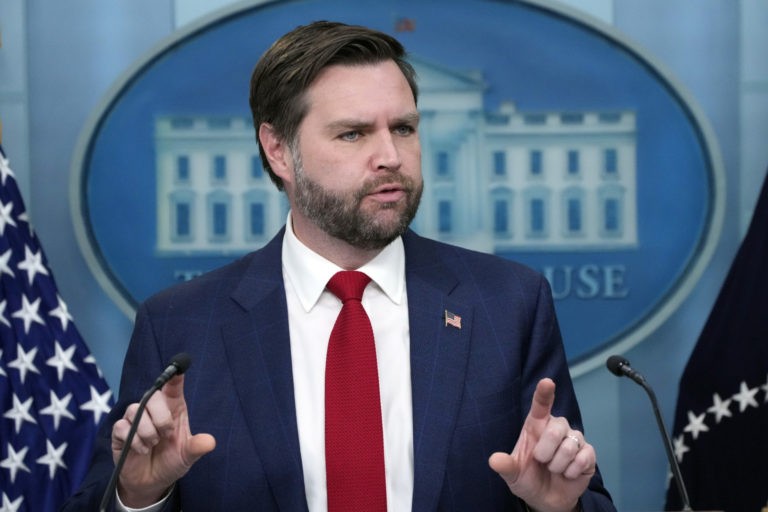
Vance Visits Israel and Says Gaza’s Fragile Ceasefire is Going Better than Expected

(Headline USA)  U.S. Vice President JD Vance and other envoys projected optimism Tuesday about Gaza‘s fragile ceasefire agreement, calling progress better than anticipated as they visited a new center in Israel for civilian and military cooperation.

Vance noted flareups of violence in recent days but said the ceasefire is going “better than I expected” after two years of war between Israel and Hamas. Envoy Steve Witkoff added that “we are exceeding where we thought we would be at this time.”

They are in Israel as questions remain over the long-term plan for peace, such as whether Hamas will disarm and who will govern Gaza.

Vance tried to downplay any idea that his visit was urgently arranged to keep the ceasefire in place. “My visit had nothing to do with the events of the past 48 hours,” he said. This is his first visit to Israel as vice president.

Vance was meeting with Israeli Prime Minister Benjamin Netanyahu and other officials and is expected to stay in the region until Thursday.

Jared Kushner, President Donald Trump’s son-in-law and one of the architects of the ceasefire agreement, noted its complexity: “Both sides are transitioning from two years of very intense warfare to now a peacetime posture.”

Vance said he feels “confident that we’re going to be in a place where this peace lasts,” but warned that if Hamas doesn’t cooperate, it will be “obliterated.” 

Hamas said it had recovered the remains of two more hostages and planned to hand them over Tuesday evening.

Vance urged a ‘little bit of patience’ amid Israeli frustration with Hamas’ pace of the returns.

“Some of these hostages are buried under thousands of pounds of rubble. Some of the hostages, nobody even knows where they are,” Vance said. “It’s just a reason to counsel in favor of a little bit of patience.”

He added that “a lot of this work is very hard” as he faced questions over next steps, and he urged flexibility.

Vance emphasized that U.S. troops would not be on the ground in Gaza, and said that “we’re in the phase now where we’re actually starting to conceptualize what that international security force would look like” for the territory.

The ceasefire took effect on Oct. 10. While it has been tested by Sunday’s fighting and mutual accusations of violations, both Israel and Hamas have said they are committed to the deal. Trump has made clear he wants it to succeed.

The head of Egypt’s intelligence agency, Maj. Gen. Hassan Rashad, traveled to Israel on Tuesday to meet with Netanyahu, Witkoff and others over the ceasefire’s implementation, according to Netanyahu’s office.

Hamas negotiators reiterated that the group is committed to ensuring the war “ends once and for all.”

Israel confirmed that Palestinian militants had released the body of Tal Haimi, who was killed in the Hamas-led Oct. 7, 2023, attack that ignited the war. He was abducted from Kibbutz Nir Yitzhak. The 42-year-old was part of its emergency response team and had four children, including one born after the attack.

Under the terms of the ceasefire, Israel is waiting for Hamas to turn over the remains of 15 hostages. Thirteen others have been turned over.

Under the deal, Israel is releasing 15 Palestinian bodies for the remains of each dead hostage, according to Gaza’s Health Ministry, part of the Hamas-run government. It said Israel had transferred another 15 on Tuesday, for a total of 165 since earlier this month.

So far, only 32 of the bodies have been identified, according to Gaza’s Health Ministry.

International organizations said they were scaling up humanitarian aid entering Gaza, while Hamas-led security forces launched a crackdown against what it called price gouging by private merchants.

The World Food Program said it had sent more than 530 trucks into Gaza in the past 10 days, enough to feed nearly half a million people for two weeks. That’s still well under the 500 to 600 that entered daily before the war.

The WFP also said it had reinstated 26 distribution points and hopes to scale up to its previous 145 points across Gaza as soon as possible.

Residents said prices for essential goods soared on Sunday after militants killed two Israeli soldiers and Israel responded with strikes that killed dozens of Palestinians. Israel also threatened to halt humanitarian aid.

At a market in the central city of Deir al-Balah, a 25-kilogram (55-pound) package of flour was selling for more than $70 on Sunday, up from about $12 shortly after the ceasefire. By Tuesday, the price was around $30.

Mohamed al-Faqawi, a Khan Younis resident, accused merchants of taking advantage of the perilous security situation. “They are exploiting us,” he said.

On Monday, Hamas said its security forces raided shops across Gaza, closing at least 10 shops and warehouses, and forced merchants to lower prices. Hamas also has imposed more order, allowing aid trucks to move safely and halting looting of deliveries.

Nahed Sheheiber, head of Gaza’s private truckers’ union, said there was no stealing aid since the ceasefire started.

But other significant challenges remain as Gaza’s financial system is in tatters. With nearly every bank branch and ATM inoperable, people pay exorbitant commissions to a network of cash brokers to get money for daily expenses.

On Tuesday, dozens of people in Deir al-Balah spent hours in line at the Bank of Palestine hoping to access their money but were turned away.

“Without having the bank open and without money, it does not matter that the prices (in the market) have dropped,” said Kamilia Al-Ajez.

A senior health official in Gaza said some bodies of Palestinians returned by Israel bore “evidence of torture” and called for a United Nations-launched investigation.

Dr. Muneer al-Boursh, the ministry’s general director, said in on social media late Monday that some had evidence of being bound with ropes and metal shackles, blindfolds, deep wounds, abrasions, burns and crushed limbs.

It was not immediately clear if any of the bodies had been prisoners; they are returned without identifications or details on how they died. The bodies could include Palestinian detainees who died in Israeli custody or bodies taken out of Gaza by Israeli troops during the war.

The Israel Prisons Service denied that prisoners had been mistreated, saying it had followed legal procedures and provided medical care and “adequate living conditions.”

Israeli hostages released from Gaza have also reported metal shackles and harsh conditions, including frequent beatings and starvation.

In the initial 2023 attack on Israel, Hamas-led militants killed around 1,200 people, mostly civilians, and abducted 251 people as hostages.

The Israel-Hamas war has killed more than 68,000 Palestinians, according to Gaza’s Health Ministry, which does not distinguish between civilians and combatants in its count. The ministry maintains detailed casualty records that are seen as generally reliable by U.N. agencies and independent experts. Israel has disputed them without providing its own toll.

Thousands more people are missing, according to the Red Cross.

Adapted from reporting by the Associated Press.

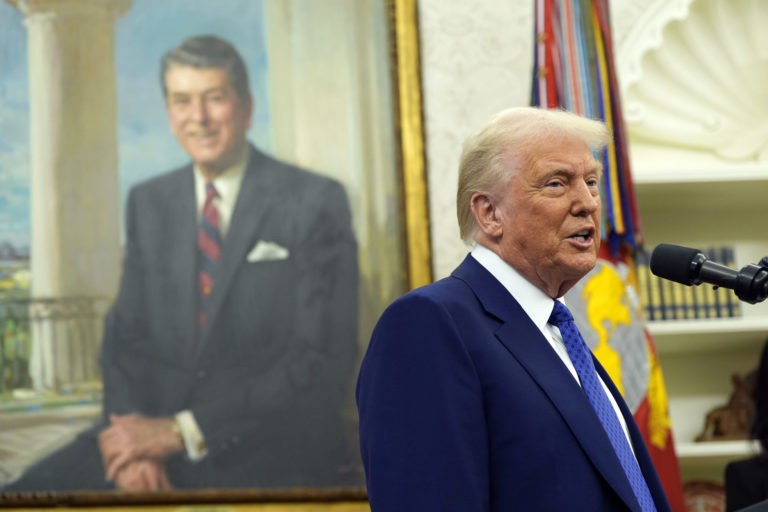
Trump Says China Doesn’t Want to Invade Taiwan

(Dave DeCamp, Antiwar.com) President Trump said on Monday that he doesn’t think China wants to invade Taiwan and expressed optimism about reaching a trade deal with Beijing despite his recent threat to increase tariffs in response to China’s rare earth export restrictions.

“I think we’ll be just fine with China. China doesn’t want to do that,” Trump told reporters in response to a question about China invading Taiwan, according to POLITICO. “As it pertains to Taiwan, and that doesn’t mean it’s not the apple of his eye, because probably it is, but I don’t see anything happening.”

The president’s comments contradict claims from US War Secretary Pete Hegseth, who said earlier this year that the threat China poses to Taiwan could be “imminent.” For years, the Pentagon has been claiming that China was preparing to be ready to invade by 2027, but the claim has never been confirmed by Beijing.

Trump is set to meet with Chinese President Xi Jinping later this month on the sidelines of the Asia-Pacific Economic Cooperation in South Korea, and he believes he can work out a deal before 100% tariffs on Chinese goods are supposed to take effect in November.

“I think when we finish our meetings in South Korea, China and I will have a really fair and really great trade deal together,” Trump said. He also said that he was planning to visit China in early 2026 after receiving an invitation from Beijing.

Trump made the comments on Monday while hosting Australian Prime Minister Anthony Albanese at the White House. While downplaying the threat of China, Trump also endorsed AUKUS, a military pact between the US, the UK, and Australia meant to counter Beijing that focuses on technology sharing and will arm Canberra with nuclear-powered submarines.

This article originally appeared at Antiwar.com. 

US To Keep Troops at Ain al-Asad Air Base in Western Iraq, Reversing Withdrawal Plan

(Dave DeCamp, Antiwar.com) US troops will remain at the Ain al-Asad Air Base in western Iraq, reversing plans to withdraw from the military installation, Iraqi Prime Minister Mohammed Shia al-Sudani said on Monday.

According to Stars and Stripes, al-Sudani said about 250 to 250 US military personnel will remain at Ain al-Asad, as well as at the al-Hahrir Air Base in the Erbil Governorate in northern Iraq’s Kurdistan region.

A US War Department official said earlier this month that the US was in the process of withdrawing from Ain al-Asad and that the US planned to keep the majority of its troops in Erbil and was leaving some military personnel in Baghdad. The official also said that the US was bringing its overall troop numbers in Iraq from 2,500 to below 2,000 under a drawdown deal signed with the Iraqi government last year.

Al-Sudani said the US troops will stay at Ain al-Asad to help forces fighting ISIS in Syria. “These personnel will assist in surveillance and coordination with US forces at the al-Tanf base in Syria to ensure that IS does not exploit the security vacuum,” he said.

While the deal the US and Iraq signed last year was framed as a withdrawal agreement, the US has been clear since it was signed that it would not lead to a full US withdrawal from Iraq. The agreement outlines a formal end to the US-led anti-ISIS coalition’s mission in Iraq, but US troops will remain in the country under a “bilateral security partnership.”

Washington and Baghdad began negotiations on the deal after al-Sudani called for an end to the foreign coalition’s mission in Iraq following a series of US airstrikes against the Popular Mobilization Forces (PMF), a coalition of Iraqi Shia militias that are part of Iraq’s security forces.

The US was bombing the PMF in retaliation for rocket and drone attacks on US bases in Iraq and Syria that were launched in response to US support for Israel’s genocidal campaign in Gaza. Those operations culminated in the January 2024 attack on Tower 22, a secretive US base in Jordan near the Syrian border, which killed three US Army Reserve soldiers and wounded dozens of National Guard members. The US launched major airstrikes against the PMF in response, and the militias largely ceased attacks on US bases since early 2024 due to pressure from the Iraqi government and Iran.

This article originally appeared at Antiwar.com. 


EXCLUSIVE: Man Subject to Charlie Kirk Assassination Conspiracies Ostracized from His Community

(Ken Silva, Headline USA) “You do need to get the death penalty. You are part of the assassination. You are a co-conspirator!”

“KARMA is actively looking David and will get right soon. TRUST”

“You will die and your family will watch.”

“I’d kill him.”

Those are just a few of the threats, accusations and vile comments levied at a Utah man at the center of conspiracy theories related to the assassination of Charlie Kirk, due to his admittedly bizarre reaction to the conservative activist’s death.

The man, David—his last name is being withheld to protect his identity—was at the Sept. 10 event with his friend, James Gaffney. Shortly after Kirk was shot, David stood up, pumped his fists and chanted “USA!” while smiling.

David’s reaction was not received well by the public.

“FBI PLEASE LOOK INTO THIS MAN IMMEDIATELY,” Matt Wallace, whose X account has more than 2 million followers, tweeted hours after Kirk’s death.

David, a registered Republican, took to X in an attempt to explain himself.

“I stood and shouted ‘USA,’ not as a provocation, but to project strength, encourage others, and create a distraction that might help calm panic or even save lives,” David said in a two-minute video posted on X. But that only prompted more criticism and threats, prompting him to delete the video.

In an exclusive interview with this publication, David went through his whole backstory, as well as his reaction and what happened afterwards. Headline USA was able to verify his identity and profession: a self-employed hair stylist in Utah County.

In the interview, David reiterated his reason for standing up after Kirk was shot.

“I didn’t know if there was another shooter or if they were targeting his team, so I stood up and yelled ‘USA!’ in hopes that it would draw attention so they could get Charlie out of there,” said David, who was in the National Guard.

As for why he had a grin on his face: “When you have that many things happen that fast, that was just my face. I’ve smiled when drill sergeants yell at me,” he said.

David also explained why he spoke in a short, monotone fashion on his original video in September. He said he just wanted to cover the main points of his story, and speak in a way so that he couldn’t be clipped and deceptively edited.

None of that has helped. David said he asked X’s artificial intelligence program, Grok, to find all the threats against him. The AI bot found more than 1,000 before it stopped processing his request, he said. David sent Headline USA a spreadsheet of the threats and accusations, some of which are still online.

After an initial public uproar, things started quieting down for David—until media personality Candace Owens re-amplified suspicions about him on Oct. 12.

“So this is sort of crazy but the man that cheered after Charlie got shot has actually never been fully identified. He is known only as ‘David,’” Owens said on X. “I am trying to get in touch with him because someone sent me some other relevant footage of him. Anyone know this is?”

David said he wasn’t happy that Owens didn’t try to contact him through private channels first.

“She could’ve easily found me without doing that. I found my account just by searching Grok for: ‘David guy who cheered,’” he said.

David said he’s messaged with Owens, who “really just seemed to want to know my personal information.”

“She didn’t want to seem to hear my side of the story. I think she already had her opinion,” David said.

But worse than the online criticism has been the reaction from some of the people in David’s real life, he said.

“My daughter was going to a homeschool group, and I told the lady who’s hosting it what happened—and she said she wasn’t sure she could believe me and that my daughter couldn’t be in the program anymore,” David said.

“At the very least, she thinks I’m a crazy maniac. My daughter’s in another program, which is good.”

David also said he left his LDS church—due in large part because he didn’t want to make it unsafe amidst the death threats—and now considers himself a non-denominational Christian. Only two people from the Mormon community have checked on how he’s doing, and that’s because it’s their job to do so, he said.

“Compare that to my clientele, who have been bringing me food and making sure I can pay my bills,” David said, his voice cracking with emotion. “I had support, but not from the people I thought I’d get it from.”

Ken Silva is the editor of Headline USA. Follow him at x.com/jd_cashless.

Chinese Gold Demand Rebounded in September

(Mike Maharrey, Money Metals News Service) Chinese wholesale gold demand rebounded in September.

This was partly due to a seasonal uptick in gold buying, along with continued support from investors as the yellow metal scaled new record highs.

China ranks as the world’s largest gold market.

In September, the London Bullion Market Association (LBMA) gold price recorded its largest monthly increase since January 2012, driving Q3 prices to the biggest quarterly gains since 2016. The LBMA gold price increased by 43 percent through the first three quarters of ’25, the best year-to-date performance since 1979.

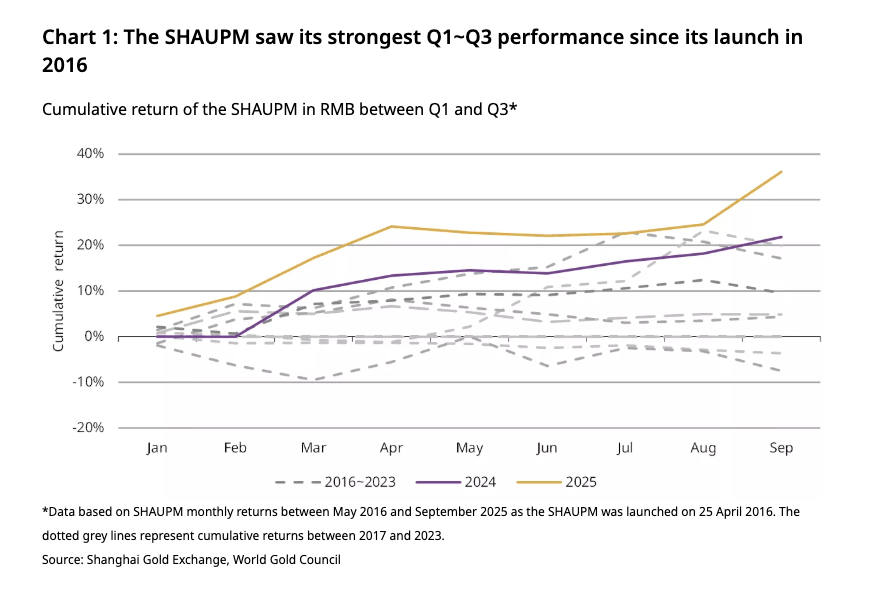
Local Chinese gold prices followed suit. The Shanghai Gold Benchmark Price PM (SHAUPM) gained 36 percent through the first nine months of 2025, charting the best year on record to date. The SHAUPM set new records 36 times through the first three quarters of the year, and the Shanghai price charted its best month on record in September.

Q3 was the second-strongest quarter on record, with the SHAUPM gaining 14 percent. The only stronger quarter came in Q1 of this year with an 18 percent surge.


The smaller SHAUPM gain compared to London was primarily due to a 4 percent appreciation in the RMB against the dollar during the period.

Chinese Gold Demand Data

Higher prices continued to create headwinds for Chinese gold jewelry sales, but investors took up some of the slack.

Wholesale gold demand came in at 118 tonnes in September, a 33-tonne month-on-month gain. Demand was 4 tonnes higher year-on-year last month.

Through the first three quarters, Chinese wholesale gold demand was 297 tonnes. That was down about 3 percent year-on-year.

The impact of higher prices is obvious as wholesale demand remains around 33 percent lower than the long-term average, largely due to sluggish jewelry sales. According to the World Gold Council, weakness in the gold jewelry sector has outpaced investment strength.

That’s not expected to improve in the coming months. According to the World Gold Council, after re-stocking in September, retailers will likely dial back their replenishment in October, following seasonal trends.

Investment demand also sagged during July and August. According to the World Gold Council, economic factors contributed to the cooling of the Chinese gold investment market in the first two months of Q3.

“Chinese investor risk appetite improved as the need for safe-haven assets declined: July and August saw better growth expectations on the back of strong Q2 economic data and a reducing U.S.-China tariff risk. This sentiment was reflected in the strong CSI300 Stock Index rally, which surged 18 percent during Q3, the strongest quarter since Q1 2019. Meanwhile, rising government bond yields – as the market priced in fewer rate cuts by the PBoC – increased opportunity costs of holding gold.”

However, Chinese gold bar and coin sales rebounded in September, even as some investors sold gold to book profits.

Chinese physical gold demand was a primary driver during the early stages of this gold bull market.

Chinese bar and coin demand grew by 44 percent year-on-year in H1. Chinese investors snapped up 115 tonnes of gold bars and coins in the second quarter alone. It was the strongest H1 for physical gold buying since 2013.

Given the rapidly increasing price, it was inevitable that demand would slow.

However, the anticipation of further price gains seems to have reignited investor interest.

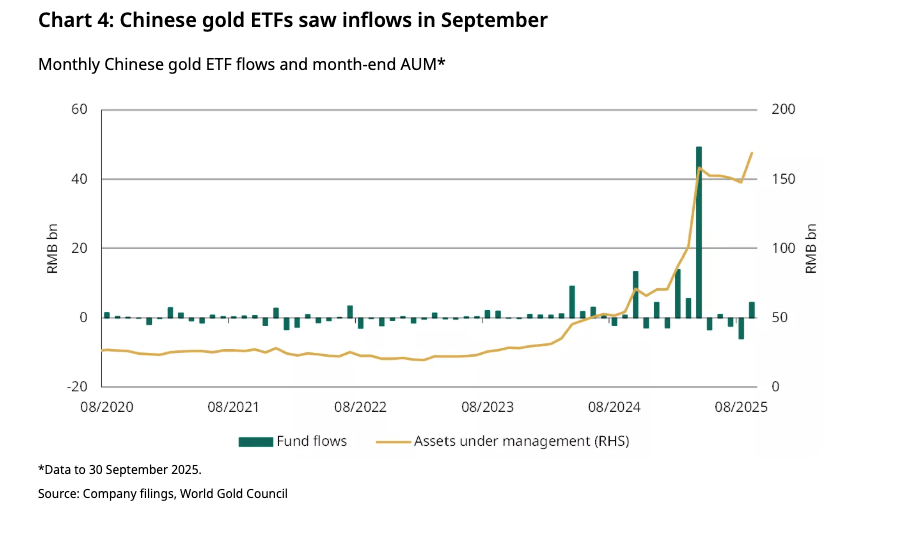
After two consecutive months of outflows, gold once again flowed into Chinese ETFs last month.

ETFs are a convenient way for investors to play the gold market, but owning ETF shares is not the same as holding physical gold.

Chinese gold-backed funds added 4.9 tonnes of gold totaling ¥4.5 billion ($622 million).

With positive September’s inflows of gold coupled with the surging price, assets under management (AUM) by Chinese gold ETF grew to another month-end peak of ¥169 billion ($22 billion).

Gold futures investor activity also improved last month. The average trading volumes on the Shanghai Futures Exchange jumped 70 percent month-on-month to 394 tonnes per day. That was 82 percent higher than the five-year average.

Gold imports were steady in September. Based on World Gold Council data, imports fell modestly by 2 tonnes month-on-month, coming in at 87 tonnes.


Mike Maharrey is a journalist and market analyst for Money Metals with over a decade of experience in precious metals. He holds a BS in accounting from the University of Kentucky and a BA in journalism from the University of South Florida.

Is Silver Overbought?

(Mike Maharrey, Money Metals News Service) Is silver overbought?

Technically, yes. But that doesn’t mean the bull market is over, as some mainstream analysts would have you believe.

From a technical standpoint, an asset is overbought when the price runs up extremely fast relative to the recent trend.

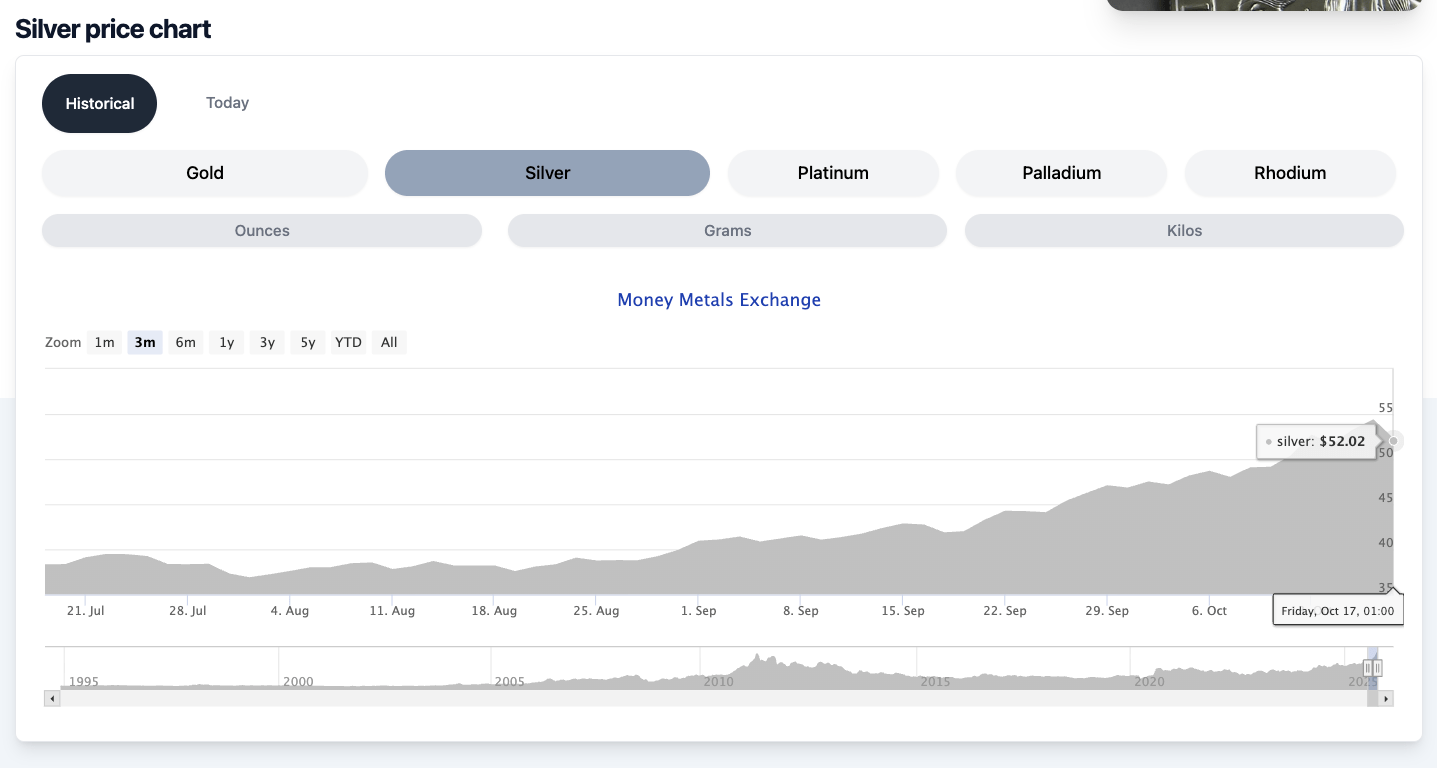
On September 18, silver was trading at $41.83. Over the next three weeks, silver rose to $54.32 an ounce, a 29.6 percent increase. It has since corrected, falling to $52 on Friday. But on Monday, the bulls were back in control, pushing silver back to $52.75.

The massive price runup in a matter of weeks is the very definition of overbought. But this rally is built on very strong fundamentals, indicating that it is not over-owned.

In a nutshell, the price of silver is rising because there simply isn’t enough metal to meet demand.

Silver demand has outstripped supply for four straight years. The structural market deficit came in at 148.9 million ounces last year. That drove the four-year market shortfall to 678 million ounces, the equivalent of 10 months of mining supply in 2024.

The Silver Institute projects a fifth straight supply deficit this year.

Movement of metal from London to New York earlier this year, due to tariff worries, drained LBMA vaults. This, coupled with a surge of investment demand and strong physical demand in India, led to a silver squeeze, pushing prices rapidly higher, resulting in this overbought situation.

There isn’t a quick, easy fix for the silver market.

This isn’t just a logistical problem. It is rooted in a fundamental lack of metal.

And you can’t print silver.

Technical Signals for the Bulls

When an asset is overbought, there is increased risk of a bull market pause, or even a reversal. However, along with the supply and demand dynamics, there are technical indicators that silver has plenty of room to move higher.

Even with the fast increase in the silver price, the gold-silver ratio still sits above 80-to-1, far above the modern average of around 60-to-1.

This indicates that silver is still significantly underpriced compared to gold.

Historically, whenever the spread grows this wide, silver rallies quickly to close the gap. This generally happens later in a gold bull market.

In 2020, for example, the ratio peaked at 123-to-1 before plunging to 60-to-1, propelling silver 80 percent higher in less than 20 weeks.

During the financial crisis of 2008–2011, the ratio dropped to 30-to-1 as silver surged to its 2011 record high.

By this measure, silver remains on sale compared to gold, with history suggesting a strong run is likely ahead.

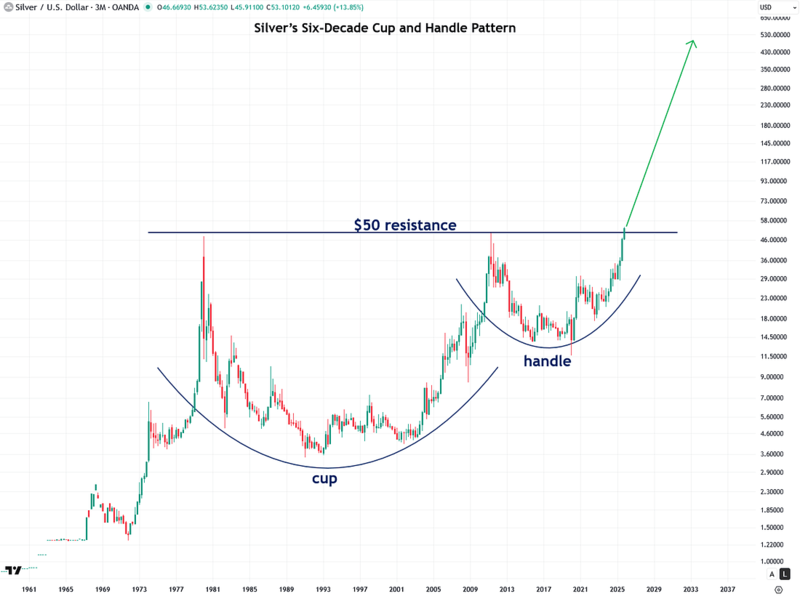
Silver also just broke out of a classic cup and handle pattern.

This is a long-term bullish pattern. You can see the “cup” with the twin highs of around $50 per ounce in 1980 and 2011. Following the 2011 peak, we see a sharp decline in the price, followed by a consolidation “handle.”

A handle pattern on the chart of a stock or commodity often precedes a breakout. Once the asset breaks above the handle (resistance), it typically portends a strong upward trend.

This silver cup-and-handle pattern has played out over an extremely long timeframe. Historically, longer patterns portend bigger breakouts with a broader base signaling a bigger upside case.

Gold followed a similar long-term pattern, resolving with a breakout to new all-time highs last year.

The current fundamental and technical dynamics indicate that the silver bull run isn’t over.  So, while silver is overbought, you shouldn’t panic sell at the first sign of a downturn.

The market is extremely volatile right now. Silver is more volatile than gold to begin with, so price swings are to be expected. But remember, bull markets rarely go up in a straight line. Corrections are healthy and present buying opportunities.


Mike Maharrey is a journalist and market analyst for Money Metals with over a decade of experience in precious metals. He holds a BS in accounting from the University of Kentucky and a BA in journalism from the University of South Florida.