(Headline USA) A fighter jet and a helicopter based off the aircraft carrier USS Nimitz both crashed into the South China Sea within 30 minutes of each other, the Navy’s Pacific Fleet said.
The three crew members of the MH-60R Sea Hawk helicopter were rescued on Sunday afternoon, and the two aviators in the F/A-18F Super Hornet fighter jet ejected and were recovered safely, and all five “are safe and in stable condition,” the fleet said in a statement.
The causes of the two crashes were under investigation, the statement said.
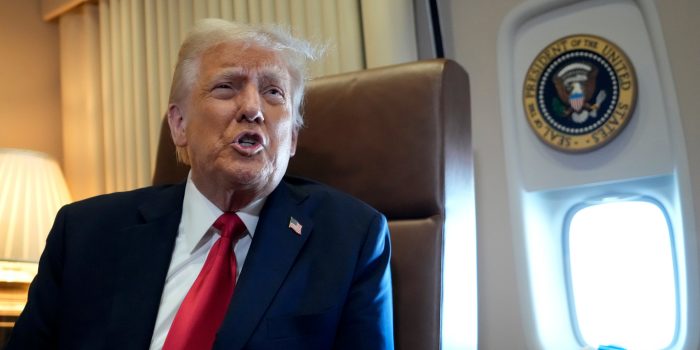
President Donald Trump, speaking to reporters aboard Air Force One en route to Tokyo on Monday, said the incidents could have been caused by “bad fuel.” He ruled out foul play and said there was “nothing to hide.”
The USS Nimitz is returning to its home port in Naval Base Kitsap in Washington state after having been deployed to the Middle East for most of the summer as part of the U.S. response to attacks by Yemen’s Houthi rebels on commercial shipping. The carrier is on its final deployment before decommissioning.
Another aircraft carrier, the USS Harry S. Truman, suffered a series of mishaps in recent months while deployed to the Middle East.
Then, in April, another F/A-18 fighter jet slipped off the Truman’s hangar deck and fell into the Red Sea.
And in May, an F/A fighter jet landing on the carrier in the Red Sea went overboard after apparently failing to catch the steel cables used to stop landing planes and forcing its two pilots to eject.
No sailors were killed in any of those mishaps. The results of investigations into those incidents have yet to be released.
But any decision will wait until after the 2026 midterm election, Newsom told CBS News in a report that aired Sunday.
“I have no idea,” Newsom said during an interview on “CBS Sunday Morning,” but added he would be lying if he said it wasn’t on his mind. He said the question about his possible candidacy for president was an “extraordinary” turn, considering the challenges he’s faced such as dyslexia and a below-average score on his SAT, formerly known as the Scholastic Aptitude Test.
“The idea that a guy who got 960 on his SAT, that still struggles to read scripts, that was always in the back of the classroom, the idea that you would even throw that out is, in and of itself, extraordinary,” Newsom told CBS News correspondent Robert Costa.
Newsom, who has long been widely expected to run for president, added he looks forward to seeing who’s running in the 2028 election. Former Vice President Kamala Harris, a Los Angeles resident who decided against running for California governor to succeed Newsom, hasn’t said whether she would seek the Democratic nomination to run against the Republican nominee.
The GOP candidate in the 2028 general election could be J.D. Vance if Republicans follow the tradition of the vice president running after the president’s final term. Harris, who joined the presidential race in July 2024 after President Joe Biden pulled out, lost to Trump.
Newsom, who backed Biden until he dropped out, conceded the reason for running must be compelling.
“I think the biggest challenge for anyone who runs for any office is people will see right through you if you don’t have that ‘why’, if you’re doing it for the wrong reasons,” he said.
Costa asked Newsom about his public appearances in July in South Carolina, which is seen as a key battleground state in the next presidential race. At one point, Newsom stopped by a coffee shop and helped serve espressos.
“I happen to, and thank God, I’m in the right business,” Newsom said. “I love people.”
Newsom stressed what he and other Democrats see as the importance of Proposition 50, the only statewide measure on the Nov. 4 California ballot. It would draw new boundaries for congressional districts to allow Democrats to pick up five more Democratic seats in the House, in response to Texas likely picking up five more Republican seats after its recent redistricting.
“It’s about our democracy. It’s about the future of this republic,” said Newsom, a vocal opponent of Republican President Donald Trump. “I think it’s about, you know, what the Founding Fathers lived and died for, this notion of the rule of law, and not the rule of Don.
“His presidency, de facto, ends next November if we’re successful, if we the people are successful in taking back the House,” the Democratic governor said.
Democratic control of the House would block advancement of Trump-backed legislation and give the Democrats power to subpoena Trump administration officials for oversight hearings.
The congressional redistricting election has garnered national interest. Newsom talked about Proposition 50 and Trump in September on CBS’ “Late Show with Stephen Colbert.”
The U.S. Department of Justice on Friday announced it would send personnel to Los Angeles, Orange, Kern, Riverside and Fresno counties to monitor polling sites. The DOJ said the goal is “to ensure transparency, ballot security and compliance with federal law.”
“Transparency at the polls translates into faith in the electoral process, and this Department of Justice is committed to upholding the highest standards of election integrity,” U.S. Attorney General Pamela Bondi said in a news release.
But Newsom has called it an effort to intimidate Democrats.
(Bethany Blankley, The Center Square) State and local government debt surpassed $6.1 trillion in 2023, according to an analysis by Reason Foundation.
The majority of debt was held by state governments, $2.66 trillion; $1.4 trillion by municipalities, $1.27 trillion by school districts, and $757 billion by counties, according to the analysis.
State and local government debt evaluated included both short- and long-term obligations, including $1.5 trillion in public pension obligations, $958 billion for retiree health care obligations, and other debt like bonds that will mature in decades, according to the foundation’s State and Local Government Finance Report.
The report includes a dashboard with drop-down menus to analyze data, allowing users to generate on-demand reports for any government entity, revenue, expense, asset, liability, population and other trends. It includes charts, contextual benchmarks, and per-capita metrics.
Totals include combined liabilities from each state government and each city, town, county and school district in each state. The report includes data for all 50 state governments, 2,317 county governments, 8,630 municipal governments, and 10,408 school districts.
It analyzed fiscal 2023 data from publicly available state and local government financial reports, including annual comprehensive financial reports, it says. The Nevada state government, several cities and counties only had fiscal 2022 data available. The report also states, “data collection at this scale can result in discrepancies.”
It appears to follow a similar review of financial reports produced by the Chicago-based nonprofit Truth in Accounting, which has been publishing reports on the fiscal health of states and cities for nearly two decades.
At the end of fiscal 2024, 25 states were unable to cover all their financial obligations, according to TIA’s 16th annual Financial State of the States report. Half of U.S. states are carrying significant debt burdens, “driven by rising costs, inflation, and ongoing pressure on budgets to fund promised pension benefits. With COVID-related federal funding winding down, states may face more difficulty managing budget pressures without additional financial support,” TIA wrote.
Assets for all 50 states totaled $2.2 trillion; total debt was $2.9 trillion in fiscal 2024, according to the TIA analysis. Combined, the states needed more than $765 billion to cover their expenses at the end of the year, TIA found, The Center Square reported.
California held the most aggregated state and local government debt of more than $1 trillion, according to the Reason analysis. New York ranked second with nearly $798 billion, followed by Texas’ $550 billion, Illinois’ $407 billion and New Jersey’s $310 billion.
Sixteen states had more than $100 billion in state and local government debt: California, New York, Texas, Illinois, New Jersey, Florida, Massachusetts, Pennsylvania, Ohio, Washington, Michigan, Georgia, Maryland, Connecticut, North Carolina and Colorado.
Nearly all states, 48, reported at least $10 billion in combined state and local debt. Only Vermont and South Dakota reported less, $8.8 billion and $5.9 billion, respectively, according to the Reason analysis.
The majority, roughly 80%, of state and local debt is long-term, including “bonds, loans, and notes (41% of the total), unfunded public pension liabilities (32%), unfunded retiree health care benefits (20%), and accrued leave payouts (2%),” according to the Reason analysis.
In 2023, state and local governments reported $4.9 trillion in long-term debt, with five states accounting for more than half the total, according to the Reason analysis.
California reported the most long-term debt of nearly $802 billion, followed by New York’s nearly $634 billion, Texas’ $461 billion, Illinois’ $362 billion and New Jersey’s nearly $289 billion, according to the Reason analysis.
Fourteen states’ long-term state and local debt exceeded $100 billion; 36 states exceeded $20 billion, according to the analysis.
California and Illinois hold the highest pension debt totaling well over $100 billion: nearly $269 billion and $228 billion, respectively, Reason’s analysis shows.
(Mike Maharrey, Money Metals News Service) Even with gold scaling record highs, Indian demand was robust in September as the festival season kicked off.
India ranks as the world’s second-largest gold market behind China.
Gold has hit record highs 48 times this year in dollar terms. The yellow metal was up by 11.6 percent in September and added another 7.9 percent through the first two weeks of October before correcting later in the month.
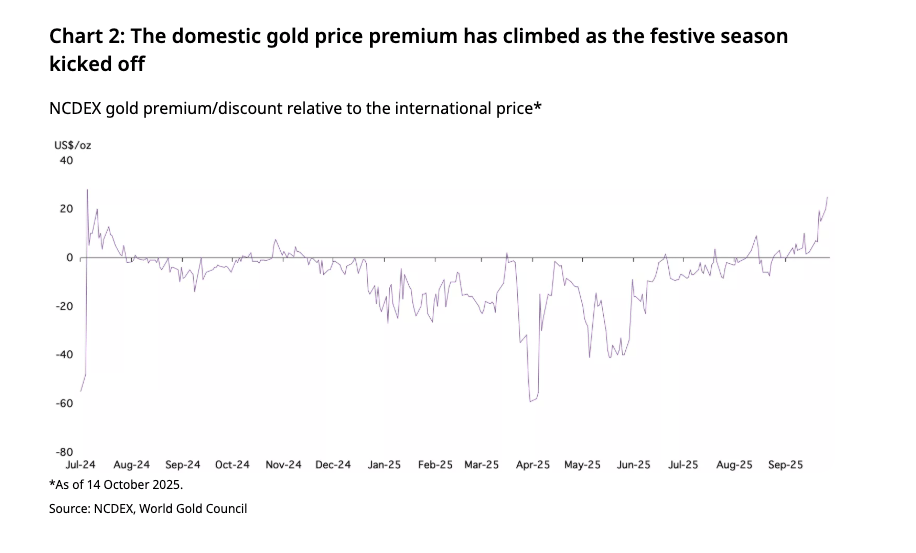
Prices rose even faster in rupee terms. By mid-October, the local price in India was at a $25 premium over international prices, signaling strong demand. This is the widest spread since July 2024, when the Indian government lowered the customs duty on gold and silver.
The higher gold price has created headwinds for Indian jewelers. However, investors have taken up the slack. Furthermore, consumers were in a buying mood as the fall festival season cranked up despite the higher prices.
According to the World Gold Council, the festival season started on a “positive note” with anecdotal evidence indicating healthy demand for both physical investment products and jewelry.
“Despite the pressure on gold jewelry consumption due to high prices and affordability, there has been a recent sales uptick, predominantly concentrated around wedding-related purchases and aligning with the wedding season.”
However, consumers are opting for lighter pieces and lower-karat jewelry. This means we will probably see lower retail volumes.
According to the World Gold Council, “Retailers’ revenues may benefit from a boost in jewelry sales, overall volume demand is bound to decline due to affordability constraints from high gold prices.”
While jewelry sales continue to feel pressure from the surging gold price, investment demand remains robust, with dealers reporting strong gold coin and bar sales.
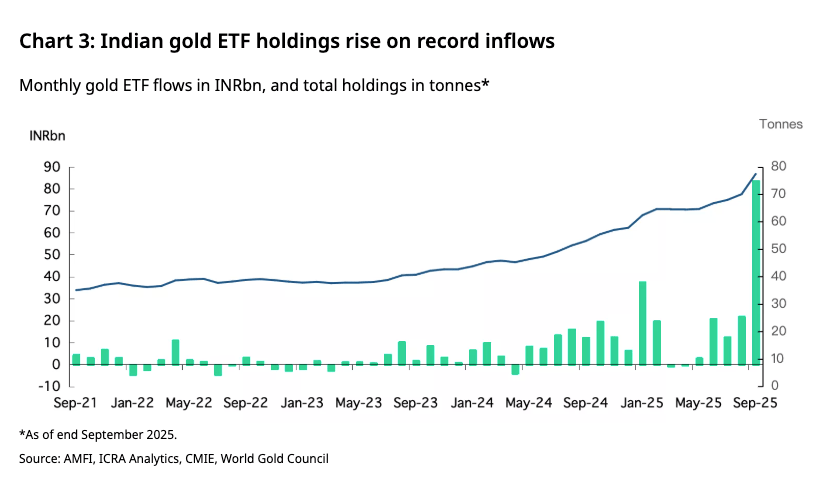
Meanwhile, India-based gold ETFs recorded the largest net inflows on record in September. Indian funds added 7.4 tonnes of gold totaling ₹83.6 billion.
According to the World Gold Council, “The sustained and unprecedented gold price rally has captured investor interest, likely fueling the surge in inflows; persistent safe-haven demand has also contributed.”
There was also a surge in new ETF clients, with 629,000 new accounts added in September. This pushed the total number of active folios to 8.7 million, a 33 percent increase since the start of the year.
A gold ETF is backed by a trust company that holds metal owned and stored by the trust. In most cases, investing in an ETF does not entitle you to any amount of physical gold. You own a share of the ETF, not gold itself. ETFs are a convenient way for investors to play the gold market, but owning ETF shares is not the same as holding physical gold.
Traditionally, Indian investors have preferred physical metal, but there is growing interest in ETFs due to the convenience.
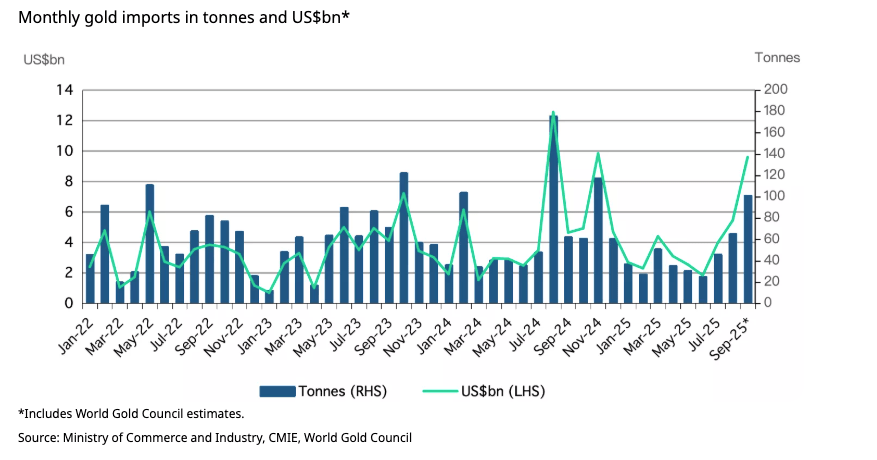
A sharp rise in gold imports reflected strong retail and investor demand. After hitting a nine-month high in August, September imports came in at $19.2 billion, a 77 percent month-on-month increase. The World Gold Council estimates the imports ranged between 100 and 104 tonnes, up from 65 tonnes in August.
According to the World Gold Council, “The surge reflects seasonal buying ahead of the festival season, supported by robust investment demand.”
Indians have a longstanding love affair with gold.
The yellow metal is deeply interwoven into the country’s marriage ceremonies, along with its religious and cultural rituals. Festival seasons typically boost gold demand.
Indians have long valued the yellow metal as a store of wealth, especially in poorer rural regions. Around two-thirds of India’s gold demand comes from beyond the urban centers, where large numbers of people operate outside the tax system. Many Indians use gold jewelry not only as an adornment but as a way to preserve wealth.
In the West, gold is generally viewed as a luxury item.
Not in India. Even poor Indians buy gold.
According to a 2018 ICE360 survey, one in every two households in India had purchased gold within the last five years. Overall, 87 percent of Indian households own some gold. Even households at the lowest income levels in India hold some of the yellow metal. According to the survey, more than 75 percent of families in the bottom 10 percent of income managed to buy some gold.
The yellow metal was a lifeline for Indians buffeted by the economic storm caused by the government’s response to COVID-19. After the Indian government locked down the country, banks tightened credit to mitigate the default risk. Unable to secure traditional loans, Indians used gold to secure financing. As Indians endured a second wave of lockdowns, many Indians resorted to selling gold outright to make ends meet.
Mike Maharrey is a journalist and market analyst for Money Metals with over a decade of experience in precious metals. He holds a BS in accounting from the University of Kentucky and a BA in journalism from the University of South Florida.
(Kyle Anzalone, Libertarian Institute) As President Donald Trump headed to Malaysia on the first leg of his Asia tour, he told the media to “put out the word” that he would like to meet with North Korean Supreme Leader Kim Jong-un.
“They have a lot of nuclear weapons, but not a lot of telephone service,” Trump said on Friday. The President met with Kim three times during his first administration. While the summits led to a significant decrease in tensions on the Korean Peninsula, Trump failed to make a deal with Kim.
Since Trump returned to the White House, top North Korean officials have said that Kim is willing to meet the President again, but Washington must remove its demand that Pyongyang give up its nuclear weapons. Secretary of State Marco Rubio has restated the long-standing policy in Washington that any deal with Pyongyang must include denuclearization.
The Wall Street Journal spoke with current and former US officials who admitted that North Korea was unlikely to give up its nuclear weapons. Trump referred to North Korea as “sort of a nuclear power.” He added, “I know how many weapons they have. I know everything about them. They have a lot of nuclear weapons.”
Two US officials said that the US had not reached out to Kim before the summit, and Trump’s statement was the first invitation to North Korea for a head-of-state meeting.
While North Korea has not committed to meeting with the US, Kim has noted that he has a positive relationship with Trump.
Hossam al-Astal, the leader of one of the groups based in southern Gaza, said that all four groups are part of a coordinated effort to take over Gaza. “We are all for the new Gaza. Soon, we will achieve full control of the Gaza Strip and will gather under one umbrella,” he told Sky News.
The term “new Gaza” has previously been used by Jared Kushner, President Trump’s son-in-law, when discussing plans to allow reconstruction in Israeli-occupied Gaza and not in areas under the control of Hamas.
“No reconstruction funds will be going into areas that Hamas still controls,” Kushner, who has been deeply involved in the Gaza negotiations, said during a visit to Israel last week.
“There are considerations happening now in the area that the IDF controls, as long as that can be secured, to start the construction as a new Gaza in order to give the Palestinians living in Gaza a place to go, a place to get jobs, a place to live.”
The largest group Israel is backing is a gang led by Yasser Abu Shabab, who admitted to looting aid trucks in 2024. Some members of his group, which is also based in southern Gaza, have ties to ISIS, according to Israeli media. The Sky News report said that a senior commander in the Abu Shabab gang said the group has between 500 and 700 fighters and that Israel has been allowing them to smuggle cash, weapons, and vehicles into Gaza.
Al-Astal said that his militia has acquired a large number of Hamas weapons from the black market in Gaza and also receives supplies, including ammunition, from abroad. He said the group also receives a weekly delivery of everyday items to support civilians living in the camp. He claimed that the militias have backing from Western states and Arab countries.
Al-Astal also suggested that the Palestinian Authority has been supporting the effort, though the PA has previously denied that it’s involved with the militias. “The Palestinian Authority cannot allow itself to admit to having a direct relationship with us. I have people within my group who are still, to this day, employees of the Palestinian Authority,” he said.
Two other militias are based in northern Gaza under the protection of the IDF. Israel has previously launched airstrikes against Hamas while they were fighting against one of the Israeli-backed militias.
Al-Astal told Sky News that he was previously in prison over accusations that he was involved in an assassination attempt against a Hamas official and escaped after October 7, 2023. “When the war started, they left us locked up, hoping the Israelis would bomb the prison and rid them of us,” he said. “Two months later, we broke down the doors and escaped.”
(Mike Maharrey, Money Metals News Service) The Bureau of Labor Statistics finally managed to get the September CPI data together. The mainstream broadly characterized it as a good report.
It wasn’t.
But it was better than forecast, and in our world of politicized government data, that was good enough. As CNBC put it, the better-than-expected report “keeps the door wide open for another interest rate cut next week.”
In a sane world, a 3 percent inflation print would put the brakes on monetary easing. However, when you have a giant debt black hole, the economy can’t function in even a modestly high-interest-rate environment. That means the powers that be will spin data however they must to justify rate cuts.
They have a choice between propping up the debt-riddled, bubble economy and inflation.
They picked inflation.
CPI Data By the Numbers
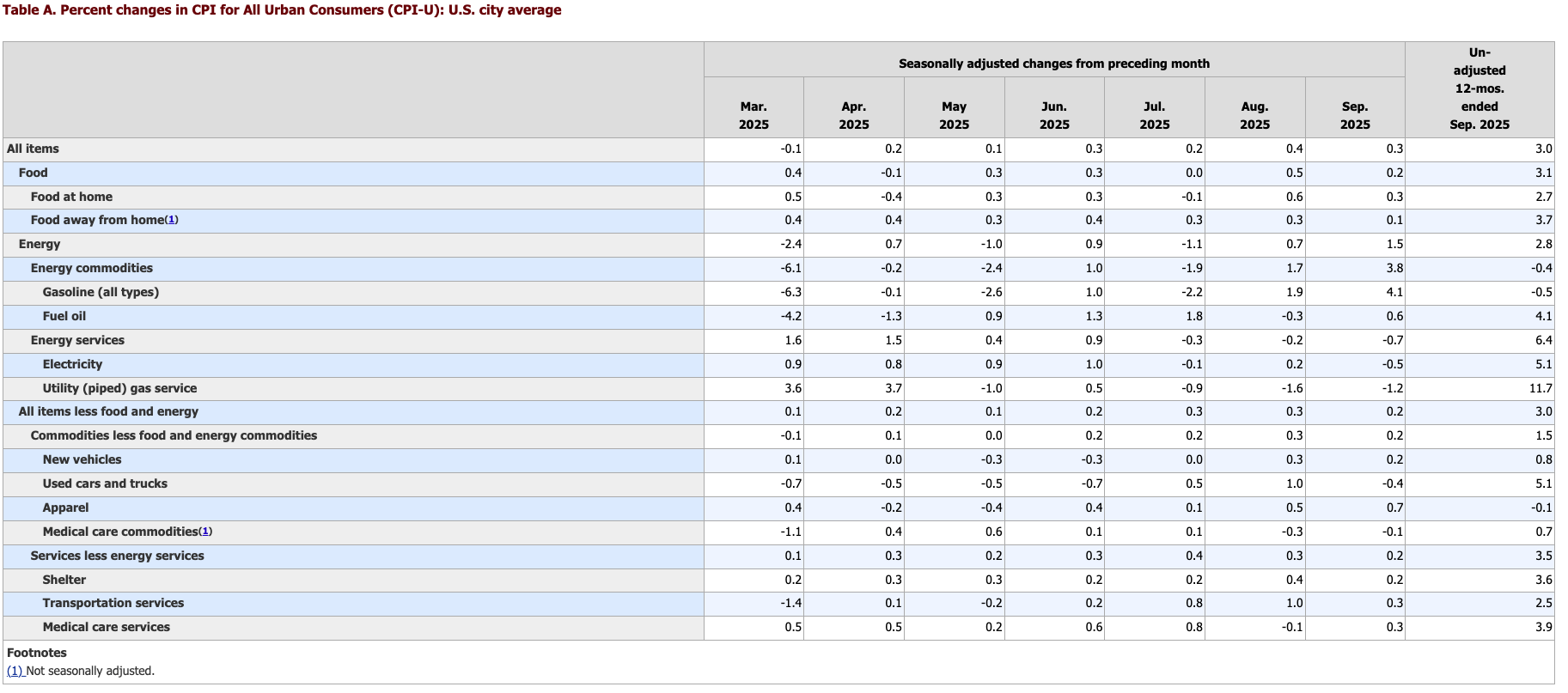
The headline annual CPI came in at 3 percent, according to BLS data. That was up from 2.9 percent in August and 2.7 percent in July. It was the highest print since January, and up from a low of 2.4 percent in March.
However, the forecast was for 3.1 percent. So, yay?
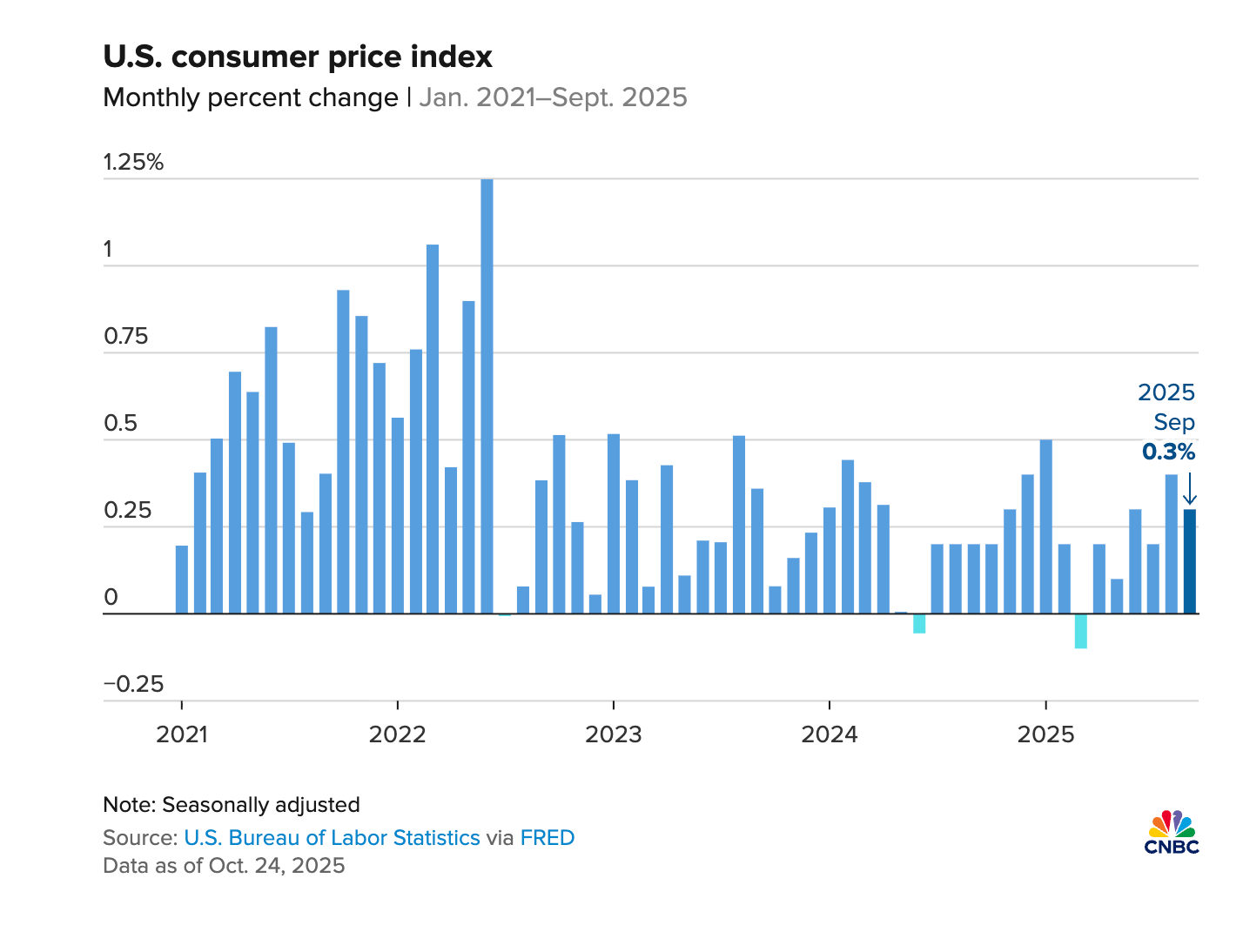
On a monthly basis, prices rose 0.3 percent. That was slightly cooler than the 0.4 percent surge in August, but still annualizes to 3.6 percent. And if you annualize the monthly CPI increases from the last three months, it comes to 3.6 percent.
However, the forecast was for 0.4 percent. So, yay?
Stripping out the more volatile food and energy prices (if only we could do that in real life), core CPI rose 3.0 percent on an annual basis. That was down a tick from 3.1 percent in August. Month-on-month, core CPI was up 0.2 percent, down from 0.3 percent in July.
However, over the last four months, core CPI has increased by 0.2, 0.3, 0.3, and 0.2 percent, annualizing to 3 percent. Core CPI has been mired in this range for months.
When you look at the CPI in graphical form, it’s clear that inflation has been bouncing in the same range since around mid-2022.
But hey, the numbers this month were better than forecast, so yay!
Of course, we should probably note that none of these numbers is anywhere near the Fed’s mythical 2 percent target.
As you parse the data, keep in mind that the CPI doesn’t tell the entire story of inflation.
The government revised the CPI formula in the 1990s so that it understated the actual rise in prices. Based on the formula used in the 1970s, CPI is closer to double the official numbers. So, if the BLS used the old formula, we’d be looking at CPI closer to 6 percent. And using an honest formula, it would probably be worse than that.
However, this is the formula the government uses, and it drives decision-making.
When we look at the data, it’s clear that prices are still rising rapidly in most categories. The price for food at home rose 0.3 percent, pushing the broader food index up 0.2 percent.
Service prices were up another 0.2 percent month-on-month and 3.5 percent annually. This is significant because you can’t blame tariffs for rising service prices.
Zombie Inflation
As I wrote after the August CPI data came out, we have zombie inflation. It just won’t die.
The fact of the matter is that inflation has been increasing for more than a year.
And the Fed is about to crank up the inflation machine even faster.
As I mentioned earlier, with the September CPI data coming in cooler than projected, it’s almost certain that the Fed will cut again during the October meeting. Perhaps more significantly, Federal Reserve Chairman Jerome Powell recently hinted that balance sheet reduction is about to come to an end.
Why would the central bank ease monetary policy when there is clearly significant inflationary pressure in the economy?
There is significant softness in the labor market. Based on the BLS data, the economy only created 22,000 jobs in August. Meanwhile, the BLS has erased nearly 1 million jobs from the data through revisions.
We don’t have any employment data for September, thanks to the government shutdown; however, private payroll growth was sluggish.
The sagging employment picture signals economic contraction.
And what do we call low economic growth and high price inflation?
Stagflation.
This puts the Fed between a rock and a hard place. In fact, it has faced this Catch-22 for months. As already noted, the Fed needs to cut to support the debt-riddled bubble economy. But it also needs higher rates to keep price inflation under control.
Obviously, it can’t do both.
It looks like the central bank chose inflation.
No matter how you choose to parse the CPI data, inflation is already increasing, and another rate cut, coupled with an end to quantitative tightening, will accelerate that trend.
As of the end of June, the money supply had expanded by more than $600 billion since its low point in mid-2023.
As of August, the M2 money supply stood at $22.2 trillion and is above the peak reached during the pandemic.
During the Fed’s inflation fight, the M2 money supply contracted. This is exactly what needs to happen to wring out inflation from the economy. The money supply bottomed a little over a year ago at $20.60 trillion.
That sounds like an impressive inflation fight, until you realize that the money supply would need to fall by at least another $3 trillion to get back to the trend of 2019. Clearly, that’s not the trajectory.
And now the Fed is going to push up the throttle on inflation.
This isn’t a situation you can vote away. All you can do is try to shield yourself from this relentless destruction of your purchasing power.
Mike Maharrey is a journalist and market analyst for Money Metals with over a decade of experience in precious metals. He holds a BS in accounting from the University of Kentucky and a BA in journalism from the University of South Florida.
(Ken Silva, Headline USA) The tech publication WIRED reported Monday that a website run by the House Democrats has exposed sensitive details of over 7,000 people, with roughly 450 of them holding top secret security clearances.
According to Wired, an “ethical security researcher” found cybersecurity flaws on the website DomeWatch, which is run by the House Democrat and whose content includes videostreams of congressional proceedings and other events.
“The researcher found data including applicants’ short written biographies and fields indicating military service, security clearances, and languages spoken, along with details like names, phone numbers, and email addresses. Each individual was also assigned an internal ID,” WIRED reported.
“The data also included information about people’s political affiliations. Among the estimated 7,000 entries, there were around 4,200 people who appeared to have experience working in Congress. In total 6,300 people were marked as having Democratic Party affiliation, while 17 were listed as having Republican Party affiliation, and another 250-plus were listed as independent or other,” the outlet added.
A database containing information on people who applied for jobs with Democrats in the US House of Representatives was left accessible on the open web. https://t.co/v6usSkLQI8
The security researcher reportedly notified House of Representatives’ Office of the Chief Administrator on Sept. 30, and the site was secured within hours.
WIRED said it contacted Office of the Chief Administrator and House Democrats for comment, which said that an investigation has been launched over the matter.
“Today, our office was informed that an outside vendor potentially exposed information stored in an internal site,” Joy Lee, spokesperson for House Democratic whip Katherine Clark, whose office has responsibility for the DomeWatch site, reportedly told WIRED in a statement.
“We immediately alerted the Office of the Chief Administration Officer, and a full investigation has been launched to identify and rectify any security vulnerabilities.”
Ken Silva is the editor of Headline USA. Follow him at x.com/jd_cashless.
(Headline USA) More than two dozen people have been indicted on drug-related charges as part of a yearslong investigation into a gang in Philadelphia, the Federal Bureau of Investigation announced Friday.
Cocaine, fentanyl and heroin were sold in the Kensington area in “one of the most prolific drug blocks in the city” from Jan. 2016 to Oct. 2025, according to the indictment. The charges come as President Donald Trump scales up federal law enforcement operations around the U.S. to crack down on crime.
“We have permanently removed a drug trafficking organization out of the streets of Philadelphia, and they’re going to stop pouring guns and chemicals and drugs into our communities,” said FBI Director Kash Patel at a news conference Friday, touting collaboration between federal and local law enforcement.
The group of 33 people were charged with 41 counts related to drug distribution, and the indictment said they maintained control of the area through violence and threats against rivals.
“This takedown is how you safeguard America from coast to coast,” he added.
The main area where the gang operated was essentially “owned” by Jose Antonio Morales Nieves, 45, known as “Flaco,” the indictment says. Other members paid him “rent” to sell drugs there. More than 20 people were arrested Friday.
Members had assigned shifts and “well-defined” roles such as setting up a schedule at all hours for the block, managing money, looking out for police, resupplying drugs and carrying out violence against rival gangs, the indictment says.
“For too long, the Weymouth Street drug trafficking organization flooded the streets of Kensington with drugs and terrorized residents with horrific acts of violence and intimidation,” Wayne Jacobs, special agent in charge of the Philadelphia FBI, said Friday. “That ended today.”
The Israeli military launched the strike in the Nuseirat Refugee Camp in central Gaza, claiming it targeted a member of Palestinian Islamic Jihad (PIJ) who was planning an attack on the IDF, a claim PIJ strongly denied.
PIJ said in a statement that the claim that its military wing, the al-Quds Brigades, was preparing an attack was “a pure false claim and fabrication through which the occupation seeks to justify its aggression and violation of the ceasefire.” PIJ, which supported the ceasefire deal, called on mediating countries to “compel” Israel to stop its attacks on Gaza.
The strike wounded four Palestinians, according to the al-Awda Hospital. “The hospital has received four injured people following the Israeli occupation’s targeting of a civilian car in the al-Ahli Club area in Nuseirat Camp in central Gaza,” the hospital said.
The Ynet report said the alleged PIJ operative who was targeted was wounded, not killed. According to Israeli sources, the strike came after Israel passed intelligence to the US, and the attack was only launched after coordination with US Central Command (CENTCOM), which included notifying CENTCOM Commander Adm Brad Cooper. CENTCOM has established a military post in southern Gaza where it is overseeing the Gaza ceasefire.
US Middle East envoy Steve Witkoff was also briefed on the strike right after it was launched. The attack marked the first time that Israel and the US used a new mechanism to coordinate on military action in Gaza under the ceasefire deal. Hamas, a signatory to the ceasefire deal, called the Israeli strike a “clear violation” of the agreement.
In response to the report and criticism of the US-Israel relationship, Israeli officials said they were coordinating with the US but insisted Israel doesn’t need “approval” to bomb Gaza.
According to the Palestinian news agency WAFA, Israel also launched a drone strike on Friday that killed two Palestinians, and there’s no sign that Israel coordinated with the US on the attack. Gaza’s Health Ministry said on Sunday that Israeli forces have killed at least 93 Palestinians in Gaza since the ceasefire went into effect, including four who were killed over the previous 48 hours.