Hondurans Sentenced to Combined 24 Years, Deportations

(Alan Wooten, The Center Square) Following prison sentences of a combined 24 years for drug charges, two Hondurans illegally in America will be deported, federal prosecutors in North Carolina say.

Their arrest, sentencing and eventual deportation is the example of an executive order from the president executed to protect Americans’ public safety from drug trafficking and illegal immigration.

According to a June 2024 publishing in the International Journal of Drug Policy, the estimated annual costs for opioid use disorder on North Carolina taxpayers – using 2022 numbers most recently available at the time – were $749 million split 53% to healthcare, 36% to criminal justice, 7% to lost tax revenue and 4% to child welfare. A next-step estimate of lost economic productivity, business expenses and statistical loss of life pushes the annual cost to $117 billion.

Olver Anacleto Amador-Calderon, 24, and Alexander Josue Viatoro-Arita, 22, were sentenced to 14 and 10 years, respectively, for trafficking fentanyl. Each pleaded guilty for conspiracy and possession charges.

“These defendants entered our country illegally and fueled the distribution of deadly fentanyl while armed with stolen firearms,” said Russ Ferguson, leading prosecutor for the U.S. Attorney’s Office in the Western District of North Carolina. “They will serve time in an American prison before they are deported, and we will continue our fight to completely eliminate fentanyl from our community.”

The Homeland Security Task Force led the investigation. That’s the product of an executive order from second-term Republican President Donald Trump in 2025 that established what is considered a whole of government interagency, led jointly by Homeland Security Investigations and the FBI. It brings with them state and local law enforcement with a goal to dismantle transnational criminal organizations, drug cartels and human trafficking networks.

Amador-Calderon was in possession of a .380 caliber Titan pistol, and Viatoro-Arita a stolen 9mm Taurus pistol with part of the serial number obliterated, prosecutors say. Viatoro-Arita’s sale of 24.99 grams of fentanyl to an individual cooperating with lawmen led to the defendants’ hotel room and search turning up 330 grams of fentanyl, approximately $33,000 in cash and two ledgers documenting drug sales.

In December 2024 and January 2025, the ledgers showed $159,400 in transactions for 11.665 kilograms of fentanyl and just under 3.3 kilograms of methamphetamine, prosecutors say.

According to the National Institute on Drug Abuse, fentanyl is 50 times more potent than heroin and 100 times more potent than morphine.

What an Awful Jobs Report! And Don’t Skip Over the Revisions

(Mike Maharrey, Money Metals News Service) What an awful jobs report.

And I’m not even talking about the contraction of -23,000 jobs in July.

I’m talking about the revisions.

The Bureau of Labor Statistics estimates that the economy shed 23,000 jobs last month.

Economists were expecting 83,000 new jobs in July.

Oops.

Interestingly, despite job losses, the unemployment rate clicked down to 4.1 percent. That’s because the labor force participation rate fell to 61.4 percent, the lowest level since the pandemic.

But in my opinion, the big story is the revisions.

They were so extreme, even the mainstream media reported on them. Typically, we never hear about the revisions (and they happen constantly).

Remember how we got those “strong” job reports in May and June?

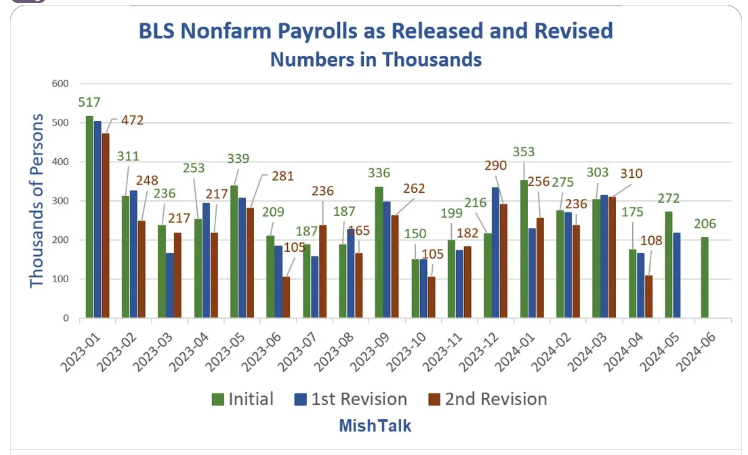
Well, May’s job numbers were revised down by 66,000, from +129,000 to +63,000. The June job data was revised down by 37,000, from +57,000 to +20,000.

When you add it all up, the total number of jobs “created” in May and June was 103,000 lower than initially reported.

Downward Revisions Are Par for the Course

These downward revisions should come as no surprise. It happens with virtually every BLS report.

In January, the bureau made its end-of-the-year adjustment to the “birth-death model” it uses to determine job growth. That erased nearly half a million jobs from the economy. To be precise, the BLS wiped out 403,000 jobs with its model revision (At the same time, it revised December’s report down from 50,000 to 48,000 jobs).

With that revision, the U.S. economy only generated an average of 15,000 jobs per month in 2025. You probably don’t have that impression if you just saw the headlines as the BLS announced its employment data each month.

If it sounds like the agency is just making stuff up, well…

In fact, downward revisions appear to be standard operating procedure for the BLS. The agency erased nearly 1 million (911,000) jobs that it initially claimed were created between March 2024 and June 2025.

In 2023, job numbers were revised down in 10 of the 12 months.

To be fair, compiling employment data is no simple task. Revisions should be expected. But why do the updates almost always remove jobs from the economy? One would think you’d see upward revisions nearly as often as downward, right?

Nope.

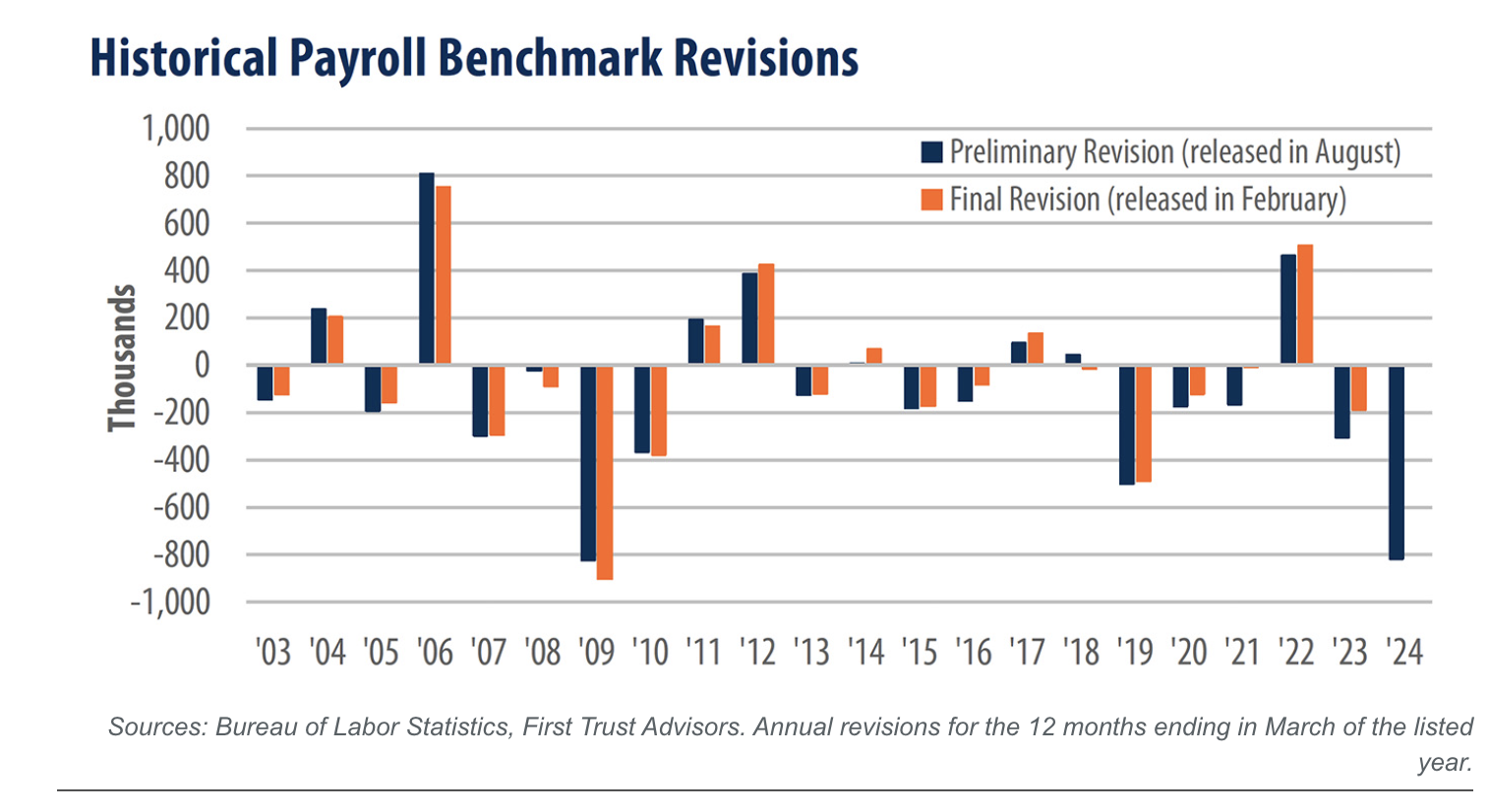
Between 2003 and 2024, the final annual BLS numbers were lower than the initial report 14 times compared to seven upward revisions.

It’s notable that markets typically only react to the initial numbers. You almost never see markets tank because the BLS erased a bunch of jobs from the economy with a few clicks of its calculator. The revisions happen quietly in the back alleys. Nobody pays any attention to them. That creates the illusion that the labor market is much stronger than it is.

It goes something like this:

This month, the government reports good news. Everybody celebrates. Markets move. The following month, the government quietly revises everything downward and reports that the good news was really bad news.

And nobody pays attention.

This month is a notable exception to that rule. We’re seeing the revisions emphasized. I guess you can’t hide under the cover of darkness forever.

This wouldn’t matter nearly as much if central bankers and government officials didn’t lean on this data to make decisions. But they do. And if the data is this unreliable, what does that tell you about the decisions based on this data?

Let’s be honest – when you look at the history, one’s got to wonder why anybody takes these numbers at face value.


Mike Maharrey is a journalist and market analyst for Money Metals with over a decade of experience in precious metals. He holds a BS in accounting from the University of Kentucky and a BA in journalism from the University of South Florida.

No! We’re Not Going to Get Rich Mining Asteroid Gold

(Mike Maharrey, Money Metals News Service) There is an unimaginable fortune floating between 150 and 400 million miles from Earth.

It’s an asteroid named Psyche.

Some people think we can solve global poverty by mining this space gold and other precious metals.

We can’t.

Scientists believe this 144-mile-long floating space rock contains large amounts of metal, including gold and platinum. They estimate the asteroid could contain $10 quintillion worth of precious metals.

I don’t even know what the number means. To put it into perspective, it would be enough money to pay every person on Earth $1.22 billion.

That would certainly put a dent in global poverty, eh? As a bonus, we wouldn’t have to hate billionaires anymore. We’d all be one!

Of course, the amount of gold on Psyche is purely speculation.

According to NASA, “The best analysis indicates that Psyche is likely made of a mixture of rock and metal, with metal composing 30 percent to 60 percent of its volume. The asteroid’s composition has been determined by radar observations and by the measurements of the asteroid’s thermal inertia (how quickly an object gains or re-radiates heat).”

Even without knowing Psyche’s exact composition, it’s fun to speculate about how much gold might be there.

Scientists estimate Psyche’s mass is roughly 2.3 × 10¹⁹ kg. Let’s say gold constitutes just 10 parts per million (purely speculative); that would amount to about 230 billion metric tonnes of gold. That’s roughly a million times more than all the gold mined in human history.

A Fool’s Errand

Every so often, people talk about mining Psyche and similar asteroids. It sounds like a great plan. I mean, if there’s that much gold and other precious metals in the asteroid, it certainly seems like something worth looking into, right?

Or maybe not.

From a practical standpoint, we’re capable of reaching the asteroid. In fact, NASA launched a mission to Psyche in 2023. The unmanned craft is expected to reach Psyche in 2029.

We also have the ability to dig for gold in space.

However, from an economic standpoint, trying to pull gold out of a space rock is a fool’s errand.

That hasn’t stopped people from trying.

In 2010, Planetary Resources and Deep Space Industries combined forces to mine asteroids. They secured some high-profile financing from the likes of Google’s Larry Page and Eric Schmidt.

It wasn’t enough.

Within a decade, the companies had been absorbed by other organizations that had nothing to do with asteroid mining.

As Lachlan Brown, writing for Space Daily, put it, it wasn’t that the precious metals weren’t there.

“[The lesson] was that the timelines are long, the capital required is vast, and investors ran out of patience long before anyone reached an asteroid.”

That isn’t stopping TransAstra Corporation from pursuing intergalactic mining. However, CEO Joel Sercel told CNBC the mining of precious metals on asteroids simply isn’t economically viable.

“If we had to develop a full-scale asteroid mining vehicle today, we would need a few hundred million dollars to do that using commercial processes. It would be difficult to convince the investment community that that’s the right thing to do. In today’s economics and in the economics of the near future, the next few years, it makes no sense to go after precious metals in asteroids. And the reason is the cost of getting to and from the asteroids is so high that it vastly outstrips the value of anything that you’d harness from the asteroids.”

The company will focus on mining water from asteroids to make rocket propellant in space. This would allow rockets to refuel en route and allow rockets to launch from Earth carrying much less heavy fuel.

Of course, technology is advancing daily. Gold mining in space isn’t out of the question in the future.

So, can we count on a future with an unlimited supply of gold and riches for all?

Even if we could, I’ve got bad news.

All of that gold wouldn’t be worth much.

One of the things that makes gold valuable is its scarcity. If somebody drug thousand of tonnes of gold back to Earth, it would be worth about as much as a bag of mulch – if that.

Brown explained why reading basing a business plan on “$10 quintillion” in gold on a space rock is a fool’s errand.

“The first is that the number assumes you could deliver all that metal to Earth at no cost, when the delivery is the entire problem. The second is more fundamental: if you actually did land that much platinum or gold, you would flood the market and collapse the price of the thing you came to sell. The markets for precious metals are small by weight, and they do not have room to absorb asteroid-scale quantities without the value evaporating.”

So, the next time somebody tells you we’re going to eliminate poverty one day by giving everybody on Earth a bunch of space gold, you can explain to them why they’re living in a fantasy world.

As Brown summed it up, “The case for asteroid mining is real, but almost nothing like the version that gets sold.


Mike Maharrey is a journalist and market analyst for Money Metals with over a decade of experience in precious metals. He holds a BS in accounting from the University of Kentucky and a BA in journalism from the University of South Florida.

Surging Asian Gold Demand Could Signal a “Structural Wealth Shift”

(Mike Maharrey, Money Metals News Service) Asian banks have beefed up their gold product and service offerings in recent months. According to The Banker, this represents “a structural wealth shift in wealth allocation.”

New products and innovations introduced in the Asian gold market run the gamut from investing platforms that offer fractionalized gold investment, to new ETF offerings, to expanded vaulting capacity.

For instance, DBS in Singapore now offers fractionalized gold trading on a retail app. On this platform, investors can purchase tokens backed by as little as 1 gram of gold.

Meanwhile, HSBC recently announced plans to increase its gold storage capacity in Hong Kong to 200 tonnes. According to official sources, HSBC isn’t alone. Officials say they plan to increase gold storage capacity in the Chinese special administrative region by around 2,000 tonnes over the next three years.

There has also been a major surge in the number of gold-backed ETFs offered in Asia. The region saw the highest ETF gold inflows of any region through the first half of the year, with Asian-based ETFs accumulating over 74 tonnes of gold. With a value of $12 billion, Asian ETF gold inflows set an H1 record.

Perhaps the most significant development in the Asian gold market was the launch of a new Hong Kong-based gold clearing and settlement system that could begin to move the center of gold trade from London and the West to China and the East.

Standard Chartered global head of sales and structuring called this “a fundamental structural shift in wealth allocation,” evidenced by rising demand for gold from central banks, institutional investors, and retail consumers.

While the recent run-up in the gold price has contributed to these developments in the Asian gold market, KPMG China head of banking and capital markets in Hong Kong, Jia Ning Song, told The Banker that this buildout isn’t just a response to a temporary bull market.

“Nobody constructs vaulting capacity, clearing memberships and tokenization platforms — multiyear, capital-intensive commitments — to monetize a 12-month rally. The investments now being made in Hong Kong’s gold ecosystem are geared towards conviction in multi-decade demand.”

Song said nearshoring investments appeal to Asian investors. Setting up local clearing venues allows banks to quote and settle gold during Asian trading hours rather than routing transactions through London and dealing with significant time zone differences.

“As credit risks become more topical, gold’s minimal counterparty risk is proving especially attractive. We anticipate the trend of nearshoring gold holdings into Asia will intensify.”

Song called gold “a fiat hedge” as weakening faith in paper currencies, particularly the dollar, has driven Asian portfolio diversification. He specifically noted the growing levels of global debt, which reached a record of $353 trillion in Q1.

World Gold Council head of Asia-Pacific Shaokai Fan said Asia has the potential to become “a global gold hub.” He said he expects growing demand for vaulting, clearing and settlement in Singapore, Hong Kong, and Shanghai.

Asia already accounts for about 60 percent of global consumer gold demand. In fact, Western investors largely sat out the bull run last year, only jumping on the bandwagon last fall. When Western investors begin to understand the dynamics driving Asian investors, they may well join the party.

We’re already seeing signs that Western investors are starting to follow Asia’s lead. Last year, Morgan Stanley CIO Michael Wilson suggested a switch to a 60/20/20 strategy, swapping half of the bond portfolio for gold to serve as a “more resilient” inflation hedge.

Given that most Western investors have little to no exposure to gold, even a modest increase in gold allocation could send prices soaring higher.


Mike Maharrey is a journalist and market analyst for Money Metals with over a decade of experience in precious metals. He holds a BS in accounting from the University of Kentucky and a BA in journalism from the University of South Florida.

U.S. Sheds 23,000 Jobs in ‘Bleak’ July Report

(Andrew Rice, The Center Square) The U.S. economy lost 23,000 jobs in July, while the unemployment rate dropped to 4.1%, according to a new report from the U.S. Bureau of Labor Statistics on Friday. 

Over the last 12 months, employment gains increased by 34,000. July’s figure keeps at pace with fluctuations over the yearlong period. 

Employment in local government education declined by 50,000 in July, a key driver of July’s numbers. 

The retail trade industry lost 19,000 jobs in July. Financial activities employment also decreased by 14,000 in July, reflecting a downward trend since the its most recent peak of 121,000 jobs in May 2025. 

The healthcare industry only added jobs at a moderate rate in July, contributing toward the overall decline in the economy. The healthcare sector only added 22,000 jobs, less than the average monthly gain of 36,000 over the last year. 

Heather Long, chief economist at Navy Federal, said the report was “surprisingly bad” and fell below economists expectations of an 80,000 job increase. 

“This is a bleak July jobs report,” Long said. 

While the unemployment rate went down slightly, Long said it was due to more than 260,000 people leaving the labor force. 

Wage growth also fell to 3.2%, the lowest rate in five years. Long said this growth is “wiped out” by high inflation. The inflation rate for June was 3.5%, down 0.7% from the previous month; the July figure is due for release on Wednesday from the U.S. Labor Department.

The labor force participation rate was 61.4%, the lowest since February 2021. 

“The Fed’s job just got a lot harder,” Long said. “The labor market is stalling again. Many industries shedding jobs or flat.” 

Chris Zaccarelli, chief investment officer at Northlight Asset Management, said the release of inflation data next week will be key to determine how the Federal Reserve will move forward. 

“If the data continues to come in higher than expected, it could raise the probability of a rate hike at the Fed’s next meeting – but today’s jobs numbers should be enough to keep the Fed on hold for at least another meeting, which all things being equal is a positive for the stock market,” Zaccarelli said. 

The central bank’s benchmark interest rates, unchanged since a 0.25% reduction in December, last week were kept in the target range of 3.5% to 3.75%. Three committee members dissented, a signal that change could be in the offing to address inflation.

Arson Suspect Confessed to Setting Dozens of Spokane Wildfires, Records Show

(Andrew Paxton, The Center Square) A 37-year-old Spokane man is facing formal arson charges after allegedly confessing to starting dozens of wildfires across Spokane County over a year-long period, culminating in a massive 3,200-acre blaze that has destroyed hundreds of structures so far.

According to court records filed Wednesday in Spokane County Superior Court, Aaron Farinacci was arrested and charged following an investigation into the fast-moving Old Trails fire.

Detectives with the Spokane County Sheriff’s Office stated in an affidavit of facts that probable cause exists to hold Farinacci responsible for the catastrophic wildfire, as well as a series of serial arson incidents dating back to July 2025.

By Aug. 2, the Old Trails fire had swept through roughly 3,200 acres near Old Trails Road and Euclid Road, destroying more than 400 structures and remaining at zero percent containment.

As of Thursday, the fire, along with two others in the area, has destroyed more than 900 structures and burned more than 10,000 acres combined, authorities said.

Investigative documents reveal that Farinacci’s alleged actions were deliberate and heavily calculated. Authorities say Farinacci monitored weather conditions through a wildfire tracking app and intentionally selecting days with severe weather warnings, court documents show.

On Aug. 1, knowing that Spokane County was under a Red Flag Warning and a Particularly Dangerous Situation advisory, he anticipated wind gusts up to 50 miles per hour before setting out to ignite the brush near active railroad tracks, according to authorities.

Investigators noted that Farinacci brought time-delay ignition components with him and timed the fire to maximize spread, remarking to detectives that conditions were ideal to start the blaze and “let the fire take its course.”

The location was chosen to maximize damage, according to the report.

“He decided to light the fire at this location because he knew it ‘was gonna get bad.’ By ‘bad’ he meant it would be a large fire, but claimed he did not intend for it to get as large as it did,” according to the report.

During police interviews, Farinacci reportedly admitted that his serial arson spree began on July 4, 2025. Over the following five weeks alone, he claimed responsibility for setting approximately 25 separate fires using lighters, primarily targeting brush areas near his residence at the Copper River Apartments, along the Spokane River, and throughout the Centennial Trail, documents show.

Among those incidents was the July 6, 2025, Aubrey White fire near mile marker 30 of the Centennial Trail. Court documents state that after igniting the fire, Farinacci sat on a nearby boulder, injured, expecting authorities to track the trail of flames directly to him. He was briefly contacted by law enforcement at the scene but not arrested at the time.

Farinacci also confessed to starting the Fort George fire on Aug. 11, 2025, in the Equestrian area of Riverside State Park. That 15-acre fire triggered evacuations for local RV parks and horse arenas.

Law enforcement personnel had stopped Farinacci on a park bench shortly after the incident, taking photos of his Arizona identification card and a package of Bic lighters, documents show.

Throughout the investigation, law enforcement described Farinacci as detail-oriented and highly knowledgeable about fire behavior, local wind patterns and emergency response procedures.

He admitted to planning a secondary strategy to provoke a fatal police encounter if cornered, but ultimately decided to feign innocence during his initial contacts with deputies. Farinacci later accompanied detectives to physically point out multiple ignition points from his previous arsons.

Farinacci was also previously convicted of manslaughter in Arizona.

He was initially being held on a $1 million bond, which was increased to $2 million following additional charges for two other fires he confessed to starting last year.

He remains in custody as formal court proceedings move forward in Spokane County Superior Court.

Trump Signs Executive Orders Targeting Birth Tourism, Birthright Citizenship

(Sarah Roderick-Fitch, The Center Square)  Following the U.S. Supreme Court ruling that overturned President Donald Trump’s executive order banning birthright citizenship, the president is taking another stab at curbing the practice through a pair of executive orders.

Trump signed the latest executive orders Thursday afternoon, targeting birth tourism, diplomats, and enemies of the U.S. from taking advantage of the Constitution’s 14th Amendment.

The president has been critical of birthright citizenship and birth tourism, arguing that the amendment was meant to ensure children born of enslaved people were entitled to citizenship, not bad actors who enter the U.S. illegally or purposefully to have a child here.

“They promise citizenship; access to public benefits; and short-term stays in specialized facilities, hotels, or rentals, but often fail to deliver on these promises. These operators coach their clients to misrepresent the purpose and duration of their travel to consular and border officials to obtain visas authorizing entry into the United States,” according to the order.

The order describes the practice as “schemes,” which has produced “thriving industries around the world that profit by enabling the evasion of American immigration law to obtain citizenship and other immigration benefits.”

The latest order targets babies born to “either parent of that person [who] is an alien enemy,” born to a parent employed by a foreign government (including ambassadors, embassy or consulate employees and people employed by an international organization “that possess international-organization immunity”), and parents “engaged in a commercial transaction to purchase or access birthright citizenship for the person, or engaged in fraudulent activity to obtain citizenship.” The order also extends to babies born in a territory or territorial waters “where citizenship is not conferred by federal statute.”

The second order gives presidential authorities to the secretary of State and the secretary of Homeland Security to combat birth tourism.

Trump described June’s SCOTUS ruling, Trump v. Barbara, as “a very unfortunate decision,” adding that his administration is “making adjustments” to curb the practice.

DOJ Says There’s No Sex Trafficking Investigation into Byron Donalds

(José Niño, Headline USA) Florida Republican gubernatorial candidate James Fishback used a Tallahassee press conference Thursday to accuse his primary rival, Rep. Byron Donalds, R-Fla., of sitting under a federal sex trafficking investigation. Federal law enforcement contradicted the claim within hours. Fishback took no questions from reporters and delivered the charge less than two weeks before Florida’s August 18 Republican primary.

Fishback said an anonymous government whistleblower brought his campaign “a disturbing pattern of evidence” showing that an existing Justice Department inquiry into Rep. Cory Mills, R-Fla., had widened to include Donalds. In a companion post on X, Fishback wrote that prosecutors are examining May 17, 2024, and November 19, 2024, dates when the two men allegedly traveled to the MGM National Harbor resort in Oxon Hill, Maryland. Prosecutors believe both men “solicited, procured, and paid women for sexual acts,” he said. 

Fishback told reporters his lawyers worked for weeks to “independently verify this investigation, and we have done just that.” Per a report by News 6, displayed a letter dated July 20, 2026, referencing the Mills inquiry one day before NBC News reported it, arguing the timing proved his source held inside knowledge. 

He also showed screenshots of texts he attributed to Mills reading “I went to MGM with Byron” and “Me and Byron.” Fishback said the department declined to comment when his attorneys asked about Donalds, contrasting that silence with a letter clearing fellow Florida Rep. Anna Paulina Luna.

A Justice Department official told the Washington Examiner no investigation into Donalds exists and the Mills inquiry is financial, not sexual. That tracks NBC News reporting tying the Mills probe to his finances and overseas business dealings. Donalds spokesman Gates McGavick called the claims “completely false,” telling Florida Politics, “We will not be distracted by this baseless and defamatory sideshow, and neither should you.” Mills denies knowing of any investigation.

Fishback acknowledged the standard he was working against, telling the room, “Our Constitution entitles Congressman Donalds to the presumption of innocence, and while he deserves that presumption, voters deserve transparency.” He insisted the event was “not political,” pledging no ads or mailers, then resumed posting about it on X within hours. 

Headline USA reached out to Byron Donald’s campaign for comment, with McGavick stressing that Fishback’s allegations are “completely false and the Department of Justice will tell you the same thing. We will not be distracted by this baseless and defamatory sideshow, and neither should you.” 

Similarly, a federal law enforcement officials informed Headline USA that Fishback’s allegations are  ”absolutely false” and that “there is no investigation into Byron Donalds.” 

José Niño is the deputy editor of Headline USA. Follow him at x.com/JoseAlNino  

Candace Owens Files Motion to Dismiss Lawsuit from Charlie Kirk’s Ex-Bodyguard

(Ken Silva, Headline USA) YouTuber Candace Owens has filed a motion to dismiss the lawsuit conservative activist Charlie Kirk’s former bodyguard, Brian Harpole, filed against her for implicating him in Kirk’s assassination.

Harpole sued Owens in April after she aired allegations from a man named Mitch Snow that he saw Harpole, Kirk’s widow Erika Kirk, and Army intelligence officers at Fort Huachuca in Arizona before Charlie’s assassination. Snow’s supposed sighting has fueled conspiracy theories that the group was plotting Charlie’s death. Snow is also a party to the lawsuit.

Owens’s motion to dismiss, filed Thursday, says that Harpole’s lawsuit should be tossed because her statements about him were “inactionable opinions, rhetorical hyperbole, and questions incapable of a defamatory meaning.” She also argues that Harpole hasn’t proven “actual malice,” nor has he plausibly alleged that he was damaged by her.

“The most obvious explanation for Plaintiff’s reputational harm is that the person Plaintiff was hired to protect was assassinated on his watch,” her motion says.

Owens’s motion only seeks to dismiss the claims against her. Snow, who was served in the lawsuit on July 23, has yet to respond.

Kirk was shot while addressing a crowd at the University of Utah on Sept. 10, 2025. The suspect, Tyler Robinson, has been charged in connection with the killing.

Harpole has previously blamed local police for failing to protect campus rooftops, allowing a gunman to fatally shoot his client.

Owens, for her part, has postured that she wants the lawsuit to reach the discovery phase—bragging on April 30 that the case now gives her subpoena power. For Owens to get her wish, the motion she filed Thursday would have to be unsuccessful.

Ken Silva is the editor of Headline USA. Follow him at x.com/jd_cashless.

Dem Lawmakers’ Catfight Erupts over DSA’s Primary Surge

(Luis CornelioHeadline USA) Two Democratic lawmakers engaged in a snarky back-and-forth on X over what is driving the electoral surge of socialists within the Democratic Party.

Reps. Ro Khanna, D-Calif., and Dan Goldman, D-N.Y., clashed over whether recent primary defeats of establishment Democrats were fueled by voters’ economic frustrations or by other issues.

Goldman, who lost his primary to democratic socialist-aligned Brad Lander, pushed back on Khanna’s claim that the socialist surge reflects growing anger over the economy.

“This is wrong,” Goldman wrote Aug. 3 on X in response to Khanna’s remarks. He noted that he and two other defeated Democrats “had very progressive records,” including support for Medicare for All.

Goldman was responding to Khanna’s appearance on Fox News, where the California congressman argued that “people are upset at an unfair political and economic system.”

Khanna fired back on X: “Dan, losing is hard.”

He added, “My point is why not reflect on the lesson voters were sending upset about AIPAC, about money going to foreign wars, about food and gas prices up because of Middle East conflicts.”

Khanna wrote that Goldman had “a long career ahead” of himself and suggested that “maybe the loss will make you a voice calling for an end to the occupation or a Palestinian state.”

Goldman, who is Jewish and a self-described “proud Zionist,” faced fiery backlash from the anti-Israel left in his district.

His opponent exploited Goldman’s support for Israel to mobilize voters in the June 23 primary. Goldman lost the race by nearly 30 percentage points.

In response, Goldman doubled down on his theory that his defeat was not a referendum on the economy.

“I know why I lost. And it’s not because of the economic concerns of working families…” he wrote.

“The voters in my district prioritized a different issue, and I respect their decision,” Goldman added. “But let’s not pretend that the outcome of my race — or Adriano’s or NY-7 — was because of economic concerns of working families struggling mightily to make ends meet.”

Goldman was referring to Rep. Adriano Espaillat, D-N.Y., who also lost his primary to DSA candidate Darializa Chevalier.

Establishment-backed Democrat Antonio Reynoso was also defeated in the primary for retiring Rep. Nydia Velázquez’s seat by DSA candidate Claire Valdez.