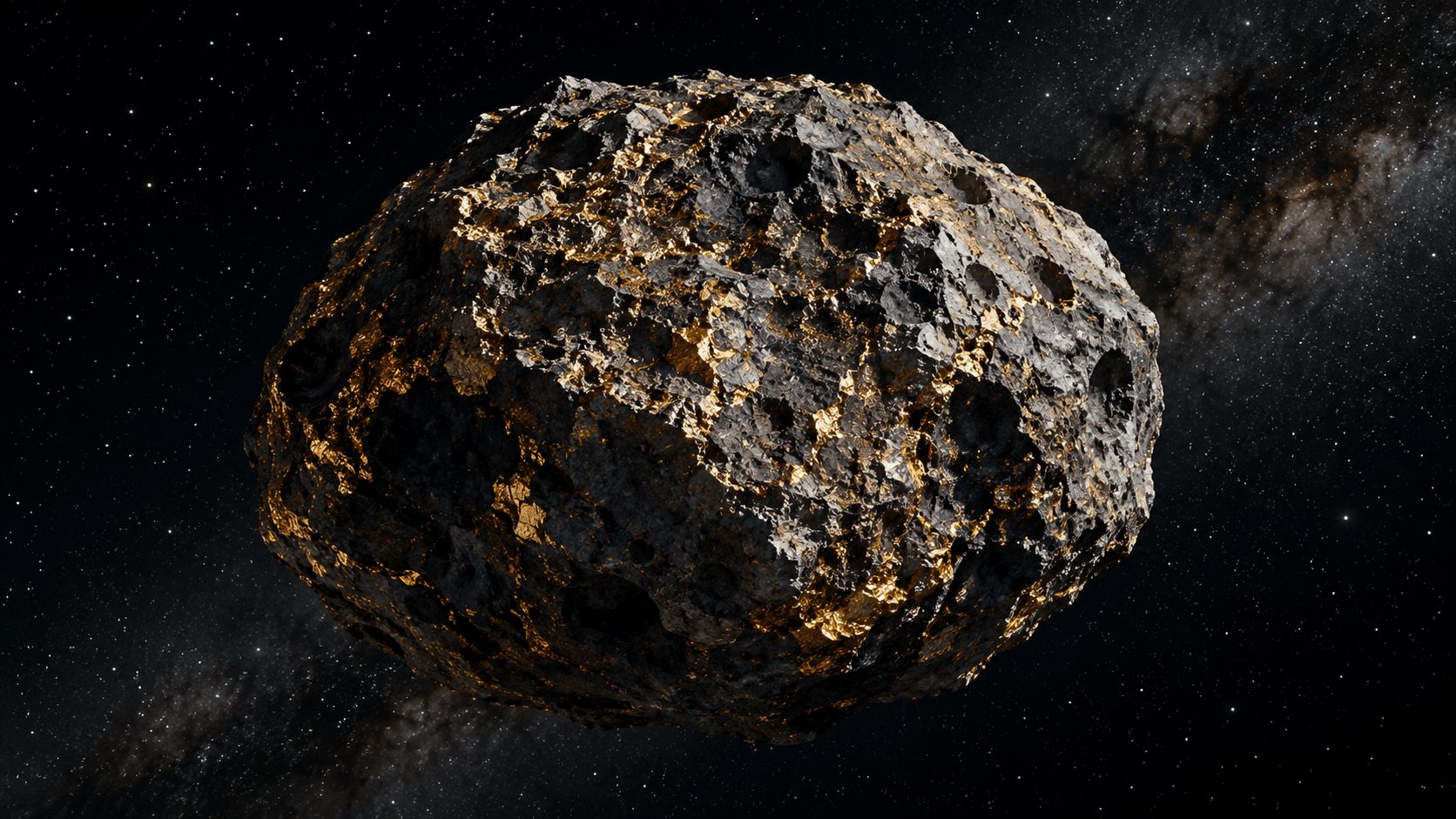
(Mike Maharrey, Money Metals News Service) There is an unimaginable fortune floating between 150 and 400 million miles from Earth.
It’s an asteroid named Psyche.
Some people think we can solve global poverty by mining this space gold and other precious metals.
We can’t.
Scientists believe this 144-mile-long floating space rock contains large amounts of metal, including gold and platinum. They estimate the asteroid could contain $10 quintillion worth of precious metals.
I don’t even know what the number means. To put it into perspective, it would be enough money to pay every person on Earth $1.22 billion.
That would certainly put a dent in global poverty, eh? As a bonus, we wouldn’t have to hate billionaires anymore. We’d all be one!
Of course, the amount of gold on Psyche is purely speculation.
According to NASA, “The best analysis indicates that Psyche is likely made of a mixture of rock and metal, with metal composing 30 percent to 60 percent of its volume. The asteroid’s composition has been determined by radar observations and by the measurements of the asteroid’s thermal inertia (how quickly an object gains or re-radiates heat).”
Even without knowing Psyche’s exact composition, it’s fun to speculate about how much gold might be there.
Scientists estimate Psyche’s mass is roughly 2.3 × 10¹⁹ kg. Let’s say gold constitutes just 10 parts per million (purely speculative); that would amount to about 230 billion metric tonnes of gold. That’s roughly a million times more than all the gold mined in human history.
A Fool’s Errand
Every so often, people talk about mining Psyche and similar asteroids. It sounds like a great plan. I mean, if there’s that much gold and other precious metals in the asteroid, it certainly seems like something worth looking into, right?
Or maybe not.
From a practical standpoint, we’re capable of reaching the asteroid. In fact, NASA launched a mission to Psyche in 2023. The unmanned craft is expected to reach Psyche in 2029.
We also have the ability to dig for gold in space.
However, from an economic standpoint, trying to pull gold out of a space rock is a fool’s errand.
That hasn’t stopped people from trying.
In 2010, Planetary Resources and Deep Space Industries combined forces to mine asteroids. They secured some high-profile financing from the likes of Google’s Larry Page and Eric Schmidt.
It wasn’t enough.
Within a decade, the companies had been absorbed by other organizations that had nothing to do with asteroid mining.
As Lachlan Brown, writing for Space Daily, put it, it wasn’t that the precious metals weren’t there.
“[The lesson] was that the timelines are long, the capital required is vast, and investors ran out of patience long before anyone reached an asteroid.”
That isn’t stopping TransAstra Corporation from pursuing intergalactic mining. However, CEO Joel Sercel told CNBC the mining of precious metals on asteroids simply isn’t economically viable.
“If we had to develop a full-scale asteroid mining vehicle today, we would need a few hundred million dollars to do that using commercial processes. It would be difficult to convince the investment community that that’s the right thing to do. In today’s economics and in the economics of the near future, the next few years, it makes no sense to go after precious metals in asteroids. And the reason is the cost of getting to and from the asteroids is so high that it vastly outstrips the value of anything that you’d harness from the asteroids.”
The company will focus on mining water from asteroids to make rocket propellant in space. This would allow rockets to refuel en route and allow rockets to launch from Earth carrying much less heavy fuel.
Of course, technology is advancing daily. Gold mining in space isn’t out of the question in the future.
So, can we count on a future with an unlimited supply of gold and riches for all?
Even if we could, I’ve got bad news.
All of that gold wouldn’t be worth much.
One of the things that makes gold valuable is its scarcity. If somebody drug thousand of tonnes of gold back to Earth, it would be worth about as much as a bag of mulch – if that.
Brown explained why reading basing a business plan on “$10 quintillion” in gold on a space rock is a fool’s errand.
“The first is that the number assumes you could deliver all that metal to Earth at no cost, when the delivery is the entire problem. The second is more fundamental: if you actually did land that much platinum or gold, you would flood the market and collapse the price of the thing you came to sell. The markets for precious metals are small by weight, and they do not have room to absorb asteroid-scale quantities without the value evaporating.”
So, the next time somebody tells you we’re going to eliminate poverty one day by giving everybody on Earth a bunch of space gold, you can explain to them why they’re living in a fantasy world.
As Brown summed it up, “The case for asteroid mining is real, but almost nothing like the version that gets sold.”
Mike Maharrey is a journalist and market analyst for Money Metals with over a decade of experience in precious metals. He holds a BS in accounting from the University of Kentucky and a BA in journalism from the University of South Florida.