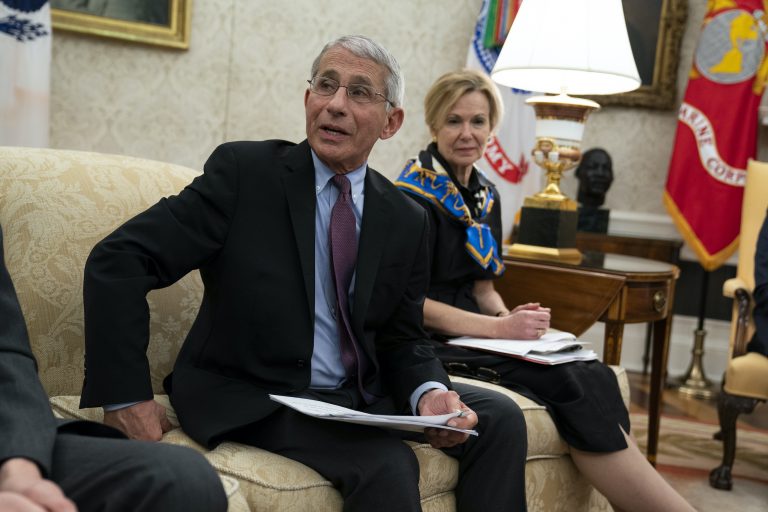
(Luis Cornelio, Headline USA) Embattled Dr. Anthony Fauci and his wife, Dr. Christine Grady, appeared upset just hours after the former COVID czar was referred to the DOJ for criminal investigation, with Grady giving the middle finger to a reporter outside their home Thursday.
Grady, a former top official at the National Institutes of Health Clinical Center, reportedly flipped off a photojournalist with the New York Post outside the couple’s Washington, D.C., home. Meanwhile, Fauci was spotted looking “downright miserable” while moving trash can at the couple’s $2.4 million home, according to the newspaper.
Grady gave the middle finger as the couple boarded a red vehicle, shortly after the Senate Committee on Homeland Security and Governmental Affairs voted to refer her husband to the DOJ for criminal prosecution over his refusal to answer questions during a contentious July 29 hearing.
Brady served as the head of the NIH’s Department of Bioethics until the Trump administration shook up leadership as the agency in 2025.
Fauci invoked his Fifth Amendment right against self-incrimination more than 100 times while facing a series of questions about his damning government notes, which revealed several of his private thoughts about the COVID-19 pandemic.
Among the revelations in the so-called diary was that Fauci privately viewed the COVID-19 lab-leak theory as plausible while publicly dismissing it as fringe.
The notes also detailed Fauci’s aggressive pursuit of media opportunities and professional recognition, including a $900,000 award for himself.
Sen. Rand Paul, R-Ky., chairman of the committee, led the effort to hold Fauci in contempt, arguing that the former White House COVID czar could not invoke the Fifth Amendment because he had already delivered opening remarks and had received a presidential pardon that shielded him from federal prosecution.
The committee voted 8-5 along party lines to hold Fauci in contempt. If the DOJ pursues the case and Fauci is ultimately indicted and convicted, he could face a maximum penalty of one year in federal prison and a $1,000 fine, according to the Post.
He is also facing investigative subpoenas from the attorneys general of Florida, West Virginia, and Louisiana in connection with his pursuit of the awards. Republican prosecutors argue that such conduct may constitute a violation of federal law.
(Thérèse Boudreaux, The Center Square) After days of drawn-out negotiations, the U.S. Senate overwhelmingly passed a short-term government funding stopgap early Saturday morning.
Both chambers of Congress now leave for the entire month of August. The House must approve the Senate’s continuing resolution when it returns before President Donald Trump can sign it into law and prevent a government shutdown on Oct.1.
Unlike the House-passed CR, which simply freezes government funding across agencies at current levels until Dec.4, the Senate’s alternative additionally adjusts funding for certain programs through Dec. 11.
The Senate’s CR slightly boosts funding for SNAP, FEMA disaster relief, wildfire management, U.S. Navy shipbuilding, small business loans, and multiple federal housing programs to meet expected demand through Dec. 11.
It also extends some programs and grants set to run out of funding on Oct. 1, the end of fiscal 2026. Those include the Food for Peace program and other foreign aid; highway infrastructure and surface transportation programs; the National Flood Insurance Program; and certain veterans’ healthcare and economic support programs, among other things.
As additional Democratic sweeteners, the bill temporarily prohibits the Office of Management and Budget from tasking political appointees with decisions on grant awards and prevents any new funding — including cross-agency funding transfers — to immigration enforcement agencies.
“For months, Senate Democrats have been clear as day. We want to reach across the aisle and hammer out a budget that delivers for the American people,” Senate Minority Leader Chuck Schumer, D-N.Y., told lawmakers Friday. “Today’s CR gives us the breathing room necessary to work out a budget that helps make life more affordable to working families and reins in Trump’s rampant chaos.”
Though Congress is supposed to renew and update funding levels for all federal agencies via 12 annual appropriations bills, it rarely does so on time. Currently, not a single appropriations bill for fiscal year 2027 – which begins Oct.1 – has passed both chambers.
Lawmakers usually pass at least a short-term funding stopgap to buy more time, sometimes passing multiple to cover an entire year, as they did for fiscal year 2025.
The Senate’s bipartisan approach is likely crucial to averting a third costly shutdown, since congressional Democrats have already proven they are willing to block government funding over immigration policy.
Senate Democrats triggered the longest government shutdown in history in February, a 76-day shutdown of the Department of Homeland Security, over demands that Republicans implement drastic reforms to ICE and Border Patrol.
Democrats only voted to end the shutdown when Republicans stripped immigration enforcement funding from the Homeland Security appropriations bill entirely, though Republicans later infused ICE and Border Patrol with a three-year cash advance via a budget reconciliation bill.
(Jon Styf, The Center Square) Two donors said they had never before made a political donation. Another said “look where I’m living” when asked if he made 7,878 donations worth $93,168.
And many more Wisconsin seniors confirmed they had not donated nearly as much as had been claimed in federal donation filings to ActBlue with the Federal Election Commission.
All of this came from multiple reports from a group of private investigators led by Kyle Corrigan of Brightline Investigations into Democratic fundraising platform ActBlue’s political donations in Wisconsin that were shared with The Center Square.
Corrigan said the two reports – one in 2023, another in 2025 – were updates on an ongoing look into a practice referred to as “smurfing,” where the group is accused of attributing more donations and higher dollar amounts to individual donors than they actually gave in a process that can shield other donors from transparency.
Corrigan wrote in his report the donations could be qualified as both identity theft and money laundering in the state. He wrote that prior claims were sent to the Door County Sheriff’s Office in 2023 but were not investigated.
“Many of the donors have a high frequency of donations, but low donation amounts,” Corrigan wrote. “These types of financial transactions are often used in money laundering and identity theft crime rings to not arise suspicions with high dollar amount transactions. The victims are chosen carefully because their information is publicly available, and Act Blue already has it.”
ActBlue did not respond to a request for comment on the Wisconsin investigation.
The reports were funded and sent back to several groups, including a 2023 report sent by Corrigan to Election Watch and Peter Bernegger and a second report that was sent to Daniel Eastman of Wisconsin Center for Election Justice, Stephen Einhorn with an informal group of five that called itself the voter integrity group, and now-U.S. Inspector General March Bell, who was then senior counsel to Republicans on the House Administration Committee working with Wisconsin Congressman Bryan Steil while working on an investigation into ActBlue.
Eastman’s group is a 501(c)4 that files lawsuits related to voter issues in the state. He has separately represented Bernegger as a private lawyer.
Eastman said that his concerns with smurfing are wide-ranging, including how foreign influence could be involved in Wisconsin elections with foreign money funneled into ActBlue alongside donations attributed to Wisconsin seniors who did not actually donate the money.
Eastman wanted to find out if Wisconsin candidates are being chosen and funded by out-of-state and foreign interests.
“They’re so blatantly camouflaging candidates,” Eastman said. “We don’t really know who the money is coming from.”
Bernegger has testified about voting abnormalities in the state in front of a state committee related to the group’s findings and was convicted of bank and mail fraud in 2009.
Bell was confirmed in his role in the Trump administration on Dec. 22.
ActBlue donations have been the subject of several congressional hearings into both donations and the potential that foreign funds are being filtered into the organization, something the group initially denied in a hearing and then later declined to answer questions after a New York Times report about how the group filters foreign contributions.
The House Administration Committee has been investigating the group since 2023 and most recently requested documents from the organization’s Board of Directors in early June.
“This is a legitimate investigation,” Corrigan said. “These are publicly available records that you can go corroborate on your own and we encourage people to do this.”
The FEC report for Appleton’s Mark Jennerjohn shows repeated small-level ActBlue donations but, when Corrigan said he interviewed Jennerjohn at his door, he scoffed and said “look where I’m living” about his small apartment and said that he donates $5 from time to time but the FEC numbers showing more than $90,000 in donations over a seven-year span were not something he could afford.
Corrigan said that, when explaining the potential issues, he tells donors not to trust him but to look at the FEC data as proof.
Corrigan said that he started with analysis of the data for all Wisconsin voters, including Republican donors.
“From what I’ve discovered over the years of doing this, the Republicans were involved with it as well on a small level as far as I understood these are donations that are being returned,” Corrigan said. “But they were 10-12 years behind Democrats with ActBlue and this entire scheme.
“It was a pretty ingenious thing to figure this out. So far we’re still sitting here talking about DOJ referrals and we have yet to see one and I’ve been working this case for the last three years.”
Henry Timm is a playwright living in Sister Bay who told Corrigan that he had never made a political donation, yet his name is on repeated ActBlue donations amounting to nearly $20,000.
“It is the perfect crime,” Corrigan said. “These people don’t check these records. Most people don’t check their FEC records. They’re not losing any money out of their bank accounts.”
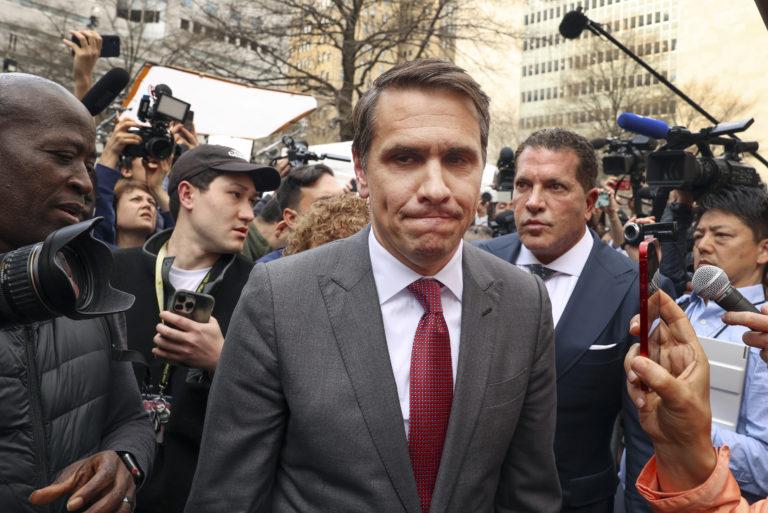
(Headline USA) The Senate confirmed Todd Blanche as attorney general in a vote early Saturday morning.
The Republican-led Senate voted 50-49 to make Blanche the second confirmed attorney general since President Donald Trump returned to the White House last year. While Blanche has already been leading the department in an acting capacity, his confirmation could free him to pursue the Trump administration’s agenda.
Blanche said on social media that he was “deeply honored by the trust and confidence President Trump has placed in me,” adding that he was “grateful” to senators for working late to confirm him.
Blanche, who was a Democrat before representing Trump, was confirmed by the narrowest of margins, opposed by two Republicans — Sens. Susan Collins of Maine and Lisa Murkowski of Alaska — and by every Democrat.
The path to confirmation for Blanche was unusually rocky, due in large part to moderate Republican concerns about a controversial settlement of Trump’s lawsuit against the Internal Revenue Service.
Under pressure, Blanche publicly promised in writing that the department would abandon Trump’s proposed $1.8 billion compensation fund for the president’s allies, including those who were persecuted for protesting at the Capitol on Jan. 6, 2021, and rein in another piece of the settlement designed to shield Trump and his family from IRS tax audits.
His appeals were enough to win over Republican Sen. Bill Cassidy, the decisive vote who threw his support behind Blanche Friday morning.
“This is not a referendum on President Trump. It is a decision regarding Mr. Blanche in very specific circumstances,” said Cassidy, who lost his primary this year to a Trump-backed challenger.
Sen. Dick Durbin of Illinois, the top Democrat on the Senate Judiciary Committee, said confirming Blanche would be a “serious mistake.” He begged his colleagues not to be on the “wrong side” of history.
Former prosecutor rises as Trump’s defender
A former federal prosecutor in New York, Blanche rose to public prominence as a lead attorney on Trump’s defense team, including during the Republican’s hush money trial in New York. He also defended Trump against criminal charges in the two federal cases brought by the Biden administration’s Department of Justice — an experience Blanche has said provided him a firsthand look at what he contends was the weaponization of the criminal justice system against Trump.
Blanche entered the Justice Department last year as deputy attorney general under Bondi, overseeing the agency’s day-to-day operations and serving as the public face for high-profile and controversial matters, like the release of millions of investigative files related to disgraced financier Jeffrey Epstein.
Blanche’s supporters say his experience as a federal prosecutor and the trust he earned from Trump in the courtroom make him better equipped than Bondi to explain to the White House the legal constraints of its demands. Republicans have also touted his efforts to bring down violent crime, tackle illegal immigration and combat violent cartels and drug trafficking.
Sen. Chuck Grassley, the Republican chairman of the Judiciary Committee, gave a full-throated endorsement of Blanche ahead of voting, saying he’s led the Justice Department with distinction. “Mr. Blanche is the right choice,” he said.
(Money Metals News Service) Platinum and palladium have participated in the broader precious-metals rally, but beneath the price action, important differences are emerging.
Money Metals host Mike Maharrey recently spoke with Edward Sterck, Director of Research at the World Platinum Investment Council (WPIC), about persistent platinum supply deficits, palladium’s dependence on the auto industry, geopolitical risks, trade policy, and potentially significant new sources of demand from hydrogen and artificial intelligence.
For roughly 10 years, platinum remained largely range-bound between about $900 and $1,100 per ounce. That changed in May 2025, when the metal began a sharp rally that continued into January 2026.
Edward Sterck said the initial catalyst was supply and demand.
The platinum market had entered its third consecutive year of significant deficits. Since commodity markets must ultimately balance, those shortfalls were filled by drawing metal from above-ground inventories. Eventually, those stocks fell to what Sterck called “unsustainably low levels,” forcing prices higher to entice holders to sell.
By the middle of the fourth quarter, another force took over. A broad precious-metals rally led by gold reflected growing demand for hard assets with value independent of the U.S. dollar.
Sterck characterized it as a “de-dollarization” or “sell America” trade. As demand spilled beyond gold, investors moved into silver, platinum, palladium and even copper.
After reaching what Sterck described as “frothy” levels in January, platinum corrected. It subsequently traded around $2,000 per ounce for a period before coming under renewed pressure. By August 6, the spot price had retreated to roughly $1,728 per ounce.
Middle East Conflict Changes the Picture
Conflict in the Middle East subsequently altered the macroeconomic environment for precious metals.
Higher oil prices increased inflation expectations and, in turn, expectations for higher Federal Reserve interest rates. That supported the dollar and weighed on dollar-denominated commodity prices.
There has been some direct impact on platinum demand because Middle Eastern oil refineries use platinum-based catalysts. When those facilities go offline, demand for catalysts can decline at the margins.
But Sterck said that effect is relatively small. The bigger influence has come through inflation expectations, anticipated Federal Reserve policy, and the dollar.
Despite those macro pressures, Sterck said the underlying supply-demand fundamentals for platinum remain favorable.
About 40% of global platinum demand comes from catalytic converters used in vehicles with internal-combustion engines. Vehicle electrification therefore represents a long-term demand headwind, although Sterck believes the transition is taking longer than many analysts previously expected.
Palladium is much more exposed. More than 80% of palladium demand is tied to the automotive sector.
Recycling creates another potential problem for palladium. WPIC expects rising recycling supply, combined with the gradual drag from vehicle electrification, eventually to push the palladium market into surplus.
But that transition keeps getting delayed.
Palladium remains in deficit today. Sterck said the existing shortage could allow the metal to continue trading alongside the broader precious-metals complex over roughly the next 12 months, even as bearish longer-term sentiment hangs over the market.
Russia Adds a Palladium Wild Card
Palladium’s supply profile makes that bearish outlook more complicated.
Russia produces about 40% of global palladium supply. A disruption at a Russian mine or another event restricting Russian supplies could therefore trigger a sharp price spike, particularly with futures positioning already skewed toward the downside.
Platinum has considerably less Russian exposure.
About 70% of global platinum mine supply comes from South Africa, rising to roughly 80% for Southern Africa when Zimbabwe is included. Russia accounts for only about 11%.
Palladium, by comparison, is concentrated between South Africa and Russia, with each producing roughly 40% of global supply.
That geopolitical exposure could also influence how automakers substitute platinum and palladium. In gasoline vehicles, Sterck said the two metals are almost one-for-one substitutes.
But manufacturers cannot simply switch between the metals whenever prices change. Once a vehicle model has completed certification and entered production, automakers generally do not alter the platinum-group-metal mix in its catalytic converter. Substitution therefore tends to occur as future models are designed and certified.
Tariff Fears Send Platinum Into the U.S.
U.S. trade policy has already produced dramatic movements in physical metal.
Sterck traced the shift to November 2024, when it became increasingly clear that tariffs would play a major role in the incoming administration’s trade policy.
U.S. end users and market participants began bringing platinum and palladium into the country ahead of anticipated needs, concerned that future trade barriers could affect metal availability.
Visible platinum inventories associated with U.S. futures exchanges surged from roughly 150,000 ounces to around 750,000 ounces—a fivefold increase. Sterck emphasized that exchange inventories represented only the visible portion of the movement, meaning additional metal could have entered the country without being deposited in those warehouses.
As some trade fears eased during 2026, metal began flowing out of futures exchange warehouses and back into the broader market, helping relieve some of the immediate tightness.
Uncertainty remains, however, including investigations under Sections 232 and 301 of U.S. trade law. Palladium faces an additional risk from a U.S. International Trade Commission case involving allegations of Russian dumping. An earlier ruling found no injury to the United States, but the decision has been appealed.
Expensive Gold Gives Platinum Jewelry an Opening
High gold prices have also created an unusual opportunity for platinum in the jewelry market.
Platinum generally competes in the mid-range and fine-jewelry segments, particularly against white gold. White gold was originally produced as a lower-cost alternative that could visually resemble platinum.
But soaring gold prices turned that relationship upside down.
Sterck said white-gold jewelry was at one point being sold at a premium to platinum jewelry, even at the retail level. That has contributed to relatively consistent growth in platinum jewelry demand in markets such as the United States and Europe.
China remains a notable exception.
Platinum jewelry became fashionable there during the late 2000s and early 2010s, with demand peaking around 2014. Since then, government policies and changing consumer preferences have contributed to a steady decline.
Hopes that soaring gold prices would spark a major revival in Chinese platinum jewelry demand have so far proved disappointing.
The Investment Case for Platinum
For investors accustomed to gold and silver, Sterck said platinum offers something different because of the diversity of its end uses.
Its industrial exposure makes platinum somewhat more pro-cyclical than gold, potentially giving it a different role within a diversified precious-metals portfolio.
Supply remains a major part of the investment case.
Sterck expects platinum deficits to persist for the foreseeable future, although investment demand could determine how tight the market remains this year. ETF outflows and metal leaving exchange warehouses could push the market closer to balance.
Monetary policy could also play an important role. Sterck believes the market may be overestimating the likelihood of Federal Reserve rate hikes. His personal expectation is for a relatively flat rate environment this year, which could provide renewed support for the precious-metals complex.
Hydrogen and AI Could Drive New Demand
Perhaps the most intriguing part of the platinum story involves emerging sources of industrial demand.
One is hydrogen.
Sterck argued that geopolitical instability could encourage countries in Europe and East Asia to place greater emphasis on energy security and accelerate development of the hydrogen economy.
He compared the potential effect to the way the oil crisis of the 1970s helped catalyze North Sea oil and gas development in Europe. Platinum is used within hydrogen technologies, making broader adoption a potentially significant source of future demand.
Artificial intelligence represents an even newer opportunity.
Sterck said WPIC has only become fully aware of some of these applications during the past six months. Semiconductor manufacturing and optical-crystal production for data-center interconnects could represent significant end uses for platinum, palladium and other platinum-group metals.
These applications are still being quantified and may not yet be fully reflected in existing supply-demand forecasts.
Could Platinum Outpace Gold Again?
Maharrey closed by asking whether platinum could ever regain its historic premium over gold.
Sterck noted that from 1980 through today, platinum has averaged roughly twice the gold price, even including recent years when platinum traded at a significant discount.
Platinum is also extraordinarily scarce. According to Sterck, it is about 30 times less available than gold.
But gold possesses an important advantage: it is a monetary asset, while platinum is not.
Gold’s larger and more liquid market has made it the preferred asset for central banks looking for alternatives to the dollar-dominated financial system. Sterck said that dynamic has helped drive central-bank gold buying since roughly 2014.
With the global system moving toward a more multipolar and uncertain geopolitical environment, Sterck sees little reason for that trend to disappear soon.
Platinum nevertheless offers a different investment story. Persistent deficits have depleted inventories, global mine supply is highly concentrated, and traditional automotive and jewelry consumption could increasingly be supplemented by hydrogen, AI infrastructure and other emerging technologies.
For precious-metals investors accustomed to thinking primarily about gold and silver, platinum may be worth watching precisely because the forces driving it are different.
The now-finalized rule, which was unveiled Thursday and kicks in Sept. 10, applies to certain aircraft under three Boeing 737 Max models: the 737-8, 737-9 and 737-8200. The FAA estimates this covers 471 planes — and said it is using this directive to address “the unsafe condition” tied to prior reports.
So far, no cracks have been found in these specific Max models. But when proposing the rule back in November, the FAA noted it had received reports of cracks in a forward bear strap for several older, “Next-Generation” 737 planes. Bear straps are metal sheets that reinforce areas on planes like doorways and emergency exits.
The Max jets have “a similar design and build process” to the older models, “making those airplanes susceptible to the same crack condition,” the FAA wrote in November. The agency warned that the issue could “adversely affect the structural integrity of the airplane” if not addressed.
In a statement, Boeing said that it previously identified and reported this issue — and “has been working with operators on it over the past six years.”
The Virginia-based aircraft maker said it sent operators inspection instructions for the affected Next Generation 737s back in 2019, and the FAA later mandated those checks in 2021. The company added that it had already expanded those inspections to Max jets — and the FAA’s latest directive now similarly mandates that process.
“We support both directives and continue to support our airline customers,” Boeing said in a statement.
The FAA noted Thursday that its directive also requires inspections of the fuselage skin of planes with existing repairs.
Boeing has been battered by years of safety, quality and production challenges — notably in the aftermath of two deadly crashes involving the larger Max 8 that killed 346 people in 2018 and 2019, as well as a 2024 incident in which a panel flew off one its Max 9 planes operated by Alaska Airlines midflight.
Just last month, the FAA said Boeing would again be allowed to take responsibility for certifying all of its 737 Max and 787 planes.
(Headline USA) Police released video Friday of a mass shooting that killed three people at an Idaho In-N-Out Burger, and praised an employee from a nearby store who engaged the gunman outdoors, slowing him down and possibly preventing more deaths as authorities were catching up.
The story of heroism told by police for the first time adds to the list of at least three more people who confronted the gunman with their own weapons as well as numerous others who rushed to comfort victims.
“What happened here was violent, frightening and deeply traumatic,” Twin Falls Police Chief Matthew Hicks said during a news conference.
The video revealed more details of the chaotic scene last weekend. The gunman walked up to the drive-thru window four times and opened fire, killing an In-N-Out employee, police said.
Ten people were shot — inside the restaurant, directly outside, on an adjacent busy road and at a car charging station in a Twin Falls visitors center lot, Hicks said.
He said investigators still don’t have a motive for the shooting. The gunman, Chad Williams, 24, killed himself.
It should have been a “normal Saturday afternoon,” Hicks said. “Employees showing up for work. Visitors coming to see our beautiful city. Instead they were confronted with chaos, fear and now loss.”
As the shooting unfolded, employees from nearby stores fled to a walking trail. When the gunman headed to the trail, he came across two people, including one with his hands in the air talking to him, according to the video.
That man distracted the gunman from possibly pursuing others on the trail. Williams subsequently killed himself as police closed in. His body was found near a canyon.
“To that young man, you are a hero,” Hicks said. “Your courage, your composure, your selflessness in that moment likely gave others the time they needed to escape harm. This community is grateful for you, and we will never forget what you did that day.”
Hicks also praised the work of an off-duty state trooper, who shot at Williams from inside the restaurant, and former police officer A.J. James, who was wounded while confronting him. Authorities previously credited an armed civilian who fired back and diverted Williams from the restaurant.
James ran toward the sound of gunfire from the drive-thru window, while the off-duty officer inside the In-N-Out exchanged gunfire with Williams through the window and directed workers out of the building, Hicks said.
He acted “heroically and unbelievably” to try to slow down the shooter, the police chief said, declining to release the off-duty officer’s name.
Braxton Steube said he was the person who encountered Williams on the trail after fleeing a Dick’s Sporting Good store.
“I said, ‘I have a family.’ I said, ‘You don’t have to do this. I’ll tell you whatever you want. I’ll do anything,’” Steube told KMVT-TV. “He started to like tear up a bit, it seemed. And he said to me, ‘Just get away from me, man.’”
Steube said the gunman shot at him and missed.
The Twin Falls In-N-Out, 130 miles (210 kilometers) southeast of Boise, the state capital, had opened in July as part of the chain’s expansion into Idaho.
Police identified those killed as Ashley Garibay, 23, of Stockton, California; Dale Schultz, 66, of Salt Lake City; and Christopher Claunch, 59, of Hagerman, Idaho.
Williams had briefly attended the College of Southern Idaho and previously lived in Arizona.
(Dave DeCamp, Antiwar.com) Iranian Parliament Speaker Mohammed Bagher Ghalibaf said on Thursday that President Donald Trump was engaging in “theater diplomacy,” citing the US president’s many threats and climbdowns amid uncertainty over whether a deal between Iran and Oman over the Strait of Hormuz will be reached.
“‘Massive attack coming… wait, never mind, they want to negotiate.’ That’s theater diplomacy on loop. Using bullying + broken promises + fake news as leverage is a failed strategy,” Ghalibaf wrote on X.
“Acknowledge the facts and fulfill your commitments. We don’t need more theater,” the Iranian parliament speaker added.
Iranian officials have said that a deal with Oman over the Strait of Hormuz is close, but it won’t automatically mean the waterway will be open to all traffic.
Iranian Deputy Foreign Minister Kazem Gharibabadi said re-opening the strait would require the US to live up to its commitments under the US-Iran Memorandum of Understanding, which would include a lifting of the US blockade of Iranian ports and the end of Israel’s war in Lebanon.
According to recent media reports, the potential Iran-Oman deal would involve inbound ships transiting the Strait on the Iranian side, while outbound ships leaving the Persian Gulf would remain close to Oman. Iranian officials have said it would involve “service fees,” while US officials have said there wouldn’t be any kind of toll.
Iran’s Fars news agency reported on Thursday that a potential draft deal would ban US and Israeli shipping through the strait, and that the ban would apply to other countries involved in the war against Iran, a condition the Trump administration is sure to reject, though it doesn’t appear the US is involved in the negotiations at this stage despite claims from Trump.
(Dave DeCamp, Antiwar.com) President Donald Trump on Thursday threatened “leakers” with jail time over reports about dwindling US military stockpiles as a result of the Iran war, and claimed the US had plenty of munitions available.
“The US has massive amounts of ‘munitions,’ especially of certain types. Additionally, large amounts are being manufactured and shipped to the US as needed,” Trump wrote on Truth Social.
“Defense companies are building the largest number of plants and factories in our country’s history. The ‘leakers’ of these treasonous statements are being hunted down,” the president added.
Some of the most significant reports about the shortage of advanced munitions didn’t come from media reports but from analyses published by the think tank the Center for International Studies (CSIS), which used publicly available data to produce its estimates.
CSIS found that the US has used about 60% of its advanced Patriot air defense missiles and about half of its interceptors for the THAAD missile defense system, though sources told CNN that the US had actually used about 80% of its THAADs during the war. While Trump says that US arms makers are working to produce more munitions, the current rate of weapons use far exceeds the rate at which they can be produced, and it will take years to significantly increase production.
Media reports have also said that the US has used up nearly all of its ATACMS missiles and Precision-Strike Missiles, which were both used extensively in strikes on Iran.
Trump also responded to a report from The Washington Post that said he lashed out at US Secretary of War Pete Hegseth over the munitions shortages, which one source told the outlet was part of the reason why Trump held off on his threats to dramatically escalate the war.
Sources told the Post that on the sidelines of a recent cabinet meeting at Camp David, Trump vented his frustration at Hegseth over the munitions shortages. The report said that Hegseth then blamed his deputy, Stephen Feinberg, for both the shortages and for failing to ensure Trump was informed about the issue.
“The Fake News, as usual, is spreading false and completely unfounded rumors. I am extremely happy with the job that Pete Hegseth is doing,” Trump wrote on Truth Social. He said that the Post published the report “despite our telling them their story is completely FALSE” and added that he believed their “fake ‘reporting’ is treasonous.”
(Headline USA) A New Mexico court has ordered Instagram and Facebook parent company Meta to pay $567 million to address harms to young people from its platforms in the second phase of a landmark trial.
Judge Bryan Biedscheid said in a ruling late Thursday that the bulk of the money — $420 million — will be used for treatment services for young people. The rest will go toward awareness and prevention, screening services and other costs over the next five years.
The new penalty is in addition to the $375 million in civil penalties that jurors ordered against Meta in March after determining the company knowingly harmed children’s mental health and concealed what it knew about child sexual exploitation on its platforms. In the second phase, prosecutors asked the judge to impose fundamental changes at Meta aimed at reining in addictive features, improving age verification and preventing child sexual exploitation through default privacy settings and closer oversight.
The total amount Meta is responsible for — $942 million — is a small fraction of of its annual profit, which was about $60 billion in 2025. Investors seemed to shrug off the New Mexico ruling in after-hours trading Thursday, sending Meta’s stock down less than half a percent to $589.44.
Still, the ruling is another setback for Meta, which faces an avalanche of lawsuits from thousands of families of children harmed by social media.
New Mexico Attorney General Raúl Torrez said it sends an unmistakable message that companies will be held accountable when their product designs knowingly put children at risk.
“Today’s decision is a victory for every parent who has worried about what social media is doing to their child and every child who deserves to grow up safer online,” he said in a statement.
Meta vowed to appeal.
“We work hard to keep people safe on our platforms and have been transparent about the challenges of identifying and removing bad actors and harmful content,” the company said in a statement. “We remain confident in our record of protecting teens online and will continue to defend ourselves against claims that misrepresent the facts.”
The judge ordered Facebook and Instagram to build banner and informational screens to clearly explain its protection features, best practices and tools to address inappropriate comment, for example, and display them regularly. Those changes and an educational campaign in New Mexico would be subject to review by the state.
The court said federal children’s privacy laws prevent Meta from applying age-verification tools to children under 13. The Children’s Online Privacy Protection Act, or COPPA, means it cannot order Meta to request children to submit personal data or be passively tracked online, even for age verification purposes.
The court also noted that ordering verification of children’s ages only for Meta and not other social media companies would be “inequitable and unduly injurious” to the company.
Instead, the court ordered Meta to continue to improve its age assurance tools in New Mexico, which include using artificial intelligence to determine people’s age based on signals such as who their friends are and what types of content they post and consume. Meta must also attempt to develop a dedicated “under-13-years-of-age prediction model” in the next two years.
Additionally, Meta should also request proof of age for Instagram and Facebook users in New Mexico it estimates to be under 13. If it determines a user to be under 13, or under 18 but without being able to estimate a specific age, Meta must treat the user as under 13 or under 18 until the user verifies their age.
The company must also partner with schools or a child safety organization to create a reporting portal where school staff can flag users who may be under 13. And it must delete personal information it has collected on users under 13. The court also ordered Meta to report on its progress twice a year on how it’s complying with the abatement measures.
Meta is also gearing up for a trial later this month in federal court in Oakland, California. Here, Meta will face the first four of 29 states that sued it in a federal multi-district lawsuit filed in 2023 for contributing to the youth mental health crisis by knowingly designing features on Instagram and Facebook that addict children to its platforms.
Eight states, including Tennessee, where a trial is currently ongoing, filed lawsuits in their own state courts.
And late last month, Meta, along with TikTok, Snap and Google’s YouTube, were sued by the families of four teenagers who died by suicide over what they describe as “years of escalating harms” from using their platforms that eventually resulted in their deaths.
What comes out of New Mexico is the first of many dominoes that will fall for Meta, said Laura Edelson, an assistant professor at Northeastern University focusing on social media and cybersecurity.
“America is not going to pass a law that bans social media,” Edelson said. “But if companies like Meta know they’re causing harm to users by product design, the states are finally finding a way to rein this in.”