

Trump Resumes Work Back at White House

(Headline USA) President Donald Trump staged a dramatic return to the White House after leaving the military hospital where he received care for COVID-19, declaring that despite his illness the nation should not fear the virus.

Landing Monday night at the White House on Marine One, Trump climbed the South Portico steps, removed his mask and declared, “I feel good.”

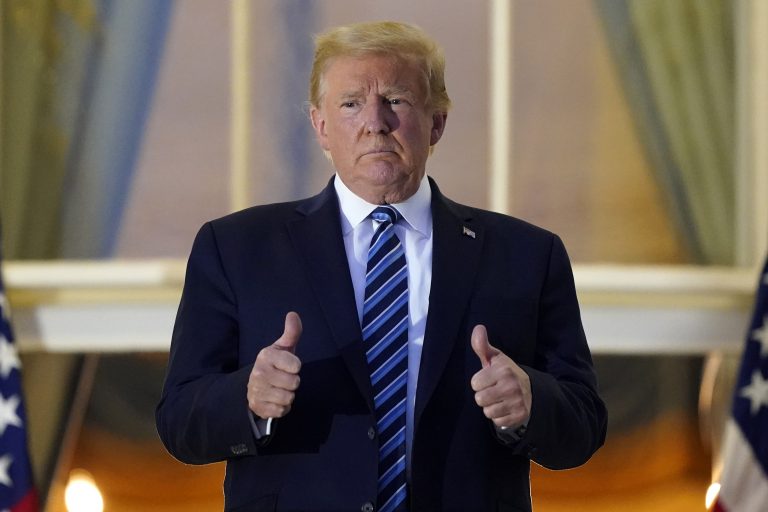
He gave a double thumbs-up to the departing helicopter from the portico terrace, where aides had arranged American flags for the sunset occasion. He entered the White House, where aides were visible milling about the Blue Room, without wearing a face covering.

The president left Walter Reed National Military Medical Center, where his doctor, Navy Cmdr. Sean Conley, said earlier Monday that the president remains contagious and would not be fully “out of the woods” for another week but that Trump had met or exceeded standards for discharge from the hospital.

Trump is expected to continue his recovery at the White House, where the reach of the outbreak that has infected the highest levels of the U.S. government is still being uncovered.

Still, Trump tweeted before leaving the hospital, “Will be back on the Campaign Trail soon!!!”

And in case anyone missed his don’t-worry message earlier, he rushed out a new video from the White House.

“Don’t be afraid of it,” Trump said of the virus. “You’re going to beat it. We have the best medical equipment, we have the best medicines.”

Democratic presidential nominee Joe Biden, who spent more than 90 minutes on the debate stage with Trump last week, said during an NBC town hall Monday night that he was glad Trump seemed to be recovering well, “but there’s a lot to be concerned about — 210,000 people have died. I hope no one walks away with the message that it’s not a problem.”

Biden tested negative for the virus on Sunday.

There was pushback from a prominent Trump political supporter as well.

Republican Sen. John Cornyn of Texas told the Houston Chronicle editorial board that Trump had “let his guard down” in his effort to show that the country was moving beyond the virus and had created “confusion” about how to stay safe.

Conley said that because of Trump’s unusual level of treatment so early after discovery of his illness he was in “uncharted territory.” But the doctor also was upbeat at an afternoon briefing and said the president could resume his normal schedule once “there is no evidence of live virus still present.”

According to the Centers for Disease Control and Prevention, those with mild to moderate symptoms of COVID-19 can be contagious for as many as — and should isolate for at least — 10 days.

Trump, in his new video, defended his decision to repeatedly flout his own administration’s guidelines to slow the spread of the virus, including by holding rallies with thousands of mostly maskless supporters.

Apparently referring to any potential danger to himself rather than others, he said: “I stood out front. I led. Nobody that’s a leader would not do what I did.”

He added: “And I know there’s a risk, there’s a danger. But that’s OK. And now I’m better. And maybe I’m immune, I don’t know.”

Adapted from reporting by Associated Press.
Infected GOP Senator Vows He’ll Go in a ‘Moon Suit’ to Vote Trump’s Court Pick

(Headline USA) Affected by COVID-19 infections, the Republican-led Senate refuses to delay confirmation of President Donald Trump‘s pick for the Supreme Court.

Congress has been holding committee hearings remotely and conducting business by Zoom already, so sick senators can also vote for Judge Amy Coney Barrett, and Democrats appear powerless to stop them.

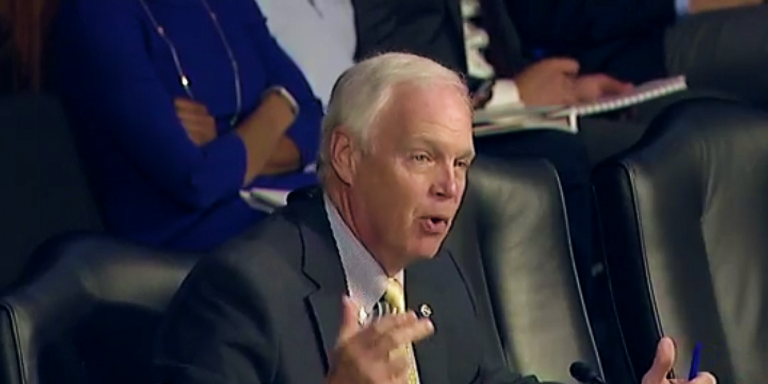
Sen. Ron Johnson, R-Wis., said Monday that he’ll go to the Capitol “in a moon suit” to vote if he’s still testing positive for the coronavirus, which has infected millions.

Trump’s nomination of Barrett in a Rose Garden ceremony apparently became ground zero for the infections now inflicting the president, his White House and its Senate allies. Three GOP senators, including Johnson, have now tested positive for the virus and several more are quarantined at home — denying Republicans a functioning majority.

Sen. Lindsey Graham, chair of the Judiciary Committee, said after talking by phone Monday with Trump that the president is “very excited” about Barrett being confirmed to the Supreme Court.

The move to confirm Trump’s third court nominee is as much about securing a conservative court for a generation to come as it is about giving Republicans what they see as their best chances at reelection.

Senate Democratic leader Chuck Schumer said Monday that the Republican leadership “has truly lost touch with reality if it’s contemplating marching COVID-stricken members to the Senate to rush through a Supreme Court nominee.”

Graham announced that hearings are set to begin in one week on Barrett’s nomination.

The Judiciary Committee is planning four days of hearings ahead of a final Senate vote by Oct. 29.

Senate Majority Leader Mitch McConnell shut the chamber to legislating through Oct. 19 over the COVID-19 infections, but said the court hearings will go on as scheduled.

“This body will not cease to function,” he said Monday, noting he was pushing ahead.

Over the weekend, one senator suggested they can vote from sickbeds if need be. There’s a long tradition of ill senators “being wheeled in to cast critical votes,” Sen. Tom Cotton, R-Ark., said on Fox News Channel.

“Where there is a will, there’s a way,” Johnson said on KHOW-630 radio.

Senators on the Judiciary Committee will have the option of connecting virtually, which will be needed as two of the panel’s Republicans, Sen. Mike Lee of Utah and Sen. Thom Tillis of North Carolina, are among those diagnosed with COVID-19.

Tillis’s office said Monday the senator feels “great” and has regained his sense of taste and smell after announcing late Friday he tested positive for the virus. His spokesman said so far, staff who had contact with the senator are being tested and have come back negative.

Johnson mentioned that his chief of staff was dealing with the virus; an aide clarified the staff member was infected last month separately from the senator.

Lee’s spokesman said no one else in his office has tested positive.

Many House and Senate panels have been operating in a hybrid capacity during the pandemic.

Voting, however, is a different matter.

The Senate requires a presence from a majority on the Judiciary Committee when it comes time to vote to send the Barrett nomination to the full Senate for confirmation — meaning all 12 GOP senators on the panel would need to be in Washington, presuming Democrats on the committee all vote against Barrett.

However, McConnell could have the full Senate vote to force the committee to discharge the nomination to the floor for final voting.

The full Senate floor votes on Barrett’s confirmation, expected the week of Oct. 26, provide another hurdle. McConnell has a slim margin, 53-47, meaning with three GOP senators now infected with COVID-19, and others home isolating, he would need to rely on Vice President Mike Pence to break a tie vote.

Advisers to Republicans suggest any sick senators can simply vote from upstairs in the galleries overlooking the Senate floor.

Outside groups are mobilizing alongside Democrats to protest the unusual process that’s about to unfold.

Democrats and their allies point to the ways Republicans refused in February 2016 to consider then-President Barack Obama’s nominee, claiming it was too close to the presidential election that year. Democrats led by Biden say the winner of the presidential election, Trump or Biden, should choose the nominee.

“They held a seat open for nine months. Certainly they can wait,” said Eli Zupnick, a spokesperson for Fix Our Senate, which advocates for rules changes including an end to the filibuster.

Zupnick said the Senate that is rushing to confirm Barrett is “the Senate that’s on the ballot” this fall.

The Democratic-led House put proxy voting procedures in place early on so lawmakers don’t need to trek to Washington to work. The Senate has resisted those options, except on committees.

Adapted from reporting by Associated Press.
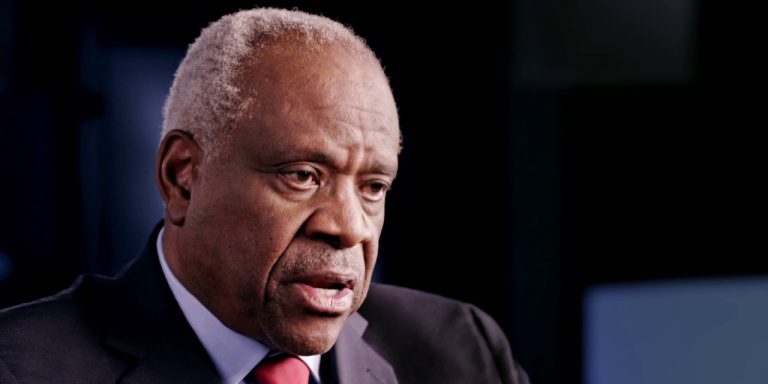
Conservative Justices Slam Court’s 2015 Decision in Gay Marriage Case

(Headline USA) The Supreme Court, already poised to turn more to the right, opened its new term Monday with a jolt from two conservative justices who raised new criticism of the court’s embrace of same-sex marriage.

The justices returned from their summer break on a somber note, following the death of Justice Ruth Bader Ginsburg, hearing arguments by phone because of the coronavirus pandemic and bracing for the possibility of post-election court challenges.

The court paused briefly to remember Ginsburg, the court’s second woman. But a statement from Justice Clarence Thomas, joined by Justice Samuel Alito, underscored conservatives’ excitement and liberals’ fears about the direction the court could take if the Senate confirms President Donald Trump’s nominee for Ginsburg’s seat, Amy Coney Barrett.

Commenting on an appeal from a former county clerk in Kentucky who objected to issuing same-sex marriage licenses, Thomas wrote that the 5-4 majority in a 2015 case had “read a right to same-sex marriage” into the Constitution, “even though that right is found nowhere in the text.”

And he said that the decision “enables courts and governments to brand religious adherents who believe that marriage is between one man and one woman as bigots.”

Thomas suggested the court needs to revisit the issue because it has “created a problem that only it can fix.”

Until then, he said, the case will continue to have “ruinous consequences for religious liberty.”

The court turned away the appeal of the former clerk, Kim Davis, among hundreds of rejected cases Monday.

Thomas’s four-page statement prompted outrage from LGBTQ rights groups and others.

Alphonso David, president of the Human Rights Campaign, said in a statement that Thomas and Alito had “renewed their war on LGBTQ rights and marriage equality” as the direction of the court “hangs in the balance.”

With Ginsburg’s death and the retirement of Justice Anthony Kennedy in 2018, only three members of the majority in the gay marriage case remain: liberal Justices Stephen Breyer, Sonia Sotomayor and Elena Kagan.

Barrett’s confirmation would bring the court to roughly a 4-4 balance between conservatives and liberals, with Chief Justice John Roberts a wild-card swing vote. Barrett has compared her approach to the law generally to that of her mentor, Justice Antonin Scalia, one of the dissenters in the gay marriage case.

Reversing the court’s decision in the gay marriage case would seem a tall order, but Thomas’s statement underscored liberals’ fears that the court could roll back some of their hardest-fought gains.

The cases the justices spent about two and a half hours discussing Monday, however, were far less prominent: a water dispute between Texas and New Mexico and a case involving a provision of the Delaware constitution that keeps the number of state judges affiliated with the two major political parties fairly even. The justices seemed prepared to uphold Delaware’s political party provision, and the argument passed without any comment about the partisan fighting over the Supreme Court’s makeup.

The justices will hear a total of 10 arguments this week and next, but the term is so far short on high-profile cases. That could change quickly because of the prospect of court involvement in lawsuits related to the election. Perhaps the biggest case currently on the justices’ docket is post-Election Day arguments in the latest Republican bid to strike down the Affordable Care Act, which provides more than 20 million people with health insurance.

The justices last heard argument in their courtroom in February and skipped planned arguments in March and April before hearing cases by phone in May. On Monday, Roberts began the hearing by noting what the public has only seen in pictures: that the door to the justices’ courtroom and the section of the court’s bench in front of Ginsburg’s chair have been draped with black fabric.

Said Roberts: “We at the court will remember her as a dear friend and a treasured colleague.”

Adapted from reporting by Associated Press.
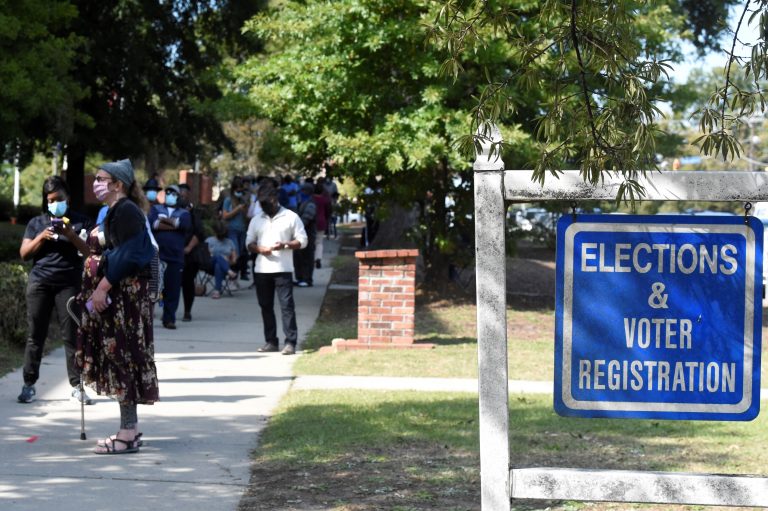
FRAUD AVERT: US Supreme Court Reinstates SC Ballot Witness Requirement

(Headline USA) The Supreme Court on Monday reinstated a requirement that South Carolina residents voting by mail in November’s election get a witness to sign their ballots.

Democrats had sought to have the requirement put on hold, blaming the coronavirus, but Republicans had defended it as deterring fraud.

While the high court reinstated the requirement as a lawsuit over it proceeds, voters have already started returning ballots.

More than 200,000 absentee ballots have been mailed and 18,000 returned, according to the state’s election commission.

The court said that any ballots cast before the court’s action Monday evening “and received within two days of this order may not be rejected for failing to comply with the witness requirement.”

State Republican Party Chairman Drew McKissick cheered the decision.

“Despite the Democrats’ efforts to hijack a pandemic and use it to meddle with our election laws, they’ve lost,” he said in a statement. “We’re pleased the Supreme Court reinstated the witness signature requirement and recognized its importance in helping to prevent election fraud.”

State Democratic Party Chairman Trav Robertson expressed disappointment with the decision.

“Our hope is that no one gets COVID-19 trying to find a witness,” he said in a statement. “We are disappointed but elections have consequences.”

South Carolina has had a witness requirement for absentee voters since 1953.

Under the current law, voters returning mail-in ballots swear an oath printed on the return envelope that confirms they are eligible to vote and that the ballot inside is theirs, among other things.

The oath has to be witnessed by one other person who has to sign below the voter’s signature and write their address.

Pointing to the coronavirus pandemic, state and national Democratic Party organizations and several individual voters challenged the requirement and other parts of state election law.

And a judge blocked the witness requirement before the state’s primary in June.

After the primary and response to the pandemic, state lawmakers made changes to the state’s election law, including allowing all residents to vote absentee in November.

But they left the witness requirement in place.

U.S. District Court Judge J. Michelle Childs, an appointee of President Barack Obama, late last month put the witness requirement on hold for the presidential election.

She wrote, without citing any evidence, that it could increase the risk of some voters of contracting the virus and require other voters already infected with the virus to risk exposing witnesses.

A three-judge panel of the U.S. Court of Appeals for the 4th Circuit reinstated the requirement before the full appeals court reversed course and put it on hold again.

As is typical when the Supreme Court acts on an emergency basis, the justices did not explain their decision.

But Justice Brett Kavanaugh, writing only for himself, said he agreed with it for two reasons.

He said it wasn’t for a court to second-guess the lawmakers’ decision to retain the witness requirement during the pandemic.

And he said that for many years the Supreme Court has “emphasized that federal courts ordinarily should not alter state election rules in the period close to an election.”

Three other justices — Clarence Thomas, Samuel Alito and Neil Gorsuch — would have required ballots that have already been returned to have a witness signature to count.

The Supreme Court has recently dealt with other cases involving ballot witness requirements for November’s election.

In Rhode Island, the court left in place an agreement by state officials to allow residents to vote by mail without getting signatures from two witnesses or a notary.

But in Alabama, where a court had put on hold in three large counties a requirement that voters get their absentee ballot notarized or witnessed by two adults, the justices reinstated it.

Approximately a dozen states require mail-in ballot envelopes to be signed by one or more witnesses or a notary.

Adapted from reporting by Associated Press.

Trump Says He’s Leaving Hospital for White House; Feels Good

(Headline USA) President Donald Trump said Monday he’s leaving the military hospital where he has been treated for COVID-19 and will continue his recovery at the White House.

He said he’s feeling good and the nation should not be afraid of the virus.

Trump’s expected return comes as the scale of the outbreak within the White House itself is still being uncovered. Press secretary Kayleigh McEnany announced she had tested positive for the virus Monday morning and was entering quarantine.

“I will be leaving the great Walter Reed Medical Center today at 6:30 P.M.,” Trump tweeted. “Feeling really good! Don’t be afraid of Covid. … I feel better than I did 20 years ago!”

Trump is expected to make the journey aboard the presidential helicopter, Marine One.

It was unclear how long Trump would remain in isolation at the White House. According to the Centers for Disease Control and Prevention, those with mild to moderate symptoms can be contagious for as many — and should isolate for at least — 10 days.

On Sunday afternoon, Trump briefly ventured out of the hospital while contagious to salute cheering supporters by motorcade.

White House officials said Trump was anxious to be released after three nights at Walter Reed National Military Medical Center, where doctors revealed on Sunday that his blood oxygen level had dropped suddenly twice in recent days.

Trump “is ready to get back to a normal work schedule,” White House chief of staff Mark Meadows told Fox News.

Joe Biden’s campaign, meanwhile, said the Democratic presidential nominee again tested negative for coronavirus Sunday. The results came five days after Biden spent more than 90 minutes on the debate stage with Trump, albeit at a distance.

Trump’s treatment with the steroid dexamethasone is in addition to the single dose he was given Friday of an experimental drug from Regeneron Pharmaceuticals Inc. that supplies antibodies to help the immune system fight the virus. Trump on Friday also began a five-day course of remdesivir, a Gilead Sciences drug currently used for moderately and severely ill patients. The drugs work in different ways — the antibodies help the immune system rid the body of virus, and remdesivir curbs the virus’ ability to multiply.

First lady Melania Trump has remained at the White House as she recovers from her own bout with the virus.

Adapted from reporting by Associated Press.
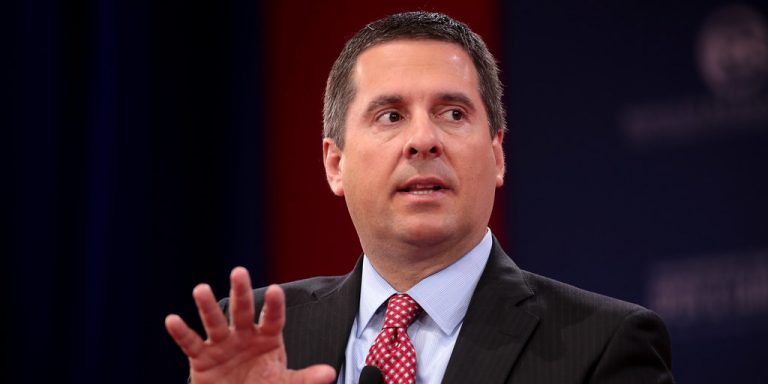
NUNES: ‘Shut Down’ Intelligence Agencies if They Continue to Withhold RussiaGate Info

Rep. Devin Nunes, R-Calif., suggested dismantling the intelligence community if its agencies continue to withhold information regarding the Russia-Gate hoax and former presidential candidate Hillary Clinton’s role in it.

A letter released last week from Director of National Intelligence John Ratcliffe confirmed that U.S. intelligence agencies received “insight” into a Russian intelligence analysis alleging that Clinton, who was running against President Trump at the time, approved a campaign to “stir up a scandal” against Trump by tying him to Russian officials.

The agencies, however, have refused to share that insight with Congress, Nunes told Fox News on Sunday.

“We want every damn bit of evidence that every intelligence agency has, or it’s maybe time to shut those agencies down,” Nunes said. “Because, at the end of the day … our liberties are more important than anything else we have in this country. And they have been stampeded over by these dirty cops.”

The FBI, CIA, and the National Security Agency have tried to argue that disclosing the Russia report would undermine the credibility of the intelligence community’s investigation.

But Ratcliffe released details about the report anyways, which was the right call, according to Nunes.

Allowing agencies to slow down the process only emboldens Democrats, he said.

“The intelligence services in this country have been corrupted by the Democratic national party and their propaganda arm in the media,” he said. “It is orchestrated among the national left-wing media, the Democratic party that has become an outrage in this country. And the intelligence community working hand in glove with the Democratic presidential nominee of 2016, Hillary Clinton, and her campaign and the Democratic National Committee. There is no guesswork here. It is obvious.”

Analyst: 2 Million Netflix Subscribers QUIT After ‘Cuties’

Wells Fargo analyst Steven Cahall estimates that Netflix will lose 2 million subscribers in U.S. and Canada after the streaming service released the child exploitation film, Cuties.

Netflix will still net 2.5 million subscribers globally, about half of Cahall’s earlier projection of 5 million new subscribers.

But he does not foresee any long-term ramifications for Netflix’s sexualization of prepubescent girls, according to The Hollywood Reporter.

“We think the current controversy and elevated churn is essentially a flash in the pan for Netflix,” he said.

Cahall said Netflix will lose about 2 million U.S. and Canadian subscribers in the third quarter, which ends Wednesday, instead of gaining 500,000 subscribers as he had previously predicted for the quarter.

The U.S. and Canadian audience “bears the brunt of the Cuties detractors,” he said.

“If we are to believe reports, then Netflix faced a short-lived but potentially stark churn uptick in September due to controversy around Cuties,” he said. “We think this could weigh more heavily on third-quarter net adds than investors realize so we reduce our estimate for global streaming net adds. … Given how strong Netflix is as a service we’re loathe to get too negative, but our churn analysis does imply some meaningful pressure.”

Netflix’s typical “churn”—the number of people who cancel their subscriptions in a month—is about 3.5 to 4 percent.

But an analysis shows that September churn “might have reached levels that were some eight times August’s churn rate.”

“If we assume that churn increased five times for a single week due to Cuties, it implies … 28 million deactivations in the third quarter,” Cahall’s analysis found.

There is some reason to believe, however, that the controversy surrounding Cuties led some people to seek out the movie, according to The Hollywood Reporter.

When surveyed, 52 percent of respondents said they watched Cuties simply because of the cultural battle surrounding it.

After they watched the movie, 65 percent of respondents either strongly agreed or somewhat agreed that Netflix should not stream the movie.

Billboard Company Censors Ad Against LeBron So Not to Hurt His Feelings

A sign company refused to allow a billboard campaign sponsored by a watchdog group that would have criticized NBA player LeBron James over his refusal to speak out against China’s human rights abuses.

The National Legal and Policy Center said it was ready to spend “several hundred thousand dollars” on the billboards during the NBA finals.

The advertisement would have shown James with a Chinese flag covering his mouth and the message, “Silence is Violence,” and would have been displayed near the entrance to the NBA “bubble” in Orlando, Fla.

But the company that owns the billboards, Outfront Media, told the group that they would not allow the ad with James’s image on it, according to an email obtained by the New York Post.

“We cannot accept the ad as it is right now,” a representative for Outfront told NLPC, saying the company would only put up the billboards if the NLPC agreed to remove James’s image. “The Chinese flag is Ok, and the silence is violence is ok,” he said.

NLPC refused to change the advertisement’s image, arguing that “some messages are too important to be suppressed.”

“When it comes to human rights in China, silence is indeed violence. We should be able to call LeBron on his hypocrisy without this censorship,” Peter Flaherty, chairman of the NLPC, told the Post.

NLPC said it did attempt to create a different version of the advertisement, but those were met with silence from Output Media.

“They just stopped returning our calls and emails,” said Tim Cramer, an executive with Operations at Mosaic, the firm that created the ads. “They thought that we were singling him out and were afraid that the ad would hurt LeBron’s feelings. But we were never going after LeBron James the person. We were going after his brand.”

James has been famously silent about China’s human rights abuses, but he did criticize Houston Rockets’ General Manager Daryl Morey last year for tweeting support for the Hong Kong protests.

“It’s utterly amazing LeBron James can buy a $36-million Beverly Hills mansion from a bubble designed to cut him off from the outside world yet he can’t find a way to champion basic human rights for all people, including those suffering under the Communist regime of China,” said NLPC’s Tom Anderson.

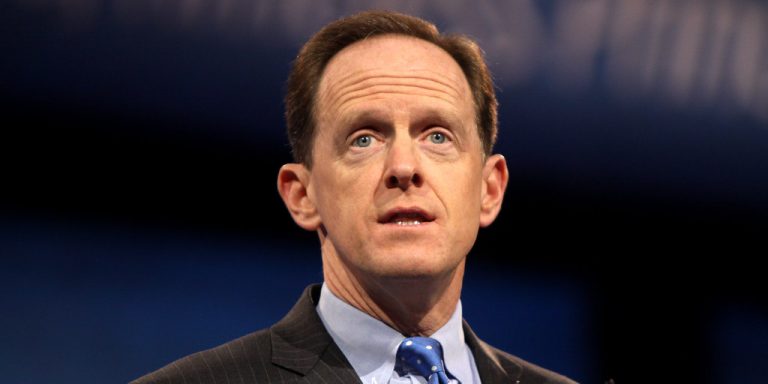
Pa. Sen. Toomey Says He Won’t Run for Another Term

(Associated Press) Republican U.S. Sen. Pat Toomey will not seek re-election in 2022 and plans to leave public service, he confirmed, a surprise move for the fiercely anti-tax and anti-regulation lawmaker who had been seen as the favorite to be the party’s nominee for governor in two years.

Toomey’s decision will force Pennsylvania Republicans to look elsewhere for candidates for both seats in a politically divided state where both parties have shown they can win statewide races.

At a news conference near his home in suburban Allentown, Toomey said he will serve out the final two years of his second term, “and after that my plan is to go back to the private sector.”

“I always thought that I’d probably serve just two terms and often mentioned that along the way,” Toomey said at the news conference at the studios of WVLT-TV, standing with his wife and three children, the youngest of whom is 10.

Toomey called his reasons “personal, not political,” and that 18 years in public office — including six years in the U.S. House from 1999 through 2004 — is a long time and had demanded sacrifices from his family.

Toomey had long expressed an interest in running for governor, and he drew calls on a daily basis from people who he said wanted to help him run for governor or for re-election to the Senate.

Once his mind was made up, he said, he felt he should be candid about it.

“I’m looking forward to more time back at home,” he said.

Toomey is a stalwart proponent of free markets and smaller government who was staunchly supported in the past by the billionaire industrialists Charles and David Koch and the Club for Growth, the take-no-prisoners free-markets advocacy group Toomey once led.

But Toomey had often expressed frustration with how the Senate operates and had never promised to run for a third term.

Still, the news of his future plans that broke Sunday has reshuffled the deck for Republicans looking ahead to the two major statewide races in two years.

As Pennsylvania’s only statewide elected Republican official outside of the courts, Toomey had been widely considered the favorite to be the gubernatorial nominee if he wanted it in 2022, when Democratic Gov. Tom Wolf is term-limited.

With both offices open in 2022, Democrats have a bench of prospects who have won statewide races — Lt. Gov. John Fetterman, state Attorney General Josh Shapiro and state Treasurer Joe Torsella — and a statewide voter registration advantage over Republicans, although the GOP has closed the gap substantially since 2016, when President Trump edged Hillary Clinton in the state.

Republicans are left without any natural heir or obvious front-runner for either governor or U.S. Senate.

The last time anything similar happened was in 2010, when then-Gov. Ed Rendell was term-limited and then-U.S. Sen. Arlen Specter switched parties to become a Democrat in his re-election bid. He was beaten in the primary.

The advantage is likely to go to the party that loses November’s presidential elections.

In mid-term elections, the party of the president tends to lose seats in Congress.

Headline USA contributed to this report.

Tech Company CEO Halts Employee Political Talkers; Will Pay Them to Just Go Away

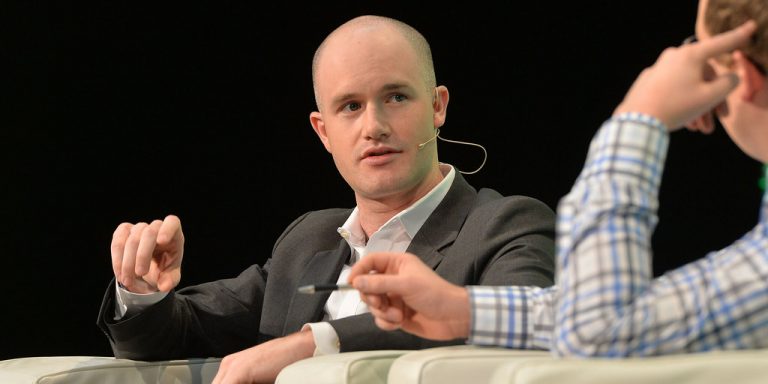
Coinbase, a cryptocurrency exchange company, is forbidding employees from discussing political and social issues at work, and offered to pay employees who decide to quit in light of the new rule.

CEO Brian Armstrong told staff in an email that the company would offer severance packages to anyone “who doesn’t feel comfortable with this new direction,” according to CNBC.

“Life is too short to work at a company that you aren’t excited about,” Armstrong said in the email. “Hopefully this package helps create a win-win outcome for those who choose to opt out.”

Armstrong explained last week that Coinbase “won’t debate causes or political candidates internally” and will not engage with issues that are “unrelated to the core mission, because we believe impact only comes with focus.”

That core mission, he said, is the use of digital currencies and the profits these currencies guarantee.

The move was triggered by “internal strife” taking over other tech companies, such as Google and Facebook, which have both been accused of liberal bias.

Both companies have also taken a proactive role in politics, banning certain ads and favoring certain political groups in their algorithms.

“While I think these efforts are well intentioned, they have the potential to destroy a lot of value at most companies, both by being a distraction, and by creating internal division,” Armstrong said. “I believe most employees don’t want to work in these divisive environments.”

Twitter CEO Jack Dorsey responded to Armstrong’s announcement and said Coinbase’s new strategy will “leave people behind.”

Armstrong responded and said he “agreed” with Dorsey, and admitted that Coinbase is political — but only about one thing: cryptocurrencies.