NBA TV Ratings TANK Just When Championship Series Heats Up

The NBA’s viewership and ratings continue to plummet as the season winds down.

Game 2 of the championship finals on Friday was reportedly the least-watched NBA finals game on record, bringing in just 4.5 million viewers.

That’s a 68 percent dip from last year’s Game 2, according to Outkick.com.

Game 1 of the NBA finals had the lowest viewership in recorded history, with just 7.41 million people watching.

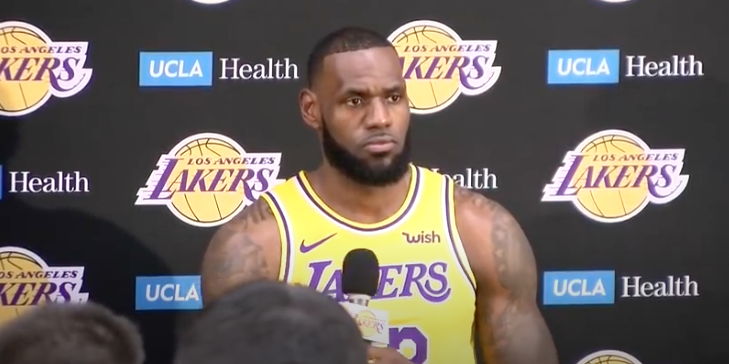
“A ship doesn’t sink for one reason, but undoubtedly, politics sit atop the historical tank,” the sports and politics Web site said. “After nearly two decades of reinventing the NBA discussion, LeBron [James] is now a detriment to the league’s brand … The NBA’s new self-inflicted identity is written in ink. Millions of turned-off Americans associate the NBA with radical politics catered to only a minimal number of sports fans.”

Lakers superstar James has become a vocal advocate for the Black Lives Matter movement, encouraging other players to wear BLM gear. As a result NBA players have knelt for the National Anthem, and the league even agreed to paint the phrase “Black Lives Matter’ on its court sidelines.

However, not everyone in the NBA agrees with James’s social-justice approach.

Meyers Leonard, who plays for Miami Heat, refused to kneel for the National Anthem back in August, even though he supports the Black Lives Matter movement.

“I am a compassionate human being and I truly love all people,” Leonard said. “I can’t fully comprehend how our world, literally and figuratively, has turned into black and white. There’s a line in the sand, so to speak: ‘If you’re not kneeling, you’re not with us.’ And that’s not true.”

Orlando Magic forward Jonathan Isaac also stood for the anthem when the league resumed play in July.

And last week Utah Jazz center Rudy Gobert went against the rest of the league and expressed condemnation on Instagram for China’s human rights abuses.

The NBA has long pursued an economic partnership with the communist nation and there has been an obvious unspoken rule about players and teams making critical statements about it.

The majority of players in the league, though, are fully on board with BLM.

Some players even suggested boycotting the playoff games over the death of Jacob Blake, who was shot by police in Kenosha, Wisc., after he pulled a knife on an officer.

Supreme Court to Hear Cases on Obamacare, Elections, 1A, Big Tech & Mueller Testimony

(Headline USA) The Supreme Court‘s docket when it begins its new session includes cases about the Affordable Care Act, elections, religious liberty, technology, and the Mueller investigation.

A week after the presidential election, the court will hear arguments in a bid by the Trump administration and Republican-led states to overturn the Obama-era health care law.

President Donald Trump, who has promised a replacement for the Affordable Care Act, and Democratic rival Joe Biden sparred over the case in the first presidential debate.

“Obamacare is no good. We made it better,” Trump said at one point.

“He has no plan for health care,” Biden said of the president.

The high court has options that are less drastic than striking down the entire Affordable Care Act. It could invalidate the law’s now toothless requirement that most Americans carry health insurance but leave in place core provisions such as subsidized health insurance, Medicaid expansion and protection for people with medical problems.

Trump has already suggested that the 2020 election could end up at the Supreme Court.

That’s part of why he says Amy Coney Barrett should be confirmed before Election Day.

Trump says he wants a full court to be available to weigh in on any campaign-related litigation.

Already, however, the court has confronted election-related cases from Wisconsin, Alabama, Rhode Island, Florida and Texas.

Among the issues: ballot witness requirements and allowing all voters to vote by mail.

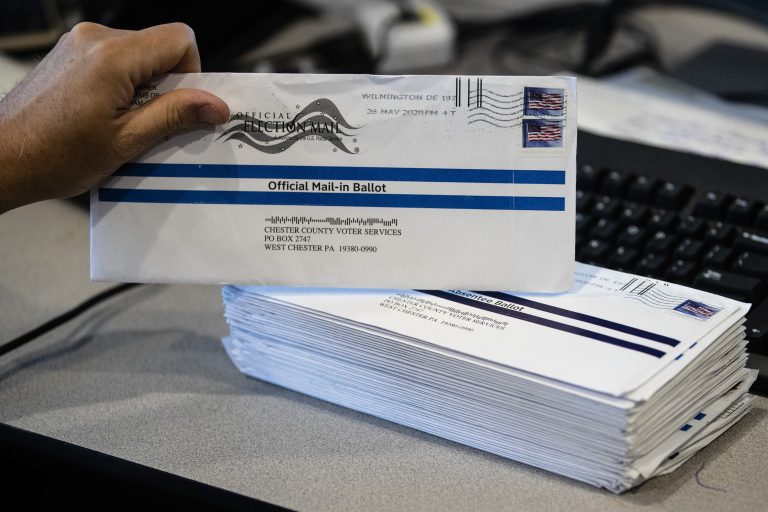
Soon the court will have to decide whether to keep in place a Pennsylvania Supreme Court decision extending the deadline for receiving and counting mail-in ballots in the battleground state and another court decision suspending the ballot witness requirement in South Carolina, where polls find a competitive Senate race.

The day after the election in November, the high court will hear a dispute involving a Philadelphia Catholic agency that won’t place foster children with same-sex couples.

It’s a big test of religious rights and could be one of the first cases the court hears with Barrett on board, if Republicans succeed in confirming her before the election.

The justices will review an appeals court ruling that upheld the city’s decision to stop placing children with the Archdiocese of Philadelphia’s agency because it would not permit same-sex couples to serve as foster parents.

The appeals court ruled that the city did not target the agency, Catholic Social Services, because of its religious beliefs, but acted only to enforce its own nondiscrimination policy in the face of what seemed to be a clear violation.

The most high-profile, big-dollar case the justices will hear arguments in this month is a copyright dispute between technology giants Oracle and Google.

The dispute has to do with Google’s development of its Android operating system for smartphones. Oracle says that in developing the popular Android, Google copied approximately 11,500 lines of its copyrighted code.

Google says it didn’t do anything improper. Oracle disagrees and sued Google in 2010. It has said it’s owed nearly $9 billion.

Lower courts have grappled with the case for a decade. Most recently, after a jury sided with Google, an appeals court overturned that ruling.

In December, the justices will hear arguments over whether Congress can have access to secret grand jury testimony from special counsel Robert Mueller’s Russia investigation — a legal process that began in summer 2019.

The court already handed Trump a victory when it agreed in July to deny the Democrats who control the House access to the material before the election.

It’s possible the justices never have to reach a definitive ruling in a sensitive dispute between the executive and legislative branches of government, if either Trump loses reelection or Republicans regain control of the House next year.

It’s hard to imagine that a Biden administration would object to turning over the Mueller documents or that House Republicans would continue to press for them.

Adapted from reporting by the Associated Press.

Senate Subpoenas Big Tech CEO; Cruz Wants Them to ‘Answer to the American People’

The Senate Commerce Committee‘s Republicans and Democrats unanimously voted on Oct. 1 to subpoena Big Tech CEOs: Twitter‘s Jack Dorsey, Google‘s Sundar Pichai, and Facebook‘s Mark Zuckerberg, the Verge reported.

The CEOs will testify before Congress regarding Section 230 of the Communications Decency Act, which protects Big Tech from free-speech liabilities.

The Senate Commerce Committee has been meeting to consider Republican Sen. Lindsay Graham’s bill to limit the scope of Section 230’s protections.

Section 230 originally encouraged the internet’s growth by allowing free speech, while also letting media platforms remove “reprehensible content,” according to Chairman Roger Wicker, R-Miss.

Big Tech has taken the freedoms which Section 230 has allowed and ran with them.

Most recently, Facebook has vowed to censor content on its platform if the election becomes too chaotic.

“…following repeated and consistent reports of political bias and the suppression of certain viewpoints, I fear that Section 230’s sweeping liability protections for Big Tech are stifling a true diversity of political discourse on the internet,” Wicker’s Majority Statement read.

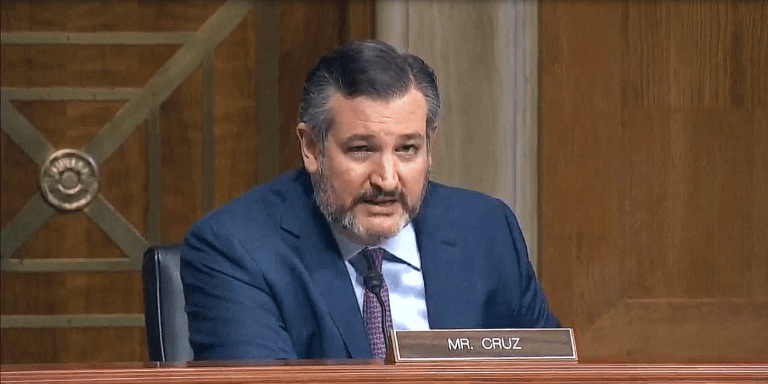
Sen. Ted Cruz, R-Tex., condemned the abuses of Big Tech and commended the Committee’s unanimous and bipartisan vote.

“This is a threat that threatens the free speech rights of every American,” Cruz said. “Right now, Big Tech believes it is totally unaccountable, which is why these CEOs declined the invitation.”

“Who in their right mind would want a handful of Silicon Valley billionaires having total control over who is allowed to speak, when they’re allowed to speak, what they’re allowed to say, and what they’re not allowed to say?”

Crack-down on Big Tech comes just weeks before the election. Both sides seek to regulate Big Tech for their own success in November.

Minority Chairman Maria Cantwell, D-Wash., has expresses her concerns regarding Big Tech and Section 230.

“I think the issues that we are discussing of how we function in an information age are of extreme importance. I think the issue of privacy and also media domination by the platforms when they put their foot on the throats of local news media is also an issue.”

Republicans and Democrats agree that Big Tech has too much influence over political opinion.

Whereas Republicans believe big media platforms are controlling free speech too much, Democrats are anxious that they aren’t doing enough.

“What I don’t want to see is a chilling effect on individuals who are in a process of trying to crack down on hate speech or misinformation about COVID during a pandemic,” Cantrell said in her Minority Statement.

“This feels like an attempt to work the refs five weeks out from the election,” said Sen. Brian Schatz, D-HI, according to Axios.

Cruz said the issue at hand is unaccountable corporate power.

“It’s why a subpoena was necessary,” Cruz said. “Because they don’t believe they answer to anybody. At the end of the day, they, like each of us, answer to the American people, answer to federal law and answer to the United States Constitution.”

Trump Says ‘I Learned a Lot About COVID,’ As Supporters Cheer Outside Hospital

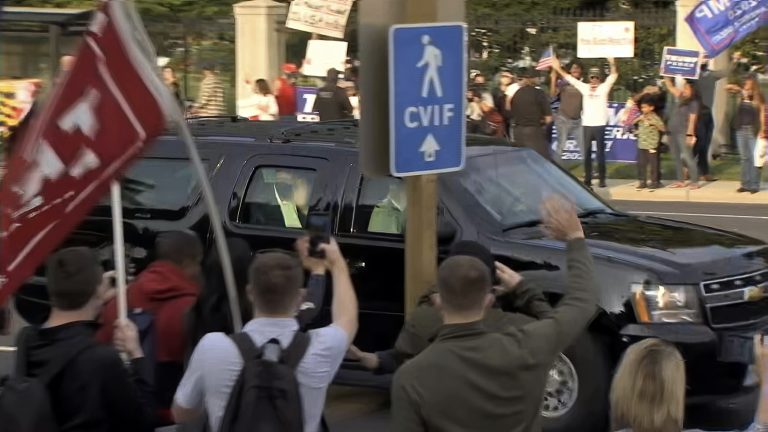
(Headline USA) Two days after being hospitalized with COVID-19, President Donald Trump declared, “I get it,” in a message to the nation Sunday before briefly leaving the hospital to salute supporters from his motorcade.

Hours earlier, Trump’s medical team reported that his blood oxygen level dropped suddenly twice in recent days and that they gave him a steroid.

The doctors also said his health is improving and that he could be discharged as early as Monday.

“It’s been a very interesting journey. I learned a lot about COVID,” Trump said, standing in his hospital room in a video posted on social media. “I learned it by really going to school.”

He added, “I get it, and I understand it.”

Before the video was posted, the president cruised by supporters in his sealed SUV, windows rolled up, driven by Secret Service agents in protective gear who were potentially exposed to the disease that has swept through the White House in recent days.

Meanwhile, former Vice President Joe Biden’s campaign said the Democratic presidential nominee again tested negative for coronavirus Sunday.

The results came five days after Biden spent more than 90 minutes on the debate stage with Trump. Biden had two negative tests on Friday, as well.

Adapted from reporting by the Associated Press.

Here’s What Happens if a Candidate for President Dies

(Headline USA) It’s a month before Election Day and President Donald Trump is in the hospital, infected with COVID-19, though in good spirits.

Democratic presidential candidate Joe Biden is 77 years old and susceptible to the virus as well.

What happens in the election — already well underway — should his condition take a turn for the worse?

If the president is unable to serve, through illness or death, the 25th Amendment makes clear the powers of the presidency transfer to Vice President Mike Pence until the president regains the ability to perform his duties.

But what happens if a candidate for president dies before Election Day? Or right after? What happens if the winning candidate dies before Inauguration Day?

It’s never happened in a country with a long transition between Election Day at the start of November and the start of a president’s new term on Jan. 20.

The Constitution, as well as state and federal election laws, would help guide the country through the process. But with no precedent, the outcome is far from certain.

The House of Representatives has the final say on who wins the presidency. Before the House might have to take charge, there are roles for political parties, state legislatures, the Electoral College, the courts and, most importantly, voters.

Here are some questions and answers about what might happen if a presidential candidate dies, before or after the election:

Can political parties replace a candidate who dies?

Yes, but not this close to Election Day. Nearly 63 million ballots have already been sent to voters, with nearly 3 million votes already cast. The deadline for candidates to withdraw has passed in all but two states — South Carolina and Connecticut — and their deadlines are a few days away.

The date of the election is set by federal law — the Tuesday after the first Monday in November — which falls this year on Nov. 3. Only Congress can change the date of the election.

“It would be impossible to change ballots at this time without delaying the election and starting the voting process over again,” said Richard Hasen, a law professor at the University of California–Irvine School of Law. “I don’t think Congress is going to do that.”

But it’s important to remember that in a presidential election, voters aren’t actually casting ballots for candidates. Instead, they are voting for slates of electors who will pick the president and vice president as members of the Electoral College.

To win the presidency, a candidate must win the backing of a majority of electors — 270 — in the Electoral College.

In modern U.S. elections, the meeting of the Electoral College is essentially a ceremonial confirmation of the choice made by voters. This year, it will take place on Dec. 14. But if the winning candidate is no longer alive, it would be anything but routine.

“The question is, who would the electors support?” said Richard Pildes, a constitutional law professor at New York University.

What happens if the winning presidential candidate dies after the election?

The 20th Amendment says the term of the current president and vice president ends at noon on Jan. 20. There is no provision to extend it. The amendment also says if the president-elect dies, the vice president-elect shall be sworn in as president at the start of the new term.

However, the winning candidate doesn’t become president-elect until a joint session of Congress counts the votes from the Electoral College and declares a winner, Pildes said.

By law, Congress is scheduled to formally receive the votes from the Electoral College on Jan. 6. The new Congress, which will be elected in November and sworn into office on Jan. 3, will preside.

What happens if the winning candidate dies before Congress declares a winner?

“That’s the worst, most confusing time,” said John Fortier, director of governmental studies at the Bipartisan Policy Center. “They are going to have to figure out what to do with (Electoral College) votes cast for a candidate who has died.”

If the winning candidate dies before the Electoral College meets, the electors could coalesce around a replacement candidate recommended by the party, perhaps the vice presidential candidate.

“For the most part, these people are picked because they are loyal party people,” Fortier said. “You could have a few stray here or there, but they are not rebels.”

A party’s electors would have an incentive to coalesce around one candidate, he said, because they wouldn’t want to risk throwing the election to the other party. But there is no guarantee they would all agree on a replacement candidate.

Some states have laws that require electors to vote for the presidential candidate who won the statewide vote; other states could quickly pass laws governing the electors in the event that a candidate dies.

“The party can say what the party wants, but the states would decide what to do with those electors,” Hasen said.

The Supreme Court ruled unanimously in July that states may require electors to support the candidate picked by voters in the election. However, the court left open what would happen if the candidate dies.

“Nothing in this opinion should be taken to permit the states to bind electors to a deceased candidate,” Justice Elena Kagan wrote in a footnote to her majority opinion.

If this happens, expect litigation.

What is the role of Congress?

The 12th Amendment to the Constitution gives Congress the final say on who is elected president and vice president.

Congress decides whether to accept or reject slates of electors from the Electoral College and to determine whether a candidate has won the required 270 electoral votes to become president.

As a check on this power, both the House and Senate must agree to reject a slate of electors. If the two chambers don’t agree, the electors get counted under federal law, said Michael Morley, an assistant law professor at Florida State University.

If no candidate reaches 270 electoral votes, the House chooses the president and the Senate chooses the vice president, in a process spelled out in the Constitution.

In the House, each state delegation gets one vote for president, and they must choose among the three candidates who received the most votes in the Electoral College.

Currently, Republicans have a majority in 26 state delegations, but the numbers could change after the November elections and a new Congress takes office.

The Senate would choose the vice president by a simple majority vote.

Election experts said they wouldn’t expect the courts to play a role at this point because the Constitution clearly grants Congress the authority to resolve a disputed election for president.

The Supreme Court did effectively decide the 2000 presidential election in favor of Republican George W. Bush by ending the recount in Florida. But the court’s ruling came before the Electoral College votes were presented to Congress.

“It is really in Congress’ hands after the electors have voted,” Fortier said.

Has Congress ever had to decide the outcome?

Congress has decided three presidential elections, but it’s been almost 150 years, according to a history of the House published by the chamber.

In 1800, Thomas Jefferson and Aaron Burr tied in the Electoral College vote, with 73 electors apiece. After six days of debate and 36 ballots, the House chose Jefferson as the nation’s third president.

In 1824, Andrew Jackson won a a plurality of the popular vote and the most Electoral College votes.

But he failed to reach a majority in a four-candidate race, and the House chose one of his opponents, John Quincy Adams, to become the nation’s sixth president. Jackson won the presidency four years later.

Congress also helped choose the president following the election in 1876 between Republican Rutherford B. Hayes and Democrat Samuel Tilden.

Tilden won the popular vote and the electoral count. But Republicans challenged the results in three Southern states, which had submitted slates of electors for both candidates, according to the House history.

To resolve the dispute, Congress set up a bipartisan commission of House members, senators and Supreme Court justices. After cutting a deal to remove federal troops from the South, ending Reconstruction following the Civil War, the commission voted along party lines to award the presidency to Hayes.

Adapted from reporting by the Associated Press.

Doctor: Trump Improving, But Not ‘Out of the Woods’ Yet

(Headline USA) President Donald Trump went through a “very concerning” period Friday and faces a “critical” next two days in his fight against COVID-19 at a military hospital, his chief of staff said Saturday.

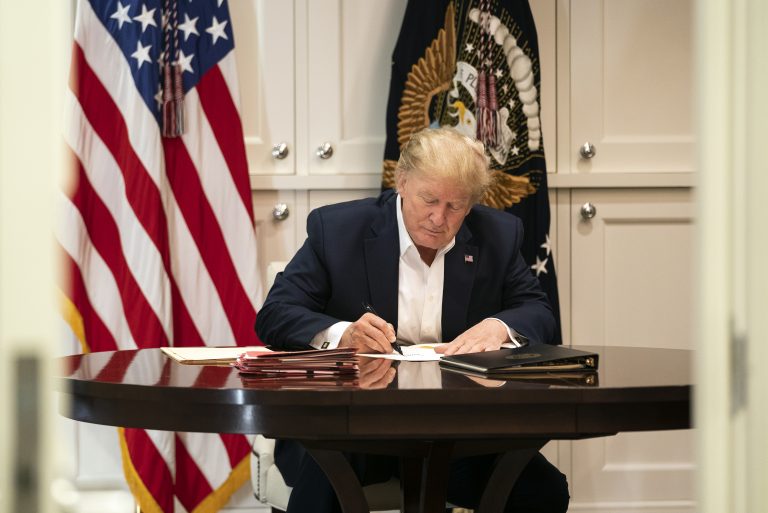
Trump remained at Walter Reed National Military Medical Center on Sunday. He offered his own assessment of his status Saturday evening in a video from his hospital suite, saying he was beginning to feel better and hoped to “be back soon.”

Hours earlier, chief of staff Mark Meadows told reporters outside the hospital, “We’re still not on a clear path yet to a full recovery.” In an update Saturday night, Trump’s chief doctor expressed cautious optimism but added that the president was “not yet out of the woods.”

Saturday’s briefing by Navy Commander Dr. Sean Conley revealed that Trump had begun exhibiting “clinical indications” of COVID-19 on Thursday afternoon.

He said that Trump’s symptoms, including a mild cough, nasal congestion and fatigue “are now resolving and improving,” and said the president had been fever-free for 24 hours.

“He’s in exceptionally good spirits,” said another doctor, Sean Dooley, who said Trump’s heart, kidney, and liver functions were normal and that he was not having trouble breathing or walking around.

In an evening health update, Conley said Trump had been up and moving around his medical suite without difficulty and conducting business.

“While not yet out of the woods, the team remains cautiously optimistic,” he said.

In the hospital video, Trump defended his decision to continue campaigning and holding large events in the midst of a pandemic.

“I had no choice,” said Trump. “I had to be out front … I can’t be locked up in a room upstairs and totally safe. … As a leader, you have to confront problems.”

Trump also thanked his medical team and hailed the state-of-the-art treatments he was receiving, comparing them to “miracles coming down from God.”

Trump is 74 years old and clinically obese, putting him at higher risk of serious complications from a virus that has infected more than 7 million people nationwide and killed more than 200,000 people in the U.S.

First Lady Melania Trump remained at the White House to recover from her own bout with the virus. She was “really handling it very nicely,” Trump said in the video, noting with a touch of humor that she was “just a little tiny bit younger” — in fact, 24 years younger.

In a memo released late Friday, Conley did report that Trump had been treated at the hospital with remdesivir, an antiviral medication, after sharing that he’d taking another experimental drug at the White House.

On Saturday, Conley said Trump’s blood oxygen level was 96%, which is in the normal range. The two experimental drugs he has received, given through an IV, have shown some promise against COVID-19. On Friday, he was given a single dose of a drug Regeneron Pharmaceuticals Inc. is testing to supply antibodies to help his immune system fight the virus.

Friday night, he began a five-day course of remdesivir, a Gilead Sciences drug currently used for moderately and severely ill patients. The drugs work in different ways — the antibodies help the immune system rid the body of virus and remdesivir curbs the virus’ ability to multiply.

“We’re maximizing all aspects of his care,” attacking the virus in multiple ways, Conley said. “I didn’t want to hold anything back if there was any possibility it would add value to his care.”

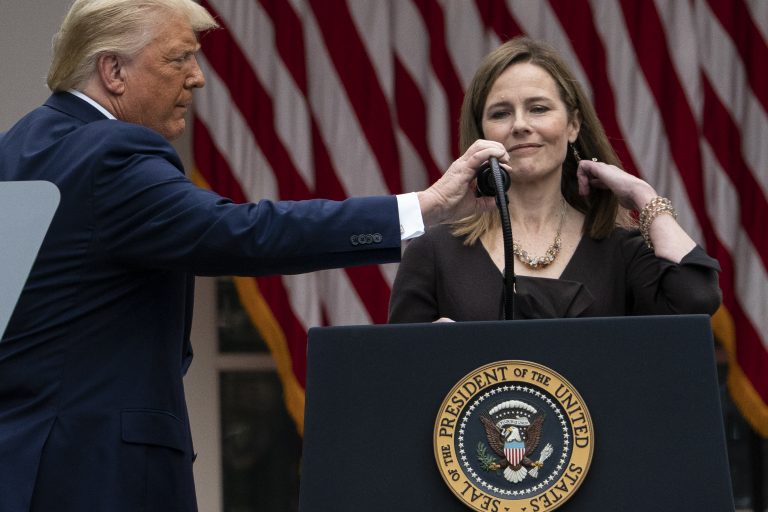
At the same time, the White House has been working to trace a flurry of new infections of close Trump aides and allies. Attention is focused in particular on last Saturday’s White House event introducing Trump’s Supreme Court nominee. That day, Trump gathered more than 150 people in the Rose Garden. There were also several indoor receptions, where Trump’s Supreme Court pick, Judge Amy Coney Barrett, her family, senators and others spent time in the close quarters of the White House, photographs show.

Among those who attended and have now tested positive: former New Jersey Gov. Chris Christie, White House counselor Kellyanne Conway, the president of the University of Notre Dame, and at least two Republican lawmakers — Utah Sen. Mike Lee and North Carolina Sen. Thom Tillis. The president’s campaign manager, Bill Stepien, and the head of the Republican National Committee, Ronna McDaniel, have also tested positive, though they were not at the event. Another prominent Republican who has tested positive: Sen. Ron Johnson. R-Wis.

Adapted from reporting by Associated Press.

Nevada Gov. Sisolak’s New COVID Orders Still Privilege Casinos Over Churches

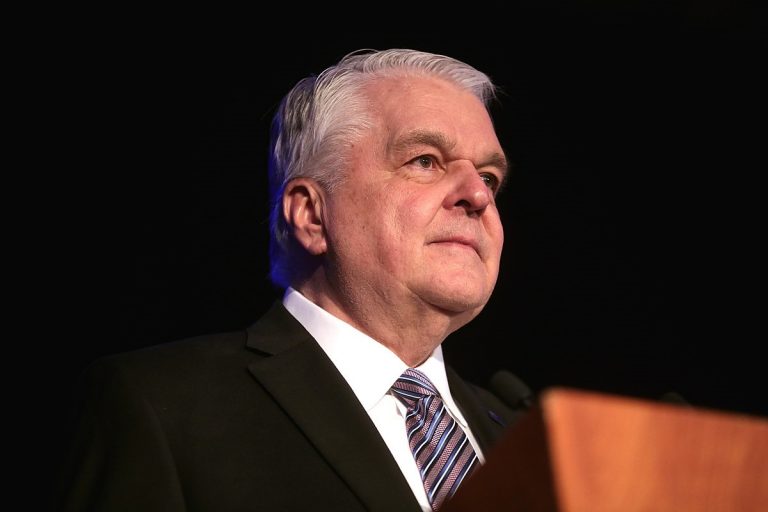
Nevada Gov. Steve Sisolak, a Democrat, updated the state’s health directives to let more people attend religious gatherings, but the order still privileges casinos over churches.

Sisolak’s anti-religious mandate lets casinos operate at 50 percent capacity, without a limit on total capacity, while forcing churches to operate at 50 percent capacity, with a 250-person limit.

These rules apply “so long as social distancing can be maintained and all other requirements can be met.” Other requirements including mandatory masking and health screenings, The Christian Post reported.

Prior to this update, churches had to limit services to 50 people, no matter the capacity level.

Even at half capacity, Nevada’s casinos can hold thousands of people.

The Alliance Defending Freedom sued the governor in Calvary Chapel Dayton Valley v. Sisolak, arguing that his 50-person limit on church attendance discriminated against houses of worship by favoring houses of gambling and violated the churches’ First Amendment rights.

The 9th Circuit U.S. Court of Appeals will hear the case, ADF reported in a press release.

“The First Amendment requires churches not be treated like second-class citizens,” said ADF Senior Counsel and Vice President of U.S. Litigation David Cortman. “Even with the governor’s new order allowing churches to gather in greater numbers, the problem remains.”

Sisolak said Wednesday in a statement that the new order is “an important step towards allowing more Nevadans to safely participate in social gatherings, including those facilitated by our faith-based communities.”

“The governor should adjust his policies to comply with the Constitution. There is no constitutional right to gamble, but there is one that protects religious Americans,” Cortman said.

“We look forward to the day when, by the governor’s order or a court order, church gatherings are, at a minimum, treated equally to other gatherings.”

Disputed Anonymous Report: Mike Pence Ordered Borders Closed Due to COVID

(Headline USA) Vice President Mike Pence in March directed the nation’s top disease control agency to use its emergency powers to effectively seal the U.S. borders.

The action has so far caused nearly 150,000 children and adults to be expelled from the country.

The top Centers for Disease Control and Prevention doctor who oversees these types of orders had refused to comply with a Trump administration directive saying there was no valid public health reason to issue it, according to an anonymous report.

So Pence intervened in early March. The vice president, who had taken over the Trump administration’s response to the growing pandemic, called Dr. Robert Redfield, the CDC’s director, and told him to use the agency’s special legal authority in a pandemic anyway.

Also on the phone call were Pence’s chief of staff, Marc Short, and acting Homeland Security Secretary Chad Wolf.

Redfield immediately ordered his senior staff to get it done, according to a former CDC official who was not authorized to discuss internal deliberations and spoke on condition of anonymity.

The CDC’s order covered the U.S. borders with both Mexico and Canada, but has mostly affected the thousands of asylum seekers and immigrants arriving at the southern border.

Public health experts had urged the administration to focus on a national mask mandate, enforce social distancing and increase the number of contact tracers to track down people exposed to the virus.

But Stephen Miller, a top aide to President Donald Trump who has been a vocal opponent of immigration, pushed for the expulsion order.

“That was a Stephen Miller special. He was all over that,” said Olivia Troye, a former top aide to Pence, who coordinated the White House coronavirus task force.

She recently resigned in protest, saying the administration had placed politics above public health. “There was a lot of pressure on DHS and CDC to push this forward.”

Title 42 of the Public Health Service Act gives federal health officials unique powers during a pandemic to take extraordinary measures to limit transmission of an infectious disease.

One of those is the ability to stop the flow of immigration from countries with high numbers of confirmed cases, a legal authority the CDC does not normally have.

Since the order went into effect on March 20, nearly 150,000 people — including at least 8,800 unaccompanied children who are normally afforded special legal protections under a court settlement and federal law — have been sent back to their countries of origin.

Pence’s spokeswoman Katie Miller, who is Stephen Miller’s wife, called the account of the phone call “false.”

“Vice President Pence never directed the CDC on this issue,” she said in an email.

Adapted from reporting by the Associated Press.

Federal Judge Says Sandmann’s Lawsuits Against Corporate Media Can Go Forward

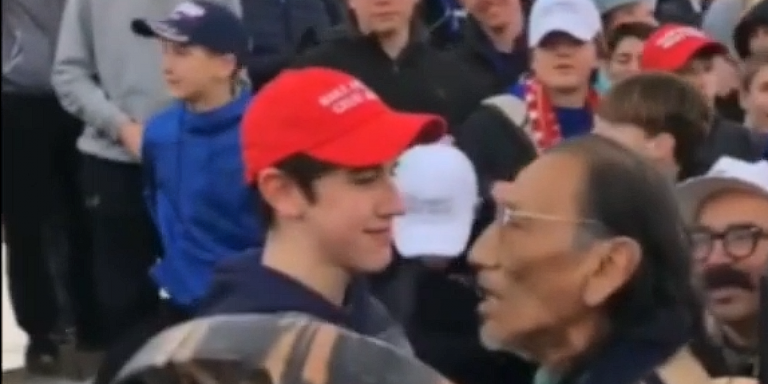
A U.S. District Court in Kentucky rejected motions to dismiss from four corporate media outlets that former Covington Catholic student Nick Sandmann sued, Fox 19 reported.

Sandmann and attorney Lin Wood filed lawsuits in March against The New York Times, Rolling Stones, ABC, CBS, and Gannett, the parent company of USA and the Cincinatti Enquirer. There was no ruling in Sandmann’s case against Gannett.

In the rulings, the opinion cited libelous references in the NYT, RS, ABC, and CBS to Sandmann blocking or preventing Nathan Phillips’ “exit” from the encounter.

The plaintiffs claim that Phillips made false and defamatory claims about Sandmann, which the media then published with malicious and destructive intentions.

They also repeated false assertions from Phillips that Sandmann acted with racial bias.

Video evidence from the media-distorted incident clearly shows that Sandmann did not force Phillips to stand in front of him and bang a drum.

Media companies had enough information from the videos that, with “reasonable journalistic care,” they could have determined that Phillips made false allegations, the lawsuit said.

The New York Times, Rolling Stones, ABC, and CBS said that they did not publish defamatory stories. Their arguments were dismissed, and the cases will proceed.

Sandmann settled a lawsuit with CNN in January and another with the Washington Post in July. Both settlements granted him an undisclosed amount of money.

Sandmann has become a symbol among conservatives of the media’s persistent desire to shape events to fit their anti-American, anti-white worldview.

The Republican Party invited him to speak to at the 2020 convention. He called out the media’s dishonesty, and later he revealed his desire to become a defamation lawyer.

“The full war machine of the mainstream media revved up into attack mode,” he said at the August convention. “The truth was not important in advancing their anti-Christian, anti-conservative … narrative.”

Florida Authorities Arrest Man for Voter Fraud Who ‘Wanted to Test the System’

(Headline USA) Florida authorities say they’ve filed a voter fraud charge against a man who said he said he “wanted to test the system” when he tried to obtain a mail-in ballot for his deceased wife.

Manatee County Supervisor of Elections Mike Bennett said he contacted the sheriff’s office after a review of voter rolls showed that Larry Wiggins’ wife had been dead for two years.

Staffers determined that Wiggins forged his late wife’s name on the ballot request, according to the Bradenton Herald.

Wiggins, who was arrested last Thursday on a voter fraud charge, told deputies that he was “testing the system to see if worked.”

Bennett said such attempts are unusual in Manatee County.

“Our message is that the Manatee County Supervisor of Elections will prosecute any attempt at voter fraud. If you are caught, we are committed to prosecute,” Bennett said.

There was no online docket for Wiggins on the Manatee County Clerk of Court’s website Saturday, so it was unclear if Wiggins had an attorney.

Adapted from reporting by the Associated Press.