CLAIM: Obama’s Iran $$$ Linked to Hillary Clinton’s Covert Weapons Sales in Benghazi

A purported military-insider-turned-whistleblower revealed that he had given evidence to a US congressman linking the Obama administration’s massive payoff in the Iran nuclear deal to a series of scandalous Middle East cover-ups.

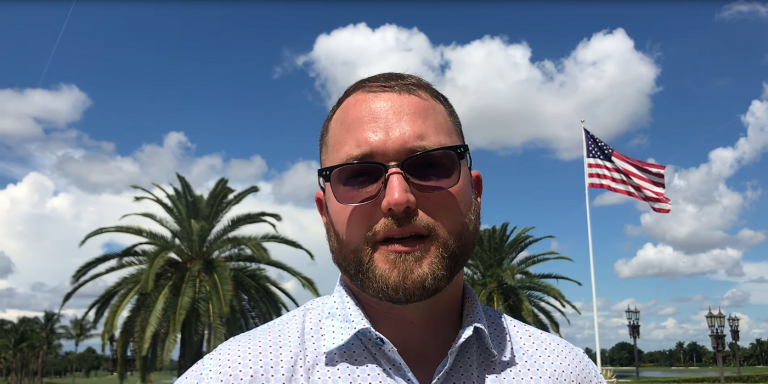
Nick Noe said he and other Benghazi insiders had gathered a cache of evidence that included audio recordings and documents of high-ranking officials to support their allegations.

“Something everybody wants to have is the evidence,” he said in a YouTube interview following his presentation Sunday at American Priority’s annual AmpFest conference.

“Guess what, we have it,” he continued. “We have irrefutable evidence … and in there you’re gonna find out some pretty shocking things.”

Noe, who was stationed at Germany’s Ramstein Air Base on Sept. 11, 2011—the fateful date of the terrorist attack on the US Embassy in Benghazi, Libya—said his role was to collect dispatches from combat units and consolidate them into situational reports.

“I was at work, and I ended up leaving thinking everything’s gonna be OK,” he said in recalling the night of the attack.

“At that point, I saw drones overhead—you could see them circling … I thought they were coordinating,” he said.

But he was shocked to find out the day afterward that nothing had happened.

Although a rescue unit from Djibouti was ready to respond, Noe’s commanding officer indicated that they had been told to stand down.

Upon leaving the military, Noe began to connect with other witnesses and whistleblowers in the effort to get his story out.

After reaching out unsuccessfully, first to a Republican congressman on the Benghazi committee and then to the FBI, Noe said the scope of the corruption and possible cover-up effort finally hit home.

“It turns out there was a lot more going on than we really understood,” he said.

He was able to connect with Charles Woods, the father of slain CIA officer Ty Woods, who was killed by a mortar while trying to protect a CIA facility in Benghazi.

The two also met Allan Harrow Parrot, a CIA whistleblower who had amassed a “treasure trove” of evidentiary documents from his decades stationed in the Middle East.

Among the claims that the men are making:

  • The Iran payoff as part of a controversial nuclear deal was intended as hush money over the shooting down of Seal Team 6, the covert special-forces team that killed Osama bin Laden.
  • The Stinger missile that shot down Seal Team 6 came from a weapon’s sale scheme overseen by then-Secretary of State Hillary Clinton from a CIA cache in Qatar.
  • Bin Laden had spent most of his post 9/11/2001 lifetime hiding out in Iran, with three different CIA directors allowing him safe refuge.
  • Prior to bin Laden’s May 2011 death, Iran was prepared to simply hand him over. However, Clinton and then-Vice President Joe Biden proposed the idea to stage a “trophy kill” in Pakistan for election-year optical purposes.

“Everybody that’s involved with this… they’re gonna hang for it,” Noe said.

“It’s pretty plain to see it’s treason, and so I’m going to look forward to seeing justice served for that crime,” he added.

Headline USA did not independently verify any of the allegations.

Noe said in the video that he was giving the documents and audio to several media outlets, and he also confirmed that he had given the materials a current congressman, although he did not identify the person.

Rep. Matt Gaetz, R-Fla., was the headliner of the AmpFest where Noe and Woods recently spoke.

Some recent evidence has suggested that there may also be a link between Iran and the Russia hoax concocted by the Clinton campaign in 2016, with support from Obama’s intelligence community, to smear and undermine GOP opponent Donald Trump.

According to recently declassified documents, the Steele dossier—the debunked series of reports commissioned by Clinton and elevated by top CIA and FBI officials to permit spying on the Trump campaign—relied heavily on claims made by Igor Danchenko, an analyst for the far-left Brookings Institution who specialized in Iran–Russia relations and had himself been investigated as a possible agent for the Kremlin.

McConnell Will Pin Dems Down w/ Vote on COVID-Relief Next Week

0

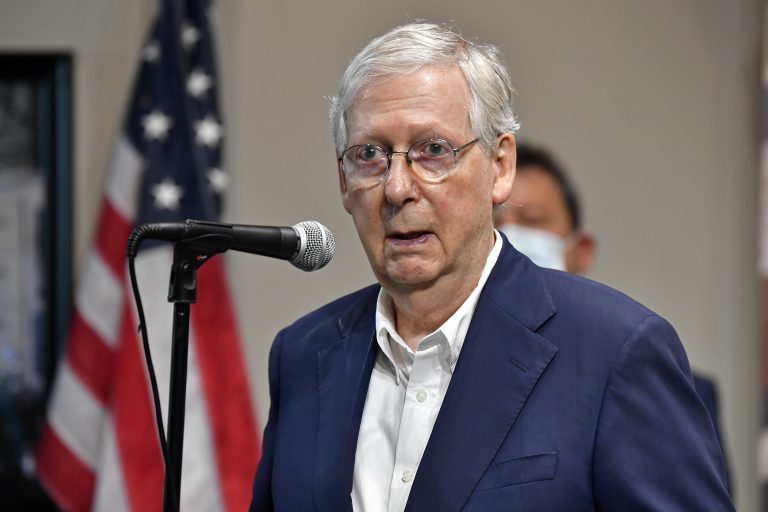
(Headline USA) Senate Majority Leader Mitch McConnell said Tuesday that he’s scheduling a procedural vote on a GOP COVID-19 relief bill next week, saying aid to hard-hit businesses shouldn’t be held up by gridlock involving other aid proposals.

The Kentucky Republican says the first item of Senate business when the chamber returns next Monday will be a procedural vote on a scaled-back aid bill. Democrats filibustered a GOP-drafted aid bill last month and recent talks on a larger deal between Treasury Secretary Steven Mnuchin and House Speaker Nancy Pelosi, D-Calif., fell apart this past weekend, probably for good.

“Democrats have spent months blocking policies they do not even oppose. They say anything short of their multi-trillion-dollar wish list, jammed with non-COVID-related demands, is ‘piecemeal’ and not worth doing,” McConnell said in a statement. “And she has worked hard to ensure that nothing is what American families get.”

McConnell’s move appears unlikely to work. The COVID relief debate appears to have gone back to a phase in which the participants have largely given up and are devoting time and effort to political positioning ahead of the election rather than negotiations and compromise.

President Donald Trump continues to agitate for “stimulus,” saying that Capitol Hill Republicans should “go big” rather than the limited approach they’ve been advocating.

While many Republicans take a skeptical view of the need for more virus relief like special unemployment benefits or direct payments to most taxpayers, some GOP senators in difficult re-election races are eager for more aid.

Under Senate rules, McConnell can call for a re-vote on the September legislation, which was filibustered by Democrats as insufficient. It also doesn’t satisfy Trump, in part because it did not provide for another round of $1,200 direct payments that would go out under his name.

McConnell could also modify the earlier GOP bill.

For her part, Pelosi issued a statement again criticizing Trump for caring chiefly about the direct payments.

“A fly on the wall or wherever else it might land in the Oval Office tells me that the President only wants his name on a check to go out before Election Day and for the market to go up,” Pelosi said in a letter to her colleagues.

She defended her hardline position on a Tuesday conference call with fellow Democrats, claiming Democrats have more leverage than ever. But the risk of emerging empty-handed until next year appears very real, which makes Democrats who hold swing-district seats won in 2018 nervous.

To recap, talks on the latest potential round of COVID relief began in July, collapsed in August, and were revived last month. Last week alone saw Trump cause the talks to collapse on Tuesday, only to revive them heading into the weekend. They then cratered again on Saturday after Trump’s latest $1.8 trillion proposal took heavy fire from both Democrats and Trump’s GOP allies.

Republicans are back to offering smaller, targeted aid that would permit endangered party members to again go on record in favor of aid, even if it’s a nonstarter with Democrats and opposed by Trump.

“What I hear from Sen. McConnell is once again take a little piece and be satisfied. What I hear from the president just the opposite,” said Sen. Dick Durbin, D-Ill. “Can the two of them sit down and agree? Wouldn’t that be a breakthrough?”

Some Democrats are convinced that Joe Biden is poised to reclaim the White House and have been pressuring Pelosi to strike a less ambitious deal that would deliver aid now rather than letting the economy to continue to struggle without help until next year. Pelosi’s response was to gather statements from a host of committee chairmen criticizing the administration’s latest offer.

“If Congress doesn’t act, the next president will inherit a real mess,” said Harvard economist Jason Furman, a former top adviser to President Barack Obama. “If the Mnuchin offer could be passed by the Senate — which is a huge “if” — that would be a lot better than waiting to get even more in January.”

Adapted from reporting by Associated Press.

HOPELESS PORTLAND: Leftist Mayor Could Be Ousted by Antifa Radical on Nov. 3rd

(Headline USA) In most election cycles, America wouldn’t pay attention to the Portland, Oregon, mayoral race — but this isn’t a normal year.

Months of riots against law enforcement have made Portland national news in a divisive election year, and President Donald Trump routinely derides Mayor Ted Wheeler as a weak liberal unable to stop unrest in his anarchist city.

But as Wheeler spars with Trump, the mayor also faces a threat at home from the opposite end of the political spectrum: a radical-left challenger who supports $50 million in law enforcement cuts and slams her opponent for what she describes as an aggressive police force. Hemmed in by critics, Wheeler recently lent his campaign $150,000 as he struggles to fend off Sarah Iannarone.

“The race is really in flux,” said Jim Moore, a Pacific University political science professor. “The thing that will cause him to lose is responding to the protests in all their complexity. That’s why Portland’s election is important nationally, not just because of the protests but also because of the president. The president brings it up all the time.”

Wheeler narrowly missed winning a second term outright in May but the career Democrat’s approval ratings plummeted as riots dominated headlines into the fall. Business interests and moderates are angry that he’s let the protests go on so long, while passionate, far-left progressives embrace the violence as necessary for rooting out “systemic racism.”

Many of those voters back Iannarone, who has attended three dozen protests and touts campaign bumper stickers that read “Everyday Antifascist. Always.”

Recent polling shows Wheeler trailing his challenger, but with many undecided voters. Oregon, a universal vote-by-mail state, will send out ballots this week.

“The hard thing for a candidate like me in a time of near revolutionary fervor for change is that I seek the elusive center,” Wheeler recently told the AP. “I don’t believe compromise is a dirty word, and I still govern with an eye to the future rather than the emotion of the moment — and right now we’re in a very fearful, anxious and emotional time in our history.”

Since May, the city has cut about $15 million from the police budget — including a gun violence reduction team, transit police and a school resource officer program — but Wheeler has resisted pressure to take away more from the bureau’s nearly $250 million budget without a safety net for mental health and homelessness calls that police handle daily.

Wheeler, as police commissioner, has also taken heat for allowing officers to use tear gas. He banned it entirely last month, and says police have made some mistakes but done some things right, too.

“When people call 911, they expect to get a response. If you’re going to eviscerate the police bureau, then you have to be able to answer the question … ‘What is the plan to actually fill the gap?’” he said. “And so far, we have not had that conversation.”

But Wheeler’s failure to engage with black activists and other protesters cost him local support, critics say, even as he drew national attention for getting tear-gassed by U.S. agents when he attended a protest outside a federal courthouse.

“I’m still trying to pin down what Ted Wheeler really stands for,” said Cameron Whitten, founder of The Black Resilience Fund who’s endorsed Iannarone. “He’s a wind vane, he’s got no base and the community is divided because of it.”

Iannarone supports calls to cut $50 million from the police budget and paints Wheeler as an establishment candidate beholden to corporate interests. She repeats an oft-cited criticism: That Wheeler failed to build critical relationships as he tried to please all sides.

A passionate advocate for public transportation and bike commuting, Iannarone has an ambitious plan for a green economy, wants free municipal Wi-Fi and has proposed increasing taxes on Airbnb for a renter bailout fund.

But she also stirred controversy in August when she said on KGW-TV that peaceful protests “might not necessarily be moving the conversation forward.” And some of her policies, such as eliminating parking for more trees, legalizing all sex work and allowing non-citizens to vote in local and state elections, might be a bridge too far for some voters.

“She is further to the left — whatever that means in Portland — of the average voter and she’s taken up positions that I think many voters would find disqualifying,” said John Horvick, political director at non-partisan public opinion firm DHM Research.

“I think that the tensions are much greater there than her campaign would acknowledge publicly.”

Recently, Iannarone has sought to temper concerns about her views on the protests. She says she rejects violence but is quick to add that “anti-fascist protesters wind up on the receiving end of police brutality more” than Trump-inspired, right-wing group members who have held several “law and order” rallies in the city.

“Opposing fascism in 2020 is a good thing. And I’ve tried to normalize that,” Iannarone said in a phone interview. “What we try to do is pull it out of this realm that Donald Trump would have it in — where he’s making people who oppose fascism the enemy — and make it more accessible to everyday people.”

One hurdle Iannarone may face is that many voters simply don’t know her. The urban planning wonk has never held elected office or worked in city government. And while she attracts a passionate Twitter following, about 30% of voters remain undecided or plan to vote for another candidate with weeks to go.

Meanwhile, Wheeler last week got the endorsements — and the deep pockets — of a coalition of business, labor and civic groups, including an environmental nonprofit that applauded his commitment to achieving 100% renewable energy by 2050 and his fight for more middle-income housing.

“It’s up to Ted, with his campaign, to get that information out to voters. And is he going to do that or not? Well, that’s the key thing,” said Moore, the political science professor. “He’s … saying the buck stops here. What he’s not been able to do is say, ‘Here’s the way we get out of this situation.’ And part of that is Ted and part of that is the situation.”

Adapted from reporting by Associated Press.

AOC: Republicans Would Reject ‘Christ Himself’ If He Came to Congress

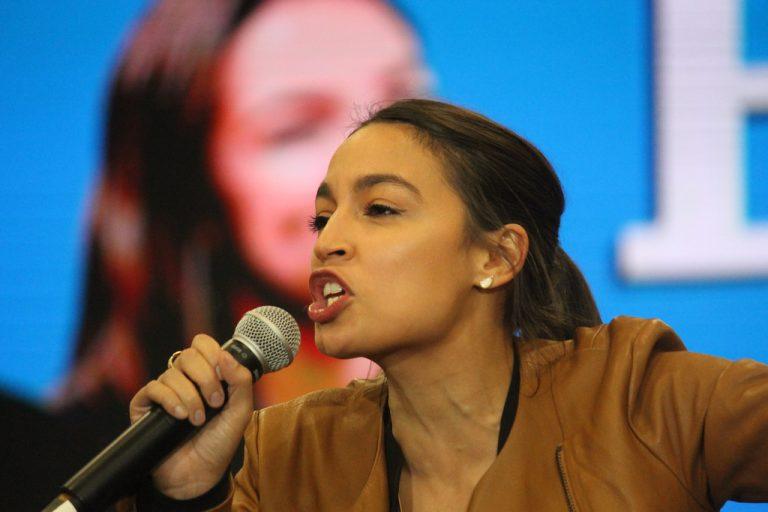
Rep. Alexandria Ocasio-Cortez, D-N.Y., claimed in bizarre Twitter rant on Monday that Republicans do not actually care about religion, and would not accept “Christ himself” if he “came to the floor of Congress and repeated his teachings.”

The Democratic socialist made the comments during Judge Amy Coney Barrett’s first day of confirmation hearings, after Republicans attacked Senate Democrats for trying to hold Barrett’s Catholic faith against her.

Quoting a speech she made on the House floor during a House Oversight hearing on religious freedom earlier this year, Ocasio-Cortez said:

Back in February, Ocasio-Cortez made a similar claim.

“Sometimes, especially this body, I feel as though if Christ himself walked through these doors and said what he said thousands of years ago, that we should love our neighbor and our enemy, that we should welcome the stranger, fight for the least of us,” she said during the hearing, “He would be maligned as a radical and rejected from these doors.”

Democrats have suggested that Barrett does not deserve to sit on the Supreme Court bench because she is a faithful Catholic.

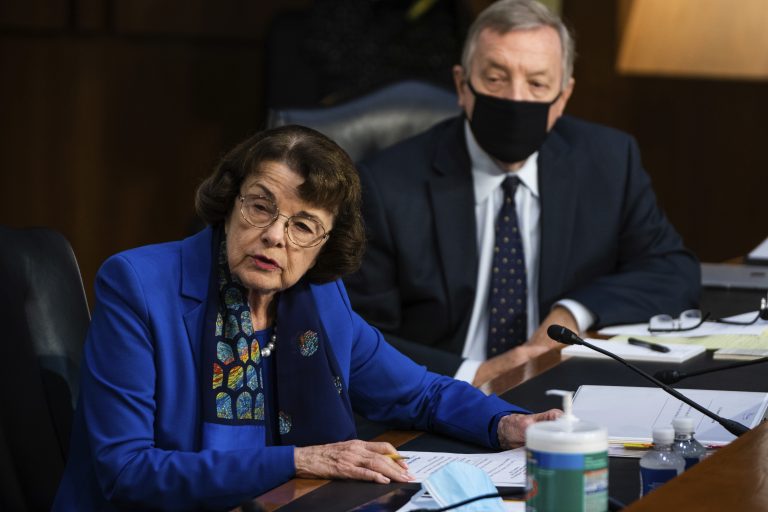
When she was nominated to the 7th Circuit Court of Appeals, Barrett was told by Sen. Dianne Feinstein, D-Calif., that her nomination was “controversial” because her Catholic “dogma lives loudly within you.”

Barrett, however, made it clear during her confirmation hearing that she would consider arguments based on their merits and according to the text of the law, not on her own personal preferences.

Leftist Group That Toppled Statues in Portland Wants to ‘Decolonize Society’

The leftist organization behind Portland’s “Day of Rage” riots said its ultimate goal is to “decolonize society by working to abolish colonial systems rooted in racism,” according to the Oregonian.

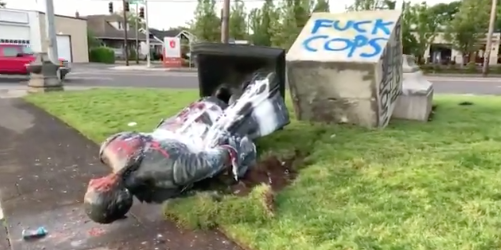
The group, known as Generational Resistance on Twitter, promoted Sunday’s riots in Portland that resulted in the toppling of an Abraham Lincoln statue and a Theodore Roosevelt statue, as well as damage to several private businesses.

Because the organizers rely primarily on social media to quickly organize and coordinate, Portland officials said they are having a difficult time cracking down on the destruction.

Generational Resistance organizers encourage protesters to shield their identities and keep others from taking pictures and videos of the events.

During Sunday’s riots, protesters were told to take “direct action” against individuals documenting the riots, and to dress in black and “cover up.”

Members of the group have called for the abolition of police, prisons, and capitalism, as well as a return of land to Native American communities and reparations for African American individuals affected by slavery.

“We stand to decolonize ourselves and decolonize society by working to abolish colonial systems rooted in racism and build community rooted in liberation,” the group said in a statement.

The “Indigenous Peoples Day of Rage” was organized by the group in response to Columbus Day, which is a federally recognized holiday.

More than 200 people gathered for the event, which was declared a riot by Portland police shortly after it began.

Protesters tore down statues of Lincoln and Roosevelt, calling them “colonizers.”

Biden Addresses Court-Packing, Sorta: ‘I’m Not a Fan’

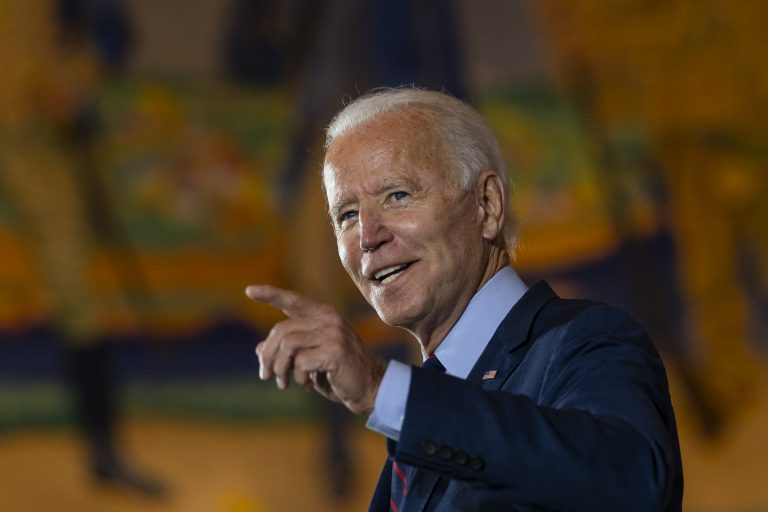
(Headline USA) Joe Biden says he is “not a fan” of adding seats to the Supreme Court, after weeks of avoiding questions about the idea that’s been pushed by progressives and used by Republicans to attack him.

“I’ve already spoken on — I’m not a fan of court packing, but I don’t want to get off on that whole issue. I want to keep focused,” the Democratic presidential nominee said in an interview Monday with Cincinnati’s WKRC.

Biden argued that the focus should remain on President Donald Trump and Republicans’ efforts to push through Amy Coney Barrett as a replacement for Justice Ruth Bader Ginsburg before the Nov. 3 election.

“That’s the court-packing the public should be focused on,” he said.

Biden has expressed opposition to the idea of expanding the Supreme Court before, but in recent weeks notably dodged multiple questions from the media about the proposal, insisting he would answer the question after the election.

Pressure on Biden to respond intensified after his running mate, California Sen. Kamala Harris, refused to answer the question during her debate with Vice President Mike Pence last week.

Harris, however, expressed support for court-packing during her primary bid for president, along with a number of other progressive candidates.

Faced with the prospect of a decades-long ideologically balanced court following Ginsburg’s death, the idea of adding seats to the nine-person court has gained renewed traction among Democrats.

That has Biden caught between the conflicting pressures of appeasing his progressive base and appealing to more moderate voters that may be open to voting for Biden but reluctant to support such sweeping structural reforms to the court.

Biden, who spent years as chairman of the Senate Judiciary Committee, expressed opposition to court-packing throughout the Democratic primary.

“No, I’m not prepared to go on and try to pack the court, because we’ll live to rue that day,” he warned in an interview with a local Iowa political blogger last summer.

But Biden has moved to the far left on issues like the Green New Deal, opposing fracking and reducing funding for law enforcement, to appease the radicals in his party.

In dodging the court-packing question in recent weeks, Biden has argued that the proposal is a distraction from GOP efforts to push through Ginsburg’s replacement.

Republicans have seized on Biden’s refusal to answer as evidence he is being disingenuous and would be beholden to the Left on the issue if elected.

“Biden evades “Court Packing” question. @FoxNews Because his puppet masters are willing to destroy the U.S. Supreme Court. Don’t let this, and so many other really bad things, happen. VOTE!” Trump tweeted earlier this week.

Adapted from reporting by Associated Press.

Silver is Critical in a High-Tech Society

0

(David Morgan, Money Metals News Service) Trust. When you lose trust, you’ve lost everything.

Consider this: At the present time the U.S. dollar is the most trusted “asset” in the world. I put quotes around asset because the U.S. dollar is actually a liability.

As trust in traditional investments like real estate, stocks, and bonds falters, the run to the dollar will inevitably take place, and soon after, the run to gold. You can already see the roots of this movement build. The dollar is not showing a great deal of strength at present, which leads me to believe that what comes next will be bifurcation: a fork in the road that dethrones the dollar as a safe haven, making gold the only true safe haven.

I might be getting ahead of myself. We’re not there yet. But it’s hard to ignore the fact that big money, smart money, is starting to move away from the dollar.

A testament to this is my personal experience with the March stock market washout. Investors with millions of dollars, who had never bought gold before in their lives, were eager to take action and move away from the bank and into gold.

This isn’t to say that the U.S. dollar value will go to absolute zero. It will not become absolutely worthless, but the fear of it reaching that point will take enough of the public’s consciousness on a global basis. The resulting run to gold will be so grand; it’ll go down in the history books.

The Banker’s Last Vestige of Hope

Cash has been considered sacrosanct, and most people don’t understand the gold market and how it functions. As a result, people tend to trust their local currency the most. Some countries more than others, and all trust the U.S. dollar as the most trustworthy.

However, when this belief system gets questioned as gold’s value increases in global currencies and surpasses all-time highs, some may recognize too late that the fiat systems are failing, and even the U.S. dollar is not worth holding.

Gold continues to move higher, but nothing about gold has changed. An ounce of gold is an ounce of gold. What is changing is the acceleration in the trust in currencies – all currencies.

These currencies will go up and down against each other. This is what I refer to as ‘the banker’s last vestige of hope’: when they try to convince people that one currency is stronger than others when, in reality, it isn’t. The perceived strength of a currency is simply a function of which country is printing money the fastest and who has got the most psychological cognitive control to make you think that your currency is stronger against another country’s currency.

The Restless Metal in a High-Tech Society

Professor Roy W. Jastram, author of Silver: The Restless Metal, concludes in his book that if there is an increase in the monetary base, it is silver, not gold, that is the best place to be. In other words: monetary inflation. He did not speak about the velocity of money and this is an important factor. However, I agree with Professor Jastram when the public gets the idea inflation is destroying their purchasing power, their savings, their future, many will seek safety. And there is nothing safer in a financial panic than the precious metals.

However, the problem with silver on a global basis is it is not easy to obtain in many foreign countries. While the U.S. has a good base to buy physical silver, countries in Europe and Asia impose a value-added tax and make it difficult to purchase. Gold, on the other hand, is far more accessible and easier to purchase overseas. If that were the case with silver, there would be many more people holding silver than there is now.

More than gold, silver is vulnerable to supply shortages due to its crucial role in our high-tech society. Consider the emerging technology of 5G phones. Most phones on the market today are not equipped to handle 5G technology, but as the global trend shifts towards integrating 5G infrastructures, it will not be long before new phones are produced to accommodate.

And these new phones will need silver: approximately 88 Million ounces of it. Do not underestimate the demand for silver just because its supply now appears to be plentiful.

As much as we hear the gold story, it truly is silver that keeps the economy running. Oil may be far more important than silver, but that does not negate the fact that we need silver to continue to operate in today’s world. The banking system cannot run without computers and there is silver in their computers, and we cannot communicate without the silver as it is required in all communications landline or wireless.

Silver is more critical than most people ever consider because it is ubiquitous. It is everywhere, in a very small amount. Every day, we handle little silver fragments, and we never even think about it—food for thought.

I discussed these topics in more detail earlier this week in an interview with FX Strategies. You can watch the full interview above…Original Source

A widely recognized expert on silver, David Morgan began investing in stocks and precious metals as a teenager. He obtained degrees in finance and economics as well as engineering. Author of the book The Silver Manifesto, he has devoted more than 30 years to educating investors on opportunities to protect and grow their wealth. In addition to advising private clients and fund managers, he writes at The Morgan Report, covering economic news, the global economy, currency debasement, and stellar opportunities in precious metals and mining stocks.

Dems’ Scare Tactics About Obamacare in Barrett Hearings are Unfounded

(Headline USA) To hear Democrats tell it, a Supreme Court with President Donald Trump‘s nominee Amy Coney Barrett could quickly get rid of the law that gives more than 20 million Americans health insurance coverage.

But that’s not the inevitable outcome of a challenge the court will hear Nov. 10, just one week after the election.

Yes, the Trump administration is asking the high court to throw out the Obama-era healthcare law, and if she is confirmed quickly Barrett could be on the Supreme Court when the court hears the case.

But even if the justices agree that the law’s mandate to buy health insurance is unconstitutional because Congress repealed the penalties for not complying, they could still leave the rest of the law alone. That would be consistent with other rulings in which the court excised a problematic provision from a law that was otherwise allowed to remain in force.

Democratic lawmakers, without evidence, sounded alarm bells Monday, the start of four days of hearings before the Senate Judiciary Committee for Barrett.

The party’s vice presidential nominee, Sen. Kamala Harris, who sits on the committee, said Republicans are “trying to get a justice onto the Court in time to ensure they can strip away the protections of the Affordable Care Act.”

“If they succeed, it will result in millions of people losing access to health care at the worst possible time: in the middle of a pandemic,” the California senator said, reciting a claim she consistently uses on the campaign trail.

Sen. Dianne Feinstein, California’s other senator and the committee’s senior Democrat, said, “Health care coverage for millions of Americans is at stake with this nomination.” And Sen. Sheldon Whitehouse of Rhode Island called Barrett’s nomination a “judicial torpedo aimed” at Affordable Care Act protections, including for preexisting health conditions.

Other Democrats on the panel made similar points.

Democrats also repeatedly brought up words Barrett wrote in 2017, when she was a law professor, criticizing Chief Justice John Roberts’s 2012 opinion saving the Affordable Care Act. Barrett wrote that Roberts had “pushed the Affordable Care Act beyond its plausible meaning to save the statute.”

After that 5-4 ruling, which split the court along ideological lines, the justices rejected a second major challenge to the healthcare law by a vote of 6-3 in 2015.

The case before the court this year stems from Congress’s decision in 2017 to eliminate the law’s unpopular fines for not having health insurance. Despite repealing the fines, lawmakers left in place the law’s requirement that virtually all Americans have coverage. Texas and other conservative-led states argue that the change makes the requirement unconstitutional and also dooms the rest of the law because the mandate was so central to it.

But the court could simply “sever” the mandate from the law and leave the rest of the law alone. Many observers see that as a likely outcome and note the upheaval that would result across the American healthcare system if the law were to be struck down in its entirety.

Before the Supreme Court’s term began in October, Paul Clement, who argued in the 2012 Affordable Care Act case, said he wasn’t sure that the addition of a new justice would change the outcome of the case. He suggested that it is unlikely that the whole statute will fall.

“I think the challengers have a very uphill battle” in arguing that the ACA should be struck down in its entirety, he said during a virtual event organized by Georgetown’s law school.

Another participant in that event, Roman Martinez, agreed. He said he thought it could be a case that surprises some people in that the justices might be able to resolve it in a broad agreement, rather than along partisan lines.

The case could also be rendered virtually meaningless if a new Congress were to restore a modest penalty for not buying health insurance, though that seems unlikely to happen.

One other key observer of the case suggested the Affordable Care Act would likely stand. Earlier this year, Virginia’s William & Mary law school held a mock argument in the case. While the individual votes were not made public, no one on the eight-person panel — which included judges, law professors and a journalist — voted to strike down the entire law.

Among those playing the role of justice: Amy Coney Barrett.

Adapted from reporting by Associated Press.

Trump Defends Virus Record in 1st Post-COVID Rally

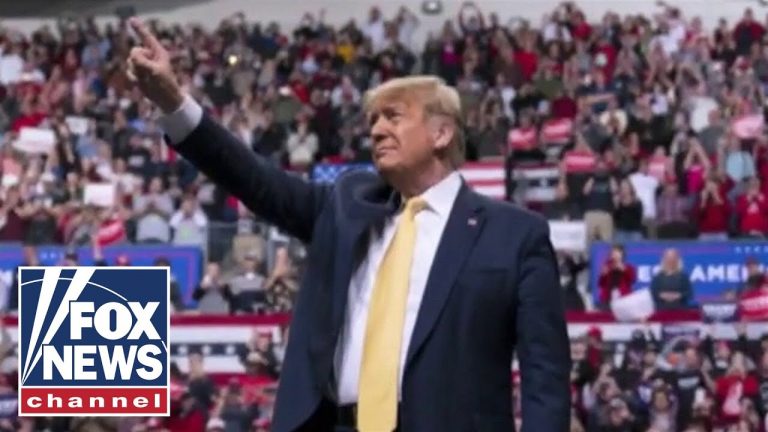
(Headline USA) Defiant as ever about the coronavirus, President Donald Trump on Monday turned his first campaign rally since contracting COVID-19 into a full-throated defense of his handling of the pandemic, joking that he was healthy enough to plunge into the crowd and give voters “a big fat kiss.”

There was no social distancing and mask-wearing was spotty among the thousands who came to see Trump’s return to Florida.

“Under my leadership, we’re delivering a safe vaccine and a rapid recovery like no one can even believe,” Trump insisted. “If you look at our upward path, no country in the world has recovered the way we have recovered.”

Boisterous and bellicose, Trump thanked the audience for their well-wishes and declared he was no longer contagious as he embarked on a frenetic final stretch of the campaign.

He insisted that, after being given experimental medication and other VIP treatment, he felt great and was glad he no longer needs to be concerned about infection because he’s now “immune.”

“I feel so powerful,” said Trump, displaying no obvious signs of lingering infection. “I’ll walk into that audience. I’ll walk in there, I’ll kiss everyone in that audience. I’ll kiss the guys and the beautiful women … everybody. I’ll just give ya a big fat kiss.”

Despite Trump’s battle with a deadly disease, it was striking how little had changed. Threats to smooch audience members aside, the rally felt like so many others during the pitched general election battle against Democrat Joe Biden.

Trump returned to his many usual attack lines, slamming Democrats as “engaged and unhinged and out for vengeance,” and hyping “tremendous progress” on virus therapeutics. He promised the third-quarter economy would be “record-setting” and claimed that, if he wins in November, “normal life” will resume, while Biden would delay the vaccine and destroy the economy with a “draconian” lockdown.

And when he was done, with his new exit song, The Village People’s “YMCA,” blaring over the loudspeakers, the president did what has become his trademark dance, pumping his fists somewhat in time to the beat as the crowd roared. But he kept his distance from the audience.

Florida is seen as crucial to his reelection chances. Trump narrowly beat his 2016 rival, Democrat Hillary Clinton, in the state by just over 112,000 votes.

Underscoring the importance of Florida, Trump will be back in the state Friday for another rally, this time in Ocala.

Trump’s Sanford rally was his first stop in a busy week that will include events in Pennsylvania, Iowa, North Carolina, Georgia and Wisconsin. The robust schedule is a stark contrast to the limited and poorly-attended events staged by Biden’s campaign.

After Air Force One lifted off from Joint Base Andrews, the president’s doctor released an update on his health that said Trump had tested negative for the virus — and had done so on consecutive days. His doctor, Navy Cmdr. Scott Conley, said the tests, taking in conjunction with other data, including viral load, have led him to conclude that Trump was not contagious.

Trump’s decision to so quickly return to the campaign trail drew criticism from Biden and other Democrats.

“President Trump comes to Sanford today bringing nothing but reckless behavior, divisive rhetoric, and fear mongering,” Biden said in a statement. “But, equally dangerous is what he fails to bring: no plan to get this virus that has taken the lives of over 15,000 Floridians under control.”

Trump continued to mock Biden for his efforts to encourage social distancing at his campaign events, deriding as “crazy” the circles Biden’s campaign uses to delineate individual space.

“He’s got a lot of bad days coming,” Trump said at another point.

Adapted from reporting by Associated Press.

Dems Try to Intimidate Republicans to Keep Them from Using Calif.’s Liberal Ballot Harvesting Laws

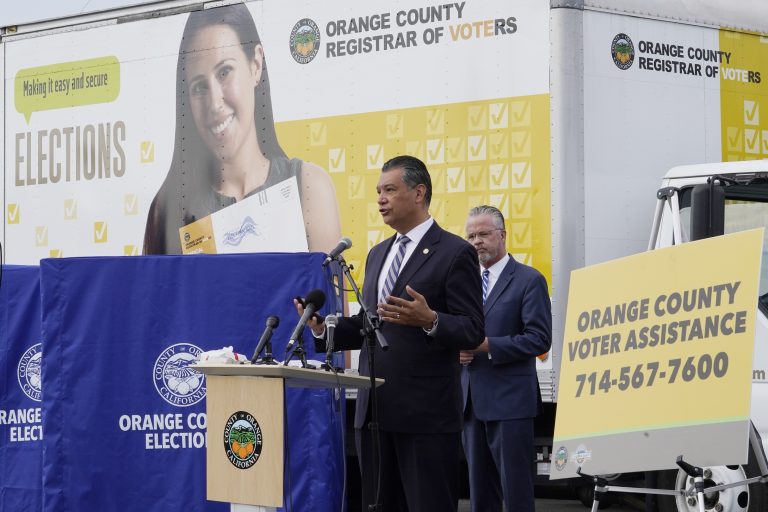
(Headline USA) California‘s chief elections official on Monday ordered Republicans to remove unofficial ballot drop boxes from churches, gun shops and other locations and Attorney General Xavier Becerra, presuming illegal activity without evidence, warned those behind “vote tampering” could face prosecution.

Republican refused, saying they are taking advantage of California’s liberal ballot collection law that allows anyone to collect ballots from voters and deliver them to county election offices.

“As of right now, we’re going to continue our ballot harvesting program,” California Republican Party spokesman Hector Barajas said.

Due to the coronavirus and concerns about health safety at polling places, California for the first time mailed ballots for the Nov. 3 election to all active registered voters — more than 21 million people. The ballots come with pre-paid envelopes for voters to mail back, free of charge.

State law also allows county election officers to set up drop boxes throughout the county where people can drop off their ballots in person. The secure boxes can sometimes weigh more than 600 pounds and are monitored frequently by local election officials.

Republicans have set up their drop boxes at churches, gas stations and gun shops in at least three California counties. Some are identified as “secure ballot dropoff location,” while others say “approved and bought by the GOP.”

The party declined to say precisely how many boxes have been distributed and where they all have been placed.

Secretary of State Alex Padilla, a Democrat, said state law only allows county election officials to set up official ballot drop boxes, with rules for how often the ballots are retrieved. He said these unofficial drop boxes lack those protections, making them vulnerable to tampering.

Padilla had his chief legal counsel send Republicans a letter on Monday ordering them to remove those boxes by Thursday. He also ordered them to provide the state with the names, addresses and birthdays of all voters who have already dropped off ballots.

Becerra, also a Democrat, went further, ramped up the intimidation and threatened to prosecute “anyone who knowingly engages in the tampering or misuse of a vote.”

“We hope that the message goes out loud and clear to anyone who is trying to improperly solicit, obtain, and manage a citizen’s vote that they are subject to prosecution,” Becerra said. “I’m trying to be careful with how I say this, but the reports we are hearing are disturbing.”

Padilla declined to speculate on why Republicans would be collecting votes via unofficial drop boxes.

“Our interest is in protecting the integrity of this election,” he said.

Barajas said the party’s drop boxes just provide voters with “another opportunity” to cast their ballots.

In a news release, the California Republican Party said state law does not specifically ban them from collecting ballots in a box. They say the law only prevents tampering or forging ballots and that people collecting the ballots cannot be paid for doing it.

“It appears Republicans are well within their right to collect ballots in this manner. It’s just that Democrats don’t like it,” Republican state Sen. Melissa Melendez posted to her official Twitter account.

Democrats have used ballot harvesting in California to turn Congressional seats in their favor in recent years, after some initially appeared to be going Republican.

The controversy surfaced during the weekend after state election officials received reports of the boxes in Fresno, Los Angeles and Orange counties, all areas with highly competitive U.S. House races. Democrats have blasted the use of the unofficial boxes and say they fear Republicans could use them to gather and discard ballots.

Officials in Ventura County also said Monday that they had received reports of groups promoting unofficial ballot drop boxes.

In California, state law says voters who can’t return their ballots themselves can ask anyone else to do it for them. Previously, people who returned a ballot for someone else also had to sign it and list their relationship to the voter. But a separate law passed in 2018 eliminated that requirement.

In Orange County, which is home to 3 million people between Los Angeles and San Diego, a regional field director for the state GOP posed for a photo with one of the boxes. The image posted to social media showed him wearing a face covering supporting the congressional campaign of Michelle Steel, a Republican county supervisor.

Steel is challenging Democratic U.S. Rep. Harley Rouda for his seat representing a coastal district. Rouda flipped the seat two years ago from longtime Republican Rep. Dana Rohrabacher.

Orange County Registrar of Voters Neal Kelley said official drop boxes are clearly recognizable and carry official county elections logo. He said it wasn’t clear how many voters had used unofficial boxes but after receiving reports about them, he notified the state and district attorney’s office, which is investigating.

Rachel Potucek, a spokeswoman for the Democratic Party of Orange County, said she didn’t know what Republicans planned to do with the ballots they collected and worried they could target Democratic areas with boxes to suppress votes.

There also were reports of GOP drop boxes at a church in the Los Angeles County community of Castaic and at various locations in Fresno County in California’s farm-rich Central Valley.

Fresno County Republicans said they will remove the boxes and ballots will be turned in to county election officials, which was always the plan, the Sacramento Bee reported.

Adapted from reporting by Associated Press.