Roberta McCain, John McCain’s Mother, Dies at 108

(Associated Press) Roberta Wright McCain, the mother of the late Sen. John McCain who used her feisty spirit to help woo voters during his 2008 presidential campaign, has died. She was 108.

A spokesperson for daughter-in-law Cindy McCain says Roberta McCain died Monday. A cause of death was not immediately released.

“It is with great sadness that I announce the death of my wonderful Mother In-law, Roberta McCain,” Cindy McCain posted on Twitter. “I couldn’t have asked for a better role model or a better friend.”

In a tweet, granddaughter Meghan McCain thanked her “Nana” for teaching her how to live life with “grit, conviction, intensity and love.”

“There will never be another one like you, you will be missed every day. I wish my daughter had gotten to meet you,” said McCain, who gave birth to her first child last month.

At 96, Roberta McCain became the Republican senator’s secret weapon at campaign stops as evidence that voters need not worry about her son’s age — then past 70 — as he sought the presidency.

She once said her son liked to hold her up as an example of “what he hopes his lifespan will be.”

In August 2018, however, it was the mother who ended up mourning the son when John McCain died of brain cancer. Despite being slowed by a stroke, Roberta McCain attended the memorial and burial services in Washington and Maryland for the middle son she called “Johnny.”

She remained energetic and active into her 90s, traveling often with her identical twin sister Rowena, who died at age 99. She attended the 2008 Republican National Convention, where her son credited “her love of life, her deep interest in the world, her strength, and her belief we are all meant to use our opportunities to make ourselves useful to our country.”

It was 1933 when a 20-year-old Roberta Wright defied her family and eloped with John McCain Jr. Documents released in 2008 showed that as a young ensign, John Jr. got into trouble when the couple decided to marry and he left his ship without permission.

“I got married young,” she told The Muskogee Phoenix in her native Oklahoma in 2008. “I was 20 years old, and it was the best decision I ever made.”

She married into a storied military family — her husband retired in 1972 with the rank of four-star admiral, the same rank held by his father, John S. “Slew” McCain Sr. Her son was held as a prisoner-of-war in Vietnam even as his father was commander in chief of Pacific forces in the late 1960s.

Roberta McCain was a young woman when her three children were born, later telling the Oklahoma paper that she was “too young and irresponsible to know you were supposed to worry about them. I just let them go. I got a kick out of watching them.”

The senator said in 2008 that his “father was often at sea, and the job of raising my brother, sister and me would fall to my mother alone.”

Her other son, Joe, told The Associated Press in 2007 that the family had endless dinner-table discussions about history, politics and legislation led by their mother.

“We were all basically on the same side of the fence,” Joe McCain said. “But it was like Talmudic scholars arguing about a single word or an adjective in the Testament.”

Joe McCain was at his mother’s side at her Washington home when she died, according to a statement from Cindy McCain. Roberta McCain’s daughter, Jean McCain, died last year.

When Sen. John McCain wrote a memoir about his experience as a POW for nearly six years in a north Vietnamese prison, he described times when he swore in English at his Vietnamese guards, who didn’t understand.

His mother later told him: “Johnny, I’m going to come over there and wash your mouth out with soap.”

Meghan McCain recalled her grandmother’s strong will and sense of duty in a 2012 column for The Daily Beast website, writing that Roberta McCain did not have “a lot of patience for excuses, especially from my father when he was growing up and acting out.”

“She once hit him over the head with a thermos in the back of a car because he was acting up so badly on a road trip,” Meghan McCain wrote.

The McCain matriarch’s spunky personality became the stuff of stories for the family — and among those in their circle of Washington society.

“Last Christmas, she wanted to drive around France. So she flew to Paris and tried to rent a car,” the senator once joked. “They said she was too old, so she bought one and drove around France.”

Cindy McCain wrote Monday that “Roberta was the liveliest presence in every room she graced, an irresistible force of nature.”

Roberta Wright was born Feb. 7, 1912, in Muskogee, Oklahoma, where her father was a businessman whose varied, colorful enterprises included bootlegging and oil wildcatting. The family moved to Los Angeles in the mid-1920s.

Her husband commanded submarines in World War II and was second in command of the cruiser St. Paul during the Korean War. He later held key posts including the Navy’s chief of congressional liaison, and died in 1981.

In 1934, when a fitness report deemed him underweight, the future admiral wrote: “My wife doesn’t know how to cook, and my meals are very irregular.”
Dems Seethe as Graham Truncates Timeline for Barrett Hearings

Sen. Lindsey Graham, R-SC, the chair of the Senate Judiciary Committee noted in his opening remarks on Monday that he really didn’t need to have a committee hearing for Supreme Court nominee Amy Coney Barrett.

Although the hearings are a time-honored formality, the growing partisan divide over judicial nominees, along with Democrats’ history of 11th-hour scheming to derail prior GOP judges and the already compressed timeline, had prompted some GOP colleagues to call for him to bypass the hearing phase altogether.

“This is probably not really about persuading each other,” Graham said.

“…But the hearing is a chance for Democrats to dig deep into her philosophy,” he said. “Most importantly it gives you a chance—the American people—to find out about Judge Barrett.”

By most reasonable standards, despite Democrat senators’ efforts not to talk about Barrett or her qualifications at all for much of the hearing’s first day, she came off exceeding the low bar that much of the media had set for her.

Along with Barrett’s own remarks, which made her seem highly relatable, her longtime friend and supervisor, Prof. Patricia O’Hara of the Notre Dame Law School, heaped praise on her professionalism and impartiality in the classroom.

“At the very beginning let me observe as Sherlock Holmes famously observed that what speaks the loudest is the dog that didn’t bark—which is, to date, of every Democrat who’s spoken, we’ve heard virtually not a single word about Judge Barrett,” said Sen. Ted Cruz, R-Texas, while prefacing his remarks.

He and other GOP members said Democrats had resorted to their deflection efforts because there was nothing they could say to undermine Barrett.

And Sen. Mike Crapo pointed out that despite the tone of hysteria in their fearmongering talking-points regarding a repeal of the Affordable Care Act, Democrats really didn’t seem in that great of a rush to address it prior to Barrett’s nomination.

“If Senate Democrats were half as concerned as they say about American families’ healthcare, they would not have filibustered a multi-hundred-billion-dollar proposal for more coronavirus relief just a few weeks ago,” he said.

While Graham praised the mostly respectful proceedings—a far cry from the petty disruptions that accompanied those of Justice Brett Kavanaugh in 2018—he roiled the opposition by announcing late Monday that he planned on moving into the next phase of the confirmation on Thursday morning, even though Thursday had been earmarked for committee questions.

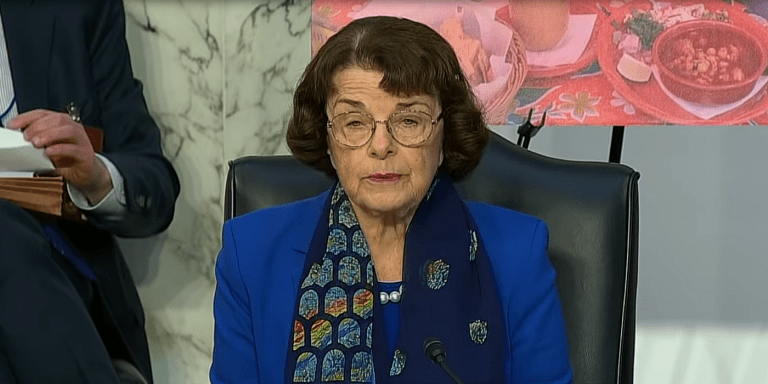
That cuts by a full quarter the opportunity that Sen. Dianne Feinstein, D-Calif., and others might have to pull off a late surprise.

Feinstein reacted indignantly by claiming it was a breach in tradition.

“Chairman Graham’s announcement that he will hold Judge Barrett’s first committee markup on Thursday morning, before we’ve even finished her hearing, is unprecedented in my time on the committee,” she claimed.

“It’s another example of Republicans ignoring rules and tradition so they can rush this nominee through before the election—and in time to supply a vote to strike down the Affordable Care Act,” she said.

Meanwhile Senate Minority Leader Charles Schumer—who recently claimed that nothing would be “off the table” in Democrats’ plans to undermine Barrett’s confirmation—reeled at being outmaneuvered by attacking Graham.

“Republicans continue to ignore norms and break promises in an effort to jam through a nominee who puts critical health care protections for 130 million Americans at risk,” he complained.

“By jumping to the next step in the process before Judge Barrett’s hearing is complete, Chairman Graham is showing that even he considers this process to be an illegitimate sham,” he added.

Earlier in the day, Schumer vowed that Democrats would do their best to boycott by refusing to give a quorum to advance the nomination.

Graham’s sly scheduling may ensure that those wishing to be present for the final day of questioning may be obligated to help initiate the committee voting also.

ACB, Kamala Invite Stark Contrasts at Senate Hearing as Both Audition for Higher Office

Two women were auditioning for historically important roles during Monday’s Senate Judiciary Committee hearing.

Both Sen. Kamala Harris, D-Calif., and Judge Amy Coney Barrett sought to use the highly watched platform to sell their respective visions for America.

Both used remarks that were prepared in advance.

Both paid heartfelt tribute to the late Justice Ruth Bader Ginsburg.

But that is where the similarities stopped short between the Democrat vice-presidential nominee and President Donald Trump’s Supreme Court nominee as each races toward her final verdict by juries comprising either the U.S. Senate or the American electorate.

Harris, who was “zooming” in to the hearing from what appeared to be her home state of California, likely felt the burden to come across as kinder and gentler than she did during the disruptive and disrespectful 2018 committee hearings for Justice Brett Kavanaugh.

Through that and other prosecutorial grillings on the committee, Harris built her brand in the Senate as a no-nonsense vanguard for the extreme Left—a hard-nosed foil to Trumpism who might, at the very least, inflict some measure of pain and suffering upon the ruling majority party.

But she struggled with reinventing her persona during her own presidential campaign and now as part of the ticket with presidential hopeful Joe Biden.

Harris’s opening statement for the hearing bore similarities to other recent public forums, including last week’s vice-presidential debate against Republican incumbent Mike Pence.

In both cases, her remarks had a staged and scripted feel—and although there were moments written in for her to exhibit her personal warmth and charisma, Harris largely fell back on a more toothless variation of the familiar attack-dog role she has played in the past.

More than seven minutes of her 10-minute speech was a carbon-copy of the talking points deployed by Democrats throughout the day.

Harris and others sought to link Barrett’s confirmation with a case scheduled to be heard on Nov. 10 that threatens to dismantle the Affordable Care Act.

“Republicans finally realize that the ACA is too popular to repeal in Congress,” Harris claimed. “So now, they are trying to bypass the will of the voters… that’s a big reason why Senate Republicans are rushing this process.”

There is no evidence suggesting that Barrett’s confirmation has anything to do with the upcoming Texas v. California case, in which the court will rule on whether the ACA’s now-defunct individual mandate is severable from the other aspects of the massive 2010 healthcare bill.

However, Barrett had previously criticized the reasoning of Chief Justice John Roberts for allowing the law to stand, despite what some maintain was an unconstitutional rationale in declaring the insurance penalty to be a “tax.”

Harris’s politically motivated allegation seemed more designed to drive voters to the polls on Nov. 3 than to raise any red flags about Barrett’s judicial fitness. But her hyperbolic attack didn’t end there.

Harris went on to imply that Barrett would roll back the protections afforded by other landmark court cases—some dating back more than six decades—including the court’s rulings on school integration and interracial marriage.

“The United States Supreme Court is often the last refuge for equal justice when our constitutional rights are being violated,” Harris said.

However, by nominating Barrett to fill the seat, “President Trump is attempting to roll back Americans’ rights for decades to come,” she claimed.

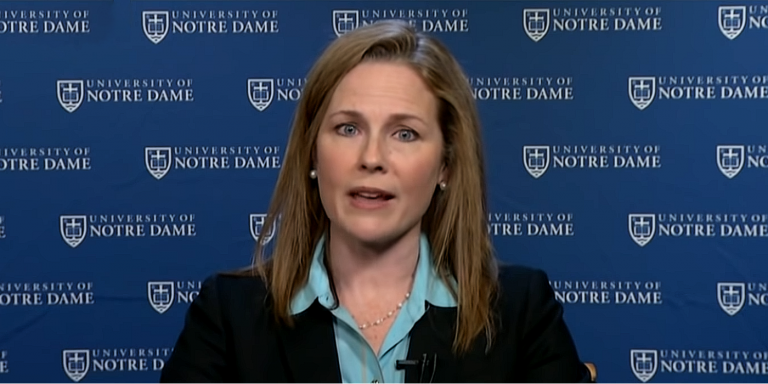
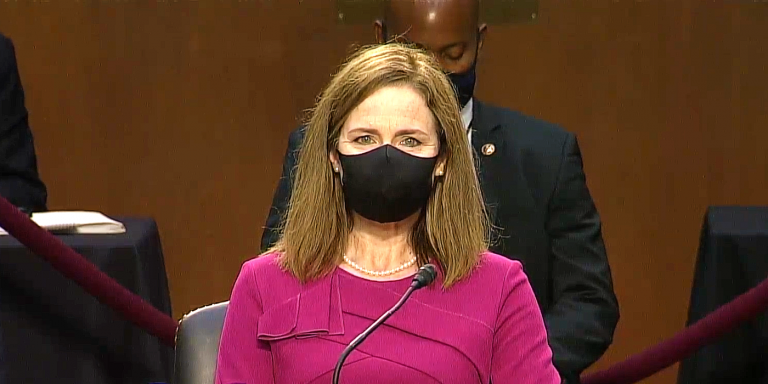
Barrett, meanwhile, sat in the committee hearing room with her husband and six of her seven children—including two adoptive Haitian children. Her youngest child, who has Down syndrome, remained at home with friends, she said.

Like Harris, Barrett spoke from a script, with her prepared remarks having been made available in advance of the hearing.

The New Orleans native offered praise to her lifetime of professional mentors, including the late Justice Antonin Scalia, whose constructionist judicial philosophy was the model for her own outlook.

“I felt like I knew the justice before I ever met him because I had read so many of his colorful, accessible opinions,” she said.

“More than the style of his writing, though, it was the content of Justice Scalia’s reasoning that shaped me,” she continued. “His judicial philosophy was straightforward: A judge must apply the law as written, not as the judge wishes it were.”

Barrett said that when issuing a ruling, she tried to imagine how she would feel if her own children were the losing party.

Barrett’s heartland charm seemed more likely to resonate with the average American than Harris’s lofty and aloof persona.

If approved, she seemed poised to sway the entire Supreme Court in a vastly different direction—and not simply by solidifying its conservative majority for the time being.

As she pointed out, she would be the only justice without an Ivy League diploma—although “I am confident that Notre Dame will hold its own, and maybe I could even teach them a thing or two about football,” she said.

Barrett also would be “the first mother of school-age children to serve on the Court” and the first justice in nearly half a century to hail from the 7th circuit, which maintains jurisdiction over Wisconsin, Illinois and Indiana.

As if her relatability weren’t enough to sell her, Barrett also exhibited a particular grace in honoring her would-be predecessor, the liberal icon Ginsburg.

“I have been nominated to fill Justice Ginsburg’s seat, but no one will ever take her place,” Barrett said. “I will be forever grateful for the path she marked and the life she led.”

Sasse Takes Down Grandstanding Dems at Barrett Hearing w/ 8th-Grade Civics Lesson

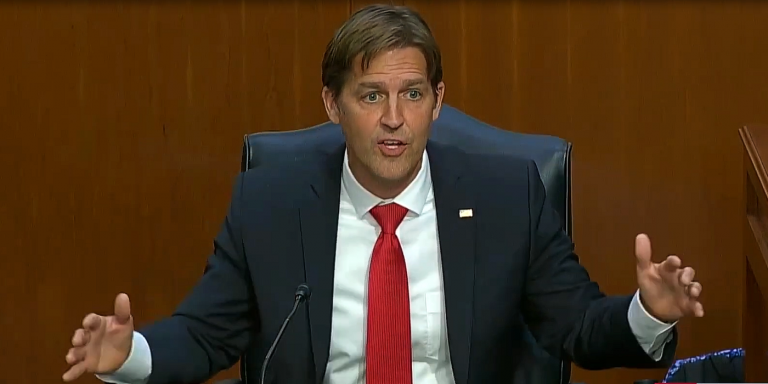
Some on the Left would no doubt accuse Sen. Ben Sasse, R-Neb., of attempting to “mansplain” the Supreme Court confirmation process of Judge Amy Coney Barrett on Monday.

But after a weekend in which Democrats and their media allies attempted to redefine the concept of “court packing” in order to euphemize and justify the politicization of the judicial branch, Sasse decided to use his allotted time during an opening statement to reteach junior-high lessons about the fundamentals of government.

“Huge parts of what we’re doing in this hearing would be really confusing to eighth-graders if civics classes across the country tuned into this hearing and tried to figure out what we’re
here to do,” Sasse said.

His lesson followed a morning of grandstanding Senate speeches that focused more on relitigating the Affordable Care Act than discussing Barrett’s qualifications.

While attempting a “spaghetti on the wall” approach to thwart or delay Barrett’s confirmation, many of the Democrats on the Senate Judiciary Committee used a Nov. 10 court case, Texas v. California, to try to frighten the public in the hopes of shifting a handful of GOP senators to block the inevitable vote.

The case will determine whether the ACA (better known as Obamacare) is unconstitutional after Trump’s 2017 Tax Cuts and Jobs Act eliminated the individual mandate requiring those uninsured to purchase insurance.

The law was previously upheld by Chief Justice John Roberts based on the contrived reasoning that the fees associated with the mandate constituted a tax rather than a penalty.

But a Texas judge determined that without the mandate in place, the whole law may now be in jeopardy since the mandate was inseverable from the legislation.

As Sen. Ted Cruz, R-Texas, noted, 100 percent of senators supported the idea of protecting pre-existing conditions, meaning they might pass new legislation to protect it.

But Democrats, such as a teary-eyed Sen. Amy Klobuchar, D-Minn., filled the chamber with visual aids of people whom they claimed would be devastated by the end of Obamacare.

“To all Americans, we don’t have some clever procedural way to stop this sham—to stop them from rushing through a nominee,” Klobuchar said.

“But we have a secret weapon that they don’t have,” she continued. “… [I]t is you calling Republican senators and telling them enough is enough.”

For Sasse, however, Klobuchar’s over-the-top theatrics seemed to be enough.

Although he acknowledged that he felt moved by the “really painful stories” she had cited and even agreed with her at times about the mishandling of the coronavirus, “I don’t know what any of that has to do with what we’re here to do today,” he said.

Many of the arguments, ostensibly in opposition of Barrett’s confirmation, seemed better suited to the 2009 Finance Committee debates over the drafting of the Obamacare legislation, he said.

“So, I think it would be very useful for us to pause and remind ourselves and do some of our civic duty to eighth graders to help them realize what a president runs for, what a senator runs for and, on the other hand, why Judge Barrett is sitting before us today.”

Sasse explained that civics should be the most basic aspects of government things that everyone agreed on regardless of their stance on political issues.

However, Democrats in the Trump era seem determined to dismantle the basic civic foundations of the government in order to benefit their own political agenda.

The attacks on Barrett were one example of that, he noted, arguing that everyone should be able to agree that “religious freedom” was a basic and undisputed tenet provided for by the Constitution.

As such, he condemned the past words of committee members like Sen. Dianne Feinstein, D-Calif., the ranking minority member, who accused Barrett of being too dogmatic in her Catholic faith.

Sasse noted that two things both sides should be united in opposing were judicial activism and court packing, both of which diminish the balance of powers and the systems of accountability established in the Constitution by turning the courts into a “super-legislative” body that is unelected and enjoys lifetime appointments.

Like several others, Sasse lamented the bygone era in which ideological “bookends” like the late Justices Antonin Scalia and Ruth Bader Ginsburg not only maintained a personal friendship outside the court, but also enjoyed near-unanimous bipartisan support during their confirmation hearings.

The reason for the current gridlock, Sasse said, was the fact that many Americans now lacked the basic understanding of American government that was necessary to make informed decisions.

“If we can back up and do a little bit of eighth-grade civics, I think it would benefit us and benefit the watching country,” he said.

Top WHO Official: Stop ‘Using Lockdowns’ to Control COVID

A top official at the World Health Organization urged world leaders to stop “using lockdowns” as the “primary control method” when fighting the coronavirus pandemic.

Studies have shown that the lockdowns many countries adopted to stop the spread of COVID-19 have resulted in hundreds of thousands of job losses, plunging nearly 100 million people around the world into “extreme poverty,” according to the Wall Street Journal.

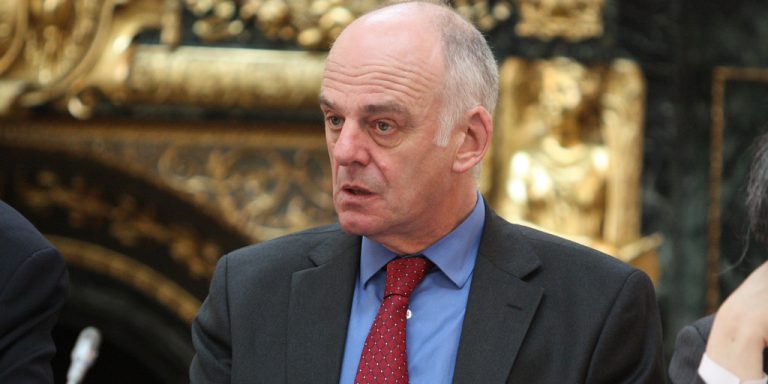
World leaders should keep this in mind as they continue to battle the coronavirus, said Dr. David Nabarro, the WHO’s special envoy on COVID-19.

“We in the World Health Organization do not advocate lockdowns as the primary means of control of this virus,” Nabarro told the Spectator. “The only time we believe a lockdown is justified is to buy you time to reorganize, regroup, rebalance your resources, protect your health workers who are exhausted. But by and large, we’d rather not do it.”

The economic effects of the shutdown will have long-term consequences that will take years to rectify, Nabarro argued.

“Just look at what’s happened to the tourism industry in the Caribbean, for example, or in the Pacific because people aren’t taking their holidays,” he explained. “Look what’s happened to smallholder farmers all over the world because their markets have got dented. Look what’s happening to poverty levels.

“It seems that we may well have a doubling of world poverty by next year. We may well have at least a doubling of child malnutrition.”

“This is a terrible, ghastly, global catastrophe, actually,” Nabarro continued. “And so we really do appeal to all world leaders: Stop using lockdown as your primary control method.”

Nabarro’s comments come as several European countries consider shutting their economies down to flatten the curve of what appears to be a second wave of COVID-19.

But instead of shutting down, world leaders need to “develop better systems” to contain the spread, said Nabarro.

“Remember, lockdowns have just one consequence that you must never ever belittle, and that is making poor people an awful lot poorer,” Nabarro said.

Dozens of Black Employees Say Planned Parenthood Has a Racism Problem

Dozens of black employees at Planned Parenthood reported encountering racism in the workplace, according to a recent investigation.

The Anti-Oppression Resource and Training Alliance conducted an internal audit of the national organization, which was based on interviews with 64 current and 12 former black employees.

Almost every one said they were subject to racist comments or actions while working for Planned Parenthood, according to Buzzfeed News.

Many of these employees reported the encounters, but the company’s Human Resources department delivered “no meaningful consequence or accountability for racial harm,” the audit states.

“I imagine that little of it will be surprising to you that the collective experience of black staff at Planned Parenthood is as heavy as it is,” Autumn Brown, an AORTA staff member who presented the findings, said. “What we were looking for was to understand … what is the collective experience of being black at Planned Parenthood? Because regardless of the individual facts of the individual incidences, if we have enough incidences that look like X, we know that that means Y.”

A Buzzfeed News investigation earlier this summer found similar results.

Many black employees said they were belittled by their bosses, and that they were unable to climb the corporate ladder, unlike their colleagues.

Planned Parenthood has been plagued with ties to racism since its founding.

Earlier this summer, one of the organization’s New York affiliates removed Planned Parenthood founder Margaret Sanger’s name from its building due to her ties to eugenics and overt racism.

“The removal of Margaret Sanger’s name from our building is both a necessary and overdue step to reckon with our legacy and acknowledge Planned Parenthood’s contributions to historical reproductive harm within communities of color,” Karen Seltzer, the chairwoman of the New York affiliate’s board, said in a statement at the time.

Sanger founded Planned Parenthood in 1916 and was a noted supporter of eugenics.

In 1919, she published an article titled “Birth Control and Racial Betterment,” in which she argued African American women should be encouraged to go on birth control to limit fertility.

WATCH: Black Lives Matter Rioters in Portland Tear Down Statues of Lincoln, Teddy Roosevelt

Portland rioters tore down historical statues of Abraham Lincoln and Theodore Roosevelt, shattered the entrance to the Oregon Historical Society, and vandalized several storefronts during the “Day of Rage” protest.

Organizers created the “Indigenous Peoples Day of Rage” in response to Columbus Day, which is a federally recognized holiday.

They called for “direct action” and warned anyone live-streaming or photographing the riots to “stay away.”

More than 200 people gathered for the event, according to NBC affiliate KGW8, and was declared a riot by Portland police shortly after it began.

Rioters tore down a statue of Lincoln with a chain, but police didn’t show up until an hour later, according to Oregon Live.

The group then tore down the statue of Roosevelt, calling him a “colonizer” and warning bystanders that if they do not support the Black Lives Matter movement they should “f— off.”

President Trump tweeted about the destruction on Monday and urged Portland law enforcement to arrest and prosecute the rioters responsible.

WATCH: Even Anti-Trumper Jake Tapper Knows Confirming Amy Coney Barrett is Constitutional

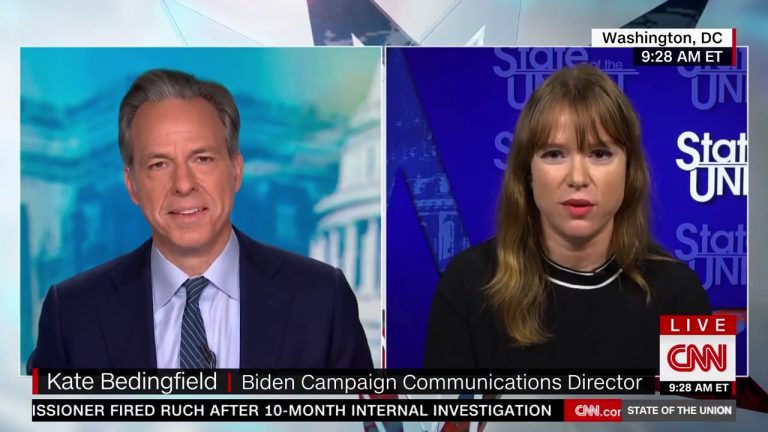
CNN’s Jake Tapper on Sunday rebuked Democratic presidential candidate Joe Biden’s deputy campaign manager for arguing that President Donald Trump’s appointment of Judge Amy Coney Barrett to the Supreme Court is “unconstitutional.”

Kate Bedingfield tried to argue that Republicans are acting unconstitutionally by moving forward with the confirmation process for Barrett.

She cited a poll that shows a majority of Americans want the winner of the presidential election to fill the Supreme Court vacancy, but as Tapper pointed out, a poll is not the Constitution.

“His (Biden’s) point is that the people have an opportunity to weigh in on this constitutional process through their vote,” Bedingfield said. “And we are now in the midst of the election. Millions of people have already cast their votes. And you see that the vast majority of people say that they want the person who wins the election on November 3 to nominate the justice to take this seat.”

“That is their constitutional — there’s the constitutional process of advise and consent,” Bedingfield continued. “The American people get to have their say by voting for president, by voting for senators. We are now 23 days from the election.”

Tapper responded: “Right, but it’s not unconstitutional.”

But Bedingfield continued to falsely claim that millions of “voters are being denied their constitutional right to have a say in this process.”

“They elected the Senate,” Tapper informed Bedingfield.

In fact, voters increased the Republican majority of the Senate after the sharply contested confirmation of Brett Kavanaugh to the Supreme Court in 2018, further validating their judgment.

She responded by citing the same poll again, which shows that “most Americans vehemently disagree” with confirming Barrett prior to the election.

“Again, Kate, that’s a poll,” Tapper fired back. “That’s not what the word constitutional means. Constitutional doesn’t mean, I like it or I don’t like it. It means it’s according to the U.S. Constitution. There’s nothing unconstitutional about what the U.S. Senate is doing.”

Leftist Radical Who Killed Patriot at Denver Rally Had No License for ‘Security’ Work

0

(Headline USA) A leftist radical claiming to be a security guard murdered a peaceful “Patriot Rally” protester in downtown Denver after an altercation tragically escalated.

Matthew Dolloff, 30, was taken into custody and charged with first-degree murder following the Saturday afternoon attack near the City Civic Center, not far from the state capital and a popular downtown pedestrian mall.

It was the latest in a litany of examples involving violent anarchist rioters—many associated with the domestic terrorist group Antifa—abusing longstanding press protections under the First Amendment by falsely impersonating legitimate journalists and others with legitimate news-gathering objectives.

Although Dolloff was not licensed to perform work as a security guard, he was hired by a local TV station nonetheless during coverage of the Patriot Rally, a counter-protest to an event being held by Black Lives Matter and Antifa.

“[T]here is no record for an active licensed security guard now or ever for an individual named Matthew Doloff or Dolloff. If he was operating as a security guard, he was in violation of the law,” said the Denver Department of Excise and Licenses.

It noted that for the offense of impersonating a security guard alone, he could face a fine of nearly a thousand dollars and up to a year in jail. Moreover, KUSA-TV, the station that hired him on behalf of its 9NEWS broadcast, could face administrative action.

KUSA said it had hired the guard through the Pinkerton security firm. “It has been the practice of 9NEWS for a number of months to hire private security to accompany staff at protests,” the station said.

The shooting victim, who died at a nearby hospital, was identified by his son as Lee Keltner, a 49-year-old U.S. Navy veteran who operated a hat-making business in the Denver area, according to the Denver Post.

“He wasn’t a part of any group,” Johnathon Keltner told the newspaper. “He was there to rally for the police department and he’d been down there before rallying for the police department.”

Surveillance and bystander footage appeared to show the two men engaged in an argument during which Keltner allegedly slapped and sprayed Mace at Dolloff, the Post reported, based on its photographs from the scene.

Dolloff allegedly drew a gun from his waistband and shot Keltner in the head, according to the Post journalist who witnessed the episode.

A woman who said she was the victim’s mother, Carol Keltner, wrote in a social media post that her son was killed after being shot in the head.

A decision on any charges will be up to the Denver District Attorney’s Office, police said.

A spokesperson for District Attorney Beth McCann said Sunday that the arrest affidavit in the case remained sealed and referred further questions to the police.

It was not immediately clear if Dolloff had an attorney.

Police Division Chief Joe Montoya said two guns were found at the scene, as well as a Mace can.

The shooting occurred beneath a city surveillance camera, and police said they have footage of the incident, KUSA-TV reported.

Representatives of Pinkerton did not immediately return email and telephone messages for comment.

Adapted from reporting by the Associated Press

Supreme Court Nominee Amy Coney Barrett Faces Senate Hearing Starting Monday

(Headline USA) Confirmation hearings for Supreme Court nominee Amy Coney Barrett are set to begin as a divided Senate moves ahead on President Donald Trump’s pick to replace the late Justice Ruth Bader Ginsburg and nudge the court slightly more towards conservatism before Election Day.

Barrett, a federal appeals court judge, will tell the Senate Judiciary Committee that she is “forever grateful” for Ginsburg’s trailblazing path as a woman. But she is resolved to maintain the perspective of her own mentor, the late conservative Justice Antonin Scalia and “apply the law as written,” according to her prepared opening remarks for the hearings, which start Monday.

“Courts are not designed to solve every problem or right every wrong in our public life,” Barrett says in the remarks, which The Associated Press obtained.

Republicans, who control the Senate, are moving to seat Barrett before the Nov. 3 election to secure Trump’s pick and hear a high-profile challenge to the Affordable Care Act and any election-related challenges.

Democrats are trying in vain to delay the fast-track confirmation by raising fresh concerns about the safety of meeting during the pandemic after two GOP senators on the panel tested positive for the novel coronavirus.

Sen. Mike Lee, R-Utah, and Sen. Thom Tillis, R-N.C., have not said if they will attend in person. Lee’s spokesman said the senator is symptom-free but would be making a decision on whether to attend Monday morning, per his doctor’s orders. A spokesman for Tillis did not respond to multiple requests for comment. Both tested positive 10 days ago.

Key Democrats are staying away. California Sen. Kamala Harris, the Democratic vice presidential nominee and a committee member, plans to participate remotely from her Senate office due to coronavirus concerns, her spokesman said Sunday.

The committee released a letter from the Architect of the Capitol on Sunday that says the hearing room has been set up in consultation with the Office of Attending Physician with appropriate distance between seats and air ventilation systems that meet or exceed industry standards.

“We’re going to work safely,” said the committee’s chairman, Sen. Lindsey Graham, R-S.C., on Fox News Channel’s “Sunday Morning Futures.” He said he took a coronavirus test last week and is “negative.”

Trump chose the 48-year-old judge after the death last month of Ginsburg, a liberal icon. It’s his third justice.

Outside groups are pushing Democrats to make a strong case against what they call, without evidence, an illegitimate confirmation, when people are already voting in some states, saying the winner of the presidency should make the pick.

“The public is with them that this shouldn’t happen before the election,” said Brian Fallon, executive director of the radical Demand Justice, which stridently advocates against right-leaning nominees.

The country will get an extended look at Barrett over the next three days in hearings like none other during the heated election environment and the pandemic limiting public access.

Faith and family punctuate her testimony, and she said would bring “a few new perspectives” as the first mother of school-age children on the nine-member court.

Barrett says she uses her children as a test when deciding cases, asking herself how she would view the decision if one of her children were the party she was ruling against.

“Even though I would not like the result, would I understand that the decision was fairly reasoned and grounded in the law?” she says in the prepared remarks.

A Catholic, she says she believes in the “power of prayer.” Barrett’s religious views and past leadership role in a Catholic faith community pose a challenge for Democrats as they try to probe her judicial approach to abortion, gay marriage and other social issues without veering into inappropriate questions of her faith.

Republicans will highlight Barrett’s belief in sticking to the text of laws and the original meaning of constitutional provisions, both Scalia trademarks.

Adapted from reporting by Associated Press.