Trump Gets Good Marks for Debate Behavior; Lets Biden Largely Evade Scandal Scrutiny

One rarely touted statistic that President Donald Trump can surely take credit for is bringing civic engagement to record levels.

A CBS/YouGov poll prior to the first presidential debate indicated that 41 percent of viewers tuned in strictly for the entertainment value.

By contrast, only 6 percent were undecided voters still waiting to make their decision.

During that debate, Trump delivered the red meat for his base, but Joe Biden answered in equal measure—or rather, initiated, according to some accounts—with his own pugnacious bickering.

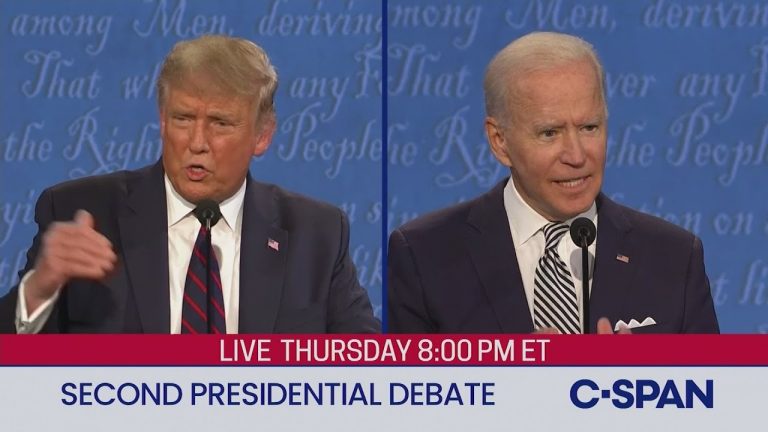
Where the first debate offered more entertainment than substance, the second (and final) debate of the 2020 election offered something for the other 59 percent.

Facing the threat of having their mics cut and a moderator prepared to be far more forceful and assertive, Trump and Biden both stayed largely within the lines of decorum.

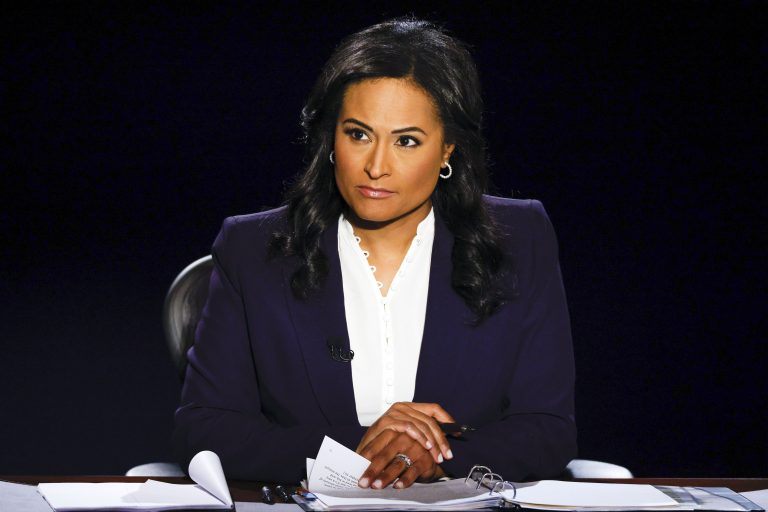
The president remained on his best behavior, even complimenting moderator Kristen Welker at one point after having spent the past week priming viewers for another two-on-one battle by highlighting her leftist bona fides on Twitter.

That may have been a favor to Welker, whose questions came off seeming more evenhanded than those of prior 2020 moderators Chris Wallace and Susan Page.

She, too, beamed at what she called a “fantastic debate” at the end, having had the bar lowered significantly by its only predecessor.

By the standards of any other campaign year, Thursday’s debate may, in fact, have seemed boisterous.

However, just as Trump missed the opportunity to fully articulate his policies in the first one, he over-corrected by failing to fully press Biden on what should now be a campaign-defining issue: his family business deals and the alarming ethical concerns that have arisen from the recovered laptop files of Biden’s son Hunter.

In a cruel twist of irony, Biden used his perceived advantage in likability to neutralize the attack.

“The character of the country is on the ballot—our character is on the ballot,” Biden chided voters.

“If this is true, then he’s in a corrupt politician, so don’t give me this stuff about how you’re an innocent baby,” Trump answered before being cut off.

The president did his best to broach the issue of Biden’s own character problems during a segment on foreign policy. He touted the $3.5 million kickback that Hunter Biden received from the wife of a Moscow oligarch according to a Senate Homeland Security and Governmental Affairs report released last month.

“I think you owe an explanation to the American people,” Trump said. “Regardless of me, I think you have to clean it up and talk to the American people.”

But Biden, who spent the better part of the past two weeks off the road preparing for the debate, came fully ready to deflect.

“There’s a reason why he’s bringing up all this malarky,” Biden said, continuing to claim—despite evidence to the contrary—that Hunter’s actions in Ukraine, China and elsewhere were entirely above board, and that he, personally, had never received any money from foreign governments.

Trump “doesn’t want to talk about the substance of issues,” Biden continued in a familiar refrain. “It’s not about his family and my family; it’s about your family,” he panned to the camera.

Facing what may be an unprecedented effort by mainstream media and social media to suppress the laptop story, Trump delved relatively little into the specifics.

He said nothing of the incriminating photos that allegedly show Hunter smoking crack and cavorting with a nude 14-year-old relative—as well as a text exchange indicating Joe Biden was aware of the behavior.

Even as one of Hunter Biden’s former business partners confirmed the authenticity of the emails on Wednesday and Director of National Intelligence John Ratcliffe said specifically that the laptop was not part of a Russian disinformation plot, the former vice president insisted that it was.

“You mean the laptop is now another Russia, Russia, Russia hoax,” Trump said, mocking the debunked conspiracy theory promoted by the Hillary Clinton campaign, with help from the FBI, last election.

But there, too, amid frustratingly little accountability to date for Obamagate’s deep-state perpetrators, Trump failed to fully wield his arsenal of outrage.

When Biden said, later in the debate, that cocaine should be decriminalized, Trump focused on making his case to the black community instead of pointing out Hunter Biden’s far-from-normal habits of drug and sexual abuse, enabled by his father’s access to power.

He also emphasized his own administration’s efforts to reform Biden’s failed 1994 criminal-justice bill rather than hammer Biden 2.0 for being too soft on crime.

Trump did succeed in bringing Biden’s moral failures back into focus on occasion, painting him as a typical career politician with a 47 year record of inaction.

“You keep talking about all these things you’re gonna do, and you’re gonna do this … I ran because of you,” Trump said, “because you did a poor job.”

He scored major points reminding viewers that it was the Obama–Biden administration that had constructed migrant detention centers that have been deceptively characterized as cages.

Of the 500 or so children who have yet to be claimed by family members following a short-lived separation policy, Trump pointed out that his policies had deterred human-smuggling coyotes and drug cartels from exploiting children at the border.

Those currently in detention “… are so well taken care of,” Trump said. “But just ask one question,” he told Welker. “Who built the cages? I’d love for you to ask him that.”

Several times during the debate, Trump sought to make a common-sense case for economic prosperity as the pathway to solving America’s problems—including those characterized by Democrats as “existential” crises.

On handling the corinavirus, Biden warned that America was “about to go into a dark winter” for which Trump lacked a clear vision.

By contrast, Trump countered in his closing remarks on leadership that “Success is going to bring us together.”

He warning that the economic policies of a Biden administration would usher in a “depression, the likes of which you’ve never seen.”

As he did in the first debate, Trump continued to call out Biden’s duplicity on fracking—an issue seen as crucial to winning battleground Pennsylvania—and he fact-check Biden’s frequent claims of his own Pennsylvania roots.

“Where I come from in Scranton [Pennsylvania] and Claymont [Delaware] the people don’t live off the stock market,” Biden said while attacking Trump’s economic policies.

Trump countered: “401ks are through the roof, stocks are through the roof and he doesn’t come from Scranton… He lived there for a short period of time, and then he left.”

Trump also forced Biden to acknowledge that part of his environmental plan involved the phasing out—or transitioning, as he characterized it—of America’s oil reliance in favor of less-reliable and more costly renewable energy sources.

“Basically, what he’s saying is that he’s going to destoy the oil industry,” Trump said. Will you remember that, Texas? Will you remember that, Pennsylvania?”
BIDEN BLUNDER? Oil ‘Has to Be Replaced’; May Hurt Him in Pa., Texas

(Headline USA) Democrat Joe Biden‘s remark that he would “transition” away from oil in the U.S. in favor of renewable energy drew quick attention Thursday night from President Donald Trump, who saw it as a boon to his election chances in key states.

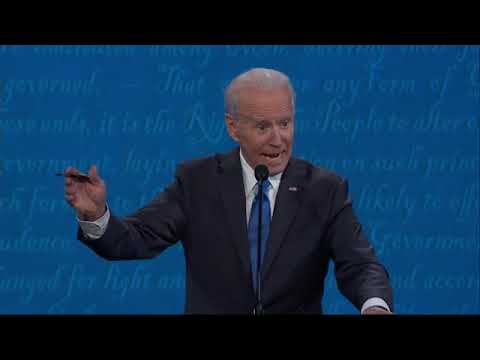
“I would transition away from the oil industry, yes,” Biden said in the presidential debate‘s closing minutes under peppering from Trump. “The oil industry pollutes, significantly. It has to be replaced by renewable energy over time.”

The Biden campaign’s climate plan calls for the U.S. to have net-zero greenhouse gas emissions by 2050. And he repeated his pledge to end federal subsidies for the oil and gas industry.

Still, Trump seemed surprised and pleased by Biden’s comment, declaring it a “big statement,” and suggesting it would come with political blowback in oil-producing states that stand to lose jobs.

“Basically what he is saying is he is going to destroy the oil industry,” Trump said. “Will you remember that Texas? Pennsylvania? Oklahoma? Ohio?”

Trump won all four states in 2016, but Pennsylvania in particular is a pivotal swing state this cycle, with both candidates investing heavily. Ohio is also in play, and Democrats even see Texas as a longshot pickup on an expanded electoral map.

After the debate, Biden told reporters he would not “ban” fossil fuels or move away from them for “a long time.”

Advocates who fight “climate change” say it means sharply cutting oil, gas and coal emissions, and that means eliminating most burning of fossil fuels. Biden talks of a 30-year transition to a carbon-free economy, by encouraging costly and inefficient wind and solar power and more energy efficiency. He has adopted most of the “Green New Deal,” most identified with socialist Rep. Alexandria Ocasio-Cortez of New York, as his own plan.

The back-and-forth came as the debate came to a close, during a segment on how the candidates would respond to climate change — a topic voters consistently rank as least important among issues. Biden says the country has a moral obligation to tackle climate change.

Politically, Republicans see Biden’s comments as potentially damaging to Democrats in states that rely on the oil and gas industry. Trump has sought to make hydraulic fracturing (“fracking”), a process of oil and natural gas extraction, a key issue in Pennsylvania.

Biden has said repeatedly in the past he would ban fracking, but now says he wouldn’t.

Pennsylvania is both a leading battleground state in the presidential election and a leader in the nation’s fracking boom. Trump has been eager on frequent campaign trips there to cut a contrast between himself and Biden on the issue. Trump touts his support for a sector he says brings economic benefits to rural areas and jobs to construction workers. The state says the oil and gas sector employs about 26,000 workers there.

Biden’s comments could add headaches for Democrats in oil-heavy states. Rep. Kendra Horn, an Oklahoma Democrat who flipped a Republican seat in 2018, tweeted that she disagreed with him.

“We must stand up for our oil and gas industry. We need an all-of-the-above energy approach that’s consumer friendly, values energy independence and protects OK jobs,” she wrote.

The American Petroleum Institute, a trade association representing the oil and gas industry, said restricting oil and gas production would “jeopardize America’s economic recovery,” increase energy costs, eliminate jobs and shift energy production oversees.

Adapted from reporting by Associated Press.

Debate Moderator Welker Interrupted Trump Way More than Biden

0

(Headline USA) Moderator Kristen Welker — with the help of an offstage mute button — helped give Americans the substantive, crackling debate over leadership that had been missing so far during the 2020 presidential campaign.

Still the liberal-leaning reporter, with her choice of issues to cover and far more interruptions of President Donald Trump than former Vice President Joe Biden, had her thumb in the scale for the Democrat. Unofficial estimates were 24 interruptions of the president versus just two of Biden. As the Media Research Center’s Dan Gainor opined following the debate:

Welker’s liberal bent influenced both the questions and how she phrased them. “You’ve described the Black Lives Matter movement as a symbol of hate,” she said to Trump. She then asked him, “What do you say to Americans who say that kind of language from a president is contributing to a climate of hate and racial strife?”

But that wasn’t how she asked Biden the question. And it had to be Trump who brought up the 1994 crime bill Biden now apologizes for.

Welker did the same thing with the Supreme Court, twisting the nomination of Amy Coney Barrett into a battle over keeping the Affordable Care Act with the scare claim, “20 million Americans could lose their health insurance almost overnight.”

But the NBC News White House correspondent worked hard Thursday to keep control of the encounter, steering but not stifling exchanges, except — it seemed — when Trump seemed to be scoring points on Biden, especially regarding scandals related to foreign business deals won by his son, Hunter, thanks to his father’s official position and last name.

But showing she was at least more fair than debate and town hall predecessors Chris Wallace, Susan Page, and Savannah Guthrie, midway through the debate she even received a compliment from the president, who said, “So far, I respect very much the way you handled this.”

Welker also benefited from a different Trump, who resisted the interruptions that spoiled his first debate with Biden. The second was canceled when Trump objected to a virtual format after he caught COVID-19, replaced by dueling town hall meetings.

“I’m jealous,” said Fox News Channel‘s Wallace, moderator of the first debate. “I would have loved to have been able to moderate that debate and get a real exchange of views instead of hundreds of interruptions.”

Shortly before Thursday’s encounter, the debate commission said it would shut off the microphone of a candidate to give his opponent a chance to get through a two-minute answer when a new subject was introduced. It seemed to work mostly as a deterrent; neither candidate tried to shout through the silence.

When the candidates were allowed to more directly engage, other than the interruptions disparity, Welker had some success in giving them room to make their points.

She was attuned to the news, asking Trump how he would reunite families separated at the southern border following the revelation that the government had lost track of the parents of hundreds of children. She twice followed up when the president didn’t directly address the question.

Welker had a sharp retort to Trump when he dodged a question on why the government had failed to agree on a new stimulus package for families suffering financially from the coronavirus.

“Because Nancy Pelosi doesn’t want to approve it,” he said.

“But you’re the president,” Welker replied, seeming to ignore the fact it takes both parties to reach agreement in divided government.

Welker asked Biden to directly address Americans who feared that his approach to health care would mean too much government involvement, and to square his desire to improve the environment without harming the economy.

She also didn’t shy away from recent stories about Biden’s son Hunter’s involvement in foreign companies and allegations that he took advantage of his father’s role as vice president. Somewhat oddly, it was Biden who first brought it up by criticizing Trump’s lawyer, Rudolph Giuliani.

“Was there anything about these relationships that was inappropriate or unethical?’ Welker asked.

Similarly, in talking about recent reports of a Trump bank account in China, she asked the president, “How can voters know that you don’t have any conflicts of interest?”

Welker, a 44-year-old Harvard graduate who was the first black woman to moderate a presidential debate since 1992, asked the candidates in personal terms what they would say to minorities who felt they had prepare their children for the possibility that law enforcement could target them for the color of their skin.

Some conservatives said on social media that they believed Welker was quicker to cut Trump off than Biden and introduced subjects — the coronavirus, race and climate change — that helped the Democrat.

But she received praise for her performance from across the political spectrum, including conservative personalities Ben Shapiro and Brit Hume.

“Kristen Welker is putting on a master class on how to moderate a presidential debate,” tweeted Philip Rucker, a liberal Washington Post reporter.

Adapted from reporting by Associated Press.

Dems Who Cheered DOJ’s Trump Smears Now Claim ‘Devastating Consequences’ if Biden Probed

Senate Democrats tipped their hand in a letter to FBI Director Christoper Wray on Thursday, revealing their terror over the political fallout of a major Biden scandal while continuing to wage a disinformation campaign to discredit the mounting evidence.

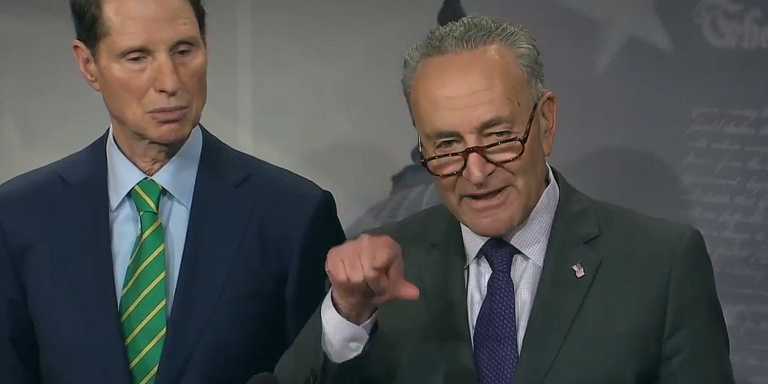
Sen. Ron Wyden, D-Ore., and Senate Minority Leader Charles Schumer, D-NY, menacingly warned Wray that any effort to analyze or investigate the contents of a laptop abandoned by Hunter Biden would be condemned as a partisan affront since doing so might further validate the explosive, potentially campaign-ending allegations that have arisen.

“In carrying out this critical national security mission, law enforcement’s handling of this matter must be above politics and beyond reproach,” they insisted.

“We therefore urge you to resist pressure from President Trump and other partisan actors to take any actions intended to benefit President Trump politically on the eve of the election,” the letter continued. “Succumbing to such pressure would deeply undermine our national security interests and the credibility of law enforcement, and could have devastating consequences for the resiliency of our democracy.”

Among the many story lines emerging from the trove of evidence is that current Democrat presidential candidate Joe Biden was deeply involved in his son’s business dealings and expected to receive a cut of the profits in return for leveraging his political clout during the Obama administration.

Most notably, emails revealed that the former vice president received a 10 percent stake in a joint capital venture involving several of his family members and one of China’s largest energy companies.

The evidence also indicated that Biden was well aware of his son’s position with Ukraine’s Burisma energy company and met with an official from the company—despite longstanding concerns over corruption,  while he was ostensibly overseeing ‘anti-corruption’ efforts in Ukraine.

Biden later forced the prosecutor investigating Burisma’s corruption to be fired by threatening to withhold a billion-dollar US loan guarantee.

Private text messages also revealed that Joe Biden was aware of a highly inappropriate relationship between Hunter and a relative, believed to be the 14-year-old daughter of then recently-deceased Beau Biden.

Hunter entered into a two-year relationship with Beau’s widow following his brother’s death. However, an exchange between him and his father suggests that he was unwelcome in the family home due to his tendency to engage in nude Face Time sessions with underage girls online.

Sexually suggestive photographs—including topless photos—of his teenage relative were allegedly uncovered on Hunter’s computer, according to Rudy Giuliani, who received the recovered hard-drive data from a Delaware computer technician.

Joe Biden has faced similar accusations of sexual impropriety with women and young girls, including a credible rape accusation involving a former congressional staffer, Tara Reade, which mainstream media likewise sought to discredit as lacking in substance.

Although evidence has shown that Hunter Biden brought in the laptop device, and that the FBI later took possession of it for a forensic analysis, Schumer and Wyden continued to claim, without evidence, that it was all part of a Russian plot to disrupt the November election.

“The attempts by President Trump’s personal attorney, Rudy Giuliani, and others to perpetuate narratives about the supposed Hunter Biden materials closely track a longstanding effort of Russia and its proxies to amplify false and misleading allegations and themes to denigrate former Vice President Biden and benefit President Trump’s reelection bid,” the senators claimed.

“As is widely known, Mr. Giuliani for years has partnered with Kremlin-linked individuals in an effort to manufacture dirt on the former Vice President,” they added.

Ironically, the two Democrats both virulently defended specious allegations and investigations into President Donald Trump that leveraged the full weight of the Justice Department, despite having a far more tenuous factual basis than the Biden scandal.

During Trump’s January impeachment trial for asking Ukraine to investigate the very corruption that Hunter Biden’s laptop now provides evidence of, Schumer held regular press conferences denouncing the president and claiming he had abused his office.

Yet, after tirelessly demanding his GOP colleagues to deviate from constitutional norms by calling new witnesses to give testimony during the Senate impeachment trial, Schumer seems to show little interest in discovering the truth when the political outcome favors Trump.

Wyden, meanwhile, faced accusations last year that he had abused his office—specifically, his seat on the Senate Intelligence Committee—by falsely claiming he had seen classified proof of collusion between Trump and Russia that would corroborate the now-debunked Steele dossier.

“There is no longer a question of whether this campaign sought to collude with a hostile foreign power to subvert America’s democracy,” he lied.

Such misleading claims helped fuel the two-year, $30+million Mueller investigation, which Democrats campaigned heavily on during the 2018 midterm election.

But after the Mueller probe failed to produce any evidence linking Trump to Russia, Wyden doubled down, insisting via a spokesperson that Trump’s supposed business ties to Russia while a private citizen still justified the tax-funded smear.

“Senator Wyden has focused consistently on questions of following the money and unraveling the sticky web of connections between the Russians and Donald Trump’s business organization, his family and his campaign,” said the spokesperson.

In fact, Wyden called on the fishing expedition to continue even after Mueller had concluded his work.

“Despite Trump apologists’ best efforts to intimidate elected members of Congress from conducting constitutionally mandated oversight, the indictments and other documents released by Robert Mueller revealed a troubling but incomplete look at those links,” his spokesperson said.

“Furthermore, Senator Wyden has been concerned with follow-the-money issues because financial entanglements can present an ongoing counterintelligence concern,” said the staffer. “If Trump has financial entanglements with Russians, our national security could be at risk.”

One reason why the senators may be so fearful of shedding light on Biden’s foreign conflicts of interest, which also would raise security concerns involving China, Russia and a litany of other bad actors: They, themselves, may be implicated.

Schumer’s name surfaced in the emails about the China scandal, for which Jim Biden (Joe’s brother) identified him—alongside Biden’s current vice-presidential running mate, Sen. Kamala Harris, D-Calif.—as one of several “key domestic contacts for phase one target projects.”

Stakes Are High for Final Presidential Debate in Election’s Home Stretch

0

(Headline USA) President Donald Trump and Democratic challenger Joe Biden hurtled toward Thursday night’s final debate, which may be the trailing incumbent’s best chance to change the race’s trajectory with just 12 days left until the election.

The two men headed for Nashville before the debate, which offers their final national stage to outline starkly different visions for a country.

Despite historic tumult wrought by the coronavirus panic’s crippling of the national economy, violent leftist rioting and a surprise Supreme Court vacancy, the race has remained largely unchanged.

While many media polls suggest that Biden holds advantages in key battleground states, the situation closely resembles Trump’s underdog position in the 2016 race against Hillary Clinton.

Leaked emails from the Democratic National Committee revealed at the time that her campaign had colluded with media and polling outlets to rig the results. Polls have continued to come under harsh scrutiny for oversampling Democrats by a considerable margin and asking leading questions that conservative voters are unlikely to respond affirmatively to.

The difference between Biden and Clinton in states that helped Trump to secure an Electoral College landslide is marginal, according to RealClear Politics.

However, Trump—who once enjoyed a healthy lead in fundraising—now faces a shortage of campaign cash in the final stretch.

Final debates often play an outsize role in electoral outcomes. But Thursday night’s showdown will be different from those past.

More than 42 million people have already cast their ballots as part of a pandemic-era rise in early voting—an effort backed by Democrats in spite of looming concerns about election integrity and the potential for vote fraud.

In an election dominated by the incumbent president’s larger-than-life personality, far fewer undecided voters remain than at this point in 2016.

And, in a visual reminder of the pandemic that has rewritten the norms of American society and fundamentally changed the campaign, sheets of plexiglass have been installed onstage between the two men.

The debate, moderated by NBC’s Kristen Welker, is a final chance for each man to make his case to a television audience of tens of millions of voters.

Tensions between the two candidates—and between Trump and Fox News moderator Chris Wallace—led to a hectoring performance during the first debate that put off many viewers as the three men proceeded to talk over one another.

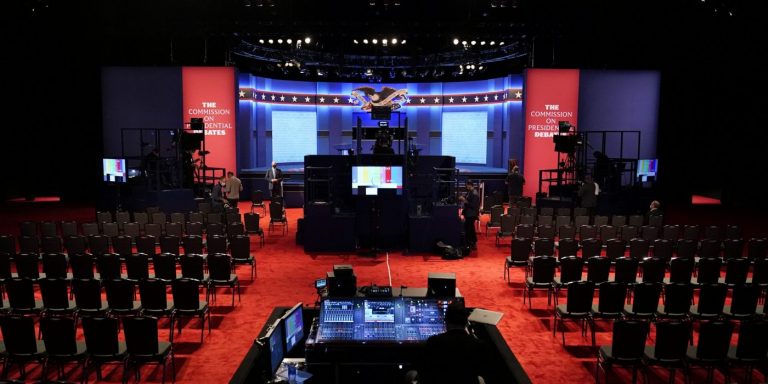
In an effort to curtail interruptions this time, the Commission on Presidential Debates announced that Trump and Biden will each have his microphone cut off while his rival delivers an opening two-minute answer to each of six debate topics.

The mute button won’t figure in the open discussion portion of the debate. And it also remained unclear whether Welker would have the power to interrupt the speakers.

Trump already has publicly criticized the moderator’s selection, pointing to evidence that revealed her to be deeply biased.

Some advisers have urged him to trade his aggressive demeanor from the first debate for a lower-key style and put the spotlight on Biden, whom he derides as “Sleepy Joe.” But Trump made no such promise.

With a growing scandal surrounding the discovery of damning emails from the hard drive of Biden’s son Hunter, and the ensuing effort by Biden’s media allies to censor or discredit it, Trump seems certain to avail himself of the one platform where he can reliably reach a broader audience than his dedicated base of support.

On Tuesday, he called on Attorney General William Barr to immediately launch an investigation into the scandal.

Biden, who has stepped off the campaign trail for several days in favor of debate prep, expects Trump to get intensely personal.

Anticipating the pressure after facing questions recently about his favorite ice cream flavor, the former vice president preemptively aimed to spin the scandal as an effort to distract from the coronavirus, its economic fallout and other crises of Trump’s term.

“Hopefully he’ll play by the rules,” Biden said as he boarded his plane for Tennessee. “I’m looking forward to this.”

Biden could also expect questions about his comments in a CBS interview, released Thursday, in which he wouldn’t rule out trying to add justices to the Supreme Court. The issue has followed him since the Sept. 18 death of Supreme Court Justice Ruth Bader Ginsburg and the GOP-controlled Senate’s rush to confirm Trump’s nominee to succeed her, Judge Amy Coney Barrett.

Biden and Trump were both tested for COVID-19 on Thursday and the results came back negative.

Trump announced just two days after the first debate that he tested positive for the virus. He later spent three nights in Walter Reed National Military Medical Center before returning to the White House.

After Trump’s COVID diagnosis, the debate commission ruled that the second debate, which was to have been held last week, be virtual.

Trump balked, and the two men holding dueling town halls instead, speaking at the same time more than 1,000 miles apart.

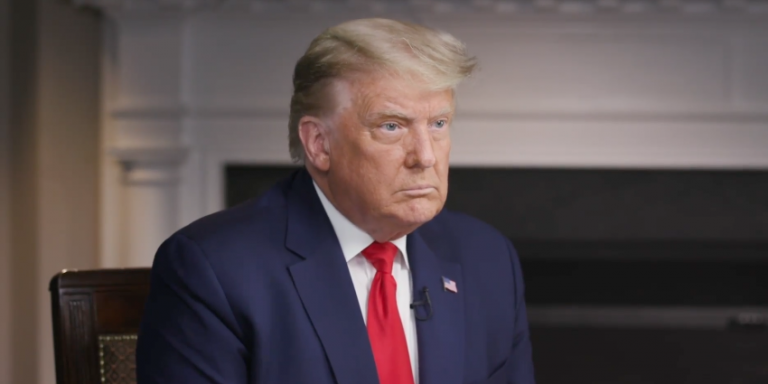
As Trump continued to complain about his unfair treatment by the news media, he posted on Facebook unedited footage of his own “60 Minutes” interview, where he repeatedly told CBS interviewer Lesley Stahl she would not have challenged Biden.

“You wouldn’t say to Biden what you just said to me,” Trump told Stahl when she questioned his characterization of the economy prior to the pandemic. “If he had it, you would never say that to Biden.”

After posting the video, Trump tweeted: “Tonight’s anchor, Kristen Welker, is far worse! #MAGA.”

Adapted from reporting by the Associated Press

Remdesivir Becomes First COVID-Treating Drug to Receive Full FDA Approval

0

(Headline USA) U.S. regulators on Thursday approved the first drug to treat COVID-19: remdesivir, an antiviral medicine given to hospitalized patients through an IV.

The drug, which California-based Gilead Sciences Inc. is calling Veklury, cut the time to recovery by five days—from 15 days to 10 on average—in a large study led by the U.S. National Institutes of Health.

It had been authorized for use on an emergency basis since spring, and now becomes the first drug to win full Food and Drug Administration approval for treating COVID-19.

President Donald Trump received it when he was stricken with the coronavirus earlier this month.

Veklury is approved for people at least 12 years old and weighing at least 88 pounds who are hospitalized for a coronavirus infection.

For patients younger than 12, the FDA will still allow the drug’s use in certain cases under its previous emergency authorization. However, there have been very few occurrences of children suffering severe symptoms from the virus that require hospitalization, even if they were to contract it.

The drug works by inhibiting a substance the virus uses to make copies of itself. Certain kidney and liver tests are required before starting patients on it to ensure it’s safe for them and to monitor for any possible side effects. And the label warns against using it with the malaria drug hydroxychloroquine, because that can curb its effectiveness.

“We now have enough knowledge and a growing set of tools to help fight COVID-19,” Gilead’s chief medical officer, Dr. Merdad Parsey, said in a statement.

The drug is either approved or has temporary authorization in about 50 countries, he noted.

Its price has been controversial, given that no studies have found it improves survival.

Last week, a large study led by the World Health Organization found the drug did not help hospitalized COVID-19 patients, but that study did not include a placebo group and was less rigorous than previous ones that found a benefit.

The FDA’s approval statement noted that, besides the NIH-led one, two other studies found the drug beneficial.

Gilead charges $2,340 for a typical treatment course for people covered by government health programs in the United States and other developed countries, and $3,120 for patients with private insurance. The amount that patients pay out of pocket depends on insurance, income and other factors.

So far, only steroids such as dexamethasone have been shown to cut the risk of dying of COVID-19.

The FDA also has given emergency authorization to using the blood of survivors—which may contain precious antibodies.

Two companies are currently seeking similar authorization for experimental antibody drugs.

Adapted from reporting by the Associated Press

Biden Floats ‘Bipartisan Commission’ to Study Feasibility of Court-Packing, Judicial Reforms

Democratic presidential candidate Joe Biden said he would form a commission to “study” the Supreme Court and propose reforms to the judicial system when asked if he supported liberals’ court-packing efforts.

In an interview with 60 Minutes, Biden was asked, once again, if he supported adding seats to the Supreme Court.

Despite many indications that Chief Justice John Roberts, a George W. Bush appointee, has crossed over into the court’s liberal wing, many on the Left continue to claim that the inevitable confirmation of Judge Amy Coney Barrett will give it a lopsided conservative tilt.

Progressives are now clamoring for the addition of at least two more justices to compensate for what they have long claimed are ‘stolen’ seats on the bench filled by President Donald Trump.

They have insisted that Trump’s predecessor, Barack Obama, was entitled to fill the seat vacated by the death of conservative Justice Antonin Scalia. But following the recent death of liberal Ruth Bader Ginsberg, they quickly pivoted to the opposite position.

Biden has refused to give a straightforward answer, initially claiming that voters didn’t “deserve” to know his position and that articulating it could potentially turn it into a focal point of the November election.

But facing backlash and public pressure over his waffling, he instead proposed to form “bipartisan” panel.

“If elected, what I will do is I’ll put together a national commission of, a bipartisan commission of scholars—constitutional scholars, Democrats, Republicans, liberal, conservative,” he claimed.

“And I will … ask them to over 180 days come back to me with recommendations as to how to reform the court system because it’s getting out of whack … the way in which it’s being handled,” he added.

Several leftist media institutions, including the Associated Press, have been ridiculed for their brazen efforts to reframe the discussion more in line with Democrat talking points.

They now claim that court-packing is not a partisan maneuver to skew the court toward an ideological agenda, but rather one to restore balance to it.

Facing a slight GOP Senate majority and assuming that Hillary Clinton would be his successor, Obama left dozens of federal judicial seats unfilled.

Trump has moved quickly to fill them, bringing a more constitutional bent to the judiciary after decades of judicial activism. Federal judges receive lifetime appointments and can only be removed through impeachment.

“It’s not about court packing,” Biden claimed. “There’s a number of other things that our constitutional scholars have debated, and I’ve looked to see what recommendations that commission might make.”

Last week, he admitted that his decision on the matter would depend on how Republicans deal with Trump’s nomination of Barrett.

“It depends on how much they rush this,” he said.

Some conservative senators, meanwhile, are pushing for Congress to come up with its own solution: a new constitutional amendment that would permanently set the number of seats on the Supreme Court at nine.

The number has remained unchanged in more than 150 years. Democrat President Franklin D. Roosevelt considered adding seats in 1937 but buckled under the backlash.

Headline USA’s Ben Sellers contributed to this report.

Hunter Biden’s Ex-Business Partner Flips, Confirms Authenticity of Emails on Corrupt China Deal

The source of a highly anticipated Wall Street Journal piece corroborating the New York Post‘s bombshell reports on Hunter Biden released a statement Wednesday to refute claims that the recovered laptop files at the heart of the scandal were part of a Russian disinformation campaign.

“The facts set forth below are true and accurate; they are not any form of domestic or foreign disinformation,” whistleblower Tony Bobulinski said in his statement, according to Breitbart. “Any suggestion to the contrary is false and offensive.”

Democrats—including House Intelligence Chair Adam Schiff, D-Calif.—and their left-wing media and social-media allies have sought to bury the potentially campaign-ending revelations with an aggressive censorship and disinformation campaign of their own.

In a conference call this week, President Donald Trump hinted that the Wall Street Journal piece would debunk the leftist media’s efforts to discredit the story.

However, the article has been delayed for unknown reasons, likely putting pressure on Trump campaign officials to seek alternative channels prior to a Thursday night debate.

Trump is expected to confront Democrat nominee Joe Biden with the allegations about his troubled, 50-year-old son.

Bobulinski identified himself in his statement as CEO of Sinohawk Holdings, an apparent shell company used to move funds around as part of a joint venture with Ye Jianming, the former chair of Chinese energy company CEFC.

According to another newly disclosed email, Biden’s current running mate, Sen. Kamala Harris, D-Calif., was one of several prominent Democrat figures identified as “key domestic contacts for phase one target projects” undertaken by the new venture, Breitbart reported.

After CEFC went bankrupt, however, Jianming was arrested by the Chinese government and has not been heard from since.

During the preliminary discussions for the CEFC deal, Bobulinski’s name surfaced in an email chain discussing “remuneration packages.”

The email’s equity-sharing proposal included 20 percent each for Hunter Biden and three partners, including Bobulinski, as well as 10 percent to be held by Hunter for “the big guy.”

Bobulinski confirmed that the person in question was Joe Biden, and that other mentions of  “JB” and “Jim” were referring to Hunter’s uncle James, also a 10 percent stakeholder.

Joe Biden, who was still serving in the Obama administration at the time of the deals, would have violated the law by receiving money directly from foreign entities.

Notwithstanding, the back-door arrangements raised serious character questions—as well as national-security concerns over the Bidens’ cozy relationship with adversarial nations that engage in frequent acts of espionage and election-interference.

Biden has often flip–flopped on his China policy, but he recently sought to attack Trump for capitulating to the Asian super-power during its efforts to cover up the deadly coronavirus pandemic.

Some of the explosive details that Hunter Biden’s abandoned laptop offered concrete evidence of had been previously disclosed or alluded to as part of a report by the Senate Homeland Security and Governmental Affairs Committee.

The report outlined—using witness testimony, recorded evidence and subpoenaed documents—a slush fund that members of the Biden family maintained through the credit line of a now-defunct holding company to purchase “extravagant” items like travel, leisure and Apple Store merchandise.

Bobulinski is now cooperating with Senate investigators and has provided a trove of supporting documents which shed further light on the illicit financial deals that benefited the Biden family and their business associates.

That includes text and WhatsApp exchanges offering additional evidence of Hunter Biden explicitly leveraging his family name and connections to power, as well as discussions about the need for secrecy concerning the former vice president’s involvement.

The Senate’s HSGAC report also disclosed the millions of dollars in kickbacks that Hunter Biden and his business associate received from other foreign entities, including a Russian oligarch and the Ukrainian energy company Burisma.

The latter played a central role in House Democrats’ impeachment of Trump last year after he requested that Kiev officials reopen a corruption investigation, which Joe Biden had forced them to close down by threatening to withhold a billion-dollar US loan.

Perhaps the most politically damning of all the details to emerge thus far from the laptop were allegations that Hunter had conducted nude online chats with underage girls and that the hard drive contained topless and suggestive pictures of a relative believed to be his then-14-year-old niece.

Rudy Giuliani, the former New York City mayor who has been Trump’s personal attorney and point-man on the Biden scandals, announced this week that he had filed a report with Delaware police.

However, it declined to pursue the case due to “credibility issues” and said it had referred the Giuliani’s concerns to the FBI, which was “investigating their veracity.”

Already, the FBI has faced criticism and serious questions over whether it was aware of the laptop and suppressed the evidence during Trump’s impeachment proceedings.

But a spokesperson for the Senate Homeland Security committee assured Trump’s GOP backers that with help from Bobulinski and others, the truth would soon emerge.

Trump Posts Unedited ’60 Minutes’ Interview Before CBS Can Edit & Air It

(Headline USA) President Donald Trump posted his full, unedited interview with “60 Minutes” on Facebook before the show’s scheduled Sunday broadcast.

The footage shows unrelenting prickly questions and interruptions by CBS anchor Lesley Stahl on a host of topics, including his response to the coronavirus pandemic, his alleged slipping support among suburban women, the lack of masks at his rallies, and the “Obamacare” replacement plan he has long promised but failed to unveil.

“Look at the bias, hatred and rudeness on behalf of 60 Minutes and CBS,” Trump wrote Thursday as he tweeted the Facebook link.

Throughout the interview Trump challenges Stahl that she and the mainstream media refuse to question Democrat nominee Joe Biden with similar aggression, after revelations from the laptop and hard drive of his son Hunter.

Trump accused the media of being too soft on his Democratic rival, which Stahl validated by denying that Biden is under siege over credible evidence that he knew about Hunter’s foreign deals with Ukraine and China, and even financially benefitted from them.

“He’s in the midst of a big scandal…,” Trump started.

“Oh, he is not!” Stahl interrupted.

As Stahl comments at one point that Trump is offering “attack after attack,” Trump responds: “It’s not attack, it’s defense. It’s defense against attacks.”

“I’m defending myself and I’m defending the institute of the presidency,” he said.

As Trump reminded her that Obama and Biden spied on his campaign and that the Russian collusion charges were fraudulent, Stahl tried to explain: “This is ‘60 Minutes’ and we can’t put on things we can’t verify.”

But Trump continued to criticize the mainstream media.

“Lesley, you’re discrediting yourself,” he said.

The interview began on a tense footing as Stahl asked the president as the camera started rolling, “Are you ready for some tough questions?” and only grew more testy.

At the end of the nearly 40 minutes, Trump blamed Stahl for starting the interview badly: “Are you ready for tough questions. That’s no way to talk. That’s no way to talk.”

“You’re so negative,” he later commented.

Trump eventually cut the interview short and declined to appear with Vice President Mike Pence on what had been planned as a “walk-and-talk” segment of the interview.

“That’s enough. Let’s go,” he said.

CBS News called the White House’s decision “unprecedented,” but said the interview would air Sunday as planned.

“The White House’s unprecedented decision to disregard their agreement with CBS News and release their footage will not deter 60 MINUTES from providing its full, fair and contextual reporting which presidents have participated in for decades,” the network said in a statement.

The long-running program is filled with segments of reporters’ narratives interspersed with clips from interviews, and rarely do interviewees get more than a few minutes’ time to present their perspectives. Of the nearly 40 minutes Trump spoke, CBS is unlikely to show more than 5 to 10 minutes of the President talking.

“60 MINUTES,” it continued, “is widely respected for bringing its hallmark fairness, deep reporting and informative context to viewers each week. Few journalists have the presidential interview experience Lesley Stahl has delivered over her decades as one of the premier correspondents in America and we look forward to audiences seeing her third interview with President Trump and subsequent interview with Vice President Pence this weekend.”

Adapted from reporting by Associated Press.

Facebook, Twitter CEOs Zuckerberg, Dorsey Subpoenaed to Testify by GOP Senators

0

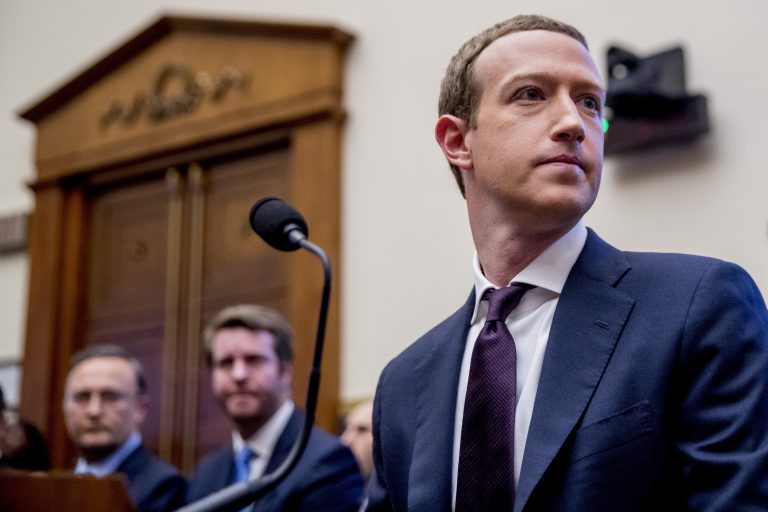
(Headline USA) The GOP push against Facebook and Twitter accelerated Thursday after Republican senators voted to authorize subpoenas of the CEOs of the social media companies to force them to address accusations of censorship in the closing weeks of the presidential campaign.

With Democrats boycotting the hearing, the Republican-controlled Senate Judiciary Committee voted to authorize the legal orders if Facebook’s Mark Zuckerberg and Twitter’s Jack Dorsey did not agree to testify voluntarily.

The committee wants to hear from them about “the suppression and/or censorship of two news articles from the New York Post,” according to the subpoena document. Senators also want information from the executives about their companies’ policies for moderating content “that may interfere” with federal elections.

A Facebook spokesperson declined comment. Twitter representatives didn’t immediately respond to a request for comment.

Facebook and Twitter acted last week to limit the online dissemination and sharing of a story from the New York Post based on potential corruption from emails and texts from Joe Biden’s son Hunter.

One email showed a top adviser for Burisma, the Ukraine gas company where Hunter Biden held a board seat, thanking Biden for giving him an opportunity to meet the elder Biden, who was vice president at the time.

It was the first time in recent memory that the two social media platforms enforced rules against misinformation on a story from a mainstream media publication.

The companies also have wrestled with how strongly they should intervene in speech on their platforms, but Facebook and Twitter have allowed articles from other outlets with far less substantiation than the Post story to be disseminated.

Conservatives have stepped up their claims — with much evidence — that Facebook, Twitter and Google, which owns YouTube, are biased, charging Silicon Valley’s social media platforms are deliberately suppressing conservative views.

The Senate Commerce, Science and Transportation, on a bipartisan vote, recently authorized subpoenas for Zuckerberg, Dorsey and Google CEO Sundar Pichai. The three have agreed to testify for a hearing planned for next week.

Democrats have focused their criticism of social media mainly on hate speech, misinformation and other content that they say can incite violence or keep people from voting — which are thinly veiled attempts to get the platforms to censor conservatives.

On Tuesday, the Justice Department filed a landmark antitrust case against Google, accusing it of abusing its dominance in online search and advertising to boost profits. It was the government’s most significant attempt to protect competition since the groundbreaking case against Microsoft more than 20 years ago.

Facebook, Amazon and Apple also have been targets of antitrust investigations by the Justice Department and the Federal Trade Commission.

Adapted from reporting by Associated Press.