Fauci Privately Warned about Miscarriage Risk for Pregnant Women Taking COVID Vaccine

(Ken Silva, Headline USA) When Anthony Fauci was leading the federal government’s response to the COVID-19 pandemic, he frequently touted how the vaccines were safe for pregnant women.

But behind closed doors, Fauci apparently had second thoughts behind, according to text messages released from his COVID-era iPhone.

According to the text messages, which Senate investigators obtained earlier this month, Dr. Vivek Murthy asked Fauci on Jan. 25, 2021, about whether the COVID vaccines are safe for pregnant women, and whether they should get vaccinated earlier or later in the pregnancy.

At first, Fauci responded that “there are no data or theoretical reason to believe that vaccinating early versus later in pregnancy would be preferred.” A couple hours later, Fauci warned that there could be risks with women getting vaccinated in their first trimester.

“Since many people have significant cytokines storm and fever after the 2nd dose, this theoretically could be associated with miscarriage in the 1st trimester,” Fauci texted.

Despite raising that concern privately, Fauci would go on to insist that the COVID vaccines were perfectly safe for pregnant women. About a week later, for instance, he said that there were “no red flags … about pregnant women.”

And in August 2021, Fauci said that “tens and tens and tens of thousands of women who have been followed by the CDC, who have been vaccinated when they were pregnant, there’s no indication whatsoever that there’s any increase of any adverse issues in a pregnant woman who was vaccinated compared to a pregnant woman who wasn’t vaccinated.

“It’s pretty clear that pregnant women should get vaccinated.”

 Public data suggests that there indeed could be risks involved with pregnant women getting the COVID jab.

For instance, a June 17, 2021, paper published in the New England Journal of Medicine found that just 700 of the 827 pregnant women—or 12.6%—who were vaccinated in a study had spontaneous abortions. That is in line with the overall spontaneous abortion rate of between 10% and 20%.

However, Dr. James A Thorp, an OB/GYN and maternal-fetal medicine specialist, noted that 700 of the women in that study were already in their third trimester. Dr. Thorp revealed that, actually, a whopping 104 out of the 127 women in the study had spontaneous abortions, which is a rate of 82%.

After releasing the abovementioned text messages, Sen. Johnson promised that his committee’s investigation into Fauci’s phone is “only just beginning.”

“We have already recovered 34,000 text messages, 522 voicemails, and 3 contacts — spanning from 2014 to a few days before Fauci left the NIH,” he said. “We will continue to scour every piece of evidence to deliver the truth to the American people.”

Johnson and other Republicans on the Senate Homeland Security Committee voted last week to hold Fauci in contempt of Congress after he cited the Fifth Amendment more than 100 times and declined to speak a week prior at a Senate hearing—despite already having accepted a sweeping pardon from former President Joe Biden. The Senate’s contempt referral has been sent to the Justice Department.

Ken Silva is the editor of Headline USA. Follow him at x.com/jd_cashless.
Ben Jones, Good Ol’ Boy ‘Dukes of Hazzard’ Actor, Dies at 84

(Headline USA) Ben Jones, who played the good ol’ boy mechanic in “The Dukes of Hazzard” TV series and parlayed his fame into a political career and two terms in the U.S. House, has died. He was 84.

Jones had a heart attack in his home Sunday in Washington, Virginia, as he was waiting to watch his beloved Atlanta Braves play baseball, his wife, Alma Viator, said on social media. Rappahannock County Sheriff Connie Compton confirmed his death.

Jones’ fame came from his role as Cooter Davenport, the mechanic who got the Duke boys out of jams as they tried to do the right thing and fight the corrupt Boss Hogg in the fictional Hazzard County, Georgia.

After playing Cooter for all seven seasons of the series from 1979 to 1985, Jones turned to politics and was elected to the U.S. House from a district near Atlanta in 1988. The Democrat served two terms before he was redistricted out of the seat.

Jones was born in North Carolina and in college got involved in acting and civil rights, he wrote in his autobiography “Redneck Boy in the Promised Land: The Confessions of ‘Crazy Cooter.’”

Acting took over his life. Jones performed in numerous stage productions and had a few minor TV and movie roles in Atlanta during the 1970s before his life-defining break came on a TV show Jones defended as a modern-day morality tale and a fine example of Southern values.

For seven seasons, Jones was one of a small band of friends and family helping Bo and Luke Duke in “The Dukes of Hazzard.” The brothers were on probation for running moonshine and were constantly trying to clear their names and stop the crooked and powerful Boss Hogg from stealing or cheating.

The Duke boys drove a modified 1969 Dodge Charger called the General Lee with a Confederate flag on its roof. Cooter owned “Cooter’s Garage” in the town square. Nearly every episode involved a car chase with jumps and stunts and a patrol car badly in need of repairs.

Cooter was often on the CB radio in his pickup truck saying “Breaker one, Breaker one. I might be crazy but I ain’t dumb. Crazy Cooter coming at you.”

“The Dukes of Hazzard” was a hit for CBS and its popularity never waned. It went into syndication and later became a prominent fixture on cable’s The Nashville Network.

Jones also credited the series with pulling him out of a self-destructive, alcoholic lifestyle that led to the failure of several marriages.

″It was like being in a Beatles movie,″ Jones said. ″Our lives changed.″

Tom Wopat, who played Luke Duke, said Jones was an integral part of making the series work.

“Ben Jones was a fine friend and a fierce advocate of all the best things we can offer in the entertainment business. He will be sorely missed,” Wopat wrote on Instagram.

After “The Dukes of Hazzard,” Jones went into politics. He kept his aw shucks personality, but took the issues seriously. In his four years in Washington, Jones was known as a Democrat who could buck his party. He was liberal on social issues and conservative on economics. 

But even in politics, he made a splash. After losing in 1992 in his redrawn district, Jones ran for Congress again in 1994. He lost to Newt Gingrich in the elections that elevated the Republican to the Speaker’s Office.

Jones would file an ethics complaint that Gingrich used tax-deductible donations to fund his partisan college course leading to a House reprimand and Gingrich’s decision to leave the body.

Jones always embraced his role as Cooter. After moving to Virginia, he would open at least three “Cooter’s” country stores in Nashville and Pigeon Forge, Tennessee, and near his home. They sold plenty of T-shirts, key chains and insulated tumblers and included Dukes of Hazzard memorabilia like one of the 300 or so General Lee cars used and abused in the TV series.

The show and Cooter lived on because it was funny, had plenty of action and car chases and had a good, family-friendly heart, Jones told the Richmond Times-Dispatch at a 2001 car show where he played in a band, signed autographs and met fans.

“The show reflects the values of the heartland of America. The good guys always win,” Jones said.


Adapted from reporting by the Associated Press

Trump Officials Propose New Requirements for Food Additives and Ingredients

(Headline USA) U.S. health officials on Monday proposed a rule change that would require food manufacturers to notify regulators before introducing new ingredients or additives into processed or packaged foods.

The proposal would change a decades-old policy that advocates have called a regulatory loophole, blaming it for allowing thousands of unvetted ingredients into the U.S. food supply.

Under the proposed rule from the Food and Drug Administration, companies would have to document and submit their safety rationale for new ingredients, giving regulators the opportunity to investigate if they see a potential risk. Currently companies can decide for themselves if an ingredient or additive is “generally recognized as safe,” or GRAS, and there is no requirement to notify or submit evidence to the FDA, although some firms do.

“Shifting to a mandatory notification system closes a decades-old information gap, giving the FDA the comprehensive visibility needed to enhance postmarket safety,” acting FDA Commissioner Kyle Diamantas told reporters on Monday.

The FDA will take comments on the proposal for 120 days.

Susan Mayne, former director of FDA’s food program, said the new requirement would give the FDA a clearer picture of the vast number of ingredients on the U.S. market, though only a small portion would actually undergo review.

“This is a reasonable first step towards a more complete inventory, but most self-affirmed GRAS ingredients will still not be reviewed for safety by the FDA, with food ingredient safety continuing to be risk-based,” said Mayne, who is now a public health expert at Yale University.

The FDA also plans to publish a list of company-submitted ingredients. Mayne said Americans should understand that “inclusion on the list would not mean FDA thinks the ingredient is safe.”

In a separate move, the FDA said it has completed work on the federal government’s first-ever definition of ultraprocessed food, but did not release any details or the proposed language. The agency said it submitted the definition to the White House for further review.

Health advocates consider an official definition of ultraprocessed food a key step toward bringing greater scrutiny to meals that are blamed for multiple chronic health problems afflicting Americans. A government-backed definition could pave the way for more federal research and, eventually, possible warning labels or other restrictions.

Neither of Monday’s announcements are likely to immediately impact American diets, which are packed with fats, sodium and sugar and are blamed for a host of chronic diseases such as obesity, diabetes and heart disease. But both initiatives are top priorities for Health Secretary Robert F. Kennedy Jr., who entered government vowing to crack down on artificial colors, additives and other ingredients.

“These two actions will change how the federal government oversees what’s in our food and how we understand the foods that Americans eat,” Kennedy said at an event Monday at HHS headquarters.

Ultraprocessed foods are made using industrial processing and additives, colors, preservatives or other ingredients not found in home kitchens. The foods include sugary cereals, sodas, chips, frozen pizzas and other grocery items.

Scientists have been working to define and classify processed foods for well over a decade. But sweeping definitions come with downsides. They can be applied to foods like whole grain bread, yogurt and granola that are all highly processed but still considered nutritious. Some recent efforts to define ultraprocessed foods include carve-outs for foods that meet nutrition standards, despite having processed ingredients.

In the U.S., an estimated 10,000 additives are allowed in food, including thickeners, preservatives and packaging ingredients.

Consumer advocates have long argued that many of those ingredients have never been properly vetted because of the FDA’s policy allowing manufacturers to certify for themselves that additives are “generally recognized as safe,” or GRAS.

FDA’s Diamantas stressed Monday that the new policy would not require all new ingredients to undergo FDA review. He said mandatory reviews would need to be enacted by Congress.

“What we’re doing is requiring companies that utilize the pathway to notify us of their conclusions so that we have greater visibility,” Diamantas said.

Under the proposal, the FDA would be expected to review new ingredient submissions within 180 days. If regulators had safety concerns they could request additional information or ask the company to delay introducing the ingredient.

Consumer advocates who have long pushed for changes said FDA’s proposal should require more than giving advance notice.

“It must also include strong, science-based safety standards and thorough, independent FDA review before chemicals are allowed in our food,” said Melanie Benesh of the nonprofit Environmental Working Group.

Kennedy said the Trump administration would ask Congress to grant FDA additional powers over ingredients.

“Congress needs to give FDA the additional tools it needs to keep pace with the changing food supply and protect the American people,” Kennedy said.

Any substance intentionally added to food is supposed to undergo formal review — unless the additive is considered safe. Since the late 1950s, the government recognized that many common ingredients in foods, such as spices and vinegar, were widely consumed and understood to be safe for consumption.

The FDA policed the GRAS exemption for years, but it took time and resources. Starting in 1997, the FDA began allowing companies to independently determine that a new additive is safe based on publicly available scientific evidence and the consensus of qualified experts.

However, the list of products deemed GRAS by companies grew to include many synthetic and natural additives, all incorporated into the food supply without independent review.

The process has created a “secret GRAS loophole,” according to the Center for Science in the Public Interest and other health groups.

Food industry officials contend their internal reviews of additives are as rigorous as the FDA’s own process.

Adapted from reporting by the Associated Press

Contiguous US Breaks Its Record for Hottest Month Ever, NOAA Says

(Headline USA) The contiguous United States set a record for its hottest month ever in July, according to the National Oceanic and Atmospheric Administration.

Last month averaged 76.89 degrees Fahrenheit (24.94 degrees Celsius) across the Lower 48 states, eclipsing the Dust Bowl’s July 1936 by an eighth of a degree.

Although it was unusually cool in Alaska, hotter than normal conditions blanketed the Lower 48, with the most excessive heat in the Mountain West, Southwest, Northern Plains and Southeast.

The biggest driver of the heat was at night. Nighttime lows, which are crucial for people and agriculture to recover from hot days, smashed the old record for hottest minimums by 0.7 degrees, NOAA said. Hotter nights are a classic sign of human-caused climate change, according to scientists.

Adapted from reporting by the Associated Press

‘N-Word’ Streamer Out on Bail after Shooting Someone

(José Niño, Headline USA) Dalton Eatherly, the online personality who goes by “Chud the Builder,” has walked out of the Montgomery County Jail after roughly two months in custody, WSMV4 reported Monday morning. Eatherly achieved online infamy earlier this year for saying the “n-word” to black people while live-streaming—antics that have sparked debates about free speech and civility.

An employee at the jail verified the release over the phone with WSMV4. Officials there refused to say what sum Eatherly put up to make bond, while a representative of the Montgomery County Sheriff’s Office told WSMV4 to take its questions to the jail instead.

Per WSMV4, Eatherly drew his first arrest in early May in Davidson County, where officers booked him on theft, disorderly conduct and resisting arrest. Employees at a Nashville restaurant reportedly removed him from the property after he declined to cover a $400 check. Davidson County records show those counts heading to a grand jury, with a judge last taking up the file on Thursday.

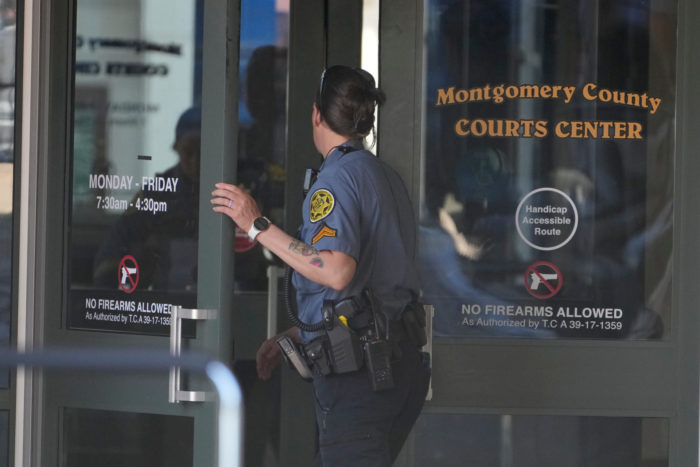
Barely a week passed before authorities filed a much more serious accusation. Investigators charged him with attempted murder tied to a shooting that allegedly left a disabled veteran wounded on the grounds outside the Montgomery County courthouse, according to a WSMV4 report. That matter also went to a grand jury for review.

A month afterward, the court held his bond in the Clarksville shooting at $1 million and imposed a curfew on him. As WSMV4 reported, the judge tacked on extra requirements that stood to complicate any attempt at release.

Roughly two weeks after that, Davidson County pulled his bond in the Nashville case. Whether the streamer must now report to jail in Davidson County remained unresolved as of Monday morning.

The Office of the District Attorney General in Nashville told WSMV4 that Eatherly satisfied his bond obligation there as well.

“Last Friday, our Assistant District Attorney tells me the Judge (despite our objection) granted a Bond to Dalton Eatherly for 15,000 dollars,” Director of Communications Steve Hayslip wrote in an email to WSMV4. “He immediately made that bond, just as he did his million dollar bond in Montgomery County.”

Should Eatherly “reoffend while awaiting trial,” Hayslip said, prosecutors will “immediately file a Motion to Revoke his bond.”

José Niño is the deputy editor of Headline USA. Follow him at x.com/JoseAlNino  

Mark Zuckerberg’s Yacht Ignores a Stranded Boat Calling for Help

(Headline USAThe crew of a yacht owned by Mark Zuckerberg did not hear a radio call for a maritime assist from a small skiff that ran out of fuel off the coast of Alaska, and by the time it did, another nearby ship had already rendered assistance, a spokesperson for the Meta CEO said.

The Alaska Beacon reported that the skiff had issued a call for assistance through the U.S. Coast Guard last week and a nearby small cruise ship, the Wilderness Legacy, towed it into nearby Farragut Bay in Southeast Alaska and refueled it.

Every ship is obligated to respond to a distress call under maritime law unless doing so would put their own ship at risk.

Although it was closer, Zuckerberg’s yacht, called Launchpad, had not responded to the call.

“I’m on a small-ship Alaska cruise with my son,” Michael Love, a passenger who said he was on the Wilderness Legacy cruise ship, wrote on Bluesky on Aug. 5.

“Our boat rescued a stranded vessel last night and apparently we did that after the Coast Guard radioed Mark Zuckerberg’s yacht — which was closer — and they repeatedly refused to respond. (There was near unanimous booing when the captain announced this),” he said.

The Alaska Beacon reported that the spokesperson told them via email on Sunday that the yacht Launchpad did not initially hear the call for assistance.

“Mark and his family were not on board at the time of the incident. As the Coast Guard noted, the boat was not in distress, and by the time the crew reviewed the Coast Guard contact on a different radio channel from the one they were operating on, the assist was already underway. We’re grateful all parties are safe,” the email to the Alaska Beacon said.

Adapted from reporting by the Associated Press

Pentagon Drafting New Strategy To Expand Options for Tactical Nuclear Weapons Use

(Dave DeCamp, Antiwar.comThe Pentagon is reportedly drafting a new nuclear strategy that’s expected to emphasize the use of tactical nuclear weapons to give the president more “options” in a potential nuclear conflict.

The strategy, first reported by NBC News, is being drafted by the Pentagon’s policy chief, Elbridge Colby, who has for more than a decade called for the US to develop additional capabilities to fight a “limited nuclear war.”

The idea would be to shift the US nuclear strategy away from the focus on using strategic nuclear weapons to wipe out an adversary’s nuclear capabilities and focus more on the possibility of using smaller, tactical nuclear weapons in a “regional” conflict.

Elbridge Colby, undersecretary of defense for policy, during a Senate Armed Services Committee hearing in Washington, DC, on March 3, 2026. (Photo by Craig Hudson/Sipa USA via Reuters Connect)

“If you actually want extended deterrence to be credible, you have to provide the nation’s political leadership with nuclear capabilities that common sense indicates you could actually use,” a source told NBC. “Otherwise you’re reducing our leadership’s options to extreme choices that the adversary won’t find credible.”

While the potential strategy would be carried out in the name of deterrence and preventing war, arms control advocates have strongly warned against the idea of developing more tactical nuclear weapons to prepare for a potential limited nuclear conflict over concerns that it would make nuclear war much more likely and that any nuclear exchange would likely lead to a global catastrophe.

“Without a firm rejection of the option to use nuclear weapons first in a conflict, by building and fielding more tactical nuclear weapons the administration is signaling its intention to use them against enemy forces and industrial infrastructure in a conflict,” the Arms Control Association said in response to the NBC report.

The ACA said that it “strongly opposes the administration’s decision to build more tactical nuclear weapons to supplement the options that exist” and pointed to the fact that the US already has at least two types of tactical nuclear weapons, including B61-12 gravity bombs, which are deployed in Europe, and the W76-2 low-yield warhead for the Trident II submarine-launched ballistic missile.

The ACA said the US Navy is also “acquiring a new nuclear-capable sea-launched cruise missile (SLCM-N) that may be available at the end of the decade for possible use in conflict with China.”

Breaking Defense reported that Colby announced on August 5 that the Pentagon was reviewing the US nuclear posture and repeatedly emphasized the term “options” in a speech he delivered that has not been made public.

Colby has been one of the leading voices in Washington’s policy circles advocating for the US to prepare for limited nuclear war. In a 2015 paper for the Center for a New American Security (CNAS) titled “A Nuclear Strategy and Posture for 2030,” Colby said the US “should make a special effort to develop the platforms and weapons, doctrine, planning capacity, and other capabilities needed to fight a limited nuclear war more effectively than plausible adversaries.”

He said that the ideal US nuclear force is “one that is not only highly survivable and able to issue a devastating blow against any adversary under any scenario but that is also capable of conducting effective limited nuclear operations in a controlled fashion while maintaining the ability to escalate to full-scale war if necessary.”

Colby made a similar argument in a 2018 piece written in Foreign Affairs titled “If You Want Peace, Prepare for Nuclear War,” published just a few months after he left the first Trump administration, where he led the development of the 2018 National Defense Strategy.

“Washington’s task is clear. It must demonstrate to Moscow and Beijing that any attempt to use force against US friends and allies would likely fail and would certainly result in costs and risks well out of proportion to whatever they might gain,” Colby wrote. “This requires conventional military power, but it also means having the right strategy and weapons to fight a limited nuclear war and come out on top.”

This article originally appeared at Antiwar.com.

New Initiative Launches to Encourage Muslim Americans to Vote

(The Center Square) A new national initiative has launched to encourage Muslim Americans to vote ahead of the Nov. 3 midterm elections.

The initiative comes after Christian, Jewish and nonpartisan nonprofit organizations have launched similar voter registration and get out the vote initiatives.

The Council on American-Islamic Relations (CAIR), the largest Muslim civil rights and advocacy organization in the U.S., launched Muslims.Vote, a non-partisan civic engagement campaign to equip American Muslims with tools and resources to vote.

Republican Govs. Ron DeSantis of Florida and Greg Abbott of Texas have designated CAIR a foreign terrorist organization. CAIR rejects the designation and sued both governors. CAIR won its lawsuit in Florida. Its lawsuit in Texas is ongoing.

Of the estimated more than 8 million Muslims in America, more than 2.5 million are registered to vote.

Muslims in America already have “the power to shape elections, especially in key swing states. But millions more eligible Muslim voters must register, show up, and make their voices count,” CAIR argues. “When we show up, our voices are heard, our votes matter, and our communities help build a more just future.”

The Muslims.Vote platform doesn’t endorse candidates. It provides voter registration information, personalized election information, ways to look up polling places, voting rights information, voting planning tools, civic engagement resources and advocacy toolkits.

CAIR is also working with mosques to register people to vote, as well as campus outreach and other initiatives, it says.

“Voting is more than a constitutional right – it is an amanah, a trust and responsibility,” CAIR Government Affairs Director Robert S. McCaw said. “Muslims.Vote was created to remove barriers to civic participation by putting everything voters need in one place.”

CAIR has identified 12 states where it says concentrated Muslim communities are located and Muslim voters can make an impact: Arizona, Florida, Georgia, Michigan, Minnesota, Nevada, North Carolina, Pennsylvania, Ohio, Texas, Virginia and Wisconsin.

The outcomes of races in these 12 states “will decide control of the U.S. House and Senate, our mobilization is not symbolic – it is decisive,” CAIR argues.

A similar argument has been made by American Renewal Project founder David Lane. For decades, Lane has been involved in encouraging evangelical Protestant Christians and prolife Roman Catholics to vote. He’s also encouraged pastors to run for office.

“If we stay home, candidates who oppose biblical values will win and then draft and pass legislation to codify into law their values,” Lane told The Center Square. “We’re asking the living God to move into the public square of America.”

While winning elections is important, Lane says, the goal is bigger.

“We all know that politicians are not going to save America, or that Wall Street or even our powerful military will,” Lane said. “If America is to be saved, biblical values must reign supreme. They must be returned to the public square.”

Multiple nonprofit organizations have mobilized voters through church voter registration initiatives for decades, including those advocating for prolife policies. In 2021, Democrats launched a “Souls to the Poll” campaign targeting Black church goers, The Center Square reported.

Under current law, through the 1954 Johnson Amendment, “charities, churches and educational organizations” are banned “from engaging in any political campaign activity.” A tax-exempt entity under IRS code 501(c)(3) is one “which does not participate in or intervene in (including the publishing or distributing of statements), any political campaign on behalf of (or in opposition to) any candidate for public office.”

In 2017, President Donald Trump issued an executive order to effectively nullify the amendment through a Treasury Department directive. This was reversed by the Biden administration. Earlier this year, the Treasury Department issued another guidance on the amendment. Regardless of Trump administration directives, the amendment remains in effect.

Earlier this year, a federal judge in Tyler, Texas, dismissed a lawsuit in which Protestant Christian pastors sought to endorse political candidates without their churches losing their tax-exempt status.

The U.S. Conference of Catholic Bishops maintains its position to not endorse or oppose political candidates but to “help Catholics form their conscience in the Gospel so they might discern which candidates and policies would advance the common good.”

Israel Is ‘Ruling Out’ the Hamas Disarmament Plan Announced by Trump

(Dave DeCamp, Antiwar.comIsraeli Prime Minister Benjamin Netanyahu on Sunday rejected for the second time a 15-point disarmament plan for Hamas that was announced by President Trump and the so-called “Board of Peace” on July 30.

“Israel does not accept the 15-point document,” Netanyahu said at the start of a cabinet meeting, according to Reuters. Last week, the Israeli leader said that the US had sent a draft, and that Israel “did not agree to it.”

In his comments on Sunday, Netanyahu added that the IDF “will not carry out any withdrawal until Hamas is disarmed … it means heavy weaponry, lighter weaponry, all weaponry. And we are talking about genuine disarmament, not fictitious disarmament.”

Netanyahu in the Oval Office on September 29, 2025 (White House photo)

Under the initial framework announced by Trump and the BoP, Israel was supposed to start withdrawing from Gaza as the process of disarming, called “decommissioning,” began to take place. But after BoP officials met with Netanyahu, the US-led body walked back that part of the deal, saying that the IDF won’t begin a withdrawal “beyond the yellow line” until Hamas was disarmed.

But even with the BoP adopting his talking points, Netanyahu has still rejected the deal. “They (the US) have ideas, some of which are acceptable to ​us and some of which are unacceptable to us,” he said on Sunday.

Following Netanyahu’s comments, a US official told Israel’s Channel 12 that the US wasn’t concerned, framing his public position as purely political since elections are coming up in Israel. “We understand his political needs [in this election period]. We have no problem with that, as long as he continues to do what we ask — especially as regards reining in the strikes in Gaza,” the US official said.

Israeli attacks in Gaza have slowed since Monday, August 3, but they haven’t stopped, as the Palestinian news agency WAFA reported on Sunday that the IDF had launched attacks across the Strip involving gunfire, artillery shelling, fire from naval vessels, and drones. Gaza’s Health Ministry said that over the previous 24-hour period, Israeli attacks killed at least one Palestinian and wounded eight.

Hamas has maintained it won’t go through with the plan unless Israel lives up to its commitments, which include ending its attacks in Gaza and withdrawing back to the original yellow line created after the ceasefire deal was signed more than nine months ago. At the time, Israel was left with 53% of Gaza under its control, but it has increased to about 70% as the IDF has been conducting ground incursions.

Senior Hamas official Basem Naim told Reuters that Hamas was still committed to the plan and called on the US to pressure Israel. “We expect the mediators and the US guarantor to press Netanyahu and his government to adhere to the roadmap and not obstruct the process for internal political and electoral reasons, while continuing to jeopardize the region’s security and stability,” he said.

This article originally appeared at Antiwar.com.

Trump Says US Is Only ‘Semi-Negotiating’ With Iran

(Dave DeCamp, Antiwar.comPresident Trump said on Sunday that the US was “low-keying it” with Iran and only “semi-negotiating” with the country, comments that come after a senior Iranian official laid out multiple conditions for the opening of the Strait of Hormuz.

“We are only semi-negotiating with them. We are just watching Iran with its huge inflation and the fact they have no money,” Trump told Axios reporter Barak Ravid, comments that were taken as a signal that the US will continue the blockade and economic pressure against Iran but won’t launch a major military escalation.

A day earlier, Mohammad Bagher Zolghadr, the head of Iran’s Supreme National Security Council, said that the conditions for the opening of the Strait of Hormuz include the US ending its threats against Iran, permanently ending the war and the other wars against Iran’s allies in Lebanon, Gaza, Iraq, and Yemen, lifting the naval blockade on Iranian ports, and pulling back US forces from the region.

Trump in the Oval Office on August 6, 2026 (White House photo)

Zolghadr also laid out economic conditions, including the lifting of all sanctions, the unfreezing of Iranian assets, and compensation for the war damages. “The Supreme National Security Council will not retreat from these demands, whether in war or in negotiations,” he said, according to Iran’s Mehr news agency.

Zolghadr’s demands are similar to the conditions Iran has laid out throughout the war for a broader deal with the US. But now Iran is demanding those conditions just to open the Strait of Hormuz, suggesting that Tehran sees the US as weakened in the region amid reports of depleting US military stockpiles and after Iran’s military was able to inflict significant damage and casualties in its strikes during the last round of attacks.

Iranian officials have previously said that a deal with Oman on the Strait of Hormuz was close but that it wouldn’t mean the waterway would be fully opened as long as the US continued its aggression against the Islamic Republic, referring to the blockade.

The Wall Street Journal reported on Sunday that Trump was laying the groundwork to declare victory if the Strait of Hormuz was fully opened and suggested to aides that he would be willing to walk away without a nuclear deal. The report said Iran’s demands have complicated that idea, and the plan now seems to be to continue the status quo for the time being.

This article originally appeared at Antiwar.com.