


Joint U.S. and Japanese Currency Intervention Reveals Eroding Dollar Dominance

(Mike Maharrey, Money Metals News Service) Last week, the U.S. intervened in the currency markets to support the Japanese yen. The way the U.S. executed the move reveals that the dollar’s reserve status isn’t what it used to be.

Typically, when the U.S. intervenes in currency markets, it buys a foreign currency using dollars. The sudden surge in demand for that currency strengthens it relative to other currencies. The downside is that the dollar sale weakens the U.S. currency.

For example, in a simple currency intervention, the U.S. buys yen with dollars. But last week was different. The Treasury Department took a new tack, buying yen with euros, thereby preserving dollar strength.

On the surface, it looks like the U.S. was willing to help Japan but was concerned with maintaining dollar strength. Notably, according to the Financial Times, the move “blindsided” the European Central Bank. U.S. officials didn’t inform the ECB until after the operation.

In an op-ed published by the Financial Times, U.C. Berkeley economics professor Barry Eichengreen argued that the way the Treasury executed this currency intervention reveals a deeper concern.

“The message is that U.S. Treasury Secretary Scott Bessent & Co worried that selling dollar securities to prop up the yen would put additional strain on the long end of the US Treasury market.”

The sagging demand for U.S. Treasuries is a growing problem for U.S. policymakers. As bond demand drops, prices fall. Inversely, yields rise. This increases the federal government’s borrowing costs. With the U.S. already spending over $1 trillion per year in interest expense, Uncle Sam can’t afford to lend money at even higher rates. Policymakers must find a way to support Treasury demand.

Eichengreen said that selling euros rather than dollars was likely partly a function of “that’s what the Treasury had on hand” in the currency stabilization fund; however, there is almost certainly more to the entire operation than that.

“It is also a way of not asking the market to swallow additional Treasuries sold to reduce dollar exposure, which would have aggravated an already delicate situation.”

The Mechanics of Currency Intervention

When a country wants to strengthen its currency, it typically sells a foreign currency (often dollars) and then buys its own currency with the proceeds. In Japan’s case, it sold dollars to buy yen.

But what if the Japanese treasury doesn’t have enough dollars on hand?

It can sell dollar assets for dollars and then buy yen with the proceeds.

The transaction would look like this:

Japan sells U.S. Treasuries for dollars ~~> Japan uses the dollars to buy yen.

This creates a bad feedback loop.

  1. The yen is weak
  2. Japan decides to intervene and defend its currency
  3. Japan needs dollars
  4. Japan sells some of its U.S. Treasury holdings to raise dollars
  5. U.S. Treasury prices fall (supply and demand – more Treasuries on the market pressure prices)
  6. Long-term yields rise (Yields are inversely correlated with bond prices)
  7. Higher U.S. yields incentivize investors to seek dollar assets
  8. The dollar recovers, but the yen weakens again

The Japanese have been engaging in market intervention for several months. The country’s foreign currency reserves fell by $75.6 billion in May. According to Bloomberg, this broadly matched the scale of yen intervention that month. Fed custody data showed a decline in Japanese Treasury holdings consistent with this liquidation.

Now enter the U.S.

Bessent doesn’t want Japan to sell Treasuries, so it offers to step in. If the U.S. buys yen, it kills two birds with one stone. The yen gets a boost without increasing the supply of Treasuries in the open market and raising yields.

In effect, U.S. intervention reduces the amount of dollars Japan needs to raise by liquidating Treasuries.

The U.S. has a vested interest in maintaining stable currency markets. Intervention is typically reserved for “excess volatility.”

But the U.S. wasn’t just trying to help a friend. It was trying to keep a lid on its own problem – a tanking Treasury market even as the U.S. needs to borrow more to keep up with ever-increasing spending.

The FIMA Repo Facility

In another move that signals Japan is willing to cooperate with the U.S. and prop up the Treasury market (or was coerced into cooperating), Japanese officials say they will use the Foreign and International Monetary Authorities (FIMA) facility to conduct future currency support operations.

In the early days of the pandemic, foreign institutions needed dollars and started selling Treasuries to raise cash. This created severe volatility and dysfunction in the Treasury market. In response, the Federal Reserve created FIMA in March 2020. This facility allows foreign monetary authorities to obtain dollars without selling Treasuries outright. Instead, the Fed loans them dollars, and the foreign government pledges Treasuries as collateral.

FIMA loans are very short-term – a maximum of seven days. However, loans can be rolled over.

Eichengreen said both the U.S. intervention and Japan’s willingness to use FIMA indicate “the dollar’s status as a reserve currency is not what it used to be.

“Central banks are accustomed to holding foreign reserves in dollars because markets in U.S. Treasury securities are liquid. Central banks hold U.S. Treasuries because they can be freely bought and sold and used in interventions. But not now, at least not in unlimited quantities. Instead, we see the U.S. Treasury stepping in with euro sales as part of its contribution to the intervention, thus limiting the volume of dollar sales needed by the Japanese authorities.”

Eichengreen said the bottom line is the U.S. is reluctant to see foreign central banks use dollar reserves due to the potential ramifications for its own financial markets.

“This is telling us that the dollar is not the attractive reserve currency it once was. When this message sinks in, other countries will redouble their search for more attractive, readily usable alternatives. Reserve diversification is apt to gather steam.”

The report put it even more bluntly:

“That strikes at the heart of dollar dominance, which is in part derived from the immense size and depth of the U.S. debt market.”

Central bank gold buying is part of the “reserve diversification” Eichengreen mentioned.

In a note, Capital Economics economist Kieran Tompkins said the move increases the appeal of holding assets like gold.

“The ability of central banks to conduct FX operations without triggering concerns from U.S. administrations about the impact on U.S. bond markets could provide fresh impetus to central banks’ demand for gold.”


Mike Maharrey is a journalist and market analyst for Money Metals with over a decade of experience in precious metals. He holds a BS in accounting from the University of Kentucky and a BA in journalism from the University of South Florida.
Former US Marine Held in Russia for More than 4 Years on Disputed Charges Has Been Released

(Headline USA) Russia released an American military veteran on Tuesday, allowing his return to the U.S. after four years of what his family and U.S. officials allege was wrongful incarceration and abusive treatment that left him near death.

Robert Gilman, a 32-year-old Massachusetts teacher and former Marine, was freed after 

President Donald Trump said he spoke with Russian President Vladimir Putin about his release, which Trump said was “very much on a Humanitarian Basis.”

“We appreciate this decision, and the fact that Russia asked for no one in return — No exchange took place,” Trump said on his Truth Social platform.

Arrests of Americans have become increasingly common in Russia in recent years. 

Concern has risen that Russia could be targeting U.S. nationals to use later as bargaining chips in talks to bring back Russians convicted of crimes in the U.S. and Europe. Five other Americans remain imprisoned in Russia with deteriorating medical issues, according to a news release from Global Reach, a group that’s been working to free them.

Secretary of State Marco Rubio posted a photo on social media of a gaunt-looking Gilman draped in an American flag and surrounded by his family aboard an airplane.

“While we appreciate this positive step, we are still seeking the immediate return of all other unjustly detained Americans,” Rubio stated.

Gilman will arrive at Andrews Air Force Base in Maryland outside of Washington on Tuesday evening, Trump said in his post.

“I just spoke to him, and he had one request — A GREAT cheeseburger when he lands,” Trump wrote. “I will take care of that!”

Gilman is bound for a military hospital in Texas, where he will be medically and psychologically assessed and treated, Eric Lebson, chief strategy officer of Global Reach, said in a statement.

Gilman was detained in 2022 on charges of beating a police officer after being taken off a train for causing a disturbance. He was convicted and handed a 3.5-year sentence.

He later was convicted of attacking a prison inspector during a cell check, beating an investigator and assaulting a guard. In October 2024, he was sentenced to eight years and one month. His sentence was extended in December to 10 years after he was found guilty of assaulting prison guards.

Russian media reported that he pleaded guilty to the charges and apologized to the guards he was charged with assaulting. The business daily Kommersant said he explained his actions by saying he wanted to stay in the prison where he was serving his sentence and avoid being moved to another penitentiary.

Gilman’s father has disputed the charges against his son, while the State Department has said the U.S. determined that Gilman was wrongfully detained, Gilman’s sister, Lexie Hudson, credited Trump and U.S. Sen. Ed Markey of Massachusetts with bringing about his release.

“There is no other reason that Robert is alive today other than that President Trump heard about the case and took action,” said Hudson, who thanked Markey “for leading our advocacy efforts in Congress.”

“The Russians treated my brother so badly,” Hudson said. “They hurt him for no reason, other than that he was both an American and a Marine. What did they get out of this? Why did they do this to such a wonderful person?”

Russian officials did not immediately comment on Gilman’s release. Russia’s Federal Penitentiary Service did not respond to a request for comment on his health deteriorating behind bars.

Gilman’s lawyer Irina Brazhnikova told the Russian news agency Interfax on Friday that Gilman was in a psychiatric ward of a civilian hospital, where he’s been since early July.

He was there “due to a psychiatric condition,” and according to doctors, his condition has worsened, but neither his defense lawyers, nor his family were allowed to visit, she said.

Before Gilman was flown out of Russia, he had been in “a dissociative stupor” for 47 days due to the abuse he had suffered in prison, according to Lebson. After Gilman was moved to the hospital, he was hooked up to a feeding tube and handcuffed to a bed.

Hospital reports conveyed Gilman’s condition “as dire and life-threatening,” pushing the 

U.S. government into action and leading to his release, Lebson said.

Markey had called on Russia and the U.S. to work together to get Gilman released. He was among at least eight Americans who remained in Russian custody after a series of high-profile prisoner exchanges with the U.S. in recent years.

Markey blamed Russia for Gilman’s poor health, saying his return to the U.S. was long overdue.

“It is a tragedy that it took Robert’s near-death condition for his case to receive the attention that it required for his release to be negotiated,” Markey said. “Throughout his detention, Robert was subjected to physical torture, forced medication, and provocations by Russian authorities. There is no doubt that his treatment by Russian authorities is the reason Robert is in this precarious state today.”

Adapted from reporting by the Associated Press.

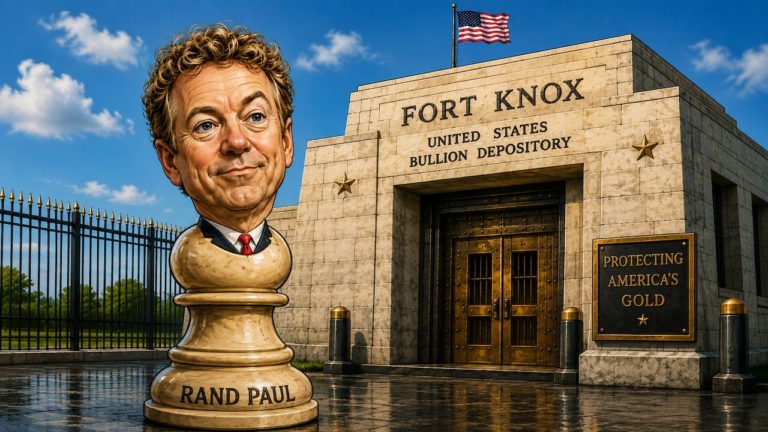
Sen. Rand Paul Becomes a Pawn in Fort Knox Gold Audit Debate

(Mike Maharrey, Money Metals News Service) Sen. Rand Paul has become Treasury Secretary Scott Bessent’s pawn.

A few weeks ago, Bessent insisted all the gold is in the vaults at Fort Knox.

“I haven’t. People on my staff have. The treasurer has been to Fort Knox, and I’m happy to say all gold is present and accounted for.”

On Monday, Paul spent one or two hours inside the Fort Knox gold depository and boldly proclaimed, “Yes, the gold is there, all (approximately) 147 million ounces. It is impressive.

With all due respect, Sen. Paul, it is absolutely impossible for you to make that statement after wandering around inside a vault for a few hours. My goodness!

U.S. gold reserves are reported to be 8,133.5 metric tons (i.e., tonnes). That’s roughly 261.5 million troy ounces. A little over half of that (147.3 million ounces according to the U.S. Mint) is stored at Fort Knox. The rest is spread out between the Denver Mint, the West Point Bullion Depository, and the Federal Reserve vault in New York.

Standard gold bars for reserve purposes typically weigh in at 400 ounces. That means there are over 300,000 bars in Fort Knox vaults. Likely, there are more than that because much of the gold held by the U.S. was formed by melting down coins in the 1930s that were not pure gold. These non-standard bars have irregular weights and do not even qualify for international settlements primarily due to lack of purity. In fact, based on documents released during a 2011 House Committee on Financial Services Hearing, only about 17 percent of the gold bars held by the U.S. government in Fort Knox meet any modern-day purity standards.

So, we’re supposed to believe that Paul spent a couple of hours or so inside the depository and can emphatically claim “all the gold is there.”

I call B.S.

Between Bessent’s statements last month and Paul’s propaganda tour, it’s almost as if there is a concerted effort to quiet calls for a legitimate audit of U.S. gold reserves. And who better to calm those voices than Rand, whose constituency is among the most vocal supporters of sound money.

Money Metals CEO Stefan Gleason put it bluntly:

“Sen. Paul has been rolled. All it took was giving him a fun chance to go into the mysterious facility.”

In a post on X, Gleason noted that Money Metals operates a precious metals depository twice the physical size of the Fort Knox facility.

“We are especially APPALLED that a giddy Sen. Rand Paul would implicitly make a mockery of proper auditing practices and whitewash decades of U.S. government mismanagement here, presumably as a ‘thanks’ to Treasury Secretary Scott Bessent who granted him this fun field trip today. No way in hell Sen. Paul can or should suggest America’s gold is fully accounted for based on a half-day visit. Even more importantly, is it encumbered? And is it okay that 83 percent of it is unacceptable on global markets due to lack of purity? What a shame.”

Ironically, Paul sponsored “The Gold Reserve Transparency Act of 2025” along with Sen. Mike Lee that would have produced a comprehensive audit of U.S. gold reserves.

Sound Money Defense League Director Jp Cortez said the tour and Rand’s subsequent insistence that the gold is “all there” raises serious questions.

“You co-sponsored a good bill that would have actually produced a full audit and accounting of America’s gold. Instead of pursuing that, you decided to go with a field trip to Fort Knox and a ‘trust me, I swear it’s all there,’ after a few hours? Why would you do that?”

Why indeed.

We Need a Real Audit

I’m not going to speculate as to why Paul came out with that statement. Politics is politics. But don’t allow this publicity stunt to take your eyes off the need for a legitimate audit.

If you aren’t familiar with general accounting principles, an audit involves a tad bit more than walking around on a guided tour.

In a proper audit, every bar would be counted and inspected by an outside entity. Serial numbers would be matched to records. The gold would be assayed to verify its weight and purity. And the details of the audit would be published and available for public inspection.

None of that has happened.

Ever.

Furthermore, audits include confirming chain of custody. We have no idea whether or not the Fort Knox gold is encumbered. Was it loaned to other entities, mobilized in currency interventions, pledged, leased, or swapped? Do any other parties have full or partial claims on the gold in the vaults? We don’t know because there is no published audit to examine.

And yet, in so many words, Paul tells us, [no worries, the gold is all there. I saw it].

In another post on X, Paul didn’t even get the total gold reserves correct, claiming the U.S. owned 477 million ounces, almost double the actual amount.

Perhaps we shouldn’t rely on Paul’s auditing prowess.

Yes. The federal government has taken some actions and called them audits.

In 1974, the government put together a publicity stunt in the name of an audit. The U.S. Treasury opened just one of its 15 Fort Knox vault compartments to politicians and reporters to view the gold and confirm its existence. It wasn’t unlike the little tour Rand just took.

Following the 1974 publicity stunt, the U.S. Treasury says it conducted a multi-year process of opening and inventorying vault compartments and affixing new tamper-evident seals to the doors of each compartment upon completion.

These so-called audits failed to meet basic transparency or accounting standards.

Some reports have since gone missing, and there is no record of comprehensive assaying, weighing, or transactional history available to the public.

Furthermore, there is evidence that seals on vault compartments have been broken over the years, bars have been moved for unknown reasons, and seals have been re-affixed without fresh auditing. Subsequent annual reviews of the schedules of compartment seals simply whitewash prior discrepancies.

In sum, the U.S. Treasury’s management of U.S. gold reserves is replete with audit “no-nos” that would never pass muster at a responsibly run private depository.

In fact, if they opened up a vault for Rand to inspect, this should trigger an audit.

Here’s the $6 billion question.

Why won’t they just audit the gold? Why is there such a persistent refusal to even entertain the idea? In fact, people like me are ridiculed for suggesting we need an audit.

I guess we’re just supposed to trust them because it’s the government?

If you ask me, that’s an even bigger reason not to trust them.

If a private business refused to audit its books, it would get shut down. But Uncle Sam plays by different rules.

Maybe it’s just me, but when somebody gets all upset when I suggest checking their work, I suspect their work might not be up to par.

I mean, think about it; you don’t have anything to hide, why wouldn’t you want the gold holdings to be verified? What’s the harm in an audit? Why this insistence that it isn’t necessary (when audits are necessary in every other business setting)?

If I were running a gold depository — and well, I kinda am… Money Metals Depository is larger than the U.S. Bullion Depository; our team knows a thing or two about auditing — I’d be clamoring for a public audit, if for no other reason than to calm the public fears. I would want people to know everything is on the up-and-up. The only reason I would resist an audit is if I knew I was hiding something.

So, what’s it going to be?

Are we going to take Bessent’s and Paul’s word for it? Or is somebody finally going to step up and do the right thing?


Mike Maharrey is a journalist and market analyst for Money Metals with over a decade of experience in precious metals. He holds a BS in accounting from the University of Kentucky and a BA in journalism from the University of South Florida.

Indian State Leader Presses US Envoy for More Student Visas

(José Niño, Headline USA) Immigration restrictionists in America have turned their attention to a New Delhi sit-down between the U.S. ambassador and a chief minister from southern India.

Telangana Chief Minister A Revanth Reddy urged U.S. Ambassador Sergio Gor last Wednesday to widen the flow of visas for students leaving his state, according to a report published by Telangana Today.

Their conversation ran half an hour and covered education, employment, investment, technology and research, Telangana Today wrote. Reddy wanted Gor’s help landing faster appointments and shorter waits for interview slots for students bound for American universities. 

Professionals with roots in the state have hit walls on H-1B processing, renewals and stamping, and Reddy raised those cases too. He asked that Washington flag changes to visa rules before they are implemented, then made his sales pitch, telling Gor that American companies in IT, artificial intelligence, life sciences, pharmaceuticals, startups and emerging technologies would find opportunities in Telangana.

The ambassador answered with a general assurance. Telangana Today reported that Gor promised full cooperation on trade, investment and cultural exchange linking the state to the United States.

American immigration hawks picked the story up fast.

“The Trump admin finally stopped rubber-stamping student visas plagued by fraud (especially from India). Now Indian officials are lobbying @USAmbIndia to reverse it. America First means holding the line,” the U.S. Tech Workers account posted on X.

A sharper take came from Nick Plumb, who steered his followers toward the same Telangana Today story.

“Believe it or not – India just asked their daddy to use his influence to increase student visas and expedite H-1Bs,” Plumb wrote, adding, “We’ve got to get him out of there.”

Hard data backs the underlying grievance. Consulates handed out 22,149 F-1 visas to Indian nationals between May and August 2025, a 62 percent slide from the 58,694 granted across the same stretch the previous year, according to a Center for Immigration Studies analysis. Chinese nationals saw a 34 percent decline. About three quarters of the Indian student visas granted in a given year clear during those four months.

Policy explains much of the gap. On May 27, 2025, Secretary of State Marco Rubio directed all U.S. embassies and consulates to pause scheduling new student visa interviews for F, M, and J visa applicants worldwide, in preparation for expanded social media vetting.

When the State Department resumed scheduling on June 18, it required all applicants to set their social media accounts to public so consular officers could screen them for “hostility” toward U.S. citizens, culture, government, or institutions— nd treat private accounts as potential evidence of evasiveness. DHS published a separate final rule on July 17, 2026 that scraps the longstanding duration of status framework and replaces it with fixed admission periods capped at four years, effective September 15, 2026, pending congressional review.

José Niño is the deputy editor of Headline USA. Follow him at x.com/JoseAlNino 

FBI Targeted Sitting AG Just One Day After Trump Fired Comey

(Luis CornelioHeadline USA) Newly declassified documents show that the FBI’s 2017 investigation of then-Attorney General Jeff Sessions may have been influenced by the political demands of two Democratic senators.

The files reveal that the FBI opened an investigation into Sessions for potential false statements to Congress just one day after Trump fired then-FBI Director James Comey and weeks after Sens. Patrick Leahy, D-Vt., and Al Franken, D-Minn., demanded that the FBI investigate him.

The files, reported first Monday by Just the News, were part of a trove of documents declassified by President Donald Trump for the White House Government Transparency Task Force.

Leahy and Franken wrote to Comey on March 20, 2017, urging him to investigate Sessions, who at the time was Comey’s boss, after Sessions told the Senate Judiciary Committee that he had no contacts with the Russian government about the 2016 presidential election.

Sessions had also testified that he “did not have communications with the Russians” while serving as a Trump campaign surrogate.

Sessions later submitted supplemental information clarifying that he had met with then-Russian Ambassador Sergey Kislyak on at least two occasions. Notably, one of those meetings, however, was an indirect interaction at a larger diplomatic gathering

ABC News previously reported on the Democrats’ letter and the FBI’s investigation of Sessions. But the newly declassified documents reveal a previously unreported detail: the Democratic senators’ letter and a copy of an article from leftist news site HuffPost were among the materials contained in the FBI’s investigative file.

Sessions did not face any charges after then-Special Counsel Robert Mueller interviewed him as part of the investigation.

Leahy and Franken, however, had demanded a far more aggressive response. They claimed in their letter that they were “concerned” by Sessions’ “lack of candor to the Committee and his failure thus far to accept responsibility for testimony that could be construed as perjury.”

Trump fired Comey on May 9, 2017. Days later, Deputy Attorney General Rod Rosenstein appointed Mueller as special counsel to oversee the FBI’s investigation into allegations of collusion between the Trump campaign and Russia.

The declassification comes less than a week after the White House released separate records showing that the FBI targeted Trump directly in the aftermath of Comey’s firing.

Reports: Trump Was Smuggled Inside a Container to Avoid Assassination Threat

(Ken Silva, Headline USA) Last month, President Donald Trump reportedly switched airplanes at the last minute when leaving a NATO summit in Turkey, due to a purported assassination threat coming from Iranian proxy forces. Instead of flying on a jet donated to him by the Qatari government, Trump was said to have used an older version of Air Force One because it has better defensive capabilities.

It turns out, Trump’s maneuvering was even more clandestine that originally reported. Not only did he switch to the older Air Force One; he was also secretly smuggled off that plane inside a catering container and taken to a third plane, according to the Washington Post and the New York Times.

Trump then took the third plane, a military aircraft, to the UK before being smuggled back onto the older Air Force One via the catering cart. Once in Britain, he departed Air Force One in front of the media, who were none the wiser about what had happened.

“The elaborate plan appears to have been developed in a matter of hours after officials determined that a threat against Mr. Trump from Iran was credible,” the Times reported Monday, citing two anonymous sources. “It came after years of threats against Mr. Trump from Iran and amid the war he launched against that country. And it was an unusual instance of the public being deceived about a president’s whereabouts.”

Trump’s secretive maneuvering came after Israel briefed the U.S. with purported intelligence about an Iranian plot to assassinate him. The Times said the decision to switch planes in Turkey stemmed from different intelligence than what the Israelis were providing. The Times added that some U.S. officials believe that the Israeli intelligence was intended to convince Trump to escalate his war against Iran.

Officials have yet to provide any evidence of a credible Iranian assassination attempt against Trump. This author’s book on the Trump assassination attempts details how the FBI and Israel manufactured dubious evidence that Iran was threatening him—though admittedly the threats may be more legitimate now amidst a full-fledged war between the countries.

There were two assassination attempts against Trump in 2024. One occurred on July 13, 2024, in Butler, Pennsylvania, when 20-year-old Thomas Crooks allegedly shot him in the ear from a rooftop during a campaign rally. The other occurred about two months later at Trump’s Palm Beach golf course, where North Carolina man Ryan Routh was spotted by Secret Service hiding in the bushes with an SKS-style rifle a mere few hundred yards away from Trump.

Additionally, a gunman tried storming the White House Correspondents’ Dinner event earlier this year in an apparent attempt to kill Trump and other officials. Trump was on a separate floor from the alleged gunman, Cole Allen, when law enforcement apprehended him.

There’s no evidence that any of those attempt were sponsored by Iran.

The FBI did arrest a Pakistani national named Asif Merchant on July 12, 2024—the day before Trump was shot—for murder-for-hire in an alleged plot to assassinate U.S. officials, including possibly Trump.

However, Merchant’s actions can hardly be called an assassination attempt. Rather, the available evidence suggests that Merchant was the target of a highly controlled FBI sting operation, and that he never posed a threat to Trump.

Indeed, the U.S. was monitoring Merchant before he even entered the U.S. in April 2024, and officials let him into the country to track him and see where he’d go.

Moreover, an FBI informant drove Merchant around while he was here, and introduced him to two undercover agents posing as “hitmen.” Merchant allegedly paid those two agents $5,000 as a downpayment for his plot—which also included staging a protest and stealing documents—and he was arrested as he was attempting to leave the country.

Merchant was found guilty in March.

The FBI did accuse one other man of being involved in an Iranian plot against Trump in a criminal complaint filed in November 2024. In that case, there’s arguably even less evidence of a credible threat to Trump.

Indeed, the defendants in that case—Farhad Shakeri, 51, of Iran; Carlisle Rivera, also known as Pop, 49, of Brooklyn, New York; and Jonathon Loadholt, 36, of Staten Island, New York—were not accused of conspiring to kill any politicians, let alone Trump. Rather, they were charged with plotting to kill a U.S. journalist of Iranian origin.

While Shakeri is one of the defendants, the government’s criminal complaint shows that he appears to have been snitching to the FBI in recent months. According to the charging papers, Shakeri participated in phone interviews with the FBI from Iran on September 30, October 8, October 17, October 28 and November 7—ostensibly trading information in exchange for a sentence reduction for an unidentified individual.

In one of those interviews, Shakeri—who was deported from the United States in 2008 after serving fourteen years in prison for robbery—told the FBI that an Iranian Revolutionary Guard Corps official was pushing him to assassinate Trump.

Shakeri further told the FBI that the IRGC official told him on October 7 that he had to provide a plan to kill Trump within seven days. Shakeri said he was unable to do so, and so Iran decided to pause its plans to kill Trump until after the election—which would have made it easier to kill him if he lost.

The FBI admitted in the charging papers that Shakeri is a liar, but said his claims about Trump “appear to be truthful.” Nevertheless, when the Justice Department secured indictments in the case a month after the criminal complaint was filed, there was no mention of the allegation against Trump.

Loadholt and Rivera both pled guilty to conspiring against the journalist, while Shakeri remains at-large in Iran.

Ken Silva is the editor of Headline USA. Follow him at x.com/jd_cashless.

Trump Signs Order Calling for Spacing Out Childhood Vaccines

(Headline USA) President Donald Trump on Monday signed an executive order calling for revamped childhood vaccine recommendations that promote his long-held theory that childhood shots should be spaced out into separate medical visits.

The order advocates separating the measles, mumps and rubella (MMR) vaccine into three different shots administered in separate appointments, and directs the nation’s health department to improve vaccine research, according to a White House fact sheet on the order. Separate measles, mumps and rubella vaccines for children are not currently available in the United States, and vaccines are already extensively researched.

Speaking about the order at the Oval Office on Monday, Trump repeatedly suggested the number or timing of vaccines could play a role in rising rates of autism spectrum disorder. He also touted several changes to the childhood vaccine schedule that his health department has already attempted, but that have been blocked by a federal judge.

The renewed focus on vaccines marks a departure from his administration’s recent efforts to emphasize less controversial health policies related to healthy eating, drug price negotiations and medical fraud crackdowns ahead of November’s midterm elections.

Even as the order calls for revised vaccine recommendations, states, not the federal government, have the authority to require vaccinations for schoolchildren. The order advises states with school vaccine mandates to consider updating their laws to reflect the administration’s preferred schedule, the fact sheet said.

Last December, Trump ordered the Department of Health and Human Services to review how peer nations approach vaccine recommendations and consider revising U.S. guidance accordingly. The department responded by cutting the number of vaccines it recommends for every child, a move that has since been blocked in court.

Changes to federal childhood vaccine recommendations customarily require approval from the director of the Centers for Disease Control and Prevention. The newly Senate-confirmed CDC director, Dr. Erica Schwartz, oversaw policies promoting vaccination of service members while in a leadership position at the U.S. Coast Guard.

Health Secretary Robert F. Kennedy Jr., a longtime anti-vaccine activist before he entered politics, set out to overhaul immunization guidance at DHS in the first year of Trump’s term. He fired an entire 17-member vaccine advisory committee, installing replacements who made far more restrictive recommendations that have since been halted by a federal judge.

In the months leading up to Monday’s announcement, Trump’s administration had largely pivoted away from talking about vaccine policy in favor of less polarizing topics like healthy eating and efforts to lower drug prices ahead of November’s elections. 

Adapted from reporting by the Associated Press

Ongoing Immigration Enforcement: More Than 175,000 Visas Revoked in 20 Months

(Bethany Blankley, The Center Square) The Trump administration continues to enforce federal immigration law by revoking visas of foreign nationals who commit crimes and pose a national security threat.

In roughly 20 months, the U.S. State Department has revoked more than 175,000 visas of foreign nationals who “violated the terms of their visas, committed crimes, called for violence against U.S. citizens, defrauded Americans, abused the immigration system or endangered national security,” the State Department announced.

Visas were revoked for those with criminal offenses, including assault, driving under the influence, theft and drugs. A significant number included reckless driving, sexual assault, child abuse, fraud and embezzlement, it said.

Secretary of State Marco Rubio maintains that “a U.S. visa is a privilege, not a right” and the State Department will “continue to identify, investigate, and revoke the visas of foreign nationals who threaten the safety of the American people.”

The State Department revoked visas “from criminals who posed a danger to American citizens, endorsed violence against Americans, arranged illegal birth tourism schemes, or engaged in fraud,” it says.

Examples include foreign nationals charged with violent crimes of felony rape, sexual battery, felony kidnapping, human trafficking, sexual exploitation of a minor, sodomy of a child, aggravated sexual battery, domestic violence, possession of child sexual abuse material and a child sex offender pardoned by Minnesota Gov. Tim Walz.

Visa revocation is occurring worldwide. A U.S. embassy in North Africa revoked more than 100 visas for “‘birth tourist’ parents who came to the United States primarily to give birth so their children would get U.S. citizenship,” the State Department said.

Others’ visas have been revoked after foreign nationals were charged with orchestrating a $5 million Medicaid scam and launching fraudulent companies “to swindle millions of dollars from clients.”

Rubio also determined that numerous foreign nationals “are deportable on foreign policy grounds,” including those connected to the Cuban communist regime and Iranian regime. Last May, he also began visa restrictions for students  connected to the Chinese Communist Party, The Center Square reported.

The State Department also revoked the visas of “multiple foreign nationals who celebrated the assassination of Charlie Kirk, including one who stated, ‘when fascists die, democrats don’t complain’ and another who said he ‘died too late.’”

Last September, Rubio implemented a policy restricting and revoking visas to foreigners who celebrate the death of U.S. citizens. It has received scrutiny by First Amendment advocates who argue that protected speech includes speech celebrating political assassinations.

The visa revocations were made after the Trump administration implemented a massive overhaul of several federal programs administered by the departments of State, Justice,  Homeland Security, U.S. Citizenship and Immigration Services, among others. This included enforcing existing immigration law, prosecuting immigration crimes, terminating so-called temporary protective status going on for decades, terminating parole programs and implementing a series of vetting reforms, work verification and citizenship requirements, The Center Square reported.

Prosecutors are ongoing for a range of visa fraud including forced labor, agricultural visa fraud, student visa fraud, marriage and welfare fraud, charter school and educational visa fraud, as well as birth tourism visa fraud, The Center Square reported.

In Texas, Gov. Greg Abbott is also cracking down on H1-B visa fraud and birth tourism and alleged welfare fraud.

Members of Congress have called for investigations into H-1B visa fraud and U visa fraud, The Center Square reported.

Advocates Seeking Republicans to Support Ending Child Marriage in the U.S.

(Bethany Blankley, The Center Square) Organizations that have been advocating to end child marriage in the U.S. are actively seeking Republicans in Congress and state legislatures to support ending the practice. They argue the issue is nonpartisan and children, especially girls, should be protected.

So far, only Democrats in Congress have sponsored the Child Marriage Prevention Act. It was first filed in 2024 and recently refiled by U.S. Sen. Dick Durbin, D-IL, with Sens. Brian Schatz of Hawaii and Kirsten Gillibrand of New York as cosponsors. U.S. Rep. Gwen Moore, D-WI, filed companion legislation.

The bill is the first concerted effort by Congress “to condemn and prevent child marriage domestically,” the Tahirih Justice Center says. It and other survivor-led organizations have been advocating to end the practice.

“For years, the United States has condemned child marriage abroad while failing to address the ways our own laws leave children here and around the world vulnerable to exploitation under the guise of marriage,” Casey Carter Swegman, director of Public Policy at the Tahirih Justice Center, said. “The Child Marriage Prevention Act is a critical step toward changing that. By supporting states to take action to end child marriage and closing legal loopholes that can be used to exploit children, this bill sends a clear message: child marriage is wrong no matter where it occurs, and we must end it.”

The bill would set minimum age requirements for U.S. petitioners and foreign beneficiaries of spouse and fiancée visas to prevent the exploitation of children in marriage-based visa programs under the guise of marriage. It would prohibit child marriage from being performed on property owned or funded by the federal government, including U.S. military bases worldwide, among other measures, according to the bill language.

It also would repeal a consummation requirement for a “proxy marriage” which has been found to incentivize and justify statutory rape. Federal law, 18 USC Section 243(c)(2), legally allowed a marital defense for statutory rape, which was removed in the Violence Against Women Reauthorization Act of 2022. A similar defense remains in U.S. Military Code 10 U.S.C. Section 920b and some state law exceptions, Equality Now explains. They must be repealed because they “effectively turn child marriage into a ‘get out of jail free’ card for predators,” it argues.

According to an UnChained At Last report, between 2000 and 2021, nearly 315,000 children were legally entered into marriage across the U.S. The vast majority were girls wed to adult men.

The bill states that girls as young as 10 were married to adult men in the U.S.; most were 16 and 17.

The bill also raises concerns about girls forced into marriage who aren’t able to file protective orders, file for divorce and have limited legal rights because they are minors. It also lists negative consequences for girls, including limited educational opportunities, poverty, mental and physical health issues as well as abuse and violence.

“Protecting children from abuse and exploitation is not a partisan issue and has always been a priority on both sides of the aisle,” Tahirih Justice Center Communications Director Rachel Pulda told The Center Square. “Across the country, Republican and Democratic lawmakers have championed bills to ban child marriage: Republicans in Missouri, Oklahoma and West Virginia and Democrats in Delaware, New York and Virginia. For the past decade, state legislators have worked across the aisle to strengthen state marriage-age laws and enact complete bans on child marriage. That progress demonstrates that legislators from across the political spectrum agree that children should not be placed at risk of abuse, trafficking, or exploitation under the guise of marriage.

“We are actively seeking Republican co-sponsors for the federal Child Marriage Prevention Act because this legislation can and should have broad bipartisan support. The question is not whether one party or another should address child marriage; it is whether Congress will come together to protect children. With child marriage still legal in most states and federal immigration loopholes continuing to expose children to exploitation, the need for bipartisan action is urgent.”

“The U.S. is obligated to address child marriage under the international human rights treaties it has ratified, including the International Covenant on Civil and Political Rights,” UnChained says. “In 2023, the United Nations Human Rights Committee expressed concern that child marriage remained legal in most of the U.S., and it urged the U.S. to “adopt measures at all levels in order to prohibit marriage under the age of 18.’”

Advocacy groups are calling on state legislatures to enact a minimum age requirement of 18 for marriage with no exceptions and for Congress to act.

The District of Columbia and 17 states have enacted such a ban: Connecticut, Delaware, Maine, Massachusetts, Michigan, Minnesota, Missouri, New Hampshire, New Jersey, New York, Oregon, Pennsylvania, Rhode Island, Vermont, Virginia and Washington. Oklahoma was the latest to do so this year. Its new law goes into effect Nov. 1.

Child marriage remains legal in 33 states: Alabama, Alaska, Arizona, Arkansas, California, Colorado, Florida, Georgia, Hawaii, Idaho, Illinois, Indiana, Iowa, Kansas, Kentucky, Louisiana, Maryland, Mississippi, Montana, Nebraska, Nevada, North Carolina, North Dakota, Ohio, South Carolina, South Dakota, Tennessee, Texas, Utah, West Virginia, Wisconsin and Wyoming.

This is down from 49 in 2018, when Delaware and New Jersey were the first two states to prohibit child marriage under age 18 with no exceptions, The Center Square reported.

In 2019, Nevada attempted to pass a total ban but limited the ban to under age 17 with a requirement for parental or judicial consent for 17 year olds.

Three states – California, Mississippi and New Mexico – have no minimum age requirement for marriage.

Taxpayer Philanthropy: Tax Cash to Nonprofits More Than Doubled Since 2016

(Arthur Kane and Jared Strong, The Center Square) In the past decade, government grants to nonprofits and the number of nonprofits that receive tax money has doubled, raising questions about whether public money is being wasted, an investigation by The Center Square found.

In 2016, federal, state and local governments gave $149.5 billion in grants to about 56,000 nonprofits registered with the IRS, an analysis of nonprofit tax returns shows. In 2020, that number went up to nearly $310 billion with more than 110,000 nonprofits receiving taxpayer funding. Two years later, the numbers peaked at $319 billion though about 10,000 fewer nonprofits received government cash, the data shows.

David Williams, president of the Taxpayers Protection Alliance, said there is not enough accountability or oversight of the money that goes to nonprofits.

“Nonprofits should survive based upon the goodwill of people, not the force of taking taxpayer dollars,” he said after The Center Square detailed the findings in the data. “Nonprofits are not accountable and government officials haven’t held them accountable.”

In 2021, the government funding for nonprofits dropped to $259 billion and two years later to nearly $222 billion. More current data was not available because many nonprofits file for extensions and do not submit their tax returns in the year they are due. And it is not clear if the 2023 tax data is complete.

The large gains coincided with an influx of government funding during the COVID-19 pandemic and the country’s recovery from it.

Since Elon Musk led the Department of Government Efficiency, there has been significant controversy about tax dollars funding nonprofits with allegations that are wasting money for frivolous programs or are being diverted to fund the lifestyles of politically connected nonprofit executives.  

This is the first story in an on-going investigation into government spending on nonprofits. There has been a lot of controversy over NGO and other nonprofit funding so The Center Square decided to dig into the data to determine which nonprofits serve legitimate needs and which are a waste or misuse of taxpayer money. If you know a nonprofit that needs investigating, please email [email protected].

The database used by The Center Square for this investigation was created from digitalized nonprofit tax returns, also known as 990s, that are found on the IRS website. Artificial Intelligence was used to extract nonprofits that receive government funds and analyze the taxpayer funding.

While the tax returns also include program data – payments to nonprofits for services – the 990s do not distinguish between government and private parties paying for the program services. Therefore, The Center Square didn’t use that data in its analysis. The data also does not include nonprofits or nongovernmental agencies (NGOs) that are not registered with the IRS because they are overseas.

The Center Square’s analysis found that more than 11,000 nonprofits — or about 10% – that receive government grants have at least one executive who makes $300,000 a year or more.

Significant tax money is going to pay nonprofit insiders.

At least a fifth of the nonprofits that receive government grants had executive salaries that took up 25% of the taxpayer funding. In hundreds of nonprofits, the government money covers 90% of top employees’ compensation, including dozens of Minnesota nonprofits. The state’s nonprofits and service organizations have faced allegations of fraudulent and diversions of money to possible Somali terror groups.

“What this shows is that taxpayers are funding salaries, not programs,” Williams said. “It’s not going towards the mission of the nonprofits.”

As part of the investigation, The Center Square found a North Carolina nonprofit receiving taxpayer money that promotes gender transitions in infants despite state law prohibiting the use of government funds for gender reassignment in children.

And an Illinois nonprofit has paid more than $2 million to businesses owned by its founder, promoting an obscure PTSD treatment that involves injecting patients in their necks.

The Center Square plans to continue digging through the 3.4 million line database to find questionable expenses and nonprofits. 

Williams, who runs a nonpartisan nonprofit dedicated to exposing how government uses tax money, said that government officials are using tax money to bolster their profile and get credit for funding charities without the taxpayers getting a say in how the money is spent.

“This is really a case of phony philanthropy,” he told The Center Square. “The politicians and bureaucrats are saying they’re philanthropic, but it’s really our money, our taxpayer money, and they shouldn’t be doing it, they should not be taking credit for it.”

Williams said the only way to get a handle on the problem is to make sure each nonprofit that gets tax money is audited annually and not allowed to obtain funding without providing proof that the tax money was well spent.

“You should be required to do a full audit every year,” he said. “And when I talk about a full audit, I’m talking about looking at receipts, exactly where the money was spent…”

Josh Rosenfeld, a director at Avoq which handled public relations for the National Council of Nonprofits, said no one at the council was available to do an interview on the increasing nonprofit spending.

“Unfortunately, I don’t think it is going to work out timing wise, as our team is going to be tied up throughout the next week or two,” he wrote in an email exchange.

Other nonprofit associations, like the Independent Sector and The Center for Effective Philanthropy, either didn’t respond or didn’t set up interviews despite The Center Square’s requests.