

More Floridians, Californians Moving to Texas than Reverse

(The Center Square) According to an analysis of migration data from the three most populous states, more Californians and Floridians are moving to Texas than Texans are moving to those states.

Overall, the majority of out-of-state movers relocating to Texas are leaving Democratic-led states that have higher state income taxes and more progressive tax policies than Texas has.

According to an analysis of moves over a 12-month period, based on PGM’s database of 18 million moves tracked between June 2024 and May 2025, more than 1.6 million adults moved to or within Texas during this timeframe.

Among them were 265,112 from out of state, averaging 22,092 a month, or 726 a day, according to the data.

The majority moving from out of state to Texas were from California (14%), Florida (9%), and Colorado (4.5%), representing nearly one-third of new Texas residents, according to the data. Movers from Arizona (3.8%) and Illinois (3.7%) rounded out the top five, according to the data.

When evaluating the data among the top three most populous states, more Californians and Floridians moved to Texas than the reverse, according to a breakdown of the data Hire A Helper exclusively provided to The Center Square.

More than double the number of Californians moved to Texas, 37,253, than Texans moved to California, 14,539, during the 12-month-period analyzed, according to the data.

Roughly one-third more Floridians moved to Texas, 24,378, than Texans moved to Florida, 15,650, over the same time period, according to the data.

According to a StorageCafe analysis, roughly 100,000 Californians have been moving to Texas a year – the equivalent of the population of Santa Barbara, The Center Square reported.

Similarly, roughly one-third more Californians moved to Florida, 16,457, than Floridians moved to California, 11,356, during the same 12 months, according to the data.

Of the moving demographics PGM analyzed, “Gen X and millennials made up 75% of new Texans, signaling a wave of professionals and families chasing opportunity, affordability, and a higher quality of life,” Hire A Helper said.

North Texas is the top moving destination, where business headquarters are relocating and Texas’ new stock exchange was launched, The Center Square reported.

Nearly 32% of those relocating moved to the Dallas–Fort Worth–Arlington area during the timeframe analyzed, according to the data.

The Houston–Pasadena–The Woodlands region received the next greatest percentage of new residents, nearly 21%; the Austin–Round Rock–San Marcos region received the third greatest of 13%, according to the data.

The majority of moves in Texas over the year were in-state, 84%, “with residents shuffling between metros for better housing and jobs,” according to the analysis.

Smaller cities in north Texas, including “Sherman–Denison (No. 5 for net gain), Tyler (No. 6 for net gain), and Granbury (No. 7 for net gain) are emerging as the next growth hotspots,” the report notes.

Texas counties saw a massive influx of residents from July 2023 to 2024, according to U.S. Census Bureau data, The Center Square reported. Four of the top 10 counties reporting the greatest numeric growth and the greatest percentage growth in the U.S. were in Texas, according to the data.

Harris County, Texas, reported the greatest population growth in 2024, followed by Miami-Dade, Florida. By contrast, California’s largest county of Los Angeles reported losses, according to the census data.

Of the 10 counties reporting the greatest growth by percentage last year, four were in Texas. Two were in Florida, none were in California, according to the census data.

Hire A Helper data also confirms yearly census data, which shows more people are moving to southern states. When looking “at the sheer volume of people moving in minus people leaving,” states reporting the greatest number of new residents over the period analyzed were South and North Carolina, Texas, Tennessee and Florida, it said.

States where more residents left than entered are all run by Democrats: California, New York, New Jersey, Massachusetts and Illinois, according to the data.

“While California certainly had people moving in [over the year analyzed], it saw an overall net decrease in residents, -128,470,” Hire A Helper said.

One key contributing factor is state income tax, the report notes. Three of the five states people are moving to have no state income tax: Texas, Tennessee and Florida. The five states experiencing an exodus have among the highest taxes in the country.

2 Helicopters Collide in New Jersey Airspace, Leaving 1 Dead and 1 Badly Hurt

(Headline USATwo helicopters crashed midair in New Jersey on Sunday, killing one person and critically injuring another, authorities say.

Hammonton Police Chief Kevin Friel said rescuers responded to a report of an aviation crash at about 11:25 a.m. Video from the scene shows a helicopter spinning rapidly to the ground. Police and fire crews subsequently extinguished flames that engulfed one of the helicopters.

The Federal Aviation Administration described the crash as a midair collision between an Enstrom F-28A helicopter and Enstrom 280C helicopter over Hammonton Municipal Airport. Only the pilots were on board each aircraft. One was killed, and the other was transported to a hospital with life-threatening injuries.

Sal Silipino, owner of a cafe near the crash site, said the pilots were regulars at the restaurant and would often have breakfast together. He said he and other customers watched the helicopters take off before one began spiraling downward, followed by the other.

“It was shocking,” he said. “I’m still shaking after that happened.”

Hammonton is a town of about 15,000 people located in Atlantic County in the southern part of New Jersey, about 35 miles southeast of Philadelphia. The town has a history of agriculture and is located near the Pine Barrens, a forested wilderness area that covers more than 1 million acres.

The FAA and National Transportation Safety Board will be investigating the crash, Friel said.

Investigators will likely first look to review any communications between the two pilots and whether they were able to see each other, said Alan Diehl, a former crash investigator for the FAA and NTSB.

“Virtually all midair collisions are a failure to what they call ‘see and avoid,’” Diehl said. “Clearly they’ll be looking at the out-of-cockpit views of the two aircraft and seeing if one pilot was approaching from the blind side.”

Although it was mostly cloudy at the time of the crash, winds were light and visibility was good, according to the weather forecasting company AccuWeather.

Adapted from reporting by the Associated Press


Donald Trump Doubles Down on Greenland Demand Despite European Outrage

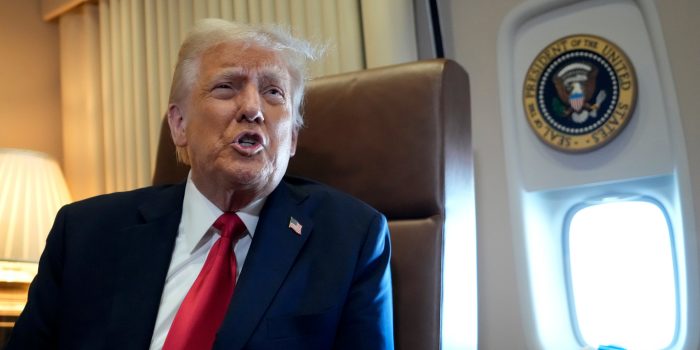
(José Niño, Headline USA) President Donald Trump has escalated his demands for control of Greenland by appointing a special envoy to pursue the Arctic territory, declaring the United States must acquire the island for national security purposes despite fierce opposition from European allies and Greenlandic leaders.

According to the Financial Times, Trump announced at his Mar-a-Lago residence that his interest extends beyond the island’s rare minerals and mining opportunities. “If you take a look at Greenland, up and down the coast, you have Russian and Chinese ships all over the place. We need it for national security. We have to have it,” he told reporters.

The appointment of Louisiana Governor Jeff Landry as special envoy to Greenland shocked Danish and Greenlandic officials, who received no consultation about the decision. The designation carries particular weight since such positions typically address major conflicts like those in Ukraine and the Middle East.

Greenland Prime Minister Jens-Frederik Nielsen expressed disappointment with Trump’s approach. “Our territorial integrity and our right to self-determination are rooted in international law and cannot simply be ignored,” he said, adding that he was “sad” his country was reduced by Trump “to a question of security and power.”

European leaders quickly rallied behind Denmark. European Commission President Ursula von der Leyen emphasized that “territorial integrity and sovereignty are fundamental principles of international law.” Foreign ministers from Germany, Norway, and Sweden also voiced support for Danish sovereignty while noting Arctic security remains an important EU priority.

Trump’s claims about Russian and Chinese naval activity near Greenland face significant dispute from local and Danish officials, who report no recent sightings of vessels from either nation. Chinese business interest in the territory has declined sharply since several failed mining and tourism ventures during the 2010s.

The president also criticized Denmark’s military commitment to the region. “Denmark has spent no money. They have no military protection,” Trump declared. However, Denmark announced in October a $4.2 billion investment in Greenland defense infrastructure, including two military units, a joint Arctic command headquarters in Nuuk, and new ships, aircraft, drones, and radar systems.

The United States maintains Pituffik space base under a 1951 agreement with Denmark, though American military presence has shrunk dramatically from a Cold War peak of 15,000 personnel to approximately 200 today.

Trump dismissed Danish historical claims to the territory. “They say that Denmark was there 300 years ago or something, with a boat. Well, we were there with boats too, I’m sure. So we’ll have to work it all out,” he said.

José Niño is the deputy editor of Headline USA. Follow him at x.com/JoseAlNino 

Trump Meeting w/ Zelenskyy Today in Effort to End Ukraine/Russia War

(Headline USAPresident Donald Trump will host his Ukrainian counterpart, Volodymyr Zelenskyy, on Sunday to try to close out a peace agreement that would end nearly four years of war sparked by Moscow’s invasion of Ukraine. Russia intensified its attacks on Ukraine’s capital and elsewhere in the days before the meeting.

Trump said he spoke with Russian President Vladimir Putin on Sunday in advance of the meeting. “I just had a good and very productive telephone call with President Putin,” he posted on Truth Social. The Kremlin confirmed the call without giving details.

Trump and Zelenskyy will meet at Mar-a-Lago, Trump’s private club in Palm Beach, where the U.S. president is spending the holidays. Zelenskyy, who arrived in Miami in the morning, said the two planned to discuss security and economic agreements in their early afternoon meeting. He said he will raise “territorial issues” as Moscow and Kyiv remain fiercely at odds over the fate of the Donbas region in eastern Ukraine.

In overnight developments, three guided aerial bombs launched by Russia struck private homes in the eastern city of Sloviansk, according to the head of the local military administration, Vadym Lakh. Three people were injured and one man died, Lakh said in a post on the Telegram messenger app.

The strike came the day after Russia attacked Ukraine’s capital with ballistic missiles and droneson Saturday, killing at least one person and wounding 27, a day before planned talks between the leaders of Ukraine and the United States, Ukrainian authorities said. Explosions boomed across Kyiv as the attack began in the early morning and continued for hours.

In advance of his meeting with Trump, Zelenskyy said Sunday that he spoke on the phone with British Prime Minister Keir Starmer, filling him in “on the situation on the frontline and on the consequences of Russian strikes.” He posted on X: “Thank you, Keir, for the constant coordination!” Zelenskyy’s office said he will speak by phone with allies after the meeting with Trump.

Trump, on Truth Social, said he and Zelenskyy will meet in the main dining room of Mar-a-Lago and the news media will be allowed in.

In a meeting Saturday with Canadian Prime Minister Mark Carney in Halifax, Nova Scotia, Zelenskyy said the key to peace is “pressure on Russia and sufficient, strong support for Ukraine.” To that end, Carney announced more economic assistance from his government to help Ukraine rebuild.

Denouncing the “barbarism” of Russia’s latest attacks on Kyiv, Carney credited both Zelenskyy and Trump with creating the conditions for a “just and lasting peace” at a crucial moment.

“Ukraine is willing to do whatever it takes to stop this war,” Zelenskyy posted Saturday. “We need to be strong at the negotiating table.”

In response to the attacks, he wrote: “We want peace, and Russia demonstrates a desire to continue the war. If the whole world — Europe and America — is on our side, together we will stop” Russian President Vladimir Putin.

Trump and Zelenskyy sitting down face-to-face also underscored the apparent progress made by Trump’s top negotiators in recent weeks as the sides traded draft peace plans and continued to shape a proposal to end the fighting. Zelenskyy told reporters Friday that the 20-point draft proposal negotiators have discussed is “about 90% ready” — echoing a figure, and the optimism, that U.S. officials conveyed when Trump’s chief negotiators met with Zelenskyy in Berlin earlier this month.

During the recent talks, the U.S. agreed to offer certain security guarantees to Ukraine similar to those offered to other members of NATO. The proposal came as Zelenskyy said he was prepared to drop his country’s bid to join the security alliance if Ukraine received NATO-like protection that would be designed to safeguard it against future Russian attacks.

‘Intensive’ weeks ahead

Zelenskyy also spoke on Christmas Day with U.S. special envoy Steve Witkoff and Jared Kushner, Trump’s son-in-law. The Ukrainian leader said they discussed “certain substantive details” and cautioned “there is still work to be done on sensitive issues” and “the weeks ahead may also be intensive.”

The U.S. president has been working to end the war in Ukraine for much of his first year back in office, showing irritation with both Zelenskyy and Putin while publicly acknowledging the difficulty of ending the conflict. Long gone are the days when, as a candidate in 2024, he boasted that he could resolve the fighting in a day.

After hosting Zelenskyy at the White House in October, Trump demanded that both Russia and Ukraine halt fighting and “stop at the battle line,” implying that Moscow should be able to keep the territory it has seized from Ukraine.

Zelenskyy said last week that he would be willing to withdraw troops from Ukraine’s eastern industrial heartland as part of a plan to end the war, if Russia also pulls back and the area becomes a demilitarized zone monitored by international forces.

Kremlin spokesman Dmitry Peskov told reporters Friday that the Kremlin had already been in contact with U.S.

“It was agreed upon to continue the dialogue,” he said.

Adapted from reporting by the Associated Press


Winder Blizzards Sweep the U.S.

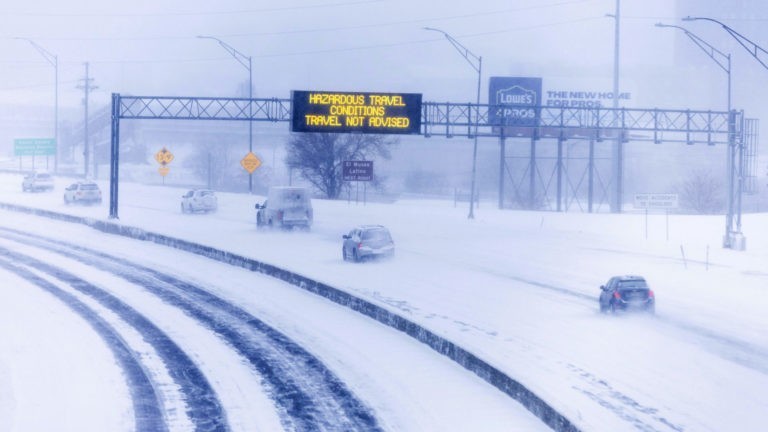
(Headline USAA powerful winter storm was sweeping east from the Plains on Sunday, driven by what meteorologists describe as an intense cyclone, setting off a chain reaction of snow, ice, rain and severe weather expected to affect much of the country.

Snow and strengthening winds spread across the Upper Midwest on Sunday, where the National Weather Service warned of whiteout conditions and possible blizzard conditions that could make travel impossible in some areas. Snowfall totals were expected to exceed a foot across parts of the upper Great Lakes, with up to 2 feet possible along the south shore of Lake Superior.

In the South, meteorologists warn of severe thunderstorms expected to signal the arrival of a sharp cold front — sometimes referred to as a “Blue Norther” — bringing a sudden temperature drop and strong north winds that will end days of record warmth across the region.

The snowy holiday season in the Upper Midwest and Northeast comes as springlike warmth continues in much of the nation’s midsection and South, where record high temperatures had Santa sweating in recent days.

The high temperature in Atlanta is forecast to be around 72 degrees Fahrenheit (22 degrees Celsius) on Sunday, continuing a warming trend after climbing to 78 F (about 26 C) to shatter the city’s record high temperature for Christmas Eve, the National Weather Service said. Numerous other record high temperatures were seen across the South and Midwest on the days after Christmas.

But that record heat is quickly coming to an end, forecasters say.

A cold front is expected to bring rain to much of the South late Sunday night into Monday, bringing much colder weather on Tuesday. The abrupt change will drop the low temperature in Atlanta to 25 F (minus 3.9 C) by early Tuesday morning. The colder temperatures in the South are expected to continue through New Year’s Day.

Over the next 48 hours, the cyclone is expected to produce heavy snow and blizzard conditions in the Midwest and Great Lakes, freezing rain in New England, thunderstorms across the eastern U.S. and South, and widespread strong winds.

The storm is expected to intensify as it moves east, drawing energy from a sharp clash between frigid air plunging south from Canada and unusually warm air that has lingered across the southern United States, according to the National Weather Service.

It follows thousands of flight delays and cancellations across the Northeast and Great Lakes regions earlier this weekend due to snow, as thousands took to the roads and airports during the busy travel period between Christmas and New Year’s.

On the other side of the country, California was experiencing a fairly dry weekend after powerful storms battered the state with heavy rains, flash flooding and mudslides. At least four people were killed including a man who was found dead Friday in a partially submerged car near Lancaster, the Los Angeles County Sheriff’s Department reported.

Adapted from reporting by the Associated Press


Somali-Run Daycare That Misspelled ‘Learning’ Received $4M in State Funding

(Ken Silva, Headline USA) Quality learning? Doesn’t seem like it.

A YouTuber named Nick Shirley has found that a Somali-run daycare in Minnesota, which received roughly $4 million in state funding over the last two years and is licensed for 99 children, appeared to be empty when he visited it recently. The daycare, Quality Learning Center, had a sign that said “Quality Learing Center”—sparking ridicule over the misspelling of “learning.”

When Shirley visited the facility, a lady outside accused him of being an Immigration and Customs Enforcement agent.

“Don’t open up! We have ICE here!” she yelled.

Ran by a man named Siman Jama Aden, the Quality Learning Center has been cited by Minnesota’s Department of Human Services for numerous infractions over the years, including for failure to keep hazardous items away from kids.

Headline USA tried contacting the facility, but the number listed online was not active.

GOP House Majority Whip Tom Emmer, R-Minn., slammed the state’s governor, Tim Walz, over the apparent scandal.

“4 million dollars of hard-earned tax dollars going to an education center that can’t even spell learning correctly. Care to explain this one, Tim Walz?” he said on Twitter/X.

The Quality Learning Center was one of numerous daycare centers Shirley visited in a video that’s going viral online. See his full investigation here.

The viral video comes as the Justice Department is investigating a multi-billion-dollar fraud scheme in Minnesota. According to the DOJ, more than half of the roughly $18 billion in federal funds that supported 14 Minnesota-run programs since 2018 may have been stolen.

The U.S. Attorney’s Office for Minnesota has charged 92 defendants in this scheme so far, 82 of which are Somalian.

Ken Silva is the editor of Headline USA. Follow him at x.com/jd_cashless.

Officials Warn Against Limits On Loans for Nursing Students

(The Center Square) Weeks after the federal government lowered the borrowing limit for student loans for graduate degrees in nursing, professionals and elected officials are sounding off on the impact.

U.S. Rep. Laura Friedman, D-Burbank, said the proposed federal rules could affect the number of people who can enter the profession and hurt nursing students in her district.

The rules will make it more difficult to attract nursing students at a time when that’s already a challenge, the California congresswoman told The Center Square in a phone interview Friday. “This is a real insult, because they are re-classifying [nurses] from being a profession. This sends a terrible signal to people who are studying for years to get these degrees so they can serve the public in a medical setting.”

The U.S. Department of Education in November proposed new limits on the amount of money a student can borrow. The department said the new rules will take effect in July if a department committee approves the changes.

The new restrictions include a $200,000 limit for loans to students seeking medical, law and other professional degrees.

Nursing, however, was not included among the professional degrees. Students pursuing a master’s degree or doctorate in nursing will be limited to $100,000 in total borrowing costs, much like students pursuing degrees in liberal arts and other areas not categorized as professional.

The proposed changes also stipulate that graduate students such as those studying nursing can only borrow $20,500 a school year. But professional students going to medical or law school could receive $50,000 a school year.

“This will benefit borrowers who will no longer be pushed into insurmountable debt to finance degrees that do not pay off,” said Nicholas Kent, the U.S. undersecretary of education in a news release issued right after the new rules were formulated.

Representatives from the U.S. Department of Education were unavailable for comment on Friday.

National Nurses United, the biggest union of registered nurses in the U.S., condemned the U.S. Department of Education’s proposed changes.

“This is an attack on the nursing profession,” National Nurses United said in a news release. “Shutting down nurses’ access to resources to seek higher education will only further contribute to forces driving nurses away from the bedside.”

According to a poll by nurse.com, 59% of nurses said they would not consider pursuing a graduate degree in the field knowing the proposed rules. Respondents said the policy change signals a negative message about the value of the profession. They added they are worried fewer people will pursue careers in nursing. About 20% said they were concerned about a reduced ability to take out the student loans required to get through nursing school and that they would have a higher personal debt.

Estimates from the Congressional Budget Office project the federal government would save roughly $284 billion over the next eight years by cutting federal student loan borrowing. However, under the One Big Beautiful Bill Act, which Congress passed in July, the federal budget deficit would swell to $3.4 trillion in those same eight years, the office estimated.

Republicans and Democrats who sit on education and health committees in the California Assembly and Senate were not available for comment on Friday. Officials with the University of California and California State University, which offer nursing degrees, were also unavailable.

Climate Activists v. the U.S. Energy Industry: Cases to Watch in 2026

(The Center Square) Anti-oil and gas advocates across the country have pursued litigation in recent years attempting to force the fossil fuel industry to pay for decades of financial damages the advocates claim were caused by climate change.

Several cases have been dismissed while others advanced through court systems, with some being considered before the U.S. Supreme Court in 2026. Critics of the litigation call it “woke lawfare” and an attempt to force progressive political policies via the judicial system.

Critics also argue the lawsuits threaten U.S. energy independence and, depending on outcomes, will have sweeping impacts on every American.

Here are some of those cases.

Chevron USA Inc. v. Plaquemines Parish, Louisiana

On Jan. 12, 2026, the U.S. Supreme Court will hear oral arguments in Plaquemines Parish, Louisiana, vs. Chevron USA Inc. The case questions to what extent a state court can litigate against an oil company for its production of oil even if it obtained federal permits to produce the oil.

The litigation challenges activities of the oil companies dating back to World War II in some cases. Chevron argued the lawsuit was flawed, claiming that the activities in question were permitted, legal, and often conducted under federal direction – particularly those tied to national security during World War II.

A Plaquemines Parish jury in April ordered Chevron to pay $744 million in damages for its role in the degradation of the state’s coastal wetlands. Environmental activists celebrated the verdict. It was the first of 42 lawsuits filed since 2013 by parishes across coastal Louisiana to go to trial.

The Trump administration’s Justice Department stepped in on Chevron’s side, urging the Supreme Court to move the case from state court to federal court.

Business groups and energy advocates warned the verdict will drive jobs and investment out of Louisiana. The Louisiana Association of Business and Industry called the decision “shortsighted,” saying it would “brand Louisiana as a state that will extort the most recognizable companies on earth for billions of dollars, decades later.”

O.H. Skinner, executive director of Alliance for Consumers, told the Center Square the case seeks to score large settlements from the energy industry and stop oil production.

“The case arises from a broader campaign of woke lawfare in which activists and municipal governments seek to use courtrooms to determine what companies are allowed to produce and what consumers can buy,” Skinner said.

Suncor Energy Inc. v. Boulder

The nation’s highest court is still deciding whether it will hear arguments in Suncor Energy Inc. v. Boulder; a case to decide whether state and local governments can use nuisance laws to sue energy companies for activities that may cause climate change.

The case, originating in Colorado, centers around a City of Boulder and Boulder County lawsuit in state court against Suncor Energy claiming it misled the public in its activities that the local governments claim led to climate change effects.

Lawyers for Suncor Energy argue that allowing a case like this one to play out goes against protections in the Clean Air Act that prevent lawsuits from occurring against emitters from across state lines.

“Public nuisance can’t be used for global problems. It can be used for local problems,” Skinner told The Center Square. “That’s what it’s supposed to be used for.”

However, Skinner said many organizations that are pursuing climate change litigation are seeking to bankrupt energy companies with large monetary settlements. He said litigants will likely attempt to drain energy companies of their resources and use the funds to advocate certain ideological causes.

“These are highly ideological dark-money-funded, multi-faceted legal campaigns to bankrupt an entire industry and confiscate it for ideological reasons,” Skinner said.

City and County of Honolulu v. Sunoco

Similarly, in 2020, City and County of Honolulu v. Sunoco was one of the first examples of public nuisance lawsuits pursued in a state court. The city and county of Honolulu filed a lawsuit in 2020 accusing oil and gas companies, including Sunoco, Exxon Mobil, BP, Chevron and Shell, of misleading the public for decades about the dangers of climate change induced by burning fossil fuels.

The companies asked the U.S. Supreme Court to intervene in the case, but the court, without ruling on the merits, declined to do so in January.

While the case is based in Hawaii, Skinner said litigants there hope it will have far-reaching effects across the country.

“They’re not trying to stop behavior just in those states,” Skinner said. ”The thing that really freaks me out is how people in regular, everyday, real America are going to potentially be affected.”

The People of the State of California v. Exxon Mobil Corporation

Going a step further than Boulder and Honolulu, California Democrat Attorney General Rob Bonta filed a complaint against ExxonMobil in 2024 for what he says are its contributions to “the deluge of plastic pollution” affecting the state.

Exxon countersued, alleging “Bonta and the US Proxies – the former for political gain and the latter pawns for the Foreign Interests – have engaged in a deliberate smear campaign against ExxonMobil, falsely claiming that ExxonMobil’s effective and innovative advanced recycling technology is a ‘false promise’ and ‘not based on truth.,” American Tort Reform Foundation reported.

One of the foreign interests is  IEJF, an Australian nonprofit that’s connected to an Australian mining conmpany “that competes with ExxonMobil in the low carbon solutions and energy transition markets, ATRF reported.

Skinner said the litigants in this case are attempting to significantly reduce plastic use throughout the state of California and potentially beyond.

“That’ll make your average person’s life dramatically harder, and it’ll make a lot of things a lot more expensive, and it’ll make having kids, like, brutal,” Skinner said.

Leon v. Exxon Mobil Corp.

Aside from monetary settlements, petitioners in this case also are seeking wrongful death claims against energy companies for their contributions to climate change. The case stems from a woman in Washington state who said her mother died from heat-related illness due to the exacerbated effects of climate change.

She is suing energy companies for their alleged creation of conditions over a period of decades that led to increased temperatures on the day her mother died.

Skinner told The Center Square this case is one of the more blatant examples of ideology affecting the way a litigant pursues cases.

“I think they care because a death is worth a lot of money,” Skinner said. “The climate homicide cases are one of the more far-fetched legal theories I’ve ever seen, because you’re leveling this incredibly staggering charge.”

Climate cases will continue to move through the court system, with one to be heard before the U.S. Supreme Court in early 2026.

Skinner is urging the U.S. Supreme Court and lower courts to rule in favor of energy companies across the country.

“We want the energy companies to win, not because they are perfect actors, but because the alternative is that our lives are governed day in and day out by woke trial lawyers, woke [nongovernmental organizations] and local governments,” Skinner said.

2025 Illegal Entries in Texas: Nearly Half the Gotaways Reported in Previous Years

(The Center Square) In President Donald Trump’s first year in office, illegal border crossers in one year in Texas totaled nearly half of gotaways reported in previous years in Texas.

They also represent roughly 10% of illegal entries in Texas in 2022 and 2023, according to U.S. Customs and Border Protection data and gotaway data obtained by The Center Square.

In fiscal 2025, 259,878 illegal border crossers were apprehended in Texas, excluding gotaways, by Border Patrol and CBP officers, according to year-end CBP data. The fiscal year goes from Oct. 1 through Sept. 30.

Gotaways is the official CBP term for those who illegally enter between ports of entry to evade capture, don’t file immigration claims and don’t return to Mexico. CBP doesn’t publicly report this data. The Center Square obtained gotaway data from Border Patrol agents, reporting it each month. At least two million gotaways were reported during the Biden administration, The Center Square exclusively reported. The total, which excludes Office of Field Operations data, is expected to be much higher due to several factors.

Many gotaways are known to have criminal records, including some on the terrorist watchlist and Special Interest Aliens (SIAs). Many have previously been deported, law enforcement officers have told The Center Square. SIAs are “known or evaluated to possibly have a nexus to terrorism” and potentially pose “a national security risk to the United States,” according to the Department of Homeland Security. At least 73,000 SIAs were arrested during the Biden administration nationwide, The Center Square reported.

In fiscal years 2022 and 2023, illegal entries in Texas totaled 1.4 million, according to CBP data. Gotways totaled several hundred thousand each year, The Center Square reported. When combined, illegal entries in Texas totaled roughly two million each year at the height of the border crisis.

In fiscal 2023, Border Patrol agents reported nearly 450,000 known gotaways in Texas, The Center Square exclusively reported. That’s nearly double the illegal entries reported in Texas in fiscal 2025.

Texas also reported the most gotaways of the four southwest border states. Its minimum 449,691 gotaways in 2023 accounted for nearly 60% of the minimum 769,174 known gotaways reported by Border Patrol agents at the southwest border that year.

Historically, Border Patrol agents working in the Del Rio and Rio Grande Valley CBP sectors reported the greatest number of illegal border crossers and gotaways in Texas. But in fiscal 2023, El Paso topped the charts.

In the El Paso and Del Rio sectors, gotaways totaled nearly half of Border Patrol apprehensions in 2023, The Center Square reported.

El Paso Sector Border Patrol agents apprehended more than 482,000 illegal border crossers and reported more than 210,000 gotaways, The Center Square reported.

Del Rio Sector Border Patrol agents apprehended nearly 400,000 illegal border crossers and reported more than 180,000 gotaways that year, The Center Square reported.

Big Bend Sector Border Patrol agents apprehended a record nearly 12,000 in a very remote region of Texas and reported more than 9,100 gotaways that year. These numbers had never been seen in that sector in Border Patrol history.

While illegal entries reached historic lows this year, gotaways are still illegally entering the U.S. in Texas.

Texas’ border security mission, Operation Lone Star, is still very much in effect. Texas Department of Public Safety OLS officers and OLS Task Force sheriffs continue to arrest gotaways, alleged human and drug smugglers and other violent criminals.

OLS DPS officers are making roughly 100 criminal arrests in Texas a week, “roughly the same as one year ago, as the criminal element crossing the border remains,” DPS Lt. Chris Olivarez told The Center Square.

They’ve also identified roughly 6,500 criminal foreign nationals with active felony warrants for a range of offenses, including murder, assault, sex crimes, human smuggling, drug smuggling, weapons and other crimes. Texas OLS created a Texas’ 10 Most Wanted Criminal Illegal Immigrants List, and officers continue to apprehend SIAs.

The SIAs they’ve apprehended are primarily men from Afghanistan, Egypt, the Congo, Mali, Syria, Turkey and other countries who would have “otherwise escaped into the interior of the U.S. had OLS officers not arrested them,” Olivarez said.

DOT Realizes Road Safety a Concern with Marijuana Rescheduling

(The Center Square) With the impending rescheduling of marijuana in the U.S., the transportation industry is searching for answers on whether it still will legally be able to test employees before sending them on the road or in the air.

Truck and school bus drivers, train engineers and pilots are all considered “safety-sensitive” transportation employees, and therefore subject to drug testing under U.S. Department of Transportation regulations.

But the DOT, which follows the U.S. Health and Human Services drug testing panel, only permits commercial transportation employers to test for Schedule I and II drugs under the Controlled Substances Act. Marijuana is currently classified as a Schedule I drug but President Donald Trump this month signed an executive order to reclassify it as a Schedule III controlled substance, despite many Republican lawmakers urging him not to.

The U.S. Drug Enforcement Agency describes Schedule I narcotics as those “with no currently accepted medical use and a high potential for abuse.” The DEA describers Schedule III substances as those “with a moderate to low potential for physical and psychological dependence.”

The concern, Brenna Lyles from the American Trucking Associations told The Center Square, is that once marijuana is reclassified as a Schedule III drug, HHS will reflect the change and employers might no longer be able to test their drivers for cannabis use.

“It’s not totally clear whether moving something from a Schedule I to a III eliminates that authority altogether, but generally it’s agreed upon based on the drug testing laws written in the Omnibus Transportation Employee Testing Act [of 1991],” Lyles, ATA’s senior director of safety policy, told The Center Square.

“HHS’s authority to issue tests and laboratories for these drugs lies in that regulatory regime naming Schedule I and Schedule II drugs specifically. So once a drug moves to that lower schedule, it becomes less clear what they can and can’t do.”

Lyles added that ATA is encouraged by DOT’s commitment to safety, referencing its recent news release that stated the agency “will continue to monitor the rescheduling process and update the transportation industry as appropriate.”

Delta-9, the form of THC present in marijuana, continues to be the most frequently detected drug among transportation industry workers subject to federal rules. Cannabinoids currently make up over 60% of all positives in the DOT’s Drug and Alcohol Clearinghouse database.

Because DOT specifically names marijuana in its own testing protocols, it is possible the current administration may interpret that to mean that the agency still has the authority to test. Yet even then, the DOT would no longer be able to rely on HHS’ testing regime, as it has done for decades, which would create a patchwork of drug testing protocols.

“At the end of the day, the piece that’s really critical is the basic technical and scientific certifications, labs, and guidance that HHS is uniquely qualified and positioned to continue issuing,” Lyles noted. “I think it would be disruptive if you’re relying on HHS for this whole panel of drug testing like cocaine and amphetamines, and then you have to return and complete a whole other testing protocol with DOT.”

Lyles added that while the current DOT seems attentive to road safety – it recently pulled 9,500 commercial truckers off the road for failing English language proficiency checks – that could change under a future administration. She would “absolutely” support making current transportation industry testing protocols for marijuana permanent.

“I think any type of clarity, whether that’s legislative or regulatory, to codify the testing requirements provides a lot of certainty for the future – some kind of safety-sensitive carve-out that specifically states that regardless of the schedule of marijuana, we will preserve this,” Lyles said.

“There are potentially some regulatory hurdles, just based on how that omnibus drug testing law was written, so I think there’s going to be things that need to happen,” she added. “That may end up being a rulemaking, and it may end up being a legislative act.”