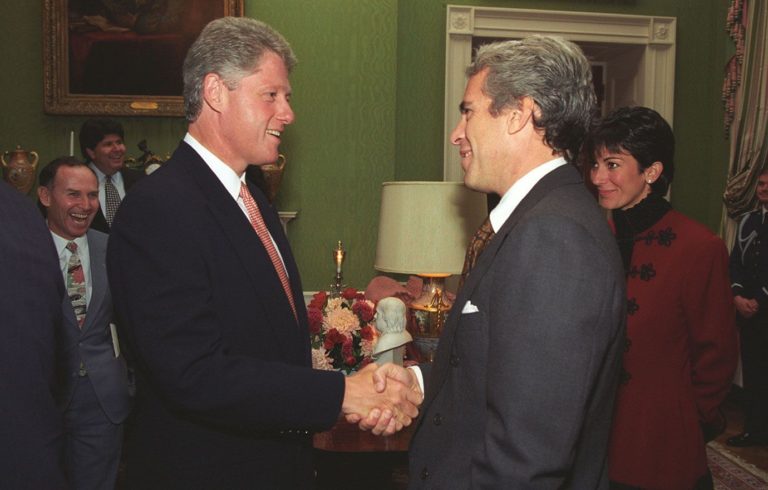
(Luis Cornelio, Headline USA) Embattled former President Bill Clinton and his wife Hillary reversed course Monday evening after weeks of defying a House Oversight Committee subpoena tied to their knowledge of late sex offender Jeffrey Epstein.
Attorneys for the Clintons said the Democratic couple would “appear for depositions on mutually agreeable dates” in an email to House Oversight Committee Chairman James Comer, R-Ky., and as reported by the New York Times.
The attorneys also urged Comer to stop a contempt of Congress vote scheduled for Wednesday. The reversal came after several Democrats joined Republicans on the committee to advance contempt proceedings against the Clintons.
The couple was originally subpoenaed on Aug. 5, 2025, while Hillary Clinton was required to appear for a deposition on Oct. 9 and Bill Clinton on Oct. 14.
A second subpoena set deposition dates for Jan. 13 for Bill and Jan. 14 for Hillary, with both individuals again failing to appear.
The Clintons’ reversal followed a blistering letter from Comer rejecting their latest attempt to dictate terms for compliance.
Bill Clinton initially sought an untranscribed interview in New York. Later, his attorneys demanded limits on the testimony’s scope or that the subpoenas be withdrawn in exchange for a transcribed interview. They also insisted the deposition be capped at four hours and that their own attorneys select the transcriber.
In a letter Monday, Comer rejected the conditions as “unreasonable.”
He added, “It has been nearly six months since your clients first received the Committee’s subpoena, more than three months since the original date of their depositions, and nearly three weeks since they failed to appear for their depositions commensurate with the Committee’s lawful subpoenas. Your clients’ desire for special treatment is both frustrating and an affront to the American people’s desire for transparency.”
Comer’s letter was issued before the Clintons agreed to testify.
🚨 After defying lawful subpoenas, Bill and Hillary Clinton are trying to dodge contempt by requesting special treatment.
Bill Clinton’s relationship with Epstein has reemerged amid the push for a reckoning over Epstein, who was found dead in 2019 in a New York jail cell as he faced sex trafficking charges.
Clinton, like a bevy of other high-powered men, had a well-documented relationship with Epstein in the late 1990s and early 2000s. According to documents and testimony from Epstein accomplice Ghislaine Maxwell, Epstein helped found the Clinton Foundation.
He has not been accused of wrongdoing in his interactions with the late financier.
(Headline USA) A suspected biolaboratory found in a Las Vegas home and now under investigation by authorities is linked to the owner of an unauthorized California biolab who was arrested in 2023, officials said Monday.
SWAT officers served a search warrant on Saturday after receiving a tip that a biolab was located at the house on the city’s east side, according to a statement from the Las Vegas Metropolitan Police Department. Officers took one person, the property manager of the residence, into custody but there was no immediate information about possible charges.
Investigators “located evidence of possible biological material, including refrigerators containing vials with unknown liquids,” the statement said.
Authorities said there is no threat to the public.
Sheriff Kevin McMahill said the home is owned by a man who was arrested in 2023 on charges of not obtaining the proper permits to manufacture tests for COVID-19, pregnancy and HIV, and mislabeling some of the kits for a biolab in Reedley, California.
The owner, Jia Bei Zhu, is scheduled to go on trial in that case in April. His attorney Anthony Capozzi said Monday that his client has been in federal custody for three years.
“He is not involved in any kind of a biolab being conducted in a home in Las Vegas,” Capozzi said. “What went on in that residence we are unaware of.”
Law enforcement took special precautions when serving the warrant on the Las Vegas home, including using a robot to clear the home and taking multiple air samples, McMahill said. Hazmat teams worked to remove items from the home.
(Kenneth Schrupp, The Center Square) Medi-Cal is paying an estimated $608 million per month for cooking, shopping, cleaning, and laundry services for elderly and disabled low-income California residents – including illegal immigrants – at their homes and mostly paid to their relatives, state records show.
These services are part of a federally-and-state-funded program called In-Home Supportive Services, which was designed to get people assistance at home without having to move to an expensive facility. But the program has grown so rapidly that it is responsible for 41% of job gains in California since January 2019, when Gov. Gavin Newsom took office.
By the end of 2025, the program had grown to 799,379 taxpayer-funded “providers,” making IHSS “provider,” according to federal occupational data, the most common job in the state.
Gov. Gavin Newsom’s office responded by accusing The Center Square of having “California Derangement Syndrome” after the news organization asked about the dominance of IHSS in California employment, citing federal statistics.
Newsom spokesperson Tara Gallegos also questioned the cited numbers.
“We don’t respond to fairy tale statistics,” she wrote in an email to The Center Square. “We’re sorry that your California Derangement Syndrome has led you down this sad path.”
Four minutes before Gallegos’ response, California’s Employment Development Department released its own report on the state’s net loss of 11,200 nonfarm payroll jobs in 2025, which would have been over seven times worse if not for IHSS growth.
The governor’s office did not respond to a follow-up with the state’s own figures.
The majority of IHSS providers are relatives of and live with recipients, and are paid an average of $18.33 per hour. The average recipient is authorized for 118.4 hours per month, thus earning the average provider an estimated $2,170.27 per month.
“We see a growth in government jobs, and dramatic decrease in private sector jobs in California, and that is very alarming and unsustainable,” said Assemblyman Carl DeMaio, R-San Diego, in an interview with The Center Square. “Not only are these not good jobs, they are literally a conduit of funding for political campaigns for the politicians that have established them.”
Since January 2019, government jobs, and taxpayer-funded jobs in healthcare and education grew by 852,400 jobs, while all other industries combined lost a net 139,300 payroll jobs. During this time, the U.S. Census estimates state’s population also declined by 156,914 residents.
As DeMaio noted, IHSS members are unionized, under SEIU Local 2015. Another SEIU healthcare union, SEIU-UHW, recently introduced a ballot measure to institute a wealth tax on California billionaires.
For the ongoing fiscal year, the state budget allocated $3.3 million for California to “support IHSS collective bargaining and its potential transition to state level collective bargaining,” suggesting changes in compensation for IHSS providers may be coming soon. This means provider wages could rise to match the state’s $25 per hour healthcare minimum wage, which would increase base labor costs for the program by 36%.
To receive paid in-home care through IHSS, a recipient is supposed visited by a social worker to establish the maximum number of allowable billable hours. There are also supposed to be scheduled visits to review the need for services.
IHSS breaks these services into two categories: domestic and related services, and personal care services.
Combined monthly billing for both domestic and personal services provided through the program is an estimated $1.6 billion per month for 85 million hours of work. IHSS is projected to cost $29.9 billion in the ongoing fiscal year, an 11.9% increase over the prior year — reflecting the program’s compounding costs.
In December, the average IHSS provider was authorized to provide 45.9 hours of care across the domestic and related services category, though not all services are utilized by each recipient (use rates range from 80.5% through 83.5%). These include domestic services — such as cleaning — buying food, preparing and cleaning after meals, laundry, and other shopping and errands.
Food-related domestic services represent a combined 35.7 hours of authorized work per recipient each month, reflected in 25.7 million hours of billable work across the IHSS workforce. At the typical IHSS wage, that’s $472 million per month on just those food-related services — domestic services, laundry, and other shopping and errands cost another $136 million per month.
Personal care includes a much wider array of services, and wider variance in usage, ranging from menstrual care (4.4% of recipients) to dressing (88.8% of recipients). Billing hours for personal care added up to 51.9 million hours per month at a taxpayer-funded cost of $951 million per month.
During last year’s budget cycle for the ongoing fiscal year, a proposal to eliminate IHSS coverage for illegal immigrants was ultimately not adopted. The state did adopt a freeze on new illegal immigrant enrollment in Medi-Cal for adults over 19 years old starting in January 2026.
While there is a long-standing rule technically barring illegal immigrants from serving as IHSS providers, illegal immigrants already enrolled in Medi-Cal are still able to secure IHSS-funded care.
(Headline USA) The Trump administration plans to deploy nearly $12 billion to create a strategic reserve of rare earth metals, a stockpile that could counter China’s ability to use its dominance of these hard to process metals as leverage in trade talks.
The White House confirmed on Monday the start of “Project Vault,” which would initially be funded by a $10 billion loan from the U.S. Export-Import Bank and nearly $1.67 billion in private capital. The minerals kept in the reserve would help to shield the manufacturers of autos, electronics and other goods from any supply chain disruptions.
During trade talks last year spurred by President Donald Trump’s tariffs, the Chinese government restricted the exporting of rare earths that are needed for jet engines, radar systems, electric vehicles, laptops and phones.
China represents about 70% of the world’s rare earths mining and 90% of global rare earths processing. That gave it a chokehold on the sector that has caused the U.S. to nurture alternative sources of the elements, creating a stockpile similar to the national reserve for petroleum.
The strategic reserve is expected to be the highlight of a ministerial meeting on critical minerals that Secretary of State Marco Rubio will host at the State Department on Wednesday.
Vice President JD Vance plans to deliver a keynote address at the meeting, which officials from several dozen European, African and Asian nations plan to attend. The meeting is also expected to include the signing of several bilateral agreements to improve and coordinate supply chain logistics.
The State Department said in its statement announcing the meeting that the gathering “will create momentum for collaboration” among the participants to secure access to rare earths.
The government-backed loan funding the reserve would be for a period of 15 years. The U.S. government has previously taken stakes in the rare earths miner MP Materials, as well as providing financial backing to the companies Vulcan Elements and USA Rare Earth.
Bloomberg News was the first to report the creation of the rare earths strategic reserve.
Trump is scheduled on Monday to meet with General Motors CEO Mary Barra and mining industry billionaire Robert Friedland.
(Andrew Rice, The Center Square) Attorneys representing Jeffrey Epstein’s victims are calling on the Department of Justice to take down its website with documents related to the convicted sex offender.
President Donald Trump, Bill Clinton, Elon Musk and many others have been named in the new release of documents. The trove of documents has also led to resignations from international leaders.
The lawyers allege some of the more than 3 million pages released over the weekend associated with Epstein violated the victims’ privacy by neglecting to redact private information. Lawyers reported thousands of redaction failures on behalf of 100 individual survivors.
Victims’ names, addresses and bank information were left unredacted, according to the lawyers.
“This Court is the last line of defense for victims who were promised protection and instead were exposed. Judicial intervention is not merely appropriate—it is essential,” the lawyers wrote.
In a Friday press conference, Deputy Attorney General Todd Blanche called on victims to notify the DOJ of any redaction errors. He pointed to an email inbox for victims to correct redactions and concerns.
“With the production of this magnitude, mistakes are inevitable,” Blanche said. “We, of course, want to immediately correct any redaction errors that our team may have made.”
Congress passed the Epstein Files Transparency Act in November, which required the Justice Department to make publicly available “in a searchable and downloadable format all unclassified records, documents, communications, and investigative materials” related to Epstein.
While the law calls for a wide swath of documents to be released, it gives several notable exceptions. The attorney general is allowed to withhold or redact portions of records containing child sexual abuse material, personally identifiable information of victims, and documents that would interfere with active federal investigations or ongoing prosecutions.
The latest release comes more than a month after the Dec. 19 deadline set by the Epstein Files Transparency Act.
The new documents contain a list of sexual assault allegations against Trump compiled by the FBI in August 2025. Officials at the Department of Justice claimed many of these tips were not credible and submitted before the 2020 election.
“Some of the documents contain untrue and sensationalist claims against President Trump that were submitted to the FBI right before the 2020 election,” a Justice Department press release reads. “To be clear, the claims are unfounded and false, and if they have a shred of credibility, they certainly would have been weaponized against President Trump already.”
The new documents also reveal communications between Elon Musk and Epstein. According to email communications, Musk appeared to try to arrange visits to one of the Caribbean islands Epstein owned.
“What day/night would be the wildest party on [y]our island?” Musk askedin a 2012 email to Epstein.
Musk denied ever visiting one of the islands and claimed to advocate strongly for the full release of the files.
“I knew I would be smeared relentlessly, despite never having attended his parties,” Musk wroteon social media, “or set foot on his creepy island or done anything wrong at all.”
Also in the documents, an emailrequesting Epstein’s presence at a 2015 fundraising event for Hillary Clinton’s presidential campaign. The fundraising event was hosted by Commerce Secretary Howard Lutnick, who extended the invitation to Epstein.
It is unclear whether Epstein attended the fundraising event. Bill and Hillary Clinton’s alleged ties to Epstein have been the source of controversy as documents have been released.
The Clintons defied a subpoena by the House Oversight Committee to testify on the investigation into Jeffrey Epstein in January.
Lawmakers have called for greater transparency in the redaction process and have attempted to schedule meetings with DOJ officials to discuss the materials. Deputy Attorney General Todd Blanche said any member of Congress can make arrangements with the DOJ to review documents in an “unredacted form.”
Reps. Ro Khanna, D-Calif., and Thomas Massie, R-Ky., requested to review files associated with Epstein shortly after the DOJ’s Friday release, according to Massie’s social media.
“We have seen a blanket approach to redactions in some areas, while in other cases, victims names were not redacted at all,” Massie and Khanna wrote. “Congress cannot properly assess the Department’s handling of the Epstein and Maxwell cases without access to the complete record.”
Outside the U.S., Peter Mandelson, a representative in the United Kingdom, resigned from his position due to ties with Epstein. Documents reveal Epstein lobbied Mandelson for favorable tax policies.
“I do not wish to cause further embarrassment to the Labour party and I am therefore stepping down from membership of the party,” Mandelson wrote in a a statement.
Mandelson and Andrew Mountbatten-Windsor, brother to King Charles III, may be summoned to testify before the U.S. Congress due to newly revealed connections with Epstein.
U.K. Prime Minister Keir Starmer called on Mountbatten-Windsor over the weekend to testify before the U.S. Congress.
“Anybody who has got information should be prepared to share that information in whatever form they are asked to do that,” Starmer said.
(Dave DeCamp, Antiwar.com) The US and Israel on Monday announced that their militaries held joint naval drills a day earlier, exercises that come amid a major US military buildup in the region to prepare for a potential attack on Iran.
US Naval Forces Central Command/5th Fleet announced the drills and said the US guided-missile destroyer USS Delbert D. Black conducted a “routine maritime exercise” with the Israeli corvette INS Eilat.
“The combined training demonstrated the strong military partnership between US 5th Fleet and the Israeli Navy,” the US statement said.
The IDF said in its statement on the drills that it “was held as part of the ongoing cooperation between the Israeli Navy and the US 5th Fleet in the Red Sea arena.”
The US and Israel have been coordinating closely as President Trump has been threatening to attack Iran. The maritime drills came a few days after the top US and Israeli generals met at the Pentagon in Washington, DC, a meeting that hasn’t been officially acknowledged.
A US aircraft carrier strike group led by the USS Abraham Lincoln recently arrived in the region, and President Trump has pointed to the “armada” in his threats to Iran. The US is also deploying additional air defenses to bases in the Middle East as it expects Iranian counterattacks if it bombs Iran.
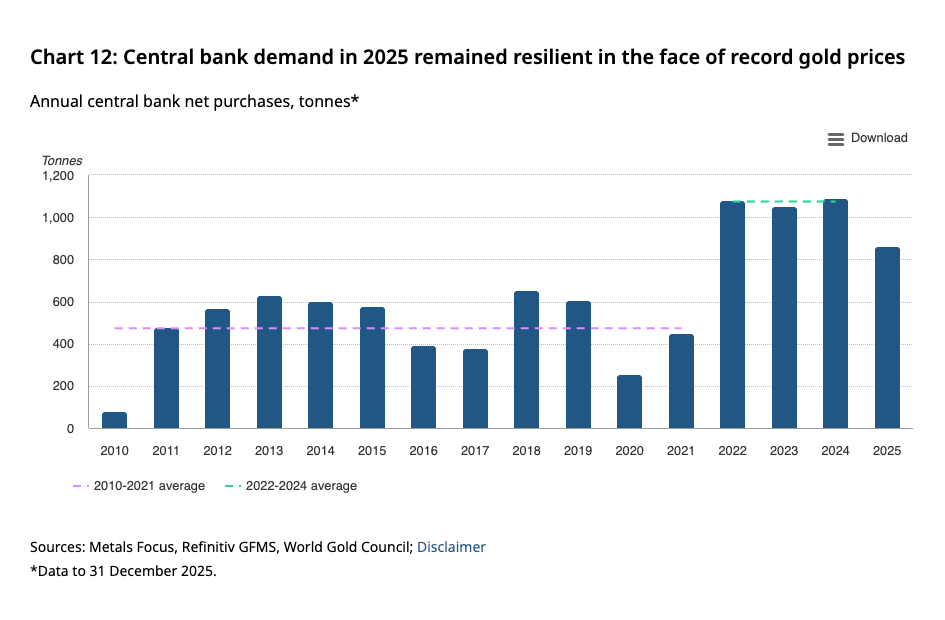
(Mike Maharrey, Money Metals News Service) Central bank gold buying moderated in 2025 but remained far above the recent historical average.
Central banks stepped up purchases in the final quarter, adding 230 tonnes to global gold reserves, a 6 percent quarter-on-quarter increase. That drove the official net full-year buying to 863.3 tonnes, according to data compiled by the World Gold Council.
Central bank gold buying was down 21 percent year-on-year, charting the lowest level since 2021.
While central bank gold purchases declined, they were still well above the 2010-2021 annual average of 473 tonnes.
Last year was the fourth-largest expansion of central bank gold reserves on record. The all-time high was set in 2022 (1,136 tonnes). It was the highest level of net purchases on record, dating back to 1950, including since the suspension of dollar convertibility into gold in 1971.
The surging gold price was likely a factor in slowing central bank gold accumulation. As the World Gold Council put it, the higher price prompted “a more cautious approach.”
“This highlights that central banks are not insensitive to price dynamics, even as their long-term strategic interest in gold remains firmly intact.”
The World Gold Council characterized 2025 central bank gold demand as “impressive,” despite falling short of the 1,000-tonne threshold, adding that it “underscores the metal’s enduring strategic appeal.”
Twenty-two central banks reported an increase in gold reserves of at least 1 tonne last year, led by Poland.
The National Bank of Poland added 102 tonnes of gold to its holdings in 2025. The Polish central bank now holds 550 tonnes of the yellow metal, accounting for around 28 percent of its official reserves.
The National Bank of Kazakhstan was the number two gold buyer in 2025 with a 52-tonne increase to its reserves. It was the Kazakh’s highest level of annual buying since 1993.
It is not uncommon for banks that buy from domestic production – such as Uzbekistan and Kazakhstan – to flip-flop between buying and selling. However, National Bank of Kazakhstan Governor Timur Suleimenov said, “We want to stay a net gold buyer,” until global tensions ease.
Brazil waded back into the gold market in the latter half of 2025. The Brazilian central bank added 43 tonnes of gold to its reserves between September and November. That boosted the country’s official gold reserves to 172 tonnes.
The Central Bank of Turkey was a steady buyer throughout 2025, making small purchases for 23 straight months through the end of October. Last year, the Turkish central bank added 27 tonnes of gold to its holdings.
The Czech National Bank has followed a similar strategy – growing its gold reserves at a slow and steady pace. It has bought gold for 34 straight months, adding 20 tonnes to its holdings last year. The Czech Republic now holds 72 tonnes of gold. Czech officials say they plan to increase gold reserves to 100 tonnes by 2028.
China slowed its pace of gold accumulation, at least based on official numbers. The People’s Bank of China reported a 27-tonne increase in gold reserves in 2025. It’s reported that gold reserves now stand at 2,306 tonnes, making up almost 9 percent of total official reserves.
China has reported an increase in its official reserves for 14 straight months, adding another tonne in December. The People’s Bank of China has increased its official holdings by 402 tonnes in that span.
Notice the emphasis on “official.”
China is among the central banks that are likely to hold significantly more gold than they publicly disclose. As Jan Nieuwenhuijs has reported, the People’s Bank of China is secretly buying large amounts of gold off the books. According to data parsed by the renowned Money Metals researcher, the Chinese central bank is currently sitting on more than 5,000 tonnes of monetary gold located in Beijing – more than TWICE what has been publicly admitted.
Other countries reporting an increase in reserves include Iraq, Cambodia, Uzbekistan, Ghana, Indonesia, Guatemala, Kyrgyz Republic, Qatar, Serbia, India, Egypt, the Philippines, Bulgaria, Slovenia, UAE, and Zimbabwe.
Even with soaring prices, there were few notable sellers in 2025.
The Monetary Authority of Singapore reported the largest decrease in reserves at 14 tonnes. Russia sold 6 tonnes of gold, and the Central Bank of Jordan reduced its holdings by 1 tonne. The German Bundesbank also reported a 1-tonne decrease in reserves connected to its coin minting program.
The World Gold Council reported significant unreported buying.
“The gap between Metals Focus’ estimates and officially reported data continues to indicate substantial opaque activity (57 percent of the annual total). This implies that some official institutions are adding to their reserves without immediate disclosure – a consistent trend in recent years.”
This is likely capturing at least some of the unreported Chinese purchases. Other banks are likely adding to their reserves quietly as well.
Despite the modest slowdown in gold accumulation, the World Gold Council remains bullish, saying that “persistent economic and geopolitical uncertainty is likely to sustain demand for gold as a reserve asset.”
“We maintain our view that central banks will continue to add gold to their reserves. Our Central Bank Gold Reserves Survey 2025 shows that respondents overwhelmingly (95 percent) expect global central bank gold reserves to increase over the next 12 months, while 43 percent believe that their own gold reserves will also increase over the same period. Notably, none of the respondents anticipate a decline in their gold reserves.”
You can read more details about that central bank survey HERE.
Mike Maharrey is a journalist and market analyst for Money Metals with over a decade of experience in precious metals. He holds a BS in accounting from the University of Kentucky and a BA in journalism from the University of South Florida.
Innecco framed the price action as historic. But so is the situation in the global supply chain for physical gold and silver.
From atop his perch at one of the largest precious metals dealers and depositories in North America, Mr. Gleason reveals what’s really happening behind the scenes with supply, demand, and metal movements — and how this situation could actually become even more explosive soon.
Kevin Warsh and The Fed
After the market moves, the interview shifts to the political storyline traders were using to explain the drop. This section focuses on Kevin Warsh, quantitative easing, and why Gleason doubts any real tightening is coming.
Gleason said he has met Kevin Warsh and described him as smart, but also entrenched in the Fed system, and was one of the masterminds of the 2008 debt monetization, government bailout playbook. Gleason claimed Warsh was “one of the architects” of quantitative easing in 2008, shaping his expectation that any “tighter Fed” storyline won’t survive reality.
His argument was straightforward. The debt burden is too large, and when “push comes to shove,” the system returns to printing and balance sheet expansion. Innecco reinforced the point by recalling early QE-era assurances that it would be limited, contrasting that with today’s still-massive balance sheet, which he cited at around $7 trillion.
U.S. Government Intervention in the Gold Market?
From Fed politics, the discussion narrows to a telling personal anecdote that hints at deeper market dynamics. This section recounts Gleason’s public question about government activity in the gold market and the insider response he found revealing.
Gleason recounted questioning Warsh at a COMEX gold dinner in New York City roughly eight years ago. He said there were about 1,000 people in the room when he asked whether the U.S. government is involved in the gold market, and if so, what the purpose of those transactions might be.
Gleason said Warsh “danced around” the question, downplayed the scale with “not as much as you would expect,” then pivoted to the importance of maintaining a strong dollar and the role of the International Monetary Fund in currency markets. Gleason interpreted the response as a tacit yes, paired with an attempt to minimize how much it mattered.
Sound Money for Individuals and States
With the macro backdrop established, the interview turns toward what people can do personally instead of waiting on institutions. This section covers the “personal gold standard” idea and the policy push happening at the state level.
Gleason argued that people don’t have to wait for central banks or politicians to “fix” anything. His view is that individuals can adopt a personal gold standard by holding physical gold and silver now, and he said those who did so over the last two or three years have been rewarded.
He also described policy momentum through work with Jp Cortez and the Sound Money Defense League. He cited state-level pushes to reduce taxes on precious metals, encourage states to hold gold reserves, and roll back regulations that burden local dealers.
He also warned against certain proposals that would expand state involvement through public-private partnerships or favored depository or payment schemes. Gleason’s view was that government should not be inserted in the middle of people’s gold ownership.
Money Should Be Left to the Free Market, Not Controlled by Government
To explain why today’s debates matter, the interview steps back into history and first principles. This section outlines how Gleason frames money, legal tender, and the shift from metal-based definitions to force-backed paper.
The interview leaned into monetary history. Gleason argued that under the U.S. Constitution and the Coinage Act of 1792, the government’s role was supposed to be limited to standardizing weights and measures, not manipulating money’s value or building a paper-credit machinery.
He pointed to legal tender laws during the Civil War as a turning point, saying they were used to force acceptance of unbacked paper money that would not have circulated as money on its own. In his telling, legal tender is the tool that tries to make “not-money” behave like money.
“Audit the Gold” Bill Introduced in U.S. House and Senate
From historical principles, the conversation returns to a modern flashpoint: trust in official gold reserves. This section covers the call to audit U.S. gold and the political names tied to that effort.
Innecco pressed with skepticism about Fort Knox, joking that nobody knows what’s in there. Gleason used that as a contrast point for private-sector custody and accountability.
The Largest Private Class 3 Vault in North America
Once trust and verification are on the table, the interview moves into how private storage compares to government storage. This section summarizes Gleason’s claims about vault capacity, security controls, and segregated ownership.
Gleason said Money Metals Depository built a Class 3 facility with four vaults totaling about 9,000 square feet, compared to Fort Knox at 4,000 square feet. He said the only larger vault he cited was the New York Fed.
He described segregated storage, sealed containers, RFID tracking, internal and external audits, cameras, dual controls, background checks, and layered physical and electronic security. He emphasized that the metal is client property held in custody, not on the company’s balance sheet.
Refinery Bottlenecks Killing Business Models, Leading to Financing Problems
From storage, the discussion shifts to the market plumbing that determines whether metal can actually move through the system. This section explains why refineries and turnaround times are becoming a critical constraint, especially for silver.
Gleason said the industry is under severe strain, with refineries in some cases not accepting silver, quoting lead times of 12 weeks or 18 weeks, and even delayed payment terms. He said two major U.S. refineries sent notices that week saying they weren’t accepting anything for three weeks because they were overwhelmed. When they reopened, he said, advances would stop.
He explained why that matters. Local coin shops (LCS) and scrap buyers often have more metal coming in than going out, so they rely on fast refinery turnaround and advance payments to keep buying. If refiners won’t take metal or won’t advance funds, bids collapse or disappear.
Gleason said Money Metals is dealing with extremely high volume. He described manual authentication and quality control as unavoidable when the public ships in metal. He also revealed that Money Metals has hired 65 people since Christmas and still needs another 40 to get on top of the volume.
China’s Is Tightening Its Grip on the Silver Supply Chain, Pricing
The interview zooms out to the global bottleneck that may be making the squeeze worse. This section focuses on China’s share of silver refining capacity and how regional premiums can redirect supply.
Gleason said 60% to 65% of the world’s silver refining capacity is in China. He also noted a premium on silver inside China, arguing that it pulls silver in and reduces the incentive to export refined metal back out.
He added that premiums in London and Asia have been visible, and described shipping pallets of silver to India when the premium made the transaction work for both parties. His point was that tightness is measurable, and premiums can act like a warning flare before shortages show up in actual availability.
How to Get the Best Price When Selling Your Gold or Silver
After the big-picture supply chain discussion, the interview turns practical for everyday sellers and buyers. This section covers the mechanics of shipping metals safely to Money Metals, or elsewhere, and what Gleason says it can cost to insure larger values.
Gleason noted that LCSs can be a more convenient place to sell, since no shipping is needed, but the seller should be prepared to get paid a much lower price because many LCSs have run out of capital.
For sellers who do ship their precious metal items to Money Metals, where higher buyback pricing is offered, Gleason recommended registered mail through the United States Postal Service (USPS) because it allows insuring precious metals. He said UPS and FedEx generally do not offer insurance for gold and silver.
He cited a rough example: shipping up to $50,000 of value could cost around $10 to $20 for postage, plus about $80 for insurance. He also stressed careful packing, filling all voids, double-boxing heavy items, and sealing all box seams fully.
Money Metals Can Provide a Loan Against a Storage Customer’s Own Metals
From logistics, the conversation pivots to liquidity and how holders can tap value without selling. This section explains the depository-secured line of credit at Money Metals that Gleason described and why it appeals in a rising market.
Gleason described a Money Metals business-purpose line of credit secured by a client’s own gold or silver held in segregated depository storage. He framed it as a way to access liquidity without selling and potentially triggering a capital gains tax event.
He said the interest rate is in the single digits annualized (tied to the bank prime rate) and emphasized that Money Metals DOES NOT lend out any customer gold under any circumstances. The borrower is simply using their own stored metal as collateral for cash.
Silver’s New Phase
To close the loop, the interview returns to price behavior and why silver may be acting differently this cycle. This section summarizes the “new reality” framing, the demand feedback loop, and why supply may not respond quickly.
Gleason referenced analyst Michael Oliver’s “new reality” framing for silver and said the move felt driven by real physical tightness and shifting psychology. He also invoked the idea of a Giffen good, describing a dynamic where demand can rise alongside price as buyers switch from gold to silver and then chase silver higher as it breaks into new levels.
He extended the idea to industry, too, saying manufacturers may increase inventory from weeks to months if they fear shortages. He argued that supply can’t respond quickly because so much silver is a byproduct of other mining and because mining lead times are long.
The Takeaway
In the final stretch, the themes converge into a single message about momentum and market structure. This section ties together the Fed backdrop, transparency questions, and the physical-market constraints that Gleason says are already tightening.
Innecco’s questions kept the conversation grounded in the mechanics behind the spikes: Fed politics, gold transparency, vaulting, refinery bottlenecks, and the way premiums can reveal stress before the public sees it.
Gleason’s core point wasn’t panic. It was momentum.
The physical market is already straining at low participation rates. If ownership expands meaningfully from today’s small slice of the public, the upside pressure on availability and premiums could intensify.
(Mike Maharrey, Money Metals News Service) Gold and silver both sold off on Friday in a correction that was probably overdue.
Gold kicked off last week trading just over $5,020. As the week went on, the price soared, topping above $5,600 before crashing back below $5,000 on Friday. The yellow metal dropped as low as $4,679 before recovering to finish around $4,900, down modestly around 2.4 percent on the week.
Even with the huge selloff, gold is still up 13 percent since the beginning of the year.
Meanwhile, silver went on a similar wild ride, topping over $120 before briefly dipping below $80. It also recovered modestly late in the day, finishing around $86.
Even with the selloff, silver is still up 18.7 percent since the beginning of the year.
What Sparked the Selloff?
Gold and silver were both due for a correction, but what sparked it?
There were two headlines that created selling pressure.
The first was Donald Trump’s announcement that Kevin Warsh will succeed Jerome Powell as chairman of the Federal Reserve. Warsh is considered much more hawkish than many of the other candidates. The markets were counting on the new Fed chief to be more willing to cut interest rates aggressively. As a so-called “inflation hawk,” many think Warsh won’t be quite so accommodating. A higher interest rate environment creates headwinds for gold and silver since they are non-yielding assets.
I go into detail about why the reaction to Warsh was knee-jerk and irrational HERE.
Not long after Trump announced Warsh as Fed chair, the Producer Price Index data came out and was much hotter than expected. The PPI climbed 0.5 percent month-on-month. The forecast was for a 0.2 percent rise. Core PPI surged 0.7 percent, smashing the 0.2 percent forecast.
Producer prices are generally considered a leading inflation indicator, as companies pass at least some of their higher costs onto consumers. That means we could see a big jump in CPI next month, which would further dampen hopes for interest rate cuts, thus creating more headwinds for gold and silver.
These two news items started the sell-off, and it was undoubtedly exacerbated by computer algorithms executing stop orders at various levels as the price fell. As more investors sold, the price fell further, incentivizing more selling in a relentless downward spiral.
Thoughts on the Sell-Off
I wanted to share a few random thoughts about the sell-off that might help when the next correction occurs (and there will be more corrections).
Keep Things in perspective – Yes, it was a big selloff. But as I already mentioned, gold and silver were only down modestly on the week, and both metals are up significantly since the beginning of the year. Think about it – people were panicking because gold fell below $5,000. This time last year, $5,000 was still far off on the horizon. And $80 silver? Last year, people wondered if it would ever get to $50.
Corrections are normal and healthy in a bull market – Nothing goes up in a straight line. As I mentioned, we were probably overdue for a correction given the speed of the most recent rally. Both metals were overbought. (a technical term meaning an asset’s price has risen high enough, fast enough, based on a predefined quantitative indicator that makes it statistically stretched to the upside relative to its recent history.) Corrections clear out weak hands, and they create buying opportunities.
Keep your eye on the fundamentals – when you see a big sell-off, ask yourself, ‘What’s changed? Are the dynamics that sparked the bull market still in place?’ If something fundamental has changed, you should reexamine your position. It could indicate a significant market pivot. But if the dynamics remained unchanged, it’s likely just a correction. The dynamics I’m looking at right now are de-dollarization, central bank gold buying, inflation pressures, Federal Reserve monetary easing, geopolitical tensions, and U.S. fiscal malfeasance. Nothing happened on Friday that indicates any of these things will reverse anytime soon.
Everything dumped Friday – You shouldn’t look at the precious metals market in isolation. What else is happening in the broader marketplace? On Friday, everything sold. Stocks were down. Bonds fell modestly. Commodities fell. The only thing that charted a gain was the dollar. That raises a question: Do you trust the long-term prospects of the dollar?
You haven’t lost money unless you sell – Ironically, I calculated my silver gains on Thursday. As some of those gains evaporated on Friday, I caught myself telling my wife we were “losing money.” But I didn’t lose a dime because I didn’t sell. Yes, I took some paper losses, but given that I bought quite a bit of silver at $12, I wasn’t losing money, even on paper. This demonstrates how easy it is to get caught up in emotion. Never let emotion drive an investment decision. As I already said, maintain perspective!
It’s not always “manipulation” – Whenever gold or silver sell off significantly, people start speculating about market manipulation. Oddly, I never hear about manipulation when prices rise wildly. Here’s the reality – prices swing. Sometimes they swing wildly, both up and down. I’m not saying manipulation doesn’t happen. I’m simply pointing out that a big price drop doesn’t “prove” they are manipulating the market.
In Conclusion
Sell-offs are scary. They’re unnerving. And they are inevitable.
Could this be the beginning of the end of the gold and silver bull markets? Certainly. But I don’t think it is, for reasons I have been hammering on in this space for months. I think we’re in the early stages of a secular bull market.
However, we should constantly reevaluate the situation with the information at hand. Markest do turn. And we should always remain humble. If we aren’t, the market will humble us! There are many factors working together to move markets up and down.
The key is to stay calm, avoid emotional decisions, and constantly evaluate the fundamentals.
Mike Maharrey is a journalist and market analyst for Money Metals with over a decade of experience in precious metals. He holds a BS in accounting from the University of Kentucky and a BA in journalism from the University of South Florida.
(José Niño, Headline USA) China has weaponized American birthright citizenship policies to create up to 1.5 million dual nationals raised under Communist Party indoctrination who will soon reach voting age in the United States, according to a report by the New York Post.
The first American newborn of 2025 arrived in Saipan to Chinese parents who deliberately traveled to give birth on US soil, a practice calledbirth tourism. as the New York Post has previously reported. Additionally, the New York Post reported that more than 70 percent of Saipan newborns have Chinese birth touristparents exploiting the territory’s visa regulations and automatic citizenship guarantees.
Chinese officials estimate 50,000 of their citizens give birth in America annually. Australia based professor Salvator Babones calculates the figure could reach 100,000 yearly. “With up to 100,000 Chinese babies being born US citizens every year,” he writes, “birth tourism may result in millions of new elite Chinese-Americans.”
The New York Postobserved that Chinese operations have flourished over 15 years, meaning between 750,000 and 1.5 million Chinese Americans are growing toward adulthood in China. These children of Communist elites attend Party controlled schools learning distorted perspectives on American values. Yet as citizens, they can vote in U.S. elections and relocate to America anytime.
This wave could impact American society beginning in 2030 when the first cohort reaches voting age.
Communist Party official Guojun Xuan exemplifies an even more suspicious practice. The 65-year-old businessman purchased over $100 million in California real estate while serving as deputy in the Xinjiang Uyghur Autonomous Regional People’s Congress. He holds senior positions in United Front Work Department organizations designed to advance Communist interests in America.
When authorities hospitalized a two month old infant under his care in May 2025, they discovered 21 children connected to Xuan, produced through surrogates across America via his Mark Surrogacy Investment LLC. According to the New York Post, records show 107 California companies containing “surrogacy” in their names, all owned by Chinese individuals.
You Win USA operated from Irvine apartments, charging clients $40,000 to $80,000 for services including customs evasion coaching. Operators instructed pregnant women to wear loose clothing hiding their condition and avoid certain ports with stricter security. They told wealthy clients to claim indigence at hospitals, paying only $4,000 when normal costs reached $25,000.
Dongyuan Li, who ran You Win USA, pleaded guilty to conspiracy to commit immigration fraud and visa fraud, receiving less than one year imprisonment.
Beijing encourages this practice because operators promise free education and Social Security benefits, not freedom. As scholar Yin Qian explains regarding similar migration tactics in Hong Kong, “These migrants served as Beijing’s ‘invisible hand’ to steer the territory in the designed direction.”
José Niño is the deputy editor of Headline USA. Follow him at x.com/JoseAlNino