U.S. House Passes National Voter ID Bill, Sends to Senate

(Thérèse Boudreaux, The Center Square) The U.S. House passed legislation Wednesday night that would implement comprehensive election security reforms nationwide, sending it over to the Senate for approval.

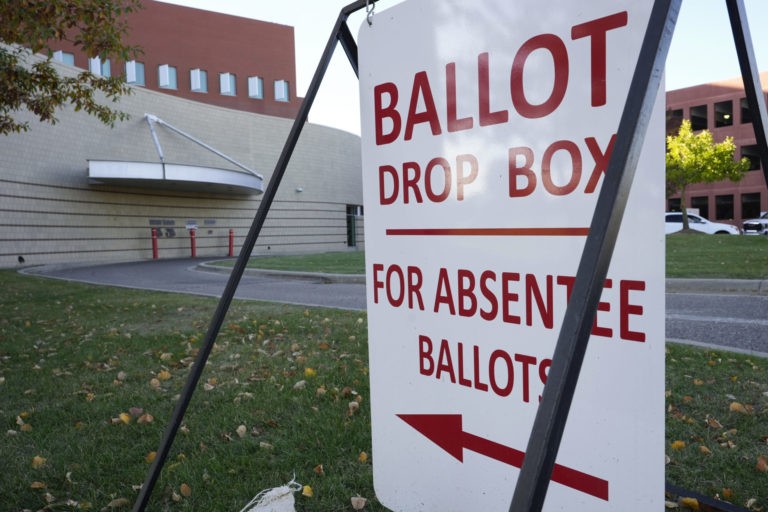
The SAVE America Act would require Americans to present proof of citizenship when registering to vote, necessitate in-person voter registration for federal elections, and require states to remove all noncitizens from their voter rolls.

Under the legislation, people would not be able to register to vote with only their driver’s license, since noncitizens can obtain that. They would instead need to present documents proving U.S. citizenship, such as a birth certificate or U.S. passport.

“We require ID for everyday activities like buying cold medicine or boarding a flight. Voting should be no different,” U.S. Rep. Scott Franklin, R-Fla., said on X. “It’s a commonsense step to protect confidence in our system.”

The bill passed 218-213, with one Democrat supporting it.

Democrats have called the legislation an act of voter suppression, given that federal law already prohibits noncitizens from voting. 

“They’re trying to say this is a voter ID bill. That’s not what’s happening here,” Democratic Whip Katherine Clark, D-Mass., said Wednesday. “This is election rigging. This is voter suppression. The American people aren’t going to stand for it.”

A majority of Americans actually support the voter ID measure. In the The Center Square Voters’ Voice Poll conducted in October, 70% of voters said they either strongly support (48%) or somewhat support (22%) requiring voter ID at the polls, while 23% either somewhat oppose (10%) or strongly oppose (13%) requiring it. The poll of more than 2,500 registered voters (including 978 Republicans, 948 Democrats, and 639 Independents) is among the most comprehensive in the country.

But since some Americans might not have access to a passport or their birth certificate, Democrats argue, the bill will simply make it harder for veterans, the disabled, minorities, and women who change their last names to register to vote.

“The so-called SAVE America Act will potentially disenfranchise millions of Americans,” Rep. Brad Schneider, D-Ill., said on social media. “It is nothing more than the culmination of Republicans’ ridiculous and shameful attempts to make it harder for people to vote.”

Republicans say the changes, if implemented nationwide, will increase voter confidence in the validity of federal election results and consequently improve turnout.

The Center Square’s Voters’ Voice poll from October also found that nearly half of young adult voters surveyed had “not very much confidence” or “no confidence at all” that the 2026 midterm elections will be conducted fairly. 

“Making sure that it’s easy to vote and hard to cheat is a core principle,” Rep. Bryan Steil, R-Wis., told lawmakers. “As we instill election integrity in our system, we will see more people participating because they will have faith in our elections.”

Unless GOP leadership in the Senate tweaks filibuster rules, as many Republicans have recently advocated, the SAVE America Act is unlikely to become law due to the filibuster.
Member of Trump’s ‘Religious Liberty Commission’ Removed After Questioning Claim That Anti-Zionism Is Antisemitic

(Dave DeCamp, Antiwar.com) A member of the Trump administration’s “Commission on Religious Liberty” has been removed after a hearing turned contentious over her objection to the idea that anti-Zionism is antisemitism.

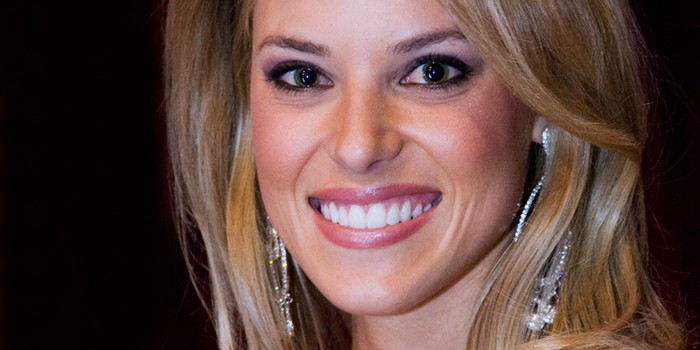
Carrie Prejean Boller, a Catholic conservative activist and model, took issue with the International Holocaust Remembrance Alliance’s (IHRA) definition of antisemitism, which has been embraced by the Trump administration’s Department of Justice and conflates criticism of the modern state of Israel with antisemitism.

“Undoubtedly, anti-Zionism is antisemitism,” Rabbi Ari Berman, president of Yeshiva University in New York, told Boller during one exchange. Boller then pointed to her Catholic faith, which does not affirm the idea that the Jewish people have a divine right to historic Palestine.

“I’m a Catholic, and Catholics do not embrace Zionism, just so you know, so are all Catholics antisemites?” she said. During the hearing, Boller also read testimony from Rabbi Yakoov Shaprio, an anti-Zionist Jew, and asked if his statement was “antisemitic.” In a post on X, Boller said she recommended Shapiro and several other Jewish Americans for the panel, but they were denied.

After facing backlash for her questioning, Boller vowed to continue speaking out. “I will never bend the knee to the state of Israel. Ever,” she said. “I am more determined than ever to speak plainly about political Zionism and the lies we’ve been sold to justify endless war, dead children, and blank checks.”

Texas Lt. Gov. Dan Patrick, another commission member who interrupted Boller’s questioning during the hearing, said on Wednesday that Boller was being removed. “No member of the Commission has the right to hijack a hearing for their own personal and political agenda on any issue. This is clearly, without question, what happened Monday in our hearing on antisemitism in America. This was my decision,” he said.

This article originally appeared at Antiwar.com.  

Trump Has ‘Very Good’ Meeting With Netanyahu

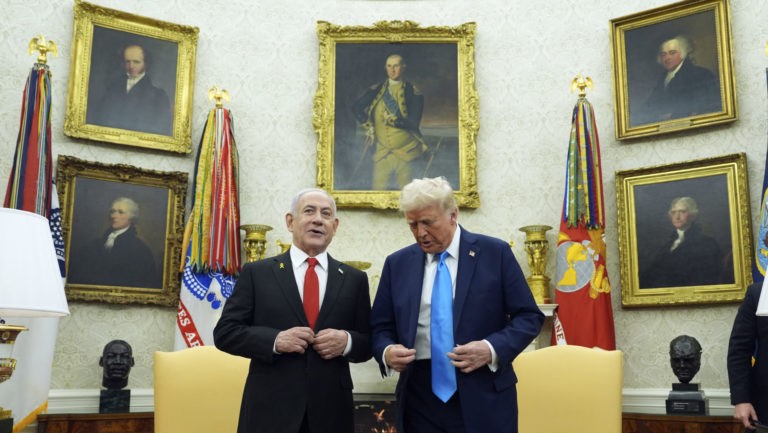
(Dave DeCamp, Antiwar.com) President Donald Trump said on Wednesday that “nothing definitive” was reached during what he described as “very good” talks with Israeli Prime Minister Benjamin Netanyahu at the White House.

“I have just finished meeting with Prime Minister Netanyahu, of Israel, and various of his Representatives,” Trump wrote on Truth Social after the meeting, which lasted three hours. “It was a very good meeting, the tremendous relationship between our two Countries continues.”

The US president said that he “insisted” to Netanyahu that US talks with Iran would continue, but made clear that the threat of the US bombing the country was still real, and The Wall Street Journal reported that the Pentagon is preparing for the potential deployment of a second aircraft carrier to the Middle East.

“There was nothing definitive reached other than I insisted that negotiations with Iran continue to see whether or not a Deal can be consummated. If it can, I let the Prime Minister know that will be a preference. If it cannot, we will just have to see what the outcome will be,” Trump wrote.

“Last time Iran decided that they were better off not making a Deal, and they were hit with Midnight Hammer — That did not work well for them,” he added, though in June 2025, the US backed an Israeli attack on Iran while negotiations between Washington and Tehran were still underway.

Before the start of the 12-Day War, Trump also put out statements claiming he wanted a deal with Iran, including one that was issued as Israeli jets were getting in the air to bomb Iran. Netanyahu has made clear that he opposes any deal with Iran and that he was in Washington to express the Israeli position.

“The Prime Minister emphasized the security needs of the State of Israel in the context of the negotiations, and the two leaders agreed on continued coordination and the close contact between them,” Netanyahu’s office said in a brief statement about the talks.

Axios reporter Barak Ravid noted in his report on the talks that, before the US and Israel launched the 12-Day War, they appeared to be at odds over the Iran talks, part of a deception campaign aimed at keeping Tehran off guard. “Trump and Netanyahu also made divergent public statements before Israel attacked Iran in June, before coordinating closely in that operation,” he wrote.

Trump told Ravid on Tuesday that he wants any deal with Iran to include limits on its ballistic missiles, a demand that’s a non-starter since Tehran’s missiles are its only form of deterrence and way of launching counterattacks if bombed by the US or Israel.

Iranian officials have been clear that the only issue on the table is its nuclear program, and, according to media reports, the US agreed to drop its demand that the talks cover missiles, but Trump’s comments suggest otherwise.

This article originally appeared at Antiwar.com. 

Report: US Smuggled Thousands of Starlink Terminals Into Iran During Protests

(Dave DeCamp, Antiwar.com) The US smuggled thousands of Starlink terminals into Iran in January to support anti-government protesters inside the country, The Wall Street Journal reported on Thursday.

The report said that the State Department purchased 7,000 Starlink terminals several months ago with the aim of providing them to anti-government elements inside Iran, and that about 6,000 were smuggled into the country in January after the Iranian government cut internet access as part of its crackdown against the protest.

The report contradicts the Trump administration’s claim that it didn’t provide any material support to the protesters, though President Trump was publicly encouraging the protests. 

“Iranian Patriots, KEEP PROTESTING – TAKE OVER YOUR INSTITUTIONS!!! Save the names of the killers and abusers. They will pay a big price,” Trump wrote on Truth Social on January 13. “I have cancelled all meetings with Iranian Officials until the senseless killing of protesters STOPS. HELP IS ON ITS WAY. MIGA!!!”

The unrest involved some armed clashes between Iranian security forces and Kurdish militants who reportedly entered Iran from Iraqi Kurdistan, where the US has a military presence. Iranian authorities said at the end of January that they had seized a shipment of 51 Starlink terminals in Iran’s Kurdistan region, which borders Iraqi Kurdistan.

US Treasury Scott Bessent has also boasted about how US sanctions collapsed Iran’s economy and sparked the protests. “At the Treasury, what we have done is created a dollar shortage in the country … It came to a swift and, I would say, grand culmination in December, when one of the largest banks in Iran went under. There was a run on the bank,” Bessent told a Senate committee last week.

“The central bank had to print money, the Iranian currency went into free fall, inflation exploded, and hence we have seen the Iranian people out on the street,” he added.

This article originally appeared at Antiwar.com.  

Trump Says It Will Be ‘Very Traumatic’ for Iran if a Nuclear Deal Isn’t Reached

(Dave DeCamp, Antiwar.com) President Donald Trump said on Thursday that it would be “very traumatic” for Iran if Washington and Tehran don’t reach a nuclear deal, echoing threats he made last year in the lead-up to the 12-Day War.

“We have to make a deal with Iran, otherwise it’s going to be very traumatic, very traumatic. I don’t want that to happen, but we have to make a deal,” Trump told reporters a day after holding talks with Israeli Prime Minister Benjamin Netanyahu at the White House.

“We had a very good meeting yesterday with Bibi Netanyahu, and he understands. But it’s ultimately up to me. If the deal isn’t a very fair deal and a very good deal with Iran, it’s going to be a very difficult time for them,” Trump added.

The US president was asked if there was a timeline for a deal and said, “I guess over the next month … They should agree very quickly.”

Netanyahu said as he was departing the US that Trump was creating “conditions” that could lead to a “good deal,” though from Israel’s perspective, a “good” agreement would require Iran to impose limits on its ballistic missiles, a demand that is a non-starter for Tehran and likely designed to collapse diplomacy.

“The talks with Trump focused primarily on the negotiations with Iran,” Netanyahu said. “The president believes the Iranians now understand who they are dealing with. I think that under the conditions he is creating, combined with the fact that they surely understand they made a mistake the last time by not reaching a deal, conditions could emerge for achieving a good agreement.”

The Israeli leader also said he was skeptical that an agreement would be reached and laid out Israel’s terms. “I won’t hide from you that I expressed general skepticism about the quality of any agreement with Iran,” he said. 

“If an agreement is reached, it must include the elements that are important to us, to the State of Israel, and in my view to the entire international community — not only the nuclear issue, but also ballistic missiles and Iran’s proxies in the region.”

According to the Israeli news site Ynet, the Israelis have laid out several conditions for a deal with Iran: limiting its ballistic missiles to a range of 300 kilometers, zero nuclear enrichment, and an end to support for its allies in the region.

The report also said that while Trump and Netanyahu’s statements focused on diplomacy with Iran, the two leaders discussed military options and that Israeli officials expect the US will eventually attack Iran.

This article originally appeared at Antiwar.com.  

Just How Much Are Those Olympic Medals Worth?

(Mike Maharrey, Money Metals News Service) It’s really exciting watching those Olympic athletes go for those silver medals, eh?

No, you don’t need to send me emails telling me there is a typo in the first line of my article. I meant what I wrote. They are going for silver.

Now, you might be thinking, ‘Mike must be on cold meds and his thinking is fuzzy.’ Well,  I am indeed on cold meds. But my thinking is just fine, thank you very much!

Yes, I know that Olympic winners earn gold medals. But the truth of the matter is that they’re mostly silver.

The 2026 Olympic gold medal is formed of 500 grams of sterling silver, an alloy containing 92.5 percent by weight of silver and 7.5 percent by weight of other metals. They are then coated with 6 grams of 24-karat gold.

Silver medals are made from 500 grams of sterling silver, and bronze medals are, well, bronze.

One thing is for certain: winners of these Winter Olympic events are getting medals worth a heck of a lot more than the summer athletes won in Paris in 2024.

The melt value of a 2026 silver medal (and the silver content in a gold medal) is around $1,160 at the current spot price of around $78.

And what was the melt value of a 2024 Olympic silver medal?

Around $535.

Even with just 6 grams of gold, the melt value of gold is significantly higher. At $5,000 an ounce, 6 grams of gold costs about $965. That makes the total value of the metal in a gold medal at $2,125.

When athletes competed in Paris in the 2024 Summer Games, the price of gold was less than half what it is today, at around $2,400 an ounce.

Axios put the value of Olympic medals in a cool inflation-adjusted chart for us. The silver price was a bit higher when Axios ran its numbers, but it is still a good visual representation.

Now, imagine if those gold medals were made of solid gold. You would be talking about a medal worth more than $83,300!

Now you know why they make the gold medal out of silver.

According to Olympic records, medals of pure gold were only handed out twice – the first time during the St. Louis Games in 1904 and then during the London Games in 1908. The medals were much smaller back then, and the average price of gold in 1904 was a mere $18.96 per ounce.

And what about those bronze medals?

Bronze is an alloy of copper and zinc. Depending on the exact formulation of the medal, it’s melt-value is about four bucks.

Lesson: don’t come in third.

And another lesson – gold and silver are a good store of value!

Photo: Fondazione Milano Cortina 2026


Mike Maharrey is a journalist and market analyst for Money Metals with over a decade of experience in precious metals. He holds a BS in accounting from the University of Kentucky and a BA in journalism from the University of South Florida.

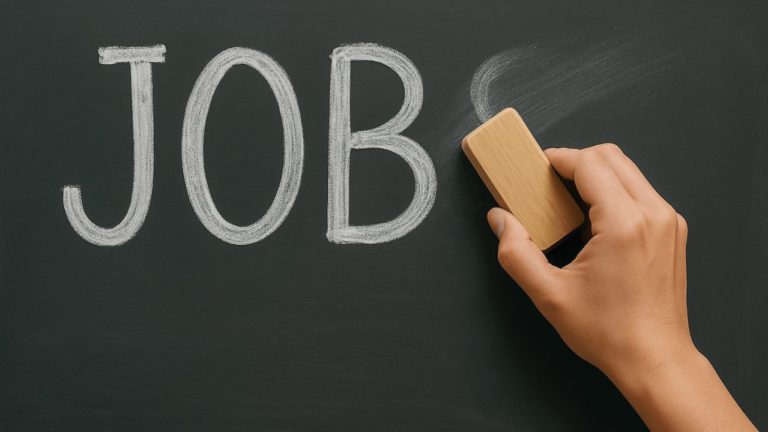
The Government Job Eraser Strikes Again!

(Mike Maharrey, Money Metals News Service) The Federal Reserve put interest rate cuts on pause at the January meeting. The central bankers cited expanding economic activity and a stable labor market as reasons for the pause.

The official FOMC statement asserted that while “job gains have remained lowthe unemployment rate has shown some signs of stabilization.” In his post-meeting press conference, Fed Chairman Jerome Powell repeatedly characterized the labor market as “stable,” insisting economic activity has been “expanding at a solid pace.”

When you listen to the central bankers at the Fed, it’s clear they pay a lot of attention to employment data. This should concern you because that data seems about as reliable as a politician’s campaign promise.

If you just read the headlines, you likely believe the job market is in pretty good shape. Every month, the Bureau of Labor Statistics tells you that a lot of jobs were created. The media trumpets these numbers and politicians lean on them to prove how great they are.

For instance, the media lauded the January BLS report as “a shock to the upside.” According to the bureau, the economy added 130,000 jobs. The forecast was for around 70,000 new jobs.

That’s great! right? This confirms what the Fed people said! The labor market is humming!

Sure. Sounds good. But just wait for the revisions.

Because, ladies and gentlemen, there will be revisions.

In fact, there were revisions in the latest data release. And they should have garnered the headlines, not the January number.

At the same time that the BLS announced this shockingly good job growth, it revised the December number down from 50,000 to 48,000 new jobs.

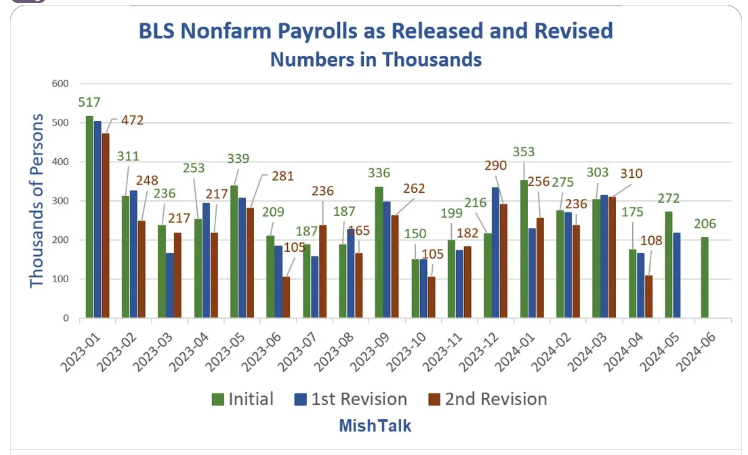
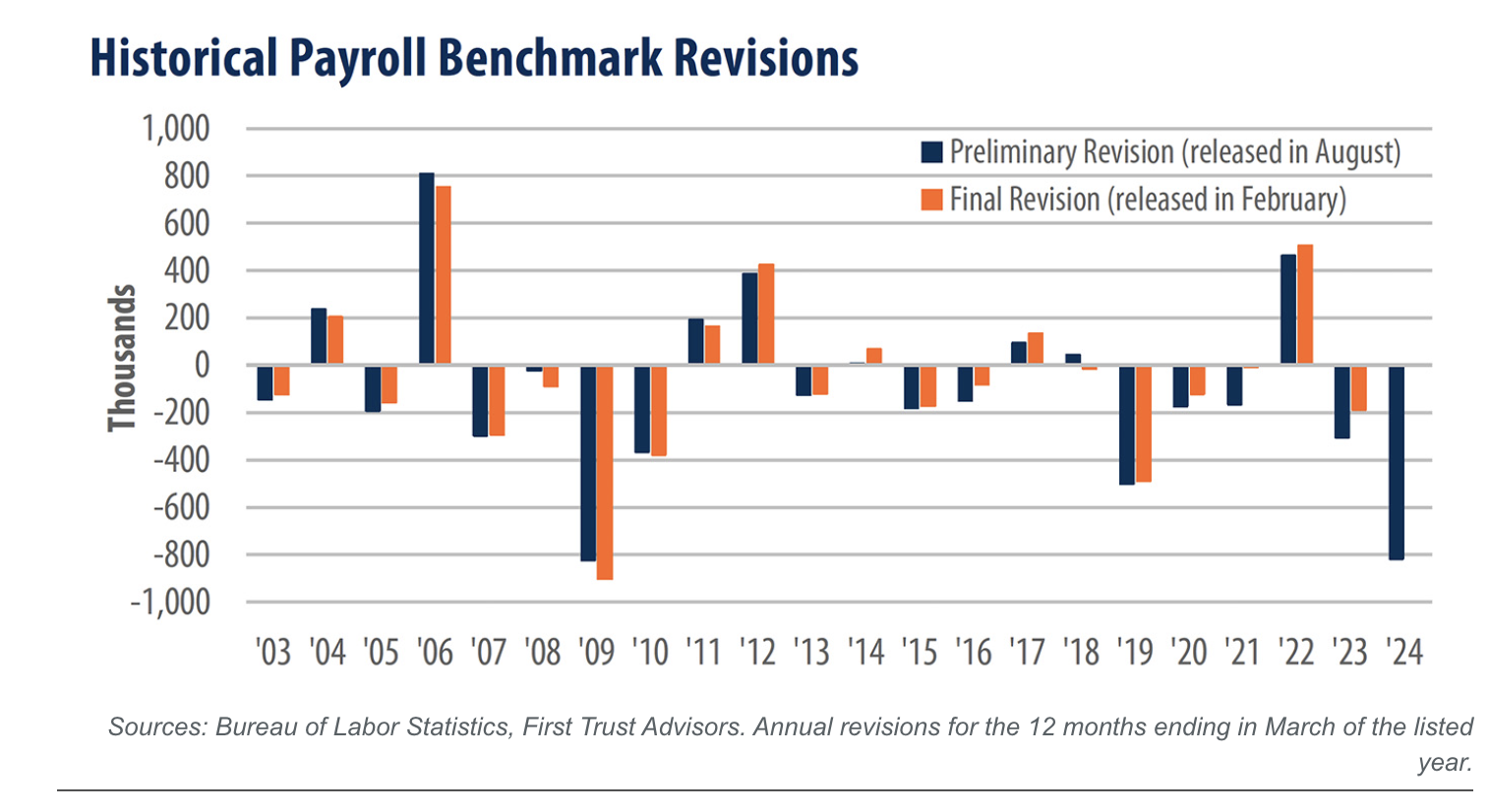
But that was just a warmup. The bureau also made its end-of-the-year adjustment to the “birth-death model” it uses to determine job growth. That erased nearly half a million jobs from the economy. To be precise, the BLS wiped out 403,000 jobs with its model revision.

With the revision, the U.S. economy only generated an average of 15,000 jobs per month in 2025. You probably don’t have that impression if you just saw the headlines as the BLS announced its employment data each month.

If it sounds like the agency is just making stuff up, well…

And even if you give the folks over at the BLS the benefit of the doubt and assume they’re doing the best they can, their best is pretty abysmal.

In fact, downward revisions are standard operating procedure for the BLS. The agency had already erased nearly 1 million (911,000) jobs that it initially claimed were created between March 2024 and June 2025.

So, what are we to make of the January report claiming the economy added a surprising 130,000 jobs?

Nothing.

Because some of these jobs will almost certainly be erased next month.

The BLS has a long history of reporting rosy job numbers only to quietly come back and revise them downward down the road. In 2023, job numbers were revised down in 10 of the 12 months.

To be fair, compiling employment data is no simple task. Revisions should be expected. But why do the updates almost always remove jobs from the economy? One would think you’d see upward revisions nearly as often as downward, right?

Nope.

Since 2003, the final annual BLS numbers were lower than the initial report 14 times compared to seven upward revisions.

It’s almost as if the agency is trying to make the government look good.

If that’s the strategy – it works.

It’s notable that markets only react to the initial numbers. You never see markets tank because the BLS erased a bunch of jobs from the economy with a few clicks of its calculator. The revisions happen quietly in the back alleys. Nobody pays any attention to them. That creates the illusion that the labor market is much stronger than it is.

It goes something like this:

This month, the government reports good news. Everybody celebrates. Markets move. The following month, the government quietly revises everything downward and reports that the good news was really bad news.

And nobody pays attention.

This wouldn’t matter nearly so much if central bankers and government officials didn’t lean so much on this data to make decisions. But they do. And if the data is this unreliable, what does that tell you about the decisions based on this data?

Let’s be honest; when you look at the history, one’s got to wonder why anybody takes these numbers at face value.

The lesson here is that we need to be somewhat skeptical of government data. And we need to pay attention – not just to the headline release, but the revisions as well.


Mike Maharrey is a journalist and market analyst for Money Metals with over a decade of experience in precious metals. He holds a BS in accounting from the University of Kentucky and a BA in journalism from the University of South Florida.

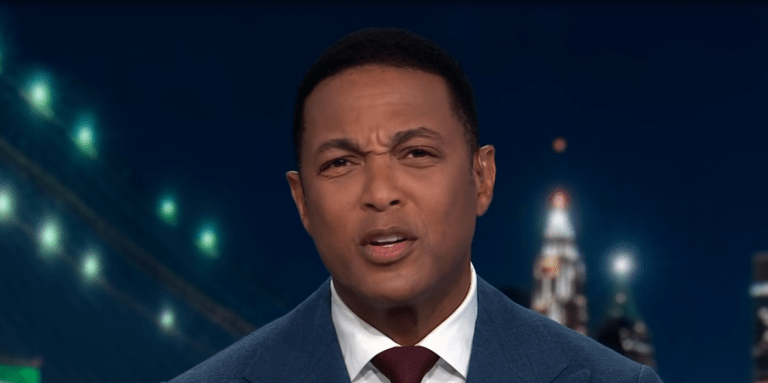
Journalist Don Lemon Set to be Arraigned in Minnesota Church Protest Case

(Headline USA) Former CNN host turned independent journalist Don Lemon is set to be arraigned in federal court in Minnesota on Friday along with four other defendants who were indicted for their alleged roles in disrupting a service at a church where an Immigration and Customs Enforcement official was a pastor.

Also scheduled for arraignment Friday is civil rights attorney Nekima Levy Armstrong. 

Arraignments in federal court typically include the entering of pleas and scheduling of future proceedings. It wasn’t clear ahead of the hearing if Lemon planned to personally appear or let his legal team handle the hearing. His attorney, Joe Thompson, did not return calls seeking comment this week.

Two more defendants, including independent journalist Georgia Fort, are to be arraigned next week. Nine defendants in all are charged in the case.

Lemon had previously said through another attorney, Marilyn Bednarsk, that he planned to plead not guilty to federal civil rights charges over his coverage of the protest at a Southern Baptist church in St. Paul.

Protesters interrupted the service at Cities Church on Jan. 18 by chanting “ICE out” and “Justice for Renee Good,” referring to the 37-year-old mother of three who was fatally shot by an ICE officer in Minneapolis last month. 

“I have spent my entire career covering the news. I will not stop now. In fact, there is no more important time than right now, this very moment for a free and independent media that shines a light on the truth and holds those in power accountable,” Lemon told reporters after his arrest.

The church protest drew sharp complaints from conservative religious and political leaders. White House press secretary Karoline Leavitt warned in a social media post at the time that “President Trump will not tolerate the intimidation and harassment of Christians in their sacred places of worship.” Even among clergy who oppose the administration’s immigration enforcement tactics, there was discomfort with such protests.

Adapted from reporting by the Associated Press

Shooting at a South Carolina State University Kills 2 and Wounds 1

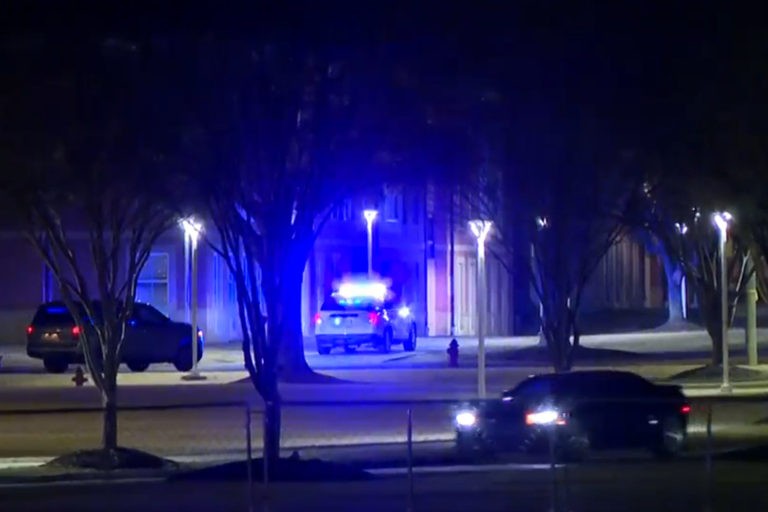
(Headline USA) Two men are dead and another was wounded after a shooting in a room at a South Carolina State University residential complex, the university said, prompting a nearly eight-hour lockdown that was lifted early Friday.

The Thursday night shooting happened a little over four months after two shootings during homecoming celebrations on Oct. 4. One, which happened near the same residential complex, killed a 19-year-old woman. A man was injured in the other shooting. School officials announced new safety measures afterward.

University officials have not confirmed the identities of the men. The condition of the man in the hospital was not known.

One man died at the scene and the other died at the hospital, the South Carolina Law Enforcement Division said in a statement. It is investigating the shooting.

The agency said information on the men who died would come from the Orangeburg County Coroner’s Office. Messages seeking comment were left at the office.

The school put the campus in Orangeburg on lockdown at about 9:15 p.m. The shooting happened inside a room in the Hugine Suites housing complex, the division said.

The lockdown was lifted about 5 a.m. Friday, the university said.

Kaya Mack had just finished making a food delivery on campus when she heard gunshots and saw lots of police officers coming through a gate.

She said she wasn’t sure where the shots were coming from.

“Their loud sirens kind of shook me,” she told WLTX-TV. “We were looking around, me and other people on campus, we’re all looking around like ‘What’s going on?’”

Investigators were on site and law enforcement was patrolling the campus and areas nearby.

The university canceled Friday classes and was making counselors available to students.

Several people have been arrested on gun-related charges in connection with the October shootings.

After the October shootings, university President Alexander Conyers announced the addition of new fencing along the campus perimeter and additional security patrols to better control pedestrian access, according to a news release at the time. Crews were also set to repair damaged perimeter barriers.

Ahead of the university’s annual Youth & ROTC Day set on Nov. 1, the university announced safety and security measures, including a second layer of fencing along the perimeter between Hugine Suites and Goff Street and repairs underway along the shared boundary between South Carolina State and Claflin University.

The school founded in 1896 is South Carolina’s only public historically Black university, and has more than 2,900 current students, according to its website.

The university community recently marked the 58th anniversary of what has come to be called the Orangeburg Massacre. They remembered three young men killed Feb. 8, 1968, when officers opened fire on a crowd of Black students who had rallied on campus after demonstrating against segregation at a local bowling alley.

Adapted from reporting by the Associated Press


Patriots’ Stefon Diggs to be Arraigned and Denies Assault Allegation

(Headline USA) New England Patriots wide receiver Stefon Diggs is scheduled to be arraigned Friday in Massachusetts on felony strangulation and other criminal charges stemming from an alleged dispute with his personal chef.

The arraignment at Dedham District Court was postponed until after Super Bowl LX so Diggs could play in the NFL championship game.

According to court records, the woman told Dedham officers she and Diggs argued about money he owed her for her work as his private chef. During the Dec. 2 encounter at his home, she said, he “smacked her across the face” and then “tried to choke her using the crook of his elbow around her neck,” leaving her feeling short of breath.

Diggs’ arraignment was originally slated for Jan. 23 but was moved to Feb. 13 — five days after the Patriots’ 29-13 loss to the Seattle Seahawks — to accommodate his playing schedule.

Diggs’ attorney has said he “categorically denies these allegations,” calling them unsubstantiated and motivated by a financial dispute. The Patriots released a statement saying they support him.

Investigators allege the woman first reported the incident to police on Dec. 16, two weeks after it occurred; she initially hesitated to file charges but later chose to do so, according to court documents.

The arraignment Friday will be the first court appearance in the case. The judge is expected to address bail conditions and set future hearing dates.

Adapted from reporting by the Associated Press