Top NC Democrat Indicted on Child Sex Charges 

(Luis CornelioHeadline USA) A former North Carolina lawmaker was indicted Monday on child sex abuse charges, according to court records reviewed by Headline USA. 

Cecil Brockman, a former member of the North Carolina House of Representatives, was indicted by a grand jury in Guilford County on two counts of statutory rape of a child under the age of 15 and two counts of indecent liberties with a child. 

The charges stem from a months-long investigation into Brockman’s alleged relationship with the minor, with whom he lived and allegedly maintained a long relationship. 

Prosecutors with the Guilford County District Attorney’s Office alleged the child told them the two met through an online dating app. 

The child’s gender is unknown. 

Brockman, who resigned from the legislature on Oct. 31, 2025, served six terms and was the first openly bisexual member of the North Carolina legislature.

The case began when Brockman called 911 in Davidson County, North Carolina, trying to locate the child, whom he said he was tracking through the Life360 app while arranging an Uber for them. 

Fox8 reported that the Davidson County Sheriff’s Office found the call odd and referred the matter to the High Point Police Department, which has jurisdiction over certain areas of Guilford County.

Upon investigation, police officers arrested Brockman in October 2025 on suspicion of statutory rape, leading to the grand jury indictment that was unsealed this week. 

Court records show Brockman previously secured a $250,000 bond following his initial arrest.  

Reports suggest Brockman remains in jail following the grand jury indictment and the passage of Iryna’s Law, legislation enacted after the brutal killing of Ukrainian refugee Iryna Zarutska. 

Shocking Audit Shows Over 600 Truck Drivers Did Not Speak English 

(Luis CornelioHeadline USA) A bombshell report from the Wyoming Highway Patrol found more than 600 violations involving commercial drivers who failed English proficiency interviews during inspections.

The findings come from a state audit launched after several high-profile crashes involving drivers who barely spoke English. 

The WHP found that 676 out of 16,676 commercial vehicle inspections resulted in violations because drivers failed interviews due to a lack of English proficiency.

In fact, the issue ranked as the eighth most common violation in the state, according to the report issued in February 2026. 

Other common violations included operating a commercial vehicle without proof of periodic inspection (1,932), tires leaking air or with less than 50% of maximum inflation (1,284), brakes out of adjustment (1,117) and others. 

The figures come amid several high-profile cases involving foreign nationals accused of causing major crashes across the country. 

In February, Indian national Singh Sukhdeep allegedly ran a red light in Hendricks County, Indiana, striking a Chevrolet pickup truck driven by 64-year-old Terry Schultz. 

Also in February, Kyrgyz national Bekzhan Beishekeev was arrested after he allegedly killed four people while swerving into oncoming traffic in Pennsylvania. 

In Florida, Indian national Harjinder Singh reportedly killed three people after attempting to make an illegal U-turn. 

All three suspects reportedly held driver’s licenses issued by several Democratic-governed states. 

Trump Demands Unconditional Surrender from Iran, Mentions Regime Change

(Morgan Sweeney, The Center Square) President Donald Trump has said he will accept nothing less from Iran than unconditional surrender, according to a social media post on Friday morning.

“There will be no deal with Iran except unconditional surrender!” the president wrote on Truth Social.

He also wrote about the selection of a new leader for the country – potentially indicating there may be an expanded U.S. presence in Iran until that is complete – in the same post. 

“After [unconditional surrender], and the selection of a great and acceptable leader(s), we, and many of our wonderful and very brave allies and partners, will work tirelessly to bring Iran back from the brink of destruction, making it economically bigger, better, and stronger than ever before,” the president wrote. 

“Iran will have a great future. Make Iran Great Again (MIGA!),” Trump concluded in his notorious all-caps style. 

The administration has been asked many times since the start of the conflict whether regime change was one of its conditions for a successful military campaign in Iran. At a press briefing Wednesday, White House Press Secretary Karoline Leavitt said that it was not one of the goals of Operation Epic Fury, but the administration wants broader political rights for Iranians.

“As for what comes next for Iran, the president has said of course, it’s a good thing for the United States to want freedom for the Iranian people, and ultimately, we hope that freedom rests in their hands,” Leavitt said.

Leavitt also responded to questions about America’s “post-conflict” role in Iran, saying the president was “actively considering and discussing with his advisors and his national security team.”

Some of the supporters of the late Ayatollah Ali Khameini, who was killed in the U.S. and Israel’s initial airstrikes on Saturday, reportedly favor his son, Mojtaba Khameini, to replace him.

Reza Pahlavi, the son of Iran’s last Shah and the country’s exiled crown prince, has long advocated for regime change. He has lived in the U.S. since 1978, and has spoken about leading the country now that the ayatollah is dead.

Charlie Kirk Flyer Removal at Campbell Questioned by FIRE

(Alan Wooten, The Center Square) Removal of flyers associated with Charlie Kirk at a private Christian liberal arts institution in the North Carolina Sandhills has drawn rebuke from a nonprofit free speech organization known as FIRE.

The Foundation for Individual Rights and Expression says removal of law student Justin Booker’s flyers “flies in the face of Campbell’s promise to its students that they have the right to free speech.”

Dominic Coletti, program officer for Campus Rights Advocacy at FIRE, wrote to university President William Downs saying in part, “Booker’s flyer was unquestionably protected by Campbell’s strong and laudable free expression promises, which bar the university from enforcing its policies against expression on the speaker’s viewpoint.”

The Center Square was unsuccessful prior to publication getting comment from the Campbell president.

Kirk was shot to death in at Utah Valley University in Orem on Sept. 10. The next day, Booker later posted flyers that included Kirk and his family and the words “end political violence” in multiple places in the law school.

The flyers were removed on Sept. 12 by Assistant Dean Regina Chavis, Coletti says, and he was told not to post any others. He said the institution cited “one policy that limits posting to designated bulletin boards and bars posting anywhere else within the law school and another giving a dean unfettered power to rip down student posters.”

Colleti, in an email shared with The Center Square, said, “If Campbell is refraining from removing some students’ flyers posted outside of designated bulletin boards, it must refrain from removing all similarly displayed flyers, or be prepared to explain to a community of law students and legal faculty why rules of purportedly general application actually apply only to those with disfavored viewpoints.

“Preferably, the university could further support a culture of free expression by allowing all such displays to remain up and formally expanding the number of areas for expression. This should not be overly difficult since, at least for some of its constituents, this expanded area for expression is already a reality.”

U.S. Cut 92,000 Jobs in ‘Dismal’ February Report, Unemployment 4.4%

(Andrew Rice , The Center Square) The U.S. economy lost 92,000 jobs in February, a significant cut after January saw a better-than-expected report, according to the Bureau of Labor Statistics.

 The unemployment rate remained steady at 4.4%. The rate only marginally increased from its 4.3% rate in January. Interestingly, health care employment decreased in February, reflecting a rare instance that the BLS attributed to strike activity. Over the past several weeks in California, thousands of nurses went on strike to protest pay, working conditions and staffing. 

Additionally, a nurses strike in New York City may have had additional effects on the health care sector, which typically drives most job growth in the report. Overall, the health-care sector lost 28,000 in February after adding 77,000 in January. 

Over the past 12 months, the health care industry has added roughly 36,000 jobs per month. 

Employment in the information and federal government sectors trended down in February as well. Jobs in the information sector decreased by 11,000 in February. 

Federal government jobs continued to decrease in February with a loss of 10,000. Since October 2024, federal government employment has decreased by 330,000. 

Heather Long, chief economist at Navy Federal, described February’s report as “dismal.” She said, overall, the U.S. economy has lost jobs since April 2025 based on the February report. 

She estimated jobs from May 2025 to February 2026 decreased by 19,000. 

“Companies are not hiring in the face of all these headwinds and uncertainty,” Long wrote on social media. “Even healthcare is starting to slow down.”

Social assistance employment was one of the few sectors to see an increase during the month of February. The sector saw an increase of 9,000 jobs, largely driven by a 12,000 job increase from the individual and family services sector. 

Nearly all major employment sectors lost jobs in February. The hospitality sector lost 27,000 jobs; manufacturing lost 12,000 jobs; and the construction sector lost 11,000 jobs. 

DHS Inspector General Says He’s Blocked from Investigating Trump Shooting

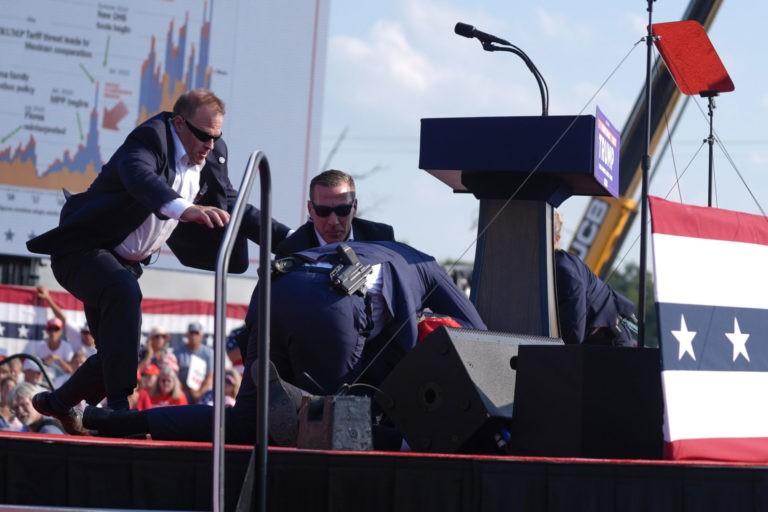
(Ken Silva, Headline USA) DHS Inspector General Joseph Cuffari has told Congress that he’s being blocked from investigating the Secret Service in relation to its failures to protect Donald Trump when he was nearly assassinated on July 13, 2024.

Cuffari’s complaint was made public shortly before DHS Secretary Kristin Noem was fired from her job Thursday for seemingly unrelated reasons.

Cuffari told the Senate Homeland Security Committee that his office opened an investigation into how the Secret Service handles intelligence concerning threats to protectees. He said that an intelligence agency outside of DHS approved his request last year to access to information related to his investigation.

“However, since September 2025, I&A has refused to conduct my indoctrination, thereby stymieing our work on this project,” he said in a letter. “This is especially troubling given the other reported attempts on President Trump’s life coupled with the present worldwide conflict.”

The fact that Cuffari is being blocked from investigating Secret Service’s intelligence handling is particularly troubling given what transpired leading up to the Butler shooting.

Indeed, Trump’s security detail, let by special agent-in-charge Sean Curran, received intelligence of an Iranian threat against Trump—but agents in the Pittsburgh office told Congress that they were never informed of such a threat. Curran was never interviewed by Congress, and was later promoted to be the director of the entire Secret Service.

Cuffari’s letter further outlined several other investigations in which the DHS is being uncooperative, including a criminal probe with national security implications.

Senate Homeland Security Committee ranking member Gary Peters, D-Mich., told the DHS on Wednesday that he’ll be investigating the DHS stonewalling.

The DHS Inspector General has been blocked from investigating the Butler shooting since 2024. In October of that year, it was alleged that the Secret Service was blocking Homeland Security auditors from accessing all of Donald Trump’s campaign events, in an attempt to hide the fact that Trump isn’t receiving sufficient protection.

“A Secret Service whistleblower has alleged to my office that Secret Service headquarters blocked several auditors from the Department of Homeland Security Office of Inspector General (OIG) from accessing recent Trump campaign events,” Sen. Josh Hawley, R-Mo., former Secret Service Director Ronald Rowe at the time.

“The whistleblower alleges that the Secret Service denied access to DHS auditors because the former president is not receiving the full level of protective assets for all of his events, and Secret Service leadership wants to obscure or simply conceal this fact.”

Additionally, a whistleblower told Sen. Chuck Grassley in October 2024 that Secret Service management was instructing its agents to inform their bosses if they get called by the DHS Inspector General for an interview.

Ken Silva is the editor of Headline USA. Follow him at x.com/jd_cashless.

ETFs Added More Gold in February Despite Recent Price Correction

(Mike Maharrey, Money Metals News Service) The big gold selloff in January didn’t seem to deter investment demand. Despite the big correction in the gold price, metal continued to flow into ETFs last month.

ETF gold holdings rose to an all-time high in January, and gold-backed funds continued to add to their assets in February. ETFs added 26 tonnes of gold last month, pushing total holdings to a record of 4,171 tonnes.

Even with the pullback in the gold price, assets under management (AUM) by gold-backed funds also hit a new all-time high of $701 billion.

It was the ninth consecutive month of positive ETF gold flows globally.

North American funds once again led inflows, reporting the addition of 27.9 tonnes of gold valued at $4.7 billion.

It was the ninth month of positive gold flows into North American ETFs. World Gold Council analysts said, “Such a sustained run is notable and shouldn’t be overlooked.

“Outside of the initial conditions phase, there have only been two other periods in which the region recorded at least nine straight months of inflows – during the Global Financial Crisis (GFC) and the COVID‑19 pandemic. Although these episodes were driven by different dynamics, both were characterized by elevated systemic risk. As a result, diversification into safe‑haven assets remains a consistent theme for investors.”

According to the World Gold Council, the recent pullback in the gold price incentivized new North American investors to enter the gold market.

The WGC pinpointed four factors driving North American gold ETF investment.

  • Heightened geopolitical risk, particularly involving Iran.
  • A more favorable opportunity cost for holding gold, driven by dollar weakness and lower rates.
  • Ongoing trade and policy uncertainty following the Supreme Court’s ruling on tariffs.
  • Equity market concern, as software and SaaS-related names continued to weigh on the broader market.

Asian funds reported gold inflows for the sixth straight month, adding 11 tonnes of gold valued at $2.3 billion.

Japanese funds led the way, driven by political uncertainty in early February, coupled with escalating tensions with China and a weakening yen.

Chinese funds reported modest inflows of gold in a month with fewer trading days due to the New Year holiday. Gold’s muted performance in RMB also created headwinds for gold in the Chinese market.

Indian funds also reported healthy inflows of gold, although the pace moderated after record months in December and January. There was an elevated number of redemptions early in the month, driven by profit-taking. World Gold Council analysts said this was offset later in the month, “underscoring sustained interest in gold ETFs.

Indian investors have historically preferred physical gold, but ETFs have grown in popularity over the last couple of years.

Europe was the only region to report ETF gold outflows, with funds shedding 13 tonnes valued at $1.8 billion. Redemptions were primarily early in the month as the January selloff spilled into February. Flows turned positive later in the month, but couldn’t offset earlier selling.

The UK accounted for the bulk of European redemptions (-$1.9 billion), reflecting the country’s outsized share of the region’s gold ETF market.

WGC analysts said, “As the bulk of outflows on 30 January and 2 February was concentrated in UK‑listed funds – and not tied to a wider regional or country-specific macro event – we do not interpret this divergence as the start of a longer-term structural trend.

Funds in other regions, including Australia and Africa, reported modest gold inflows of 0.3 tonnes valued at $17 million. Australia drove inflows, which were offset by outflows in South African funds.

ETFs are a convenient way for investors to play the gold market, but owning ETF shares is not the same as holding physical gold.

ETFs are relatively liquid. You can buy or sell an ETF with a couple of mouse clicks. You don’t have to worry about transporting or storing metal. In a nutshell, it allows investors to play the gold market without buying full ounces of metal at the spot price.

Since you are just buying a number in a computer, you can easily trade your ETF shares for another stock or cash whenever you want, even multiple times on the same day. Many speculative investors take advantage of this liquidity.

But while a gold ETF is a convenient way to play the price of gold on the market, you don’t possess any gold. You have paper. And you don’t know for sure that the fund has all the gold either, especially when the fund sees inflows. In such a scenario, there have been difficulties or delays in obtaining physical metal.

Gold Trading Volumes

Unsurprisingly, gold trading volumes dipped from January’s record high in February after the selloff but remain historically elevated.

Trading volume averaged $478 billion per day, down from $623 billion per day the prior month. However, volume was still 32 percent above the 2025 average.

In tonnage terms, the drop was more substantial, falling 26 percent to 2,969 tonnes per day. That was slightly below last year’s average.

According to the World Gold Council, “The month‑on‑month decline largely reflected profit‑taking, lighter Asian participation during the Lunar New Year holiday, and gold trading sideways after recovering most of its early‑month drop.

Over-the-counter (OTC) volume dipped by about 12 percent month-on-month to $245 billion per day. That was still elevated by historical standards.

COMEX net longs fell 21 percent in February to 504 tonnes. Money manager net longs decreased 18 percent to 311 tonnes, while Other net longs declined 27 percent to 194 tonnes.


Mike Maharrey is a journalist and market analyst for Money Metals with over a decade of experience in precious metals. He holds a BS in accounting from the University of Kentucky and a BA in journalism from the University of South Florida.


Why Dead People Might Be Better Investors Than You

(Mike Maharrey, Money Metals News Service) Don’t just do something; stand there! Turns out this might be a pretty good investment strategy.

Research conducted by Dalbar, Fidelity, and Vanguard reveals that dead people tend to be better investors than the living.

Now, I’m not suggesting suicide here. But you can adopt the strategy a dead person would employ – doing absolutely nothing (Because, obviously, that’s all a dead person can do).

Based on the abovementioned research, the best investors aren’t necessarily the smartest people. They don’t have degrees in finance. They aren’t even the most experienced. They’re dead. Or perhaps they’re still walking among us, but they forgot they had an investment account.

How does this make sense?

Well, if you’re dead or don’t realize you have an account, you aren’t going to tinker with it. You just let it ride. You don’t overreact to every news headline. You don’t panic when the Dow has a down day. You don’t freak out when you see our precious metals ticker bleeding red.

Business coach Nat Berman put it this way in a post on X:

“The best investors are patient, consistent, and almost boring. They set a strategy, automate contributions, and let compounding do the work. They don’t let emotions drive decisions and are humble about what they can’t predict. The traits that create exceptional investors are all learnable: patience, consistency, humility, and emotional control.”

One of the key points here is that dead people don’t get caught up in their feelz.

Humans are emotional beings, and emotions often drive our decision-making. I’m not prone to panic or rejoice over daily price movements. Still, I’ll confess that when gold and silver sold off steeply in January, I was a little uncomfortable watching the negative numbers get bigger and bigger. And I’m not going to lie. Selling crossed my mind.

Brad Klontz is a certified financial planner and financial psychologist. He says human behavior is the biggest threat to our portfolio.

“It’s them selling [investments] when they’re in a panic state, and conversely, buying when they’re all excited. We are our own worst enemy, and it’s why dead investors outperform the living.”

Klontz said humans are evolutionarily wired to “run with the herd.”

“Our approach to investing is actually psychologically the absolute wrong way to invest, but we’re wired to do it that way.”

Ritholtz Wealth Management CIO Barry Ritholtz agreed, saying big market moves can trigger a “fight or flight” response in our brains.

“We evolved to survive and adapt on the savanna, and our intuition … wants us to make an immediate emotional response. That immediate response never has a good outcome in the financial markets.”

Of course, I don’t really mean you should completely ignore your portfolio. That would be foolish. You do need to adjust from time to time. And there are times to buy and a time to sell.

If you watch the markets at all, you know that every bit of news seems to drive some kind of move. But almost all of them are short-lived. So, you don’t want to react to every new post that pops up on X. Trying to time the markets based on what has become a 30-second news cycle will wreck your savings and your sanity.

It’s not that you should ignore headlines completely, but you should always try to put them in a broader context. This is why I constantly emphasize the macro environment. When you see a price swing, ask yourself, “Did anything just happen signaling a change in the fundamentals?” If the answer is yes, well, it might be time to make a move. But if the answer is no, you probably want to stand pat.

I’ll give you an example. Every time people imagine the Federal Reserve might not ease monetary policy as quickly as hoped, gold sells off. However, when you have an economy with a Debt Black Hole and a government that can’t stop borrowing and spending, you know that the central bank is going to have to set policy to accommodate those realities. Words dribbling out of the mouths of Fed members, or a data release that seems to indicate inflation is still running hot doesn’t change those fiscal realities. So, when the markets react to those things, it will eventually unwind that trade because it’s not rooted in reality.

You don’t have to be dead to be a good investor. You don’t even need to be dead inside. But you do need to keep your emotions in check, stay focused on the fundamentals, and don’t react to every single news headline or price move.

And when it comes to gold, remember that the powers that be are always going to be debasing your currency. You lose purchasing power week after week. No headline is going to change that reality!


Mike Maharrey is a journalist and market analyst for Money Metals with over a decade of experience in precious metals. He holds a BS in accounting from the University of Kentucky and a BA in journalism from the University of South Florida.

Congressman to Retire after Admitting to Fiery Affair

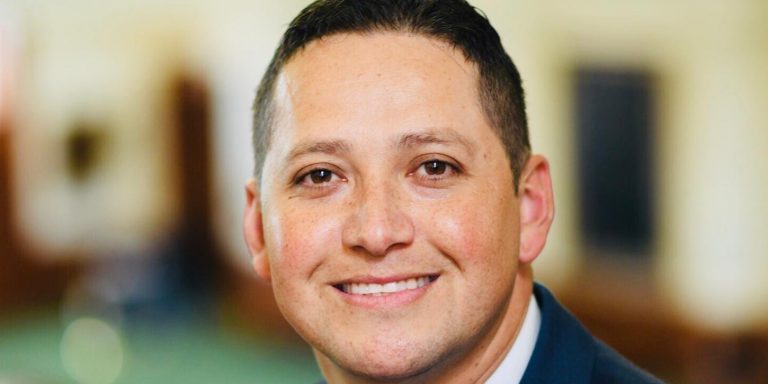
(Headline USARepublican Rep. Tony Gonzales of Texas said late Thursday he was withdrawing from his reelection race, after having admitted an affair with a former staff member who later died by lighting herself on fire, but he vowed to finish out his term in Congress.

He had faced calls from GOP leadership to end his reelection bid, and from others in Congress to resign.

“After deep reflection and with the support of my loving family, I have decided not to seek re-election,” Gonzales said in a statement posted late Thursday to X.

The move is the latest in a quickly changing situation that stunned Capitol Hill and resulted in a House Ethics Committee investigation into his conduct. Gonzales’ decision to bow out of the race appears to clear the field. On Tuesday, he had been forced into a May runoff against Brandon Herrera, a gun manufacturer and YouTube gun-rights influencer who narrowly lost to him in the 2024 primary.

House Speaker Mike Johnson and the GOP leadership earlier Thursday had called on Gonzales to withdraw from reelection after Gonzales, a day earlier, acknowledged a relationship that has upturned the political world in his home state and in Washington.

“We have encouraged him to address these very serious allegations directly with his constituents and his colleagues,” said Johnson, Majority Leader Steve Scalise, Whip Tom Emmer, and GOP Conference Chairwoman Lisa McClain in a statement.

“In the meantime, Leadership has asked Congressman Gonzales to withdraw from his race for reelection.”

Johnson, R-La., has been under enormous pressure from his own GOP lawmakers to take action, and several Republicans have already called for Gonzales to step aside. Rep. Anna Paulina Luna, R-Fla., has introduced two resolutions to punish Gonzales. The first seeks to remove him from his assignments on the House Appropriations and Homeland Security committees, while the second seeks to censure him.

House Democratic Leader Hakeem Jeffries of New York, meanwhile, said he would support expelling Gonzales from the House, a rare step that requires a two-thirds vote from the chamber.

GOP leaders notably did not call for Gonzales to resign from office as they struggle to maintain their slim majority in the House, which they hold by only a handful of seats.

Their move came after Gonzales, appearing on the “Joe Pags Show,” was asked whether he had a relationship with the aide, Regina Ann Santos-Aviles.

Santos-Aviles, 35, died after setting herself on fire in the backyard of her home in Uvalde, Texas. The Bexar County Medical Examiner’s Office later ruled her death a suicide.

“I made a mistake and I had a lapse in judgment, and there was a lack of faith, and I take full responsibility for those actions,” Gonzales said.

The congressman, now in his third term, had said he would not step down in response to the allegations, telling reporters recently that there will be opportunities for all the details and facts to come out.

Gonzales, a father of six, first won his seat in 2020 after retiring from a 20-year career in the Navy that included time in Iraq and Afghanistan.

In the interview broadcast Wednesday, Gonzales said he had not spoken to Santos-Aviles since June 2024. She died in September 2025.

“I had absolutely nothing to do with her tragic passing, and in fact, I was shocked just as much as everyone else,” Gonzales said.

Gonzales went on to say he had reconciled with his wife, Angel, and has asked God to forgive him. He also said he looked forward to the Ethics Committee investigation.

Johnson and GOP leadership urged that committee to “act expeditiously.”

Under House ethics rules, lawmakers may not engage in a sexual relationship with any employee of the House under their supervision.

Adapted from reporting by the Associated Press

Jeffrey Epstein Helped Arrange Young Woman’s Placement in Elite Israeli Military Unit

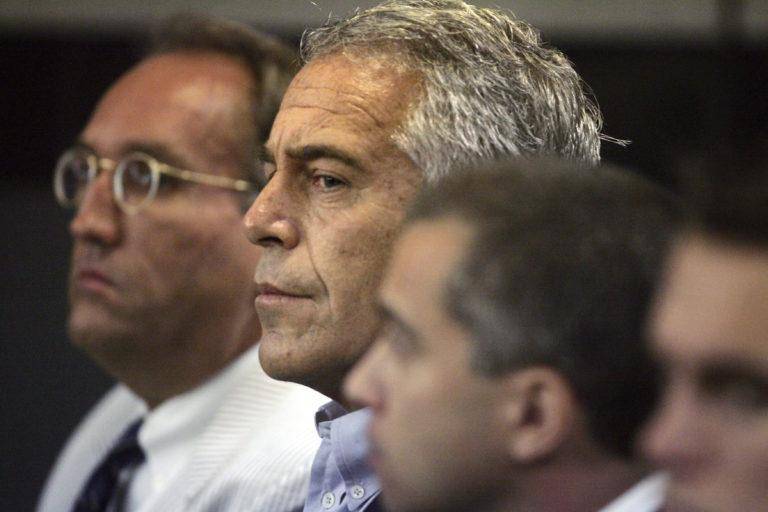
(José Niño, Headline USA) Emails released from the Jeffrey Epstein files show the sex trafficking billionaire worked Israeli connections to help his lawyer’s daughter join an elite Israeli Defense Forces unit, The Grayzone reported Tuesday.

Epstein’s request came in a June 29, 2011 email to Anat Barak, the daughter of former Israeli Prime Minister Ehud Barak. In the message, the financier described the young woman, identified as Tali, as an 18 year old who had been accepted to Columbia University’s Barnard College and had “been to Israel more than a dozen times.”

The young woman had spent summers hiking the Israel Trail and “working as a counselor at a summer camp in Dimona Israel for children who are victims of terrorist attacks,” and would therefore “be a great asset to any unit,” Epstein wrote. He added that upon her return from military service, “she would be a fantastic ambassador for Israel” at what he called “one of the more important college campuses in the country, Columbia.”

Hours later, Barak responded that Tali “sounds like an amazing girl” and informed the billionaire “I’ll be in touch with her, and we’ll take care of her.”

The senior Israeli politician’s daughter then sent an email to Tali explaining that “Jeffrey Epstein told me about you and about your plans to join the IDF this summer.” She added “This is absolutely wonderful” and “Kol Ha’kavod!,” a Hebrew expression meaning much respect.

A Grayzone review of public records indicates Tali is Talia Lefkowitz. Her father, Jay Lefkowitz, worked as Epstein’s lawyer and helped negotiate the billionaire’s sweetheart deal with then US Attorney Alex Acosta. At the time, her father argued that Epstein was “not in any way a typical sex offender.”

Talia Lefkowitz did not respond to an email from The Grayzone requesting comment on her relationship with Epstein.

According to her LinkedIn profile, Talia went on to serve as a sergeant in a Special Forces Paratrooper Unit, likely Israel’s 35th Brigade. When she returned to study at Barnard after her time as a lone soldier, she emerged as a vocal advocate for Zionism, writing op eds for prominent Israeli media outlets including the Jerusalem Post and Times of Israel.

Per the Grayzone report, Lefkowitz became heavily involved in the Columbia Barnard chapter of Hillel International, a global Jewish youth organization. She later served on the Hillel International board from 2020 to 2022.

Currently Lefkowitz is employed as a philanthropy advisor to the Areivim Philanthropic Group, which aims to impact the next generation of Jews through formal and experiential Jewish, Hebrew, Zionist, and Israel education. According to her biography at Areivim, she “worked for five years for The Paul E. Singer Foundation,” which ultra Zionist billionaire Paul Singer has used to support neoconservative media outlets and pro Israel causes.

José Niño is the deputy editor of Headline USA. Follow him at x.com/JoseAlNino