Hobbs Snubbed on Sanctions, Lake Files Appeal for Ariz. Election Integrity

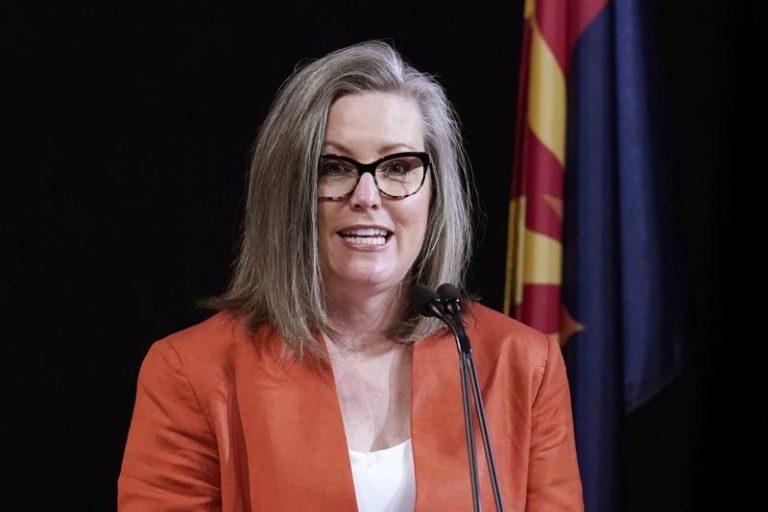
(Mark Pellin, Headline USA) Arizona’s alleged Democrat Gov.-elect Katie Hobbs was dealt a rebuke when the judge who last week ruled against an elections challenge lawsuit filed by Republican Kari Lake refused to order sanctions against Lake and her legal team.

Maricopa County Superior Court Judge Peter Thompson on Tuesday denied sanctions totaling upwards of $700,000 being sought by Hobbs, ruling that fines and sanctions weren’t justified.

Thompson had previously rejected Lake’s claims that widespread ballot-tabulating and voting-machine failures on Election Day had resulted from intentional misconduct and impacted results. The court on Tuesday ruled that Lake’s failure to prove her case doesn’t “equate to a finding that her claims were, or were not, groundless and presented in bad faith.”

“There is no doubt that each side believes firmly in its position with great conviction,” Thompson wrote.

“The fact that Plaintiff failed to meet the burden of clear and convincing evidence required … does not equate to a finding that her claims were, or were not, groundless and presented in bad faith. Any legal decision must be based on the law and facts rather than subjective beliefs or partisan opinions, no matter how strongly held.”

Thompson did order Lake to pay about $33,000 to cover costs for retaining expert witnesses during the two-day trail last week.

Left out of the mix was the bulk of sanctions being sought by Hobbs, which had included a big payday for Democrat attorney and bagman Marc Elias. The Steele dossier conspirator represented Hobbs during the elections litigation in her dual capacity as Arizona’s incumbent secretary of state, who oversaw the state’s grossly flawed midterm, and as Democrat candidate for governor.

Hobbs allegedly won the midterm by about 17,000 votes. Multiple voter-machine malfunctions and tabulator errors disenfranchised tens of thousands of voters from majority-Republican precincts, Lake argued in her elections challenge.

“We’re going to appeal this,” Lake reiterated Tuesday on Steve Bannon’s War Room podcast. “We think we have absolute merit with this lawsuit, and we’re going to appeal it and take it even higher.”

Hobbs is slated to be sworn as Arizona’s governor Jan. 5 and Lake’s appeal, while a hearing date has not been set, is expected to be expedited.

Economists: Guaranteed Income Programs Should Replace, not Supplement, Other Welfare

(In Hudson, New York, participants in the city’s guaranteed income program that started in 2020 were counseled on how the $500 a month they were set to receive over a 5-year-period would impact other government subsidies for which they are eligible.

“Will participants lose other public benefits that they might currently be receiving?” the program’s website asked on the Frequently Asked Question section.

“This question can only be answered on a case-by-case basis,” it continued. “Prior to committing to participating, all recipients will be offered benefits’ counseling to decide if participation is best for their specific situation.”

Universal basic income programs provide recurring, direct payments to qualified (generally, lower-income) individuals with no strings attached. They are usually paid for by taxpayers, but some private foundations also provide funding.

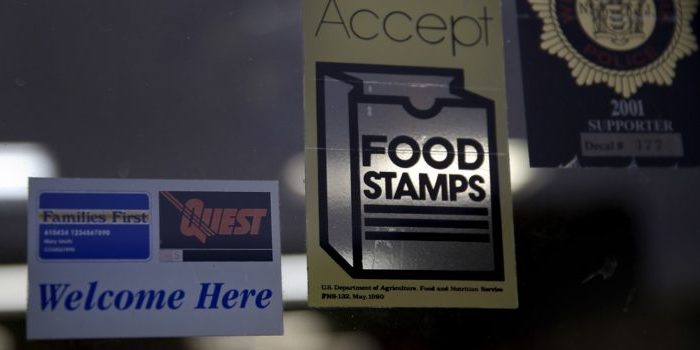
The concern among many participants in guaranteed income programs is that the new revenue could cancel out other social subsidy programs, such as food stamps.

But many economists say the best way for guaranteed income programs to work is if they consolidate all government aid programs, creating one subsidy with less bureaucracy and thereby reducing administrative expenses paid for by taxpayers.

According to USGovernmentSpending.com, the cost of the 13 largest federal safety net programs that include Medicaid, Supplemental Security Income, Supplemental Nutritional Assistance Program (SNAP), Earned Income Tax Credits, U.S. Department of Housing and Urban Development subsidies, job training and school lunch programs increased from $772 billion in 2019 to $1.06 trillion in 2021.

Antony Davies, an associate professor of economics at Duquesne University, said universal income programs that consolidate the more than 100 taxpayer-funded federal welfare programs would be welcomed.

Davies said the administrative costs of all those welfare programs could be consolidated into a universal basic income program and it could be beneficial.

Hudson’s program is open to “20 randomly-selected” residents “who are above the age of 18 and earn less than $35,153 each year,” according to the city.

“Participants may be single, married, with children or without,” it said. “Selection will be conducted via a random lottery weighted by equity factors and overseen by independent researchers at the University of Pennsylvania and the University of Tennessee Knoxville.”

Cities, states and private foundations across the country have launched similar pilot guaranteed income programs.

For example, the city of Los Angeles started its own guaranteed income program and Los Angeles County has launched two in 2022. San Francisco launched one specifically for the transgender community.

Chicago also launched a guaranteed income program in 2022. Its pilot program provides 5,000 households in Chicago $500 a month in taxpayer money for 12 months.

Denver, Shreveport (La.), Durham (N.C.), Gainesville (Fla.) and the state of Georgia all announced universal basic income types of programs in 2022. Minneapolis, Ann Arbor and Grand Rapids tapped into COVID-19 tax dollars to start their own pilot programs.

The Shriver Center on Poverty Law released a report in April that stated that the current social safety net is insufficient “given the economic situation we face.”

The COVID-19 pandemic has led to support for policies that give additional cash to struggling Americans, the report stated.

“Federal policies such as increased unemployment insurance, an expanded and fully refundable Child Tax Credit (CTC), and stimulus checks have led to burgeoning support for permanent cash transfer programs like a guaranteed income,” the report concluded.

“Guaranteed income helps families by giving them direct cash to meet their needs—whether for housing, childcare or other household essentials,” Audra Wilson, CEO and president of the Shriver Center on Poverty Law, said in a statement to The Center Square.

“While expanding these programs is a step in the right direction, we have more work to do to end poverty,” she added. “We must continue to fight for paying living wages to reduce inequity and improve quality of life for everyone.”

Veronique de Rugy, the George Gibbs chair in political economy and a senior research fellow at the Mercatus Center at George Mason University, agrees with Davies.

“While cash programs are better than paternalistic welfare programs, cash programs shouldn’t be implemented unless they replace current welfare programs,” de Rugy said in an email to The Center Square.

Biden Admin Backs Risky Geoengineering Plan to Block Sun

(Molly Bruns, Headline USA) The Biden administration has proposed funding and outlining a five-year study into solar geoengineering, a science that pertains to deflecting the sun’s rays before they hit the earth.

According to the Guardian, one method the government is testing is sending a group of planes to spray reflective particles into the upper atmosphere. Ideally, this would block sunlight and keep surface temperatures from rising too high.

A White House spokesperson for the Office of Science and Technology Policy clarified that the basis for its recent proposal is “not new research, but a report that highlights some of the key knowledge gaps and recommendations of priority topics for relevant research.”

The spokesperson added the the Biden administration has been taking drastic measures to cut down on carbon-dioxide levels and greenhouse-gas emissions.

Critics argue that there are potential downsides to blocking the sun’s rays, including the negative impacts on photosynthesis for plants—and particularly those that are part of the food cycle.

David Victor, a political scientist at the University of California told the MIT Technology Review that it laid the stage for a devious plot worthy of a James Bond villain.

“A “Greenfinger, self-appointed protector of the planet … could force a lot of geoengineering on his own,” Victor said.

Already, reports have linked billionaire depopulationist Bill Gates to such an endeavor.

Despite the concerns, some American scientists consider reflecting sun rays to be a viable solution to climate change.

“Until recently, I thought it was too risky, but slow progress on cutting emissions has increased motivation to understand techniques at the margins like solar geoengineering,” said Chris Field, who chaired a National Academies of Sciences report last year that recommended at least $100m being spent researching the issue.

“I don’t think we should deploy it yet and there are still a ton of concerns, but we need to better understand it,” Field said. “Climate change is causing widespread impacts, it’s costing lives and wrecking economies.”

A U.S. startup known as Make Sunsets already ran two internal test flights of sulpher-injected balloons into the stratosphere, according to the Freedom First Network.

The group, which is backed by two large venture capital funds, is named after the deep red sunsets and “shiny clouds” that would “prevent catastrophic global warming” should their experiment work.

“Any human-caused release of carbon dioxide is geoengineering,” it argued on its website. “We screwed up the atmosphere, and now we have a moral obligation to fix things!”

REPORT: Attacks on Churches Nearly Tripled in the Last Four Years

(Molly Bruns, Headline USA) A recent analysis from the Family Research Council discovered that attacks on churches have nearly tripled since 2018.

According to the report, “between January 2018 and September 2022, at least 420 acts of hostility against U.S. churches occurred.”

The acts of violence included vandalism, arson, gun related incidents, bomb threats and more. There was also an increase in the frequency over the course of the three years.

In 2021, the FBI reported 240 “hate crimes” against Catholics, Protestants, Eastern Orthodox or other Christians, which was up 213 anti-Christian crimes in 2020.

Out of the total 420 attacks on churches, 397 different churches were targeted in 45 different states.

The majority of the reported incidents were vandalism, with 342 reports of destruction or defacement of property, ransacking or theft, 12 gun-related incidents, 11 bomb threats and 19 other threats of assault and interruption of services.

Areas with greater populations had the most incidents. California had the highest number of incidents, with 51. Texas followed next, with 33; then New York, with 31; and Florida, with 23.

Delaware, Montana, Nebraska, New Hampshire and Vermont were the only states without any reported hate crimes.

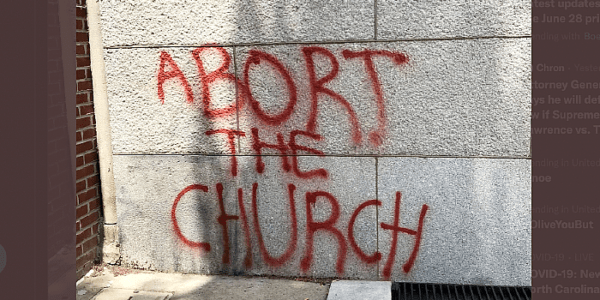
After the leak of the U.S. Supreme Court’s draft decision in Dobbs v. Jackson Women’s Health to overturn federal abortion mandates, there was a massive spike in graffiti vandalism.

At least 57 of these incidents took place between January 2022 and September 2022, and were directly tied to pro-abortion protests or with pro-abortion messages.

The motives of many of the attacks are unclear, and several of them were committed by minors. Other incidents included satanic or anarchist symbols.

The FRC report emphasized the importance of religious freedom, a right ostensibly protected under the First Amendment of the U.S. Constitution.

“Religious freedom is not maintained by good laws and policies alone; it also relies on cultural support,” the report said.

“When church attendees feel targeted by members of their communities or church buildings bear the brunt of outrage over political events, a more grievous assault is occurring on the ability to choose and live out one’s faith safely, both at church and in the public square,” it continued. “Violent or destructive incidents that interfere with an individual’s lawful free exercise of religion at their house of worship present a significant nationwide challenge.”

House Dems to Release Trump’s Taxes on Friday, Setting Risky Precedent

(Headline USA) Former President Donald Trump’s tax returns are expected to be released by the House Ways and Means committee on Friday, a congressional aide confirmed Tuesday.

That’s the next time the House, which is on break for the holidays, is scheduled to meet for a routine pro forma session. The new Congress, with Republicans in control of the House, begins Jan. 3.

The aide was not authorized to discuss the timing of the release publicly and spoke on condition of anonymity.

The Democratic-controlled committee voted last week to release Trump’s returns, with some redactions of sensitive information, such as Social Security numbers and contact information.

The vote came the same day the panel released a report in which it found that the IRS failed to pursue mandatory audits of Trump on a timely basis during his presidency.

It indicated the Trump administration may have disregarded an IRS requirement dating back to 1977 that mandates audits of a president’s tax filings.

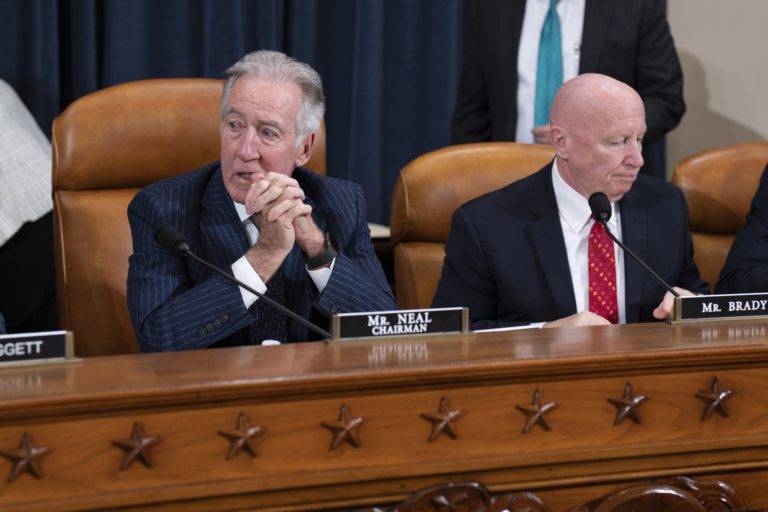
The IRS only began to audit Trump’s 2016 tax filings on April 3, 2019, more than two years into Trump’s presidency and just months after Democrats took control of the House. That date coincided with Rep. Richard Neal, D-Mass., the panel chairman, asking the IRS for information related to Trump’s tax returns.

The vote was the culmination of a yearslong fight between Trump and Democrats that played out everywhere from the campaign trail to the halls of Congress and the Supreme Court.

Democrats on the tax-writing House Ways and Means Committee argued that transparency and the rule of law were at stake, while Republicans countered that the release would set a dangerous precedent with regard to the loss of privacy protections.

Democrats coyly deflected by insisting Trump was the exception, not the rule.

“This is about the presidency, not the president,” Neal told reporters last week.

Rep. Kevin Brady of Texas, the panel’s top GOP member, said, “Regrettably, the deed is done.”

Adapted from reporting by the Associated Press

Zelenskyy & BlackRock CEO Team Up to Rebuild Ukraine

(Joshua Paladino, Headline USA) Two leading globalists, BlackRock CEO Larry Fink and Ukrainian President Volodymyr Zelenskyy, have partnered to rebuild war-torn Ukraine to conform with the Great Reset agenda.

The Ukrainian president’s office announced that Zelenskyy and Fink had “agreed to focus in the near term on coordinating the efforts of all potential investors and participants in the reconstruction of our country, channeling investment into the most relevant and impactful sectors of the Ukrainian economy,” reported America First Report.

Following Fink and Zelenskyy’s meeting in September, the BlackRock Financial Markets Advisory and the Ukrainian Ministry of Economy signed a memorandum in November that outlined a partnership.

The agreement said that BlackRock would give “advisory support for designing an investment framework, with a goal of creating opportunities for both public and private investors to participate in the future reconstruction and recovery of the Ukrainian economy.”

BlackRock will channel the more than $100 billion that the US Congress has sent to Ukraine, including $45 billion in the most recent handout, to corporations adhering to the radical ESG agenda.

The financial firm’s coordination will ensure that globalist bureaucrats, politicians and investors will receive adequate kickbacks.

Since BlackRock’s investment strategy ignores economic fundamentals, the ESG project demands a perpetual flow of government money, which Congress has been able to launder under the pretext of supporting the war in Ukraine.

“Expect the people of Ukraine to be kept in a state of peril because nothing drives a perpetual money-printing scheme better than problems that never get solved,” JD Rucker wrote for the America First Report.

BlackRock channels private investments into businesses and nations that support its Environmental, Social and Corporate Governance campaign.

ESG investments aim to transform the world’s economic, political and social life by banning carbon fuel sources and becoming dependent upon unreliable alternative energies, by transitioning from nation-state political bonds to a one-world surveillance state and by ensuring that queer ideology obliterates marriage and the family.

The ESG strategy focuses on promoting a Leftist ideological agenda, not on investing in businesses that will provide necessary goods and services as well as stable returns for investors.

Dems Block Scrapping Va. Grocery Sales Tax

(Madison Hirneisen – The Center Square) – Virginia will reduce its grocery sales tax rate starting Jan. 1, resulting in a 1% tax on groceries and certain essential personal hygiene products.

Virginia will eliminate the 1.5% state retail sales and use tax on food and certain hygiene products, leaving a 1% local option sales tax.

Most staple grocery options and cold prepared foods for home consumption qualify for the reduced tax rate, as well as personal hygiene products like diapers, bed sheets and most feminine hygiene products, according to the Virginia Department of Taxation. Alcohol, tobacco, prepared hot food packaged for immediate consumption and seeds and plants to grow food at home do not qualify for the reduced tax rate.

Virginia is one of 13 states that imposes a sales tax on groceries, according to an analysis from the Center on Budget and Policy Priorities. Illinois, which imposes a 1% sales tax on groceries, has suspended the tax until July 1, 2023, while Kansas lawmakers passed a plan this year to eliminate the state’s sales tax on groceries by 2025.

Earlier this year, Virginia Republican Gov. Glenn Youngkin touted a plan to completely repeal the grocery tax, but his recently proposed budget amendments and tax relief package do not include any mention of eliminating the remaining local 1% tax on groceries. When asked why a proposal to eliminate the grocery tax was not included in the budget amendments, Youngkin told reporters he is focusing on bringing down individual and corporate tax rates.

“In year one, Gov. Youngkin delivered $4 billion in tax relief for Virginia taxpayers, providing needed relief as inflation and rising costs continue stealing the paychecks of hardworking families,” Youngkin spokeswoman Macaulay Porter told the Center Square in a statement. “While Democrats blocked the local grocery tax proposal, the governor is incredibly pleased that the state grocery tax will be removed in January and he will focus on reducing tax rates for all Virginians in the upcoming session.”

Starting in February, state revenues will replace K-12 education funding that came from a portion of the 1.5% sales and use tax on groceries. One percent of the state’s 1.5% sales and use tax rate on groceries was dedicated toward education funding, while the remaining 0.5% was allocated to the Commonwealth Transportation Fund.

A fiscal analysis from the Department of Taxation estimates the elimination of the state retail sales and use tax on food and hygiene products will result in revenue losses of up to $415.1 million in future fiscal years.

Skyrocketing Health-Care Costs Underscore Failure of Obamacare’s ‘Public Option’

(Ezekiel Loseke, Headline USA) Despite President Joe Biden’s campaign-trail options to bring more afforable health care to the masses, premiums are set to rise astronomically again in 2023, making it less accessible than ever.

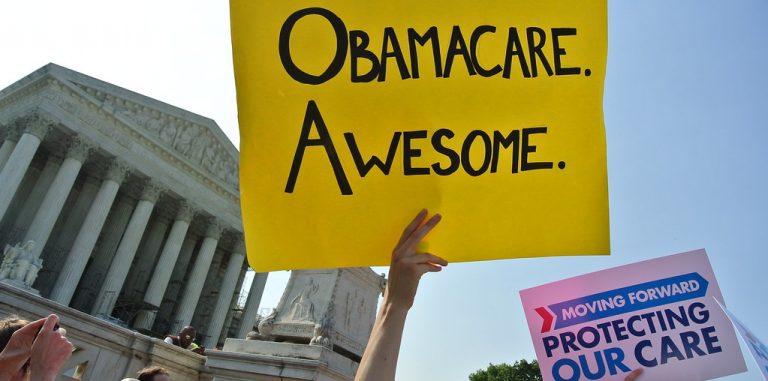
While the system’s current pricing problems stem largely from the Obama-era passage of the Affordable Care Act, which forced middle-class insurees to subsidize the cost of uninsured individuals (many of them illegal immigrants), the controversial law’s plan to disrupt industry price-gouging by introducing a public option has proven to be an abject failure.

Washington state, Nevada and Colorado all passed laws enabling Obamacare’s “public option,” but all three have failed to produce the promised lowered prices, according to Politico.

In Colorado, for example, only one insurance company (out of eight), met the cost-cutting measures set by the politicians who created the program.

The Colorado law required all insurance companies who offer individual and small group plans to produce at least one ‘public option’ plan. This plan must cut premium costs by 5% every year for three years, while increasing benefits, including reducing out-of-pocket costs and increasing “cultural responsiveness.”

The failure of all but one plan to meet this standard was “a shot across the bow” according to Sabrina Corlette, a research professor and founding co-director of the Center on Health Insurance Reforms at Georgetown University’s McCourt School of Public Policy.

However, it may not be the fault of the insurance companies themselves as much as the lofty demands of government regulators who have set them up for failure.

Amanda Massey, executive director of the Colorado Association of Health Plans, said the goals are untenable.

“Certainly, [insurers are] trying to do everything they can to reduce the costs, but I think we have to be very thoughtful about ensuring that carriers can still be solvent and cover the costs of their claims,” Massey said.

In Nevada, the state has already had to implement easier targets for the industry to aspire to.

Previously, the goal had been to reduce premiums by 20%, but policy makers are meeting to consider reducing the goal to 16%.

State Sen. Nicole Canizzaro, D-Nevada, who introduced the bill, expressed some optimism.

“Obviously we’ve got a long way to go, but I think that’s a great step in the right direction and a great first step,” she said. “Even [16%] is something I’m proud of and I think will make a difference.”

In Washington state, the first state to try the policy, enrollment remains very low and prices are still far higher than what was promised by lawmakers.

State Rep. Eileen Cody, D-Wash., who sponsored and introduced the public-option bill, expressed dissatisfaction with its function.

“It’s still got a ways to go,” she said. “It’s not exactly what I had envisioned—I’ll put it that way.”

Robert Moffit, a senior research fellow in the Center for Health and Welfare Policy at the Heritage Foundation, explained that the failure of these policies was perfectly predictable.

“They’re price controls. That’s what they are,” he said.

“And they’ll have the same effect that we’ve had in price controls for centuries, which is a reduced availability of the controlled commodities, whether they’re medical services or wheat or anything else,” he continued. “I think the likelihood of them being successful, making a price control system work, is nil.”

US Army Scrambling to Find Soldiers to Serve

(Jacob Bruns, Headline USA) In the fallout from its numerous woke policies, the United States Army has struggled to meet its recruiting needs.

And now, after years of difficulty, senior leaders in Congress and the recruiting office are wondering if the ranks can even be filled any longer, the Military Times reported.

The U.S. Army alone missed its 2022 recruiting goals by 15,000 recruits, and missed its Congressionally-authorized goals by nearly 20,000. Service officials subsequently told Congress that they did not believe they could rebound in 2023, resulting in the lowering of standards.

Many warned that the lack of recruiting success does not bode well for the future of military operations.

“End strength is supposed to be tied to requirements,” said Katherine Kuzminski, a member of the Center for a New American Security. “And so the question becomes: if the end strength is reduced, are the requirements reduced?”

The military’s woke policies, like most, stem from America’s “elite” universities.

One of the most disastrous of those policies was the now-repealed vaccine mandate, which thinned out the ranks and slowed recruiting, despite the fact that the mainstream media systematically ignored the problem.

“The opaqueness of the Department continues to frustrate Members of Congress attempting to perform oversight of the Executive Branch,” U.S. Republicans Reps. Mike Johnson, Chip Roy and Thomas Massie wrote. “Our repeated inquiries remain unanswered.”

Former Marine Lt. Gen. Gregory Newbold likewise attacked the military’s woke policies, suggesting that the upper level administration has “warfare dementia.”

“This ‘warfare dementia’ is a dangerous and potentially catastrophic malady, because the price for it could alter the success of the American experiment and most assuredly will be paid in blood,” Newbold wrote.

He noted that ideology has no place in the military, which must be aimed at winning wars.

“The condition is exacerbated and enabled when the most senior military leaders — those who ought to know better — defer to the idealistic judgments of those whose credentials are either nonexistent or formed entirely by ideology.”

More Pain at the Pump on the Horizon?

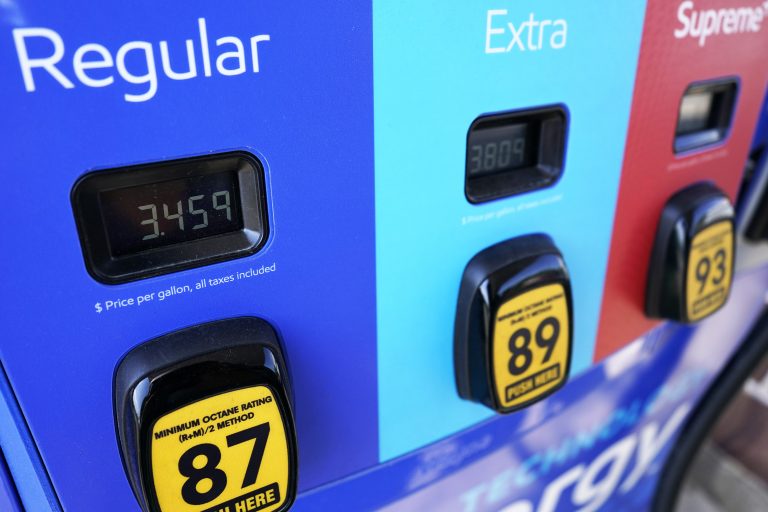
(Jacob Bruns, Headline USA) After a brief election-season respite from President Joe Biden’s oppressive gas prices, some industry watchers have projected that prices are set to skyrocket once more, the Daily Mail reported.

Coming off a summer with record-high gas prices, it looked as if things were going to cool off for a while. But with 2023 approaching, Patrick De Haan, head of petroleum analysis at GasBuddy, said things are about to get worse again.

“2023 is not going to be a cakewalk for motorists,” he warned. “It could be expensive.”

Based on De Haan’s projections, things look like they will be dire once more by the late spring and into the summer.

“The national average could breach $4 a gallon as early as May—and that’s something that could last through much of the summer driving season,” he said.

Though prices have cooled to a national average of $3.10 per gallon as of late December, De Haan said that we should expect prices to climb to nearly $4.25 in the near future.

Oil supplies have dwindled due to the bans on Russian exports and a decision by OPEC countries, led by Saudi Arabia, to limit their production following Biden’s provocative rhetoric toward the longtime U.S. ally.

Meanwhile, domestic production—which had led the U.S. to become an oil-independent exporter for the first time in decades under former President Donald Trump—has shrunk because of the Biden administration’s anti-energy policies.

In order to cover for his near depletion of America’s Strategic Petroleum Reserve while trying to artificially ease the gas crisis ahead of the November miderm election, Biden has pledged to replenish the supply in the coming months by purchasing 3 million barrels of oil at a premium cost.

As Biden tries to cover for his blunders, many on the Right have suggested that his blatant disrespect for the American people is grounds for impeachment.

“It turns out, the oil being released isn’t for us,” said Fox News Host Tucker Carlson in July, after Biden was caught selling millions of barrels to America’s geopolitical rivals.

“It’s going to India and China!” Carlson continued. “As gas prices hit record highs in the United States and many American citizens can’t afford to fuel their own cars, the Biden administration is selling off our emergency oil reserves to China.”